THE LAST
LESSON
-Alphonse Daude
ENGLISH PROJECT
Submitted by:
Angel Duhan Bhaavya Bakshi
Yashvi Mittal
Mrs. Arti Malik
Submitted to:
Certificate
This is to certify that Angel Duhan , Yashvi Mittal and
Bhaavya Bakshi of Class 12th Commerce of Scholars Rosary
Senior Secondary School Roll No. 07 , 16 and 87 has
successfully completed their English project file. They has
taken proper care and utmost sincerity in completion of her
project. All the work related to the project was done by the
candidate themselves. The approach towards the subject has
been sincere and scientific.
I certify that this project is upto my expectations and as per
the guidelines issued by the CBSE.
Acknowledgement
In the accomplishment of this project successfully, many people have
best owned upon me their blessings and their heart pledged support.
This time I am utilizing to thank all the people who have been concerned
with this project. Primarily I would like to thank God for being able to
complete this project with success. Then I would like to thank my English
teacher Ms. Arti Malik , whose valuable guidance has been the ones that
helped me patch this project and make it full proof success. Her
suggestions and instructions have served as the major contributor
towards the completion of the project. Then I would like to thank my
parents who have helped me with their valuable suggestions and
guidance has been very helpful in various phases of the completion of
the project.
About the author
01 03 04
02
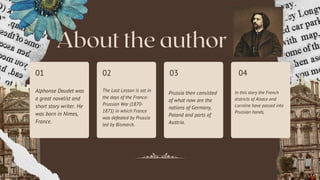
Alphonse Daudet was
a great novelist and
short story writer. He
was born in Nimes,
France.
The Last Lesson is set in
the days of the Franco-
Prussian War (1870-
1871) in which France
was defeated by Prussia
led by Bismarck.
In this story the French
districts of Alsace and
Lorraine have passed into
Prussian hands,
Prussia then consisted
of what now are the
nations of Germany,
Poland and parts of
Austria.
Back ground of the lesson
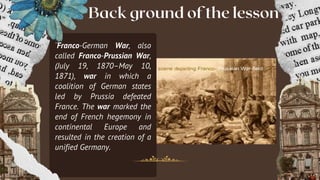
¨Franco-German War, also
called Franco-Prussian War,
(July 19, 1870–May 10,
1871), war in which a
coalition of German states
led by Prussia defeated
France. The war marked the
end of French hegemony in
continental Europe and
resulted in the creation of a
unified Germany.
War Memorial France
The Last Lesson
SUMMARY
The story is narrated by a young boy named Franz, who lives in
the French region of Alsace-Lorraine, which has been annexed
by the Prussians. One day, Franz is reluctant to go to school as
he has not prepared for a test on French participles. On his way,
he notices an unusual stillness in the village and sees people
gathered in front of the bulletin board, which is known for bad
news. When he arrives at school, he is surprised to find the usual
hustle and bustle replaced by an eerie silence.
Franz's French teacher, M. Hamel, is dressed in his formal clothes, and
the usually empty back benches are occupied by the village elders. M.
Hamel announces that it will be the last French lesson for them, as an
order from Berlin has mandated that only German will be taught in
schools.
This news shocks Franz, and he is filled with regret for not taking his
lessons seriously. He realizes the importance of his mother tongue and
feels a strong emotional connection to it. Throughout the lesson, M.
Hamel speaks passionately about the French language, calling it the
most beautiful language in the world and urging the class to guard it
among themselves. He explains the significance of holding on to one's
language and culture, even in the face of oppression.
As the class goes on, Franz is filled with a sense of guilt for his
previous lack of interest in his studies. M. Hamel, who has taught
in the village for forty years, appears emotional as he writes on the
blackboard, "Vive La France!" (Long Live France), signifying his
love for his country. The story ends with the school bell ringing for
the last time, and the villagers and students feeling the weight of
the loss of their language and identity.
Theme
01 03 04
02
Loss of Language and
Cultural Identity
The story reflects on
how language is
deeply tied to one’s
culture and identity.
The Value of
Education and the
Power of Language
Regret and realization
Franz's regret at not
learning French
properly mirrors a
collective regret of
the villagers for not
valuing their culture.
Resistance to
Oppression
M. Hamel's defiant
teaching of French to
the very end
symbolizes resistance
against cultural
imperialism
Message
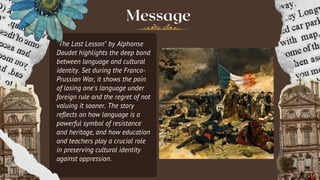
"The Last Lesson" by Alphonse
Daudet highlights the deep bond
between language and cultural
identity. Set during the Franco-
Prussian War, it shows the pain
of losing one's language under
foreign rule and the regret of not
valuing it sooner. The story
reflects on how language is a
powerful symbol of resistance
and heritage, and how education
and teachers play a crucial role
in preserving cultural identity
against oppression.
Central Idea
The central idea of "The Last Lesson" by Alphonse Daudet revolves around
the relationship between language, cultural identity, and resistance against
oppression. Set in the context of the Franco-Prussian War, the story depicts
how the imposition of a foreign language—German—over French in the
region of Alsace-Lorraine symbolizes the erasure of cultural identity. The
emotional reaction of the students, villagers, and especially the teacher, M.
Hamel, to this loss highlights the significance of language as a carrier of
culture, history, and collective memory.
The story reflects on the regret of not valuing one’s language and education
until it is on the verge of being taken away. It emphasizes the importance of
preserving one's language as an act of resistance against cultural domination
and as an expression of national pride. Through M. Hamel’s final lesson and
the collective realization of the villagers, the narrative conveys that language
is more than just a means of communication—it is a vital part of who we are,
shaping our identity, thoughts, and connection to our heritage
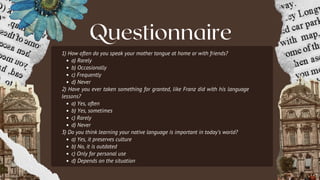
Questionnaire
1) How often do you speak your mother tongue at home or with friends?
a) Rarely
b) Occasionally
c) Frequently
d) Never
2) Have you ever taken something for granted, like Franz did with his language
lessons?
a) Yes, often
b) Yes, sometimes
c) Rarely
d) Never
3) Do you think learning your native language is important in today’s world?
a) Yes, it preserves culture
b) No, it is outdated
c) Only for personal use
d) Depends on the situation
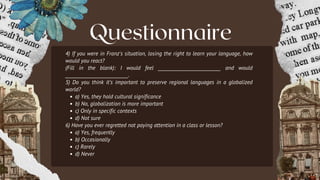
Questionnaire
4) If you were in Franz's situation, losing the right to learn your language, how
would you react?
(Fill in the blank): I would feel ___________________________ and would
___________________________.
5) Do you think it’s important to preserve regional languages in a globalized
world?
a) Yes, they hold cultural significance
b) No, globalization is more important
c) Only in specific contexts
d) Not sure
6) Have you ever regretted not paying attention in a class or lesson?
a) Yes, frequently
b) Occasionally
c) Rarely
d) Never
Questionnaire
7)Do you think it’s important to preserve regional languages in a globalized
world?
a) Yes, they hold cultural significance
b) No, globalization is more important
c) Only in specific contexts
d) Not sure
8) Do you think schools should place more emphasis on teaching regional
languages? Why or why not?
(Fill in the blank): Schools should/should not emphasize regional languages
because ___________________________.
9) What role do you think your school plays in promoting the use of your mother
tongue?
(Fill in the blank): My school promote/does my mother tongue by
___________________________.
Results
D
34.3%
B
25.5%
C
22.5%
A
17.6%
Sample Size - 15
Q1)
Q2)
B
43.5%
C
22.9%
A
20.6%
D
13%
Q3)
A
34.6%
C
23.5%
D
22.1%
B
19.9%
Results
C
37.4%
D
28.5%
B
21.1%
A
13%
Sample Size - 15
Q5)
Q6)
A
37.6%
B
30.9%
C
20.1%
D
11.4%
Q7)
A
31.1%
D
29.8%
B
24.5%
C
14.6%
Conclusion
I would like to share my experience while doing this project. I learnt
many new was things for my English project, I read "The Last Lesson" by
Alphonse Daudet. The story follows a young boy named Franz who faces
his final French lesson before the imposition of German language and
rule in his region. Through Franz's eyes and the emotional farewell of his
dedicated teacher, M. Hamel, the book reveals the deep bond between
language and cultural identity. It explores themes of loss, regret, and the
significance of preserving one’s linguistic and cultural heritage. I enjoyed
reading this story and reflecting on its powerful message about the value
of language and the impact of losing it.
Bibliography
www.google.com
www.wikipedia.org
www.scribd.com
Thank You