Session-1
1:30-3:30- Pearl (MF)
9:45-11:45- Gold (MF)
7:30-9:30- Diamond (TTh)
Session- 2
1:30-3:30- Pearl (MF)
9:45-11:45- Gold (MF)
7:30-9:30- Diamond (TTh)
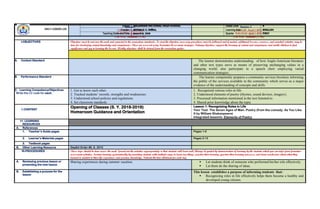
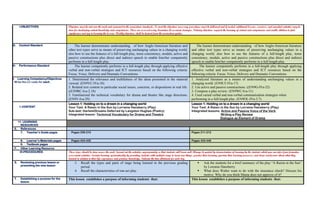
I-OBJECTIVES Objectives must be met over the week and connected to the curriculum standards. To meet the objectives necessary procedures must be followed and if needed, additional lessons, exercises, and remedial activities may be
done for developing content knowledge and competencies. These are assessed using Formative Assessment strategies. Valuing objectives support the learning of content and competencies and enable children to find
significance and joy in learning the lessons. Weekly objectives shall be derived from the curriculum guides.
A. Content Standard The learner demonstrates understanding of how Anglo-American literature
and other text types serve as means of preserving unchanging values in a
changing world; also participate in a speech choir employing varied
communication strategies.
B. Performance Standard The learner competently prepares a community services brochure informing
the public of the services available in the community which serves as a major
evidence of the understanding of concepts and skills.
C. Learning Competency/Objectives
Write the LC code for each.
1. Got to know each other.
2. Tracked students’ records, strengths and weaknesses.
3. Understood school policies and regulations.
4. Set classroom standards.
1. Recognized various roles in life.
2. Understood elements of poetry (rhymes, sound devices, imagery).
3. Processed information mentioned in the text listened to.
4. Shared prior knowledge about the topic
1.CONTENT
Opening of Classes (S. Y. 2018-2019)
Homeroom Guidance and Orientation
Lesson 1: Recognizing Roles in Life
Your Text: The Seven Ages of Man- Poetry (from the comedy: As You Like
It by William Shakespeare)
Integrated lesson/s: Elements of Poetry
11. LEARNING
RESOURCES
A. References
1. Teacher’s Guide pages Pages 1-6
2. Learner’s Materials pages Pages 2-13
3. Textbook pages
B. Other Learning Resource DepEd Order #8, S. 2015
III-PROCEDURES These steps should be done across the week. Spread out the activities appropriately so that students will learn well. Always be guided by demonstration of learning by the students which you can infer from formative
assessment activities. Sustain learning systematically by providing students with multiple ways to learn new things, practice their learning, question their learning processes, and draw conclusions about what they
learned in relation to their life experiences and previous knowledge. Indicate the time allotment for each step.
A. Reviewing previous lesson or
presenting the new lesson
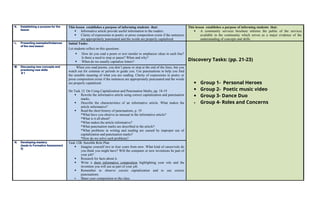
Sharing experiences during summer vacation.  Let students think of someone who performed his/her role effectively.
 Let them do the sharing of ideas.
B. Establishing a purpose for the
lesson
This lesson establishes a purpose of informing students that:
 Recognizing roles in life effectively helps them become a healthy and
developed young citizens.
DAILY LESSON LOG
School BAGANIAN NATIONAL HIGH SCHOOL Grade Level 9
Teacher RONALD Z. NIÑAL Learning Area ENGLISH
Teaching Dates and Time June 4-8, 2018 Quarter FIRST
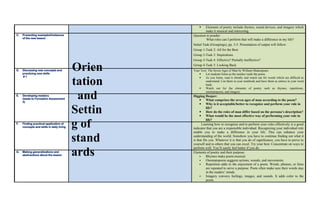
 Elements of poetry include rhymes, sound devices, and imagery which
make it musical and interesting.
C. Presenting examples/Instances
of the new lesson
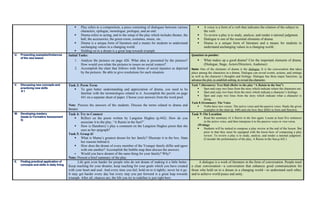
Question to ponder:
What roles can I perform that will make a difference in my life?
Initial Task (Groupings), pp. 3-5. Presentation of output will follow.
Group 1-Task 2: All for the Best
Group 2-Task 3: Inspirations
Group 3-Task 4: Effective? Partially Ineffective?
Group 4-Task 5: Looking Back
D. Discussing new concepts and
practicing new skills
# 1
Your Text: The Seven Ages of Man by William Shakespeare
 Let students listen as the teacher reads the poem.
 As you listen, read it silently and watch out for words which are difficult to
understand. List them in your notebook and have them as entries in your word
bank.
 Watch out for the elements of poetry such as rhymes, repetitions,
onomatopoeia, and imagery.
E. Developing mastery
(leads to Formative Assessment
3)
Digging Deeper:
 What comprises the seven ages of man according to the poem?
 Why is it acceptable/better to recognize and perform your role in
life?
 How do the roles of man differ based on the persona’s description?
 What would be the most effective way of performing your role in
life?
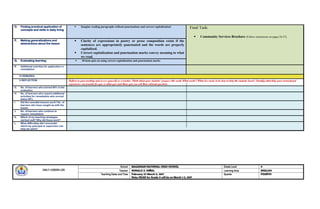
F. Finding practical application of
concepts and skills in daily living
Learning how to recognize and to perform your roles effectively is a good
indicator that you are a responsible individual. Recognizing your individual role
enable you to make a difference in your life. This can enhance your
understanding of the world. Somehow you have to continue finding out what it
is that fits you. Whatever it is that you do of significance, you have to prove to
yourself and to others that you can excel. Try your best. Concentrate on ways to
perform well. You’ll surely feel better if you do.
G. Making generalizations and
abstractions about the lesson
Elements of poetry and their purpose:
 Rhymes make poem musical.
 Onomatopoeia suggests actions, sounds, and movements.
 Repetition adds to the enjoyment of a poem. Words, phrases, or lines
are repeated to serve a purpose. Poets often make sure their words stay
in the readers’ minds.
 Imagery conveys feelings, images, and sounds. It adds color to the
poem.
Orien
tation
and
Settin
g of
stand
ards
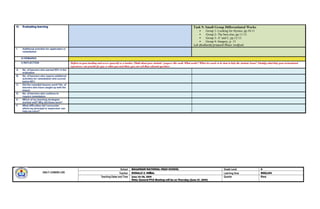
H. Evaluating learning Task 9: Small Group Differentiated Works
 Group 1- Looking for rhymes, pp.10-11
 Group 2- The best clue, pp.11-12
 Group 3- A2
and C, pp.12-13
 Group 4- Imagery, p. 13
Let students present their output.
I. Additional activities for application or
remediation
IV-REMARKS
V-REFLECTION Reflect on your teaching and assess yourself as a teacher. Think about your students’ progress this week. What works? What else needs to be done to help the students learn? Identify what help your instructional
supervisors can provide for you so when you meet them, you can ask them relevant questions.
A. No. of learners who earned 80% in the
evaluation
B. No. of learners who require additional
activities for remediation who scored
below 80%
C. Did the remedial lessons work? No. of
learners who have caught up with the
lesson
D. No. of learners who continue to
require remediation
E. Which of my teaching strategies
worked well? Why did these work?
F. What difficulties did I encounter
which my principal or supervisor can
help me solve?
DAILY LESSON LOG
School BAGANIAN NATIONAL HIGH SCHOOL Grade Level 9
Teacher RONALD Z. NIÑAL Learning Area ENGLISH
Teaching Dates and Time June 24-28, 2019
Note: General PTA Meeting will be on Thursday (June 27, 2019)
Quarter First
Session-1
1:00-3:00- Gold (MW)
7:30-9:30- Pearl (TTh)
1:00-3:00- Diamond (TTh)
Session- 2
1:00-3:00- Gold (MW)
7:30-9:30- Pearl (TTh)
1:00-3:00- Diamond (TTh)
I-OBJECTIVES Objectives must be met over the week and connected to the curriculum standards. To meet the objectives necessary procedures must be followed and if needed, additional lessons, exercises, and remedial activities may be
done for developing content knowledge and competencies. These are assessed using Formative Assessment strategies. Valuing objectives support the learning of content and competencies and enable children to find
significance and joy in learning the lessons. Weekly objectives shall be derived from the curriculum guides.
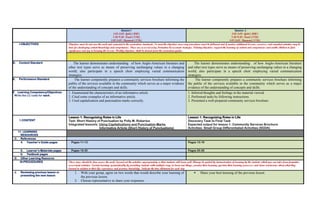
D. Content Standard The learner demonstrates understanding of how Anglo-American literature and
other text types serve as means of preserving unchanging values in a changing
world; also participate in a speech choir employing varied communication
strategies.
The learner demonstrates understanding of how Anglo-American literature
and other text types serve as means of preserving unchanging values in a changing
world; also participate in a speech choir employing varied communication
strategies.
E. Performance Standard The learner competently prepares a community services brochure informing the
public of the services available in the community which serves as a major evidence
of the understanding of concepts and skills.
The learner competently prepares a community services brochure informing
the public of the services available in the community which serves as a major
evidence of the understanding of concepts and skills.
F. Learning Competency/Objectives
Write the LC code for each.
1. Enumerated the characteristics of an informative article.
2. Cited some examples of an informative article.
3. Used capitalization and punctuation marks correctly.
1. Inferred thoughts and feelings in the material viewed.
2. Performed tasks by following instructions.
3. Presented a well-prepared community services brochure.
1.CONTENT
Lesson 1: Recognizing Roles in Life
Text: Short History of Punctuation by Polly M. Robertus
Integrated lesson/s: Using Capitalizations and Punctuation Marks
Informative Article (Short History of Punctuations)
Lesson 1: Recognizing Roles in Life
Discovery Task to Final Task
Expected output for lesson 1: Community Services Brochure
Activities: Small Group Differentiated Activities (SGDA)
11. LEARNING
RESOURCES
C. References
4. Teacher’s Guide pages Pages 11-13 Pages 13-19
5. Learner’s Materials pages Pages 18-20 Pages 20-28
6. Textbook pages
D. Other Learning Resource
III-PROCEDURES These steps should be done across the week. Spread out the activities appropriately so that students will learn well. Always be guided by demonstration of learning by the students which you can infer from formative
assessment activities. Sustain learning systematically by providing students with multiple ways to learn new things, practice their learning, question their learning processes, and draw conclusions about what they
learned in relation to their life experiences and previous knowledge. Indicate the time allotment for each step.
J. Reviewing previous lesson or
presenting the new lesson
1. With your group, agree on two words that would describe your learning of
the previous lesson.
2. Choose representative to share your responses.
 Share your best learning of the previous lesson.
K. Establishing a purpose for the
lesson
This lesson establishes a purpose of informing students that:
 Informative article provide useful information to the readers.
 Clarity of expressions in poetry or prose composition exists if the sentences
are appropriately punctuated and the words are properly capitalized.
This lesson establishes a purpose of informing students that:
 A community services brochure informs the public of the services
available in the community which serves as a major evidence of the
understanding of concepts and skills.
L. Presenting examples/Instances
of the new lesson
Initial Tasks:
Let students reflect on this questions:
 How do you read a poem or text inorder to emphasize ideas in each line?
Is there a need to stop or pause? When and why?
 When do we usually capitalize letters? Discovery Tasks: (pp. 21-23)
 Group 1- Personal Heroes
 Group 2- Poetic music video
 Group 3- Dance Duo
 Group 4- Roles and Concerns
M. Discussing new concepts and
practicing new skills
# 1
When you read poems, you don’t pause or stop at the end of the lines, but you
watch out for commas or periods to guide you. Use punctuations to help you find
the sensible meaning of what you are reading. Clarity of expressions in poetry or
prose composition exists if the sentences are appropriately punctuated and the words
are properly capitalized.
Do Task 12: On Using Capitalization and Punctuation Marks, pp. 18-19
 Rewrite the informative article using correct capitalization and punctuation
marks.
 Describe the characteristics of an informative article. What makes the
article informative?
 Read the short history of punctuations, p. 19
*What have you observe as unusual in the informative article?
*What is it all about?
*What makes the article informative?
*What punctuation marks are described in the article?
*What problems in writing and reading are caused by improper use of
capitalization and punctuation marks?
*How do we solve such problems?
N. Developing mastery
(leads to Formative Assessment
3)
Task 12B. Sensible Role Plan
 Imagine yourself two to four years from now. What kind of career/role do
you think you might have? Will the computer or new inventions be part of
your job?
 Research for facts about it.
 Write a short informative composition highlighting your role and the
invention you will use as part of your job.
 Remember to observe correct capitalization and to use correct
punctuations.
 Share your composition to the class.
O. Finding practical application of
concepts and skills in daily living
 Imagine reading paragraphs without punctuations and correct capitalization! Final Task:
 Community Services Brochure (Follow instructions on pages 24-27)
P. Making generalizations and
abstractions about the lesson
 Clarity of expressions in poetry or prose composition exists if the
sentences are appropriately punctuated and the words are properly
capitalized.
 Correct capitalization and punctuation marks convey meaning to what
we read.
Q. Evaluating learning  10-item quiz on using correct capitalization and punctuation marks
R. Additional activities for application or
remediation
IV-REMARKS
V-REFLECTION Reflect on your teaching and assess yourself as a teacher. Think about your students’ progress this week. What works? What else needs to be done to help the students learn? Identify what help your instructional
supervisors can provide for you so when you meet them, you can ask them relevant questions.
G. No. of learners who earned 80% in the
evaluation
H. No. of learners who require additional
activities for remediation who scored
below 80%
I. Did the remedial lessons work? No. of
learners who have caught up with the
lesson
J. No. of learners who continue to
require remediation
K. Which of my teaching strategies
worked well? Why did these work?
L. What difficulties did I encounter
which my principal or supervisor can
help me solve?
DAILY LESSON LOG
School BAGANIAN NATIONAL HIGH SCHOOL Grade Level 9
Teacher RONALD Z. NIÑAL Learning Area ENGLISH
Teaching Dates and Time February 27-March 9, 2017
Note: NCAE for Grade 9 will be on March 1-2, 2017
Quarter FOURTH
Session-1
9:45-11:45- Pearl (MW)
9:45-11:45- Gold (TTh)
1:30-3:30- Diamond (TTh)
Session- 2
9:45-11:45- Pearl (MW)
9:45-11:45- Gold (TTh)
1:30-3:30- Diamond (TTh)
I-OBJECTIVES Objectives must be met over the week and connected to the curriculum standards. To meet the objectives necessary procedures must be followed and if needed, additional lessons, exercises, and remedial activities may be
done for developing content knowledge and competencies. These are assessed using Formative Assessment strategies. Valuing objectives support the learning of content and competencies and enable children to find
significance and joy in learning the lessons. Weekly objectives shall be derived from the curriculum guides.
G. Content Standard The learner demonstrates understanding of how Anglo-American literature and
other text types serve as means of preserving unchanging values in a changing world;
also how to use the features of a full-length play, tense consistency, modals, active and
passive constructions plus direct and indirect speech to enable him/her competently
performs in a full-length play.
The learner demonstrates understanding of how Anglo-American literature
and other text types serve as means of preserving unchanging values in a
changing world; also how to use the features of a full-length play, tense
consistency, modals, active and passive constructions plus direct and indirect
speech to enable him/her competently performs in a full-length play.
H. Performance Standard The learner competently performs in a full-length play through applying effective
verbal and non-verbal strategies and ICT resources based on the following criteria:
Focus, Voice, Delivery and Dramatic Conventions.
The learner competently performs in a full-length play through applying
effective verbal and non-verbal strategies and ICT resources based on the
following criteria: Focus, Voice, Delivery and Dramatic Conventions.
I. Learning Competency/Objectives
Write the LC code for each.
1. Determined the relevance and truthfulness of the ideas presented in the material
viewed. (EN9VC-IVa-10)
2. Related text content to particular social issues, concerns, or dispositions in real life.
((EN9RC-Iva-2.18)
3. Familiarized the technical vocabulary for drama and theatre like stage directions.
(EN9V-Iva-29)
1. Analyzed literature as a means of understanding unchanging values in a
changing world. (EN9LT-IVa-17)
2. Use active and passive constructions. ((EN9G-IVa-22)
3. Compose a play review. (EN9WC-Iva-11)
4. Used varied verbal and non-verbal communication strategies when
performing in a full-length play. (EN9OL-IVa-3.7)
1.CONTENT
Lesson 1: Holding on to a dream in a changing world
Your Text: A Raisin in the Sun by Lorraine Hansberry (Play)
Sub-text: Harlem/Dreams Deferred by Langston Hughes (Poetry)
Integrated lesson: Technical Vocabulary for Drama and Theatre
Lesson 1: Holding on to a dream in a changing world
Your Text: A Raisin in the Sun by Lorraine Hansberry (Play)
Integrated lessons: Active and Passive Voice of the Verb
Writing a Play Review
Dialogue as Element of Drama
11. LEARNING
RESOURCES
E. References
7. Teacher’s Guide pages Pages 209-210 Pages 211-212
8. Learner’s Materials pages Pages 424-435 Pages 433-446
9. Textbook pages
F. Other Learning Resource
III-PROCEDURES These steps should be done across the week. Spread out the activities appropriately so that students will learn well. Always be guided by demonstration of learning by the students which you can infer from formative
assessment activities. Sustain learning systematically by providing students with multiple ways to learn new things, practice their learning, question their learning processes, and draw conclusions about what they
learned in relation to their life experiences and previous knowledge. Indicate the time allotment for each step.
S. Reviewing previous lesson or
presenting the new lesson
3. Recall the types and parts of stage being learned in the previous grading
period.
4. Recall the characteristics of one-act play.
 Ask the students for a brief summary of the play “A Raisin in the Sun”
by Lorraine Hansberry.
 What does Walter want to do with the insurance check? Discuss his
motive. Why do you think Mama does not approve of it?
T. Establishing a purpose for the
lesson
This lesson establishes a purpose of informing students that: This lesson establishes a purpose of informing students that:
 Play refers to a composition, a piece consisting of dialogues between various
characters, epilogue, monologue, prologue, and an end.
 Drama refers to acting, and to the setup of the play which includes theater, the
hall, the accessories, the green room, costumes, music, etc.
 Drama is a unique form of literature and a means for students to understand
unchanging values in a changing world.
 Holding on to a dream is a great leap towards triumph.
 A voice is a form of a verb that indicates the relation of the subject to
the verb.
 To review a play is to study, analyze, and render a rational judgment.
 Dialogue is one of the essential elements of drama.
 Drama is a unique form of literature and a means for students to
understand unchanging values in a changing world.
U. Presenting examples/Instances
of the new lesson
Initial Tasks:
1. Analyze the pictures on page 426. What idea is presented by the pictures?
How would you relate the pictures to issues on social context?
2. Accomplish the chart that follows with forms of social injustice as depicted
by the pictures. Be able to give resolutions for each situation.
Question to ponder:
 What makes up a good drama? Cite the important elements of drama.
(Dialogue, Stage, Actors/Directors, Audience)
Note: One of the elements of drama is the dialogue. It is the conversation that takes
place among the characters in a drama. Dialogue can reveal events, actions, and settings
as well as the character’s thoughts and feelings. Dialogue has three major functions: to
advance the plot, to establish setting, to reveal the character.
V. Discussing new concepts and
practicing new skills
# 1
Task 3: Perm Term
 To gain better understanding and appreciation of drama, you need to be
familiar with the terminologies related to it. Accomplish the puzzle on page
441 on a separate sheet of paper. Choose your answers from the word pool.
Note: Process the answers of the students. Discuss the terms related to drama and
theater.
Task 7 (literature): Text Hub (Refer to the play “A Raisin in the Sun”)
 Spot and copy two lines from the story which indicate where the characters are.
 Spot and copy two lines from the story which indicate a character’s feelings.
 Spot and copy two lines from the story which indicate what a character is
doing.
Task 8 (Grammar): The Voice
 Verbs have two voices. The active voice and the passive voice. Study the given
examples in the chart (p. 440) and cite how they differ in form and function.
W. Developing mastery
(leads to Formative Assessment
3)
Task 4: Try to Connect
 Reflect on the poem written by Langston Hughes (p.442). How do you
associate it to the play, “A Raisin in the Sun?”
 How is Hansberry’s play a comment on the Langston Hughes poem that she
uses as her epigraph?
Task 5: Grasp it!
 What is Mama’s greatest dream for her family? Illustrate it in the box. State
her reasons behind it.
 How does the dream of every member of the Younger family differ and agree
with one another? Accomplish the bubble map then discuss the answers.
 Would you have dreamt of the same thing for your family? Why?
Note: Present a brief summary of the play.
Task 9: On Location
 Read the summary of A Raisin in the Sun again. Locate at least five sentences
in the active voice, and then transpose it to the passive voice or vice-versa.
(Writing)
 Students will be tasked to compose a play review at the end of the lesson. But
prior to that they must be equipped with the know-how of composing a play
review. To review a play is to study, analyse, and render a rational judgment.
(Consider the preliminaries of the play, A Raisin in the Sun-p.442.)
X. Finding practical application of
concepts and skills in daily living
Life gets even harder for people who do not dream of making it a little better.
Keep reaching for your dreams; keep reaching for your goals which you have created
with your heart and soul. And every time you fail, hold on to it tightly; never let it go.
It may get harder every day but every step you put forward is a great leap towards
triumph. After all, chances are, the life you try to redefine is just right here.
A dialogue is a work of literature in the form of conversation. People need
a clear conversation—a conversation that enhances good communication for
those who hold on to a dream in a changing world—to understand each other,
and to achieve world peace and unity.
Y. Making generalizations and
abstractions about the lesson
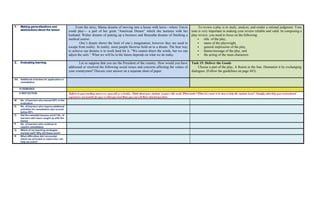
From the story, Mama dreams of moving into a house with lawn—where Travis
could play— a part of her great “American Dream” which she nurtures with her
husband. Walter dreams of putting up a business and Beneatha dreams of finishing a
medical course.
One’s dream shows the limit of one’s imagination; however they are used to
escape from reality. In reality, most people likewise hold on to a dream. The best way
to achieve our dreams is to work hard for it. “We cannot direct the winds, but we can
adjust the sails.” What we will be in the future depends on what we do today.
To review a play is to study, analyze, and render a rational judgment. Your
tone is very important in making your review reliable and valid. In composing a
play review, you need to focus on the following:
 title of the play,
 name of the playwright,
 general impression of the play,
 theme/message of the play, and
 the acting of the main characters.
Z. Evaluating learning Let us suppose that you are the President of the country. How would you have
addressed or resolved the following social issues and concerns affecting the values of
your countrymen? Discuss your answer on a separate sheet of paper.
Task 15: Deliver the Goods
Choose a part of the play, A Raisin in the Sun. Dramatize it by exchanging
dialogues. (Follow the guidelines on page 443).
AA. Additional activities for application or
remediation
IV-REMARKS
V-REFLECTION Reflect on your teaching and assess yourself as a teacher. Think about your students’ progress this week. What works? What else needs to be done to help the students learn? Identify what help your instructional
supervisors can provide for you so when you meet them, you can ask them relevant questions.
M. No. of learners who earned 80% in the
evaluation
N. No. of learners who require additional
activities for remediation who scored
below 80%
O. Did the remedial lessons work? No. of
learners who have caught up with the
lesson
P. No. of learners who continue to
require remediation
Q. Which of my teaching strategies
worked well? Why did these work?
R. What difficulties did I encounter
which my principal or supervisor can
help me solve?

419161081-lesson-plan-9-punctuation-capitalization-docx.docx

  • 1.
    Session-1 1:30-3:30- Pearl (MF) 9:45-11:45-Gold (MF) 7:30-9:30- Diamond (TTh) Session- 2 1:30-3:30- Pearl (MF) 9:45-11:45- Gold (MF) 7:30-9:30- Diamond (TTh) I-OBJECTIVES Objectives must be met over the week and connected to the curriculum standards. To meet the objectives necessary procedures must be followed and if needed, additional lessons, exercises, and remedial activities may be done for developing content knowledge and competencies. These are assessed using Formative Assessment strategies. Valuing objectives support the learning of content and competencies and enable children to find significance and joy in learning the lessons. Weekly objectives shall be derived from the curriculum guides. A. Content Standard The learner demonstrates understanding of how Anglo-American literature and other text types serve as means of preserving unchanging values in a changing world; also participate in a speech choir employing varied communication strategies. B. Performance Standard The learner competently prepares a community services brochure informing the public of the services available in the community which serves as a major evidence of the understanding of concepts and skills. C. Learning Competency/Objectives Write the LC code for each. 1. Got to know each other. 2. Tracked students’ records, strengths and weaknesses. 3. Understood school policies and regulations. 4. Set classroom standards. 1. Recognized various roles in life. 2. Understood elements of poetry (rhymes, sound devices, imagery). 3. Processed information mentioned in the text listened to. 4. Shared prior knowledge about the topic 1.CONTENT Opening of Classes (S. Y. 2018-2019) Homeroom Guidance and Orientation Lesson 1: Recognizing Roles in Life Your Text: The Seven Ages of Man- Poetry (from the comedy: As You Like It by William Shakespeare) Integrated lesson/s: Elements of Poetry 11. LEARNING RESOURCES A. References 1. Teacher’s Guide pages Pages 1-6 2. Learner’s Materials pages Pages 2-13 3. Textbook pages B. Other Learning Resource DepEd Order #8, S. 2015 III-PROCEDURES These steps should be done across the week. Spread out the activities appropriately so that students will learn well. Always be guided by demonstration of learning by the students which you can infer from formative assessment activities. Sustain learning systematically by providing students with multiple ways to learn new things, practice their learning, question their learning processes, and draw conclusions about what they learned in relation to their life experiences and previous knowledge. Indicate the time allotment for each step. A. Reviewing previous lesson or presenting the new lesson Sharing experiences during summer vacation.  Let students think of someone who performed his/her role effectively.  Let them do the sharing of ideas. B. Establishing a purpose for the lesson This lesson establishes a purpose of informing students that:  Recognizing roles in life effectively helps them become a healthy and developed young citizens. DAILY LESSON LOG School BAGANIAN NATIONAL HIGH SCHOOL Grade Level 9 Teacher RONALD Z. NIÑAL Learning Area ENGLISH Teaching Dates and Time June 4-8, 2018 Quarter FIRST
  • 2.
     Elements ofpoetry include rhymes, sound devices, and imagery which make it musical and interesting. C. Presenting examples/Instances of the new lesson Question to ponder: What roles can I perform that will make a difference in my life? Initial Task (Groupings), pp. 3-5. Presentation of output will follow. Group 1-Task 2: All for the Best Group 2-Task 3: Inspirations Group 3-Task 4: Effective? Partially Ineffective? Group 4-Task 5: Looking Back D. Discussing new concepts and practicing new skills # 1 Your Text: The Seven Ages of Man by William Shakespeare  Let students listen as the teacher reads the poem.  As you listen, read it silently and watch out for words which are difficult to understand. List them in your notebook and have them as entries in your word bank.  Watch out for the elements of poetry such as rhymes, repetitions, onomatopoeia, and imagery. E. Developing mastery (leads to Formative Assessment 3) Digging Deeper:  What comprises the seven ages of man according to the poem?  Why is it acceptable/better to recognize and perform your role in life?  How do the roles of man differ based on the persona’s description?  What would be the most effective way of performing your role in life? F. Finding practical application of concepts and skills in daily living Learning how to recognize and to perform your roles effectively is a good indicator that you are a responsible individual. Recognizing your individual role enable you to make a difference in your life. This can enhance your understanding of the world. Somehow you have to continue finding out what it is that fits you. Whatever it is that you do of significance, you have to prove to yourself and to others that you can excel. Try your best. Concentrate on ways to perform well. You’ll surely feel better if you do. G. Making generalizations and abstractions about the lesson Elements of poetry and their purpose:  Rhymes make poem musical.  Onomatopoeia suggests actions, sounds, and movements.  Repetition adds to the enjoyment of a poem. Words, phrases, or lines are repeated to serve a purpose. Poets often make sure their words stay in the readers’ minds.  Imagery conveys feelings, images, and sounds. It adds color to the poem. Orien tation and Settin g of stand ards
  • 3.
    H. Evaluating learningTask 9: Small Group Differentiated Works  Group 1- Looking for rhymes, pp.10-11  Group 2- The best clue, pp.11-12  Group 3- A2 and C, pp.12-13  Group 4- Imagery, p. 13 Let students present their output. I. Additional activities for application or remediation IV-REMARKS V-REFLECTION Reflect on your teaching and assess yourself as a teacher. Think about your students’ progress this week. What works? What else needs to be done to help the students learn? Identify what help your instructional supervisors can provide for you so when you meet them, you can ask them relevant questions. A. No. of learners who earned 80% in the evaluation B. No. of learners who require additional activities for remediation who scored below 80% C. Did the remedial lessons work? No. of learners who have caught up with the lesson D. No. of learners who continue to require remediation E. Which of my teaching strategies worked well? Why did these work? F. What difficulties did I encounter which my principal or supervisor can help me solve? DAILY LESSON LOG School BAGANIAN NATIONAL HIGH SCHOOL Grade Level 9 Teacher RONALD Z. NIÑAL Learning Area ENGLISH Teaching Dates and Time June 24-28, 2019 Note: General PTA Meeting will be on Thursday (June 27, 2019) Quarter First
  • 4.
    Session-1 1:00-3:00- Gold (MW) 7:30-9:30-Pearl (TTh) 1:00-3:00- Diamond (TTh) Session- 2 1:00-3:00- Gold (MW) 7:30-9:30- Pearl (TTh) 1:00-3:00- Diamond (TTh) I-OBJECTIVES Objectives must be met over the week and connected to the curriculum standards. To meet the objectives necessary procedures must be followed and if needed, additional lessons, exercises, and remedial activities may be done for developing content knowledge and competencies. These are assessed using Formative Assessment strategies. Valuing objectives support the learning of content and competencies and enable children to find significance and joy in learning the lessons. Weekly objectives shall be derived from the curriculum guides. D. Content Standard The learner demonstrates understanding of how Anglo-American literature and other text types serve as means of preserving unchanging values in a changing world; also participate in a speech choir employing varied communication strategies. The learner demonstrates understanding of how Anglo-American literature and other text types serve as means of preserving unchanging values in a changing world; also participate in a speech choir employing varied communication strategies. E. Performance Standard The learner competently prepares a community services brochure informing the public of the services available in the community which serves as a major evidence of the understanding of concepts and skills. The learner competently prepares a community services brochure informing the public of the services available in the community which serves as a major evidence of the understanding of concepts and skills. F. Learning Competency/Objectives Write the LC code for each. 1. Enumerated the characteristics of an informative article. 2. Cited some examples of an informative article. 3. Used capitalization and punctuation marks correctly. 1. Inferred thoughts and feelings in the material viewed. 2. Performed tasks by following instructions. 3. Presented a well-prepared community services brochure. 1.CONTENT Lesson 1: Recognizing Roles in Life Text: Short History of Punctuation by Polly M. Robertus Integrated lesson/s: Using Capitalizations and Punctuation Marks Informative Article (Short History of Punctuations) Lesson 1: Recognizing Roles in Life Discovery Task to Final Task Expected output for lesson 1: Community Services Brochure Activities: Small Group Differentiated Activities (SGDA) 11. LEARNING RESOURCES C. References 4. Teacher’s Guide pages Pages 11-13 Pages 13-19 5. Learner’s Materials pages Pages 18-20 Pages 20-28 6. Textbook pages D. Other Learning Resource III-PROCEDURES These steps should be done across the week. Spread out the activities appropriately so that students will learn well. Always be guided by demonstration of learning by the students which you can infer from formative assessment activities. Sustain learning systematically by providing students with multiple ways to learn new things, practice their learning, question their learning processes, and draw conclusions about what they learned in relation to their life experiences and previous knowledge. Indicate the time allotment for each step. J. Reviewing previous lesson or presenting the new lesson 1. With your group, agree on two words that would describe your learning of the previous lesson. 2. Choose representative to share your responses.  Share your best learning of the previous lesson.
  • 5.
    K. Establishing apurpose for the lesson This lesson establishes a purpose of informing students that:  Informative article provide useful information to the readers.  Clarity of expressions in poetry or prose composition exists if the sentences are appropriately punctuated and the words are properly capitalized. This lesson establishes a purpose of informing students that:  A community services brochure informs the public of the services available in the community which serves as a major evidence of the understanding of concepts and skills. L. Presenting examples/Instances of the new lesson Initial Tasks: Let students reflect on this questions:  How do you read a poem or text inorder to emphasize ideas in each line? Is there a need to stop or pause? When and why?  When do we usually capitalize letters? Discovery Tasks: (pp. 21-23)  Group 1- Personal Heroes  Group 2- Poetic music video  Group 3- Dance Duo  Group 4- Roles and Concerns M. Discussing new concepts and practicing new skills # 1 When you read poems, you don’t pause or stop at the end of the lines, but you watch out for commas or periods to guide you. Use punctuations to help you find the sensible meaning of what you are reading. Clarity of expressions in poetry or prose composition exists if the sentences are appropriately punctuated and the words are properly capitalized. Do Task 12: On Using Capitalization and Punctuation Marks, pp. 18-19  Rewrite the informative article using correct capitalization and punctuation marks.  Describe the characteristics of an informative article. What makes the article informative?  Read the short history of punctuations, p. 19 *What have you observe as unusual in the informative article? *What is it all about? *What makes the article informative? *What punctuation marks are described in the article? *What problems in writing and reading are caused by improper use of capitalization and punctuation marks? *How do we solve such problems? N. Developing mastery (leads to Formative Assessment 3) Task 12B. Sensible Role Plan  Imagine yourself two to four years from now. What kind of career/role do you think you might have? Will the computer or new inventions be part of your job?  Research for facts about it.  Write a short informative composition highlighting your role and the invention you will use as part of your job.  Remember to observe correct capitalization and to use correct punctuations.  Share your composition to the class.
  • 6.
    O. Finding practicalapplication of concepts and skills in daily living  Imagine reading paragraphs without punctuations and correct capitalization! Final Task:  Community Services Brochure (Follow instructions on pages 24-27) P. Making generalizations and abstractions about the lesson  Clarity of expressions in poetry or prose composition exists if the sentences are appropriately punctuated and the words are properly capitalized.  Correct capitalization and punctuation marks convey meaning to what we read. Q. Evaluating learning  10-item quiz on using correct capitalization and punctuation marks R. Additional activities for application or remediation IV-REMARKS V-REFLECTION Reflect on your teaching and assess yourself as a teacher. Think about your students’ progress this week. What works? What else needs to be done to help the students learn? Identify what help your instructional supervisors can provide for you so when you meet them, you can ask them relevant questions. G. No. of learners who earned 80% in the evaluation H. No. of learners who require additional activities for remediation who scored below 80% I. Did the remedial lessons work? No. of learners who have caught up with the lesson J. No. of learners who continue to require remediation K. Which of my teaching strategies worked well? Why did these work? L. What difficulties did I encounter which my principal or supervisor can help me solve? DAILY LESSON LOG School BAGANIAN NATIONAL HIGH SCHOOL Grade Level 9 Teacher RONALD Z. NIÑAL Learning Area ENGLISH Teaching Dates and Time February 27-March 9, 2017 Note: NCAE for Grade 9 will be on March 1-2, 2017 Quarter FOURTH
  • 7.
    Session-1 9:45-11:45- Pearl (MW) 9:45-11:45-Gold (TTh) 1:30-3:30- Diamond (TTh) Session- 2 9:45-11:45- Pearl (MW) 9:45-11:45- Gold (TTh) 1:30-3:30- Diamond (TTh)
  • 8.
    I-OBJECTIVES Objectives mustbe met over the week and connected to the curriculum standards. To meet the objectives necessary procedures must be followed and if needed, additional lessons, exercises, and remedial activities may be done for developing content knowledge and competencies. These are assessed using Formative Assessment strategies. Valuing objectives support the learning of content and competencies and enable children to find significance and joy in learning the lessons. Weekly objectives shall be derived from the curriculum guides. G. Content Standard The learner demonstrates understanding of how Anglo-American literature and other text types serve as means of preserving unchanging values in a changing world; also how to use the features of a full-length play, tense consistency, modals, active and passive constructions plus direct and indirect speech to enable him/her competently performs in a full-length play. The learner demonstrates understanding of how Anglo-American literature and other text types serve as means of preserving unchanging values in a changing world; also how to use the features of a full-length play, tense consistency, modals, active and passive constructions plus direct and indirect speech to enable him/her competently performs in a full-length play. H. Performance Standard The learner competently performs in a full-length play through applying effective verbal and non-verbal strategies and ICT resources based on the following criteria: Focus, Voice, Delivery and Dramatic Conventions. The learner competently performs in a full-length play through applying effective verbal and non-verbal strategies and ICT resources based on the following criteria: Focus, Voice, Delivery and Dramatic Conventions. I. Learning Competency/Objectives Write the LC code for each. 1. Determined the relevance and truthfulness of the ideas presented in the material viewed. (EN9VC-IVa-10) 2. Related text content to particular social issues, concerns, or dispositions in real life. ((EN9RC-Iva-2.18) 3. Familiarized the technical vocabulary for drama and theatre like stage directions. (EN9V-Iva-29) 1. Analyzed literature as a means of understanding unchanging values in a changing world. (EN9LT-IVa-17) 2. Use active and passive constructions. ((EN9G-IVa-22) 3. Compose a play review. (EN9WC-Iva-11) 4. Used varied verbal and non-verbal communication strategies when performing in a full-length play. (EN9OL-IVa-3.7) 1.CONTENT Lesson 1: Holding on to a dream in a changing world Your Text: A Raisin in the Sun by Lorraine Hansberry (Play) Sub-text: Harlem/Dreams Deferred by Langston Hughes (Poetry) Integrated lesson: Technical Vocabulary for Drama and Theatre Lesson 1: Holding on to a dream in a changing world Your Text: A Raisin in the Sun by Lorraine Hansberry (Play) Integrated lessons: Active and Passive Voice of the Verb Writing a Play Review Dialogue as Element of Drama 11. LEARNING RESOURCES E. References 7. Teacher’s Guide pages Pages 209-210 Pages 211-212 8. Learner’s Materials pages Pages 424-435 Pages 433-446 9. Textbook pages F. Other Learning Resource III-PROCEDURES These steps should be done across the week. Spread out the activities appropriately so that students will learn well. Always be guided by demonstration of learning by the students which you can infer from formative assessment activities. Sustain learning systematically by providing students with multiple ways to learn new things, practice their learning, question their learning processes, and draw conclusions about what they learned in relation to their life experiences and previous knowledge. Indicate the time allotment for each step. S. Reviewing previous lesson or presenting the new lesson 3. Recall the types and parts of stage being learned in the previous grading period. 4. Recall the characteristics of one-act play.  Ask the students for a brief summary of the play “A Raisin in the Sun” by Lorraine Hansberry.  What does Walter want to do with the insurance check? Discuss his motive. Why do you think Mama does not approve of it? T. Establishing a purpose for the lesson This lesson establishes a purpose of informing students that: This lesson establishes a purpose of informing students that:
  • 9.
     Play refersto a composition, a piece consisting of dialogues between various characters, epilogue, monologue, prologue, and an end.  Drama refers to acting, and to the setup of the play which includes theater, the hall, the accessories, the green room, costumes, music, etc.  Drama is a unique form of literature and a means for students to understand unchanging values in a changing world.  Holding on to a dream is a great leap towards triumph.  A voice is a form of a verb that indicates the relation of the subject to the verb.  To review a play is to study, analyze, and render a rational judgment.  Dialogue is one of the essential elements of drama.  Drama is a unique form of literature and a means for students to understand unchanging values in a changing world. U. Presenting examples/Instances of the new lesson Initial Tasks: 1. Analyze the pictures on page 426. What idea is presented by the pictures? How would you relate the pictures to issues on social context? 2. Accomplish the chart that follows with forms of social injustice as depicted by the pictures. Be able to give resolutions for each situation. Question to ponder:  What makes up a good drama? Cite the important elements of drama. (Dialogue, Stage, Actors/Directors, Audience) Note: One of the elements of drama is the dialogue. It is the conversation that takes place among the characters in a drama. Dialogue can reveal events, actions, and settings as well as the character’s thoughts and feelings. Dialogue has three major functions: to advance the plot, to establish setting, to reveal the character. V. Discussing new concepts and practicing new skills # 1 Task 3: Perm Term  To gain better understanding and appreciation of drama, you need to be familiar with the terminologies related to it. Accomplish the puzzle on page 441 on a separate sheet of paper. Choose your answers from the word pool. Note: Process the answers of the students. Discuss the terms related to drama and theater. Task 7 (literature): Text Hub (Refer to the play “A Raisin in the Sun”)  Spot and copy two lines from the story which indicate where the characters are.  Spot and copy two lines from the story which indicate a character’s feelings.  Spot and copy two lines from the story which indicate what a character is doing. Task 8 (Grammar): The Voice  Verbs have two voices. The active voice and the passive voice. Study the given examples in the chart (p. 440) and cite how they differ in form and function. W. Developing mastery (leads to Formative Assessment 3) Task 4: Try to Connect  Reflect on the poem written by Langston Hughes (p.442). How do you associate it to the play, “A Raisin in the Sun?”  How is Hansberry’s play a comment on the Langston Hughes poem that she uses as her epigraph? Task 5: Grasp it!  What is Mama’s greatest dream for her family? Illustrate it in the box. State her reasons behind it.  How does the dream of every member of the Younger family differ and agree with one another? Accomplish the bubble map then discuss the answers.  Would you have dreamt of the same thing for your family? Why? Note: Present a brief summary of the play. Task 9: On Location  Read the summary of A Raisin in the Sun again. Locate at least five sentences in the active voice, and then transpose it to the passive voice or vice-versa. (Writing)  Students will be tasked to compose a play review at the end of the lesson. But prior to that they must be equipped with the know-how of composing a play review. To review a play is to study, analyse, and render a rational judgment. (Consider the preliminaries of the play, A Raisin in the Sun-p.442.) X. Finding practical application of concepts and skills in daily living Life gets even harder for people who do not dream of making it a little better. Keep reaching for your dreams; keep reaching for your goals which you have created with your heart and soul. And every time you fail, hold on to it tightly; never let it go. It may get harder every day but every step you put forward is a great leap towards triumph. After all, chances are, the life you try to redefine is just right here. A dialogue is a work of literature in the form of conversation. People need a clear conversation—a conversation that enhances good communication for those who hold on to a dream in a changing world—to understand each other, and to achieve world peace and unity.
  • 10.
    Y. Making generalizationsand abstractions about the lesson From the story, Mama dreams of moving into a house with lawn—where Travis could play— a part of her great “American Dream” which she nurtures with her husband. Walter dreams of putting up a business and Beneatha dreams of finishing a medical course. One’s dream shows the limit of one’s imagination; however they are used to escape from reality. In reality, most people likewise hold on to a dream. The best way to achieve our dreams is to work hard for it. “We cannot direct the winds, but we can adjust the sails.” What we will be in the future depends on what we do today. To review a play is to study, analyze, and render a rational judgment. Your tone is very important in making your review reliable and valid. In composing a play review, you need to focus on the following:  title of the play,  name of the playwright,  general impression of the play,  theme/message of the play, and  the acting of the main characters. Z. Evaluating learning Let us suppose that you are the President of the country. How would you have addressed or resolved the following social issues and concerns affecting the values of your countrymen? Discuss your answer on a separate sheet of paper. Task 15: Deliver the Goods Choose a part of the play, A Raisin in the Sun. Dramatize it by exchanging dialogues. (Follow the guidelines on page 443). AA. Additional activities for application or remediation IV-REMARKS V-REFLECTION Reflect on your teaching and assess yourself as a teacher. Think about your students’ progress this week. What works? What else needs to be done to help the students learn? Identify what help your instructional supervisors can provide for you so when you meet them, you can ask them relevant questions. M. No. of learners who earned 80% in the evaluation N. No. of learners who require additional activities for remediation who scored below 80% O. Did the remedial lessons work? No. of learners who have caught up with the lesson P. No. of learners who continue to require remediation Q. Which of my teaching strategies worked well? Why did these work? R. What difficulties did I encounter which my principal or supervisor can help me solve?