PATROCINIO NATIONAL HIGH SCHOOL
Claveria District I
Claveria, MisamisOriental
TASKS FOR ENGLISH GROUP
GRADE LEVEL GRADING PERIOD TEST ITEMS
Grade 7
First Grading
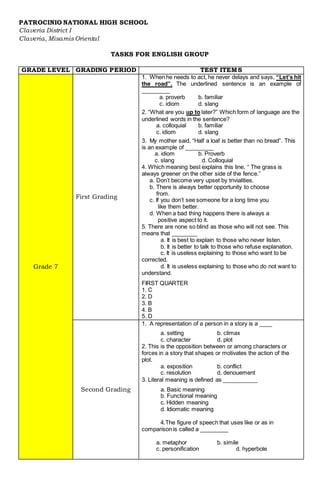
1. When he needs to act, he never delays and says, “Let’s hit
the road”. The underlined sentence is an example of
_________
a. proverb b. familiar
c. idiom d. slang
2. “What are you up to later?” Which form of language are the
underlined words in the sentence?
a. colloquial b. familiar
c. idiom d. slang
3. My mother said, “Half a loaf is better than no bread”. This
is an example of _________
a. idiom b. Proverb
c. slang d. Colloquial
4. Which meaning best explains this line, “ The grass is
always greener on the other side of the fence.”
a. Don’t become very upset by trivialities.
b. There is always better opportunity to choose
from.
c. If you don’t see someone for a long time you
like them better.
d. When a bad thing happens there is always a
positive aspect to it.
5. There are none so blind as those who will not see. This
means that ________
a. It is best to explain to those who never listen.
b. It is better to talk to those who refuse explanation.
c. It is useless explaining to those who want to be
corrected.
d. It is useless explaining to those who do not want to
understand.
FIRST QUARTER
1. C
2. D
3. B
4. B
5. D
Second Grading
1. A representation of a person in a story is a ____
a. setting b. climax
c. character d. plot
2. This is the opposition between or among characters or
forces in a story that shapes or motivates the action of the
plot.
a. exposition b. conflict
c. resolution d. denouement
3. Literal meaning is defined as ___________
a. Basic meaning
b. Functional meaning
c. Hidden meaning
d. Idiomatic meaning
4.The figure of speech that uses like or as in
comparison is called a _________
a. metaphor b. simile
c. personification d. hyperbole
5. The place in school that you go to for research is the
_________
a. library b. office
c. canteen d. classroom
SECOND QUARTER
1. C
2. B
3. A
4. B
5. A
Third Grading
Direction: Link sentences using connectors that signal
chronological and logical sequence.
1. The Philippines gained its independence from the
Japanese__________ thousands of lives were sacrificed.
a. although b. primarily
c. unless d. until
2. The Americans ______ the Filipinos worked hand-in-hand
to protect the country.
a. as well as b. first of all
c. in addition to d. to top it all
3. The Filipinos fought for our freedom _______ the Japanese
left our country.
a. however b. primarily
c. since d. until
4. The Filipinos achieved peace _______ of their bravery.
a. although b. because
c. first d. finally
5. We would have been conquered by other
countries________ they had given up.
a. however b. if
c. later d. next
THIRD QUARTER
1. A
2. A
3. D
4. B
5. B
Fourth Grading
Direction: Use contextual clues in understanding the underline
words in the following sentences.
1. We should make the countries march together towards a
bright destiny.
a. past b. doom
c. future d. present
2. We might have ideological differences but these should
not divide us into hostile camps.
a. based on ideas
b. based on idioms
c. based on identity
d. based on idolatry
3. We might have ideological differences but these should not
divide us into hostile camps.
a. friendly b. amicable
c. sympathetic d. unpleasant
4. Success should not make us vain nor need failure make us
sad.
a. too pretty b. too proud
c. too worthy d. too valuable
5. Strive to maintain the relationship of common brotherhood.
a. ill will b. society
c. friendship d. immorality
FOURTH QUARTER
1.C
2. A
3. D
4. B
5. C
Grade 8
First Grading
1. The Japanese Tea Ceremony is a cultural tradition that
originated in China. Before the ceremony begins, the
host cleans the serving bowls, boils water, prepares a
sweet treat for the guests, and then mixes the tea in
front of the guests. What characteristics of the
Japanese may be reflected on this ceremony?
a. They consider their guests as very important
people.
b. They are service oriented people.
c. They drink their tea only in the company of friends.
d. They want to impress their guests.
2. Why are references included in a Research Project?
a. To give courtesy to the authors of the works that you
have read.
b. To keep a record of everything that you have read
in writing the report.
c. To impress lecturers.
d. To fully identify the source of information and ideas
discussed in the report so that others may check for
themselves.
3. Below are examples of a CLINE, except:
a. Friendly, sociable, outgoing, gregarious
b. Beautiful, pretty, ugly, gorgeous
c. Shouted, yelled, whispered, screamed
d. Faith, hope, love
4. In most Chinese and Japanese folktales, there would
oftentimes be the presence of a loving mother or father
and a dutiful son or daughter. What does it say about
the Chinese or Japanese values?
a. Family is always right
b. Chinese and Japanese children are dependent on
their parents.
c. Family is important
d. Chinese and Japanese parents are protective of
their children.
5. A poem which scattered philosophical quatrains of rare
music and charm, written in answer to many questions
about life. The verses were written not by a man of
letters, but by a famous mathematician and astronomer
who lived in Persia in the eleventh century.
a. I am an African Child
b. Comfort by Koran
c. The Rubaiyat of Omar Khayam
d. Ramayana and Mahabharata
FIRST QUARTER
1.C
2. A
3. D
4. B
5. C
Second Grading
1. An Indonesian folktale “Banyuwangi”, is a combination
of two words in Indonesian language.
a. Banyu means bathroom and wangi means
champion.
b. Banyu means waterfalls and wangi means love.
c. Banyu means water and wangi means fragrance.
d. Banyu means love at first sight and wangi means
odorless.
2. It is designed to provide an opportunity for a group to
hear several people or groups of expert knowledgeable
about specific issue or topic, present information and
discuss personal views.
a. Opinion Poll Survey
b. Panel Discussion
c. Debate
d. Speech
3. It is a type of characterwhich exhibits the characteristics
of a particular class or group of people. This type may
be very individualized and unpredictable in personality
and action, and still be a representative of the class or
group to which he or she belongs.
a. Stock Character
b. Type Character
c. Flat Character
d. Round Character
4. These are graphical tools for organizing and
representing knowledge; usually enclosed in circles or
boxes of some type, and relationships between
concepts indicated by a connecting line linking two
concepts.
a. Mind Map
b. Word Map
c. Concept Map
d. World Map
5. It is essential to the plot. It is a struggle between two or
more opposing forces which makes the plot move.
a. Character
b. Plot
c. Theme
d. Conflict
SECOND QUARTER
1.C
2. B
3. B
4. C
5. D
Third Grading
1. It is the act of referring to words or ideas that evoke a
positive emotional response from an audience. Virtue
words are often used.
a. Card Stacking
b. Name Calling
c. Plain Folks
d. Glittering Generalities
2. It contains a story about a Moabite woman who was
redeemed into a Hebrew family. It was written by
Samuel and was penned during the time of David.
a. The Story of Ruth
b. The Cat
c. The Arabian Nights
d. The Tale of Chunhyang
3. A writing task that asks you to summarize and evaluate
a text. It can be a book, chapter, or journal article.
a. Movie Review
b. Precis
c. Summary
d. Critical Review
4. A story which is about a political prisoner who uses
magic to escape execution.
a. The Story of Ruth
b. The Arabian Nights
c. The Tale of Chunhyang
d. The Cat
5. Which of the following is an example of correct
bibliographical entry for a book?
a. Ronald Takaki, Iron Cages: Raceand Culture in 19th
Century America (New York: Oxford University
Press, 1990), 113.
b. Lee Tamahori, Director, Once were Warriors, 1995.
c. Thompson, Samuel M. “The Authority of Law.”
Ethics 75 (October 1964): 16 – 24.
d. Takaki, Ronald. Iron Cages: Race and Culture in
19th
Century America. New York: Oxford University
Press, 1990.
THIRD QUARTER
1.D
2. A
3. D
4. D
5. D
Fourth Grading
1. Which of the following DOES NOT refer to a kernel
sentence?
a. Simple
b. Active
c. Extended
d. Declarative
2. What did Nelson Mandela mean by his statement “ As I
walked out the door toward the gate that would lead to
my freedom, I know if I didn’t leave my bitterness
behind, I’d still be in prison?”
a. He is happy to be free.
b. He will always be a prisoner.
c. He remembers his hatred.
d. He forgave those who imprisoned him.
3. What does the word “Singa” means?
a. Lion
b. Monkey
c. Horse
d. Tiger
4. It is used to send messages with content. It has a clear
objective when asking for information, for a refund, or
making a complaint.
a. Interactional language
b. Transactional language
c. Business letters
d. Friendly letters
5. A list of citations to books, articles, and documents.
Each citation is followed by a brief descriptive and
evaluative paragraph.
a. References
b. Sources
c. Bibliography
d. Annotated Bibliography
FOURTH QUARTER
1.C
2. D
3. A
4. B
5. D
Grade 9
First Grading
1. “The hissing of the snake made me shoo it away”. The
underlined phrase uses:
a. Rhyme b. Alliteration
c. Consonance d. Onomatopoeia
2. In the line “doubting, drearing dreams no mortal enter dared
to dream before”, what sound device is
being used?
a. Rhyme b. Alliteration
c. Onomatopoeia d. None
3. “the crows in boughs throws endless brawls”. This line uses
what kind of rhyme?
a. end rhymes b. internal rhymes
c. both a & b d. None
4. ______________ is the repetition of consonant sounds
within and at the end of the words.
a. Rhyme b. Alliteration
c. Consonance d. Onomatopoeia
5. Tone is the attitude of the author towards the subject. What
tone does the author show if he is charging one’s wrong
doing?
a. accusatory tone
b. optimistic tone
c. reflective tone
d. sarcastic tone
1. d
2. b
3. b
4. c
5. a
Second Grading
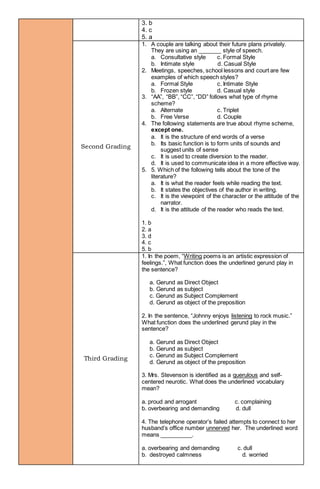
1. A couple are talking about their future plans privately.
They are using an _______ style of speech.
a. Consultative style c. Formal Style
b. Intimate style d. Casual Style
2. Meetings, speeches, school lessons and court are few
examples of which speech styles?
a. Formal Style c. Intimate Style
b. Frozen style d. Casual style
3. “AA”, “BB”, “CC”, “DD” follows what type of rhyme
scheme?
a. Alternate c. Triplet
b. Free Verse d. Couple
4. The following statements are true about rhyme scheme,
except one.
a. It is the structure of end words of a verse
b. Its basic function is to form units of sounds and
suggest units of sense
c. It is used to create diversion to the reader.
d. It is used to communicate idea in a more effective way.
5. 5. Which of the following tells about the tone of the
literature?
a. It is what the reader feels while reading the text.
b. It states the objectives of the author in writing.
c. It is the viewpoint of the character or the attitude of the
narrator.
d. It is the attitude of the reader who reads the text.
1. b
2. a
3. d
4. c
5. b
Third Grading
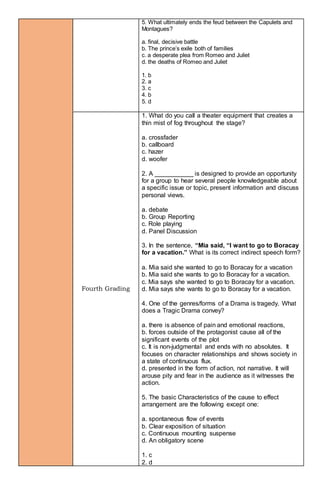
1. In the poem, “Writing poems is an artistic expression of
feelings.”, What function does the underlined gerund play in
the sentence?
a. Gerund as Direct Object
b. Gerund as subject
c. Gerund as Subject Complement
d. Gerund as object of the preposition
2. In the sentence, “Johnny enjoys listening to rock music.”
What function does the underlined gerund play in the
sentence?
a. Gerund as Direct Object
b. Gerund as subject
c. Gerund as Subject Complement
d. Gerund as object of the preposition
3. Mrs. Stevenson is identified as a querulous and self-
centered neurotic. What does the underlined vocabulary
mean?
a. proud and arrogant c. complaining
b. overbearing and demanding d. dull
4. The telephone operator’s failed attempts to connect to her
husband’s office number unnerved her. The underlined word
means __________.
a. overbearing and demanding c. dull
b. destroyed calmness d. worried
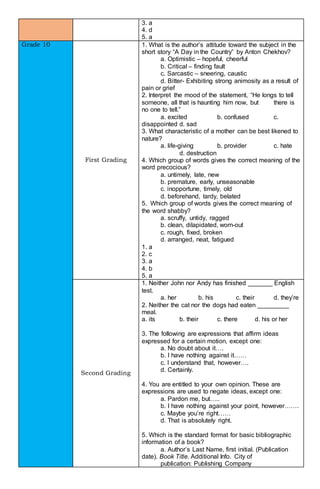
5. What ultimately ends the feud between the Capulets and
Montagues?
a. final, decisive battle
b. The prince’s exile both of families
c. a desperate plea from Romeo and Juliet
d. the deaths of Romeo and Juliet
1. b
2. a
3. c
4. b
5. d
Fourth Grading
1. What do you call a theater equipment that creates a
thin mist of fog throughout the stage?
a. crossfader
b. callboard
c. hazer
d. woofer
2. A ___________ is designed to provide an opportunity
for a group to hear several people knowledgeable about
a specific issue or topic, present information and discuss
personal views.
a. debate
b. Group Reporting
c. Role playing
d. Panel Discussion
3. In the sentence, “Mia said, “I want to go to Boracay
for a vacation.” What is its correct indirect speech form?
a. Mia said she wanted to go to Boracay for a vacation
b. Mia said she wants to go to Boracay for a vacation.
c. Mia says she wanted to go to Boracay for a vacation.
d. Mia says she wants to go to Boracay for a vacation.
4. One of the genres/forms of a Drama is tragedy. What
does a Tragic Drama convey?
a. there is absence of pain and emotional reactions,
b. forces outside of the protagonist cause all of the
significant events of the plot
c. It is non-judgmental and ends with no absolutes. It
focuses on character relationships and shows society in
a state of continuous flux.
d. presented in the form of action, not narrative. It will
arouse pity and fear in the audience as it witnesses the
action.
5. The basic Characteristics of the cause to effect
arrangement are the following except one:
a. spontaneous flow of events
b. Clear exposition of situation
c. Continuous mounting suspense
d. An obligatory scene
1. c
2. d
3. a
4. d
5. a
Grade 10
First Grading
1. What is the author’s attitude toward the subject in the
short story “A Day in the Country” by Anton Chekhov?
a. Optimistic – hopeful, cheerful
b. Critical – finding fault
c. Sarcastic – sneering, caustic
d. Bitter- Exhibiting strong animosity as a result of
pain or grief
2. Interpret the mood of the statement, “He longs to tell
someone, all that is haunting him now, but there is
no one to tell.”
a. excited b. confused c.
disappointed d. sad
3. What characteristic of a mother can be best likened to
nature?
a. life-giving b. provider c. hate
d. destruction
4. Which group of words gives the correct meaning of the
word precocious?
a. untimely, late, new
b. premature, early, unseasonable
c. inopportune, timely, old
d. beforehand, tardy, belated
5. Which group of words gives the correct meaning of
the word shabby?
a. scruffy, untidy, ragged
b. clean, dilapidated, worn-out
c. rough, fixed, broken
d. arranged, neat, fatigued
1. a
2. c
3. a
4. b
5. a
Second Grading
1. Neither John nor Andy has finished _______ English
test.
a. her b. his c. their d. they’re
2. Neither the cat nor the dogs had eaten _________
meal.
a. its b. their c. there d. his or her
3. The following are expressions that affirm ideas
expressed for a certain motion, except one:
a. No doubt about it….
b. I have nothing against it……
c. I understand that, however….
d. Certainly.
4. You are entitled to your own opinion. These are
expressions are used to negate ideas, except one:
a. Pardon me, but…..
b. I have nothing against your point, however…….
c. Maybe you’re right……
d. That is absolutely right.
5. Which is the standard format for basic bibliographic
information of a book?
a. Author’s Last Name, first initial. (Publication
date). Book Title. Additional Info. City of
publication: Publishing Company
b. Author’s Last Name, first Name. (Date).Title of
the Article. (Volume and Pages)Additional
Info. City of publication: Publishing Company
c. Author’s Last Name, first initial. (Date).Title of
the Article. Book Title (Volume and
Pages) City of publication: Publishing Company
d. Author’s Last Name, first Name. (Publication
Date). Book Title (Volume and Pages) City
of publication: Publishing Company
1. b
2. b
3. c
4. d
5. a
Third Grading
1. It is a speech written that involve convincing some to
change their opinion or at the very least take into
account some ideas that have really been considered
before.
a. Informative Speech
b. Persuasive Speech
c. Argumentative Speech
d. Narrative Speech
2. What kind speech is Informative Speech?
a. A speech intends to inform and to share new
ideas and build perceptions about a certain
topic.
b. A written speech that convinces the readers of
the validity of the writer’s argument about an
issue.
c. A speech that assumes that the reader
disagrees with the writer.
d. A speech that is highly persuasive and logical.
3. What kind of speech is persuasive speech?
a. A speech intends to inform and to share new
ideas and build perceptions about a certain
topic.
b. A written speech that convinces the readers of
the validity of the writer’s argument about an
issue.
c. A speech that assumes that the reader
disagrees with the writer.
d. A speech that is highly logical.
4. The following are rules of using quotation marks
directly, except one:
a. Periods and commas always go inside
quotation marks, even inside single quotes
b. Use quotation marks with quoted material that
is more than three lines in length.
c. Use quotation marks to set off a direct quotation
only.
d. Use single quotation marks for quotes within
quotes.
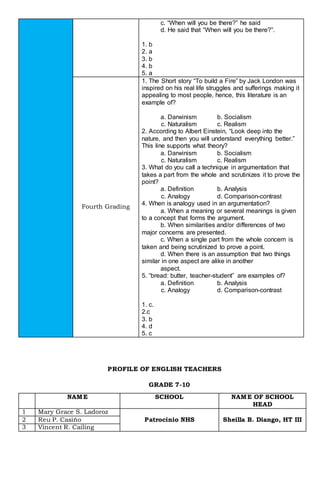
5. What is the correct direct quotation pattern of the
sentence “He asked when you will be there.”?
a. “When will you be here?” he asked.
b. He asked that “When will you be here?”.
c. “When will you be there?” he said
d. He said that “When will you be there?”.
1. b
2. a
3. b
4. b
5. a
Fourth Grading
1. The Short story “To build a Fire” by Jack London was
inspired on his real life struggles and sufferings making it
appealing to most people, hence, this literature is an
example of?
a. Darwinism b. Socialism
c. Naturalism c. Realism
2. According to Albert Einstein, “Look deep into the
nature, and then you will understand everything better.”
This line supports what theory?
a. Darwinism b. Socialism
c. Naturalism c. Realism
3. What do you call a technique in argumentation that
takes a part from the whole and scrutinizes it to prove the
point?
a. Definition b. Analysis
c. Analogy d. Comparison-contrast
4. When is analogy used in an argumentation?
a. When a meaning or several meanings is given
to a concept that forms the argument.
b. When similarities and/or differences of two
major concerns are presented.
c. When a single part from the whole concern is
taken and being scrutinized to prove a point.
d. When there is an assumption that two things
similar in one aspect are alike in another
aspect.
5. “bread: butter, teacher-student” are examples of?
a. Definition b. Analysis
c. Analogy d. Comparison-contrast
1. c.
2.c
3. b
4. d
5. c
PROFILE OF ENGLISH TEACHERS
GRADE 7-10
NAME SCHOOL NAME OF SCHOOL
HEAD
1 Mary Grace S. Ladoroz
Patrocinio NHS Sheilla B. Diango, HT III2 Reu P. Casiño
3 Vincent R. Cailing

Task english group

  • 1.
    PATROCINIO NATIONAL HIGHSCHOOL Claveria District I Claveria, MisamisOriental TASKS FOR ENGLISH GROUP GRADE LEVEL GRADING PERIOD TEST ITEMS Grade 7 First Grading 1. When he needs to act, he never delays and says, “Let’s hit the road”. The underlined sentence is an example of _________ a. proverb b. familiar c. idiom d. slang 2. “What are you up to later?” Which form of language are the underlined words in the sentence? a. colloquial b. familiar c. idiom d. slang 3. My mother said, “Half a loaf is better than no bread”. This is an example of _________ a. idiom b. Proverb c. slang d. Colloquial 4. Which meaning best explains this line, “ The grass is always greener on the other side of the fence.” a. Don’t become very upset by trivialities. b. There is always better opportunity to choose from. c. If you don’t see someone for a long time you like them better. d. When a bad thing happens there is always a positive aspect to it. 5. There are none so blind as those who will not see. This means that ________ a. It is best to explain to those who never listen. b. It is better to talk to those who refuse explanation. c. It is useless explaining to those who want to be corrected. d. It is useless explaining to those who do not want to understand. FIRST QUARTER 1. C 2. D 3. B 4. B 5. D Second Grading 1. A representation of a person in a story is a ____ a. setting b. climax c. character d. plot 2. This is the opposition between or among characters or forces in a story that shapes or motivates the action of the plot. a. exposition b. conflict c. resolution d. denouement 3. Literal meaning is defined as ___________ a. Basic meaning b. Functional meaning c. Hidden meaning d. Idiomatic meaning 4.The figure of speech that uses like or as in comparison is called a _________ a. metaphor b. simile c. personification d. hyperbole
  • 2.
    5. The placein school that you go to for research is the _________ a. library b. office c. canteen d. classroom SECOND QUARTER 1. C 2. B 3. A 4. B 5. A Third Grading Direction: Link sentences using connectors that signal chronological and logical sequence. 1. The Philippines gained its independence from the Japanese__________ thousands of lives were sacrificed. a. although b. primarily c. unless d. until 2. The Americans ______ the Filipinos worked hand-in-hand to protect the country. a. as well as b. first of all c. in addition to d. to top it all 3. The Filipinos fought for our freedom _______ the Japanese left our country. a. however b. primarily c. since d. until 4. The Filipinos achieved peace _______ of their bravery. a. although b. because c. first d. finally 5. We would have been conquered by other countries________ they had given up. a. however b. if c. later d. next THIRD QUARTER 1. A 2. A 3. D 4. B 5. B Fourth Grading Direction: Use contextual clues in understanding the underline words in the following sentences. 1. We should make the countries march together towards a bright destiny. a. past b. doom c. future d. present 2. We might have ideological differences but these should not divide us into hostile camps. a. based on ideas b. based on idioms c. based on identity d. based on idolatry 3. We might have ideological differences but these should not divide us into hostile camps. a. friendly b. amicable c. sympathetic d. unpleasant 4. Success should not make us vain nor need failure make us sad. a. too pretty b. too proud c. too worthy d. too valuable 5. Strive to maintain the relationship of common brotherhood. a. ill will b. society c. friendship d. immorality FOURTH QUARTER 1.C 2. A
  • 3.
    3. D 4. B 5.C Grade 8 First Grading 1. The Japanese Tea Ceremony is a cultural tradition that originated in China. Before the ceremony begins, the host cleans the serving bowls, boils water, prepares a sweet treat for the guests, and then mixes the tea in front of the guests. What characteristics of the Japanese may be reflected on this ceremony? a. They consider their guests as very important people. b. They are service oriented people. c. They drink their tea only in the company of friends. d. They want to impress their guests. 2. Why are references included in a Research Project? a. To give courtesy to the authors of the works that you have read. b. To keep a record of everything that you have read in writing the report. c. To impress lecturers. d. To fully identify the source of information and ideas discussed in the report so that others may check for themselves. 3. Below are examples of a CLINE, except: a. Friendly, sociable, outgoing, gregarious b. Beautiful, pretty, ugly, gorgeous c. Shouted, yelled, whispered, screamed d. Faith, hope, love 4. In most Chinese and Japanese folktales, there would oftentimes be the presence of a loving mother or father and a dutiful son or daughter. What does it say about the Chinese or Japanese values? a. Family is always right b. Chinese and Japanese children are dependent on their parents. c. Family is important d. Chinese and Japanese parents are protective of their children. 5. A poem which scattered philosophical quatrains of rare music and charm, written in answer to many questions about life. The verses were written not by a man of letters, but by a famous mathematician and astronomer who lived in Persia in the eleventh century. a. I am an African Child b. Comfort by Koran c. The Rubaiyat of Omar Khayam d. Ramayana and Mahabharata FIRST QUARTER 1.C 2. A 3. D 4. B 5. C Second Grading 1. An Indonesian folktale “Banyuwangi”, is a combination of two words in Indonesian language. a. Banyu means bathroom and wangi means champion. b. Banyu means waterfalls and wangi means love. c. Banyu means water and wangi means fragrance.
  • 4.
    d. Banyu meanslove at first sight and wangi means odorless. 2. It is designed to provide an opportunity for a group to hear several people or groups of expert knowledgeable about specific issue or topic, present information and discuss personal views. a. Opinion Poll Survey b. Panel Discussion c. Debate d. Speech 3. It is a type of characterwhich exhibits the characteristics of a particular class or group of people. This type may be very individualized and unpredictable in personality and action, and still be a representative of the class or group to which he or she belongs. a. Stock Character b. Type Character c. Flat Character d. Round Character 4. These are graphical tools for organizing and representing knowledge; usually enclosed in circles or boxes of some type, and relationships between concepts indicated by a connecting line linking two concepts. a. Mind Map b. Word Map c. Concept Map d. World Map 5. It is essential to the plot. It is a struggle between two or more opposing forces which makes the plot move. a. Character b. Plot c. Theme d. Conflict SECOND QUARTER 1.C 2. B 3. B 4. C 5. D Third Grading 1. It is the act of referring to words or ideas that evoke a positive emotional response from an audience. Virtue words are often used. a. Card Stacking b. Name Calling c. Plain Folks d. Glittering Generalities
  • 5.
    2. It containsa story about a Moabite woman who was redeemed into a Hebrew family. It was written by Samuel and was penned during the time of David. a. The Story of Ruth b. The Cat c. The Arabian Nights d. The Tale of Chunhyang 3. A writing task that asks you to summarize and evaluate a text. It can be a book, chapter, or journal article. a. Movie Review b. Precis c. Summary d. Critical Review 4. A story which is about a political prisoner who uses magic to escape execution. a. The Story of Ruth b. The Arabian Nights c. The Tale of Chunhyang d. The Cat 5. Which of the following is an example of correct bibliographical entry for a book? a. Ronald Takaki, Iron Cages: Raceand Culture in 19th Century America (New York: Oxford University Press, 1990), 113. b. Lee Tamahori, Director, Once were Warriors, 1995. c. Thompson, Samuel M. “The Authority of Law.” Ethics 75 (October 1964): 16 – 24. d. Takaki, Ronald. Iron Cages: Race and Culture in 19th Century America. New York: Oxford University Press, 1990. THIRD QUARTER 1.D 2. A 3. D 4. D 5. D Fourth Grading 1. Which of the following DOES NOT refer to a kernel sentence? a. Simple b. Active c. Extended d. Declarative 2. What did Nelson Mandela mean by his statement “ As I walked out the door toward the gate that would lead to my freedom, I know if I didn’t leave my bitterness behind, I’d still be in prison?” a. He is happy to be free.
  • 6.
    b. He willalways be a prisoner. c. He remembers his hatred. d. He forgave those who imprisoned him. 3. What does the word “Singa” means? a. Lion b. Monkey c. Horse d. Tiger 4. It is used to send messages with content. It has a clear objective when asking for information, for a refund, or making a complaint. a. Interactional language b. Transactional language c. Business letters d. Friendly letters 5. A list of citations to books, articles, and documents. Each citation is followed by a brief descriptive and evaluative paragraph. a. References b. Sources c. Bibliography d. Annotated Bibliography FOURTH QUARTER 1.C 2. D 3. A 4. B 5. D Grade 9 First Grading 1. “The hissing of the snake made me shoo it away”. The underlined phrase uses: a. Rhyme b. Alliteration c. Consonance d. Onomatopoeia 2. In the line “doubting, drearing dreams no mortal enter dared to dream before”, what sound device is being used? a. Rhyme b. Alliteration c. Onomatopoeia d. None 3. “the crows in boughs throws endless brawls”. This line uses what kind of rhyme? a. end rhymes b. internal rhymes c. both a & b d. None 4. ______________ is the repetition of consonant sounds within and at the end of the words. a. Rhyme b. Alliteration c. Consonance d. Onomatopoeia 5. Tone is the attitude of the author towards the subject. What tone does the author show if he is charging one’s wrong doing? a. accusatory tone b. optimistic tone c. reflective tone d. sarcastic tone 1. d 2. b
  • 7.
    3. b 4. c 5.a Second Grading 1. A couple are talking about their future plans privately. They are using an _______ style of speech. a. Consultative style c. Formal Style b. Intimate style d. Casual Style 2. Meetings, speeches, school lessons and court are few examples of which speech styles? a. Formal Style c. Intimate Style b. Frozen style d. Casual style 3. “AA”, “BB”, “CC”, “DD” follows what type of rhyme scheme? a. Alternate c. Triplet b. Free Verse d. Couple 4. The following statements are true about rhyme scheme, except one. a. It is the structure of end words of a verse b. Its basic function is to form units of sounds and suggest units of sense c. It is used to create diversion to the reader. d. It is used to communicate idea in a more effective way. 5. 5. Which of the following tells about the tone of the literature? a. It is what the reader feels while reading the text. b. It states the objectives of the author in writing. c. It is the viewpoint of the character or the attitude of the narrator. d. It is the attitude of the reader who reads the text. 1. b 2. a 3. d 4. c 5. b Third Grading 1. In the poem, “Writing poems is an artistic expression of feelings.”, What function does the underlined gerund play in the sentence? a. Gerund as Direct Object b. Gerund as subject c. Gerund as Subject Complement d. Gerund as object of the preposition 2. In the sentence, “Johnny enjoys listening to rock music.” What function does the underlined gerund play in the sentence? a. Gerund as Direct Object b. Gerund as subject c. Gerund as Subject Complement d. Gerund as object of the preposition 3. Mrs. Stevenson is identified as a querulous and self- centered neurotic. What does the underlined vocabulary mean? a. proud and arrogant c. complaining b. overbearing and demanding d. dull 4. The telephone operator’s failed attempts to connect to her husband’s office number unnerved her. The underlined word means __________. a. overbearing and demanding c. dull b. destroyed calmness d. worried
  • 8.
    5. What ultimatelyends the feud between the Capulets and Montagues? a. final, decisive battle b. The prince’s exile both of families c. a desperate plea from Romeo and Juliet d. the deaths of Romeo and Juliet 1. b 2. a 3. c 4. b 5. d Fourth Grading 1. What do you call a theater equipment that creates a thin mist of fog throughout the stage? a. crossfader b. callboard c. hazer d. woofer 2. A ___________ is designed to provide an opportunity for a group to hear several people knowledgeable about a specific issue or topic, present information and discuss personal views. a. debate b. Group Reporting c. Role playing d. Panel Discussion 3. In the sentence, “Mia said, “I want to go to Boracay for a vacation.” What is its correct indirect speech form? a. Mia said she wanted to go to Boracay for a vacation b. Mia said she wants to go to Boracay for a vacation. c. Mia says she wanted to go to Boracay for a vacation. d. Mia says she wants to go to Boracay for a vacation. 4. One of the genres/forms of a Drama is tragedy. What does a Tragic Drama convey? a. there is absence of pain and emotional reactions, b. forces outside of the protagonist cause all of the significant events of the plot c. It is non-judgmental and ends with no absolutes. It focuses on character relationships and shows society in a state of continuous flux. d. presented in the form of action, not narrative. It will arouse pity and fear in the audience as it witnesses the action. 5. The basic Characteristics of the cause to effect arrangement are the following except one: a. spontaneous flow of events b. Clear exposition of situation c. Continuous mounting suspense d. An obligatory scene 1. c 2. d
  • 9.
    3. a 4. d 5.a Grade 10 First Grading 1. What is the author’s attitude toward the subject in the short story “A Day in the Country” by Anton Chekhov? a. Optimistic – hopeful, cheerful b. Critical – finding fault c. Sarcastic – sneering, caustic d. Bitter- Exhibiting strong animosity as a result of pain or grief 2. Interpret the mood of the statement, “He longs to tell someone, all that is haunting him now, but there is no one to tell.” a. excited b. confused c. disappointed d. sad 3. What characteristic of a mother can be best likened to nature? a. life-giving b. provider c. hate d. destruction 4. Which group of words gives the correct meaning of the word precocious? a. untimely, late, new b. premature, early, unseasonable c. inopportune, timely, old d. beforehand, tardy, belated 5. Which group of words gives the correct meaning of the word shabby? a. scruffy, untidy, ragged b. clean, dilapidated, worn-out c. rough, fixed, broken d. arranged, neat, fatigued 1. a 2. c 3. a 4. b 5. a Second Grading 1. Neither John nor Andy has finished _______ English test. a. her b. his c. their d. they’re 2. Neither the cat nor the dogs had eaten _________ meal. a. its b. their c. there d. his or her 3. The following are expressions that affirm ideas expressed for a certain motion, except one: a. No doubt about it…. b. I have nothing against it…… c. I understand that, however…. d. Certainly. 4. You are entitled to your own opinion. These are expressions are used to negate ideas, except one: a. Pardon me, but….. b. I have nothing against your point, however……. c. Maybe you’re right…… d. That is absolutely right. 5. Which is the standard format for basic bibliographic information of a book? a. Author’s Last Name, first initial. (Publication date). Book Title. Additional Info. City of publication: Publishing Company
  • 10.
    b. Author’s LastName, first Name. (Date).Title of the Article. (Volume and Pages)Additional Info. City of publication: Publishing Company c. Author’s Last Name, first initial. (Date).Title of the Article. Book Title (Volume and Pages) City of publication: Publishing Company d. Author’s Last Name, first Name. (Publication Date). Book Title (Volume and Pages) City of publication: Publishing Company 1. b 2. b 3. c 4. d 5. a Third Grading 1. It is a speech written that involve convincing some to change their opinion or at the very least take into account some ideas that have really been considered before. a. Informative Speech b. Persuasive Speech c. Argumentative Speech d. Narrative Speech 2. What kind speech is Informative Speech? a. A speech intends to inform and to share new ideas and build perceptions about a certain topic. b. A written speech that convinces the readers of the validity of the writer’s argument about an issue. c. A speech that assumes that the reader disagrees with the writer. d. A speech that is highly persuasive and logical. 3. What kind of speech is persuasive speech? a. A speech intends to inform and to share new ideas and build perceptions about a certain topic. b. A written speech that convinces the readers of the validity of the writer’s argument about an issue. c. A speech that assumes that the reader disagrees with the writer. d. A speech that is highly logical. 4. The following are rules of using quotation marks directly, except one: a. Periods and commas always go inside quotation marks, even inside single quotes b. Use quotation marks with quoted material that is more than three lines in length. c. Use quotation marks to set off a direct quotation only. d. Use single quotation marks for quotes within quotes. 5. What is the correct direct quotation pattern of the sentence “He asked when you will be there.”? a. “When will you be here?” he asked. b. He asked that “When will you be here?”.
  • 11.
    c. “When willyou be there?” he said d. He said that “When will you be there?”. 1. b 2. a 3. b 4. b 5. a Fourth Grading 1. The Short story “To build a Fire” by Jack London was inspired on his real life struggles and sufferings making it appealing to most people, hence, this literature is an example of? a. Darwinism b. Socialism c. Naturalism c. Realism 2. According to Albert Einstein, “Look deep into the nature, and then you will understand everything better.” This line supports what theory? a. Darwinism b. Socialism c. Naturalism c. Realism 3. What do you call a technique in argumentation that takes a part from the whole and scrutinizes it to prove the point? a. Definition b. Analysis c. Analogy d. Comparison-contrast 4. When is analogy used in an argumentation? a. When a meaning or several meanings is given to a concept that forms the argument. b. When similarities and/or differences of two major concerns are presented. c. When a single part from the whole concern is taken and being scrutinized to prove a point. d. When there is an assumption that two things similar in one aspect are alike in another aspect. 5. “bread: butter, teacher-student” are examples of? a. Definition b. Analysis c. Analogy d. Comparison-contrast 1. c. 2.c 3. b 4. d 5. c PROFILE OF ENGLISH TEACHERS GRADE 7-10 NAME SCHOOL NAME OF SCHOOL HEAD 1 Mary Grace S. Ladoroz Patrocinio NHS Sheilla B. Diango, HT III2 Reu P. Casiño 3 Vincent R. Cailing