Elena Garzón Q
Study Skills Workshop
Memory Techniques
Memory
The power and process of
reproducing and recalling what has
been learned and retained
Types of Memory
 Semantic: Words and Symbols
 Implicit: How to
 Remote: Data collected over time
 Working: Extremely short-term, lasting
momentarily
 Episodic: Recent experience
The way I learn affects how I
remembered…
Visual Learners
 Write things down because you remember them
better
 Copy over your notes. Rewriting helps
 Use color
 Write vocabulary words on index cards. Use
colors
The way I learn affects how I
remembered…
Auditory Learners
 Try studying with somebody so you can talk
and hear the information
 Recite out loud what you want to
remember
 Write vocabulary words on index cards and
review them frequently by reading them
aloud
The way I learn affects how I
remembered…
Haptic Learner
 To memorize, pace or walk around while
reciting or looking at a list
 Close your eyes and write the information
in the air or on a desk.
You never forget…
 Your brain never loses
anything
 Forgetting: it is either
the inability to recall
stored information or the
failure to store
information in the first
place
 The things that interest
you
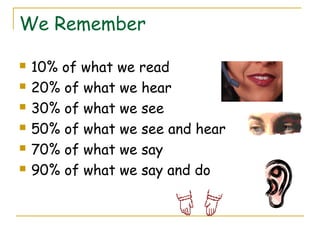
We Remember
 10% of what we read
 20% of what we hear
 30% of what we see
 50% of what we see and hear
 70% of what we say
 90% of what we say and do
Process of Memory
 Attention and Selection
 Encoding
 Storage
 Retrieval
Attention and Selection
The first process of memory is
attention. There is much more
information in your environment than
you can process at any given time. You
must make choices (conscious and
unconscious) regarding what you will
attend to and store in your memory
Encoding = Receiving information
 How are memories formed?
 It refers to translating incoming
information into a mental representation
that can be stored in memory
 You can encode the information on a
number of different ways
 According to sound (acoustic code)
 What it looks like (visual code)
 What it means (semantic code)
Storage = Retention of
information
 It is the process of holding information in
your memory
 Short-Term vs. Long-Term Memory
 Transfer from Short to Long-term
 Repeating the information
 Practicing
 Thinking about it deeply (elaborate) –
drawing connections between what you are
trying to remember and the other things
that you are familiar to you
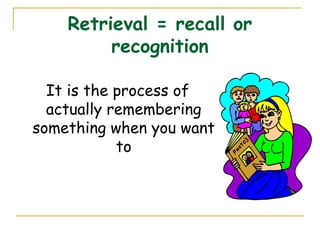
Retrieval = recall or
recognition
It is the process of
actually remembering
something when you want
to
Memory Techniques
1. Learn from the general to the specific
2. Make it meaningful
3. Create associations
4. Learn it once, actively
5. Relax
6. Recite and repeat
Memory Techniques
7. Create pictures
- draw diagrams, mind maps
- create action
- make pictures vivid
- turn abstract ideas into
concrete actions or images
Memory Techniques
8. Write it down (outline, 3x5 cards, summary)
9. Reduce interference
10. Over learn
11. Escape the short-term memory trap
12. Use daylight
13. Distribute Learning
14. Be aware of attitudes
Memory Techniques
15. Choose what not to store in memory
16. Combine memory techniques
17. Remember something else
18. Notice when you do remember
19. Use it before you lose it
20. Remember, you never forget.
21. Grouping by category, alphabet,
chronological order
Memory Techniques
22. Create abbreviations
23. Visualize
24. Review
 24 hrs after learning takes place
 10 minute review reinforces one
hour class
 periodically to move material
from short- to long-term memory
Mnemonics
 Are methods for remembering
information that is otherwise
quite difficult to recall
 A word or a sentence which is
intended to be easier to
remember than the thing it
stands for.
MNEMONIC DEVICES
 Acronyms – words created from the
initial letters of a series of words
 NASA : National Aeronautics and Space
Administration
 Acrostics – sentences that help you
remember a series of letters that
stand for something
 “Every Good Boy Does Fine (E,G,B,D and
F)
Mnemonic Devices
 Rhymes and Songs – Make a rhyme or a
song of the facts
 Alphabet (Twinkle, Twinkle little Star)
 Loci Systems – creates visual
associations with familiar locations. It
can also help you remember things in a
particular order
 Peg Systems – employs key words
represented by numbers
 Example 1=bun, 2=shoe, 3=tree, 4=door
Remembering Names
 Recite and repeat in
conversation
 Ask the other person to recite
and repeat
 Visualize
 Admit you don’t know
 Introduce yourself again
 Use associations
Remembering Names
 Limit the number of new
names you learn at one time
 Ask for photos
 Go early
 Make it a game
Thank You
 moncyvarghesek@gmail.com

English

  • 1.
  • 2.
  • 5.
    Memory The power andprocess of reproducing and recalling what has been learned and retained
  • 6.
    Types of Memory Semantic: Words and Symbols  Implicit: How to  Remote: Data collected over time  Working: Extremely short-term, lasting momentarily  Episodic: Recent experience
  • 7.
    The way Ilearn affects how I remembered… Visual Learners  Write things down because you remember them better  Copy over your notes. Rewriting helps  Use color  Write vocabulary words on index cards. Use colors
  • 8.
    The way Ilearn affects how I remembered… Auditory Learners  Try studying with somebody so you can talk and hear the information  Recite out loud what you want to remember  Write vocabulary words on index cards and review them frequently by reading them aloud
  • 9.
    The way Ilearn affects how I remembered… Haptic Learner  To memorize, pace or walk around while reciting or looking at a list  Close your eyes and write the information in the air or on a desk.
  • 10.
    You never forget… Your brain never loses anything  Forgetting: it is either the inability to recall stored information or the failure to store information in the first place  The things that interest you
  • 11.
    We Remember  10%of what we read  20% of what we hear  30% of what we see  50% of what we see and hear  70% of what we say  90% of what we say and do
  • 12.
    Process of Memory Attention and Selection  Encoding  Storage  Retrieval
  • 13.
    Attention and Selection Thefirst process of memory is attention. There is much more information in your environment than you can process at any given time. You must make choices (conscious and unconscious) regarding what you will attend to and store in your memory
  • 14.
    Encoding = Receivinginformation  How are memories formed?  It refers to translating incoming information into a mental representation that can be stored in memory  You can encode the information on a number of different ways  According to sound (acoustic code)  What it looks like (visual code)  What it means (semantic code)
  • 15.
    Storage = Retentionof information  It is the process of holding information in your memory  Short-Term vs. Long-Term Memory  Transfer from Short to Long-term  Repeating the information  Practicing  Thinking about it deeply (elaborate) – drawing connections between what you are trying to remember and the other things that you are familiar to you
  • 16.
    Retrieval = recallor recognition It is the process of actually remembering something when you want to
  • 17.
    Memory Techniques 1. Learnfrom the general to the specific 2. Make it meaningful 3. Create associations 4. Learn it once, actively 5. Relax 6. Recite and repeat
  • 18.
    Memory Techniques 7. Createpictures - draw diagrams, mind maps - create action - make pictures vivid - turn abstract ideas into concrete actions or images
  • 19.
    Memory Techniques 8. Writeit down (outline, 3x5 cards, summary) 9. Reduce interference 10. Over learn 11. Escape the short-term memory trap 12. Use daylight 13. Distribute Learning 14. Be aware of attitudes
  • 20.
    Memory Techniques 15. Choosewhat not to store in memory 16. Combine memory techniques 17. Remember something else 18. Notice when you do remember 19. Use it before you lose it 20. Remember, you never forget. 21. Grouping by category, alphabet, chronological order
  • 21.
    Memory Techniques 22. Createabbreviations 23. Visualize 24. Review  24 hrs after learning takes place  10 minute review reinforces one hour class  periodically to move material from short- to long-term memory
  • 22.
    Mnemonics  Are methodsfor remembering information that is otherwise quite difficult to recall  A word or a sentence which is intended to be easier to remember than the thing it stands for.
  • 23.
    MNEMONIC DEVICES  Acronyms– words created from the initial letters of a series of words  NASA : National Aeronautics and Space Administration  Acrostics – sentences that help you remember a series of letters that stand for something  “Every Good Boy Does Fine (E,G,B,D and F)
  • 24.
    Mnemonic Devices  Rhymesand Songs – Make a rhyme or a song of the facts  Alphabet (Twinkle, Twinkle little Star)  Loci Systems – creates visual associations with familiar locations. It can also help you remember things in a particular order  Peg Systems – employs key words represented by numbers  Example 1=bun, 2=shoe, 3=tree, 4=door
  • 25.
    Remembering Names  Reciteand repeat in conversation  Ask the other person to recite and repeat  Visualize  Admit you don’t know  Introduce yourself again  Use associations
  • 26.
    Remembering Names  Limitthe number of new names you learn at one time  Ask for photos  Go early  Make it a game
  • 27.