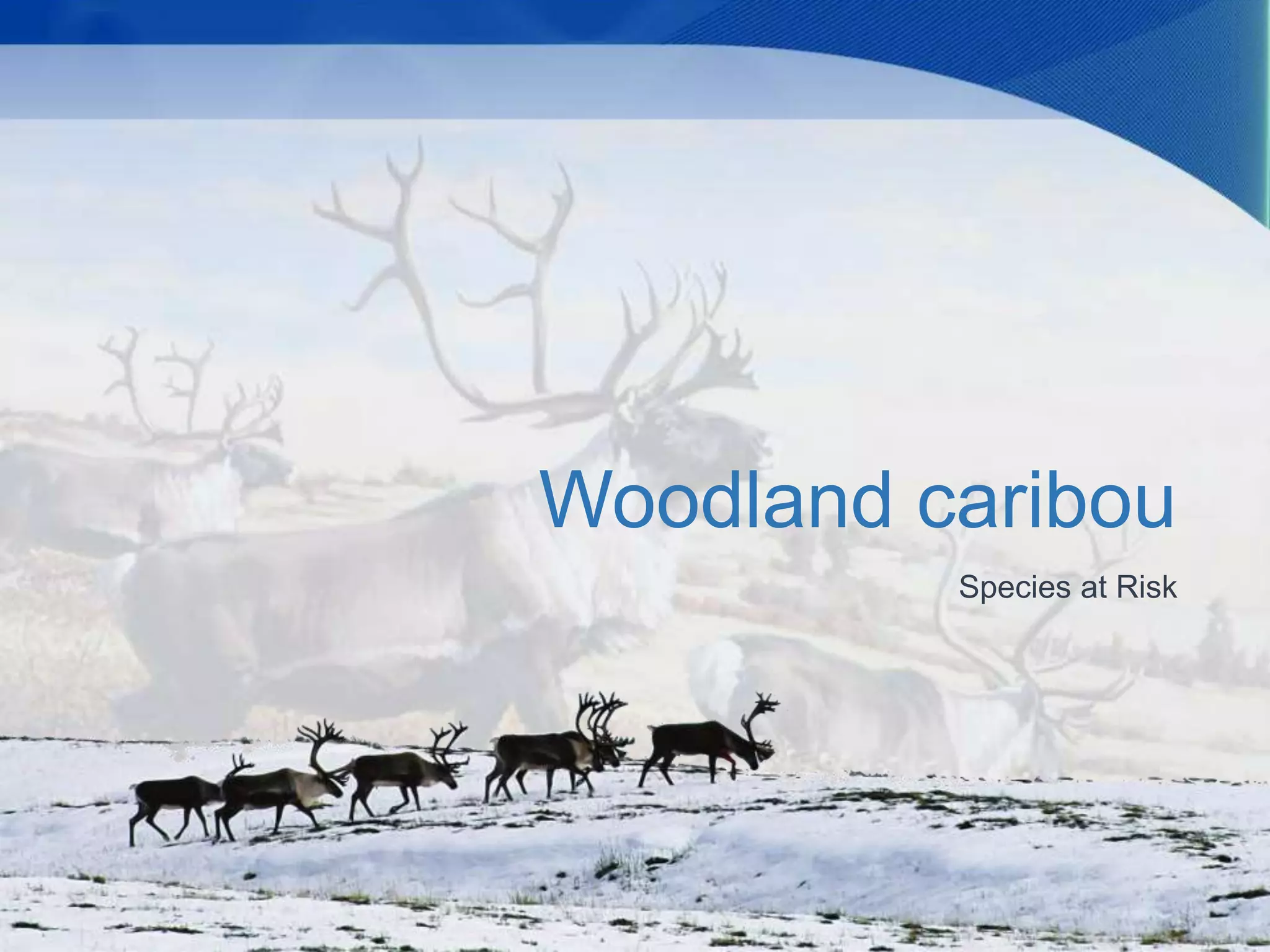
Woodland caribou
Species at Risk
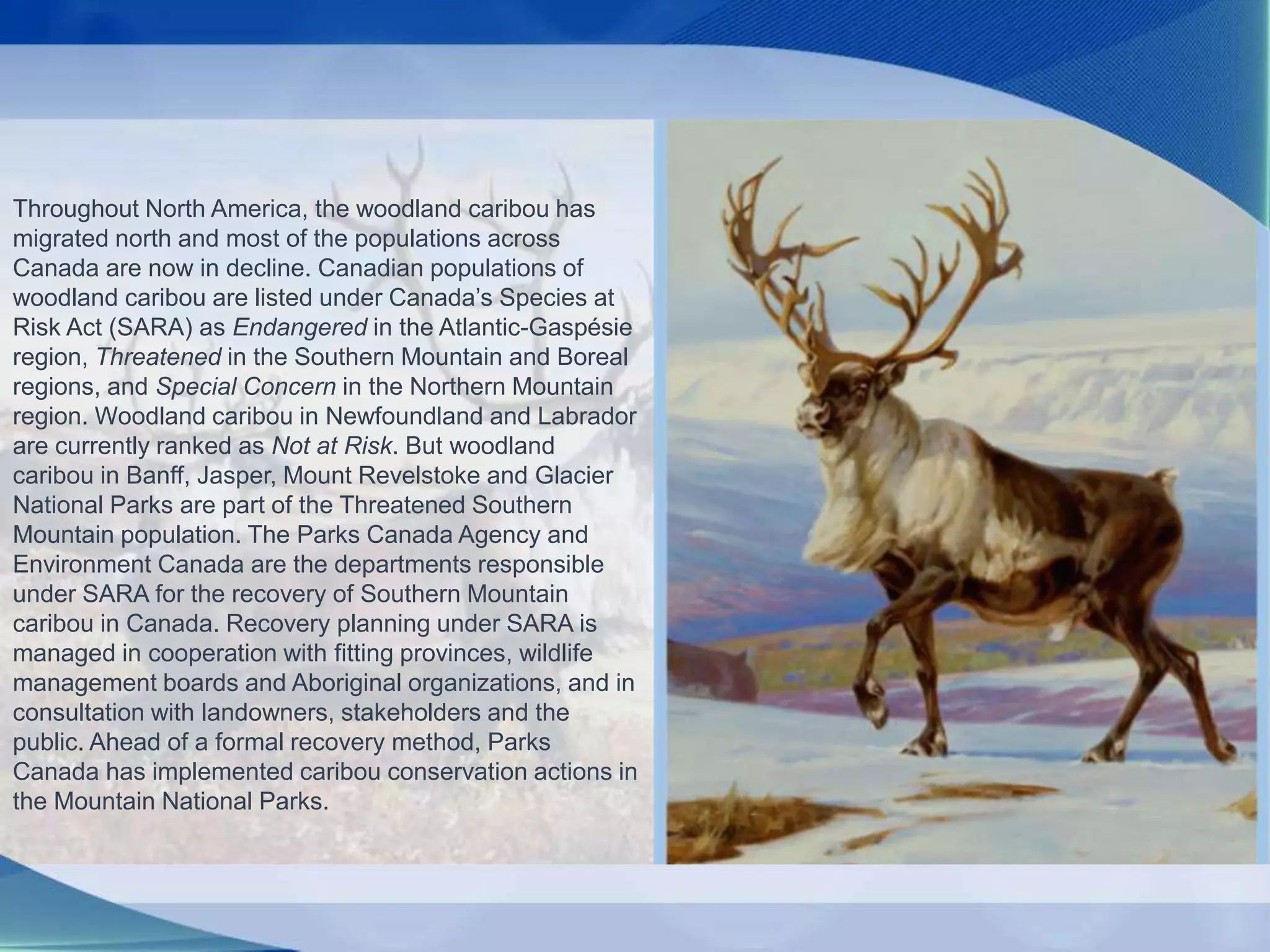
Throughout North America, the woodland caribou has
migrated north and most of the populations across
Canada are now in decline. Canadian populations of
woodland caribou are listed under Canada’s Species at
Risk Act (SARA) as Endangered in the Atlantic-Gaspésie
region, Threatened in the Southern Mountain and Boreal
regions, and Special Concern in the Northern Mountain
region. Woodland caribou in Newfoundland and Labrador
are currently ranked as Not at Risk. But woodland
caribou in Banff, Jasper, Mount Revelstoke and Glacier
National Parks are part of the Threatened Southern
Mountain population. The Parks Canada Agency and
Environment Canada are the departments responsible
under SARA for the recovery of Southern Mountain
caribou in Canada. Recovery planning under SARA is
managed in cooperation with fitting provinces, wildlife
management boards and Aboriginal organizations, and in
consultation with landowners, stakeholders and the
public. Ahead of a formal recovery method, Parks
Canada has implemented caribou conservation actions in
the Mountain National Parks.
Caribou (often called “reindeer”) are a species known as Rangifer
tarandus. They are the only member of the deer family in which both
male and females grow antlers, and they have very unique adaptations
to the the harsh climates they call home. Caribou have semi-hollow hair
that traps warm air next to their skin to keep them insulated against the
cold. Even their noses are covered with hair, and their tails and ears are
small to help limit heat loss. Woodland caribou are a subspecies of
caribou that live in the boreal forests and mountain regions of Canada.
Historically, woodland caribou ranged across Canada from the islands
of British Columbia to the islands of the east coast, north into the Yukon
and Northwest Territories, and south into parts of the northern United
States. Their range has been retracting northward, and in some areas
woodland caribou have disappeared altogether. Today they are found in
small areas throughout the boreal forests of Canada. The Southern
Mountain population consists of herds found in the mountains of Alberta
and southeastern BC.
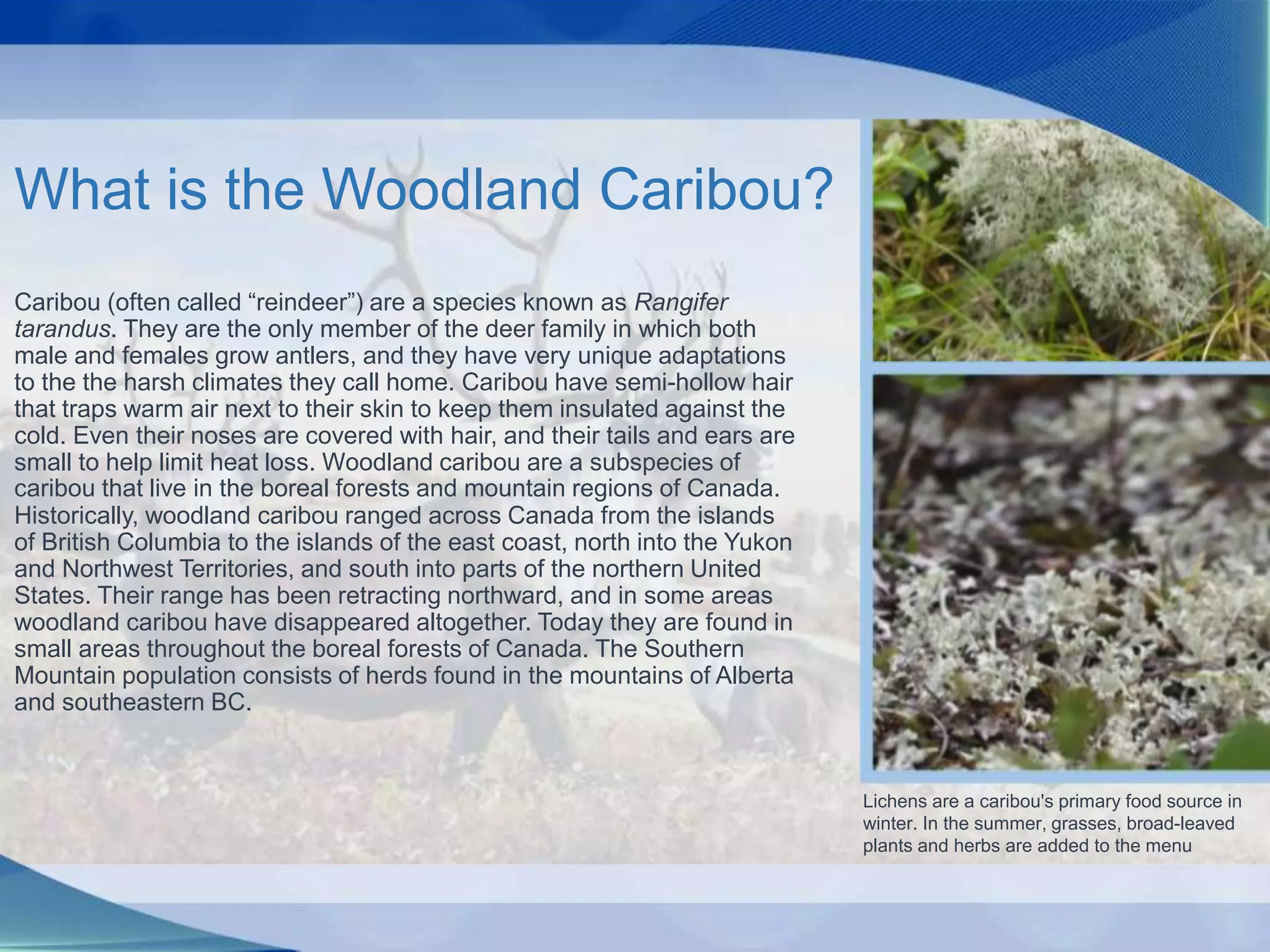
Lichens are a caribou's primary food source in
winter. In the summer, grasses, broad-leaved
plants and herbs are added to the menu
What is the Woodland Caribou?
Why is it at risk?
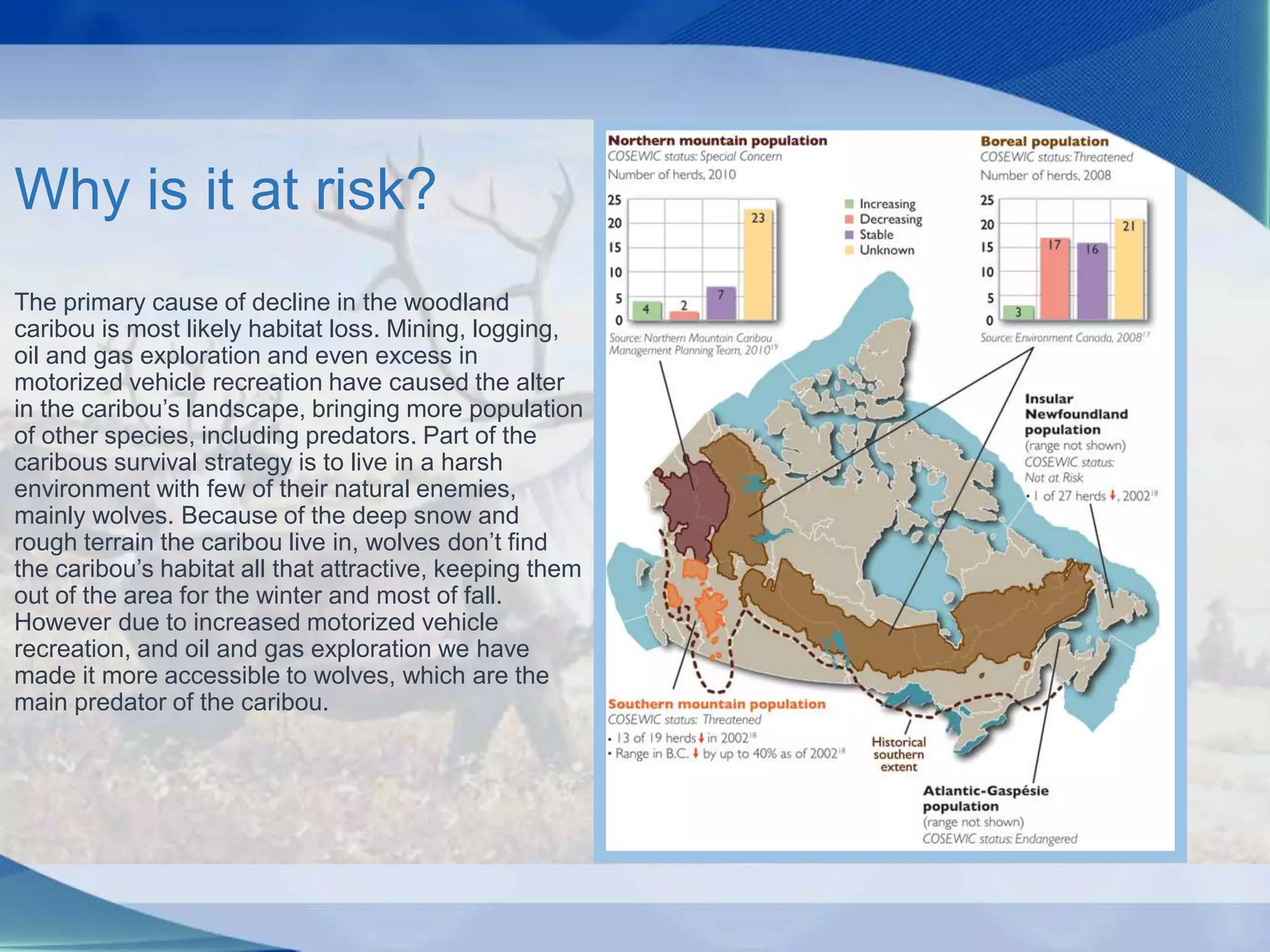
The primary cause of decline in the woodland
caribou is most likely habitat loss. Mining, logging,
oil and gas exploration and even excess in
motorized vehicle recreation have caused the alter
in the caribou’s landscape, bringing more population
of other species, including predators. Part of the
caribous survival strategy is to live in a harsh
environment with few of their natural enemies,
mainly wolves. Because of the deep snow and
rough terrain the caribou live in, wolves don’t find
the caribou’s habitat all that attractive, keeping them
out of the area for the winter and most of fall.
However due to increased motorized vehicle
recreation, and oil and gas exploration we have
made it more accessible to wolves, which are the
main predator of the caribou.
Why are they important?
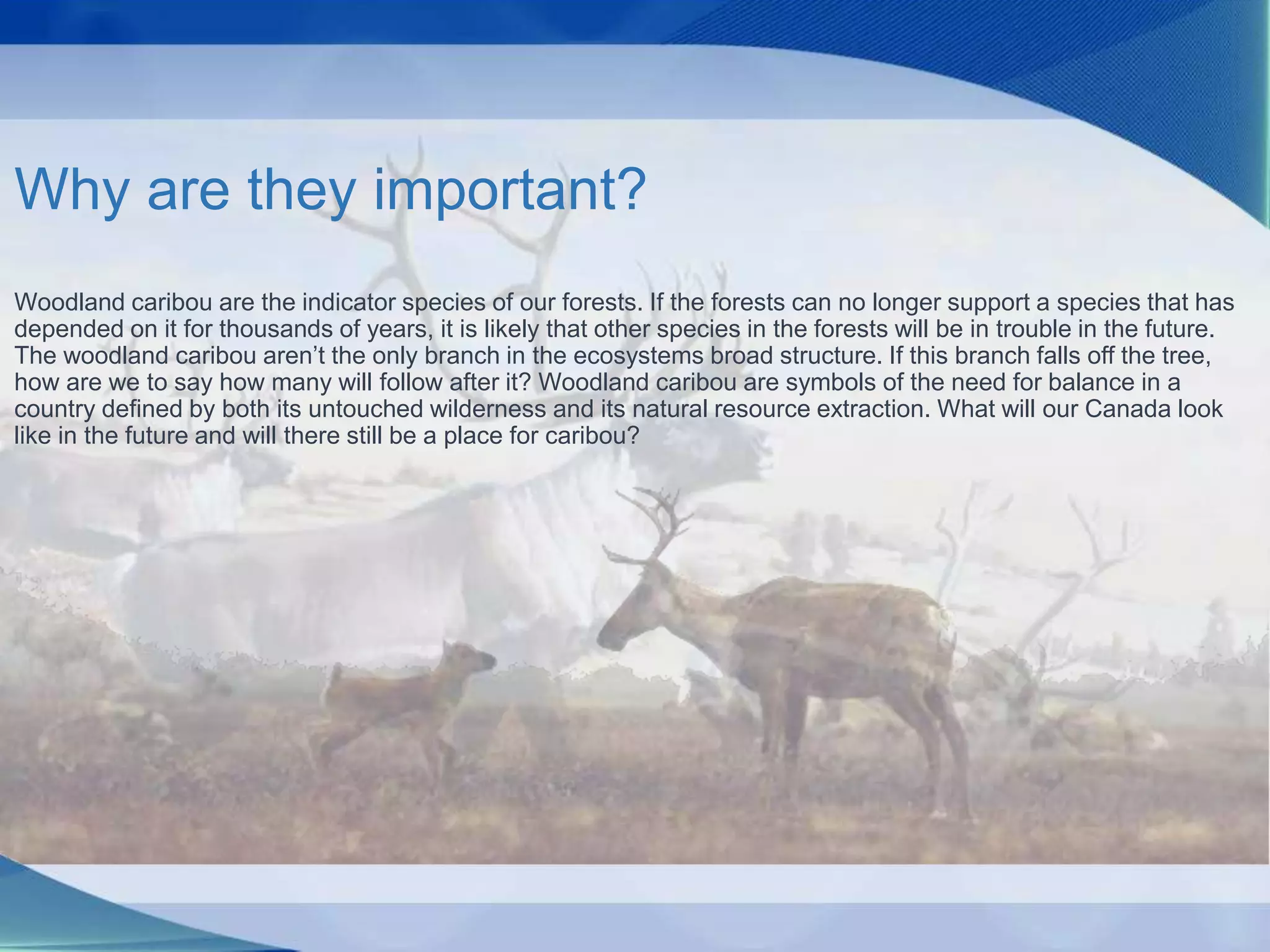
Woodland caribou are the indicator species of our forests. If the forests can no longer support a species that has
depended on it for thousands of years, it is likely that other species in the forests will be in trouble in the future.
The woodland caribou aren’t the only branch in the ecosystems broad structure. If this branch falls off the tree,
how are we to say how many will follow after it? Woodland caribou are symbols of the need for balance in a
country defined by both its untouched wilderness and its natural resource extraction. What will our Canada look
like in the future and will there still be a place for caribou?
Bibliography
"Basic Facts About Woodland Caribou." Defenders of Wildlife. N.p., 19 Mar. 2012. Web. 03 Dec. 2015.
http://www.defenders.org/woodland-caribou/basic-facts
"Boreal Woodland Caribou." David Suzuki Foundation. N.p., n.d. Web. 02 Dec. 2015.
http://www.davidsuzuki.org/issues/wildlife-habitat/science/critical-species/boreal-woodland-caribou/
"Boreal Woodland Caribou." Wikipedia. Wikimedia Foundation, 20 Dec. 2013. Web. 7 Jan. 2016.
https://en.wikipedia.org/wiki/Boreal_woodland_caribou
"Species at Risk - Woodland Caribou." FSC Forest Stewardship Council®. N.p., n.d. Web. 04 Dec. 2015.
https://ca.fsc.org/en/our-work/forest-management-standard-revision-01/species-at-risk-woodland-caribou
"Species Profile | Caribou Boreal Population." Species at Risk Public Registry. N.p., 14 Aug. 2015. Web. 2 Dec.
2015. http://www.registrelep-sararegistry.gc.ca/species/speciesDetails_e.cfm?sid=636

English 10-1 - Man vs. Nature: Butterflies Make Better Canaries - Assignment 2

  • 1.
  • 2.
    Throughout North America,the woodland caribou has migrated north and most of the populations across Canada are now in decline. Canadian populations of woodland caribou are listed under Canada’s Species at Risk Act (SARA) as Endangered in the Atlantic-Gaspésie region, Threatened in the Southern Mountain and Boreal regions, and Special Concern in the Northern Mountain region. Woodland caribou in Newfoundland and Labrador are currently ranked as Not at Risk. But woodland caribou in Banff, Jasper, Mount Revelstoke and Glacier National Parks are part of the Threatened Southern Mountain population. The Parks Canada Agency and Environment Canada are the departments responsible under SARA for the recovery of Southern Mountain caribou in Canada. Recovery planning under SARA is managed in cooperation with fitting provinces, wildlife management boards and Aboriginal organizations, and in consultation with landowners, stakeholders and the public. Ahead of a formal recovery method, Parks Canada has implemented caribou conservation actions in the Mountain National Parks.
  • 3.
    Caribou (often called“reindeer”) are a species known as Rangifer tarandus. They are the only member of the deer family in which both male and females grow antlers, and they have very unique adaptations to the the harsh climates they call home. Caribou have semi-hollow hair that traps warm air next to their skin to keep them insulated against the cold. Even their noses are covered with hair, and their tails and ears are small to help limit heat loss. Woodland caribou are a subspecies of caribou that live in the boreal forests and mountain regions of Canada. Historically, woodland caribou ranged across Canada from the islands of British Columbia to the islands of the east coast, north into the Yukon and Northwest Territories, and south into parts of the northern United States. Their range has been retracting northward, and in some areas woodland caribou have disappeared altogether. Today they are found in small areas throughout the boreal forests of Canada. The Southern Mountain population consists of herds found in the mountains of Alberta and southeastern BC. Lichens are a caribou's primary food source in winter. In the summer, grasses, broad-leaved plants and herbs are added to the menu What is the Woodland Caribou?
  • 4.
    Why is itat risk? The primary cause of decline in the woodland caribou is most likely habitat loss. Mining, logging, oil and gas exploration and even excess in motorized vehicle recreation have caused the alter in the caribou’s landscape, bringing more population of other species, including predators. Part of the caribous survival strategy is to live in a harsh environment with few of their natural enemies, mainly wolves. Because of the deep snow and rough terrain the caribou live in, wolves don’t find the caribou’s habitat all that attractive, keeping them out of the area for the winter and most of fall. However due to increased motorized vehicle recreation, and oil and gas exploration we have made it more accessible to wolves, which are the main predator of the caribou.
  • 5.
    Why are theyimportant? Woodland caribou are the indicator species of our forests. If the forests can no longer support a species that has depended on it for thousands of years, it is likely that other species in the forests will be in trouble in the future. The woodland caribou aren’t the only branch in the ecosystems broad structure. If this branch falls off the tree, how are we to say how many will follow after it? Woodland caribou are symbols of the need for balance in a country defined by both its untouched wilderness and its natural resource extraction. What will our Canada look like in the future and will there still be a place for caribou?
  • 6.
    Bibliography "Basic Facts AboutWoodland Caribou." Defenders of Wildlife. N.p., 19 Mar. 2012. Web. 03 Dec. 2015. http://www.defenders.org/woodland-caribou/basic-facts "Boreal Woodland Caribou." David Suzuki Foundation. N.p., n.d. Web. 02 Dec. 2015. http://www.davidsuzuki.org/issues/wildlife-habitat/science/critical-species/boreal-woodland-caribou/ "Boreal Woodland Caribou." Wikipedia. Wikimedia Foundation, 20 Dec. 2013. Web. 7 Jan. 2016. https://en.wikipedia.org/wiki/Boreal_woodland_caribou "Species at Risk - Woodland Caribou." FSC Forest Stewardship Council®. N.p., n.d. Web. 04 Dec. 2015. https://ca.fsc.org/en/our-work/forest-management-standard-revision-01/species-at-risk-woodland-caribou "Species Profile | Caribou Boreal Population." Species at Risk Public Registry. N.p., 14 Aug. 2015. Web. 2 Dec. 2015. http://www.registrelep-sararegistry.gc.ca/species/speciesDetails_e.cfm?sid=636