English 10-1 Man vs Nature
THE PEARY CARIBOU
Introduction
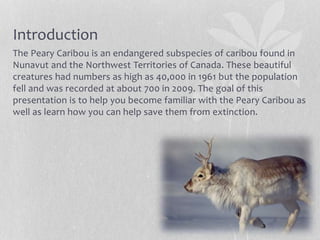
The Peary Caribou is an endangered subspecies of caribou found in
Nunavut and the Northwest Territories of Canada. These beautiful
creatures had numbers as high as 40,000 in 1961 but the population
fell and was recorded at about 700 in 2009. The goal of this
presentation is to help you become familiar with the Peary Caribou as
well as learn how you can help save them from extinction.
Description
The Peary Caribou also
known as tuktu in Inukitut,
are averaged at about 130lb
for females and 240lb for
males, and they measure
between 1.4m and 1.7m in
length. Their coats are made
up of hollow hairs that traps
in heat and insulates the
caribou. In the winter their
coats are white and thick and
in the summer they are
darker and short. Both male
and female Peary caribou
have antlers and sharp
hooves shaped like shovels
for digging for food in the
snow.
More Facts
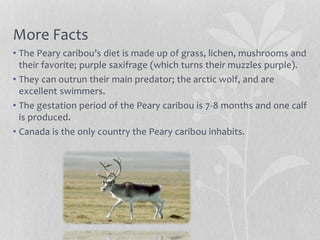
• The Peary caribou’s diet is made up of grass, lichen, mushrooms and
their favorite; purple saxifrage (which turns their muzzles purple).
• They can outrun their main predator; the arctic wolf, and are
excellent swimmers.
• The gestation period of the Peary caribou is 7-8 months and one calf
is produced.
• Canada is the only country the Peary caribou inhabits.
Causes Of
Endangerment
The Peary Caribou was
assigned the status of
endangered in May of 2004
and remains on the
endangered species list.
The causes of endangerment
include:
• Variability of severity of
winter
• Inbreeding
• Competition for food
• Migration interference
Variability of Severity of Winter
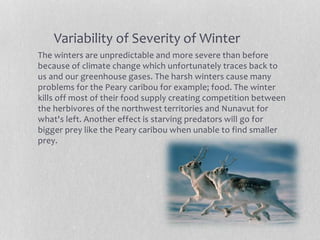
The winters are unpredictable and more severe than before
because of climate change which unfortunately traces back to
us and our greenhouse gases. The harsh winters cause many
problems for the Peary caribou for example; food. The winter
kills off most of their food supply creating competition between
the herbivores of the northwest territories and Nunavut for
what's left. Another effect is starving predators will go for
bigger prey like the Peary caribou when unable to find smaller
prey.
Migration
Interference
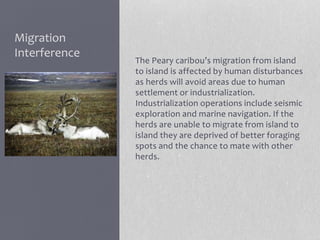
The Peary caribou’s migration from island
to island is affected by human disturbances
as herds will avoid areas due to human
settlement or industrialization.
Industrialization operations include seismic
exploration and marine navigation. If the
herds are unable to migrate from island to
island they are deprived of better foraging
spots and the chance to mate with other
herds.
Inbreeding
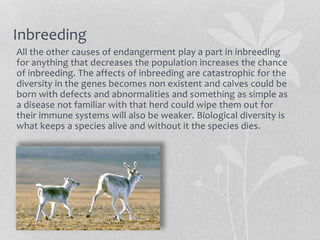
All the other causes of endangerment play a part in inbreeding
for anything that decreases the population increases the chance
of inbreeding. The affects of inbreeding are catastrophic for the
diversity in the genes becomes non existent and calves could be
born with defects and abnormalities and something as simple as
a disease not familiar with that herd could wipe them out for
their immune systems will also be weaker. Biological diversity is
what keeps a species alive and without it the species dies.
What’s Being Done
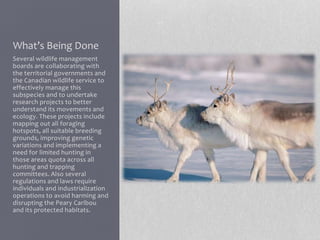
Several wildlife management
boards are collaborating with
the territorial governments and
the Canadian wildlife service to
effectively manage this
subspecies and to undertake
research projects to better
understand its movements and
ecology. These projects include
mapping out all foraging
hotspots, all suitable breeding
grounds, improving genetic
variations and implementing a
need for limited hunting in
those areas quota across all
hunting and trapping
committees. Also several
regulations and laws require
individuals and industrialization
operations to avoid harming and
disrupting the Peary Caribou
and its protected habitats.
What We Can Do
• We need to do our part to limit our contributions to climate
change. That involves cutting down on the burning of fossil
fuels for example; walking and biking to places or carpooling
if you have to use a motor vehicle, and turning off the lights
or heater when they’re not needed. Another thing we can do
is spread the word about the Peary caribou and how we can
help save them from extinction.
Bibliography
• "Peary Caribou." Wikipedia. Wikimedia
Foundation, n.d. Web. 07 Nov. 2016.
• "Peary Caribou." Nature Canada.
Nature Canada, 2008. Web. 07 Nov.
2016.
• "Species Profile: Peary
Caribou." Species at Risk Public
Registry. Government of Canada, 2016.
Web. 07 Nov. 2016.
• "Peary Caribou." NWT Species at Risk.
Government of the Northwest
Territories, n.d. Web. 07 Nov. 2016.

The Peary Caribou

  • 1.
    English 10-1 Manvs Nature THE PEARY CARIBOU
  • 2.
    Introduction The Peary Caribouis an endangered subspecies of caribou found in Nunavut and the Northwest Territories of Canada. These beautiful creatures had numbers as high as 40,000 in 1961 but the population fell and was recorded at about 700 in 2009. The goal of this presentation is to help you become familiar with the Peary Caribou as well as learn how you can help save them from extinction.
  • 3.
    Description The Peary Cariboualso known as tuktu in Inukitut, are averaged at about 130lb for females and 240lb for males, and they measure between 1.4m and 1.7m in length. Their coats are made up of hollow hairs that traps in heat and insulates the caribou. In the winter their coats are white and thick and in the summer they are darker and short. Both male and female Peary caribou have antlers and sharp hooves shaped like shovels for digging for food in the snow.
  • 4.
    More Facts • ThePeary caribou’s diet is made up of grass, lichen, mushrooms and their favorite; purple saxifrage (which turns their muzzles purple). • They can outrun their main predator; the arctic wolf, and are excellent swimmers. • The gestation period of the Peary caribou is 7-8 months and one calf is produced. • Canada is the only country the Peary caribou inhabits.
  • 5.
    Causes Of Endangerment The PearyCaribou was assigned the status of endangered in May of 2004 and remains on the endangered species list. The causes of endangerment include: • Variability of severity of winter • Inbreeding • Competition for food • Migration interference
  • 6.
    Variability of Severityof Winter The winters are unpredictable and more severe than before because of climate change which unfortunately traces back to us and our greenhouse gases. The harsh winters cause many problems for the Peary caribou for example; food. The winter kills off most of their food supply creating competition between the herbivores of the northwest territories and Nunavut for what's left. Another effect is starving predators will go for bigger prey like the Peary caribou when unable to find smaller prey.
  • 7.
    Migration Interference The Peary caribou’smigration from island to island is affected by human disturbances as herds will avoid areas due to human settlement or industrialization. Industrialization operations include seismic exploration and marine navigation. If the herds are unable to migrate from island to island they are deprived of better foraging spots and the chance to mate with other herds.
  • 8.
    Inbreeding All the othercauses of endangerment play a part in inbreeding for anything that decreases the population increases the chance of inbreeding. The affects of inbreeding are catastrophic for the diversity in the genes becomes non existent and calves could be born with defects and abnormalities and something as simple as a disease not familiar with that herd could wipe them out for their immune systems will also be weaker. Biological diversity is what keeps a species alive and without it the species dies.
  • 9.
    What’s Being Done Severalwildlife management boards are collaborating with the territorial governments and the Canadian wildlife service to effectively manage this subspecies and to undertake research projects to better understand its movements and ecology. These projects include mapping out all foraging hotspots, all suitable breeding grounds, improving genetic variations and implementing a need for limited hunting in those areas quota across all hunting and trapping committees. Also several regulations and laws require individuals and industrialization operations to avoid harming and disrupting the Peary Caribou and its protected habitats.
  • 10.
    What We CanDo • We need to do our part to limit our contributions to climate change. That involves cutting down on the burning of fossil fuels for example; walking and biking to places or carpooling if you have to use a motor vehicle, and turning off the lights or heater when they’re not needed. Another thing we can do is spread the word about the Peary caribou and how we can help save them from extinction.
  • 11.
    Bibliography • "Peary Caribou."Wikipedia. Wikimedia Foundation, n.d. Web. 07 Nov. 2016. • "Peary Caribou." Nature Canada. Nature Canada, 2008. Web. 07 Nov. 2016. • "Species Profile: Peary Caribou." Species at Risk Public Registry. Government of Canada, 2016. Web. 07 Nov. 2016. • "Peary Caribou." NWT Species at Risk. Government of the Northwest Territories, n.d. Web. 07 Nov. 2016.