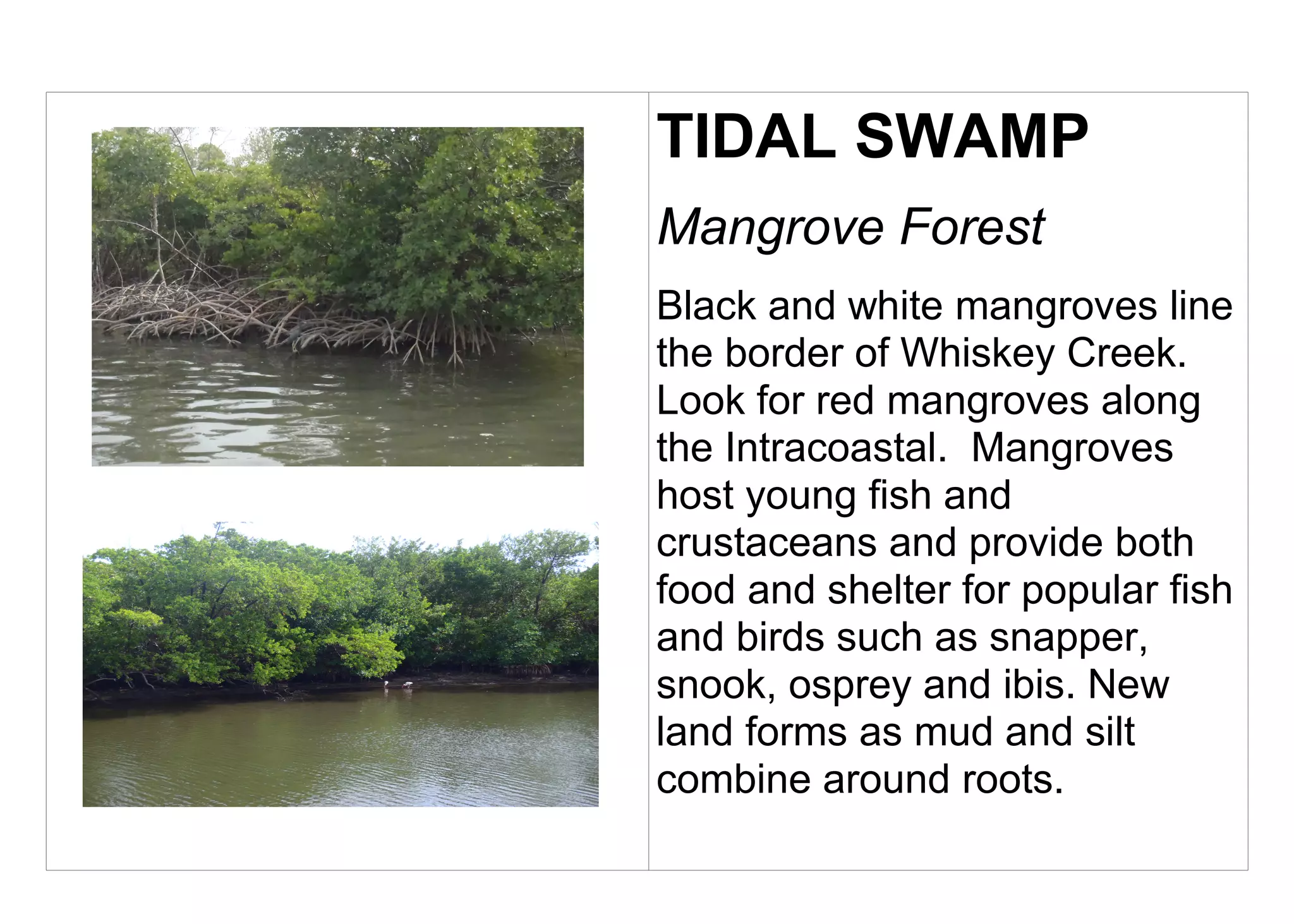
TIDAL SWAMP
Mangrove Forest
Black and white mangroves line
the border of Whiskey Creek.
Look for red mangroves along
the Intracoastal. Mangroves
host young fish and
crustaceans and provide both
food and shelter for popular fish
and birds such as snapper,
snook, osprey and ibis. New
land forms as mud and silt
combine around roots.
COASTAL MARINE
HABITAT
Beach & Fore Dune

The beach and fore dune are the
primary nesting habitat for shore
birds and marine turtles. Shifts in
the sand, wind, saltwater flooding,
salt spray and intense heat limit
vegetation to hardy plants able to
thrive with little nutrients. Vegetation
stabilizes the sand. Walking or
trampling over vegetation is a major
threat.
TIDAL CREEK
Estuarine Unconsolidated
Substrate
The loosely formed mud, sand and
shell bottom of Whiskey Creek
provides an important habitat for
invertebrates and bottom feeding
fish. While more protected than the
seashore, environmental fluctuations
or extremely high tides can destroy
many animals. The creek serves as
a nursery for young fish. Manatees,
looking for warm and calm water,
are often observed at high tide.
COASTAL HAMMOCK
Maritime Hammock /
Maritime Forest
The dense canopy of the coastal
tropical hammock minimizes
temperature fluctuations by
protecting the land from the harsh
sun and reducing loss of heat at
night. This hardwood hammock
houses poisonwood, wild coffee, sea
grape, live oak and saw palmetto.
Invasive exotic Australian pine and
Brazilian pepper are regularly
removed.
Sources:

Tidal Swamp
photo: Lisa Magill
text: John U. Lloyd Beach State Park Land Management Plan Amendment, June 2011

Coastal Marine Habitat
photo Lisa Magill
text John U. Lloyd Beach State Park Land Management Plan Amendment, June 2011

Tidal Creek
photo Lisa Magill
text John U. Lloyd Beach State Park Land Management Plan Amendment, June 2011

Coastal Hammock
photo Lisa Magill
text John U. Lloyd Beach State Park Land Management Plan Amendment, June 2011

Coastal Signs

  • 1.
    TIDAL SWAMP Mangrove Forest Blackand white mangroves line the border of Whiskey Creek. Look for red mangroves along the Intracoastal. Mangroves host young fish and crustaceans and provide both food and shelter for popular fish and birds such as snapper, snook, osprey and ibis. New land forms as mud and silt combine around roots.
  • 3.
    COASTAL MARINE HABITAT Beach &Fore Dune The beach and fore dune are the primary nesting habitat for shore birds and marine turtles. Shifts in the sand, wind, saltwater flooding, salt spray and intense heat limit vegetation to hardy plants able to thrive with little nutrients. Vegetation stabilizes the sand. Walking or trampling over vegetation is a major threat.
  • 4.
    TIDAL CREEK Estuarine Unconsolidated Substrate Theloosely formed mud, sand and shell bottom of Whiskey Creek provides an important habitat for invertebrates and bottom feeding fish. While more protected than the seashore, environmental fluctuations or extremely high tides can destroy many animals. The creek serves as a nursery for young fish. Manatees, looking for warm and calm water, are often observed at high tide.
  • 5.
    COASTAL HAMMOCK Maritime Hammock/ Maritime Forest The dense canopy of the coastal tropical hammock minimizes temperature fluctuations by protecting the land from the harsh sun and reducing loss of heat at night. This hardwood hammock houses poisonwood, wild coffee, sea grape, live oak and saw palmetto. Invasive exotic Australian pine and Brazilian pepper are regularly removed.
  • 6.
    Sources: Tidal Swamp photo: LisaMagill text: John U. Lloyd Beach State Park Land Management Plan Amendment, June 2011 Coastal Marine Habitat photo Lisa Magill text John U. Lloyd Beach State Park Land Management Plan Amendment, June 2011 Tidal Creek photo Lisa Magill text John U. Lloyd Beach State Park Land Management Plan Amendment, June 2011 Coastal Hammock photo Lisa Magill text John U. Lloyd Beach State Park Land Management Plan Amendment, June 2011