Spanish animals in
     danger
Description
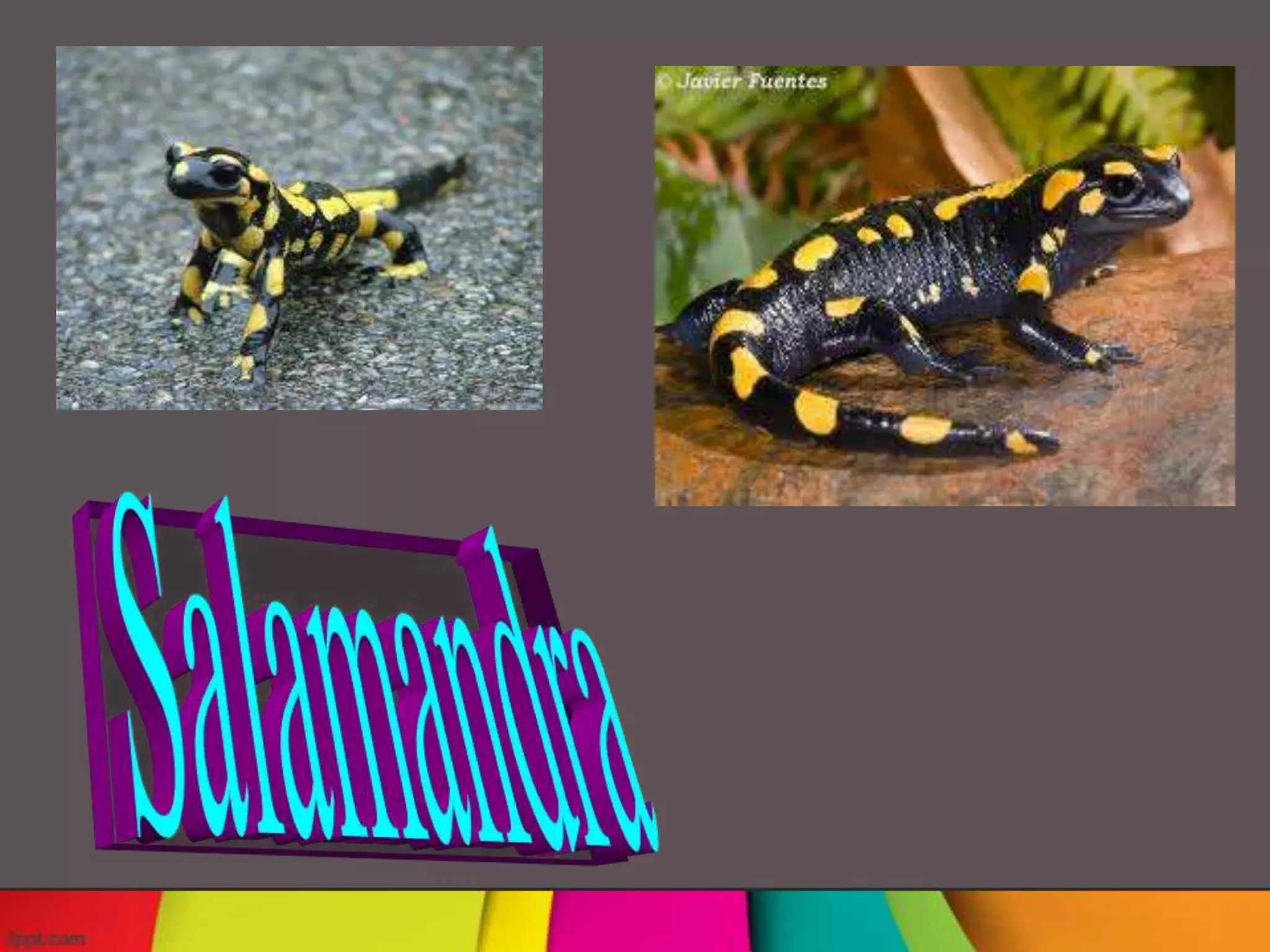
The salamander is a specie amphibian family
urodelo Salamandridae.
Adults aged 18 to 25 cm including the tail, with
females slightly larger. In exceptional cases may
reach 28 or 30 cm. Thick body and short tail, no
dorsal or caudal crest.


Habitat
It is a nocturnal animal, but may be active
during the day if the relative humidity is
high, on rainy days or foggy, and when the
temperature is cool but more than 3 C. By
day takes refuge under leaf litter, fallen
trees or under rocks.
Larvae are found in streams and clean
water sources.
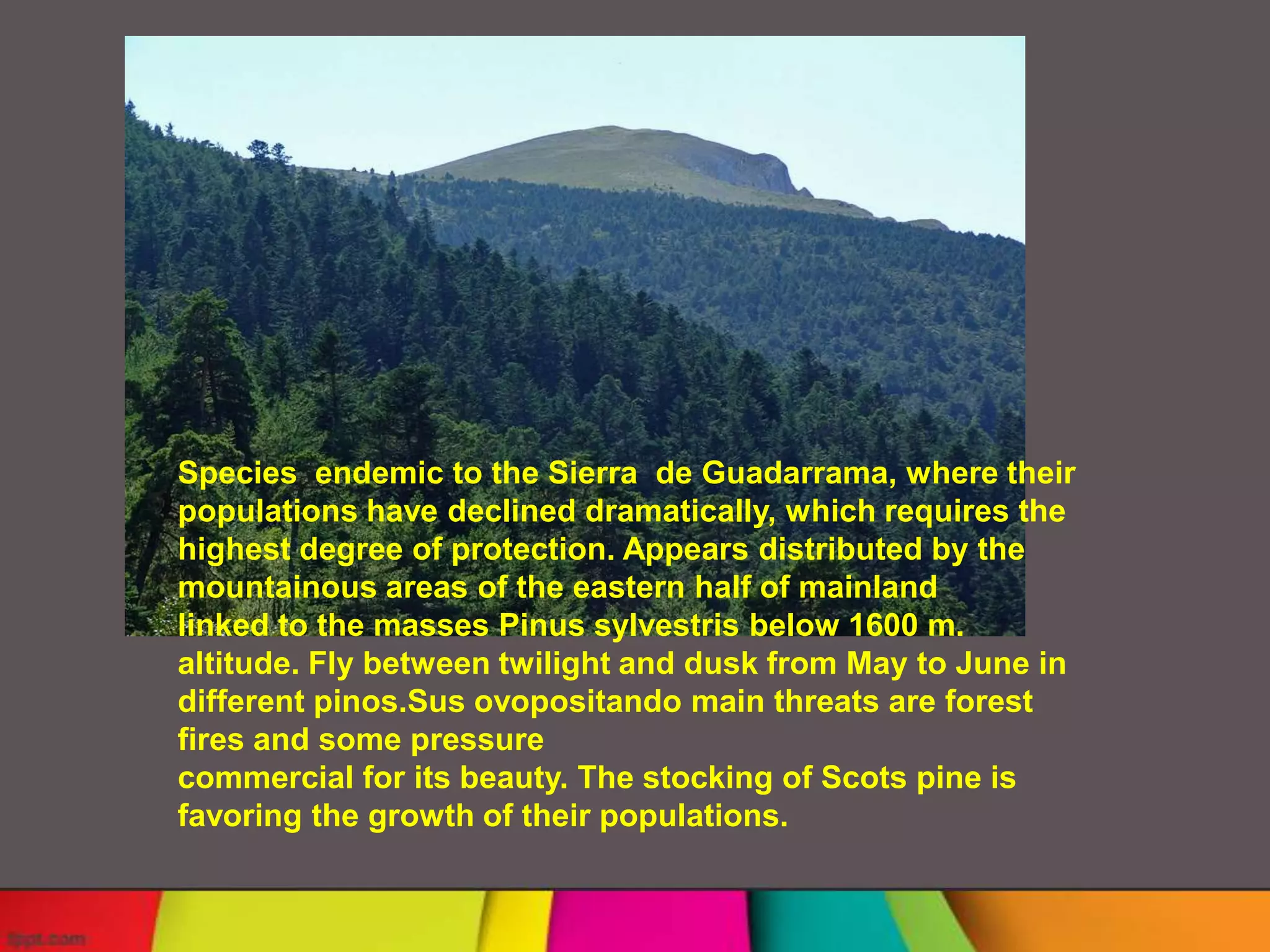
Species endemic to the Sierra de Guadarrama, where their
populations have declined dramatically, which requires the
highest degree of protection. Appears distributed by the
mountainous areas of the eastern half of mainland
linked to the masses Pinus sylvestris below 1600 m.
altitude. Fly between twilight and dusk from May to June in
different pinos.Sus ovopositando main threats are forest
fires and some pressure
commercial for its beauty. The stocking of Scots pine is
favoring the growth of their populations.
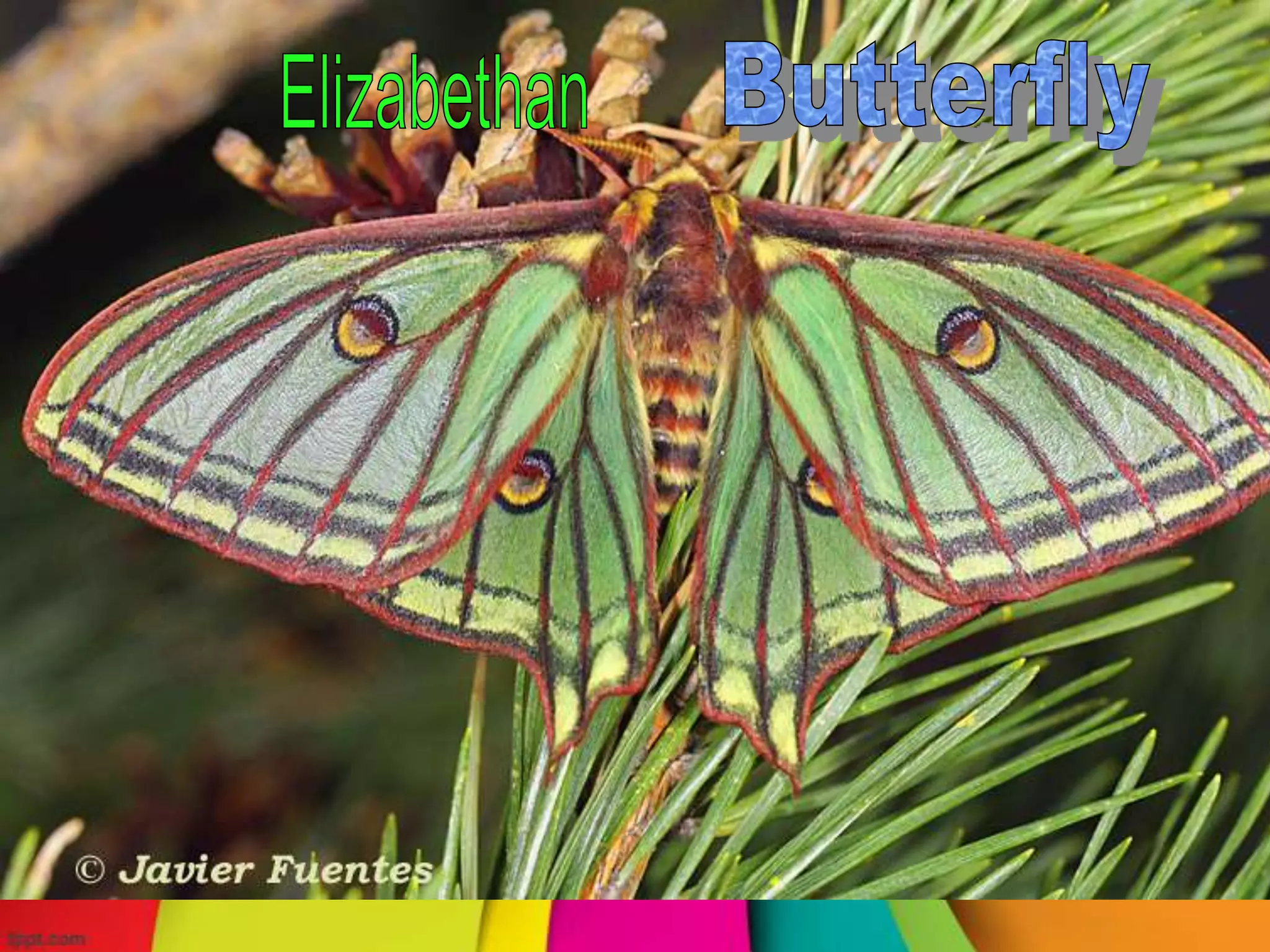
Caterpillar reaches 60 mm.
long, brownish gray and green
young then, with a fairly broad
dorsal line of orange ocher
dotted with white, and some
scattered white hairs. The
chrysalis, about 35 mm long, is
protected by a strong brown
cocoon under leaves or moss
from the stones.
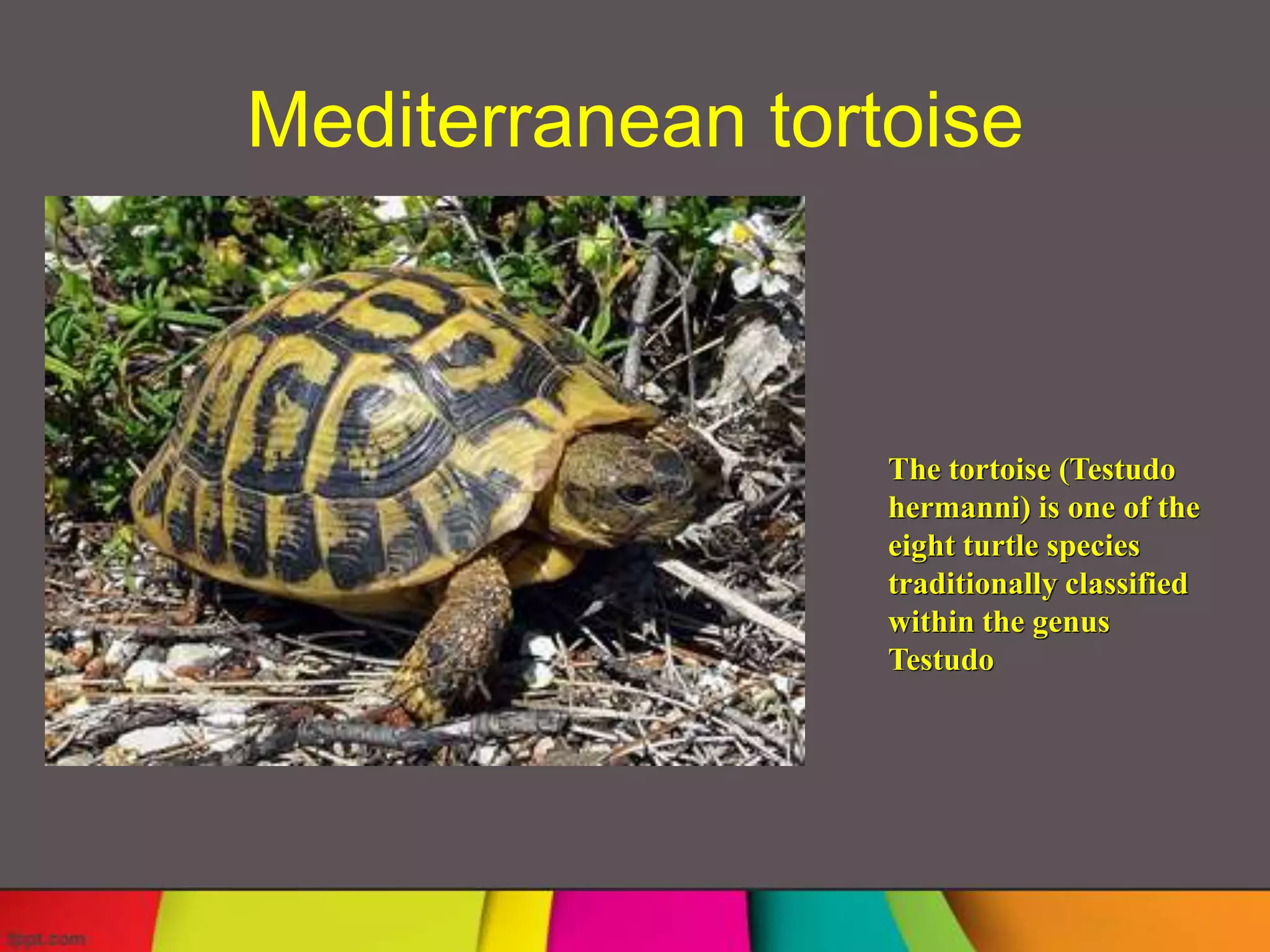
Mediterranean tortoise


                  The tortoise (Testudo
                  hermanni) is one of the
                  eight turtle species
                  traditionally classified
                  within the genus
                  Testudo
Habitat
The turtles prefer areas of low slope steppe
vegetation, bushes and shrubs of small size,
typical of Mediterranean vegetation.

           They can live
           over 80 years.
                                          They are mostly herbivorous reptiles. The
                                          wild live in a habitat that is characterized by
                                          long periods of drought that forces them to
                                          feed on dried herbs. In these cases, they
                                          supplement their diet by eating arthropods
                                          or snails, the latter are an important source
                                          of calcium, which brings the shell.
Samarugo

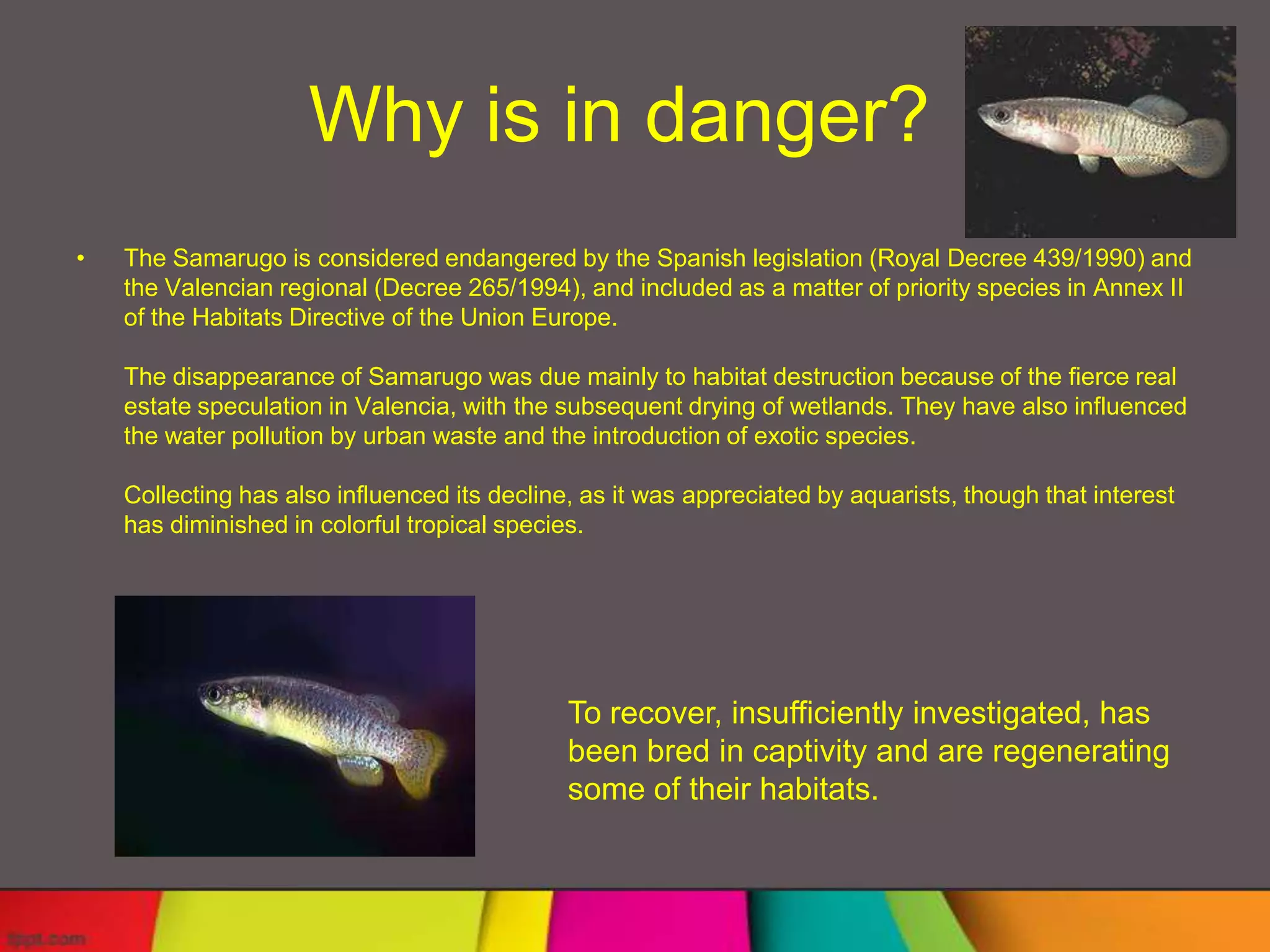
•   The Samarugo (Valencia hispanica) or samaruc (in Valencian) is a fish actinopterigio, euryhaline,
    native to the still water and streams in the area of the Mediterranean coast. It is one of the three
    species that are native ciprinodontiformes the Iberian Peninsula, together with (Aphanius iberus)
    and Salinete (Aphanius baeticus).
    Hábitat
•   We found in marshes and fresh water springs in the southern part of Europe, especially in
    Valencia, having disappeared from other areas. It is threatened by habitat destruction, to the
    extent that it has been argued that only he could be found in three areas, small streams of water
    very clean, but has now been given enough repopulation through conservation actions
    undertaken, with which have recovered ranges.
    He felt like a piece of aquarium, but today the regulation and the difficulty of their care they do
    funny that way.
•   It is a small fish that barely reaches 8 cm. It is characterized by a mouth with teeth jaw with a
    single tip, arranged in several rows, and a color between brown and yellow (males also have the
    edges of the fins orange).
Why is in danger?
•   The Samarugo is considered endangered by the Spanish legislation (Royal Decree 439/1990) and
    the Valencian regional (Decree 265/1994), and included as a matter of priority species in Annex II
    of the Habitats Directive of the Union Europe.

    The disappearance of Samarugo was due mainly to habitat destruction because of the fierce real
    estate speculation in Valencia, with the subsequent drying of wetlands. They have also influenced
    the water pollution by urban waste and the introduction of exotic species.

    Collecting has also influenced its decline, as it was appreciated by aquarists, though that interest
    has diminished in colorful tropical species.


                                              To recover, insufficiently investigated, has
                                              been bred in captivity and are regenerating
                                              some of their habitats.
Iberian wolf
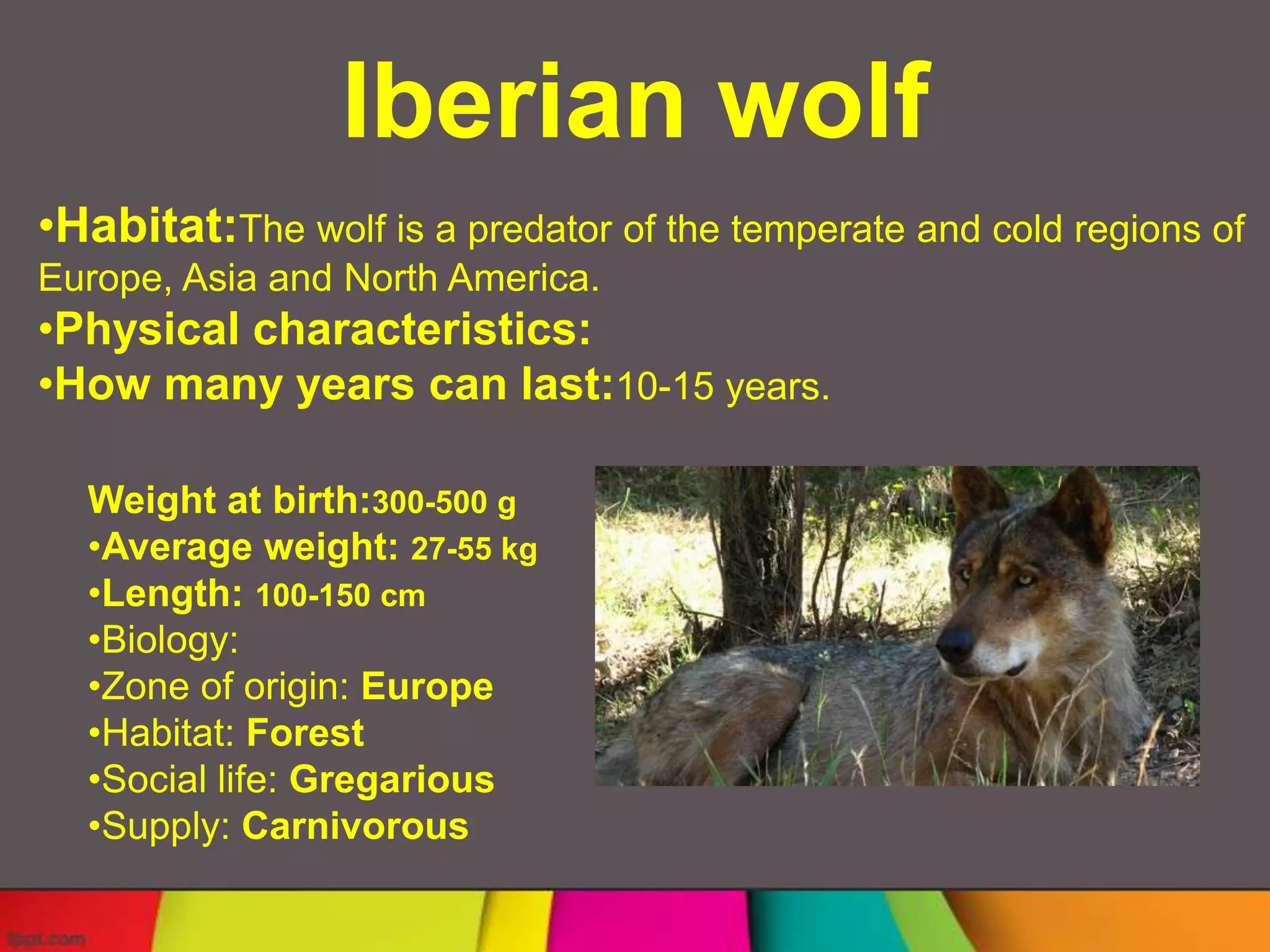
•Habitat:The wolf is a predator of the temperate and cold regions of
Europe, Asia and North America.
•Physical characteristics:
•How many years can last:10-15 years.

  Weight at birth:300-500 g
  •Average weight: 27-55 kg
  •Length: 100-150 cm
  •Biology:
  •Zone of origin: Europe
  •Habitat: Forest
  •Social life: Gregarious
  •Supply: Carnivorous
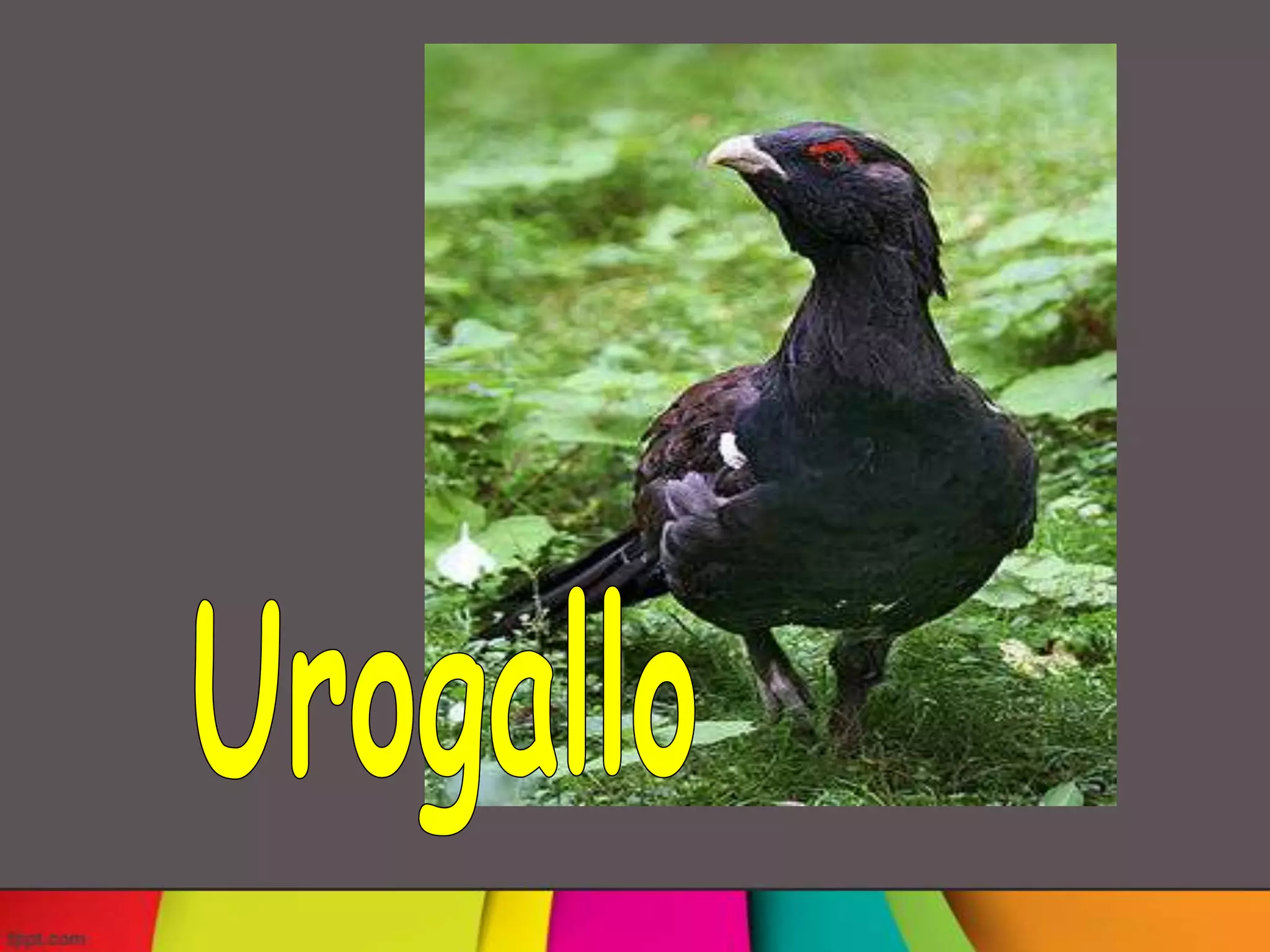
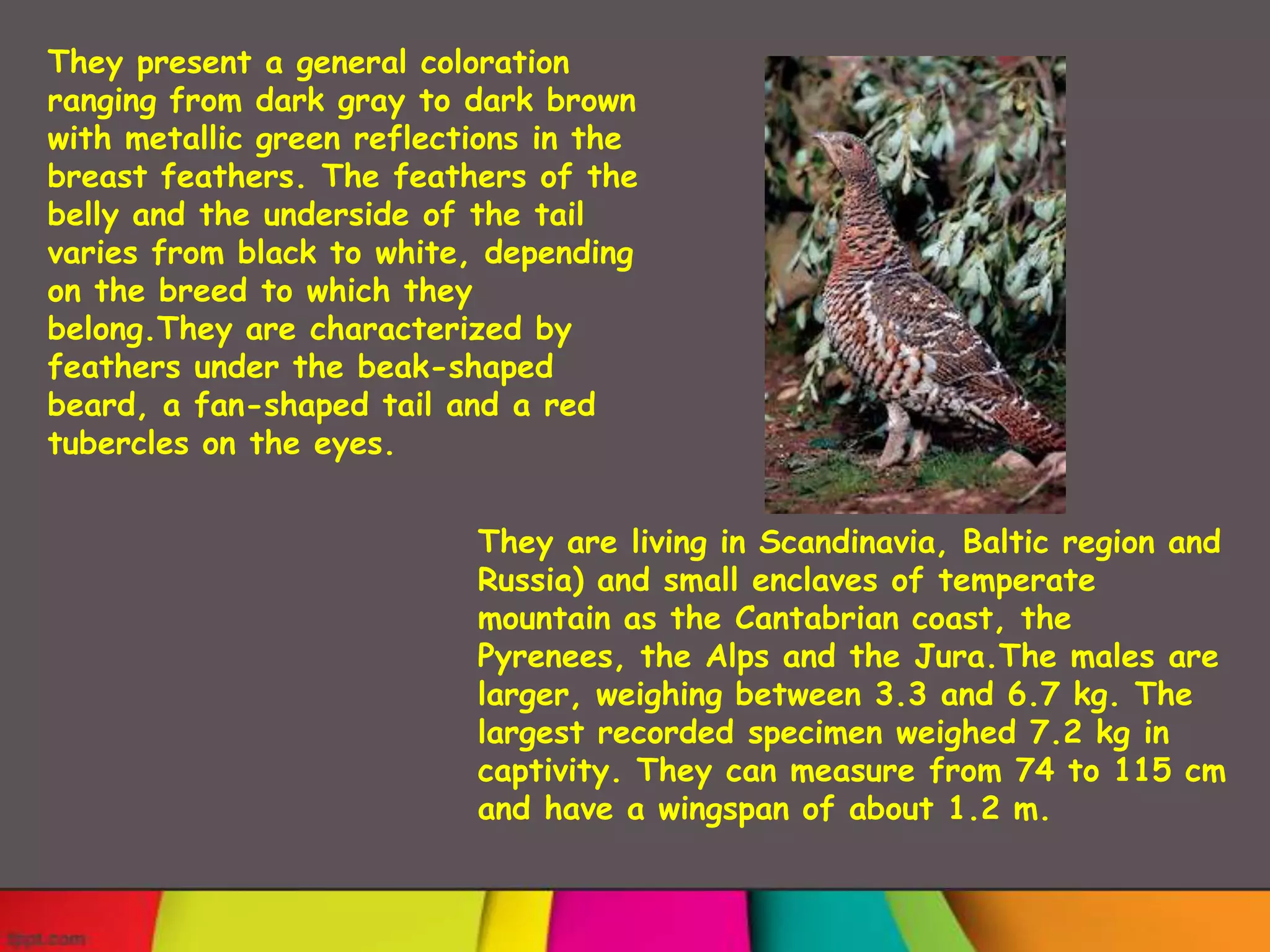
They present a general coloration
ranging from dark gray to dark brown
with metallic green reflections in the
breast feathers. The feathers of the
belly and the underside of the tail
varies from black to white, depending
on the breed to which they
belong.They are characterized by
feathers under the beak-shaped
beard, a fan-shaped tail and a red
tubercles on the eyes.


                           They are living in Scandinavia, Baltic region and
                           Russia) and small enclaves of temperate
                           mountain as the Cantabrian coast, the
                           Pyrenees, the Alps and the Jura.The males are
                           larger, weighing between 3.3 and 6.7 kg. The
                           largest recorded specimen weighed 7.2 kg in
                           captivity. They can measure from 74 to 115 cm
                           and have a wingspan of about 1.2 m.
Common red squirrel
         Its body measures between 20 and 30 cm and its tail
         between 15 and 25 cm. Weighs 250 to 340 g. Its coat is
         reddish. When winter comes are tufts of hair on the
         ears. In its front paws have four fingers or hands while
         the later has five


                     It is normal inhabitant of the coniferous
                     forests and is also present in other wooded
                     land. It is active during the day searching
                     for and consuming fruits, seeds, bark and
                     even insects, eggs and poultry. Does not
                     hibernate but remains active by consuming
                     what has been stored in different cavities
                     of trees and rocks. It operates in the trees
                     but does not hesitate to get them off to
                     collect food. Also anything with ease
Normally lives in the shady areas of coniferous forests, although it can
be found in deciduous forests, and is most common in areas of low
mountain at altitude, preferring young, closed forests.
The nests are spherical, with an approximate size of 22 cm., And have
2 access holes to facilitate the escape, one more than another and can
be plugged from the inside. They are usually placed between tree
branches and its interior is lined with moss, leaves, twigs, straw or
lichens.
It adapts to life from sea level to 2,000 meters.
Its distribution in the Iberian Peninsula is high
Eat all kinds of tree seeds, gnaws the cone
scales to reach the nuts, will also feed on
shoots, buds, roots, mushrooms, hazelnuts
, walnuts, acorns, ayucos, berries, lichens,
mistletoe, and some bird eggs small
size, and even in times of scarcity, it is
worth invertebrates.

It is an arboreal species, which falls to the
ground only for feeding, moving from one
tree to another more distant or drinking.
Giant lizard of Canary Island
Gallotia simony is a species of lacertid, that can be found on the
island of el hierro one of the Cannary Island. The species was
oonce present trought out much of the island and on the small
offshore Roque Chico De Salmor, but is not confined to a fed
small areas of cliff whih sparse vegetacion
About two feet O,6m long the
                                             Hierro gigant lizard is a ticket
                                             reptile with a broad head.Adults
                                             are dark grey to bround in colour
                                             with to rows of pale orange
                                             patches running along its sides


Té hierro gigant lizard is omnivorius. It eats
plants notably verode and lavandula
abrotanoides as well as insect. Mating
begins is May an the 5 to 13 eggs are laid
from June until the end of Agust .Their
eggs hatch after 61 days.
Canary Shrew
                                              Located in the Canary Islands, it is
                                              presents on the islands of
                                              Lanzarote, Mtña.Clara, Fuerteventura and
                                              Lobos.
                                            This species is on the other of 9 July 1998
                                            by which certain species are included in
                                            the National Cataloge of Threatened
                                            Species.

    Its length of 6-7.5 cm.It is similar to the
                     mouse.
It is distingished by the pointed snout and
have 5 fingers on the frot legs. Make their
nests under stones, dry lining whith
begetation. They stand one or two young
blind and no hair
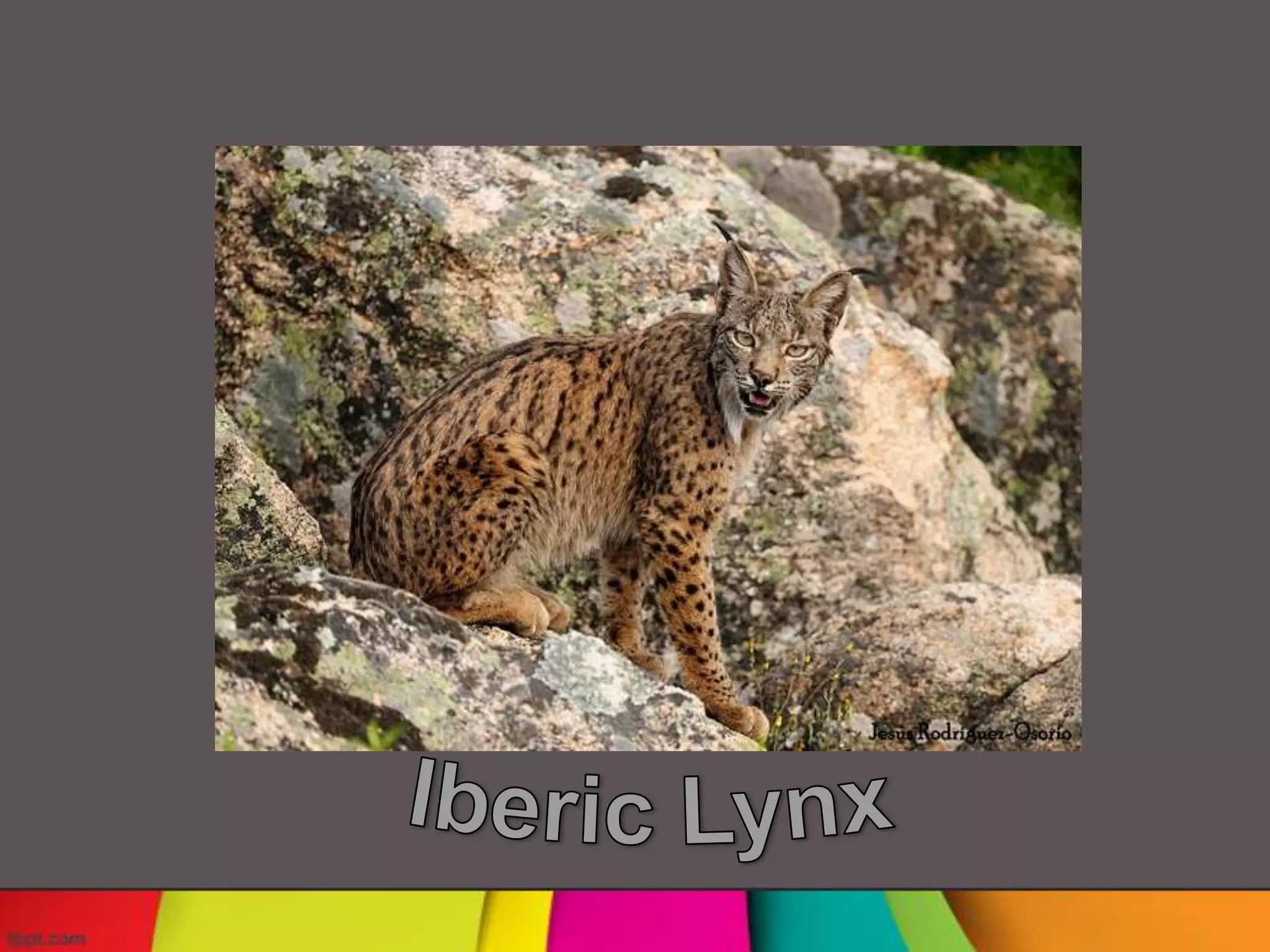
The lynx is is a carnivorous mammal that
lives exclusively in the northern
hemisphere in Eurasia and North America,
four species are known, they are
characterized according to the average
size, strong legs, long ears, short tail and
body more or less mottled.


    The coat has different
    colors depending on the
    species.
    The four species
    have spots and
    stripes whose
    density varies
    with individuals. Usually,
    animals are more intensely
     spotted living further
    south.
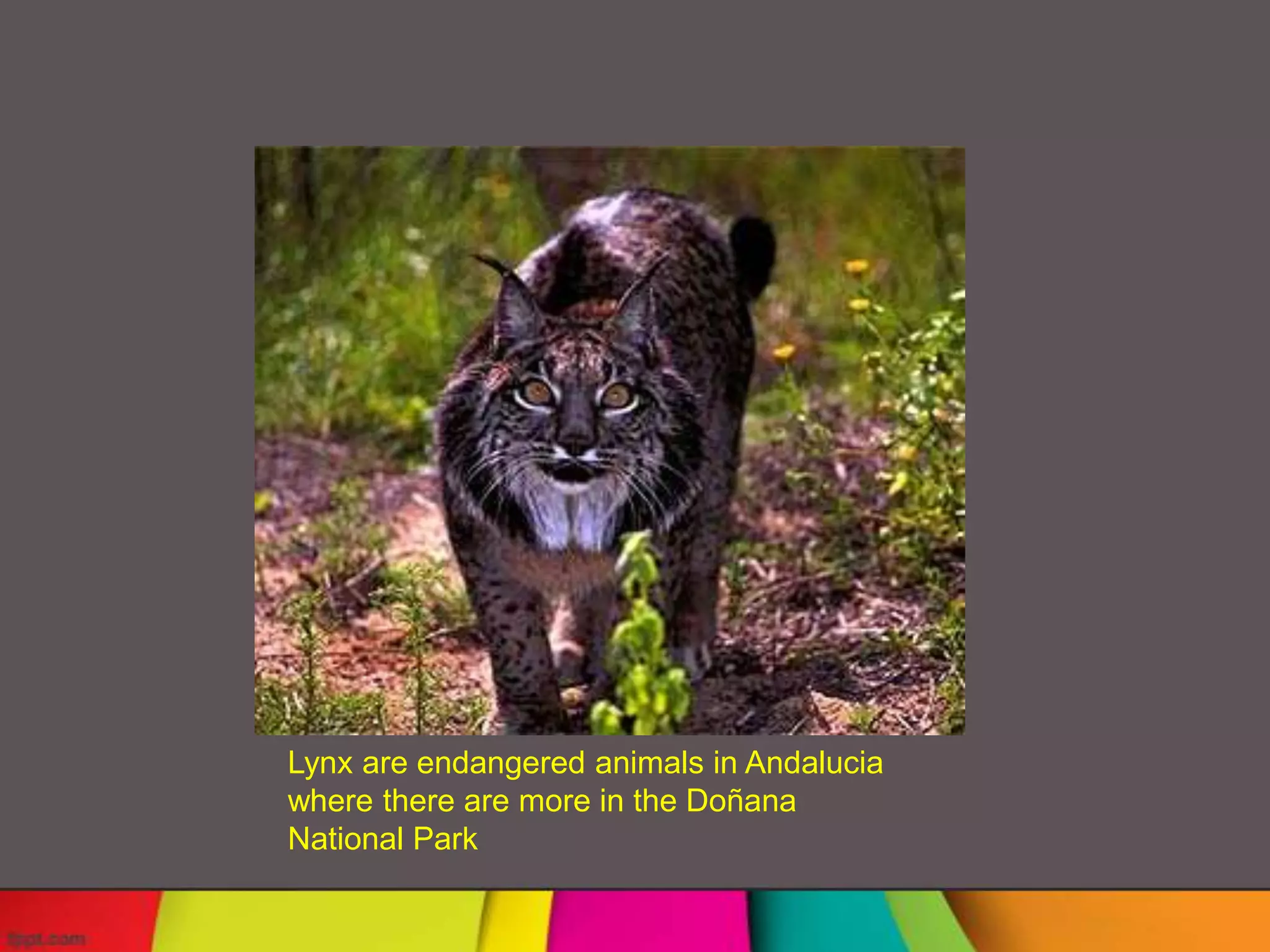
Lynx are endangered animals in Andalucia
where there are more in the Doñana
National Park
The Black hawk
Live: Inhabits savannas and forests.
Eat : parrots and birds of the size of
those who hunt doves in flight.
Babies who may have are:The female
lays 1 to 3 eggs incubate for 30 days.
Its scientific name is: Crax fasciolata


                                     As is: Head and neck black, white throat
                                     and chin. Eyes dark brown, bare eye
                                     ring, cinnamon chest, lower chest black
                                     barred with cinnamon, dark rufous
                                     below. Black dorsal tail like having 3 or 4
                                     white bands, yellow legs.
                                     ●Why is endangered: is in danger of

                                     extinction because people put poison
                                     and traps that eat the rabbits.
MALVASÍA CARIBLANCA
Its preferred Habitat are the gaps of freshwater or brackish
(generally of less than 2 meters deep), with wide belt of
vegetation surrounding and vegetation.

Su hábitat preferido son las lagunas de agua dulce o salobre
(generalmente de menos de 2 metros de profundidad), con
ancho cinturón de vegetación perilagunar y vegetación
semisumergida.
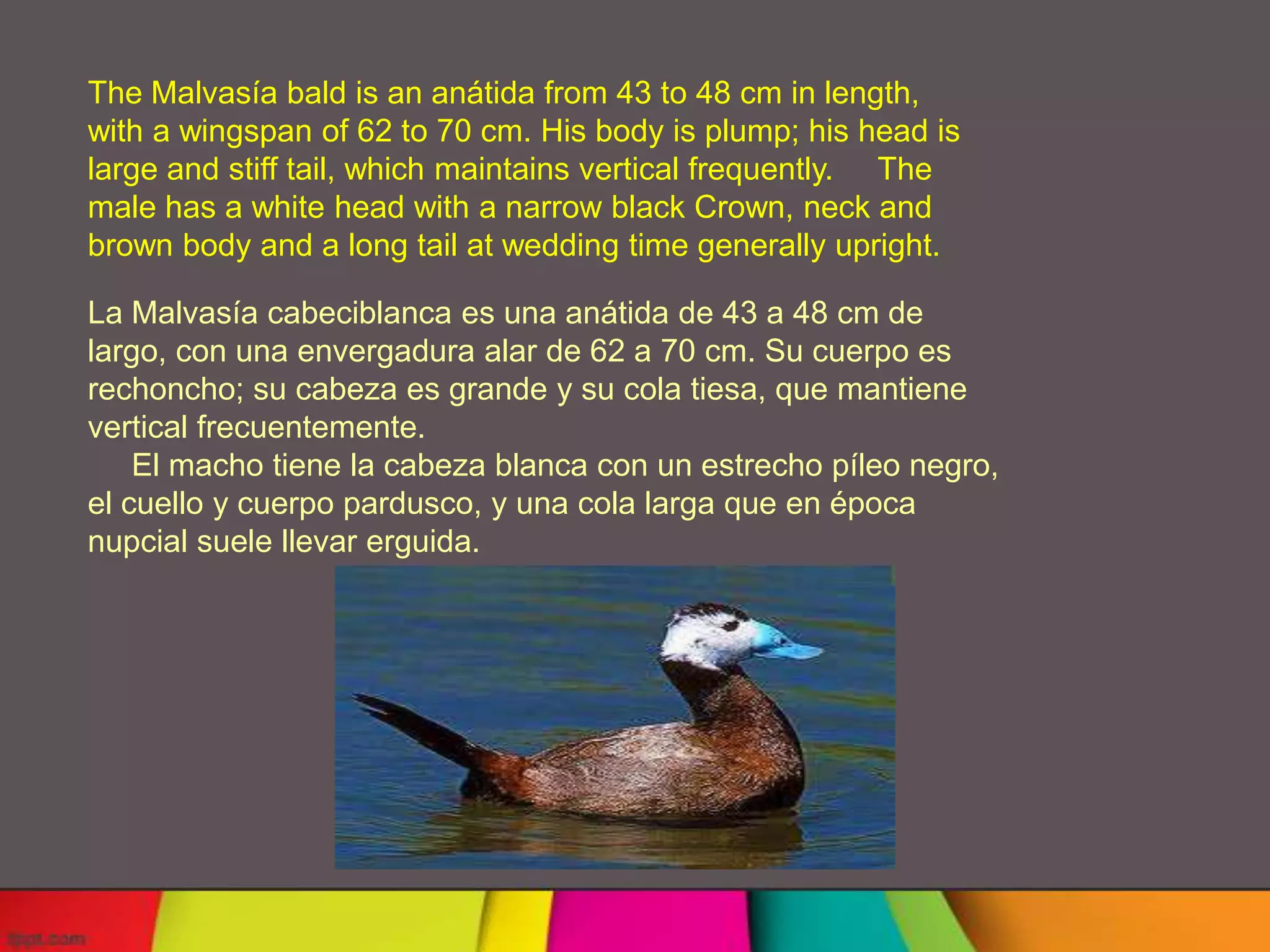
The Malvasía bald is an anátida from 43 to 48 cm in length,
with a wingspan of 62 to 70 cm. His body is plump; his head is
large and stiff tail, which maintains vertical frequently. The
male has a white head with a narrow black Crown, neck and
brown body and a long tail at wedding time generally upright.

La Malvasía cabeciblanca es una anátida de 43 a 48 cm de
largo, con una envergadura alar de 62 a 70 cm. Su cuerpo es
rechoncho; su cabeza es grande y su cola tiesa, que mantiene
vertical frecuentemente.
    El macho tiene la cabeza blanca con un estrecho píleo negro,
el cuello y cuerpo pardusco, y una cola larga que en época
nupcial suele llevar erguida.
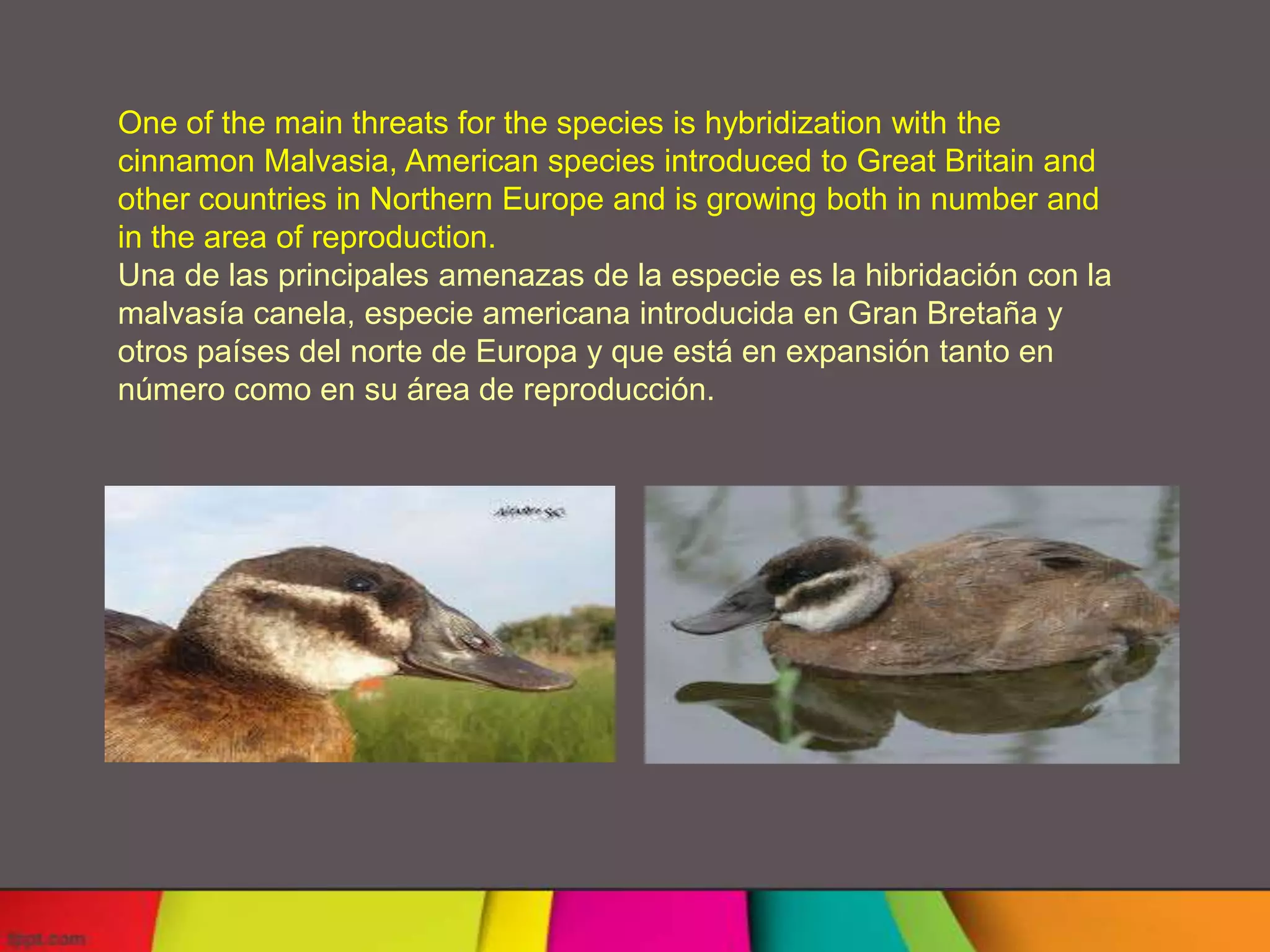
One of the main threats for the species is hybridization with the
cinnamon Malvasia, American species introduced to Great Britain and
other countries in Northern Europe and is growing both in number and
in the area of reproduction.
Una de las principales amenazas de la especie es la hibridación con la
malvasía canela, especie americana introducida en Gran Bretaña y
otros países del norte de Europa y que está en expansión tanto en
número como en su área de reproducción.
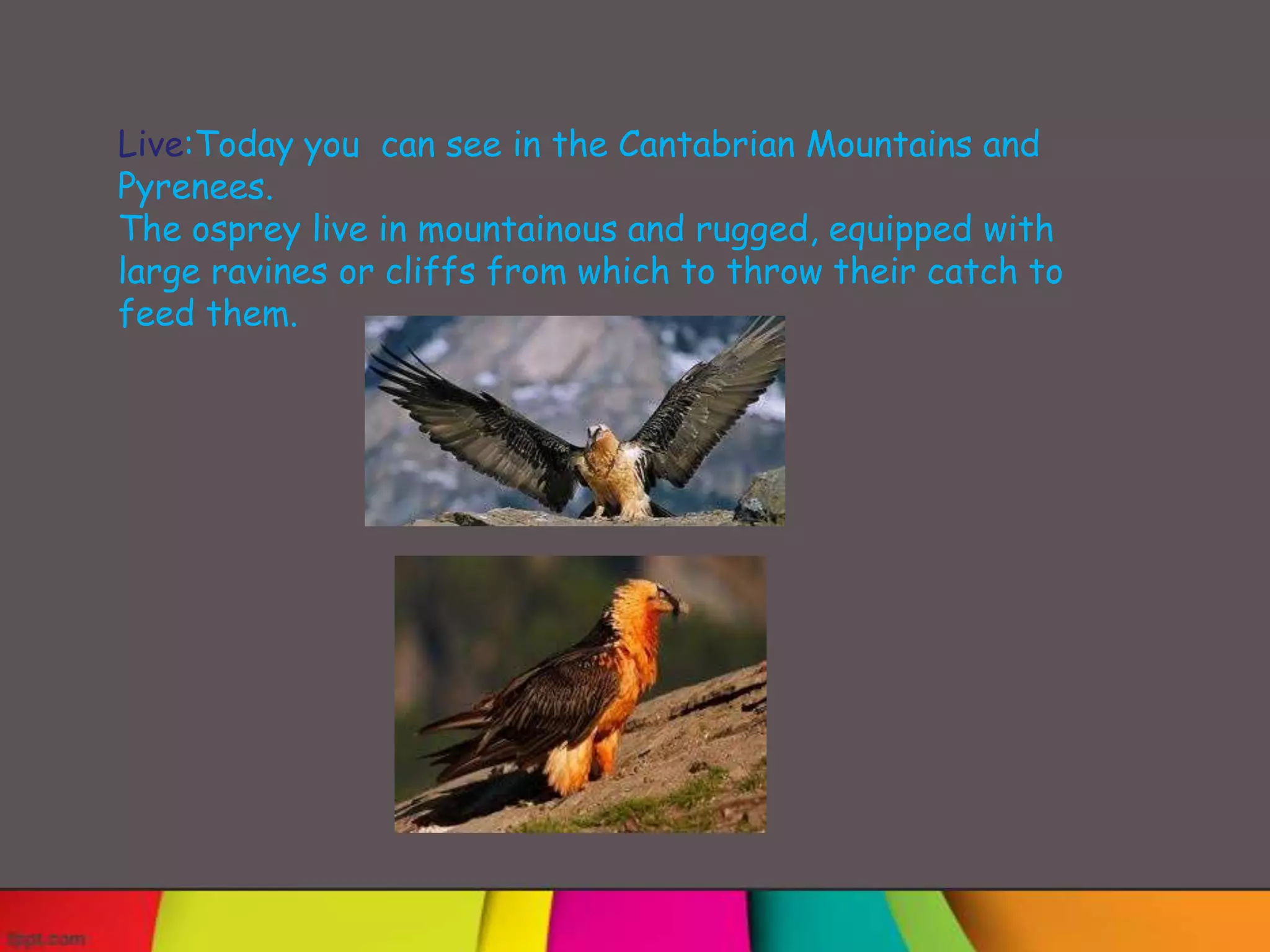
OSPREY
    Name: Gypaetus
    barbatus

    Eat: It's a vulture than
    other birds of prey like.
    It is named for its
    habit of tracing bones
    and shells to great
    heights to release, split
    them against the rocks
    and to eat them for
    food.
Live:Today you can see in the Cantabrian Mountains and
Pyrenees.
The osprey live in mountainous and rugged, equipped with
large ravines or cliffs from which to throw their catch to
feed them.
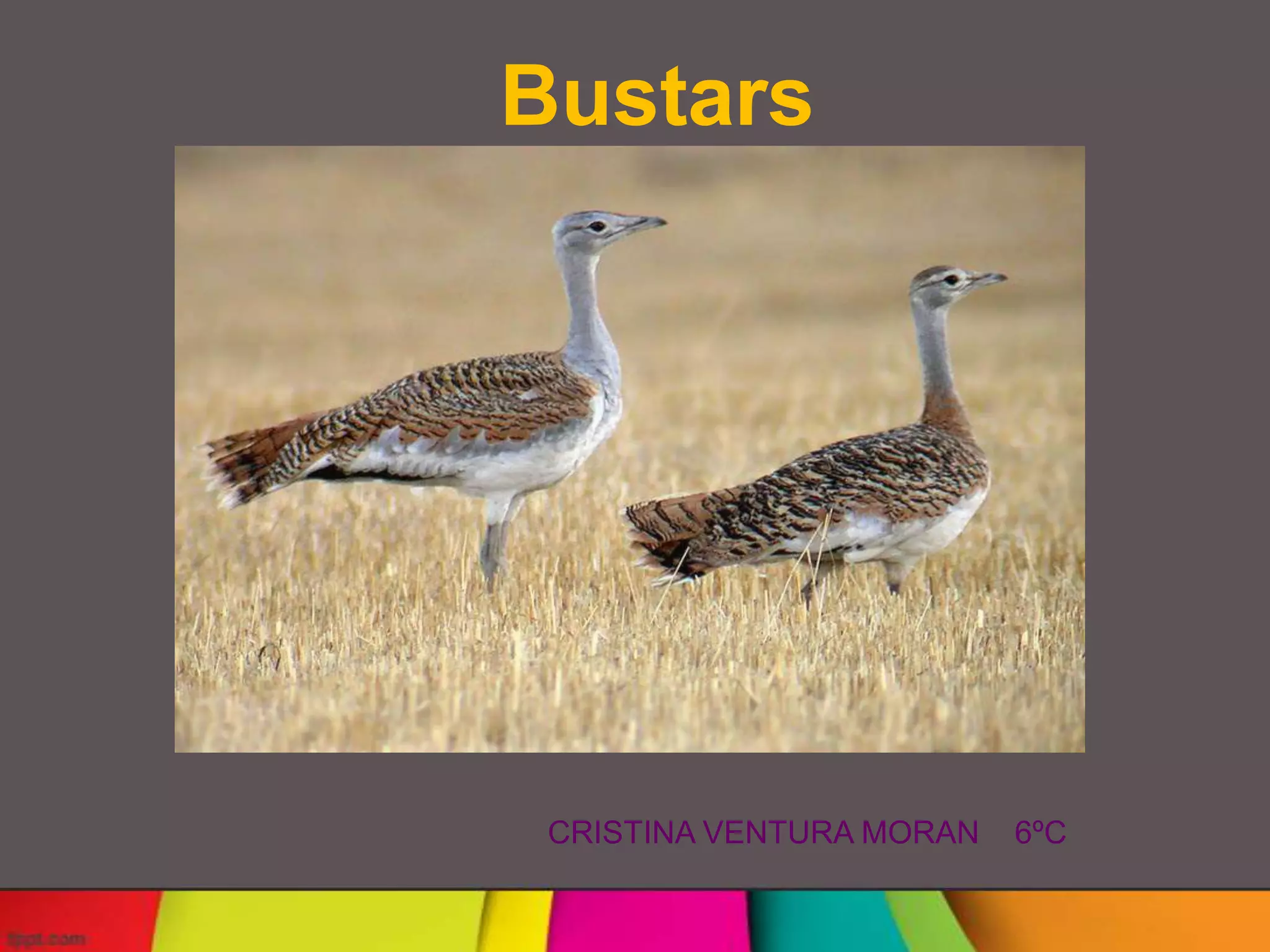
Bustars


 CRISTINA VENTURA MORAN   6ºC
The Bustards (Otididae) are a
 family of birds including the
bustards Gruiformes and little
           bustards.
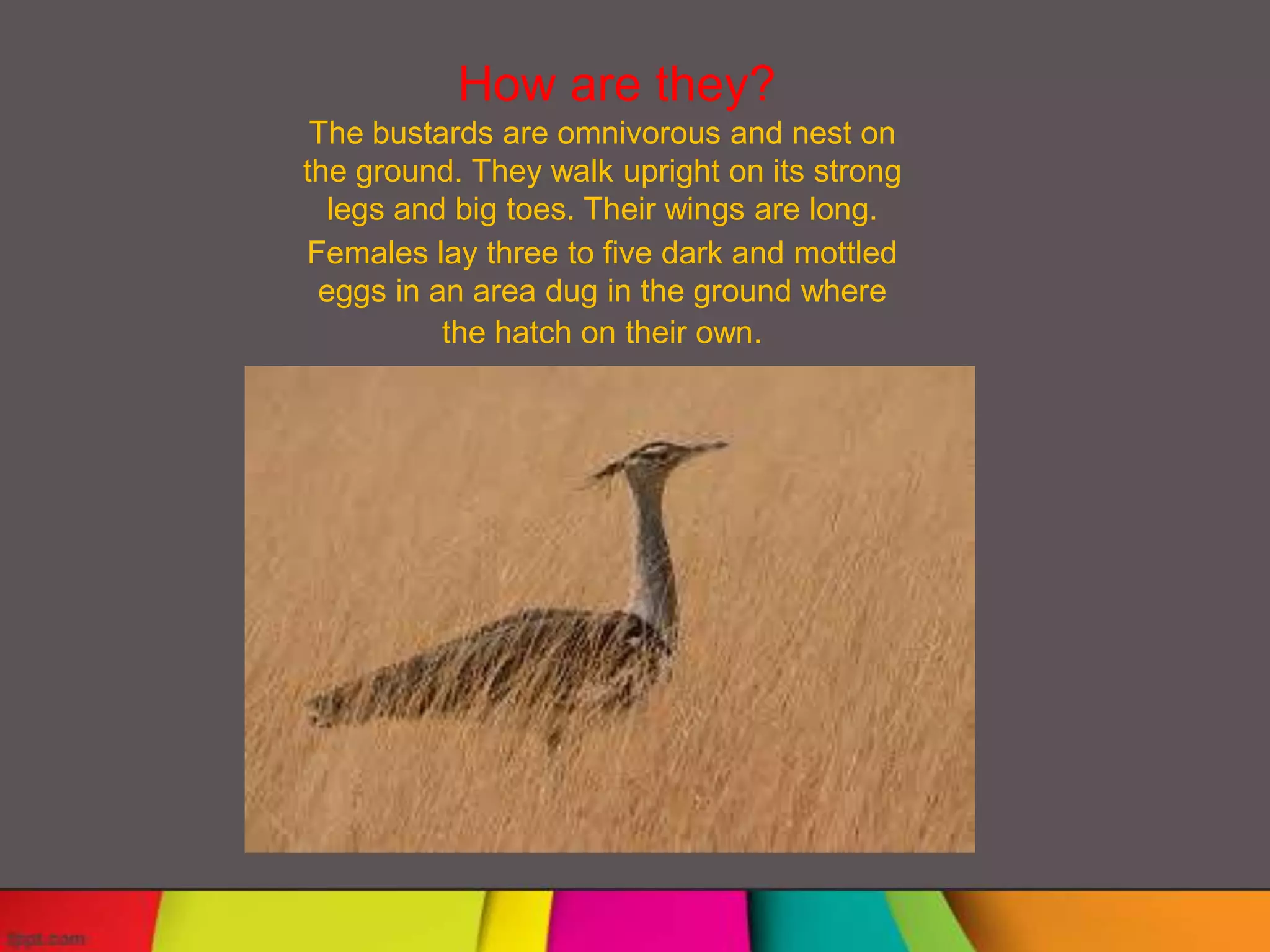
How are they?
 The bustards are omnivorous and nest on
the ground. They walk upright on its strong
  legs and big toes. Their wings are long.
Females lay three to five dark and mottled
 eggs in an area dug in the ground where
          the hatch on their own.
RED TUNA
its large size makes the big fishing boats are attracted to
        the trade by the valuable species SPECIES
CONSUMPTION OF THAT MAKES START DISAPPEAR!
 For example, have been sold and other countries, more
          than 173,000 euros for tuna of 200 kilos.
Where you live?
red tunalive mainly in the pelagic
 ecosystem of the North Atlantic
and adjacent seas, particularly in
    the Mediterranean Sea.
Its scientific name is …
Thunnus albacares

FEATURES...His flesh       is pink and has a capacity to carry oxygen hig
than other fish species.
PHOTOS
MOUNTAIN GOAT
T     he Iberian ibex is a species with strong sexual
dimorphism, like many other cattle. The females are about 1.20
meters long and 60 tall at the withers, weighing between 30 and 45
kilos. It has horns very short and closely resembles a domestic
goat, domestic goat but would have its origin in the bezoar goat
La cabra montesa es una
especie con fuerte
dimorfismo sexual, al igual
que muchos otros
bóvidos. Las hembras
miden unos 1,20 metros
de largo y otros 60 de
altura en la cruz, pesando
entre 30 y 45 kilos. Tiene
cuernos bastante cortos y
se parece bastante a una
cabra doméstica, aunque
la cabra doméstica tendría
su origen en la cabra
bezoar
Made by the students and teachers of
         Luis Cernuda School
        Castilleja de la Cuesta
             Sevilla- Spain


  This project has been funded with support
       from the European Commission.
This presentation reflects the views only of the
 author, and the Commission cannot be held
 responsible for any use which may be made
     of the information contained there in

Animals in danger all

  • 1.
  • 3.
    Description The salamander isa specie amphibian family urodelo Salamandridae. Adults aged 18 to 25 cm including the tail, with females slightly larger. In exceptional cases may reach 28 or 30 cm. Thick body and short tail, no dorsal or caudal crest. Habitat It is a nocturnal animal, but may be active during the day if the relative humidity is high, on rainy days or foggy, and when the temperature is cool but more than 3 C. By day takes refuge under leaf litter, fallen trees or under rocks. Larvae are found in streams and clean water sources.
  • 5.
    Species endemic tothe Sierra de Guadarrama, where their populations have declined dramatically, which requires the highest degree of protection. Appears distributed by the mountainous areas of the eastern half of mainland linked to the masses Pinus sylvestris below 1600 m. altitude. Fly between twilight and dusk from May to June in different pinos.Sus ovopositando main threats are forest fires and some pressure commercial for its beauty. The stocking of Scots pine is favoring the growth of their populations.
  • 6.
    Caterpillar reaches 60mm. long, brownish gray and green young then, with a fairly broad dorsal line of orange ocher dotted with white, and some scattered white hairs. The chrysalis, about 35 mm long, is protected by a strong brown cocoon under leaves or moss from the stones.
  • 7.
    Mediterranean tortoise The tortoise (Testudo hermanni) is one of the eight turtle species traditionally classified within the genus Testudo
  • 8.
    Habitat The turtles preferareas of low slope steppe vegetation, bushes and shrubs of small size, typical of Mediterranean vegetation. They can live over 80 years. They are mostly herbivorous reptiles. The wild live in a habitat that is characterized by long periods of drought that forces them to feed on dried herbs. In these cases, they supplement their diet by eating arthropods or snails, the latter are an important source of calcium, which brings the shell.
  • 9.
    Samarugo • The Samarugo (Valencia hispanica) or samaruc (in Valencian) is a fish actinopterigio, euryhaline, native to the still water and streams in the area of the Mediterranean coast. It is one of the three species that are native ciprinodontiformes the Iberian Peninsula, together with (Aphanius iberus) and Salinete (Aphanius baeticus). Hábitat • We found in marshes and fresh water springs in the southern part of Europe, especially in Valencia, having disappeared from other areas. It is threatened by habitat destruction, to the extent that it has been argued that only he could be found in three areas, small streams of water very clean, but has now been given enough repopulation through conservation actions undertaken, with which have recovered ranges. He felt like a piece of aquarium, but today the regulation and the difficulty of their care they do funny that way. • It is a small fish that barely reaches 8 cm. It is characterized by a mouth with teeth jaw with a single tip, arranged in several rows, and a color between brown and yellow (males also have the edges of the fins orange).
  • 10.
    Why is indanger? • The Samarugo is considered endangered by the Spanish legislation (Royal Decree 439/1990) and the Valencian regional (Decree 265/1994), and included as a matter of priority species in Annex II of the Habitats Directive of the Union Europe. The disappearance of Samarugo was due mainly to habitat destruction because of the fierce real estate speculation in Valencia, with the subsequent drying of wetlands. They have also influenced the water pollution by urban waste and the introduction of exotic species. Collecting has also influenced its decline, as it was appreciated by aquarists, though that interest has diminished in colorful tropical species. To recover, insufficiently investigated, has been bred in captivity and are regenerating some of their habitats.
  • 11.
    Iberian wolf •Habitat:The wolfis a predator of the temperate and cold regions of Europe, Asia and North America. •Physical characteristics: •How many years can last:10-15 years. Weight at birth:300-500 g •Average weight: 27-55 kg •Length: 100-150 cm •Biology: •Zone of origin: Europe •Habitat: Forest •Social life: Gregarious •Supply: Carnivorous
  • 13.
    They present ageneral coloration ranging from dark gray to dark brown with metallic green reflections in the breast feathers. The feathers of the belly and the underside of the tail varies from black to white, depending on the breed to which they belong.They are characterized by feathers under the beak-shaped beard, a fan-shaped tail and a red tubercles on the eyes. They are living in Scandinavia, Baltic region and Russia) and small enclaves of temperate mountain as the Cantabrian coast, the Pyrenees, the Alps and the Jura.The males are larger, weighing between 3.3 and 6.7 kg. The largest recorded specimen weighed 7.2 kg in captivity. They can measure from 74 to 115 cm and have a wingspan of about 1.2 m.
  • 14.
    Common red squirrel Its body measures between 20 and 30 cm and its tail between 15 and 25 cm. Weighs 250 to 340 g. Its coat is reddish. When winter comes are tufts of hair on the ears. In its front paws have four fingers or hands while the later has five It is normal inhabitant of the coniferous forests and is also present in other wooded land. It is active during the day searching for and consuming fruits, seeds, bark and even insects, eggs and poultry. Does not hibernate but remains active by consuming what has been stored in different cavities of trees and rocks. It operates in the trees but does not hesitate to get them off to collect food. Also anything with ease
  • 15.
    Normally lives inthe shady areas of coniferous forests, although it can be found in deciduous forests, and is most common in areas of low mountain at altitude, preferring young, closed forests. The nests are spherical, with an approximate size of 22 cm., And have 2 access holes to facilitate the escape, one more than another and can be plugged from the inside. They are usually placed between tree branches and its interior is lined with moss, leaves, twigs, straw or lichens. It adapts to life from sea level to 2,000 meters. Its distribution in the Iberian Peninsula is high
  • 16.
    Eat all kindsof tree seeds, gnaws the cone scales to reach the nuts, will also feed on shoots, buds, roots, mushrooms, hazelnuts , walnuts, acorns, ayucos, berries, lichens, mistletoe, and some bird eggs small size, and even in times of scarcity, it is worth invertebrates. It is an arboreal species, which falls to the ground only for feeding, moving from one tree to another more distant or drinking.
  • 17.
    Giant lizard ofCanary Island Gallotia simony is a species of lacertid, that can be found on the island of el hierro one of the Cannary Island. The species was oonce present trought out much of the island and on the small offshore Roque Chico De Salmor, but is not confined to a fed small areas of cliff whih sparse vegetacion
  • 18.
    About two feetO,6m long the Hierro gigant lizard is a ticket reptile with a broad head.Adults are dark grey to bround in colour with to rows of pale orange patches running along its sides Té hierro gigant lizard is omnivorius. It eats plants notably verode and lavandula abrotanoides as well as insect. Mating begins is May an the 5 to 13 eggs are laid from June until the end of Agust .Their eggs hatch after 61 days.
  • 19.
    Canary Shrew Located in the Canary Islands, it is presents on the islands of Lanzarote, Mtña.Clara, Fuerteventura and Lobos. This species is on the other of 9 July 1998 by which certain species are included in the National Cataloge of Threatened Species. Its length of 6-7.5 cm.It is similar to the mouse. It is distingished by the pointed snout and have 5 fingers on the frot legs. Make their nests under stones, dry lining whith begetation. They stand one or two young blind and no hair
  • 21.
    The lynx isis a carnivorous mammal that lives exclusively in the northern hemisphere in Eurasia and North America, four species are known, they are characterized according to the average size, strong legs, long ears, short tail and body more or less mottled. The coat has different colors depending on the species. The four species have spots and stripes whose density varies with individuals. Usually, animals are more intensely spotted living further south.
  • 22.
    Lynx are endangeredanimals in Andalucia where there are more in the Doñana National Park
  • 23.
    The Black hawk Live:Inhabits savannas and forests. Eat : parrots and birds of the size of those who hunt doves in flight. Babies who may have are:The female lays 1 to 3 eggs incubate for 30 days. Its scientific name is: Crax fasciolata As is: Head and neck black, white throat and chin. Eyes dark brown, bare eye ring, cinnamon chest, lower chest black barred with cinnamon, dark rufous below. Black dorsal tail like having 3 or 4 white bands, yellow legs. ●Why is endangered: is in danger of extinction because people put poison and traps that eat the rabbits.
  • 25.
    MALVASÍA CARIBLANCA Its preferredHabitat are the gaps of freshwater or brackish (generally of less than 2 meters deep), with wide belt of vegetation surrounding and vegetation. Su hábitat preferido son las lagunas de agua dulce o salobre (generalmente de menos de 2 metros de profundidad), con ancho cinturón de vegetación perilagunar y vegetación semisumergida.
  • 26.
    The Malvasía baldis an anátida from 43 to 48 cm in length, with a wingspan of 62 to 70 cm. His body is plump; his head is large and stiff tail, which maintains vertical frequently. The male has a white head with a narrow black Crown, neck and brown body and a long tail at wedding time generally upright. La Malvasía cabeciblanca es una anátida de 43 a 48 cm de largo, con una envergadura alar de 62 a 70 cm. Su cuerpo es rechoncho; su cabeza es grande y su cola tiesa, que mantiene vertical frecuentemente. El macho tiene la cabeza blanca con un estrecho píleo negro, el cuello y cuerpo pardusco, y una cola larga que en época nupcial suele llevar erguida.
  • 27.
    One of themain threats for the species is hybridization with the cinnamon Malvasia, American species introduced to Great Britain and other countries in Northern Europe and is growing both in number and in the area of reproduction. Una de las principales amenazas de la especie es la hibridación con la malvasía canela, especie americana introducida en Gran Bretaña y otros países del norte de Europa y que está en expansión tanto en número como en su área de reproducción.
  • 28.
    OSPREY Name: Gypaetus barbatus Eat: It's a vulture than other birds of prey like. It is named for its habit of tracing bones and shells to great heights to release, split them against the rocks and to eat them for food.
  • 29.
    Live:Today you cansee in the Cantabrian Mountains and Pyrenees. The osprey live in mountainous and rugged, equipped with large ravines or cliffs from which to throw their catch to feed them.
  • 30.
  • 31.
    The Bustards (Otididae)are a family of birds including the bustards Gruiformes and little bustards.
  • 32.
    How are they? The bustards are omnivorous and nest on the ground. They walk upright on its strong legs and big toes. Their wings are long. Females lay three to five dark and mottled eggs in an area dug in the ground where the hatch on their own.
  • 33.
  • 34.
    its large sizemakes the big fishing boats are attracted to the trade by the valuable species SPECIES CONSUMPTION OF THAT MAKES START DISAPPEAR! For example, have been sold and other countries, more than 173,000 euros for tuna of 200 kilos.
  • 35.
    Where you live? redtunalive mainly in the pelagic ecosystem of the North Atlantic and adjacent seas, particularly in the Mediterranean Sea.
  • 36.
    Its scientific nameis … Thunnus albacares FEATURES...His flesh is pink and has a capacity to carry oxygen hig than other fish species.
  • 37.
  • 38.
  • 39.
    T he Iberian ibex is a species with strong sexual dimorphism, like many other cattle. The females are about 1.20 meters long and 60 tall at the withers, weighing between 30 and 45 kilos. It has horns very short and closely resembles a domestic goat, domestic goat but would have its origin in the bezoar goat
  • 40.
    La cabra montesaes una especie con fuerte dimorfismo sexual, al igual que muchos otros bóvidos. Las hembras miden unos 1,20 metros de largo y otros 60 de altura en la cruz, pesando entre 30 y 45 kilos. Tiene cuernos bastante cortos y se parece bastante a una cabra doméstica, aunque la cabra doméstica tendría su origen en la cabra bezoar
  • 41.
    Made by thestudents and teachers of Luis Cernuda School Castilleja de la Cuesta Sevilla- Spain This project has been funded with support from the European Commission. This presentation reflects the views only of the author, and the Commission cannot be held responsible for any use which may be made of the information contained there in