ENDANGERED SPECIES IN CATALONIA IES Rubió i Ors
Endangered Species in Catalonia The Ministry of Environment and Housing of the Generalitat de Catalunya is about to publish a catalogue about the native endangered species in our area. Its main objective is to raise awareness and protect these animals. A total of 84 species will appear under the legal category of endangered while 175 will be classified as vulnerable. The destruction of habitats and the introduction of foreign species, together with climate changes resulting from  global warming are some of the risks faced by these species.
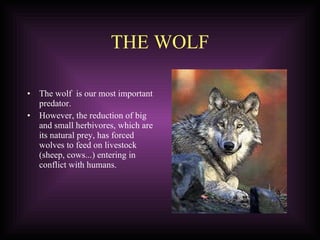
THE WOLF The wolf  is our most important predator.  However, the reduction of big and small herbivores, which are its natural prey, has forced wolves to feed on livestock (sheep, cows...) entering in conflict with humans.
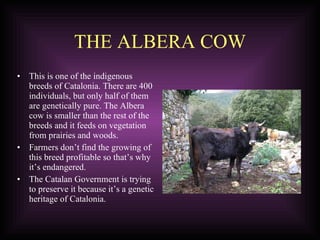
THE ALBERA COW This is one of the indigenous breeds of Catalonia. There are 400 individuals, but only half of them are genetically pure. The Albera cow is smaller than the rest of the breeds and it feeds on vegetation from prairies and woods. Farmers don’t find the growing of  this breed profitable so that’s why it’s endangered. The Catalan Government is trying to preserve it because it’s a genetic heritage of Catalonia.
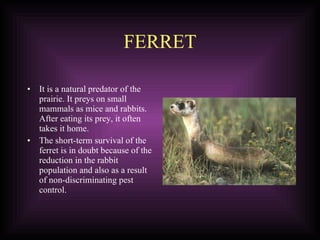
FERRET It is a natural predator of the prairie. It preys on small mammals as mice and rabbits. After eating its prey, it often takes it home.  The short-term survival of the ferret is in doubt because of the reduction in the rabbit population and also as a result of non-discriminating pest control.
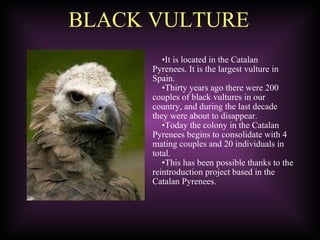
BLACK VULTURE It is located in the Catalan Pyrenees. It is the largest vulture in Spain.  Thirty years ago there were 200 couples of black vultures in our country, and during the last decade they were about to disappear.  Today the colony in the Catalan Pyrenees begins to consolidate with 4  mating couples and 20 individuals in total. This has been possible thanks to the reintroduction project based in the Catalan Pyrenees.
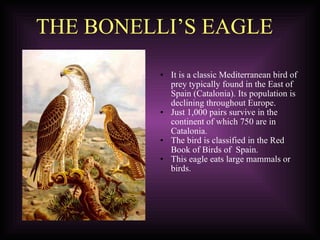
THE BONELLI’S EAGLE It is a classic Mediterranean bird of prey typically found in the East of Spain (Catalonia). Its population is declining throughout Europe. Just 1,000 pairs survive in the continent of which 750 are in Catalonia. The bird is classified in the Red Book of Birds of  Spain. This eagle eats large mammals or birds.
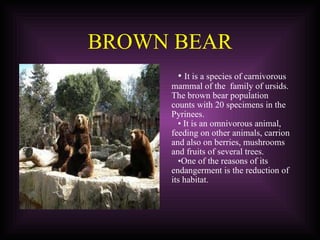
BROWN BEAR It is a species of carnivorous mammal of the  family of ursids. The brown bear population counts with 20 specimens in the Pyrinees.   It is an omnivorous animal, feeding on other animals, carrion and also on berries, mushrooms and fruits of several trees.  One of the reasons of its endangerment is the reduction of its habitat.
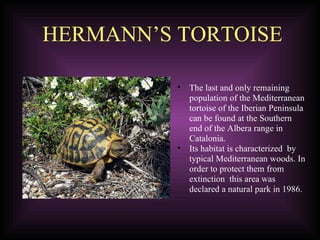
  HERMANN’S TORTOISE The last and only remaining population of the Mediterranean tortoise of the Iberian Peninsula can be found at the Southern end of the Albera range in Catalonia. Its habitat is characterized  by typical Mediterranean woods. In order to protect them from extinction  this area was declared a natural park in 1986.
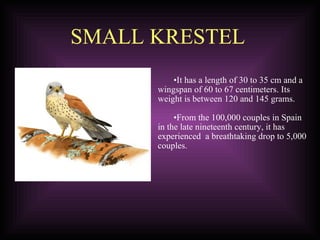
  SMALL KRESTEL  It has a length of 30 to 35 cm and a wingspan of 60 to 67 centimeters. Its weight is between 120 and 145 grams. From the 100,000 couples in Spain in the late nineteenth century, it has experienced  a breathtaking drop to 5,000 couples.
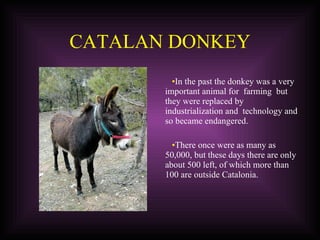
CATALAN DONKEY In the past the donkey was a very important animal for  farming  but  they were replaced by  industrialization and  technology and  so became endangered. There once were as many as 50,000, but these days there are only about 500 left, of which more than 100 are outside Catalonia.
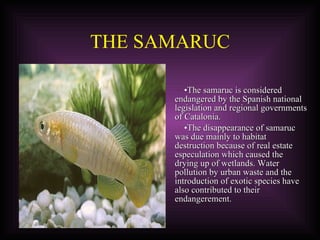
THE SAMARUC The samaruc is considered endangered by the Spanish national legislation and regional governments of Catalonia. The disappearance of samaruc was due mainly to habitat destruction because of real estate especulation which caused the drying up of wetlands. Water pollution by urban waste and the introduction of exotic species have also contributed to their endangerement.

Animals 2

  • 1.
    ENDANGERED SPECIES INCATALONIA IES Rubió i Ors
  • 2.
    Endangered Species inCatalonia The Ministry of Environment and Housing of the Generalitat de Catalunya is about to publish a catalogue about the native endangered species in our area. Its main objective is to raise awareness and protect these animals. A total of 84 species will appear under the legal category of endangered while 175 will be classified as vulnerable. The destruction of habitats and the introduction of foreign species, together with climate changes resulting from global warming are some of the risks faced by these species.
  • 3.
    THE WOLF Thewolf is our most important predator. However, the reduction of big and small herbivores, which are its natural prey, has forced wolves to feed on livestock (sheep, cows...) entering in conflict with humans.
  • 4.
    THE ALBERA COWThis is one of the indigenous breeds of Catalonia. There are 400 individuals, but only half of them are genetically pure. The Albera cow is smaller than the rest of the breeds and it feeds on vegetation from prairies and woods. Farmers don’t find the growing of this breed profitable so that’s why it’s endangered. The Catalan Government is trying to preserve it because it’s a genetic heritage of Catalonia.
  • 5.
    FERRET It isa natural predator of the prairie. It preys on small mammals as mice and rabbits. After eating its prey, it often takes it home. The short-term survival of the ferret is in doubt because of the reduction in the rabbit population and also as a result of non-discriminating pest control.
  • 6.
    BLACK VULTURE Itis located in the Catalan Pyrenees. It is the largest vulture in Spain. Thirty years ago there were 200 couples of black vultures in our country, and during the last decade they were about to disappear. Today the colony in the Catalan Pyrenees begins to consolidate with 4 mating couples and 20 individuals in total. This has been possible thanks to the reintroduction project based in the Catalan Pyrenees.
  • 7.
    THE BONELLI’S EAGLEIt is a classic Mediterranean bird of prey typically found in the East of Spain (Catalonia). Its population is declining throughout Europe. Just 1,000 pairs survive in the continent of which 750 are in Catalonia. The bird is classified in the Red Book of Birds of Spain. This eagle eats large mammals or birds.
  • 8.
    BROWN BEAR Itis a species of carnivorous mammal of the  family of ursids. The brown bear population counts with 20 specimens in the Pyrinees.   It is an omnivorous animal, feeding on other animals, carrion and also on berries, mushrooms and fruits of several trees. One of the reasons of its endangerment is the reduction of its habitat.
  • 9.
      HERMANN’S TORTOISEThe last and only remaining population of the Mediterranean tortoise of the Iberian Peninsula can be found at the Southern end of the Albera range in Catalonia. Its habitat is characterized by typical Mediterranean woods. In order to protect them from extinction this area was declared a natural park in 1986.
  • 10.
      SMALL KRESTEL It has a length of 30 to 35 cm and a wingspan of 60 to 67 centimeters. Its weight is between 120 and 145 grams. From the 100,000 couples in Spain in the late nineteenth century, it has experienced a breathtaking drop to 5,000 couples.
  • 11.
    CATALAN DONKEY Inthe past the donkey was a very important animal for farming but they were replaced by industrialization and technology and so became endangered. There once were as many as 50,000, but these days there are only about 500 left, of which more than 100 are outside Catalonia.
  • 12.
    THE SAMARUC Thesamaruc is considered endangered by the Spanish national legislation and regional governments of Catalonia. The disappearance of samaruc was due mainly to habitat destruction because of real estate especulation which caused the drying up of wetlands. Water pollution by urban waste and the introduction of exotic species have also contributed to their endangerement.