Welcome
This presentation is owned by
ABUL KALAM AZAD PATWARY
Assistant teacher of Lakshmipur govt girls high
school(English)
“for class 9-10”
GyanBikash.com
The Sundarbans
The Sundarbans (Bengali: সুন্দরবন, Shundorbôn) is a natural
region in Bengal. It is the largest single block of tidal
halophytic mangrove forest in the world.The Sundarbans
covers approximately 10,000 square kilometres
(3,900 sq mi) of which 60 percent is in Bangladesh with the
remainder in India.The Sundarbans is a UNESCO World
Heritage Site.
The Sundarbans National Park is a National Park,Tiger
Reserve, and a Biosphere Reserve located in the
Sundarbans delta in the Indian state of West Bengal.
Sundarbans South, East and West are three protected
forests in Bangladesh.This region is densely covered by
mangrove forests, and is one of the largest reserves for
the Bengal tiger.
Village in a clearing of Sundarbans. Drawing by Frederic
Peter Layard after an original sketch of 1839
The history of the area can be traced
back to 200–300 AD. A ruin of a city built
by Chand Sadagar has been found in the
Baghmara Forest Block. During the
Mughal period, the Mughal Kings leased
the forests of the Sundarbans to nearby
residents. Many criminals took refuge in
the Sundarbans from the advancing
armies of Emperor Akbar.
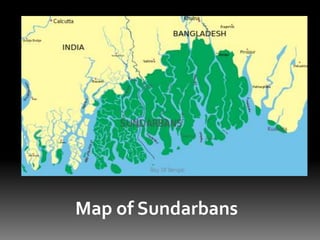
Map of Sundarbans
The Sundarban forest lies in the vast delta on the Bay of
Bengal formed by the super confluence of the Padma,
Brahmaputra and Meghna rivers across southern
Bangladesh.The seasonally flooded Sundarbans
freshwater swamp forests lie inland from the mangrove
forests on the coastal fringe. The forest covers 10,000
square kilometres (3,900 sq mi) of which about 6,000
square kilometres (2,300 sq mi) are in Bangladesh.It
became inscribed as a UNESCO world heritage site in
1997.The Indian part of Sundarbans is estimated to be
about 4,110 square kilometres (1,590 sq mi), of which
about 1,700 square kilometres (660 sq mi) is occupied by
waterbodies in the forms of river, canals and creeks of
width varying from a few meters to several kilometres.
A total 245 genera and 334 plant species
were recorded by David Prain in 1903.
While most of the mangroves in other
parts of the world are characterised by
members of the Rhizophoraceae,
Avicenneaceae or Combretaceae, the
mangroves of Bangladesh are
dominated by the Malvaceae and
Euphorbiaceae.
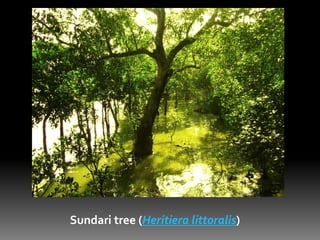
Sundari tree (Heritiera littoralis)
Golpata (Nypa fruticans)
The Sundarbans provides a unique ecosystem
and a rich wildlife habitat. According to the
2011 tiger census, the Sundarbans have
about 270 tigers. Although previous rough
estimates had suggested much higher figures
close to 300, the 2011 census provided the
first ever scientific estimate of tigers from the
areaTiger attacks are frequent in the
Sundarbans. Between 100 and 250 people are
killed per year.
Animals….
Workers in the Sundarbans wear face
masks on the back of their heads to fool
tigers
Chital deers (Axis axis) are widely seen
A rhesus macaque (Macaca mulatta)
A largetooth sawfish (Pristis microdon)
People of Sundarbans
People are waiting for ferryboat
during low tide.Water transport
is the only means of
communication for visiting the
Sundarbans from one area to
another.
Honey hunters in the Sundarbans
Bonbibi, the goddess of Sundarbans
Tourists
visiting the
Sundarbans
Thank
You
That’s all for today…

The sundarbans

  • 1.
  • 2.
    This presentation isowned by ABUL KALAM AZAD PATWARY Assistant teacher of Lakshmipur govt girls high school(English) “for class 9-10” GyanBikash.com
  • 3.
  • 5.
    The Sundarbans (Bengali:সুন্দরবন, Shundorbôn) is a natural region in Bengal. It is the largest single block of tidal halophytic mangrove forest in the world.The Sundarbans covers approximately 10,000 square kilometres (3,900 sq mi) of which 60 percent is in Bangladesh with the remainder in India.The Sundarbans is a UNESCO World Heritage Site. The Sundarbans National Park is a National Park,Tiger Reserve, and a Biosphere Reserve located in the Sundarbans delta in the Indian state of West Bengal. Sundarbans South, East and West are three protected forests in Bangladesh.This region is densely covered by mangrove forests, and is one of the largest reserves for the Bengal tiger.
  • 7.
    Village in aclearing of Sundarbans. Drawing by Frederic Peter Layard after an original sketch of 1839
  • 8.
    The history ofthe area can be traced back to 200–300 AD. A ruin of a city built by Chand Sadagar has been found in the Baghmara Forest Block. During the Mughal period, the Mughal Kings leased the forests of the Sundarbans to nearby residents. Many criminals took refuge in the Sundarbans from the advancing armies of Emperor Akbar.
  • 9.
  • 10.
    The Sundarban forestlies in the vast delta on the Bay of Bengal formed by the super confluence of the Padma, Brahmaputra and Meghna rivers across southern Bangladesh.The seasonally flooded Sundarbans freshwater swamp forests lie inland from the mangrove forests on the coastal fringe. The forest covers 10,000 square kilometres (3,900 sq mi) of which about 6,000 square kilometres (2,300 sq mi) are in Bangladesh.It became inscribed as a UNESCO world heritage site in 1997.The Indian part of Sundarbans is estimated to be about 4,110 square kilometres (1,590 sq mi), of which about 1,700 square kilometres (660 sq mi) is occupied by waterbodies in the forms of river, canals and creeks of width varying from a few meters to several kilometres.
  • 11.
    A total 245genera and 334 plant species were recorded by David Prain in 1903. While most of the mangroves in other parts of the world are characterised by members of the Rhizophoraceae, Avicenneaceae or Combretaceae, the mangroves of Bangladesh are dominated by the Malvaceae and Euphorbiaceae.
  • 12.
  • 13.
  • 14.
    The Sundarbans providesa unique ecosystem and a rich wildlife habitat. According to the 2011 tiger census, the Sundarbans have about 270 tigers. Although previous rough estimates had suggested much higher figures close to 300, the 2011 census provided the first ever scientific estimate of tigers from the areaTiger attacks are frequent in the Sundarbans. Between 100 and 250 people are killed per year.
  • 15.
  • 17.
    Workers in theSundarbans wear face masks on the back of their heads to fool tigers
  • 18.
    Chital deers (Axisaxis) are widely seen
  • 20.
    A rhesus macaque(Macaca mulatta)
  • 22.
    A largetooth sawfish(Pristis microdon)
  • 23.
  • 25.
    People are waitingfor ferryboat during low tide.Water transport is the only means of communication for visiting the Sundarbans from one area to another.
  • 26.
    Honey hunters inthe Sundarbans
  • 27.
    Bonbibi, the goddessof Sundarbans
  • 28.
  • 29.