
Copyright © 2015 Accenture All rights reserved.
Software Testing
Symposium
MELBOURNE
26 APRIL, 2017
ORGANISED BY TESTINGMIND
Engineering Systems For the Cloud – Opportunities & Challenges
April 2017
Your Presenter
• Trevor is part of the ATA (Advanced Technology Architecture) Group within
Technology Consulting and leads the Performance Engineering Capability for ANZ
• In his current role Trevor works closely with accounts across ANZ advocating
Proactive Performance Management with a view to delivering applications that scale
first time around.
• Trevor Warren is passionate about challenging the status-quo and finding reasons to
innovate.
Name : Trevor Warren
Position : Technical Architect, Performance
Engineering Capability Lead, ANZ
Organisation : Advanced Technical Architecture
Contact # : 0423 607 688
Email : trevor.warren@accenture.com
Interesting Facts
• Been an aviation buff for a long time now
• Used to fly, but no longer
• Used to travel the country preaching the gospel
of Open Source & Free Software i.e. GNU,
Linux, etc.
• Organizer for the Melbourne Raspberry Pi
Hackers Club (CCHS, Hawthorn)
• Also run an Open Body Of Knowledge on
Systems Performance Engineering called –
Practical Performance Analyst
(www.practicalperformanceanalyst.com)
Agenda
• A Bit Of History – The Case For Change
• Bi-Modal IT – Managing Unpredictability & Delivering Required Change
• Cloud Computing Today - Opportunities
• Customer Expectations
• Costs Of Cloud Adoption - Challenges
• Case Studies
• What You Might Want To Do
Copyright © 2015 Accenture All rights reserved.
A Bit Of History – The Case For Change
6
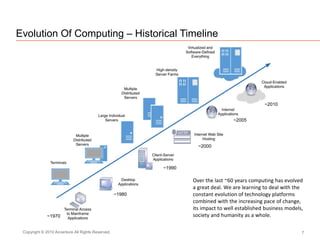
Evolution Of Computing – Historical Timeline
7Copyright © 2010 Accenture All Rights Reserved.
~1970
~2010
~2005
~2000
~1990
~1980
Over the last ~60 years computing has evolved
a great deal. We are learning to deal with the
constant evolution of technology platforms
combined with the increasing pace of change,
its impact to well established business models,
society and humanity as a whole.
World GDP Growth – Increasing Pace Of Change
8Copyright © 2010 Accenture All Rights Reserved.
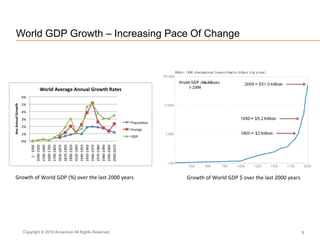
Growth of World GDP (%) over the last 2000 years Growth of World GDP $ over the last 2000 years
Rate Of Consumption – Increasing Pace Of Change
9Copyright © 2010 Accenture All Rights Reserved.
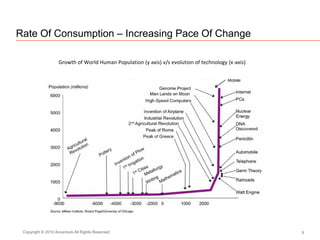
Growth of World Human Population (y axis) v/s evolution of technology (x-axis)
Rate Of Consumption – Increasing Pace Of Change
10Copyright © 2010 Accenture All Rights Reserved.
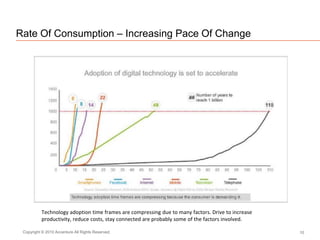
Technology adoption time frames are compressing due to many factors. Drive to increase
productivity, reduce costs, stay connected are probably some of the factors involved.
Rate Of Consumption – Increasing Pace Of Change
11Copyright © 2010 Accenture All Rights Reserved.
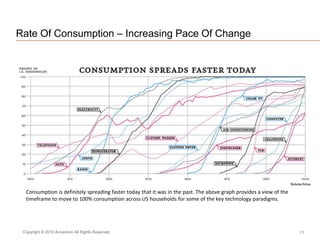
Consumption is definitely spreading faster today that it was in the past. The above graph provides a view of the
timeframe to move to 100% consumption across US households for some of the key technology paradigms.
Rate Of Consumption – Increasing Pace Of Change
12Copyright © 2010 Accenture All Rights Reserved.
Over the last ~200 years computing has evolved a great deal. We are learning to deal with the constant evolution of
technology platforms, combined with the increasing pace of change, its impact to well established business models,
including society and humanity as a whole.
Copyright © 2015 Accenture All rights reserved.
Bimodal IT – Managing Un-predictability &
Delivering The Required Change
13
Copyright © 2015 Accenture All rights reserved.
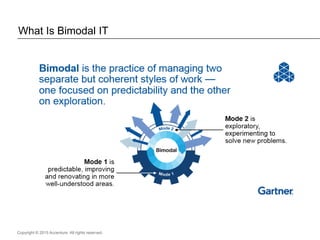
What Is Bimodal IT
Copyright © 2015 Accenture All rights reserved.
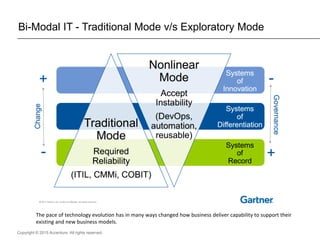
Bi-Modal IT - Traditional Mode v/s Exploratory Mode
The pace of technology evolution has in many ways changed how business deliver capability to support their
existing and new business models.
Copyright © 2015 Accenture All rights reserved.
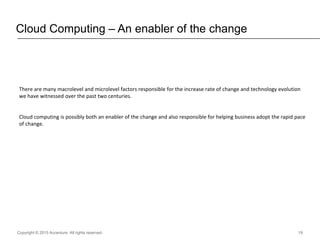
Cloud Computing – An enabler of the change
19
a
There are many macrolevel and microlevel factors responsible for the increase rate of change and technology evolution
we have witnessed over the past two centuries.
Cloud computing is possibly both an enabler of the change and also responsible for helping business adopt the rapid pace
of change.
Copyright © 2015 Accenture All rights reserved.
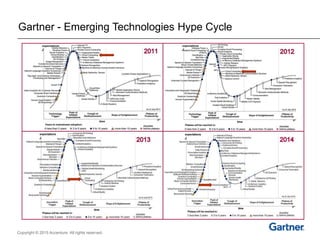
Gartner - Emerging Technologies Hype Cycle
Copyright © 2015 Accenture All rights reserved.
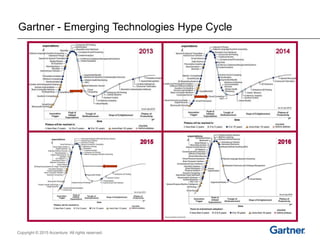
Gartner - Emerging Technologies Hype Cycle
Copyright © 2015 Accenture All rights reserved.
Cloud Computing Today - Opprtunities
22
Copyright © 2015 Accenture All rights reserved.
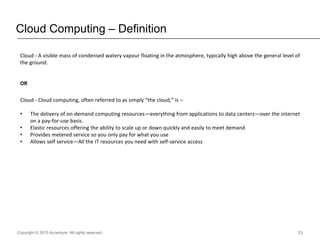
Cloud Computing – Definition
23
a
Cloud - A visible mass of condensed watery vapour floating in the atmosphere, typically high above the general level of
the ground.
OR
Cloud - Cloud computing, often referred to as simply “the cloud,” is –
• The delivery of on-demand computing resources—everything from applications to data centers—over the internet
on a pay-for-use basis.
• Elastic resources offering the ability to scale up or down quickly and easily to meet demand
• Provides metered service so you only pay for what you use
• Allows self service—All the IT resources you need with self-service access
Copyright © 2015 Accenture All rights reserved.
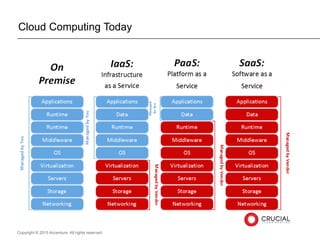
Cloud Computing Today
Copyright © 2015 Accenture All rights reserved.
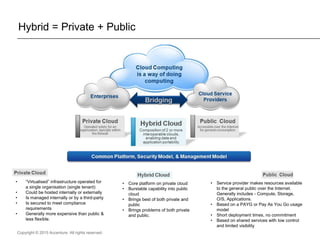
Hybrid = Private + Public
• “Virtualised” infrastructure operated for
a single organisation (single tenant)
• Could be hosted internally or externally
• Is managed internally or by a third-party
• Is secured to meet compliance
requirements
• Generally more expensive than public &
less flexible.
• Service provider makes resources available
to the general public over the Internet.
Generally includes - Compute, Storage,
O/S, Applications.
• Based on a PAYG or Pay As You Go usage
model
• Short deployment times, no commitment
• Based on shared services with low control
and limited visibility
• Core platform on private cloud
• Burstable capability into public
cloud
• Brings best of both private and
public
• Brings problems of both private
and public.
Copyright © 2015 Accenture All rights reserved.
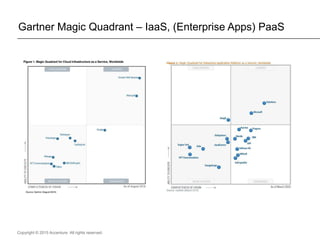
Gartner Magic Quadrant – IaaS, (Enterprise Apps) PaaS
Copyright © 2015 Accenture All rights reserved.
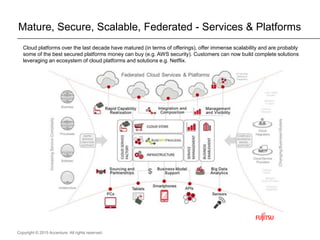
Mature, Secure, Scalable, Federated - Services & Platforms
Cloud platforms over the last decade have matured (in terms of offerings), offer immense scalability and are probably
some of the best secured platforms money can buy (e.g. AWS security). Customers can now build complete solutions
leveraging an ecosystem of cloud platforms and solutions e.g. Netflix.
Copyright © 2015 Accenture All rights reserved.
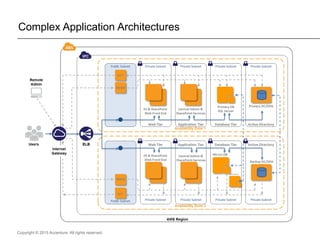
Complex Application Architectures
Copyright © 2015 Accenture All rights reserved.
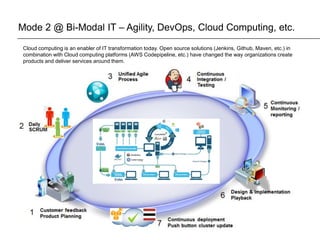
Mode 2 @ Bi-Modal IT – Agility, DevOps, Cloud Computing, etc.
Cloud computing is an enabler of IT transformation today. Open source solutions (Jenkins, Github, Maven, etc.) in
combination with Cloud computing platforms (AWS Codepipeline, etc.) have changed the way organizations create
products and deliver services around them.
Copyright © 2015 Accenture All rights reserved.
Customer Expectations
30
In the new Digital world, performance is a key enabler of the customer
experience. Poor performance will make or break a digital business.
In A Digital World Performance Is An Enabler…..
Faster systems allow IT spend to be moved from license and hardware
spend to services spend.
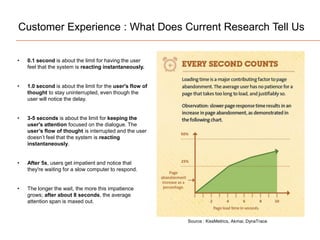
Customer Experience : What Does Current Research Tell Us
• 0.1 second is about the limit for having the user
feel that the system is reacting instantaneously.
• 1.0 second is about the limit for the user's flow of
thought to stay uninterrupted, even though the
user will notice the delay.
• 3-5 seconds is about the limit for keeping the
user's attention focused on the dialogue. The
user’s flow of thought is interrupted and the user
doesn’t feel that the system is reacting
instantaneously.
• After 5s, users get impatient and notice that
they're waiting for a slow computer to respond.
• The longer the wait, the more this impatience
grows; after about 8 seconds, the average
attention span is maxed out.
Source : KissMetrics, Akmai, DynaTrace
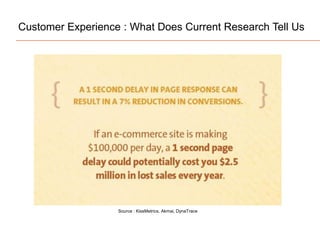
Customer Experience : What Does Current Research Tell Us
Source : KissMetrics, Akmai, DynaTrace
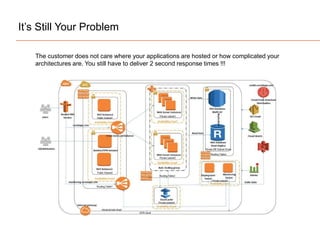
It’s Still Your Problem
The customer does not care where your applications are hosted or how complicated your
architectures are. You still have to deliver 2 second response times !!!
Copyright © 2015 Accenture All rights reserved.
Costs of Cloud Adoption - Challenges
35
Copyright © 2015 Accenture All rights reserved.
Things Do Go Wrong….
Copyright © 2015 Accenture All rights reserved.
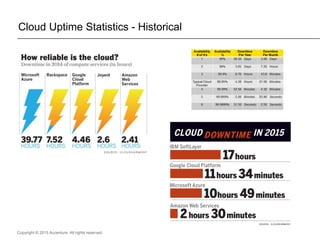
Cloud Uptime Statistics - Historical
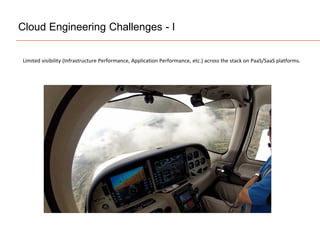
Cloud Engineering Challenges - I
Limited visibility (Infrastructure Performance, Application Performance, etc.) across the stack on PaaS/SaaS platforms.
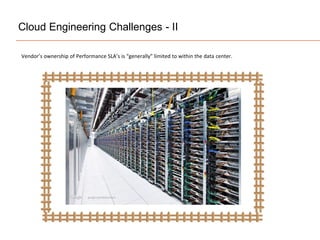
Cloud Engineering Challenges - II
Vendor’s ownership of Performance SLA’s is “generally” limited to within the data center.
Cloud Engineering Challenges - III
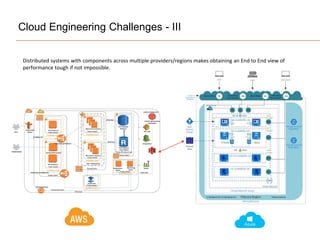
Distributed systems with components across multiple providers/regions makes obtaining an End to End view of
performance tough if not impossible.
Cloud Engineering Challenges - IV
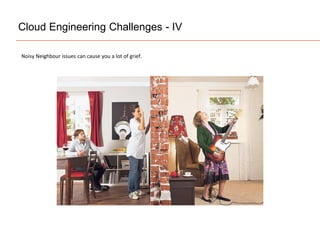
Noisy Neighbour issues can cause you a lot of grief.
Cloud Engineering Challenges - V
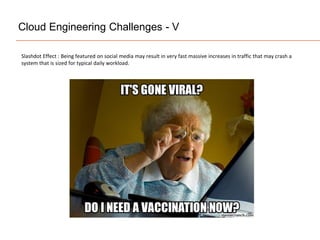
Slashdot Effect : Being featured on social media may result in very fast massive increases in traffic that may crash a
system that is sized for typical daily workload.
Cloud Engineering Challenges - VI
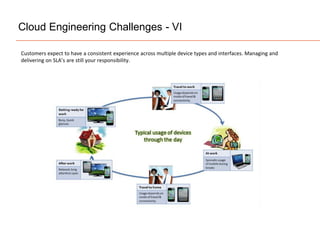
Customers expect to have a consistent experience across multiple device types and interfaces. Managing and
delivering on SLA’s are still your responsibility.
Copyright © 2015 Accenture All rights reserved.
Case Studies
44
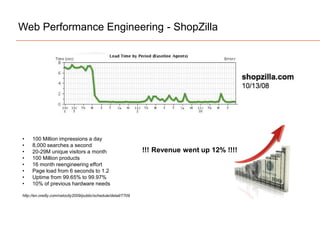
Web Performance Engineering - ShopZilla
• 100 Million impressions a day
• 8,000 searches a second
• 20-29M unique visitors a month
• 100 Million products
• 16 month reengineering effort
• Page load from 6 seconds to 1.2
• Uptime from 99.65% to 99.97%
• 10% of previous hardware needs
http://en.oreilly.com/velocity2009/public/schedule/detail/7709
!!! Revenue went up 12% !!!!
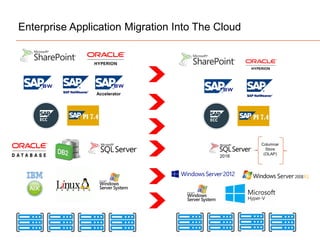
Enterprise Application Migration Into The Cloud
Accelerator
Columnar
Store
(OLAP)
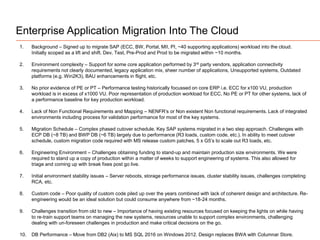
Enterprise Application Migration Into The Cloud
1. Background – Signed up to migrate SAP (ECC, BW, Portal, MII, PI, ~40 supporting applications) workload into the cloud.
Initially scoped as a lift and shift. Dev, Test, Pre-Prod and Prod to be migrated within ~10 months.
2. Environment complexity – Support for some core application performed by 3rd party vendors, application connectivity
requirements not clearly documented, legacy application mix, sheer number of applications, Unsupported systems, Outdated
platforms (e.g. Win2K3), BAU enhancements in flight, etc.
3. No prior evidence of PE or PT – Performance testing historically focussed on core ERP i.e. ECC for x100 VU, production
workload is in excess of x1000 VU. Poor representation of production workload for ECC, No PE or PT for other systems, lack of
a performance baseline for key production workload.
4. Lack of Non Functional Requirements and Mapping – NENFR’s or Non existent Non functional requirements. Lack of integrated
environments including process for validation performance for most of the key systems.
5. Migration Schedule – Complex phased cutover schedule. Key SAP systems migrated in a two step approach. Challenges with
ECP DB (~8 TB) and BWP DB (~6 TB) largely due to performance (R3 loads, custom code, etc.). In ability to meet cutover
schedule, custom migration code required with MS release custom patches, 5 x G5’s to scale out R3 loads, etc.
6. Engineering Environment – Challenges obtaining funding to stand-up and maintain production size environments. We were
required to stand up a copy of production within a matter of weeks to support engineering of systems. This also allowed for
triage and coming up with break fixes post go live.
7. Initial environment stability issues – Server reboots, storage performance issues, cluster stability issues, challenges completing
RCA, etc.
8. Custom code – Poor quality of custom code piled up over the years combined with lack of coherent design and architecture. Re-
engineering would be an ideal solution but could consume anywhere from ~18-24 months.
9. Challenges transition from old to new – Importance of having existing resources focused on keeping the lights on while having
to re-train support teams on managing the new systems, resources unable to support complex environments, challenging
dealing with un-foreseen challenges in production and make critical decisions on the go.
10. DB Performance – Move from DB2 (Aix) to MS SQL 2016 on Windows 2012. Design replaces BWA with Columnar Store.
Copyright © 2015 Accenture All rights reserved.
What Can You Do
50
Copyright © 2015 Accenture All rights reserved.
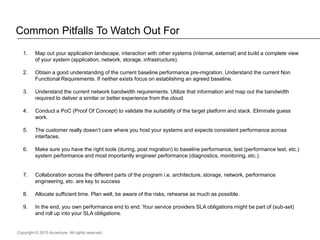
Common Pitfalls To Watch Out For
1. Map out your application landscape, interaction with other systems (internal, external) and build a complete view
of your system (application, network, storage, infrastructure).
2. Obtain a good understanding of the current baseline performance pre-migration. Understand the current Non
Functional Requirements. If neither exists focus on establishing an agreed baseline.
3. Understand the current network bandwidth requirements. Utilize that information and map out the bandwidth
required to deliver a similar or better experience from the cloud.
4. Conduct a PoC (Proof Of Concept) to validate the suitability of the target platform and stack. Eliminate guess
work.
5. The customer really doesn’t care where you host your systems and expects consistent performance across
interfaces.
6. Make sure you have the right tools (during, post migration) to baseline performance, test (performance test, etc.)
system performance and most importantly engineer performance (diagnostics, monitoring, etc.).
7. Collaboration across the different parts of the program i.e. architecture, storage, network, performance
engineering, etc. are key to success
8. Allocate sufficient time. Plan well, be aware of the risks, rehearse as much as possible.
9. In the end, you own performance end to end. Your service providers SLA obligations might be part of (sub-set)
and roll up into your SLA obligations.
Copyright © 2015 Accenture All rights reserved.
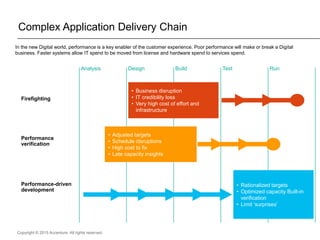
Performance-driven
development
Analysis Design Build Test Run
• Rationalized targets
• Optimized capacity Built-in
verification
• Limit ‘surprises’
Performance
verification
• Adjusted targets
• Schedule disruptions
• High cost to fix
• Late capacity insights
Firefighting
• Business disruption
• IT credibility loss
• Very high cost of effort and
infrastructure
In the new Digital world, performance is a key enabler of the customer experience. Poor performance will make or break a Digital
business. Faster systems allow IT spend to be moved from license and hardware spend to services spend.
Complex Application Delivery Chain
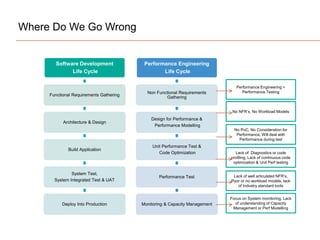
Where Do We Go Wrong
Software Development
Life Cycle
Functional Requirements Gathering
Architecture & Design
Build Application
System Test,
System Integrated Test & UAT
Deploy Into Production
Performance Engineering
Life Cycle
Non Functional Requirements
Gathering
Design for Performance &
Performance Modelling
Unit Performance Test &
Code Optimization
Performance Test
Monitoring & Capacity Management
No NFR’s, No Workload Models
No PoC, No Consideration for
Performance, Will deal with
Performance during test
Lack of Diagnostics or code
profiling, Lack of continuous code
optimization & Unit Perf testing
Lack of well articulated NFR’s,
Poor or no workload models, lack
of Industry standard tools
Focus on System monitoring, Lack
of understanding of Capacity
Management or Perf Modelling
Performance Engineering =
Performance Testing
Copyright © 2015 Accenture All rights reserved.
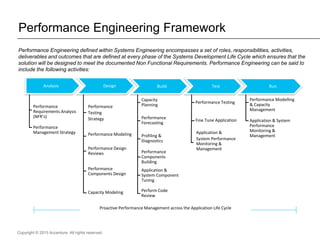
Performance Engineering Framework
Performance Engineering defined within Systems Engineering encompasses a set of roles, responsibilities, activities,
deliverables and outcomes that are defined at every phase of the Systems Development Life Cycle which ensures that the
solution will be designed to meet the documented Non Functional Requirements. Performance Engineering can be said to
include the following activities:
Performance Modelling
& Capacity
Management
Application & System
Performance
Monitoring &
Management
Performance Testing
Fine Tune Application
Capacity
Planning
Performance
Forecasting
Profiling &
Diagnostics
Performance
Components
Building
Application &
System Component
Tuning
Perform Code
Review
Performance
Testing
Strategy
Performance Modeling
Performance Design
Reviews
Performance
Components Design
Performance
Requirements Analysis
(NFR’s)
Performance
Management Strategy
Analysis Design Build Test Run
Proactive Performance Management across the Application Life Cycle
Capacity Modeling
Application &
System Performance
Monitoring &
Management
Copyright © 2015 Accenture All rights reserved.
Thank You
55

Engineering Systems For The Cloud

  • 1.
    Copyright © 2015Accenture All rights reserved. Software Testing Symposium MELBOURNE 26 APRIL, 2017 ORGANISED BY TESTINGMIND
  • 2.
    Engineering Systems Forthe Cloud – Opportunities & Challenges April 2017
  • 3.
    Your Presenter • Trevoris part of the ATA (Advanced Technology Architecture) Group within Technology Consulting and leads the Performance Engineering Capability for ANZ • In his current role Trevor works closely with accounts across ANZ advocating Proactive Performance Management with a view to delivering applications that scale first time around. • Trevor Warren is passionate about challenging the status-quo and finding reasons to innovate. Name : Trevor Warren Position : Technical Architect, Performance Engineering Capability Lead, ANZ Organisation : Advanced Technical Architecture Contact # : 0423 607 688 Email : trevor.warren@accenture.com
  • 4.
    Interesting Facts • Beenan aviation buff for a long time now • Used to fly, but no longer • Used to travel the country preaching the gospel of Open Source & Free Software i.e. GNU, Linux, etc. • Organizer for the Melbourne Raspberry Pi Hackers Club (CCHS, Hawthorn) • Also run an Open Body Of Knowledge on Systems Performance Engineering called – Practical Performance Analyst (www.practicalperformanceanalyst.com)
  • 5.
    Agenda • A BitOf History – The Case For Change • Bi-Modal IT – Managing Unpredictability & Delivering Required Change • Cloud Computing Today - Opportunities • Customer Expectations • Costs Of Cloud Adoption - Challenges • Case Studies • What You Might Want To Do
  • 6.
    Copyright © 2015Accenture All rights reserved. A Bit Of History – The Case For Change 6
  • 7.
    Evolution Of Computing– Historical Timeline 7Copyright © 2010 Accenture All Rights Reserved. ~1970 ~2010 ~2005 ~2000 ~1990 ~1980 Over the last ~60 years computing has evolved a great deal. We are learning to deal with the constant evolution of technology platforms combined with the increasing pace of change, its impact to well established business models, society and humanity as a whole.
  • 8.
    World GDP Growth– Increasing Pace Of Change 8Copyright © 2010 Accenture All Rights Reserved. Growth of World GDP (%) over the last 2000 years Growth of World GDP $ over the last 2000 years
  • 9.
    Rate Of Consumption– Increasing Pace Of Change 9Copyright © 2010 Accenture All Rights Reserved. Growth of World Human Population (y axis) v/s evolution of technology (x-axis)
  • 10.
    Rate Of Consumption– Increasing Pace Of Change 10Copyright © 2010 Accenture All Rights Reserved. Technology adoption time frames are compressing due to many factors. Drive to increase productivity, reduce costs, stay connected are probably some of the factors involved.
  • 11.
    Rate Of Consumption– Increasing Pace Of Change 11Copyright © 2010 Accenture All Rights Reserved. Consumption is definitely spreading faster today that it was in the past. The above graph provides a view of the timeframe to move to 100% consumption across US households for some of the key technology paradigms.
  • 12.
    Rate Of Consumption– Increasing Pace Of Change 12Copyright © 2010 Accenture All Rights Reserved. Over the last ~200 years computing has evolved a great deal. We are learning to deal with the constant evolution of technology platforms, combined with the increasing pace of change, its impact to well established business models, including society and humanity as a whole.
  • 13.
    Copyright © 2015Accenture All rights reserved. Bimodal IT – Managing Un-predictability & Delivering The Required Change 13
  • 14.
    Copyright © 2015Accenture All rights reserved. What Is Bimodal IT
  • 15.
    Copyright © 2015Accenture All rights reserved. Bi-Modal IT - Traditional Mode v/s Exploratory Mode The pace of technology evolution has in many ways changed how business deliver capability to support their existing and new business models.
  • 16.
    Copyright © 2015Accenture All rights reserved. Cloud Computing – An enabler of the change 19 a There are many macrolevel and microlevel factors responsible for the increase rate of change and technology evolution we have witnessed over the past two centuries. Cloud computing is possibly both an enabler of the change and also responsible for helping business adopt the rapid pace of change.
  • 17.
    Copyright © 2015Accenture All rights reserved. Gartner - Emerging Technologies Hype Cycle
  • 18.
    Copyright © 2015Accenture All rights reserved. Gartner - Emerging Technologies Hype Cycle
  • 19.
    Copyright © 2015Accenture All rights reserved. Cloud Computing Today - Opprtunities 22
  • 20.
    Copyright © 2015Accenture All rights reserved. Cloud Computing – Definition 23 a Cloud - A visible mass of condensed watery vapour floating in the atmosphere, typically high above the general level of the ground. OR Cloud - Cloud computing, often referred to as simply “the cloud,” is – • The delivery of on-demand computing resources—everything from applications to data centers—over the internet on a pay-for-use basis. • Elastic resources offering the ability to scale up or down quickly and easily to meet demand • Provides metered service so you only pay for what you use • Allows self service—All the IT resources you need with self-service access
  • 21.
    Copyright © 2015Accenture All rights reserved. Cloud Computing Today
  • 22.
    Copyright © 2015Accenture All rights reserved. Hybrid = Private + Public • “Virtualised” infrastructure operated for a single organisation (single tenant) • Could be hosted internally or externally • Is managed internally or by a third-party • Is secured to meet compliance requirements • Generally more expensive than public & less flexible. • Service provider makes resources available to the general public over the Internet. Generally includes - Compute, Storage, O/S, Applications. • Based on a PAYG or Pay As You Go usage model • Short deployment times, no commitment • Based on shared services with low control and limited visibility • Core platform on private cloud • Burstable capability into public cloud • Brings best of both private and public • Brings problems of both private and public.
  • 23.
    Copyright © 2015Accenture All rights reserved. Gartner Magic Quadrant – IaaS, (Enterprise Apps) PaaS
  • 24.
    Copyright © 2015Accenture All rights reserved. Mature, Secure, Scalable, Federated - Services & Platforms Cloud platforms over the last decade have matured (in terms of offerings), offer immense scalability and are probably some of the best secured platforms money can buy (e.g. AWS security). Customers can now build complete solutions leveraging an ecosystem of cloud platforms and solutions e.g. Netflix.
  • 25.
    Copyright © 2015Accenture All rights reserved. Complex Application Architectures
  • 26.
    Copyright © 2015Accenture All rights reserved. Mode 2 @ Bi-Modal IT – Agility, DevOps, Cloud Computing, etc. Cloud computing is an enabler of IT transformation today. Open source solutions (Jenkins, Github, Maven, etc.) in combination with Cloud computing platforms (AWS Codepipeline, etc.) have changed the way organizations create products and deliver services around them.
  • 27.
    Copyright © 2015Accenture All rights reserved. Customer Expectations 30
  • 28.
    In the newDigital world, performance is a key enabler of the customer experience. Poor performance will make or break a digital business. In A Digital World Performance Is An Enabler….. Faster systems allow IT spend to be moved from license and hardware spend to services spend.
  • 29.
    Customer Experience :What Does Current Research Tell Us • 0.1 second is about the limit for having the user feel that the system is reacting instantaneously. • 1.0 second is about the limit for the user's flow of thought to stay uninterrupted, even though the user will notice the delay. • 3-5 seconds is about the limit for keeping the user's attention focused on the dialogue. The user’s flow of thought is interrupted and the user doesn’t feel that the system is reacting instantaneously. • After 5s, users get impatient and notice that they're waiting for a slow computer to respond. • The longer the wait, the more this impatience grows; after about 8 seconds, the average attention span is maxed out. Source : KissMetrics, Akmai, DynaTrace
  • 30.
    Customer Experience :What Does Current Research Tell Us Source : KissMetrics, Akmai, DynaTrace
  • 31.
    It’s Still YourProblem The customer does not care where your applications are hosted or how complicated your architectures are. You still have to deliver 2 second response times !!!
  • 32.
    Copyright © 2015Accenture All rights reserved. Costs of Cloud Adoption - Challenges 35
  • 33.
    Copyright © 2015Accenture All rights reserved. Things Do Go Wrong….
  • 34.
    Copyright © 2015Accenture All rights reserved. Cloud Uptime Statistics - Historical
  • 35.
    Cloud Engineering Challenges- I Limited visibility (Infrastructure Performance, Application Performance, etc.) across the stack on PaaS/SaaS platforms.
  • 36.
    Cloud Engineering Challenges- II Vendor’s ownership of Performance SLA’s is “generally” limited to within the data center.
  • 37.
    Cloud Engineering Challenges- III Distributed systems with components across multiple providers/regions makes obtaining an End to End view of performance tough if not impossible.
  • 38.
    Cloud Engineering Challenges- IV Noisy Neighbour issues can cause you a lot of grief.
  • 39.
    Cloud Engineering Challenges- V Slashdot Effect : Being featured on social media may result in very fast massive increases in traffic that may crash a system that is sized for typical daily workload.
  • 40.
    Cloud Engineering Challenges- VI Customers expect to have a consistent experience across multiple device types and interfaces. Managing and delivering on SLA’s are still your responsibility.
  • 41.
    Copyright © 2015Accenture All rights reserved. Case Studies 44
  • 42.
    Web Performance Engineering- ShopZilla • 100 Million impressions a day • 8,000 searches a second • 20-29M unique visitors a month • 100 Million products • 16 month reengineering effort • Page load from 6 seconds to 1.2 • Uptime from 99.65% to 99.97% • 10% of previous hardware needs http://en.oreilly.com/velocity2009/public/schedule/detail/7709 !!! Revenue went up 12% !!!!
  • 43.
    Enterprise Application MigrationInto The Cloud Accelerator Columnar Store (OLAP)
  • 44.
    Enterprise Application MigrationInto The Cloud 1. Background – Signed up to migrate SAP (ECC, BW, Portal, MII, PI, ~40 supporting applications) workload into the cloud. Initially scoped as a lift and shift. Dev, Test, Pre-Prod and Prod to be migrated within ~10 months. 2. Environment complexity – Support for some core application performed by 3rd party vendors, application connectivity requirements not clearly documented, legacy application mix, sheer number of applications, Unsupported systems, Outdated platforms (e.g. Win2K3), BAU enhancements in flight, etc. 3. No prior evidence of PE or PT – Performance testing historically focussed on core ERP i.e. ECC for x100 VU, production workload is in excess of x1000 VU. Poor representation of production workload for ECC, No PE or PT for other systems, lack of a performance baseline for key production workload. 4. Lack of Non Functional Requirements and Mapping – NENFR’s or Non existent Non functional requirements. Lack of integrated environments including process for validation performance for most of the key systems. 5. Migration Schedule – Complex phased cutover schedule. Key SAP systems migrated in a two step approach. Challenges with ECP DB (~8 TB) and BWP DB (~6 TB) largely due to performance (R3 loads, custom code, etc.). In ability to meet cutover schedule, custom migration code required with MS release custom patches, 5 x G5’s to scale out R3 loads, etc. 6. Engineering Environment – Challenges obtaining funding to stand-up and maintain production size environments. We were required to stand up a copy of production within a matter of weeks to support engineering of systems. This also allowed for triage and coming up with break fixes post go live. 7. Initial environment stability issues – Server reboots, storage performance issues, cluster stability issues, challenges completing RCA, etc. 8. Custom code – Poor quality of custom code piled up over the years combined with lack of coherent design and architecture. Re- engineering would be an ideal solution but could consume anywhere from ~18-24 months. 9. Challenges transition from old to new – Importance of having existing resources focused on keeping the lights on while having to re-train support teams on managing the new systems, resources unable to support complex environments, challenging dealing with un-foreseen challenges in production and make critical decisions on the go. 10. DB Performance – Move from DB2 (Aix) to MS SQL 2016 on Windows 2012. Design replaces BWA with Columnar Store.
  • 45.
    Copyright © 2015Accenture All rights reserved. What Can You Do 50
  • 46.
    Copyright © 2015Accenture All rights reserved. Common Pitfalls To Watch Out For 1. Map out your application landscape, interaction with other systems (internal, external) and build a complete view of your system (application, network, storage, infrastructure). 2. Obtain a good understanding of the current baseline performance pre-migration. Understand the current Non Functional Requirements. If neither exists focus on establishing an agreed baseline. 3. Understand the current network bandwidth requirements. Utilize that information and map out the bandwidth required to deliver a similar or better experience from the cloud. 4. Conduct a PoC (Proof Of Concept) to validate the suitability of the target platform and stack. Eliminate guess work. 5. The customer really doesn’t care where you host your systems and expects consistent performance across interfaces. 6. Make sure you have the right tools (during, post migration) to baseline performance, test (performance test, etc.) system performance and most importantly engineer performance (diagnostics, monitoring, etc.). 7. Collaboration across the different parts of the program i.e. architecture, storage, network, performance engineering, etc. are key to success 8. Allocate sufficient time. Plan well, be aware of the risks, rehearse as much as possible. 9. In the end, you own performance end to end. Your service providers SLA obligations might be part of (sub-set) and roll up into your SLA obligations.
  • 47.
    Copyright © 2015Accenture All rights reserved. Performance-driven development Analysis Design Build Test Run • Rationalized targets • Optimized capacity Built-in verification • Limit ‘surprises’ Performance verification • Adjusted targets • Schedule disruptions • High cost to fix • Late capacity insights Firefighting • Business disruption • IT credibility loss • Very high cost of effort and infrastructure In the new Digital world, performance is a key enabler of the customer experience. Poor performance will make or break a Digital business. Faster systems allow IT spend to be moved from license and hardware spend to services spend. Complex Application Delivery Chain
  • 48.
    Where Do WeGo Wrong Software Development Life Cycle Functional Requirements Gathering Architecture & Design Build Application System Test, System Integrated Test & UAT Deploy Into Production Performance Engineering Life Cycle Non Functional Requirements Gathering Design for Performance & Performance Modelling Unit Performance Test & Code Optimization Performance Test Monitoring & Capacity Management No NFR’s, No Workload Models No PoC, No Consideration for Performance, Will deal with Performance during test Lack of Diagnostics or code profiling, Lack of continuous code optimization & Unit Perf testing Lack of well articulated NFR’s, Poor or no workload models, lack of Industry standard tools Focus on System monitoring, Lack of understanding of Capacity Management or Perf Modelling Performance Engineering = Performance Testing
  • 49.
    Copyright © 2015Accenture All rights reserved. Performance Engineering Framework Performance Engineering defined within Systems Engineering encompasses a set of roles, responsibilities, activities, deliverables and outcomes that are defined at every phase of the Systems Development Life Cycle which ensures that the solution will be designed to meet the documented Non Functional Requirements. Performance Engineering can be said to include the following activities: Performance Modelling & Capacity Management Application & System Performance Monitoring & Management Performance Testing Fine Tune Application Capacity Planning Performance Forecasting Profiling & Diagnostics Performance Components Building Application & System Component Tuning Perform Code Review Performance Testing Strategy Performance Modeling Performance Design Reviews Performance Components Design Performance Requirements Analysis (NFR’s) Performance Management Strategy Analysis Design Build Test Run Proactive Performance Management across the Application Life Cycle Capacity Modeling Application & System Performance Monitoring & Management
  • 50.
    Copyright © 2015Accenture All rights reserved. Thank You 55