Is Engineering forIs Engineering for
Me?Me?
What is an Engineer?
PROBLEM
SOLVER
Engineers are problem solvers.
→Use available technology to solve problems
→Rely on creativity and academic skills
→Use math, science, and computers
It is very important to note that even though the
tasks are very different, many of the methods
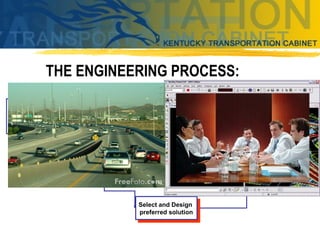
THE ENGINEERING PROCESS:
IDENTIFY and
define a problem
IDENTIFY and
define a problem
Implement
Solution
Implement
Solution
ANALYZE
the problem
ANALYZE
the problem
Propose solutionsPropose solutions
Select and Design
preferred solution
Select and Design
preferred solution
The First Engineers
Egyptians
ENGINEERS THROUGHOUT HISTORY
GREEKS
ROMANS
MAYANS
AZTECS
English
TYPES OF
ENGINEERS
CIVIL
CHEMICAL
ELECTRICAL
COMPUTER
INDUSTRIAL
MECHANICAL
AERONAUTICAL
Material
Agricultural
Bio-Systems
Architectural
Mining
TYPES OF CIVIL ENGINEERS
 STRUCTURAL
 TRANSPORTATION
 GEOTECHNICAL
 ENVIRONMENTAL
 WATER RESOURCES
 CONSTRUCTION
Structural Engineer
Design and build
structures.
Mainly designs
bridges, buildings,
and tunnels
Transportation Engineer
Designs
transportation
highway systems
Models traffic flow,
delay, etc.
Develops timing
system for traffic
signals.
Horizontal CurveVertical Curve
Geotechnical Engineer
Perform site
investigations
Foundation Design
Tunnel Design
Embankment Design
Retaining Wall
Design
Environmental Engineer
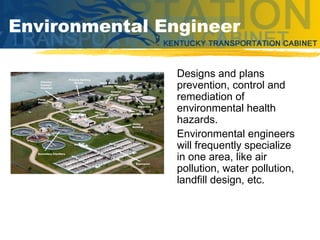
Designs and plans
prevention, control and
remediation of
environmental health
hazards.
Environmental engineers
will frequently specialize
in one area, like air
pollution, water pollution,
landfill design, etc.
Water Resource Engineer
Duties
Data collection
Hydrologic and hydraulic modeling
Perform watershed assessments
Preparation of drainage and water
quality technical reports
Conduct stormwater utilities
feasibility studies and
implementation
Perform drainage calculations for
design discharges, open
channels, weirs and collection
systems
perform storm water quality
related design (BMPS)
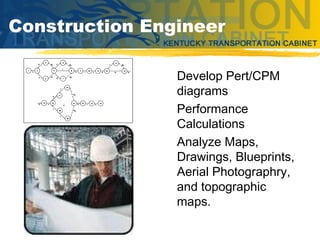
Construction Engineer
Develop Pert/CPM
diagrams
Performance
Calculations
Analyze Maps,
Drawings, Blueprints,
Aerial Photographry,
and topographic
maps.
STRUCTURAL ENGINEERS
Who does this?
TRANSPORTATION ENGINEERS
Who does this?
ENVIRONMENTAL
ENGINEERS
Who does this?
GEOTECHNICAL
ENGINEERS
Who does this?
WATER RESOURCE ENGINEERS
Who does this?
Tips:
How to Become an Engineer!
•Take as much math and science as possible
•Take ACT and SAT in your junior year
•Consider Co-Op Schools
•Look for scholarships
How to Become an Engineer!
Suggested High School Education:
Additional Chemistry
Computer Class
Graphic Class
KYTC
Applications accepted for UK, Western, Ky State, and UL
Summer Job and stipend
$4850 – freshman and sophomore
$5250 – juniors and seniors
Check out state website:
transportation.ky.gov/scholarship/info.asp
Scholarships!

Engineering presentation

Editor's Notes

  • #4 You don’t have to be a genius to be an engineer, but people who become engineers like math, science, and problem solving.
  • #5 In general this is a flow chart of the steps engineers follow in solving problems. First, you identify and define your problem Second, you analyze the problem Third you design and propose solutions Forth you refine your proposal 5) And after going through this process you have hopefully found a solution to your initial problem.
  • #8 Types of engineers include: Civil (bridges, buildings, airports) Environmental Chemical Electrical (design, develop, test, and supervise the manufacture of electrical and electronic equipment) Industrial (Robots, conveyors, facility planning) Mechanical (designing and producing products cars ect.)
  • #9 Types of engineers include: Civil (bridges, buildings, airports) Environmental Chemical Electrical (design, develop, test, and supervise the manufacture of electrical and electronic equipment) Industrial (Robots, conveyors, facility planning) Mechanical (designing and producing products cars ect.)
  • #16 Types of engineers include: Civil (bridges, buildings, airports) Environmental Chemical Electrical (design, develop, test, and supervise the manufacture of electrical and electronic equipment) Industrial (Robots, conveyors, facility planning) Mechanical (designing and producing products cars ect.)
  • #17 Types of engineers include: Civil (bridges, buildings, airports) Environmental Chemical Electrical (design, develop, test, and supervise the manufacture of electrical and electronic equipment) Industrial (Robots, conveyors, facility planning) Mechanical (designing and producing products cars ect.)
  • #18 Types of engineers include: Civil (bridges, buildings, airports) Environmental Chemical Electrical (design, develop, test, and supervise the manufacture of electrical and electronic equipment) Industrial (Robots, conveyors, facility planning) Mechanical (designing and producing products cars ect.)
  • #19 Types of engineers include: Civil (bridges, buildings, airports) Environmental Chemical Electrical (design, develop, test, and supervise the manufacture of electrical and electronic equipment) Industrial (Robots, conveyors, facility planning) Mechanical (designing and producing products cars ect.)
  • #20 Types of engineers include: Civil (bridges, buildings, airports) Environmental Chemical Electrical (design, develop, test, and supervise the manufacture of electrical and electronic equipment) Industrial (Robots, conveyors, facility planning) Mechanical (designing and producing products cars ect.)
  • #21 On a typical day, I spend the majority of my time working with computer aided design (Autocad and Microstation) I also spend time traing younger employees, attending team meetings, and sometimes public meetings. The next few slides are from some of the many projects that I have been involved with since working with Presnell.
  • #22 On a typical day, I spend the majority of my time working with computer aided design (Autocad and Microstation) I also spend time traing younger employees, attending team meetings, and sometimes public meetings. The next few slides are from some of the many projects that I have been involved with since working with Presnell.
  • #23 On a typical day, I spend the majority of my time working with computer aided design (Autocad and Microstation) I also spend time traing younger employees, attending team meetings, and sometimes public meetings. The next few slides are from some of the many projects that I have been involved with since working with Presnell.