


Engineering
Summarized information
Introduction
 The creative application of scientific principles to design or develop
structures, machines, apparatus, or manufacturing processes, or works
utilizing them singly or in combination; or to construct or operate the same
with full cognizance of their design; or to forecast their behavior under
specific operating conditions; all as respects an intended function, economics
of operation or safety to life and property.
Main Braches
Chemical engineering – The application of physics, chemistry, biology, and engineering principles in order to
carry out chemical processes on a commercial scale, such as petroleum refining, microfabrication, fermentation,
and biomolecule production.
Civil engineering – The design and construction of public and private works, such as infrastructure (airports,
roads, railways, water supply and treatment etc.), bridges, dams, and buildings.
Electrical engineering – The design, study and manufacture of various electrical and electronic systems, such
as electrical circuits, generators, motors, electromagnetic/electromechanical devices, electronic devices,
electronic circuits, optical fibers, optoelectronic devices, computer systems, telecommunications,
instrumentation, controls, and electronics.
Mechanical engineering – The design and manufacture of physical or mechanical systems, such as power and
energy systems, aerospace/aircraft products, weapon systems, transportation products, engines, compressors,
powertrains, kinematic chains, vacuum technology, and vibration isolation equipment.
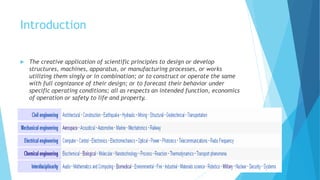
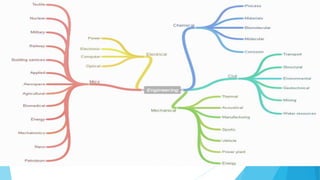
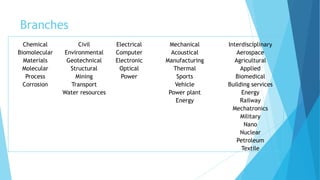
Branches
Chemical Civil Electrical Mechanical Interdisciplinary
Biomolecular Environmental Computer Acoustical Aerospace
Materials Geotechnical Electronic Manufacturing Agricultural
Molecular Structural Optical Thermal Applied
Process Mining Power Sports Biomedical
Corrosion Transport Vehicle Building services
Water resources Power plant Energy
Energy Railway
Mechatronics
Military
Nano
Nuclear
Petroleum
Textile
Chemical
Field Intro
Agricultural
Agricultural engineers look for solutions to problems involving the use of plants, animals and the natural environment. In the past, they
focused largely on improvements to crop and livestock production. While this function continues, the scope of practice is widening to include
land and resource management, pollution concerns, machinery for growing...
Biological and Biosystems
Biological and Biosytems Engineers draw on the biotechnologies found in the food, pharmaceutical, petroleum and textiles industries and
combine them with engineering design. Engineers in these areas may develop processes in which microorganisms produce antibiotics more
efficiently, or conduct research into how microbes can be used to digest oil spills.
Chemical
Chemical engineers apply principles of chemistry, mathematics and physics to the design and operation of industrial equipment and methods
for the manufacture of chemical products. The fibers in clothing, soaps and detergents, leather, paints and plastics are all designed and
produced by chemical engineers.
Environmental - wind
turbines
Environmental engineers develop feasible solutions to problems affecting the welfare of humans and nature. They work to prevent pollution of
the environment by designing systems of air and water quality control, vibration and noise reduction, and hazardous waste disposal. They also
work to clean up contaminated soil, water and air.
Food s
Food engineers apply the concepts and principles of engineering to the conversion of raw food stuffs into safe consumer products of the
highest possible quality. They work in the areas of food handling, processing, packaging and distribution.
Forestry
Forestry engineers study the effects of industrialization on nature, silviculture, hydrology and renewable resources. They are involved in the
development of sustainable forestry as well as the design of lumber harvesting and processing equipment.
Material
Material engineers study the properties of existing materials, find new ways to work with them and develop new materials. Material engineers
work in a variety of fields. For example, the petrochemical industry requires material engineers because many modern materials, such as
synthetic rubbers and plastics, are made from the by-products of petroleum...
Plastics Plastics engineers study the properties of polymer materials. They also design machines used to manipulate and shape plastics.
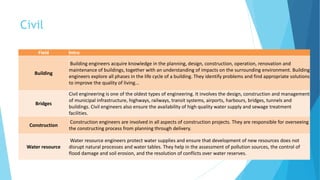
Civil
Field Intro
Building
Building engineers acquire knowledge in the planning, design, construction, operation, renovation and
maintenance of buildings, together with an understanding of impacts on the surrounding environment. Building
engineers explore all phases in the life cycle of a building. They identify problems and find appropriate solutions
to improve the quality of living...
Bridges
Civil engineering is one of the oldest types of engineering. It involves the design, construction and management
of municipal infrastructure, highways, railways, transit systems, airports, harbours, bridges, tunnels and
buildings. Civil engineers also ensure the availability of high quality water supply and sewage treatment
facilities.
Construction
Construction engineers are involved in all aspects of construction projects. They are responsible for overseeing
the constructing process from planning through delivery.
Water resource
Water resource engineers protect water supplies and ensure that development of new resources does not
disrupt natural processes and water tables. They help in the assessment of pollution sources, the control of
flood damage and soil erosion, and the resolution of conflicts over water reserves.
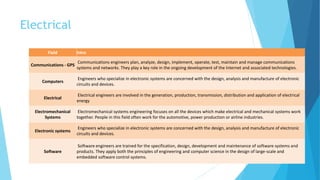
Electrical
Field Intro
Communications - GPS
Communications engineers plan, analyze, design, implement, operate, test, maintain and manage communications
systems and networks. They play a key role in the ongoing development of the Internet and associated technologies.
Computers
Engineers who specialize in electronic systems are concerned with the design, analysis and manufacture of electronic
circuits and devices.
Electrical
Electrical engineers are involved in the generation, production, transmission, distribution and application of electrical
energy
Electromechanical
Systems
Electromechanical systems engineering focuses on all the devices which make electrical and mechanical systems work
together. People in this field often work for the automotive, power production or airline industries.
Electronic systems
Engineers who specialize in electronic systems are concerned with the design, analysis and manufacture of electronic
circuits and devices.
Software
Software engineers are trained for the specification, design, development and maintenance of software systems and
products. They apply both the principles of engineering and computer science in the design of large-scale and
embedded software control systems.
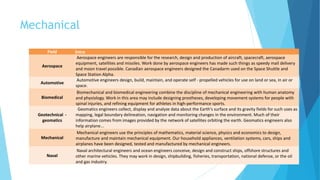
Mechanical
Field Intro
Aerospace
Aerospace engineers are responsible for the research, design and production of aircraft, spacecraft, aerospace
equipment, satellites and missiles. Work done by aerospace engineers has made such things as speedy mail delivery
and moon travel possible. Canadian aerospace engineers designed the Canadarm used on the Space Shuttle and
Space Station Alpha.
Automotive
Automotive engineers design, build, maintain, and operate self - propelled vehicles for use on land or sea, in air or
space.
Biomedical
Biomechanical and biomedical engineering combine the discipline of mechanical engineering with human anatomy
and physiology. Work in this area may include designing prostheses, developing movement systems for people with
spinal injuries, and refining equipment for athletes in high-performance sports.
Geotechnical -
geomatics
Geomatics engineers collect, display and analyze data about the Earth's surface and its gravity fields for such uses as
mapping, legal boundary delineation, navigation and monitoring changes in the environment. Much of their
information comes from images provided by the network of satellites orbiting the earth. Geomatics engineers also
help airplane...
Mechanical
Mechanical engineers use the principles of mathematics, material science, physics and economics to design,
manufacture and maintain mechanical equipment. Our household appliances, ventilation systems, cars, ships and
airplanes have been designed, tested and manufactured by mechanical engineers.
Naval
Naval architectural engineers and ocean engineers conceive, design and construct ships, offshore structures and
other marine vehicles. They may work in design, shipbuilding, fisheries, transportation, national defense, or the oil
and gas industry.
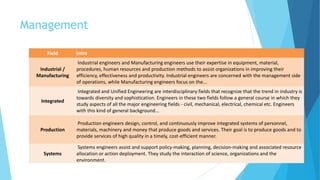
Management
Field Intro
Industrial /
Manufacturing
Industrial engineers and Manufacturing engineers use their expertise in equipment, material,
procedures, human resources and production methods to assist organizations in improving their
efficiency, effectiveness and productivity. Industrial engineers are concerned with the management side
of operations, while Manufacturing engineers focus on the...
Integrated
Integrated and Unified Engineering are interdisciplinary fields that recognize that the trend in industry is
towards diversity and sophistication. Engineers in these two fields follow a general course in which they
study aspects of all the major engineering fields - civil, mechanical, electrical, chemical etc. Engineers
with this kind of general background...
Production
Production engineers design, control, and continuously improve integrated systems of personnel,
materials, machinery and money that produce goods and services. Their goal is to produce goods and to
provide services of high quality in a timely, cost-efficient manner.
Systems
Systems engineers assist and support policy-making, planning, decision-making and associated resource
allocation or action deployment. They study the interaction of science, organizations and the
environment.
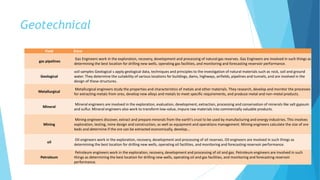
Geotechnical
Field Intro
gas pipelines
Gas Engineers work in the exploration, recovery, development and processing of natural gas reserves. Gas Engineers are involved in such things as
determining the best location for drilling new wells, operating gas facilities, and monitoring and forecasting reservoir performance.
Geological
soil samples Geological s apply geological data, techniques and principles to the investigation of natural materials such as rock, soil and ground
water. They determine the suitability of various locations for buildings, dams, highways, airfields, pipelines and tunnels, and are involved in the
design of these structures.
Metallurgical
Metallurgical engineers study the properties and characteristics of metals and other materials. They research, develop and monitor the processes
for extracting metals from ores, develop new alloys and metals to meet specific requirements, and produce metal and non-metal products.
Mineral
Mineral engineers are involved in the exploration, evaluation, development, extraction, processing and conservation of minerals like salt gypsum
and sulfur. Mineral engineers also work to transform low-value, impure raw materials into commercially valuable products.
Mining
Mining engineers discover, extract and prepare minerals from the earth's crust to be used by manufacturing and energy industries. This involves
exploration, testing, mine design and construction, as well as equipment and operations management. Mining engineers calculate the size of ore
beds and determine if the ore can be extracted economically, develop...
oil
Oil engineers work in the exploration, recovery, development and processing of oil reserves. Oil engineers are involved in such things as
determining the best location for drilling new wells, operating oil facilities, and monitoring and forecasting reservoir performance.
Petroleum
Petroleum engineers work in the exploration, recovery, development and processing of oil and gas. Petroleum engineers are involved in such
things as determining the best location for drilling new wells, operating oil and gas facilities, and monitoring and forecasting reservoir
performance.
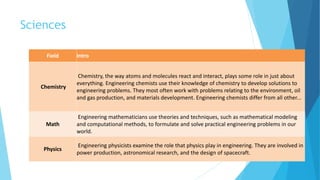
Sciences
Field Intro
Chemistry
Chemistry, the way atoms and molecules react and interact, plays some role in just about
everything. Engineering chemists use their knowledge of chemistry to develop solutions to
engineering problems. They most often work with problems relating to the environment, oil
and gas production, and materials development. Engineering chemists differ from all other...
Math
Engineering mathematicians use theories and techniques, such as mathematical modeling
and computational methods, to formulate and solve practical engineering problems in our
world.
Physics
Engineering physicists examine the role that physics play in engineering. They are involved in
power production, astronomical research, and the design of spacecraft.

Engineering - Iinformation for teenagers

  • 1.
  • 2.
    Introduction  The creativeapplication of scientific principles to design or develop structures, machines, apparatus, or manufacturing processes, or works utilizing them singly or in combination; or to construct or operate the same with full cognizance of their design; or to forecast their behavior under specific operating conditions; all as respects an intended function, economics of operation or safety to life and property.
  • 5.
    Main Braches Chemical engineering– The application of physics, chemistry, biology, and engineering principles in order to carry out chemical processes on a commercial scale, such as petroleum refining, microfabrication, fermentation, and biomolecule production. Civil engineering – The design and construction of public and private works, such as infrastructure (airports, roads, railways, water supply and treatment etc.), bridges, dams, and buildings. Electrical engineering – The design, study and manufacture of various electrical and electronic systems, such as electrical circuits, generators, motors, electromagnetic/electromechanical devices, electronic devices, electronic circuits, optical fibers, optoelectronic devices, computer systems, telecommunications, instrumentation, controls, and electronics. Mechanical engineering – The design and manufacture of physical or mechanical systems, such as power and energy systems, aerospace/aircraft products, weapon systems, transportation products, engines, compressors, powertrains, kinematic chains, vacuum technology, and vibration isolation equipment.
  • 6.
    Branches Chemical Civil ElectricalMechanical Interdisciplinary Biomolecular Environmental Computer Acoustical Aerospace Materials Geotechnical Electronic Manufacturing Agricultural Molecular Structural Optical Thermal Applied Process Mining Power Sports Biomedical Corrosion Transport Vehicle Building services Water resources Power plant Energy Energy Railway Mechatronics Military Nano Nuclear Petroleum Textile
  • 7.
    Chemical Field Intro Agricultural Agricultural engineerslook for solutions to problems involving the use of plants, animals and the natural environment. In the past, they focused largely on improvements to crop and livestock production. While this function continues, the scope of practice is widening to include land and resource management, pollution concerns, machinery for growing... Biological and Biosystems Biological and Biosytems Engineers draw on the biotechnologies found in the food, pharmaceutical, petroleum and textiles industries and combine them with engineering design. Engineers in these areas may develop processes in which microorganisms produce antibiotics more efficiently, or conduct research into how microbes can be used to digest oil spills. Chemical Chemical engineers apply principles of chemistry, mathematics and physics to the design and operation of industrial equipment and methods for the manufacture of chemical products. The fibers in clothing, soaps and detergents, leather, paints and plastics are all designed and produced by chemical engineers. Environmental - wind turbines Environmental engineers develop feasible solutions to problems affecting the welfare of humans and nature. They work to prevent pollution of the environment by designing systems of air and water quality control, vibration and noise reduction, and hazardous waste disposal. They also work to clean up contaminated soil, water and air. Food s Food engineers apply the concepts and principles of engineering to the conversion of raw food stuffs into safe consumer products of the highest possible quality. They work in the areas of food handling, processing, packaging and distribution. Forestry Forestry engineers study the effects of industrialization on nature, silviculture, hydrology and renewable resources. They are involved in the development of sustainable forestry as well as the design of lumber harvesting and processing equipment. Material Material engineers study the properties of existing materials, find new ways to work with them and develop new materials. Material engineers work in a variety of fields. For example, the petrochemical industry requires material engineers because many modern materials, such as synthetic rubbers and plastics, are made from the by-products of petroleum... Plastics Plastics engineers study the properties of polymer materials. They also design machines used to manipulate and shape plastics.
  • 8.
    Civil Field Intro Building Building engineersacquire knowledge in the planning, design, construction, operation, renovation and maintenance of buildings, together with an understanding of impacts on the surrounding environment. Building engineers explore all phases in the life cycle of a building. They identify problems and find appropriate solutions to improve the quality of living... Bridges Civil engineering is one of the oldest types of engineering. It involves the design, construction and management of municipal infrastructure, highways, railways, transit systems, airports, harbours, bridges, tunnels and buildings. Civil engineers also ensure the availability of high quality water supply and sewage treatment facilities. Construction Construction engineers are involved in all aspects of construction projects. They are responsible for overseeing the constructing process from planning through delivery. Water resource Water resource engineers protect water supplies and ensure that development of new resources does not disrupt natural processes and water tables. They help in the assessment of pollution sources, the control of flood damage and soil erosion, and the resolution of conflicts over water reserves.
  • 9.
    Electrical Field Intro Communications -GPS Communications engineers plan, analyze, design, implement, operate, test, maintain and manage communications systems and networks. They play a key role in the ongoing development of the Internet and associated technologies. Computers Engineers who specialize in electronic systems are concerned with the design, analysis and manufacture of electronic circuits and devices. Electrical Electrical engineers are involved in the generation, production, transmission, distribution and application of electrical energy Electromechanical Systems Electromechanical systems engineering focuses on all the devices which make electrical and mechanical systems work together. People in this field often work for the automotive, power production or airline industries. Electronic systems Engineers who specialize in electronic systems are concerned with the design, analysis and manufacture of electronic circuits and devices. Software Software engineers are trained for the specification, design, development and maintenance of software systems and products. They apply both the principles of engineering and computer science in the design of large-scale and embedded software control systems.
  • 10.
    Mechanical Field Intro Aerospace Aerospace engineersare responsible for the research, design and production of aircraft, spacecraft, aerospace equipment, satellites and missiles. Work done by aerospace engineers has made such things as speedy mail delivery and moon travel possible. Canadian aerospace engineers designed the Canadarm used on the Space Shuttle and Space Station Alpha. Automotive Automotive engineers design, build, maintain, and operate self - propelled vehicles for use on land or sea, in air or space. Biomedical Biomechanical and biomedical engineering combine the discipline of mechanical engineering with human anatomy and physiology. Work in this area may include designing prostheses, developing movement systems for people with spinal injuries, and refining equipment for athletes in high-performance sports. Geotechnical - geomatics Geomatics engineers collect, display and analyze data about the Earth's surface and its gravity fields for such uses as mapping, legal boundary delineation, navigation and monitoring changes in the environment. Much of their information comes from images provided by the network of satellites orbiting the earth. Geomatics engineers also help airplane... Mechanical Mechanical engineers use the principles of mathematics, material science, physics and economics to design, manufacture and maintain mechanical equipment. Our household appliances, ventilation systems, cars, ships and airplanes have been designed, tested and manufactured by mechanical engineers. Naval Naval architectural engineers and ocean engineers conceive, design and construct ships, offshore structures and other marine vehicles. They may work in design, shipbuilding, fisheries, transportation, national defense, or the oil and gas industry.
  • 11.
    Management Field Intro Industrial / Manufacturing Industrialengineers and Manufacturing engineers use their expertise in equipment, material, procedures, human resources and production methods to assist organizations in improving their efficiency, effectiveness and productivity. Industrial engineers are concerned with the management side of operations, while Manufacturing engineers focus on the... Integrated Integrated and Unified Engineering are interdisciplinary fields that recognize that the trend in industry is towards diversity and sophistication. Engineers in these two fields follow a general course in which they study aspects of all the major engineering fields - civil, mechanical, electrical, chemical etc. Engineers with this kind of general background... Production Production engineers design, control, and continuously improve integrated systems of personnel, materials, machinery and money that produce goods and services. Their goal is to produce goods and to provide services of high quality in a timely, cost-efficient manner. Systems Systems engineers assist and support policy-making, planning, decision-making and associated resource allocation or action deployment. They study the interaction of science, organizations and the environment.
  • 12.
    Geotechnical Field Intro gas pipelines GasEngineers work in the exploration, recovery, development and processing of natural gas reserves. Gas Engineers are involved in such things as determining the best location for drilling new wells, operating gas facilities, and monitoring and forecasting reservoir performance. Geological soil samples Geological s apply geological data, techniques and principles to the investigation of natural materials such as rock, soil and ground water. They determine the suitability of various locations for buildings, dams, highways, airfields, pipelines and tunnels, and are involved in the design of these structures. Metallurgical Metallurgical engineers study the properties and characteristics of metals and other materials. They research, develop and monitor the processes for extracting metals from ores, develop new alloys and metals to meet specific requirements, and produce metal and non-metal products. Mineral Mineral engineers are involved in the exploration, evaluation, development, extraction, processing and conservation of minerals like salt gypsum and sulfur. Mineral engineers also work to transform low-value, impure raw materials into commercially valuable products. Mining Mining engineers discover, extract and prepare minerals from the earth's crust to be used by manufacturing and energy industries. This involves exploration, testing, mine design and construction, as well as equipment and operations management. Mining engineers calculate the size of ore beds and determine if the ore can be extracted economically, develop... oil Oil engineers work in the exploration, recovery, development and processing of oil reserves. Oil engineers are involved in such things as determining the best location for drilling new wells, operating oil facilities, and monitoring and forecasting reservoir performance. Petroleum Petroleum engineers work in the exploration, recovery, development and processing of oil and gas. Petroleum engineers are involved in such things as determining the best location for drilling new wells, operating oil and gas facilities, and monitoring and forecasting reservoir performance.
  • 13.
    Sciences Field Intro Chemistry Chemistry, theway atoms and molecules react and interact, plays some role in just about everything. Engineering chemists use their knowledge of chemistry to develop solutions to engineering problems. They most often work with problems relating to the environment, oil and gas production, and materials development. Engineering chemists differ from all other... Math Engineering mathematicians use theories and techniques, such as mathematical modeling and computational methods, to formulate and solve practical engineering problems in our world. Physics Engineering physicists examine the role that physics play in engineering. They are involved in power production, astronomical research, and the design of spacecraft.