MECHANICS WELDING
L | C | LOGISTICS
PLANT MANUFACTURING AND BUILDING FACILITIES EQUIPMENT
Engineering-Book
ENGINEERING FUNDAMENTALS AND HOW IT WORKS
April 2020
Expertise in Manufacturing Process Engineering Optimization Solutions & Industrial Engineering Projects Management
Supply Chain Manufacturing & DC Facilities Logistics Operations Planning Management
Welding
1. Strength of deposited weld material
2. Type of joint and weld.
3. Size of weld ..important
4. Location of weld in relation to parts joined.
5. Types of stress to which the weld is subjected
6. Conditions under which weld is carried out
7. Type of equipment used for welding
8. Skill of welder
Variables related to welded joints
Welding
Welding
Guidance Principles
A generous factor of safety should be used (3 to 5) and if fluctuating loads are present
then additional design margins should be included to allow for fatigue
Use the minimum amount of filler material consistent with the job requirement
Try to design joint such that load path is not through the weld
For the direct loading case the butt weld stresses are tensile/ compressive σ t for the fillet
welds the stresses are assumed to be shear τ s applied to the weld throat.
For butt welded joints subject to bending the butt weld stresses result from a
tensile/compressive stress σ b and a direct shear stress τ s .
In these cases the design basis stress should be
σ r = Sqrt (σ b
2 + 4τ s
2)
The stresses from joints subject to torsion loading include shear stress from the applied load and
shear stresses from the torque loading. The resulting stresses should be added vectorially taking
care to choose the location of the highest stresses
Welding
Welding
Welding
Welding
Method of
Loading
Weldment
Stress in
Weld
σ b
τ s
Weld
size (h)
Weldment
Stress in
Weld
σ b
τ s
Weld size
(h)
Weldment
Stress in
Weld
τ b
τ s
Weld size
(h)
Welding
Method of
Loading
Weldment
Stress in
Weld
σ b
τ s
Weld size
(h)
Weldment
Stress in
Weld
σ b
τ s
Weld size
(h)
Weldment
Stress in
Weld
τ b
τ s
Weld size
(h)
Welding
The method of assessing fillet welds groups treating welds as lines is reasonably safe and
conservative and is very convenient to use.
a) Weld subject to bending....See table below for typical unit areas and unit Moments of Inertia
A fillet weld subject to bending is easily assessed as follows.
1) The area of the fillet weld A u..(unit thickness) is calculated assuming the weld is one unit thick..
2) The (unit) Moment of Inertia I u is calculated assuming the weld is one unit thick..
3) The maximum shear stress due to bending is determined...τ b = M.y/I u
4) The maximum shear stress due to direct shear is determined.. τ s = P /A
5) The resultant stress τ r = Sqrt (τ b
2
+ τ s
2
)
6) By comparing the design strength p w with the resultant stress τ r the value of the weld throat
thickness is calculated and then the weld size.
i.e. if the τ r /p w = 5 then the throat thickess t = 5 units and the weld leg size h = 1,414t
Welding
Welding
Example of Weld in Torsion..
P = Applied load = 10 000N
P w = Design Strength = 220 N/mm 2
(Electrode E35 steel S275) Design Strength
b = 120mm.
d = 150 mm
x = b2
/ 2(b+d) = 27mm.. (From table below)
y = d2
/ 2(b+d) = 42mm..(From table below)
Welding
Example of Weld in Bending..
P= 30000 Newtons
d= 100mm
b= 75mm
y = 50mm
Design Stress p w = 220 N/mm 2
(Electrode E35 steel S275) Design Strength
Moment = M = 30000*60=18.10 5
Nmm
The angle of the resulting specific load to the horizontal element
= arctan(85,71/166,5)= 27,5o
.
This is an angle with the weld throat θ = 45o
+ 27,5o
= 72,5o
Referring to weld capacities table below.Weld Capacities K is calculated at 1,36 for this resultant
direction of forces.
PT = a.K.pwfor a E35 Weld electrode used with S275 steel
pw = 220 N/mm2
and therefore PT = a*300N/mm2
..
A 3mm weld (a = 2,1mm) therefore will therefore have a design capacity of 630 N/mm run and will
easily be able to support the load of 186,86 N per mm run
Welding
It is accepted that it is reasonably accurate to use properties based on unit weld thickness in
calculation to determine the strength of welds as shown in the examples on this page. The weld
properties Ixx Iyy and J are assumed to be proportional to the weld thickness. The typical accuracy of
this method of calculation is shown below...
This is illustrated in the tabled values below
d b h Ixx Iyy J= Ixx +Iyy
Accurate 3 60 50 955080 108000 1063080
Simple 3 60 50 900000 108000 1008000
Error 6% 0 5%
Welding
Weld
Throat Area
Unit Area
Location of
COG
x
y
I xx-(unit) J-(Unit)
Welding
-
-
Welding
The weld loading should be such that
{ (FL/PL) 2
+ (FT/PT) 2
} ≤ 1
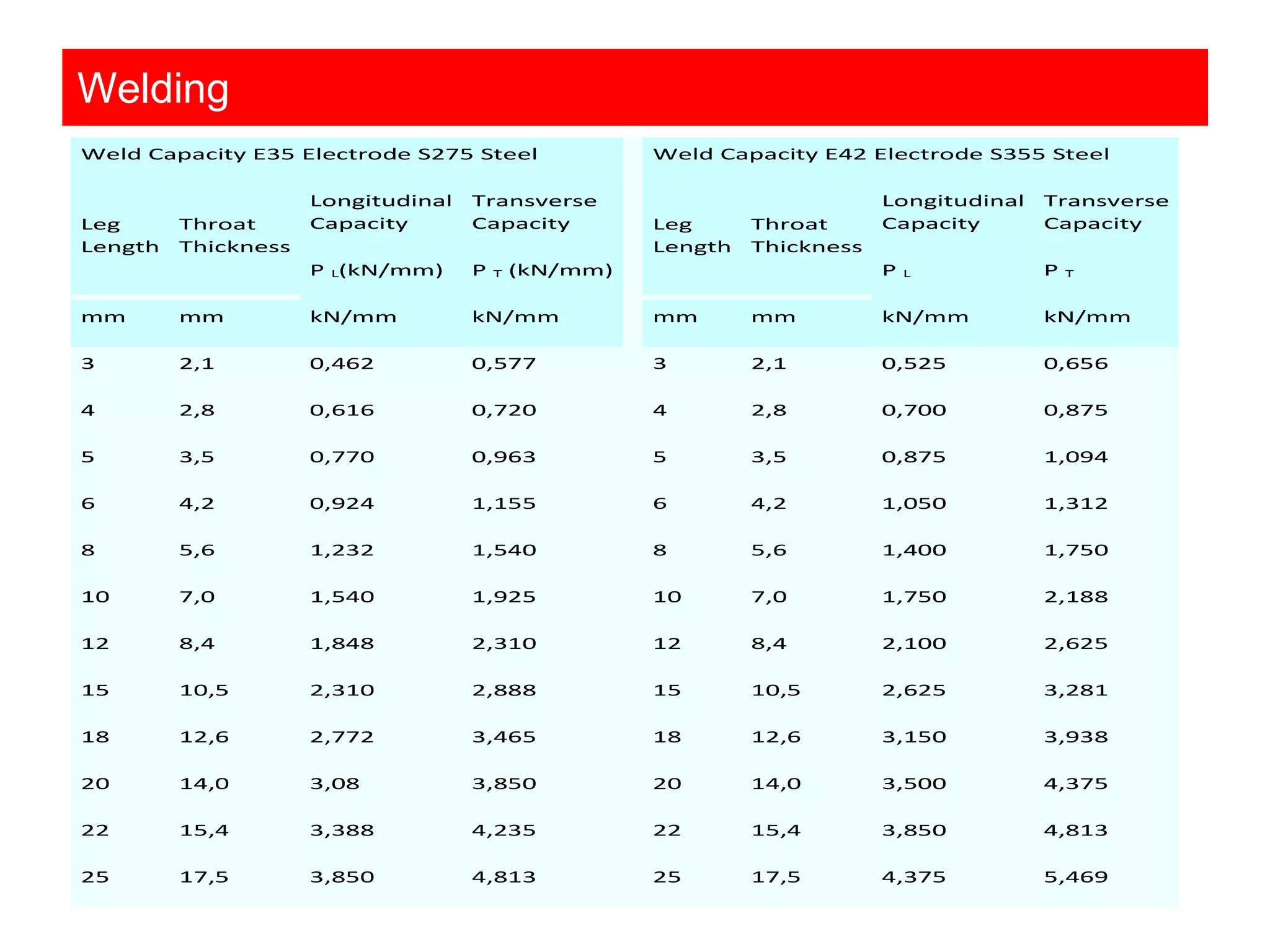
The following table is in accord with data in BS 5950 part 1. Based on design strengths as shown in
table below ... Design Strength
PL = a.pw
PT = a.K.pw
a = weld throat size.
K =1,25 √ (1,5 / (1 + Cos 2
θ )
PT based on elements transmitting forces at 90o i.e θ = 45o and K = 1,25
Welding
Weld Capacity E35 Electrode S275 Steel Weld Capacity E42 Electrode S355 Steel
Leg
Length
Throat
Thickness
Longitudinal
Capacity
Transverse
Capacity Leg
Length
Throat
Thickness
Longitudinal
Capacity
Transverse
Capacity
P L(kN/mm) P T (kN/mm) P L P T
mm mm kN/mm kN/mm mm mm kN/mm kN/mm
3 2,1 0,462 0,577 3 2,1 0,525 0,656
4 2,8 0,616 0,720 4 2,8 0,700 0,875
5 3,5 0,770 0,963 5 3,5 0,875 1,094
6 4,2 0,924 1,155 6 4,2 1,050 1,312
8 5,6 1,232 1,540 8 5,6 1,400 1,750
10 7,0 1,540 1,925 10 7,0 1,750 2,188
12 8,4 1,848 2,310 12 8,4 2,100 2,625
15 10,5 2,310 2,888 15 10,5 2,625 3,281
18 12,6 2,772 3,465 18 12,6 3,150 3,938
20 14,0 3,08 3,850 20 14,0 3,500 4,375
22 15,4 3,388 4,235 22 15,4 3,850 4,813
25 17,5 3,850 4,813 25 17,5 4,375 5,469
Welding
Design Strength p w of fillet welds
Electrode classification
Steel Grade
35 43 50
N/mm2
N/mm2
N/mm2
S275 220 220 220
S355 220 250 250
S460 220 250 280
Welding
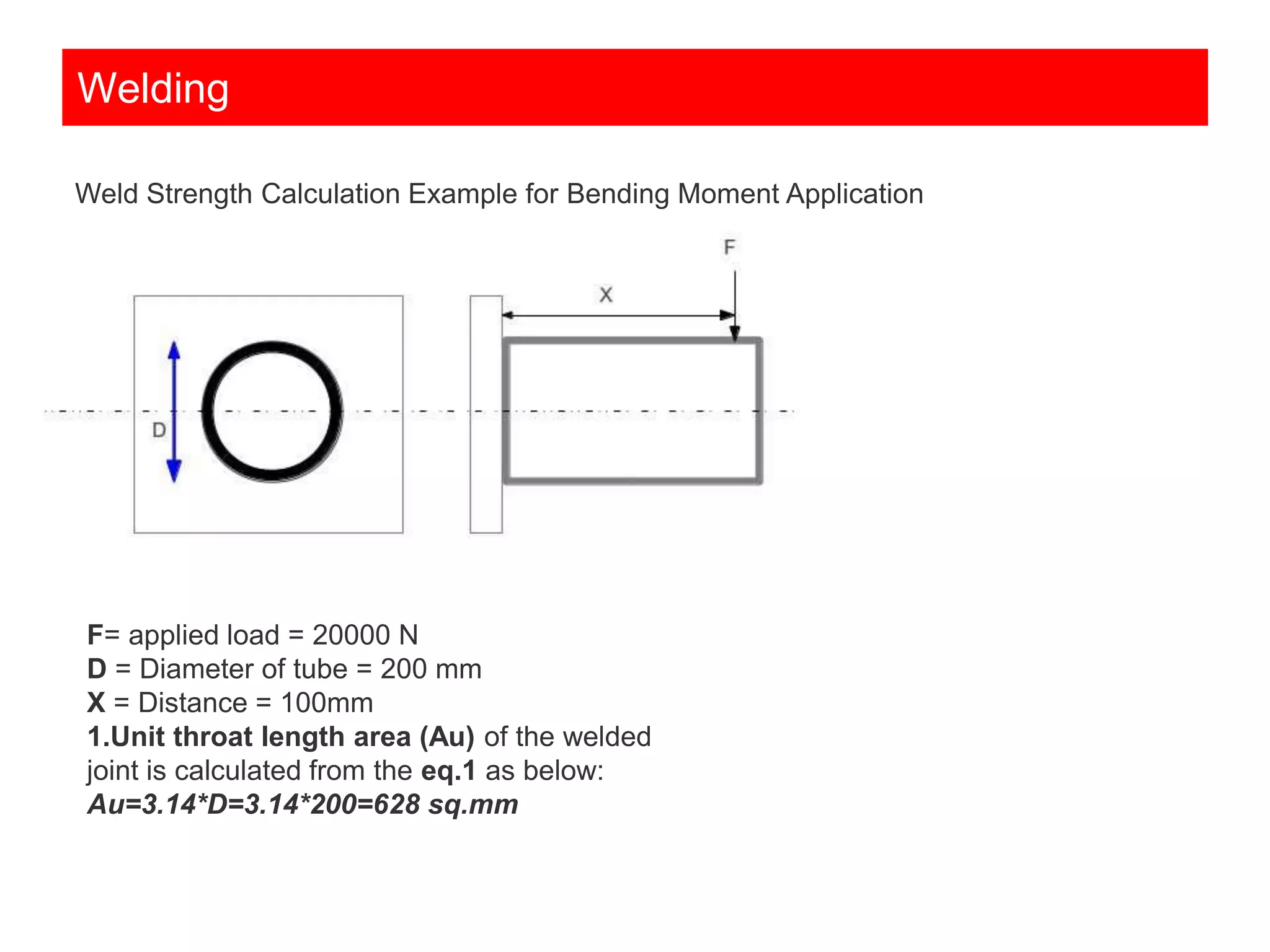
Weld Strength Calculation Example for Bending Moment Application
F= applied load = 20000 N
D = Diameter of tube = 200 mm
X = Distance = 100mm
1.Unit throat length area (Au) of the welded
joint is calculated from the eq.1 as below:
Au=3.14*D=3.14*200=628 sq.mm
Welding
2.Design strength (Pw) is calculated from the eq.2 as:Pw=0.5*fu=0.5*430 = 215 N/sq.
Mm
Where,
fu is the ultimate tensile stress of the parent material.
Assuming the parent material as S275 which has ultimate stress value (fu) 430 N/sq.mm.
3.Unit area moment of inertia (Iu) for the circular welded area around the tube can be
calculated asIu=3.14*(D/2)*(D/2)*(D/2)=3.14*200*200*200/8=3140000 mm3
Where,
3.14 is the value of PI.
4.Direct shear stress (τs) for the fillet welded connection is calculated from
the eq.3 as:τs=F/Au=20000/628=31.87 N/sq.mm
Welding
5.Shear stress due to bending ( τb) is calculated from the eq.4 as:
τb=M*Y/Iu=F*X*0.5*D/Iu= 20000*100*0.5*200/3140000 = 63.69 N/sq.mm
Where,
M is the bending moment for the applied force
Y is the distance between the X-X axis and the extreme fiber of the welded cross section,
it is radius for the circular cross section.
6.Resultant stress (τ) can be found out after weld stress analysis calculation by using
the eq.5 as:
τ=√(τs* τs + τb* τb)=(31.78*31.78+63.69*63.69)=71.17 N/sq.mm or Mpa
7.Weld throat size (t) to be calculated using the eq.6 like:
t= τ / Pw=71.17 / 215= 0.331 mm
8.Weld leg length (L) need to be find out using the eq.7 as:
L=1.414*t = 1.414*0.331 = 0.468 mm
So, from the fillet weld size calculation example we found that the required minimum weld
leg length to withstand the weld force is to be 0.468 mm, we will take the 3mm as the
weld size
Welding
Welding
Welding
Welding
Welding
Ultrasonic Testing Of Welds
Ultrasonic testing technology is based on the ability
of high-frequency oscillations (about 20,000 Hz) to
propagate into the metal and be reflected from
surface scratches, voids, and other discontinuities.
Artificially created, directed diagnostic wave enters
into the tested material and in the case of a defect
deviates from its normal propagation.The nature of
the defect can
be recognized by graphical and parametric readings
Welding
For example:
 distance to the fault – through the propagation time of the ultrasonic wave in the tested
material;
 relative size of the defect – through the amplitude of the reflected pulse.
There are five main methods of ultrasonic testing, which are used in the industry, and
which differ only in the way of registration and evaluation of the data:
 shadow method (control of reducing the amplitude of the ultrasonic vibration of transmitted
and reflected pulses);
 mirror-shadow method (detect defects in welds through the attenuation coefficient of the
reflected vibrations);
 echo-mirror method or “tandem” (which means to use two machines which working
together and from different directions detect the defects);
 delta method (control of ultrasonic energy, which is re-emitted from the defect);
 echo method (registration of the reflected signal from the defect).
Welding
The procedure of the inspection:
 Remove all the paint and rust from welding seams and of the area 50 – 70 mm on both
sides.
 For more correct results of UFD, it is required to provide a good passing of ultrasonic
vibrations. Therefore, the metal surface around the weld seam and also the weld seam
itself should be treated with “couplet” or any other liquid like of that kind (transformer,
turbine, machine oil or grease, glycerin, etc.).
 The device is to be pre-configured for the specific tasks:
– for thickness up to 20 mm – standard configuration (notches);
– for thickness over than 20 mm – configure DGS diagrams;
– for quality testing of the welds – configure AVG diagrams.
Welding
 The transducer is moved zigzag along the seam and at the same time trying to turn around
its axis at 10-15 degrees.
 At occurrence of stable flaw signal move the transducer again and again. Find the position,
where the flaw signal will show it’s maximum.
 Make sure that the welding steam itself does not cause such reflection of the oscillations. It
is often the case during UFD.
 If not, then the position of the defect should be recorded.
 As usual, weld seam inspection is carried out in one or two approaches.
 T-joints (90 degrees weld seams) are checked by echo method.
Welding
Via ultrasonic inspection following defects can be detected:
 cracks in the weld zone;
 pores;
 lack of fusion in welded joints;
 stratification of weld metal;
 discontinuities and incomplete fusion of weld joints;
 slack metal in the lower zone of the weld;
 areas which are affected by corrosion;
 areas with the mismatch of chemical composition;
 areas with distortion geometric size.
Categories
 TOP Instruments
 Hardness Testing
 Ultrasonic Testing
 Coating Testing
 Construction Materials Testing
 Magnetic Testing
Welding
Welding
Welding
Ultrasonic flaw detector is designed for nondestructive testing of metals, plastics, glass,
composite materials, weld inspection and thickness measurement of the various products
and structures.
The Flaw detector allows user to detect various defects such as discontinuities, cracks
and heterogeneity of materials in semi-finished products and welded joints, to measure
the depth and coordinates of defects, the thickness of products, the speed of propagation
and attenuation of ultrasonic vibrations (UT) in the material.
Ultrasonic Flaw detector is produced in small housing of optimal size for performing
testing in tight spaces. The device has color display with high resolution (320*480 pixels),
which significantly improves it’s usability.
Welding
7 Most Common Welding Defects, Causes, and Remedies
Welding
Welding defects can be said to be the irregularities formed in a given weld metal as a
result of incorrect welding patterns, wrong welding process, or due to poor welding skills
from the welder’s part. Weld flaws may come in different sizes, shapes, and degrees of
severity.
There are different types of welding defects that can transpire during the welding process.
From porosity and cracking, to burn through and undercut, each has several causes.
However, regardless of the application and material on which they occur, one thing
remains true to all of them; they’re common, costly, cause downtime and loss of
productivity.
Luckily enough, there are various remedies that can help welders minimize these welding
defects. In this article, we shall be discussing the seven most common welding defects,
causes, and remedies plus 2 others.
Welding
What are welding defects?
Welding defects/flaws can be defined as weld surface irregularities, imperfections,
discontinuities, or inconsistencies that are formed in welded parts.
These defects differ from the desired weld bead size, shape, and quality. Welding defects
could occur either from the outside or inside the weld metal.
Defects in weld joints could cause the rejection of parts and assemblies, an increase in
the cost of maintenance, a reduction in performance and could cause catastrophic
failures posing the risks of loss of life and property.
Welding defects and remedies
Mistakes sometimes occurs during a welding process. These could lead to different forms
of welding defects. As a guide, We present to you the seven most common welding
defects and their preventive measures.
Welding
1. Porosity
Porosity usually occurs as a result of weld
contamination. This happens when gas is
trapped inside or along the surface of the weld
metal. Just like other weld defects, Porosity
results in weak welds that may easily collapse.
• Causes of Porosity:
Often, Contaminated or inadequate shielding gas is the common cause of porosity.
However, Porosity could also be caused by using too high gas flow, longer arc,
inadequate electrode deoxidant, and the presence of paint, rust, grease, or oil.
At the same time, having a dirty base metal or extending the welding far beyond the
nozzle could cause porosity.
Additionally, air currents from cooling fans may contaminate the shielding gas envelope
around the weld-puddle, thereby causing porosity.
Another common cause of this welding flaw is poor seal (loose-fitting) in the shielding gas
channel.
Welding
• Remedies for Porosity:
You can remedy the porosity of a weld by; cleaning the materials to be welded before you
begin welding, using correct arc distance, employing the proper welding technique, and
using the right electrodes.
Again, ensure that there is adequate gas flow and replace any gas hoses that may be
causing leaks. Also, when welding outside or in drafty areas, place a welding screen
around the work area. This will help ameliorate porosity issues.
2. Undercutting
Undercutting is a crater or groove that is formed
near the toe of the weld. In this case, the weld
metal fails to fill-in the grooved area resulting in
a weak-weld that is liable to cracking along the
toes.
Welding
• Causes of Undercutting:
Wrong filler metal, excessive heat, fast weld speed, as well as poor welding technique,
may all leads to undercut welding defect on a welding joint.
Also, very high weld current, incorrect use of shielding gas and using the wrong electrode
could cause undercuts.
• Remedies for Undercutting:
Undercutting in welding can be avoided by employing the right welding technique that
does not involve excessive weaving.
Lowering the arc length and minimizing the travel speed of the electrode can also help
prevent undercutting.
Another remedy to undercutting problem is adjusting the angle of the gun to point directly
towards the weld joint.
Welding
3. Burn Through
As the name implies, burn through occurs when
the weld metal penetrates through the base
metal, burning through it. This kind of welding
flaw is most common with soft or thin metals,
especially those that are 1/4″ or less. Also too
much weld penetration can often lead to burn
through.
• Causes of burn through:
The primary cause of burn through is excessive heat. Also having too large root opening
on the weld joint can results in burn through.
• Remedies for burn through:
When burn through occurs, the easiest way to rectify the problem is to lower the voltage
and the wire feed speed.
Also increasing the travel pace can help remedy the problem, especially when welding on
aluminum material.
Increasing the wire extension and using a weaving technique while welding can also help
minimize the potential for burn through.
Welding
4. Incomplete Penetration
Incomplete joint penetration (lack of
penetration) happens when there is a shallow
fusion between the base metal and filler
metal, rather than full penetration of the joint.
It results in a gap, cracks, or even joint failure.
• Causes of incomplete joint penetration:
Incomplete joint penetration could occur when the groove you are welding is too narrow,
and the weld metal does not reach the bottom of the joint.
Improper joint preparation and insufficient heat input are the two primary causes of lack of
penetration. Improper shielding gas mixture and welding wire diameter can also be a
factor.
Also, if you leave too much space between the two metals you are welding, the metals
will not melt together on the first pass and hence results in incomplete penetration.
Welding
• Remedies for incomplete penetration:
There are a number of remedies for incomplete joint penetration; this includes; using
higher wire feed speed and voltage, reducing the travel pace to allow more weld metal
penetrates through the joint, and proper joint design and preparation.
The joint should be prepared in such a way to allow the welder to maintain the proper
wire extension and still access the bottom of the weld joint. Again, ensure that ‘the wire
type and diameters’ and ‘the gas and the gas mixture’ are compatible
5. Cracks
Weld Cracks are the most serious type of welding defects. Weld Cracks are not
acceptable in the welding industry.
However, a crack may occur just about everywhere in a weld; in the weld metal, on the
plate next to the weld metal, or anyplace affected by intense heat.
The three major types of weld cracks are: Hot cracks, cold cracks, and crater cracks
Welding
• Causes of weld cracks:
Weld Crack could be caused by so many things such as base metal contamination, poor
joint design, failure to preheat before welding, low welding current, high welding speed,
using hydrogen when welding ferrous materials and welding at too high voltage.
• Remedies for weld cracks:
You can prevent this type of weld flaw by using the right metal. Proper joint design and
preparation is also another way to prevent cracking. Crater cracking can be prevented by
using a backfilling technique. Right Selection of filler metal and shielding gas can also
help prevent cracking problems.
6. Incomplete Fusion
Incomplete fusion occurs when the weld
metal fails to properly fuse with the base
metal, or when the individual weld beads
don’t fuse together. This type of weld
defect is also referred to as cold lap.
Welding
Causes of incomplete fusion
Incorrect gun angle is the most common cause of incomplete fusion. However,
contaminants on the base metal and insufficient heat can also cause this weld defect.
In some instances, too short arc length, very high travel speed, too low welding
amperage or when the electrode size is too small for the thickness of the metal you are
welding, all could result to incomplete fusion
• Remedies for incomplete fusion:
The very first thing to do to prevent this weld flaw is to properly clean the base metal
before you start the welding; make sure that the base metal is free of oil, grease, dirt or
other debris.
Make sure the weld angle is between 0 to 15 degrees; this will allow you to fully access
the groove of the weld.
Also, for joints that require weaving technique, holding the arc on the sidewall for some
time is very vital to help prevent this type of defect. Ensure that there is enough heat input
to coalesce the base metal and the weld metal fully.
Welding
7. Slag Inclusions
Slag is the waste material that is usually
formed while welding, bits of this solid
waste material may accidentally be
incorporated into the weld and causes
contamination.
• Causes of slag inclusions:
Some of the common causes of slag inclusions include failure to properly clean a welding
pass before applying the next pass, incorrect welding angle, incorporation of flux from
stick welding electrode, and too low welding amperage.
8. Warpage
Warpage is an unwanted distortion in the
shape of a piece of metal. This occurs when
the welder fails to properly control the
expansion and contraction of the base
material.
Welding
• Causes of warpage:
Warpage may arise when the welder clamps the welding joints too tightly, welding a piece
of metal over and over again can also cause the metal to warp.
When welding a T-joint, the vertical part of the ‘T’ may sometimes pull itself towards the
weld. Also, the more heat input you use, the more the chances you have to end up with a
warpage.
• Remedies for warpage:
Warpage can be prevented by using only the required amount of heat. Opting for
moderate travel speed and wire feed speed while welding can also help curtail the
problem of warpage
Welding
9. Overlap
overlap occurs when the weld face extends far above the weld toe.
In this case, the weld metal rollout and forms an angle less than 90
degrees.
• Causes of Overlap
Overlap welding defect can arise when using large electrodes greater than the metal size.
High welding current and the use of improper welding technique can also cause this
defect.
• Remedies for Overlap
Overlap welding defect can be avoided by employing the correct welding Technique,
using small Welding electrode and less welding has.
Welding
Conclusion
While welding defects and discontinuities may arise due to the welder’s poor welding
skills, however, even the most skilled and experienced welders may in one way or
another experience weld defects.
But the only way to stop these welding irregularities from negatively affecting productivity
and increasing the cost of operations is by identifying and rectifying the problems as
quickly as possible.
Thank You
L | C | LOGISTICS
PLANT MANUFACTURING AND BUILDING FACILITIES EQUIPMENT
Engineering-Book
ENGINEERING FUNDAMENTALS AND HOW IT WORKS
MECHANICS WELDING

Engineering plant facilities 15 mechanics welding

  • 1.
    MECHANICS WELDING L |C | LOGISTICS PLANT MANUFACTURING AND BUILDING FACILITIES EQUIPMENT Engineering-Book ENGINEERING FUNDAMENTALS AND HOW IT WORKS April 2020 Expertise in Manufacturing Process Engineering Optimization Solutions & Industrial Engineering Projects Management Supply Chain Manufacturing & DC Facilities Logistics Operations Planning Management
  • 2.
    Welding 1. Strength ofdeposited weld material 2. Type of joint and weld. 3. Size of weld ..important 4. Location of weld in relation to parts joined. 5. Types of stress to which the weld is subjected 6. Conditions under which weld is carried out 7. Type of equipment used for welding 8. Skill of welder Variables related to welded joints
  • 3.
  • 4.
    Welding Guidance Principles A generousfactor of safety should be used (3 to 5) and if fluctuating loads are present then additional design margins should be included to allow for fatigue Use the minimum amount of filler material consistent with the job requirement Try to design joint such that load path is not through the weld For the direct loading case the butt weld stresses are tensile/ compressive σ t for the fillet welds the stresses are assumed to be shear τ s applied to the weld throat. For butt welded joints subject to bending the butt weld stresses result from a tensile/compressive stress σ b and a direct shear stress τ s . In these cases the design basis stress should be σ r = Sqrt (σ b 2 + 4τ s 2) The stresses from joints subject to torsion loading include shear stress from the applied load and shear stresses from the torque loading. The resulting stresses should be added vectorially taking care to choose the location of the highest stresses
  • 5.
  • 6.
  • 7.
  • 8.
    Welding Method of Loading Weldment Stress in Weld σb τ s Weld size (h) Weldment Stress in Weld σ b τ s Weld size (h) Weldment Stress in Weld τ b τ s Weld size (h)
  • 9.
    Welding Method of Loading Weldment Stress in Weld σb τ s Weld size (h) Weldment Stress in Weld σ b τ s Weld size (h) Weldment Stress in Weld τ b τ s Weld size (h)
  • 10.
    Welding The method ofassessing fillet welds groups treating welds as lines is reasonably safe and conservative and is very convenient to use. a) Weld subject to bending....See table below for typical unit areas and unit Moments of Inertia A fillet weld subject to bending is easily assessed as follows. 1) The area of the fillet weld A u..(unit thickness) is calculated assuming the weld is one unit thick.. 2) The (unit) Moment of Inertia I u is calculated assuming the weld is one unit thick.. 3) The maximum shear stress due to bending is determined...τ b = M.y/I u 4) The maximum shear stress due to direct shear is determined.. τ s = P /A 5) The resultant stress τ r = Sqrt (τ b 2 + τ s 2 ) 6) By comparing the design strength p w with the resultant stress τ r the value of the weld throat thickness is calculated and then the weld size. i.e. if the τ r /p w = 5 then the throat thickess t = 5 units and the weld leg size h = 1,414t
  • 11.
  • 12.
    Welding Example of Weldin Torsion.. P = Applied load = 10 000N P w = Design Strength = 220 N/mm 2 (Electrode E35 steel S275) Design Strength b = 120mm. d = 150 mm x = b2 / 2(b+d) = 27mm.. (From table below) y = d2 / 2(b+d) = 42mm..(From table below)
  • 13.
    Welding Example of Weldin Bending.. P= 30000 Newtons d= 100mm b= 75mm y = 50mm Design Stress p w = 220 N/mm 2 (Electrode E35 steel S275) Design Strength Moment = M = 30000*60=18.10 5 Nmm The angle of the resulting specific load to the horizontal element = arctan(85,71/166,5)= 27,5o . This is an angle with the weld throat θ = 45o + 27,5o = 72,5o Referring to weld capacities table below.Weld Capacities K is calculated at 1,36 for this resultant direction of forces. PT = a.K.pwfor a E35 Weld electrode used with S275 steel pw = 220 N/mm2 and therefore PT = a*300N/mm2 .. A 3mm weld (a = 2,1mm) therefore will therefore have a design capacity of 630 N/mm run and will easily be able to support the load of 186,86 N per mm run
  • 14.
    Welding It is acceptedthat it is reasonably accurate to use properties based on unit weld thickness in calculation to determine the strength of welds as shown in the examples on this page. The weld properties Ixx Iyy and J are assumed to be proportional to the weld thickness. The typical accuracy of this method of calculation is shown below... This is illustrated in the tabled values below d b h Ixx Iyy J= Ixx +Iyy Accurate 3 60 50 955080 108000 1063080 Simple 3 60 50 900000 108000 1008000 Error 6% 0 5%
  • 15.
    Welding Weld Throat Area Unit Area Locationof COG x y I xx-(unit) J-(Unit)
  • 16.
  • 17.
    Welding The weld loadingshould be such that { (FL/PL) 2 + (FT/PT) 2 } ≤ 1 The following table is in accord with data in BS 5950 part 1. Based on design strengths as shown in table below ... Design Strength PL = a.pw PT = a.K.pw a = weld throat size. K =1,25 √ (1,5 / (1 + Cos 2 θ ) PT based on elements transmitting forces at 90o i.e θ = 45o and K = 1,25
  • 18.
    Welding Weld Capacity E35Electrode S275 Steel Weld Capacity E42 Electrode S355 Steel Leg Length Throat Thickness Longitudinal Capacity Transverse Capacity Leg Length Throat Thickness Longitudinal Capacity Transverse Capacity P L(kN/mm) P T (kN/mm) P L P T mm mm kN/mm kN/mm mm mm kN/mm kN/mm 3 2,1 0,462 0,577 3 2,1 0,525 0,656 4 2,8 0,616 0,720 4 2,8 0,700 0,875 5 3,5 0,770 0,963 5 3,5 0,875 1,094 6 4,2 0,924 1,155 6 4,2 1,050 1,312 8 5,6 1,232 1,540 8 5,6 1,400 1,750 10 7,0 1,540 1,925 10 7,0 1,750 2,188 12 8,4 1,848 2,310 12 8,4 2,100 2,625 15 10,5 2,310 2,888 15 10,5 2,625 3,281 18 12,6 2,772 3,465 18 12,6 3,150 3,938 20 14,0 3,08 3,850 20 14,0 3,500 4,375 22 15,4 3,388 4,235 22 15,4 3,850 4,813 25 17,5 3,850 4,813 25 17,5 4,375 5,469
  • 19.
    Welding Design Strength pw of fillet welds Electrode classification Steel Grade 35 43 50 N/mm2 N/mm2 N/mm2 S275 220 220 220 S355 220 250 250 S460 220 250 280
  • 20.
    Welding Weld Strength CalculationExample for Bending Moment Application F= applied load = 20000 N D = Diameter of tube = 200 mm X = Distance = 100mm 1.Unit throat length area (Au) of the welded joint is calculated from the eq.1 as below: Au=3.14*D=3.14*200=628 sq.mm
  • 21.
    Welding 2.Design strength (Pw)is calculated from the eq.2 as:Pw=0.5*fu=0.5*430 = 215 N/sq. Mm Where, fu is the ultimate tensile stress of the parent material. Assuming the parent material as S275 which has ultimate stress value (fu) 430 N/sq.mm. 3.Unit area moment of inertia (Iu) for the circular welded area around the tube can be calculated asIu=3.14*(D/2)*(D/2)*(D/2)=3.14*200*200*200/8=3140000 mm3 Where, 3.14 is the value of PI. 4.Direct shear stress (τs) for the fillet welded connection is calculated from the eq.3 as:τs=F/Au=20000/628=31.87 N/sq.mm
  • 22.
    Welding 5.Shear stress dueto bending ( τb) is calculated from the eq.4 as: τb=M*Y/Iu=F*X*0.5*D/Iu= 20000*100*0.5*200/3140000 = 63.69 N/sq.mm Where, M is the bending moment for the applied force Y is the distance between the X-X axis and the extreme fiber of the welded cross section, it is radius for the circular cross section. 6.Resultant stress (τ) can be found out after weld stress analysis calculation by using the eq.5 as: τ=√(τs* τs + τb* τb)=(31.78*31.78+63.69*63.69)=71.17 N/sq.mm or Mpa 7.Weld throat size (t) to be calculated using the eq.6 like: t= τ / Pw=71.17 / 215= 0.331 mm 8.Weld leg length (L) need to be find out using the eq.7 as: L=1.414*t = 1.414*0.331 = 0.468 mm So, from the fillet weld size calculation example we found that the required minimum weld leg length to withstand the weld force is to be 0.468 mm, we will take the 3mm as the weld size
  • 23.
  • 24.
  • 25.
  • 26.
  • 27.
    Welding Ultrasonic Testing OfWelds Ultrasonic testing technology is based on the ability of high-frequency oscillations (about 20,000 Hz) to propagate into the metal and be reflected from surface scratches, voids, and other discontinuities. Artificially created, directed diagnostic wave enters into the tested material and in the case of a defect deviates from its normal propagation.The nature of the defect can be recognized by graphical and parametric readings
  • 28.
    Welding For example:  distanceto the fault – through the propagation time of the ultrasonic wave in the tested material;  relative size of the defect – through the amplitude of the reflected pulse. There are five main methods of ultrasonic testing, which are used in the industry, and which differ only in the way of registration and evaluation of the data:  shadow method (control of reducing the amplitude of the ultrasonic vibration of transmitted and reflected pulses);  mirror-shadow method (detect defects in welds through the attenuation coefficient of the reflected vibrations);  echo-mirror method or “tandem” (which means to use two machines which working together and from different directions detect the defects);  delta method (control of ultrasonic energy, which is re-emitted from the defect);  echo method (registration of the reflected signal from the defect).
  • 29.
    Welding The procedure ofthe inspection:  Remove all the paint and rust from welding seams and of the area 50 – 70 mm on both sides.  For more correct results of UFD, it is required to provide a good passing of ultrasonic vibrations. Therefore, the metal surface around the weld seam and also the weld seam itself should be treated with “couplet” or any other liquid like of that kind (transformer, turbine, machine oil or grease, glycerin, etc.).  The device is to be pre-configured for the specific tasks: – for thickness up to 20 mm – standard configuration (notches); – for thickness over than 20 mm – configure DGS diagrams; – for quality testing of the welds – configure AVG diagrams.
  • 30.
    Welding  The transduceris moved zigzag along the seam and at the same time trying to turn around its axis at 10-15 degrees.  At occurrence of stable flaw signal move the transducer again and again. Find the position, where the flaw signal will show it’s maximum.  Make sure that the welding steam itself does not cause such reflection of the oscillations. It is often the case during UFD.  If not, then the position of the defect should be recorded.  As usual, weld seam inspection is carried out in one or two approaches.  T-joints (90 degrees weld seams) are checked by echo method.
  • 31.
    Welding Via ultrasonic inspectionfollowing defects can be detected:  cracks in the weld zone;  pores;  lack of fusion in welded joints;  stratification of weld metal;  discontinuities and incomplete fusion of weld joints;  slack metal in the lower zone of the weld;  areas which are affected by corrosion;  areas with the mismatch of chemical composition;  areas with distortion geometric size. Categories  TOP Instruments  Hardness Testing  Ultrasonic Testing  Coating Testing  Construction Materials Testing  Magnetic Testing
  • 32.
  • 33.
  • 34.
    Welding Ultrasonic flaw detectoris designed for nondestructive testing of metals, plastics, glass, composite materials, weld inspection and thickness measurement of the various products and structures. The Flaw detector allows user to detect various defects such as discontinuities, cracks and heterogeneity of materials in semi-finished products and welded joints, to measure the depth and coordinates of defects, the thickness of products, the speed of propagation and attenuation of ultrasonic vibrations (UT) in the material. Ultrasonic Flaw detector is produced in small housing of optimal size for performing testing in tight spaces. The device has color display with high resolution (320*480 pixels), which significantly improves it’s usability.
  • 35.
    Welding 7 Most CommonWelding Defects, Causes, and Remedies
  • 36.
    Welding Welding defects canbe said to be the irregularities formed in a given weld metal as a result of incorrect welding patterns, wrong welding process, or due to poor welding skills from the welder’s part. Weld flaws may come in different sizes, shapes, and degrees of severity. There are different types of welding defects that can transpire during the welding process. From porosity and cracking, to burn through and undercut, each has several causes. However, regardless of the application and material on which they occur, one thing remains true to all of them; they’re common, costly, cause downtime and loss of productivity. Luckily enough, there are various remedies that can help welders minimize these welding defects. In this article, we shall be discussing the seven most common welding defects, causes, and remedies plus 2 others.
  • 37.
    Welding What are weldingdefects? Welding defects/flaws can be defined as weld surface irregularities, imperfections, discontinuities, or inconsistencies that are formed in welded parts. These defects differ from the desired weld bead size, shape, and quality. Welding defects could occur either from the outside or inside the weld metal. Defects in weld joints could cause the rejection of parts and assemblies, an increase in the cost of maintenance, a reduction in performance and could cause catastrophic failures posing the risks of loss of life and property. Welding defects and remedies Mistakes sometimes occurs during a welding process. These could lead to different forms of welding defects. As a guide, We present to you the seven most common welding defects and their preventive measures.
  • 38.
    Welding 1. Porosity Porosity usuallyoccurs as a result of weld contamination. This happens when gas is trapped inside or along the surface of the weld metal. Just like other weld defects, Porosity results in weak welds that may easily collapse. • Causes of Porosity: Often, Contaminated or inadequate shielding gas is the common cause of porosity. However, Porosity could also be caused by using too high gas flow, longer arc, inadequate electrode deoxidant, and the presence of paint, rust, grease, or oil. At the same time, having a dirty base metal or extending the welding far beyond the nozzle could cause porosity. Additionally, air currents from cooling fans may contaminate the shielding gas envelope around the weld-puddle, thereby causing porosity. Another common cause of this welding flaw is poor seal (loose-fitting) in the shielding gas channel.
  • 39.
    Welding • Remedies forPorosity: You can remedy the porosity of a weld by; cleaning the materials to be welded before you begin welding, using correct arc distance, employing the proper welding technique, and using the right electrodes. Again, ensure that there is adequate gas flow and replace any gas hoses that may be causing leaks. Also, when welding outside or in drafty areas, place a welding screen around the work area. This will help ameliorate porosity issues. 2. Undercutting Undercutting is a crater or groove that is formed near the toe of the weld. In this case, the weld metal fails to fill-in the grooved area resulting in a weak-weld that is liable to cracking along the toes.
  • 40.
    Welding • Causes ofUndercutting: Wrong filler metal, excessive heat, fast weld speed, as well as poor welding technique, may all leads to undercut welding defect on a welding joint. Also, very high weld current, incorrect use of shielding gas and using the wrong electrode could cause undercuts. • Remedies for Undercutting: Undercutting in welding can be avoided by employing the right welding technique that does not involve excessive weaving. Lowering the arc length and minimizing the travel speed of the electrode can also help prevent undercutting. Another remedy to undercutting problem is adjusting the angle of the gun to point directly towards the weld joint.
  • 41.
    Welding 3. Burn Through Asthe name implies, burn through occurs when the weld metal penetrates through the base metal, burning through it. This kind of welding flaw is most common with soft or thin metals, especially those that are 1/4″ or less. Also too much weld penetration can often lead to burn through. • Causes of burn through: The primary cause of burn through is excessive heat. Also having too large root opening on the weld joint can results in burn through. • Remedies for burn through: When burn through occurs, the easiest way to rectify the problem is to lower the voltage and the wire feed speed. Also increasing the travel pace can help remedy the problem, especially when welding on aluminum material. Increasing the wire extension and using a weaving technique while welding can also help minimize the potential for burn through.
  • 42.
    Welding 4. Incomplete Penetration Incompletejoint penetration (lack of penetration) happens when there is a shallow fusion between the base metal and filler metal, rather than full penetration of the joint. It results in a gap, cracks, or even joint failure. • Causes of incomplete joint penetration: Incomplete joint penetration could occur when the groove you are welding is too narrow, and the weld metal does not reach the bottom of the joint. Improper joint preparation and insufficient heat input are the two primary causes of lack of penetration. Improper shielding gas mixture and welding wire diameter can also be a factor. Also, if you leave too much space between the two metals you are welding, the metals will not melt together on the first pass and hence results in incomplete penetration.
  • 43.
    Welding • Remedies forincomplete penetration: There are a number of remedies for incomplete joint penetration; this includes; using higher wire feed speed and voltage, reducing the travel pace to allow more weld metal penetrates through the joint, and proper joint design and preparation. The joint should be prepared in such a way to allow the welder to maintain the proper wire extension and still access the bottom of the weld joint. Again, ensure that ‘the wire type and diameters’ and ‘the gas and the gas mixture’ are compatible 5. Cracks Weld Cracks are the most serious type of welding defects. Weld Cracks are not acceptable in the welding industry. However, a crack may occur just about everywhere in a weld; in the weld metal, on the plate next to the weld metal, or anyplace affected by intense heat. The three major types of weld cracks are: Hot cracks, cold cracks, and crater cracks
  • 44.
    Welding • Causes ofweld cracks: Weld Crack could be caused by so many things such as base metal contamination, poor joint design, failure to preheat before welding, low welding current, high welding speed, using hydrogen when welding ferrous materials and welding at too high voltage. • Remedies for weld cracks: You can prevent this type of weld flaw by using the right metal. Proper joint design and preparation is also another way to prevent cracking. Crater cracking can be prevented by using a backfilling technique. Right Selection of filler metal and shielding gas can also help prevent cracking problems. 6. Incomplete Fusion Incomplete fusion occurs when the weld metal fails to properly fuse with the base metal, or when the individual weld beads don’t fuse together. This type of weld defect is also referred to as cold lap.
  • 45.
    Welding Causes of incompletefusion Incorrect gun angle is the most common cause of incomplete fusion. However, contaminants on the base metal and insufficient heat can also cause this weld defect. In some instances, too short arc length, very high travel speed, too low welding amperage or when the electrode size is too small for the thickness of the metal you are welding, all could result to incomplete fusion • Remedies for incomplete fusion: The very first thing to do to prevent this weld flaw is to properly clean the base metal before you start the welding; make sure that the base metal is free of oil, grease, dirt or other debris. Make sure the weld angle is between 0 to 15 degrees; this will allow you to fully access the groove of the weld. Also, for joints that require weaving technique, holding the arc on the sidewall for some time is very vital to help prevent this type of defect. Ensure that there is enough heat input to coalesce the base metal and the weld metal fully.
  • 46.
    Welding 7. Slag Inclusions Slagis the waste material that is usually formed while welding, bits of this solid waste material may accidentally be incorporated into the weld and causes contamination. • Causes of slag inclusions: Some of the common causes of slag inclusions include failure to properly clean a welding pass before applying the next pass, incorrect welding angle, incorporation of flux from stick welding electrode, and too low welding amperage. 8. Warpage Warpage is an unwanted distortion in the shape of a piece of metal. This occurs when the welder fails to properly control the expansion and contraction of the base material.
  • 47.
    Welding • Causes ofwarpage: Warpage may arise when the welder clamps the welding joints too tightly, welding a piece of metal over and over again can also cause the metal to warp. When welding a T-joint, the vertical part of the ‘T’ may sometimes pull itself towards the weld. Also, the more heat input you use, the more the chances you have to end up with a warpage. • Remedies for warpage: Warpage can be prevented by using only the required amount of heat. Opting for moderate travel speed and wire feed speed while welding can also help curtail the problem of warpage
  • 48.
    Welding 9. Overlap overlap occurswhen the weld face extends far above the weld toe. In this case, the weld metal rollout and forms an angle less than 90 degrees. • Causes of Overlap Overlap welding defect can arise when using large electrodes greater than the metal size. High welding current and the use of improper welding technique can also cause this defect. • Remedies for Overlap Overlap welding defect can be avoided by employing the correct welding Technique, using small Welding electrode and less welding has.
  • 49.
    Welding Conclusion While welding defectsand discontinuities may arise due to the welder’s poor welding skills, however, even the most skilled and experienced welders may in one way or another experience weld defects. But the only way to stop these welding irregularities from negatively affecting productivity and increasing the cost of operations is by identifying and rectifying the problems as quickly as possible.
  • 50.
    Thank You L |C | LOGISTICS PLANT MANUFACTURING AND BUILDING FACILITIES EQUIPMENT Engineering-Book ENGINEERING FUNDAMENTALS AND HOW IT WORKS MECHANICS WELDING