@ESRIDublin #ESRIevents#ESRIpublications www.esri.ie
The ENGINE Model: Determining
optimal development of the Irish
electricity sector under different
policy scenarios
DATE
14/03/2019
VENUE
ESRI, Dublin, Ireland
AUTHOR
Desta Fitiwi
Desta.Fitiwi@esri.ie
@ESRIDublin #ESRIevents #ESRIpublications www.esri.ie2
Presentation Outline
• Introduction
• The ENGINE Model
• Application Examples
• Insights from Irish Case Study
• Summary
@ESRIDublin #ESRIevents #ESRIpublications www.esri.ie3
Introduction(1/2)
• EU-wide ambitious targets for emission reduction
• 80% below the 1990 level [EC 2017, 2050 Low-carbon Economy]
• All energy sectors are expected to contribute to this goal.
• In particular, a massive electrification of heating and transport sectors is
anticipated in the coming years.
• And, the energy has to be sourced from renewables and renewables only
• Increased renewable generation and electrification of energy sectors (other
than electricity) is posing new challenges for power system planners.
• Variability and uncertainty
• The location, as well as the level and operation, of each generation resource
is increasingly important.
• Implications on costs, emissions, grid reinforcements and technical issues
• Many commercial and public models exist:
• Integrated energy system models such as TIMES, PRIMES, MESSAGE, POLES,
OSeMOSYS, MARKAL, REDS, NEMS, …………………………., BACKBONE
• Energy models such as PLEXOS, BALMOREL, METIS, NePlan, LEAP, ...
• Power system models such as FAST, WILMAR, Promod, ……, ENGINE
@ESRIDublin #ESRIevents #ESRIpublications www.esri.ie4
Introduction(2/2)
• Also, several models in the extant
literature
• However, most fail to account for
spatial aspects and electricity
network effects.
• Hence, solutions obtained without
considering these effects may prove
infeasible or suboptimal.
• This is especially important in insular
and weakly interconnected systems.
• E.g. for the Irish case, a Copper Plate
assumption may lead to a totally
different expansion solution that is
26% less expensive as compared to
the model that uses a “Physical
Network”.
• The ENGINE model has evolved
because of all these issues.
@ESRIDublin #ESRIevents #ESRIpublications www.esri.ie
The ENGINE Model – What Is It?
Input OutputTools and Methods
5
Electricity Network and Generation INvEstment
@ESRIDublin #ESRIevents #ESRIpublications www.esri.ie6
The ENGINE Model – Key Features(1/3)
Least-cost Holistic Uncertainty
Accuracy
Policy-driven
Infrastructure-driven
@ESRIDublin #ESRIevents #ESRIpublications www.esri.ie7
The ENGINE Model – Key Features(2/3)
• Reasonably accurate representation of the
physical characteristics of power systems via
• Linearized AC optimal power flow based network
model
• Considers both active and reactive power flows in
a linear manner.
• Captures natural voltage magnitude deviations
from nominal values across electric transmission
systems.
• Generally, the model closely resembles the AC
optimal power flow one, which governs flows
in power systems.
@ESRIDublin #ESRIevents #ESRIpublications www.esri.ie8
The ENGINE Model – Key Features(1/3)
• Objective function
• Minimize TC = Investment Cost + O&M Cost +
Unserved Power Cost + Emission Cost
• Constraints:
• Active and reactive power load balances
at each transmission node
(Kirchhoff's current law)
• Flow limits
• Constraints related to network losses
• Active and reactive power flows (Kirchhoff's voltage
law)
• Power production limits
• Logical and budget constraints
• Reactive power source limits
• Renewable portfolio standard (RPS) limit
• Spatial renewable allocation constraints
• System non-synchronous penetration (SNSP) limit
Reactive power
Active power
@ESRIDublin #ESRIevents #ESRIpublications www.esri.ie9
Problem and Solution Structures
@ESRIDublin #ESRIevents #ESRIpublications www.esri.ie10
More Solution Structures
• Rolling horizon with overlaps
• To avoid end-of-horizon effects
• Robust plus “What-if” Solutions
• Backward or forward propagation approach
Planning horizon
@ESRIDublin #ESRIevents #ESRIpublications www.esri.ie11
Model Application Examples
Irish Case Studies
@ESRIDublin #ESRIevents #ESRIpublications www.esri.ie12
About the Irish System
• Irish system data
• Main source is EirGrid
• Represents the network
aggregated at 110 kV or higher
voltage level
• plus generator nodes and
• NI’s transmission network.
• Overall the base case system has
• 676 nodes
• 900 lines and transformers
• 174 generators
• 292 MW pumped hydro
• 10 MW battery storage
@ESRIDublin #ESRIevents #ESRIpublications www.esri.ie13
Four Scenarios
Infrastructure-
driven
Policy-
driven
Demand-
driven
Changing lifestyles
Emerging electricity consumption
E-mobility
E-heating
Renewable
integration
Climate change
Sustainability
Energy security
@ESRIDublin #ESRIevents #ESRIpublications www.esri.ie14
Further Considerations
• Regional weights for onshore wind allocation
• Generation technologies
• CCGT with and without CCS, Coal with and without CCS
• Biomass, Solar PV, Wind onshore, Wind offshore
• Storage
• Battery and Pumped hydro
NUTS3 region IE022 IE012 IE013 IE023 IE024 IE025 IE011
𝜉𝜉𝑟𝑟𝑟𝑟𝑟𝑟 1.00 2.06 2.70 1.79 1.61 1.55 2.07
Cost reduction
(cumulative)
Technology Capex (M€/MW) 2020 2025 2030
Wind onshore 1.4 0.05 0.1 0.2
Wind offshore 3.65 0.05 0.1 0.2
PV 1.5 0.05 0.1 0.2
Biomass 2.25 0.02 0.05 0.1
Coal 0.8 0.05 0.08 0.1
Coal with CCS 2.4 0.05 0.08 0.1
CCGT 1.1 0.05 0.08 0.1
CCGT with CCS 4.4 0.05 0.08 0.1
Emission price (Euros/tons of CO2)
Year Price
2018 17
2020 20
2025 25
2030 30
@ESRIDublin #ESRIevents #ESRIpublications www.esri.ie15
Decommissioning
and
North-south Interconnector
@ESRIDublin #ESRIevents #ESRIpublications www.esri.ie16
Considered Cases
Cases
Variations
Decommissioning Interconnector
Grand plan Yes Yes
No IC Yes No
Status quo gen No Yes
Paralysis No No
Desta Z. Fitiwi, Muireann Lynch and Valentin Bertsch, "Optimal development of electricity generation mix considering fossil fuel phase-
out and strategic multi-area interconnection", ESRI Working Paper No. 616, Feb. 2019 (published).
• 50% RES-E target by 2030
• SNSP level set to 75%
• No storage and HVDC interconnections
@ESRIDublin #ESRIevents #ESRIpublications www.esri.ie17
Generation Expansion Results
0
1000
2000
3000
Grandplan
NoIC
Statusquogen
Paralysis
Grandplan
NoIC
Statusquogen
Paralysis
Grandplan
NoIC
Statusquogen
Paralysis
2020 2025 2030
Newinstalledcapacity(MW)
Onshore CCGT Solar PV Offshore
@ESRIDublin #ESRIevents #ESRIpublications www.esri.ie18
Impact on Emissions
0
5
10
15
20
25
2017 2020 2025 2030
Expectedemissions(MtCO2)
Grand plan No IC Status quo gen Paralysis
• Having high RES-E target may not mean everything
• Emission reductions are driven by decommissioning
@ESRIDublin #ESRIevents #ESRIpublications www.esri.ie19
Grid Expansion Needs (1/2)
0.76
0.8
0.84
0.88
0.92
0.96
1
0 2000 4000 6000 8000
cdf
Time (hours)
Grand plan 2025 Grand plan 2030
Paralysis 2030 Paralysis 2025
The Paralysis scenario leads to more congestion
and hence more grid investment needs
@ESRIDublin #ESRIevents #ESRIpublications www.esri.ie20
Grid Expansion Needs (2/2)
Cases Grand plan No IC Status quo gen Paralysis
Number of components
congested 142 154 151 176
Total congested length (km) 3.509 3,659 4,020 4,435
Congested length-year
(km*hour/year) 9,943 10,354 13,920 15,409
Comparison of congestion across the cases
Paralysis scenario leads to the most grid reinforcement needs
• 35% more congested length compared to that of the Grand plan
scenario
@ESRIDublin #ESRIevents #ESRIpublications www.esri.ie21
Reliability and RES Curtailment
0
5
10
15
2020 2025 2030
Expectedcurtailment
ofwindpower(%)
Grand plan No IC
Status quo gen Paralysis
• “Paralysis” leads to
the highest EENS.
• N-S interconnector
seems to have some
contribution in terms
of reliability.
• But, no visible
differences in RES
curtailments among
the cases
0
0.84
3.5
4.5
0
1
2
3
4
5
Grand plan No IC Status quo
gen
Paralysis
%changeinunservedenergy
comparedto"Grandplan"
@ESRIDublin #ESRIevents #ESRIpublications www.esri.ie22
Effect of Changes in Carbon Price
Grand plan Paralysis
Carbon price (€/tCO2) 20 30 45 55 20 30 45 55
Change in system cost (%) 0.0 +2.6 +6.3 +8.5 0.0 +3.5 +8.3 +11.3
Change in expected wind
energy curtailment (%) 0.0 -0.6 -0.7 -1.1 0.0 -0.6 -1.4 -2.0
Changes in expected
emissions (%) 0.0 -0.1 -0.1 -0.2 0.0 -0.25 -0.30 -0.32
• Increased carbon price has
little effect in reducing
emissions
• High RES-E target may
render carbon price signal
ineffective
• Costs increase substantially
with carbon price
0
1000
2000
3000
4000
5000
6000
7000
20 30 45 55 20 30 45 55
Grand plan Paralysis
Newgenerationcapacity(MW)
CCGT
Solar
Offshore
Onshore
@ESRIDublin #ESRIevents #ESRIpublications www.esri.ie23
Effect of Changes in RES-E Target
Grand plan RE
eco
Grand plan
RE40
Grand plan
RE50
Grand plan
RE60
RES-E target 35 40 50 60
Change in system cost (%) 0 +1 +11 +25
Change in expected RES energy
curtailment (%) 0 -71 +55 +81
Changes in expected emissions (%) 0 -4 -16 -30
0
2000
4000
6000
8000
10000
Grand plan
RE eco
Grand plan
RE40
Grand plan
RE50
Grand plan
RE60
Newinstalledcapacity(MW)
CCGT Onshore Solar Offshore
• Exponential increase in
generation capacity needs
with increased RES-E target
• So is curtailed RES energy
• This may be due to the lack
of energy storage media.
@ESRIDublin #ESRIevents #ESRIpublications www.esri.ie24
Centralized
vs
Decentralized
RES Development
Desta Z. Fitiwi, Muireann Lynch and Valentin Bertsch, "Optimal development of electricity generation mix under centralised and
decentralized RES development portfolios: Insights from Irish case study", ESRI Working Paper No. XXX, XXX. 2019 (forthcoming)
@ESRIDublin #ESRIevents #ESRIpublications www.esri.ie25
Centralized vs Decentralized (1/4)
• Centralized RES development portfolio
 Large-scale wind and solar PV
investments determined by a high level
central planner.
 A few connection nodes
 Selected based on electrical
connectivity and proximity to resources
 Storage system mainly composed of
large-scale pumped hydro and battery
• Up to 55% RES-E integration target by
2030.
• System Non-Synchronous Penetration
(SNSP) is set to 75%.
PHEP Locations
COOMATAGGART
TRALEE
CASTLEBAR
BALLYBEG
OLDSTREET (360 MW)
@ESRIDublin #ESRIevents #ESRIpublications www.esri.ie26
Centralized vs Decentralized (2/4)
• Decentralized RES development portfolio
 Solar PV and onshore wind installations are
mainly community-driven.
 High-level incentives for self-sufficiency
 Which means more embedded generations
 Only solar PV can be installed in populated
areas
 Storage mainly composed of distributed
battery energy storage systems
 No investment in 2020, moderate by 2025 and
high in 2030
• Up to 55% RES-E integration target by
2030.
• System Non-Synchronous Penetration
(SNSP) is set to 75%.
PHEP Locations
COOMATAGGART
TRALEE
CASTLEBAR
BALLYBEG
OLDSTREET (360 MW)
@ESRIDublin #ESRIevents #ESRIpublications www.esri.ie27
Centralized vs Decentralized (3/4)
0.76
0.8
0.84
0.88
0.92
0.96
1
0 1500 3000 4500 6000 7500
cdf
Hours
Decentralized RES-E 55
Centralized RES-E 55
• Centralized RES development leads
to more congestion in the system
 Implications on grid expansion
needs
Centralized Decentralized % Change
2020 Onshore wind 1464 1450 -1
2025
New CCGT 1108 1046 -6
Onshore wind 2160 2180 +1
BESS 39 168 +77
2030
Onshore wind 1518 115 -1225
Solar PV 160 349 +54
BESS 0 171 +100
PHEP 737 1239 +41
Aggregate (MW) 6827 6717 -1
Cumulative cost (M€) 4447 4334 -3
@ESRIDublin #ESRIevents #ESRIpublications www.esri.ie28
Centralized vs Decentralized (4/4)
Centralized Decentralized
New CCGT New CCGT
@ESRIDublin #ESRIevents #ESRIpublications www.esri.ie29
Growing Datacentres
@ESRIDublin #ESRIevents #ESRIpublications www.esri.ie30
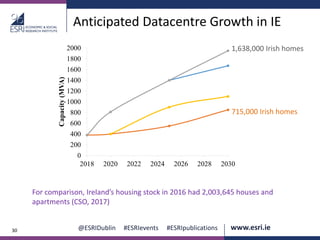
Anticipated Datacentre Growth in IE
0
200
400
600
800
1000
1200
1400
1600
1800
2000
2018 2020 2022 2024 2026 2028 2030
Capacity(MVA)
715,000 Irish homes
1,638,000 Irish homes
For comparison, Ireland’s housing stock in 2016 had 2,003,645 houses and
apartments (CSO, 2017)
@ESRIDublin #ESRIevents #ESRIpublications www.esri.ie31
Possible System-wide Effects
y2020 y2025 y2030 Cumulative y2020 y2025 y2030 Cumulative
%
Increase
Generation
expansion
(MW)
CCGT 0 686 0 686 0 1046 0 1046 +34
Onshore wind 1450 1438 757 3644 1450 2180 115 3744 +3
Solar PV 0 0 0 0 0 0 349 349 +100
Offshore wind 0 0 0 0 0 0 0 0 -
Storage (MW)
BESS 0 181 0 181 0 168 171 339 +47
PHEP 0 0 738 738 0 0 1239 1239 +40
Self-sufficiency (%) 10 19 23 51 10 21 22 53 +2
NPV cost (M€) 1884 1293 822 3999 1884 1433 1017 4334 +8
Expected emissions (MtCO2) 18 12 11 41 18 12 13 44 +7
Expected RES curtailment (%) 2 6 7 15 2 7 3 12 -22
Datacentre frozen at 2020 level Growing datacentre
@ESRIDublin #ESRIevents #ESRIpublications www.esri.ie32
Impact on Generation Expansion Needs
• As much as 50% increase in new generation expansion needs.
• System-wide costs may increase by 29%.
0
3000
6000
Decentralized Growing DC Decentralized Frozen DC
Installedcapacity,MW
New CCGT Onshore wind Solar PV Offshore wind
~ +2.2GW
No storage
@ESRIDublin #ESRIevents #ESRIpublications www.esri.ie33
Impact on Expected Emissions
• On average, emissions in the power sector across the island
may increase by more than 14%.
• A hurdle to meeting Ireland’s stringent emission reduction
targets.
0
3
6
9
Decentralized Growing DC Decentralized Frozen DC
Expectedemissions(MtCO2e)
+14%
No storage
@ESRIDublin #ESRIevents #ESRIpublications www.esri.ie34
Impact on Expected Energy Not Served
• Involuntary load shedding in the entire island may increase by
more than 18%.
• A big concern for ordinary consumers.
• And, system operators may also feel the pressure.
0
3
6
Decentralized Growing DC Decentralized Frozen DC
Expectedenergynotserved
(GWh)
+18%
No storage
@ESRIDublin #ESRIevents #ESRIpublications www.esri.ie35
Impact on Network Expansion Needs
• N.B. Expansion needs assessments are plain, and do not
account for N-1 security criteria.
RES
Development
Portfolios
Growing datacentres
Datacentre capacity frozen at
2018 level
Centralized Decentralized Centralized Decentralized
Lines 39 23 28 19
Transformers 8 6 7 4
Length (km) 500 200 370 145
28%
No storage
@ESRIDublin #ESRIevents #ESRIpublications www.esri.ie36
Alleviating the Impacts
Optimally allocating 30% of new DCs along
the fibre optics corridor and adopting
decentralized RES development can, for
example, reduce network reinforcement
needs by ~66%.
DCs Share (%)
IE023 4.88
IE013 6.91
IE022 5.61
IE021 69.16
IE025 9.21
IE024 3.78
IE012 0.45
66%
Case
Growing DC capacity
DC capacity
frozen at
2018 level
Distributed
DCs
Centralized Decentralized Decentralized Decentralized
Lines 39 23 19 23
Transformers 8 6 4 6
Length (km) 500 200 145 170
No storage
@ESRIDublin #ESRIevents #ESRIpublications www.esri.ie37
0
10
20
30
40
50
60
2019 2024 2029
RES-E 55
RES-E 40
Difference between 55 and 40?
Climate Change Plan
X&Y’s Plan
@ESRIDublin #ESRIevents #ESRIpublications www.esri.ie38
RES-E 40 to RES-E 55
y2020 y2025 y2030 Cumulative y2020 y2025 y2030 Cumulative
%
Increase
Generation
expansion
(MW)
CCGT 0 1358 3 1361 0 1046 0 1046 -30
Onshore
wind 1450 797 32 2279 1450 2180 115 3744 +39
Solar PV 0 0 349 349 0 0 349 349 0
Offshore
wind 0 0 0 0 0 0 0 0 -
Storage
(MW)
BESS 0 0 240 240 0 168 171 339 +29
PHEP 0 0 360 360 0 0 1239 1239 +71
Self-sufficiency (%) 10 13 14 37 10 21 22 53 +30
NPV cost (M€) 1884 1386 993 4263 1884 1433 1017 4334 +2
Expected emissions
(MtCO2) 18 13 14 45 18 12 13 44 -3
Expected RES
curtailment (%) 2 5 4 11 2 7 3 12 +8
@ESRIDublin #ESRIevents #ESRIpublications www.esri.ie39
Coordination of Generation and Transmission
Expansion Planning
@ESRIDublin #ESRIevents #ESRIpublications www.esri.ie40
Benefits of GEP-TEP Coordination
Centralized
GEP&TEP GEP
2020 Onshore wind 1464 1464
2025
New CCGT 1094 1108
Onshore wind 1848 2160
BESS 28 39
2030
Onshore wind 1804 1518
Solar PV 0 160
PHEP 770 737
Total (MW) 7008 6827
Cumulative cost (M€) 4267 4447 4% reduction
Decentralized
GEP&TEP GEP
2020 Onshore wind 1450 1450
2025
New CCGT 1050 1046
Onshore wind 2183 2180
BESS 170 168
2030
Onshore wind 111 115
Solar PV 0 349
BESS 0 171
PHEP 1344 1239
Total (MW) 6308 6717 6% reduction
Cumulative cost (M€) 4286 4334 1% reduction
0
5
10
15
20
25
2017 2020 2025 2030
Expectedemissions(MtCO2)
GEP&TEP GEP
@ESRIDublin #ESRIevents #ESRIpublications www.esri.ie41
Energy Storage for Ireland (ESFI)?
@ESRIDublin #ESRIevents #ESRIpublications www.esri.ie42
Role of Storage (1/2)
With storage No storage
[Units in MW] Centralized Centralized % Change
2020 Onshore wind 1464 1464 0
2025
New CCGT 1108 1132 +2
Onshore wind 2160 2177 +1
BESS 39 0 -
2030
Onshore wind 1518 3499 +57
Biomass 0 0 -
Solar PV 160 160 +0
Offshore wind 0 1977 +100
BESS 0 0 -
PHEP 737 0 -
Cumulative (MW) 7187 10408 +31
Cumulative cost (M€) 4447 4477 +1
COOMATAGGART
TRALEE
CASTLEBAR
BALLYBEG
OLDSTREET (360 MW)
• Investment deferral
• Reducing stress on the network
@ESRIDublin #ESRIevents #ESRIpublications www.esri.ie43
Role of Storage (2/2)
With storage No storage
[Units in MW] Decentralized Decentralized % Change
2020 Onshore wind 1450 1464 +1
2025
New CCGT 1046 1138 +8
Onshore wind 2180 2260 +4
BESS 168 0 -
2030
Onshore wind 115 115 0
Biomass 0 0 -
Solar PV 349 2404 +85
Offshore wind 0 1791 +100
BESS 171 0 -
PHEP 1239 0 -
Cumulative (MW) 6717 9171 +27
Cumulative cost (M€) 4334 4612 +6
COOMATAGGART
TRALEE
CASTLEBAR
BALLYBEG
OLDSTREET (360 MW)
Investment deferral
Reducing stress on the network
@ESRIDublin #ESRIevents #ESRIpublications www.esri.ie44
Hypothetical Experiments
@ESRIDublin #ESRIevents #ESRIpublications www.esri.ie45
“Offshore Wind Only” Policy (1/2)
HYPOTHETICAL EXPERIMENT 1
Strong public opposition to onshore
wind and solar PV power installations
forces change in renewable
development portfolio.
• By 2021, a favourable renewable
support scheme is put in place.
 Which encourages massive
investments in offshore wind.
• Hence, offshore wind constitutes a
lion’s share of the total generation
capacity additions by 2025 and
beyond.
• This will be accompanied by
investments in new pumped hydro
and large-scale battery.
Many u-shaped
valleys in the Irish
island suitable for
seawater PHEP
@ESRIDublin #ESRIevents #ESRIpublications www.esri.ie46
y2020 y2025 y2030 Cumulative
Decentralized
RES-E 55
Generation
expansion
(MW)
CCGT 0 861 0 861
Onshore wind 1450 0 0 1450
Offshore wind 0 1724 637 2361
Storage (MW)
BESS 0 458 153 611 339
PHEP 0 0 900 900 1239
NPV cost (M€) 1884 1624 1179 4686 4334
Expected emissions (MtCO2) 18 12 13 43 44
Expected RES curtailment (%) 2 5 4 10 12
“Offshore Wind Only” Policy (2/2)
The “Offshore wind only” policy
• Leads to only 7% increase in system cost.
• Achieves the same RES-E target with lower generation capacity.
• Requires lower investment in storage, thanks to the relatively stable offshore wind
power output.
• Lower emissions and curtailments.
@ESRIDublin #ESRIevents #ESRIpublications www.esri.ie47
Next Irish General Election 2021 (1/2)
HYPOTHETICAL EXPERIMENT 2
By 2021, Ireland abandons its commitments for
climate action.
• Hence, fossil fuels will continue to be the
mainstream sources of power generation.
• New policy with limited or no support for
renewable power generation.
• Not conducive for new investments in renewables.
@ESRIDublin #ESRIevents #ESRIpublications www.esri.ie48
2020 2025 2030
New generation capacity (MW) 1450 1516 213
Total cost (M€) 1884 1375 1306
Renewable curtailment (%) 2 4 3
Renewable share (%) 40 36 34
2020 2025 2030
1450 0 0
1884 1373 1261
2 11 8
40 33 33
22
18
13
12
22
18
14
15
22
18
18
19
2017 2020 2025 2030
EXPECTEDEMISSIONS
(MTCO2)
RES-E 55 New Fossil Status Quo Gen
Next Irish General Election 2021 (2/2)
New
fossil
Status
quo gen
@ESRIDublin #ESRIevents #ESRIpublications www.esri.ie49
Diversification Policy (1/2)
HYPOTHETICAL EXPERIMENT 3
The policy stipulates new investments in
renewable power generation sources should be
composed of:
 55% Onshore wind
 30% Offshore wind
 5% Biomass
 10% Solar PV
 ?% Tidal and Wave
@ESRIDublin #ESRIevents #ESRIpublications www.esri.ie50
Diversification Policy (2/2)
Diversify Diversify
Centralized Centralized % Change Decentralized Decentralized % Change
2020 Onshore wind 1464 1464 0 1450 1450 0
2025
New CCGT 1108 1108 0 1046 1046 0
Onshore wind 2160 2160 0 2180 2180 0
BESS 39 39 0 168 168 0
2030
Onshore wind 1518 0 - 115 0 -
Biomass 0 329 +100 0 330 +100
Solar PV 160 659 +76 349 660 +47
Offshore wind 0 1977 +100 0 1980 +100
BESS 0 0 - 171 171 0
PHEP 737 493 -49 1239 496 -150
Cumulative (MW) 7187 8229 +13 6717 8480 +21
Cumulative cost (M€) 4447 4584 +3 4334 4437 +2
• Such a policy leads to lower need for energy storage media.
@ESRIDublin #ESRIevents #ESRIpublications www.esri.ie51
Summary
• The utility of ENGINE model has been demonstrated by running various policy
scenarios:
 Decommissioning, North-south interconnection, RES development portfolios, Massive datacentre
rollout, RES-E targets, Carbon price, SNSP level, GEP-TEP interaction, Storage, High RES
diversification and Do-nothing
 Future analysis will include the impact of increasing electrification of heating and transport sectors
• Costs and emissions are driven primarily by the decommissioning of old inefficient
generation units
• High RES target may render carbon price relatively ineffective in reducing system
emissions.
 Increased carbon prices have little effect other than increasing costs.
• With no storage, renewable portfolio is initially onshore wind based, and
investments in solar PV and offshore wind are delayed until 2030.
• But with storage, the optimal renewable portfolio is mainly onshore wind based.
@ESRIDublin #ESRIevents #ESRIpublications www.esri.ie52
Summary
• Numerical results demonstrate clear benefits of:
 Deploying energy storage systems in the Irish system, mainly in terms of deferring
expensive power generation and transmission infrastructures.
 Coordinating generation and transmission expansion planning
• Moderate diversification may not be too costly.
• Offshore wind oriented policy requires lower storage capacity.
• The anticipated growth of datacentres by 2030 could have strong implications new
generation capacity, grid expansion needs, average GHG emissions and involuntary load
shedding.
• Investors should be encouraged to plan for power generation self-sufficiency.
 By investing in onsite or offsite generation and energy storage systems.
 Adopting energy efficiency measures.
• Right policy to optimally allocate new datacentres in regional places.
 E.g. Reduction in grid reinforcement needs by two third if 30% of new DC capacity is
allocated in regional places and decentralized RES development is adopted.
@ESRIDublin #ESRIevents #ESRIpublications www.esri.ie53
Thank you very much for your
attention!
This work has emanated from research conducted with the financial support of Science Foundation Ireland
under the SFI Strategic Partnership Programme Grant Number SFI/15/SPP/E3125. The opinions, findings and
conclusions or recommendations expressed in this material are those of the authors and do not necessarily
reflect the views of the Science Foundation Ireland.
This work has also benefited from the valuable support of EirGrid, the Transmission System Operator in the
Republic of Ireland. Hence, the authors would like to greatly acknowledge EirGrid’s contributions in providing
data and insights for this work.
www.esipp.ie
14 March 2019
@ESRIDublin #ESRIevents #ESRIpublications www.esri.ie54
Cost Comparisons
Case
Year Cost term Grand plan No IC Status quo gen Paralysis
2020
Investment 130 130 130 130
Emission 263 263 263 263
O&M 1355 1355 1355 1355
2025
Investment 206 206 153 152
Emission 177 177 240 240
O&M 1004 1004 1026 1026
2030
Investment 173 173 175 179
Emission 137 137 189 189
O&M 1276 1278 1294 1295
Cumulative 4721 4724 4825 4829
NPV of system-wide cost (in M€)
@ESRIDublin #ESRIevents #ESRIpublications www.esri.ie55
Effect of Changes in SNSP Limit
Grand plan
SNSP75
Grand plan
SNSP85
Grand plan
SNSP100
SNSP limit 75 85 100
Change in system cost (%) 0 -2 -4
Change in expected variable RES power curtailment (%) 0 -106 -596
Change in expected emissions (%) 0 +2 +4
1,267 1,373 1,405
2,440 2,440 2,440
599
1,971
1,669 1,384
0
1000
2000
3000
4000
5000
6000
7000
Grand plan SNSP75 Grand plan SNSP85 Grand plan SNSP100
Newinstalledcapacity(MW)
CCGT Onshore Solar Offshore
@ESRIDublin #ESRIevents #ESRIpublications www.esri.ie56
Effects of Datacentre
DC Status Quo
2020 2025 2030Cumulative
Generation expansion
(MW)
CCGT 0 686 0 686
Onshore wind 1450 1438 757 3644
Solar PV 0 0 0 0
Offshore wind 0 0 0 0
Storage (MW)
BESS 0 181 0 181
PHEP 0 0 738 738
Self-sufficiency level (%) 10 19 23 17*
NPV cost (M€) 1884 1293 822 3999
Expected emissions (MtCO2) 18 12 11 41
Expected RES curtailment (%) 2 6 7 15
Expanding DC
2020 2025 2030 Cumulative % Increase
Generation expansion
(MW)
CCGT 0 1046 0 1046 34
Onshore wind 1450 2180 115 3744 3
Solar PV 0 0 349 349 100
Offshore wind 0 0 0 0 -
Storage (MW)
BESS 0 168 171 339 47
PHEP 0 0 1239 1239 40
Self-sufficiency level 10 21 22 18* 2
NPV cost (M€) 1884 1433 1017 4334 8
Expected emissions (MtCO2) 18 12 13 44 7
Expected RES curtailment (%) 2 7 3 12 -22
@ESRIDublin #ESRIevents #ESRIpublications www.esri.ie57
Parameter Assumptions
Generation technology
Operation cost
(€/MWh)
Emission rate
(tCO2/MWh) Investment cost
(M€/MW)
Cost reductions
(cumulative)
2020 2025 2030
Offshore wind 22.8 0.015 3.65 0.05 0.10 0.20
Onshore wind 13.0 0.015 1.40 0.05 0.10 0.20
Solar PV 11.4 0.046 1.50 0.05 0.10 0.20
Biomass 54.0 0.230 2.25 0.02 0.05 0.10
Coal 34.0 0.925 0.90 0.05 0.08 0.10
Coal with CCS 38.0 0.185 4.40 0.05 0.08 0.10
CCGT 40.0 0.367 0.90 0.05 0.08 0.10
CCGT with CCS
55.0 0.037
2.40 0.05 0.08 0.10
Hydro 10.5 0.010 - - - -
Gas oil fired 80.0 1.041 - - - -
Heavy fuel oil fired
100.0 0.769
- - - -
Table A.1. Parameter assumptions of generators (existing and candidate alike)
@ESRIDublin #ESRIevents #ESRIpublications www.esri.ie58
Policy Implications
• Given the anticipated datacentre growth, policy makers should be aware
that meeting national renewable and emission reduction targets in the
coming decade or so would require unprecedented effort.
• With massive investments in renewables, decommissioning of existing older
generators, which need to also be accompanied by large-scale grid
reinforcements.
• Thus, data companies should be encouraged/urged to:
• Partly (or fully) cover their electricity consumption; Invest in key
infrastructures such as energy storage systems;
• Adopt swift energy efficiency measures.
• Other remedies also exist
• adopting decentralized RES development, and optimally allocating new
datacentres at regional places rather than in and around Dublin.

The ENGINE model: Determining optimal development of the Irish electricity sector under different policy scenarios

  • 1.
    @ESRIDublin #ESRIevents#ESRIpublications www.esri.ie TheENGINE Model: Determining optimal development of the Irish electricity sector under different policy scenarios DATE 14/03/2019 VENUE ESRI, Dublin, Ireland AUTHOR Desta Fitiwi Desta.Fitiwi@esri.ie
  • 2.
    @ESRIDublin #ESRIevents #ESRIpublicationswww.esri.ie2 Presentation Outline • Introduction • The ENGINE Model • Application Examples • Insights from Irish Case Study • Summary
  • 3.
    @ESRIDublin #ESRIevents #ESRIpublicationswww.esri.ie3 Introduction(1/2) • EU-wide ambitious targets for emission reduction • 80% below the 1990 level [EC 2017, 2050 Low-carbon Economy] • All energy sectors are expected to contribute to this goal. • In particular, a massive electrification of heating and transport sectors is anticipated in the coming years. • And, the energy has to be sourced from renewables and renewables only • Increased renewable generation and electrification of energy sectors (other than electricity) is posing new challenges for power system planners. • Variability and uncertainty • The location, as well as the level and operation, of each generation resource is increasingly important. • Implications on costs, emissions, grid reinforcements and technical issues • Many commercial and public models exist: • Integrated energy system models such as TIMES, PRIMES, MESSAGE, POLES, OSeMOSYS, MARKAL, REDS, NEMS, …………………………., BACKBONE • Energy models such as PLEXOS, BALMOREL, METIS, NePlan, LEAP, ... • Power system models such as FAST, WILMAR, Promod, ……, ENGINE
  • 4.
    @ESRIDublin #ESRIevents #ESRIpublicationswww.esri.ie4 Introduction(2/2) • Also, several models in the extant literature • However, most fail to account for spatial aspects and electricity network effects. • Hence, solutions obtained without considering these effects may prove infeasible or suboptimal. • This is especially important in insular and weakly interconnected systems. • E.g. for the Irish case, a Copper Plate assumption may lead to a totally different expansion solution that is 26% less expensive as compared to the model that uses a “Physical Network”. • The ENGINE model has evolved because of all these issues.
  • 5.
    @ESRIDublin #ESRIevents #ESRIpublicationswww.esri.ie The ENGINE Model – What Is It? Input OutputTools and Methods 5 Electricity Network and Generation INvEstment
  • 6.
    @ESRIDublin #ESRIevents #ESRIpublicationswww.esri.ie6 The ENGINE Model – Key Features(1/3) Least-cost Holistic Uncertainty Accuracy Policy-driven Infrastructure-driven
  • 7.
    @ESRIDublin #ESRIevents #ESRIpublicationswww.esri.ie7 The ENGINE Model – Key Features(2/3) • Reasonably accurate representation of the physical characteristics of power systems via • Linearized AC optimal power flow based network model • Considers both active and reactive power flows in a linear manner. • Captures natural voltage magnitude deviations from nominal values across electric transmission systems. • Generally, the model closely resembles the AC optimal power flow one, which governs flows in power systems.
  • 8.
    @ESRIDublin #ESRIevents #ESRIpublicationswww.esri.ie8 The ENGINE Model – Key Features(1/3) • Objective function • Minimize TC = Investment Cost + O&M Cost + Unserved Power Cost + Emission Cost • Constraints: • Active and reactive power load balances at each transmission node (Kirchhoff's current law) • Flow limits • Constraints related to network losses • Active and reactive power flows (Kirchhoff's voltage law) • Power production limits • Logical and budget constraints • Reactive power source limits • Renewable portfolio standard (RPS) limit • Spatial renewable allocation constraints • System non-synchronous penetration (SNSP) limit Reactive power Active power
  • 9.
    @ESRIDublin #ESRIevents #ESRIpublicationswww.esri.ie9 Problem and Solution Structures
  • 10.
    @ESRIDublin #ESRIevents #ESRIpublicationswww.esri.ie10 More Solution Structures • Rolling horizon with overlaps • To avoid end-of-horizon effects • Robust plus “What-if” Solutions • Backward or forward propagation approach Planning horizon
  • 11.
    @ESRIDublin #ESRIevents #ESRIpublicationswww.esri.ie11 Model Application Examples Irish Case Studies
  • 12.
    @ESRIDublin #ESRIevents #ESRIpublicationswww.esri.ie12 About the Irish System • Irish system data • Main source is EirGrid • Represents the network aggregated at 110 kV or higher voltage level • plus generator nodes and • NI’s transmission network. • Overall the base case system has • 676 nodes • 900 lines and transformers • 174 generators • 292 MW pumped hydro • 10 MW battery storage
  • 13.
    @ESRIDublin #ESRIevents #ESRIpublicationswww.esri.ie13 Four Scenarios Infrastructure- driven Policy- driven Demand- driven Changing lifestyles Emerging electricity consumption E-mobility E-heating Renewable integration Climate change Sustainability Energy security
  • 14.
    @ESRIDublin #ESRIevents #ESRIpublicationswww.esri.ie14 Further Considerations • Regional weights for onshore wind allocation • Generation technologies • CCGT with and without CCS, Coal with and without CCS • Biomass, Solar PV, Wind onshore, Wind offshore • Storage • Battery and Pumped hydro NUTS3 region IE022 IE012 IE013 IE023 IE024 IE025 IE011 𝜉𝜉𝑟𝑟𝑟𝑟𝑟𝑟 1.00 2.06 2.70 1.79 1.61 1.55 2.07 Cost reduction (cumulative) Technology Capex (M€/MW) 2020 2025 2030 Wind onshore 1.4 0.05 0.1 0.2 Wind offshore 3.65 0.05 0.1 0.2 PV 1.5 0.05 0.1 0.2 Biomass 2.25 0.02 0.05 0.1 Coal 0.8 0.05 0.08 0.1 Coal with CCS 2.4 0.05 0.08 0.1 CCGT 1.1 0.05 0.08 0.1 CCGT with CCS 4.4 0.05 0.08 0.1 Emission price (Euros/tons of CO2) Year Price 2018 17 2020 20 2025 25 2030 30
  • 15.
    @ESRIDublin #ESRIevents #ESRIpublicationswww.esri.ie15 Decommissioning and North-south Interconnector
  • 16.
    @ESRIDublin #ESRIevents #ESRIpublicationswww.esri.ie16 Considered Cases Cases Variations Decommissioning Interconnector Grand plan Yes Yes No IC Yes No Status quo gen No Yes Paralysis No No Desta Z. Fitiwi, Muireann Lynch and Valentin Bertsch, "Optimal development of electricity generation mix considering fossil fuel phase- out and strategic multi-area interconnection", ESRI Working Paper No. 616, Feb. 2019 (published). • 50% RES-E target by 2030 • SNSP level set to 75% • No storage and HVDC interconnections
  • 17.
    @ESRIDublin #ESRIevents #ESRIpublicationswww.esri.ie17 Generation Expansion Results 0 1000 2000 3000 Grandplan NoIC Statusquogen Paralysis Grandplan NoIC Statusquogen Paralysis Grandplan NoIC Statusquogen Paralysis 2020 2025 2030 Newinstalledcapacity(MW) Onshore CCGT Solar PV Offshore
  • 18.
    @ESRIDublin #ESRIevents #ESRIpublicationswww.esri.ie18 Impact on Emissions 0 5 10 15 20 25 2017 2020 2025 2030 Expectedemissions(MtCO2) Grand plan No IC Status quo gen Paralysis • Having high RES-E target may not mean everything • Emission reductions are driven by decommissioning
  • 19.
    @ESRIDublin #ESRIevents #ESRIpublicationswww.esri.ie19 Grid Expansion Needs (1/2) 0.76 0.8 0.84 0.88 0.92 0.96 1 0 2000 4000 6000 8000 cdf Time (hours) Grand plan 2025 Grand plan 2030 Paralysis 2030 Paralysis 2025 The Paralysis scenario leads to more congestion and hence more grid investment needs
  • 20.
    @ESRIDublin #ESRIevents #ESRIpublicationswww.esri.ie20 Grid Expansion Needs (2/2) Cases Grand plan No IC Status quo gen Paralysis Number of components congested 142 154 151 176 Total congested length (km) 3.509 3,659 4,020 4,435 Congested length-year (km*hour/year) 9,943 10,354 13,920 15,409 Comparison of congestion across the cases Paralysis scenario leads to the most grid reinforcement needs • 35% more congested length compared to that of the Grand plan scenario
  • 21.
    @ESRIDublin #ESRIevents #ESRIpublicationswww.esri.ie21 Reliability and RES Curtailment 0 5 10 15 2020 2025 2030 Expectedcurtailment ofwindpower(%) Grand plan No IC Status quo gen Paralysis • “Paralysis” leads to the highest EENS. • N-S interconnector seems to have some contribution in terms of reliability. • But, no visible differences in RES curtailments among the cases 0 0.84 3.5 4.5 0 1 2 3 4 5 Grand plan No IC Status quo gen Paralysis %changeinunservedenergy comparedto"Grandplan"
  • 22.
    @ESRIDublin #ESRIevents #ESRIpublicationswww.esri.ie22 Effect of Changes in Carbon Price Grand plan Paralysis Carbon price (€/tCO2) 20 30 45 55 20 30 45 55 Change in system cost (%) 0.0 +2.6 +6.3 +8.5 0.0 +3.5 +8.3 +11.3 Change in expected wind energy curtailment (%) 0.0 -0.6 -0.7 -1.1 0.0 -0.6 -1.4 -2.0 Changes in expected emissions (%) 0.0 -0.1 -0.1 -0.2 0.0 -0.25 -0.30 -0.32 • Increased carbon price has little effect in reducing emissions • High RES-E target may render carbon price signal ineffective • Costs increase substantially with carbon price 0 1000 2000 3000 4000 5000 6000 7000 20 30 45 55 20 30 45 55 Grand plan Paralysis Newgenerationcapacity(MW) CCGT Solar Offshore Onshore
  • 23.
    @ESRIDublin #ESRIevents #ESRIpublicationswww.esri.ie23 Effect of Changes in RES-E Target Grand plan RE eco Grand plan RE40 Grand plan RE50 Grand plan RE60 RES-E target 35 40 50 60 Change in system cost (%) 0 +1 +11 +25 Change in expected RES energy curtailment (%) 0 -71 +55 +81 Changes in expected emissions (%) 0 -4 -16 -30 0 2000 4000 6000 8000 10000 Grand plan RE eco Grand plan RE40 Grand plan RE50 Grand plan RE60 Newinstalledcapacity(MW) CCGT Onshore Solar Offshore • Exponential increase in generation capacity needs with increased RES-E target • So is curtailed RES energy • This may be due to the lack of energy storage media.
  • 24.
    @ESRIDublin #ESRIevents #ESRIpublicationswww.esri.ie24 Centralized vs Decentralized RES Development Desta Z. Fitiwi, Muireann Lynch and Valentin Bertsch, "Optimal development of electricity generation mix under centralised and decentralized RES development portfolios: Insights from Irish case study", ESRI Working Paper No. XXX, XXX. 2019 (forthcoming)
  • 25.
    @ESRIDublin #ESRIevents #ESRIpublicationswww.esri.ie25 Centralized vs Decentralized (1/4) • Centralized RES development portfolio  Large-scale wind and solar PV investments determined by a high level central planner.  A few connection nodes  Selected based on electrical connectivity and proximity to resources  Storage system mainly composed of large-scale pumped hydro and battery • Up to 55% RES-E integration target by 2030. • System Non-Synchronous Penetration (SNSP) is set to 75%. PHEP Locations COOMATAGGART TRALEE CASTLEBAR BALLYBEG OLDSTREET (360 MW)
  • 26.
    @ESRIDublin #ESRIevents #ESRIpublicationswww.esri.ie26 Centralized vs Decentralized (2/4) • Decentralized RES development portfolio  Solar PV and onshore wind installations are mainly community-driven.  High-level incentives for self-sufficiency  Which means more embedded generations  Only solar PV can be installed in populated areas  Storage mainly composed of distributed battery energy storage systems  No investment in 2020, moderate by 2025 and high in 2030 • Up to 55% RES-E integration target by 2030. • System Non-Synchronous Penetration (SNSP) is set to 75%. PHEP Locations COOMATAGGART TRALEE CASTLEBAR BALLYBEG OLDSTREET (360 MW)
  • 27.
    @ESRIDublin #ESRIevents #ESRIpublicationswww.esri.ie27 Centralized vs Decentralized (3/4) 0.76 0.8 0.84 0.88 0.92 0.96 1 0 1500 3000 4500 6000 7500 cdf Hours Decentralized RES-E 55 Centralized RES-E 55 • Centralized RES development leads to more congestion in the system  Implications on grid expansion needs Centralized Decentralized % Change 2020 Onshore wind 1464 1450 -1 2025 New CCGT 1108 1046 -6 Onshore wind 2160 2180 +1 BESS 39 168 +77 2030 Onshore wind 1518 115 -1225 Solar PV 160 349 +54 BESS 0 171 +100 PHEP 737 1239 +41 Aggregate (MW) 6827 6717 -1 Cumulative cost (M€) 4447 4334 -3
  • 28.
    @ESRIDublin #ESRIevents #ESRIpublicationswww.esri.ie28 Centralized vs Decentralized (4/4) Centralized Decentralized New CCGT New CCGT
  • 29.
    @ESRIDublin #ESRIevents #ESRIpublicationswww.esri.ie29 Growing Datacentres
  • 30.
    @ESRIDublin #ESRIevents #ESRIpublicationswww.esri.ie30 Anticipated Datacentre Growth in IE 0 200 400 600 800 1000 1200 1400 1600 1800 2000 2018 2020 2022 2024 2026 2028 2030 Capacity(MVA) 715,000 Irish homes 1,638,000 Irish homes For comparison, Ireland’s housing stock in 2016 had 2,003,645 houses and apartments (CSO, 2017)
  • 31.
    @ESRIDublin #ESRIevents #ESRIpublicationswww.esri.ie31 Possible System-wide Effects y2020 y2025 y2030 Cumulative y2020 y2025 y2030 Cumulative % Increase Generation expansion (MW) CCGT 0 686 0 686 0 1046 0 1046 +34 Onshore wind 1450 1438 757 3644 1450 2180 115 3744 +3 Solar PV 0 0 0 0 0 0 349 349 +100 Offshore wind 0 0 0 0 0 0 0 0 - Storage (MW) BESS 0 181 0 181 0 168 171 339 +47 PHEP 0 0 738 738 0 0 1239 1239 +40 Self-sufficiency (%) 10 19 23 51 10 21 22 53 +2 NPV cost (M€) 1884 1293 822 3999 1884 1433 1017 4334 +8 Expected emissions (MtCO2) 18 12 11 41 18 12 13 44 +7 Expected RES curtailment (%) 2 6 7 15 2 7 3 12 -22 Datacentre frozen at 2020 level Growing datacentre
  • 32.
    @ESRIDublin #ESRIevents #ESRIpublicationswww.esri.ie32 Impact on Generation Expansion Needs • As much as 50% increase in new generation expansion needs. • System-wide costs may increase by 29%. 0 3000 6000 Decentralized Growing DC Decentralized Frozen DC Installedcapacity,MW New CCGT Onshore wind Solar PV Offshore wind ~ +2.2GW No storage
  • 33.
    @ESRIDublin #ESRIevents #ESRIpublicationswww.esri.ie33 Impact on Expected Emissions • On average, emissions in the power sector across the island may increase by more than 14%. • A hurdle to meeting Ireland’s stringent emission reduction targets. 0 3 6 9 Decentralized Growing DC Decentralized Frozen DC Expectedemissions(MtCO2e) +14% No storage
  • 34.
    @ESRIDublin #ESRIevents #ESRIpublicationswww.esri.ie34 Impact on Expected Energy Not Served • Involuntary load shedding in the entire island may increase by more than 18%. • A big concern for ordinary consumers. • And, system operators may also feel the pressure. 0 3 6 Decentralized Growing DC Decentralized Frozen DC Expectedenergynotserved (GWh) +18% No storage
  • 35.
    @ESRIDublin #ESRIevents #ESRIpublicationswww.esri.ie35 Impact on Network Expansion Needs • N.B. Expansion needs assessments are plain, and do not account for N-1 security criteria. RES Development Portfolios Growing datacentres Datacentre capacity frozen at 2018 level Centralized Decentralized Centralized Decentralized Lines 39 23 28 19 Transformers 8 6 7 4 Length (km) 500 200 370 145 28% No storage
  • 36.
    @ESRIDublin #ESRIevents #ESRIpublicationswww.esri.ie36 Alleviating the Impacts Optimally allocating 30% of new DCs along the fibre optics corridor and adopting decentralized RES development can, for example, reduce network reinforcement needs by ~66%. DCs Share (%) IE023 4.88 IE013 6.91 IE022 5.61 IE021 69.16 IE025 9.21 IE024 3.78 IE012 0.45 66% Case Growing DC capacity DC capacity frozen at 2018 level Distributed DCs Centralized Decentralized Decentralized Decentralized Lines 39 23 19 23 Transformers 8 6 4 6 Length (km) 500 200 145 170 No storage
  • 37.
    @ESRIDublin #ESRIevents #ESRIpublicationswww.esri.ie37 0 10 20 30 40 50 60 2019 2024 2029 RES-E 55 RES-E 40 Difference between 55 and 40? Climate Change Plan X&Y’s Plan
  • 38.
    @ESRIDublin #ESRIevents #ESRIpublicationswww.esri.ie38 RES-E 40 to RES-E 55 y2020 y2025 y2030 Cumulative y2020 y2025 y2030 Cumulative % Increase Generation expansion (MW) CCGT 0 1358 3 1361 0 1046 0 1046 -30 Onshore wind 1450 797 32 2279 1450 2180 115 3744 +39 Solar PV 0 0 349 349 0 0 349 349 0 Offshore wind 0 0 0 0 0 0 0 0 - Storage (MW) BESS 0 0 240 240 0 168 171 339 +29 PHEP 0 0 360 360 0 0 1239 1239 +71 Self-sufficiency (%) 10 13 14 37 10 21 22 53 +30 NPV cost (M€) 1884 1386 993 4263 1884 1433 1017 4334 +2 Expected emissions (MtCO2) 18 13 14 45 18 12 13 44 -3 Expected RES curtailment (%) 2 5 4 11 2 7 3 12 +8
  • 39.
    @ESRIDublin #ESRIevents #ESRIpublicationswww.esri.ie39 Coordination of Generation and Transmission Expansion Planning
  • 40.
    @ESRIDublin #ESRIevents #ESRIpublicationswww.esri.ie40 Benefits of GEP-TEP Coordination Centralized GEP&TEP GEP 2020 Onshore wind 1464 1464 2025 New CCGT 1094 1108 Onshore wind 1848 2160 BESS 28 39 2030 Onshore wind 1804 1518 Solar PV 0 160 PHEP 770 737 Total (MW) 7008 6827 Cumulative cost (M€) 4267 4447 4% reduction Decentralized GEP&TEP GEP 2020 Onshore wind 1450 1450 2025 New CCGT 1050 1046 Onshore wind 2183 2180 BESS 170 168 2030 Onshore wind 111 115 Solar PV 0 349 BESS 0 171 PHEP 1344 1239 Total (MW) 6308 6717 6% reduction Cumulative cost (M€) 4286 4334 1% reduction 0 5 10 15 20 25 2017 2020 2025 2030 Expectedemissions(MtCO2) GEP&TEP GEP
  • 41.
    @ESRIDublin #ESRIevents #ESRIpublicationswww.esri.ie41 Energy Storage for Ireland (ESFI)?
  • 42.
    @ESRIDublin #ESRIevents #ESRIpublicationswww.esri.ie42 Role of Storage (1/2) With storage No storage [Units in MW] Centralized Centralized % Change 2020 Onshore wind 1464 1464 0 2025 New CCGT 1108 1132 +2 Onshore wind 2160 2177 +1 BESS 39 0 - 2030 Onshore wind 1518 3499 +57 Biomass 0 0 - Solar PV 160 160 +0 Offshore wind 0 1977 +100 BESS 0 0 - PHEP 737 0 - Cumulative (MW) 7187 10408 +31 Cumulative cost (M€) 4447 4477 +1 COOMATAGGART TRALEE CASTLEBAR BALLYBEG OLDSTREET (360 MW) • Investment deferral • Reducing stress on the network
  • 43.
    @ESRIDublin #ESRIevents #ESRIpublicationswww.esri.ie43 Role of Storage (2/2) With storage No storage [Units in MW] Decentralized Decentralized % Change 2020 Onshore wind 1450 1464 +1 2025 New CCGT 1046 1138 +8 Onshore wind 2180 2260 +4 BESS 168 0 - 2030 Onshore wind 115 115 0 Biomass 0 0 - Solar PV 349 2404 +85 Offshore wind 0 1791 +100 BESS 171 0 - PHEP 1239 0 - Cumulative (MW) 6717 9171 +27 Cumulative cost (M€) 4334 4612 +6 COOMATAGGART TRALEE CASTLEBAR BALLYBEG OLDSTREET (360 MW) Investment deferral Reducing stress on the network
  • 44.
    @ESRIDublin #ESRIevents #ESRIpublicationswww.esri.ie44 Hypothetical Experiments
  • 45.
    @ESRIDublin #ESRIevents #ESRIpublicationswww.esri.ie45 “Offshore Wind Only” Policy (1/2) HYPOTHETICAL EXPERIMENT 1 Strong public opposition to onshore wind and solar PV power installations forces change in renewable development portfolio. • By 2021, a favourable renewable support scheme is put in place.  Which encourages massive investments in offshore wind. • Hence, offshore wind constitutes a lion’s share of the total generation capacity additions by 2025 and beyond. • This will be accompanied by investments in new pumped hydro and large-scale battery. Many u-shaped valleys in the Irish island suitable for seawater PHEP
  • 46.
    @ESRIDublin #ESRIevents #ESRIpublicationswww.esri.ie46 y2020 y2025 y2030 Cumulative Decentralized RES-E 55 Generation expansion (MW) CCGT 0 861 0 861 Onshore wind 1450 0 0 1450 Offshore wind 0 1724 637 2361 Storage (MW) BESS 0 458 153 611 339 PHEP 0 0 900 900 1239 NPV cost (M€) 1884 1624 1179 4686 4334 Expected emissions (MtCO2) 18 12 13 43 44 Expected RES curtailment (%) 2 5 4 10 12 “Offshore Wind Only” Policy (2/2) The “Offshore wind only” policy • Leads to only 7% increase in system cost. • Achieves the same RES-E target with lower generation capacity. • Requires lower investment in storage, thanks to the relatively stable offshore wind power output. • Lower emissions and curtailments.
  • 47.
    @ESRIDublin #ESRIevents #ESRIpublicationswww.esri.ie47 Next Irish General Election 2021 (1/2) HYPOTHETICAL EXPERIMENT 2 By 2021, Ireland abandons its commitments for climate action. • Hence, fossil fuels will continue to be the mainstream sources of power generation. • New policy with limited or no support for renewable power generation. • Not conducive for new investments in renewables.
  • 48.
    @ESRIDublin #ESRIevents #ESRIpublicationswww.esri.ie48 2020 2025 2030 New generation capacity (MW) 1450 1516 213 Total cost (M€) 1884 1375 1306 Renewable curtailment (%) 2 4 3 Renewable share (%) 40 36 34 2020 2025 2030 1450 0 0 1884 1373 1261 2 11 8 40 33 33 22 18 13 12 22 18 14 15 22 18 18 19 2017 2020 2025 2030 EXPECTEDEMISSIONS (MTCO2) RES-E 55 New Fossil Status Quo Gen Next Irish General Election 2021 (2/2) New fossil Status quo gen
  • 49.
    @ESRIDublin #ESRIevents #ESRIpublicationswww.esri.ie49 Diversification Policy (1/2) HYPOTHETICAL EXPERIMENT 3 The policy stipulates new investments in renewable power generation sources should be composed of:  55% Onshore wind  30% Offshore wind  5% Biomass  10% Solar PV  ?% Tidal and Wave
  • 50.
    @ESRIDublin #ESRIevents #ESRIpublicationswww.esri.ie50 Diversification Policy (2/2) Diversify Diversify Centralized Centralized % Change Decentralized Decentralized % Change 2020 Onshore wind 1464 1464 0 1450 1450 0 2025 New CCGT 1108 1108 0 1046 1046 0 Onshore wind 2160 2160 0 2180 2180 0 BESS 39 39 0 168 168 0 2030 Onshore wind 1518 0 - 115 0 - Biomass 0 329 +100 0 330 +100 Solar PV 160 659 +76 349 660 +47 Offshore wind 0 1977 +100 0 1980 +100 BESS 0 0 - 171 171 0 PHEP 737 493 -49 1239 496 -150 Cumulative (MW) 7187 8229 +13 6717 8480 +21 Cumulative cost (M€) 4447 4584 +3 4334 4437 +2 • Such a policy leads to lower need for energy storage media.
  • 51.
    @ESRIDublin #ESRIevents #ESRIpublicationswww.esri.ie51 Summary • The utility of ENGINE model has been demonstrated by running various policy scenarios:  Decommissioning, North-south interconnection, RES development portfolios, Massive datacentre rollout, RES-E targets, Carbon price, SNSP level, GEP-TEP interaction, Storage, High RES diversification and Do-nothing  Future analysis will include the impact of increasing electrification of heating and transport sectors • Costs and emissions are driven primarily by the decommissioning of old inefficient generation units • High RES target may render carbon price relatively ineffective in reducing system emissions.  Increased carbon prices have little effect other than increasing costs. • With no storage, renewable portfolio is initially onshore wind based, and investments in solar PV and offshore wind are delayed until 2030. • But with storage, the optimal renewable portfolio is mainly onshore wind based.
  • 52.
    @ESRIDublin #ESRIevents #ESRIpublicationswww.esri.ie52 Summary • Numerical results demonstrate clear benefits of:  Deploying energy storage systems in the Irish system, mainly in terms of deferring expensive power generation and transmission infrastructures.  Coordinating generation and transmission expansion planning • Moderate diversification may not be too costly. • Offshore wind oriented policy requires lower storage capacity. • The anticipated growth of datacentres by 2030 could have strong implications new generation capacity, grid expansion needs, average GHG emissions and involuntary load shedding. • Investors should be encouraged to plan for power generation self-sufficiency.  By investing in onsite or offsite generation and energy storage systems.  Adopting energy efficiency measures. • Right policy to optimally allocate new datacentres in regional places.  E.g. Reduction in grid reinforcement needs by two third if 30% of new DC capacity is allocated in regional places and decentralized RES development is adopted.
  • 53.
    @ESRIDublin #ESRIevents #ESRIpublicationswww.esri.ie53 Thank you very much for your attention! This work has emanated from research conducted with the financial support of Science Foundation Ireland under the SFI Strategic Partnership Programme Grant Number SFI/15/SPP/E3125. The opinions, findings and conclusions or recommendations expressed in this material are those of the authors and do not necessarily reflect the views of the Science Foundation Ireland. This work has also benefited from the valuable support of EirGrid, the Transmission System Operator in the Republic of Ireland. Hence, the authors would like to greatly acknowledge EirGrid’s contributions in providing data and insights for this work. www.esipp.ie 14 March 2019
  • 54.
    @ESRIDublin #ESRIevents #ESRIpublicationswww.esri.ie54 Cost Comparisons Case Year Cost term Grand plan No IC Status quo gen Paralysis 2020 Investment 130 130 130 130 Emission 263 263 263 263 O&M 1355 1355 1355 1355 2025 Investment 206 206 153 152 Emission 177 177 240 240 O&M 1004 1004 1026 1026 2030 Investment 173 173 175 179 Emission 137 137 189 189 O&M 1276 1278 1294 1295 Cumulative 4721 4724 4825 4829 NPV of system-wide cost (in M€)
  • 55.
    @ESRIDublin #ESRIevents #ESRIpublicationswww.esri.ie55 Effect of Changes in SNSP Limit Grand plan SNSP75 Grand plan SNSP85 Grand plan SNSP100 SNSP limit 75 85 100 Change in system cost (%) 0 -2 -4 Change in expected variable RES power curtailment (%) 0 -106 -596 Change in expected emissions (%) 0 +2 +4 1,267 1,373 1,405 2,440 2,440 2,440 599 1,971 1,669 1,384 0 1000 2000 3000 4000 5000 6000 7000 Grand plan SNSP75 Grand plan SNSP85 Grand plan SNSP100 Newinstalledcapacity(MW) CCGT Onshore Solar Offshore
  • 56.
    @ESRIDublin #ESRIevents #ESRIpublicationswww.esri.ie56 Effects of Datacentre DC Status Quo 2020 2025 2030Cumulative Generation expansion (MW) CCGT 0 686 0 686 Onshore wind 1450 1438 757 3644 Solar PV 0 0 0 0 Offshore wind 0 0 0 0 Storage (MW) BESS 0 181 0 181 PHEP 0 0 738 738 Self-sufficiency level (%) 10 19 23 17* NPV cost (M€) 1884 1293 822 3999 Expected emissions (MtCO2) 18 12 11 41 Expected RES curtailment (%) 2 6 7 15 Expanding DC 2020 2025 2030 Cumulative % Increase Generation expansion (MW) CCGT 0 1046 0 1046 34 Onshore wind 1450 2180 115 3744 3 Solar PV 0 0 349 349 100 Offshore wind 0 0 0 0 - Storage (MW) BESS 0 168 171 339 47 PHEP 0 0 1239 1239 40 Self-sufficiency level 10 21 22 18* 2 NPV cost (M€) 1884 1433 1017 4334 8 Expected emissions (MtCO2) 18 12 13 44 7 Expected RES curtailment (%) 2 7 3 12 -22
  • 57.
    @ESRIDublin #ESRIevents #ESRIpublicationswww.esri.ie57 Parameter Assumptions Generation technology Operation cost (€/MWh) Emission rate (tCO2/MWh) Investment cost (M€/MW) Cost reductions (cumulative) 2020 2025 2030 Offshore wind 22.8 0.015 3.65 0.05 0.10 0.20 Onshore wind 13.0 0.015 1.40 0.05 0.10 0.20 Solar PV 11.4 0.046 1.50 0.05 0.10 0.20 Biomass 54.0 0.230 2.25 0.02 0.05 0.10 Coal 34.0 0.925 0.90 0.05 0.08 0.10 Coal with CCS 38.0 0.185 4.40 0.05 0.08 0.10 CCGT 40.0 0.367 0.90 0.05 0.08 0.10 CCGT with CCS 55.0 0.037 2.40 0.05 0.08 0.10 Hydro 10.5 0.010 - - - - Gas oil fired 80.0 1.041 - - - - Heavy fuel oil fired 100.0 0.769 - - - - Table A.1. Parameter assumptions of generators (existing and candidate alike)
  • 58.
    @ESRIDublin #ESRIevents #ESRIpublicationswww.esri.ie58 Policy Implications • Given the anticipated datacentre growth, policy makers should be aware that meeting national renewable and emission reduction targets in the coming decade or so would require unprecedented effort. • With massive investments in renewables, decommissioning of existing older generators, which need to also be accompanied by large-scale grid reinforcements. • Thus, data companies should be encouraged/urged to: • Partly (or fully) cover their electricity consumption; Invest in key infrastructures such as energy storage systems; • Adopt swift energy efficiency measures. • Other remedies also exist • adopting decentralized RES development, and optimally allocating new datacentres at regional places rather than in and around Dublin.