ME 245
Engineering Mechanics I
Contact Hours: 3.00
Credit Hours: 3.00
Objective
1. Introduction to the construction of “Free Body Diagrams” of real-world problems and apply
Newton’s Laws of motion and vector operations to assess equilibrium of particles and bodies
2. To apply the principles of equilibrium of particles and bodies to analyze the forces in planar
truss members and structures.
3. Understanding the theory of dry friction and analysing the equilibrium of rigid bodies
subjected to this force
4. To discuss the concepts of center of gravity, centroids and moment of inertia and apply the
concepts to compute their location for bodies of arbitrary shape
Topics to be covered
 Basic concepts of mechanics: Free body diagrams;
 Statics of particles and rigid bodies;
 Properties of forces: Concurrent / coplanar / non-coplanar force systems, resultant of forces, resolution of forces,
rectangular and polar components of forces in plane and 3-D space;
 Analysis of structures: Forces in trusses, frames and machines, zero force members;
 Forces in cables;
 Friction;
 Equilibrium of rigid bodies: Conditions for maintaining equilibrium in 2-D and 3-D;
 Statical determinacy: Identification of known forces and solution of unknown reactions for a structure, combined
loads, application of equilibrium equations for statical determinacy;
 Moments of inertia: Of areas and masses; moments of force in vector notation;
 Equivalent force system;
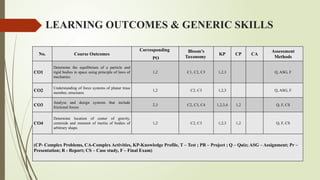
LEARNING OUTCOMES & GENERIC SKILLS
No. Course Outcomes
Corresponding
PO
Bloom’s
Taxonomy
KP CP CA
Assessment
Methods
CO1
Determine the equilibrium of a particle and
rigid bodies in space using principle of laws of
mechanics
1,2 C1, C2, C3 1,2,3 Q, ASG, F
CO2
Understanding of force systems of planar truss
member, structures
1,2 C2, C3 1,2,3 Q, ASG, F
CO3
Analyse and design systems that include
frictional forces
2,3 C2, C3, C4 1,2,3,4 1,2 Q, F, CS
CO4
Determine location of center of gravity,
centroids and moment of inertia of bodies of
arbitrary shape.
1,2 C2, C3 1,2,3 1,2 Q, F, CS
(CP- Complex Problems, CA-Complex Activities, KP-Knowledge Profile, T – Test ; PR – Project ; Q – Quiz; ASG – Assignment; Pr –
Presentation; R - Report; CS – Case study, F – Final Exam)
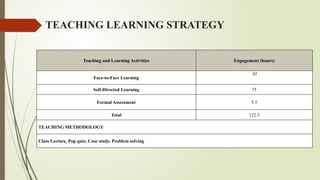
TEACHING LEARNING STRATEGY
Teaching and Learning Activities Engagement (hours)
Face-to-Face Learning
42
Self-Directed Learning 75
Formal Assessment 5.5
Total 122.5
TEACHING METHODOLOGY
Class Lecture, Pop quiz, Case study, Problem solving
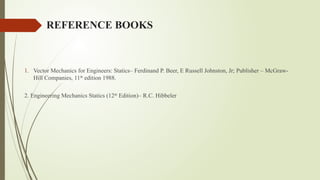
REFERENCE BOOKS
1. Vector Mechanics for Engineers: Statics– Ferdinand P. Beer, E Russell Johnston, Jr; Publisher – McGraw-
Hill Companies, 11th
edition 1988.
2. Engineering Mechanics Statics (12th
Edition)– R.C. Hibbeler
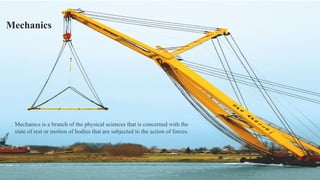
Mechanics
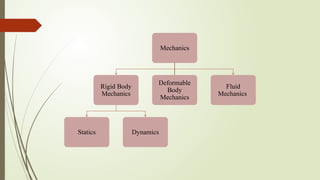
Mechanics is a branch of the physical sciences that is concerned with the
state of rest or motion of bodies that are subjected to the action of forces.
Mechanics
Rigid Body
Mechanics
Statics Dynamics
Deformable
Body
Mechanics
Fluid
Mechanics
Fundamental Concepts
 Particle: A particle has a mass, but a size that can be neglected. When a body is idealized as a particle, the
principles of mechanics reduce to a rather simplified form since the geometry of the body will not be
involved in the analysis of the problem.
 Rigid Body: A rigid body can be considered as a combination of a large number of particles in which all the
particles remain at a fixed distance from one another, both before and after applying a load. In most cases
the actual deformations occurring in structures, machines, mechanisms, and the like are relatively small, and
the rigid-body assumption is suitable for analysis.
 Concentrated Force: A concentrated force represents the effect of a loading which is assumed to act at a
point on a body. We can represent a load by a concentrated force, provided the area over which the load is
applied is very small compared to the overall size of the body.
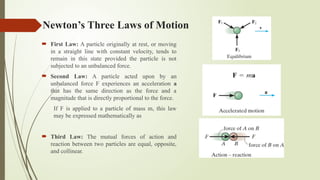
Newton’s Three Laws of Motion
 First Law: A particle originally at rest, or moving
in a straight line with constant velocity, tends to
remain in this state provided the particle is not
subjected to an unbalanced force.
 Second Law: A particle acted upon by an
unbalanced force F experiences an acceleration a
that has the same direction as the force and a
magnitude that is directly proportional to the force.
If F is applied to a particle of mass m, this law
may be expressed mathematically as
 Third Law: The mutual forces of action and
reaction between two particles are equal, opposite,
and collinear.
Newton’s Law of Gravitational Attraction
 Shortly after formulating his three laws of motion, Newton postulated a law governing the gravitational
attraction between any two particles. Stated mathematically
 Weight: According to Equation, any two particles or bodies have a mutual attractive (gravitational) force
acting between them. In the case of a particle located at or near the surface of the earth, however, the only
gravitational force having any sizable magnitude is that between the earth and the particle. Consequently,
this force, termed the weight, will be the only gravitational force considered in our study of mechanics.
let,
 By comparison with , we can see that g is the acceleration due to gravity. Since it depends on r, then the
weight of a body is not an absolute quantity. Instead, it’s magnitude is determined from where the
measurement was made. For most engineering calculations, however, g is determined at sea level and at a
latitude of 45°,which is considered the “standard location.”
Homework
 Systems of Units
 Conversion of Units
 Prefixes

Chapter 1 Vector Mechanics Statics Mechanical Engineer.pptx

  • 1.
    ME 245 Engineering MechanicsI Contact Hours: 3.00 Credit Hours: 3.00
  • 2.
    Objective 1. Introduction tothe construction of “Free Body Diagrams” of real-world problems and apply Newton’s Laws of motion and vector operations to assess equilibrium of particles and bodies 2. To apply the principles of equilibrium of particles and bodies to analyze the forces in planar truss members and structures. 3. Understanding the theory of dry friction and analysing the equilibrium of rigid bodies subjected to this force 4. To discuss the concepts of center of gravity, centroids and moment of inertia and apply the concepts to compute their location for bodies of arbitrary shape
  • 3.
    Topics to becovered  Basic concepts of mechanics: Free body diagrams;  Statics of particles and rigid bodies;  Properties of forces: Concurrent / coplanar / non-coplanar force systems, resultant of forces, resolution of forces, rectangular and polar components of forces in plane and 3-D space;  Analysis of structures: Forces in trusses, frames and machines, zero force members;  Forces in cables;  Friction;  Equilibrium of rigid bodies: Conditions for maintaining equilibrium in 2-D and 3-D;  Statical determinacy: Identification of known forces and solution of unknown reactions for a structure, combined loads, application of equilibrium equations for statical determinacy;  Moments of inertia: Of areas and masses; moments of force in vector notation;  Equivalent force system;
  • 4.
    LEARNING OUTCOMES &GENERIC SKILLS No. Course Outcomes Corresponding PO Bloom’s Taxonomy KP CP CA Assessment Methods CO1 Determine the equilibrium of a particle and rigid bodies in space using principle of laws of mechanics 1,2 C1, C2, C3 1,2,3 Q, ASG, F CO2 Understanding of force systems of planar truss member, structures 1,2 C2, C3 1,2,3 Q, ASG, F CO3 Analyse and design systems that include frictional forces 2,3 C2, C3, C4 1,2,3,4 1,2 Q, F, CS CO4 Determine location of center of gravity, centroids and moment of inertia of bodies of arbitrary shape. 1,2 C2, C3 1,2,3 1,2 Q, F, CS (CP- Complex Problems, CA-Complex Activities, KP-Knowledge Profile, T – Test ; PR – Project ; Q – Quiz; ASG – Assignment; Pr – Presentation; R - Report; CS – Case study, F – Final Exam)
  • 5.
    TEACHING LEARNING STRATEGY Teachingand Learning Activities Engagement (hours) Face-to-Face Learning 42 Self-Directed Learning 75 Formal Assessment 5.5 Total 122.5 TEACHING METHODOLOGY Class Lecture, Pop quiz, Case study, Problem solving
  • 6.
    REFERENCE BOOKS 1. VectorMechanics for Engineers: Statics– Ferdinand P. Beer, E Russell Johnston, Jr; Publisher – McGraw- Hill Companies, 11th edition 1988. 2. Engineering Mechanics Statics (12th Edition)– R.C. Hibbeler
  • 7.
    Mechanics Mechanics is abranch of the physical sciences that is concerned with the state of rest or motion of bodies that are subjected to the action of forces.
  • 8.
  • 9.
    Fundamental Concepts  Particle:A particle has a mass, but a size that can be neglected. When a body is idealized as a particle, the principles of mechanics reduce to a rather simplified form since the geometry of the body will not be involved in the analysis of the problem.  Rigid Body: A rigid body can be considered as a combination of a large number of particles in which all the particles remain at a fixed distance from one another, both before and after applying a load. In most cases the actual deformations occurring in structures, machines, mechanisms, and the like are relatively small, and the rigid-body assumption is suitable for analysis.  Concentrated Force: A concentrated force represents the effect of a loading which is assumed to act at a point on a body. We can represent a load by a concentrated force, provided the area over which the load is applied is very small compared to the overall size of the body.
  • 10.
    Newton’s Three Lawsof Motion  First Law: A particle originally at rest, or moving in a straight line with constant velocity, tends to remain in this state provided the particle is not subjected to an unbalanced force.  Second Law: A particle acted upon by an unbalanced force F experiences an acceleration a that has the same direction as the force and a magnitude that is directly proportional to the force. If F is applied to a particle of mass m, this law may be expressed mathematically as  Third Law: The mutual forces of action and reaction between two particles are equal, opposite, and collinear.
  • 11.
    Newton’s Law ofGravitational Attraction  Shortly after formulating his three laws of motion, Newton postulated a law governing the gravitational attraction between any two particles. Stated mathematically  Weight: According to Equation, any two particles or bodies have a mutual attractive (gravitational) force acting between them. In the case of a particle located at or near the surface of the earth, however, the only gravitational force having any sizable magnitude is that between the earth and the particle. Consequently, this force, termed the weight, will be the only gravitational force considered in our study of mechanics. let,  By comparison with , we can see that g is the acceleration due to gravity. Since it depends on r, then the weight of a body is not an absolute quantity. Instead, it’s magnitude is determined from where the measurement was made. For most engineering calculations, however, g is determined at sea level and at a latitude of 45°,which is considered the “standard location.”
  • 12.
    Homework  Systems ofUnits  Conversion of Units  Prefixes