Experience High Definition Video Conferencinghttp://www.youtube.com/watch?v=bLQa6qtIK5c
Engaging Liberal Education at a DistanceAAC&U Annual MeetingJanuary 28, 2011This Session is sponsored by the National Institute for Technology in Liberal Education.
ParticipantsGret Antilla, Executive Director, Consortium for Innovative Environments in LearningKebokile Dengu-Zvobogo, Associate Dean, International Programs, Pitzer CollegePaul Burkhardt, Executive Vice-President for Academic Affairs and Provost,  Prescott CollegeEd Clausen, Vice President for Academic Affairs, Daemen CollegeRebecca Davis, Program Officer for the Humanities, National Institute for Technology in Liberal Education
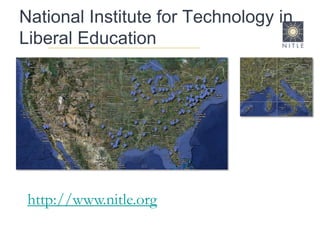
National Institute for Technology in Liberal Educationhttp://www.nitle.org
Liberal Education in the Globally Networked WorldSmall Liberal Arts CollegesResidential, LocalClose Personal Interaction Face-to-Face FocusTraditional study abroad with complete immersion in another cultureGlobally Networked WorldAlways connectedAccess to global resources & informationHigh-speed digital networksHigh-definition video
Session OutlineDiscuss projects exploring how high-speed digital networks and high-definition video can enable institutions committed to liberal education to share academic expertise Undergraduate ResearchInter-institutional Collaborative Courses & CurriculumGlobal CompetenceInternational sitesForeign Language Acquisition
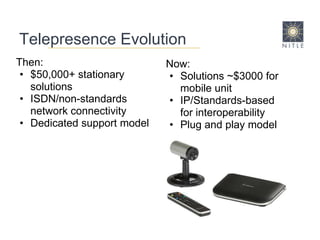
Telepresence EvolutionThen:$50,000+ stationary solutions
ISDN/non-standards network connectivity
Dedicated support modelNow:Solutions ~$3000 for mobile unit
IP/Standards-based for interoperability
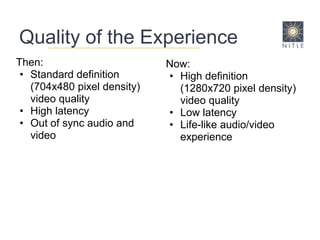
Plug and play modelQuality of the ExperienceThen:Standard definition (704x480 pixel density) video quality
High latency
Out of sync audio and videoNow:High definition (1280x720 pixel density) video quality
Low latency
Life-like audio/video experienceIntercampus CoursesHigh-Definition Videoconferencing, Shared Academics and the Liberal Arts College, Eric Jansson, NITLESunoikisis, Virtual Department of Classical StudiesIntercampus Team Taught CoursesProgram Evaluation and Model Design, PIs: Susan Frost, Emory University & Deborah Olsen, Virginia Tech Evaluation Report and How to guide available at:  http://www.colleges.org/techcenter/Archives/reports.html
Sunoikisis Evaluation ConclusionsFurthers a core goal of liberal educationSuccessful collaboration of formerly competitive collegesUnbundling of instructional components to pool instructional resources
Sunoikisis Lessons LearnedHybrid model: include asynchronous interactionNeed for collaboration leadModels for academic creditSunoikisis: Each campus offers courseCGMA: GIS in Mediterranean ArchaeologyDePauw University, Millsaps College, Rhodes College, The College of WoosterRotating teaching responsibilities and course offering
Sunoikisis ChallengesChallengesPoor student engagement with faculty and students on other campusesNeed to adapt teaching & learning to virtual classroomTechnology infrastructureInadequate recognition for faculty work
What is CIEL?Consortium for Innovative Environments in LearningAlverno College - Daemen College - The Evergreen State College - Fairhaven College at Western Washington University - Hampshire College - Johnston Center for Integrative Studies at the University of Redlands - Marlboro College - New College at the University of Alabama - New College of Florida - New Century College and University Life of George Mason University - Pitzer College - Prescott College - Richard Stockton College of New Jersey
CIEL schools put innovation and experimentation at the core of their mission, organization, and everyday work. Though each school is distinct, each shares a commitment to the following goals and practices: Interdisciplinary, Integrative and Experiential learningIntegration of theory and practiceIndependent  and individualized learningAuthentic assessment strategiesGlobalized curriculumand commitment to teaching and learning for social justice

Engaging lib ed_distance_final

  • 1.
    Experience High DefinitionVideo Conferencinghttp://www.youtube.com/watch?v=bLQa6qtIK5c
  • 2.
    Engaging Liberal Educationat a DistanceAAC&U Annual MeetingJanuary 28, 2011This Session is sponsored by the National Institute for Technology in Liberal Education.
  • 3.
    ParticipantsGret Antilla, ExecutiveDirector, Consortium for Innovative Environments in LearningKebokile Dengu-Zvobogo, Associate Dean, International Programs, Pitzer CollegePaul Burkhardt, Executive Vice-President for Academic Affairs and Provost, Prescott CollegeEd Clausen, Vice President for Academic Affairs, Daemen CollegeRebecca Davis, Program Officer for the Humanities, National Institute for Technology in Liberal Education
  • 4.
    National Institute forTechnology in Liberal Educationhttp://www.nitle.org
  • 5.
    Liberal Education inthe Globally Networked WorldSmall Liberal Arts CollegesResidential, LocalClose Personal Interaction Face-to-Face FocusTraditional study abroad with complete immersion in another cultureGlobally Networked WorldAlways connectedAccess to global resources & informationHigh-speed digital networksHigh-definition video
  • 6.
    Session OutlineDiscuss projectsexploring how high-speed digital networks and high-definition video can enable institutions committed to liberal education to share academic expertise Undergraduate ResearchInter-institutional Collaborative Courses & CurriculumGlobal CompetenceInternational sitesForeign Language Acquisition
  • 7.
  • 8.
  • 9.
  • 10.
  • 11.
    Plug and playmodelQuality of the ExperienceThen:Standard definition (704x480 pixel density) video quality
  • 12.
  • 13.
    Out of syncaudio and videoNow:High definition (1280x720 pixel density) video quality
  • 14.
  • 15.
    Life-like audio/video experienceIntercampusCoursesHigh-Definition Videoconferencing, Shared Academics and the Liberal Arts College, Eric Jansson, NITLESunoikisis, Virtual Department of Classical StudiesIntercampus Team Taught CoursesProgram Evaluation and Model Design, PIs: Susan Frost, Emory University & Deborah Olsen, Virginia Tech Evaluation Report and How to guide available at: http://www.colleges.org/techcenter/Archives/reports.html
  • 16.
    Sunoikisis Evaluation ConclusionsFurthersa core goal of liberal educationSuccessful collaboration of formerly competitive collegesUnbundling of instructional components to pool instructional resources
  • 17.
    Sunoikisis Lessons LearnedHybridmodel: include asynchronous interactionNeed for collaboration leadModels for academic creditSunoikisis: Each campus offers courseCGMA: GIS in Mediterranean ArchaeologyDePauw University, Millsaps College, Rhodes College, The College of WoosterRotating teaching responsibilities and course offering
  • 18.
    Sunoikisis ChallengesChallengesPoor studentengagement with faculty and students on other campusesNeed to adapt teaching & learning to virtual classroomTechnology infrastructureInadequate recognition for faculty work
  • 19.
    What is CIEL?Consortiumfor Innovative Environments in LearningAlverno College - Daemen College - The Evergreen State College - Fairhaven College at Western Washington University - Hampshire College - Johnston Center for Integrative Studies at the University of Redlands - Marlboro College - New College at the University of Alabama - New College of Florida - New Century College and University Life of George Mason University - Pitzer College - Prescott College - Richard Stockton College of New Jersey
  • 20.
    CIEL schools putinnovation and experimentation at the core of their mission, organization, and everyday work. Though each school is distinct, each shares a commitment to the following goals and practices: Interdisciplinary, Integrative and Experiential learningIntegration of theory and practiceIndependent and individualized learningAuthentic assessment strategiesGlobalized curriculumand commitment to teaching and learning for social justice

Editor's Notes

  • #2 Virtually travelingImmediacy of interactionCultural informationFace to face interactionThis is what we mean by a globally networked worldPlus, don’t we all want to teach without our pants on? ;)Video is about 2 minutes
  • #5 My name is Rebecca Davis, and I will be moderating today’s session, which is sponsored by the National Institute for Technology in Liberal Education aka NITLE. We work with a diverse community of liberal arts colleges and universities. This national network is focused on developing a deep understanding of the undergraduate student experience, the impact of the broader technological environment on teaching and learning, and the future of liberal education.
  • #6 The current technological environment presents some challenges to the traditional model of liberal education that we see in most institutions within the NITLE network. We typically work with small liberal arts colleges that privilege face-to-face interaction. Based on the monastic tradition, students are supposed to focus only on learning in their current environment. And, the key way to gain global knowledge is to study abroad. Today’s globally networked world presents a challenge to that model. Students, whether abroad or on campus, are always connected, with access to global resources and information. And once they leave college they will likely live and work in the same context. Small liberal arts colleges, then, are presented with the challenge of maintaining the values of liberal education and preparing students to exercise their liberal arts abilities in a networked world. The model of distance education with asynchronous interaction is one answer to education in a networked world, but this model is diametrically opposed to the educational model of our institutions. Faced with this challenge colleges could pull in and try to strengthen their local focus, or they can find ways to engage the global network in ways consistent with their values.
  • #7 Today, we will examine this challenge specifically through the lens of one new technology—high definition video conferencing over high-speed digital networks. Our presenters will share lessons learned from past experiences with various types of video-conferencing, including traditional and desktop, and explain how they are applying those lessons in current projects using high def video. Projects include undergraduate research, collaborative courses and curriculum, promoting global competence, connecting with international sites, and foreign language acquisition. In these examples, our panelists have explored how to use technology to interact at a distance in ways consistent with their liberal arts mission. Finally, we will end with a discussion of how these technologies can facilitate liberal education.
  • #10 Flesh this out:NITLE has experience with intercampus pedagogy. Let me share one model that would benefit from high def video . . .
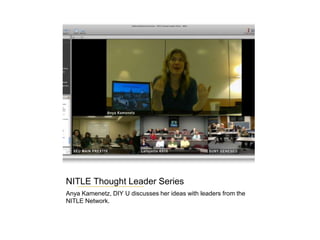
  • #20 About the NITLE 2011 Thought Leader SeriesThe NITLE 2011 Thought Leader Series offers two immediate benefits. 1. Chief academic and information officers and other campus leaders from liberal arts colleges will have direct access to thought leaders who are currently influencing discourse and policy about higher education and its future. 2. Campuses that connect to the series will gain direct experience with the application of interactive, high-definition video for educational and collaborative purposes.