
Neil Morris
Director of Digital Learning
Professor of Educational Technology,
Innovation and Change, School of
Education
University of Leeds
Content and images © University of Leeds
Email: n.p.morris@leeds.ac.uk
Twitter: @neilmorrisleeds, @unileedsonline
Digital technology and Higher Education:
delivering benefits for student education
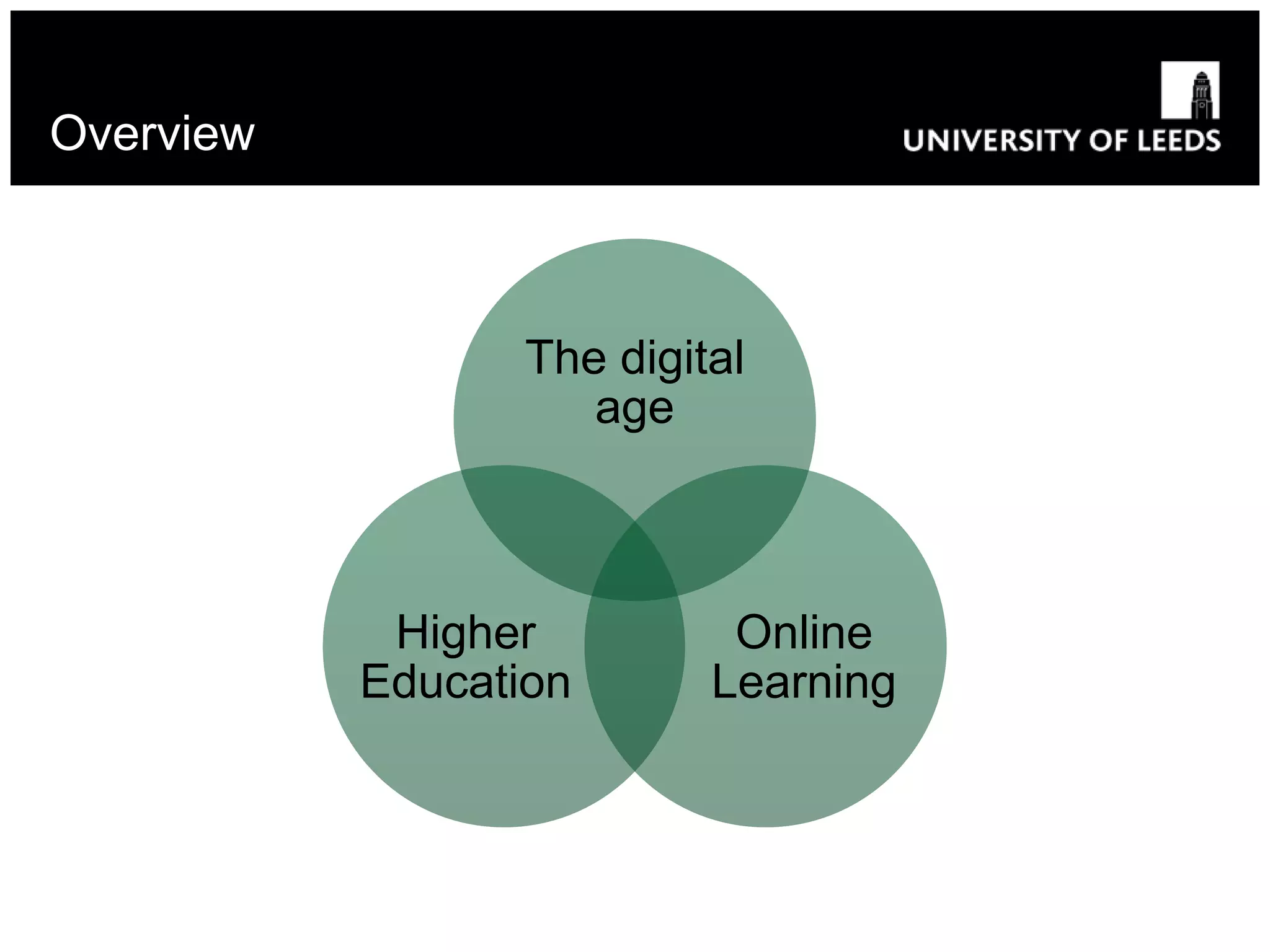
Overview
The digital
age
Online
Learning
Higher
Education
Learning and Teaching
“Tell me and I forget, teach me and I
may remember, involve me and I learn.”
Benjamin Franklin
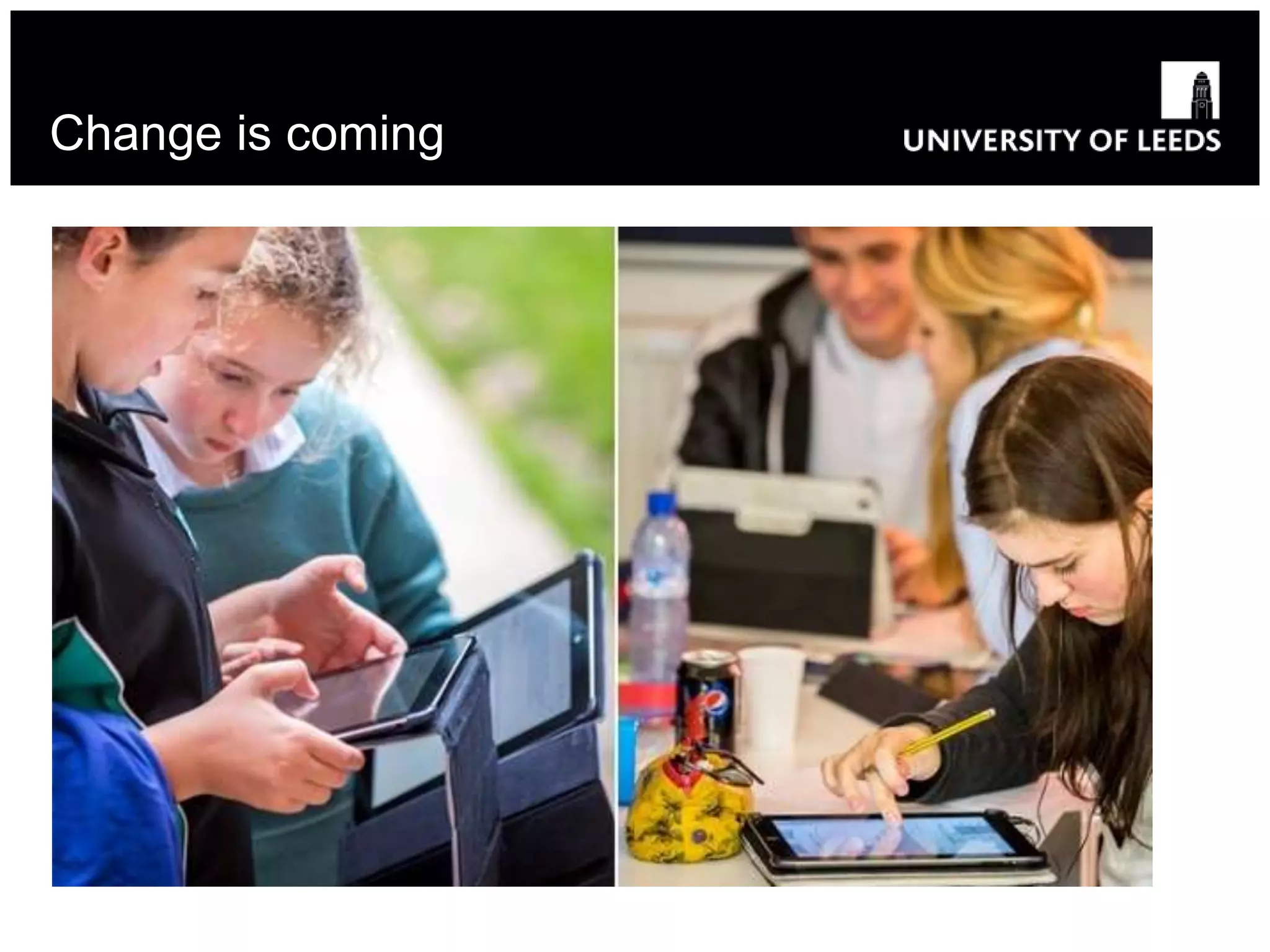
Change is coming
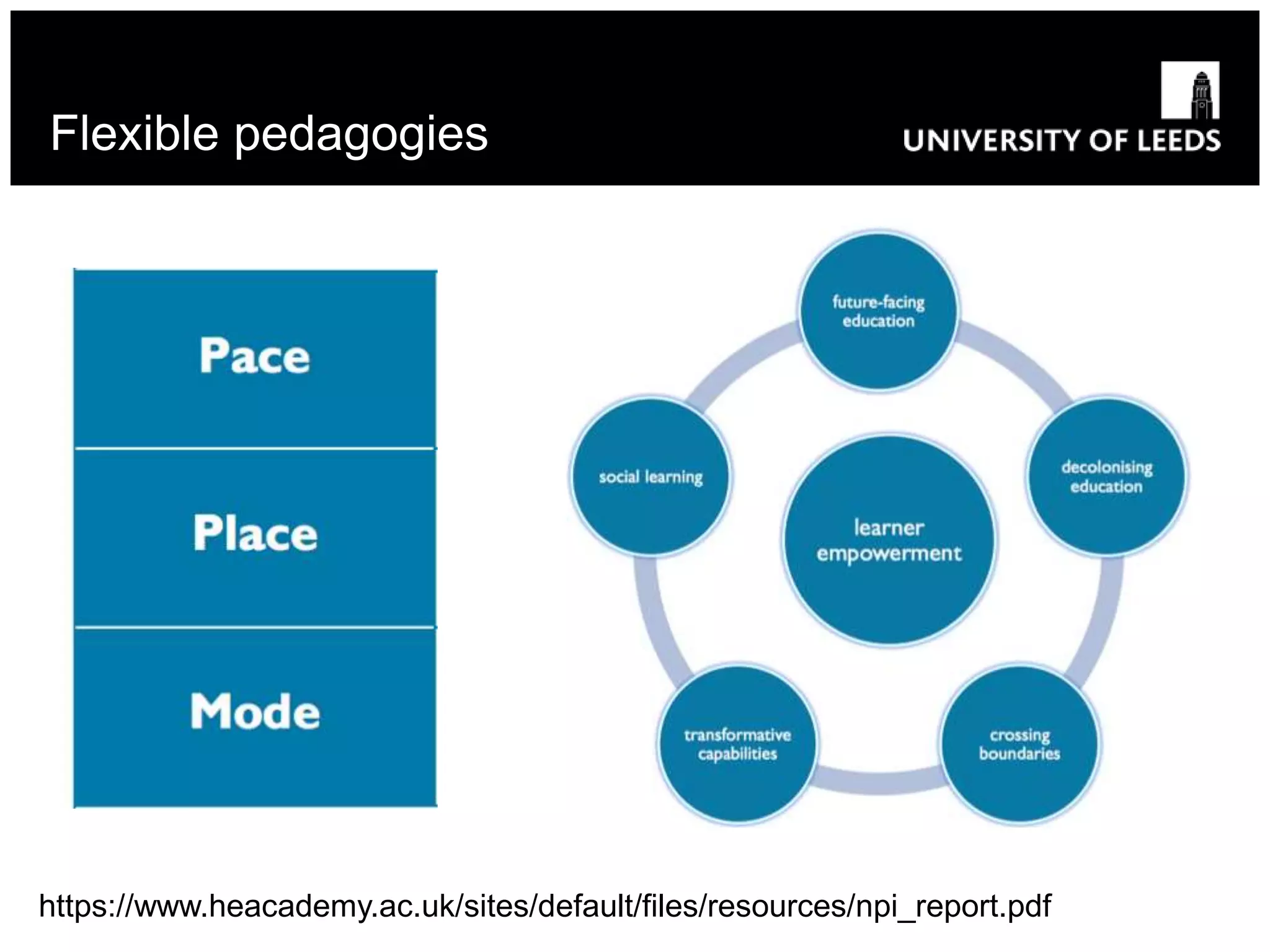
Flexible pedagogies
https://www.heacademy.ac.uk/sites/default/files/resources/npi_report.pdf
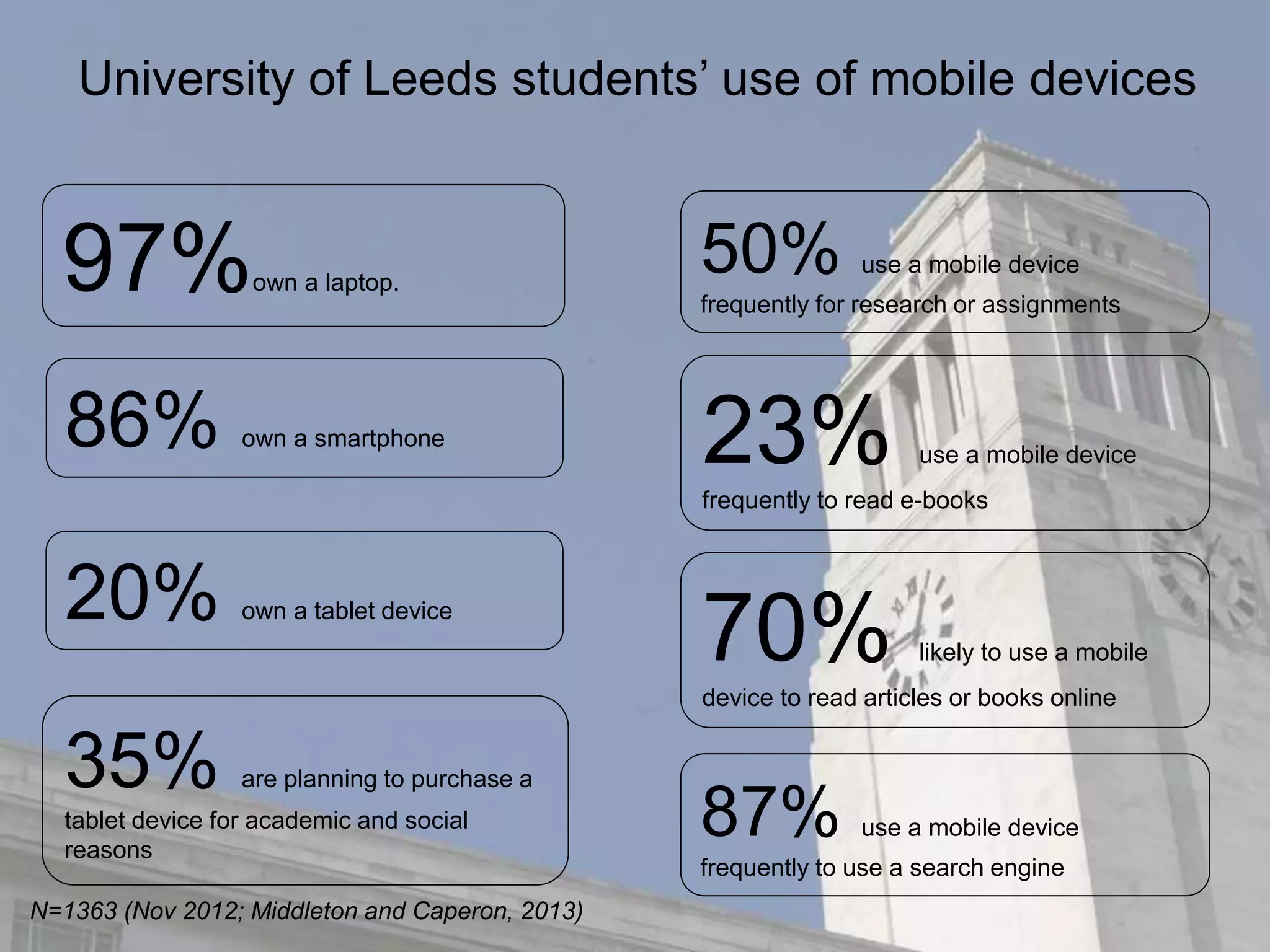
N=1363 (Nov 2012; Middleton and Caperon, 2013)
50% use a mobile device
frequently for research or assignments
23% use a mobile device
frequently to read e-books
86% own a smartphone
97%own a laptop.
20% own a tablet device
35% are planning to purchase a
tablet device for academic and social
reasons
70% likely to use a mobile
device to read articles or books online
87% use a mobile device
frequently to use a search engine
University of Leeds students’ use of mobile devices
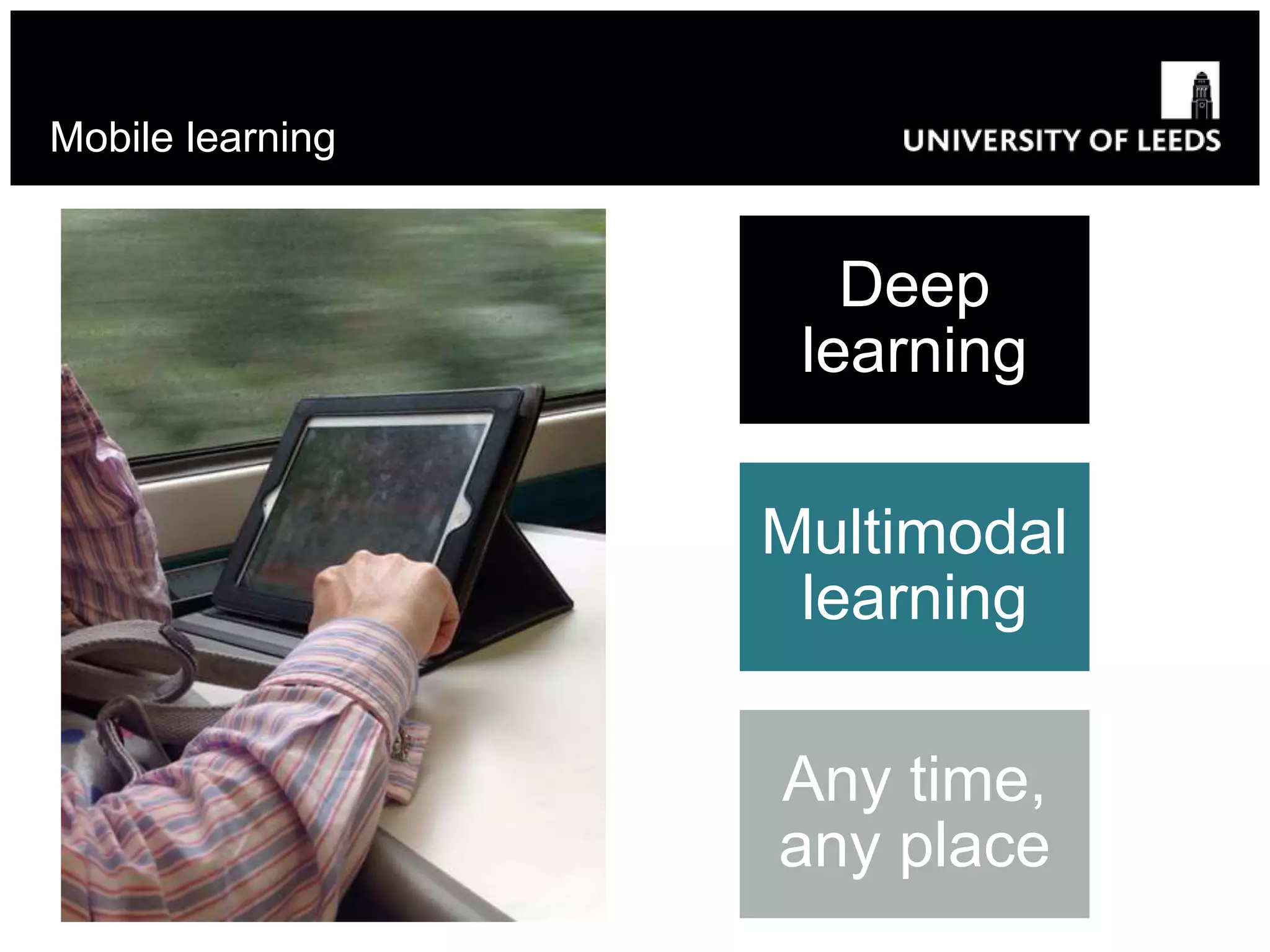
Mobile learning
Deep
learning
Multimodal
learning
Any time,
any place
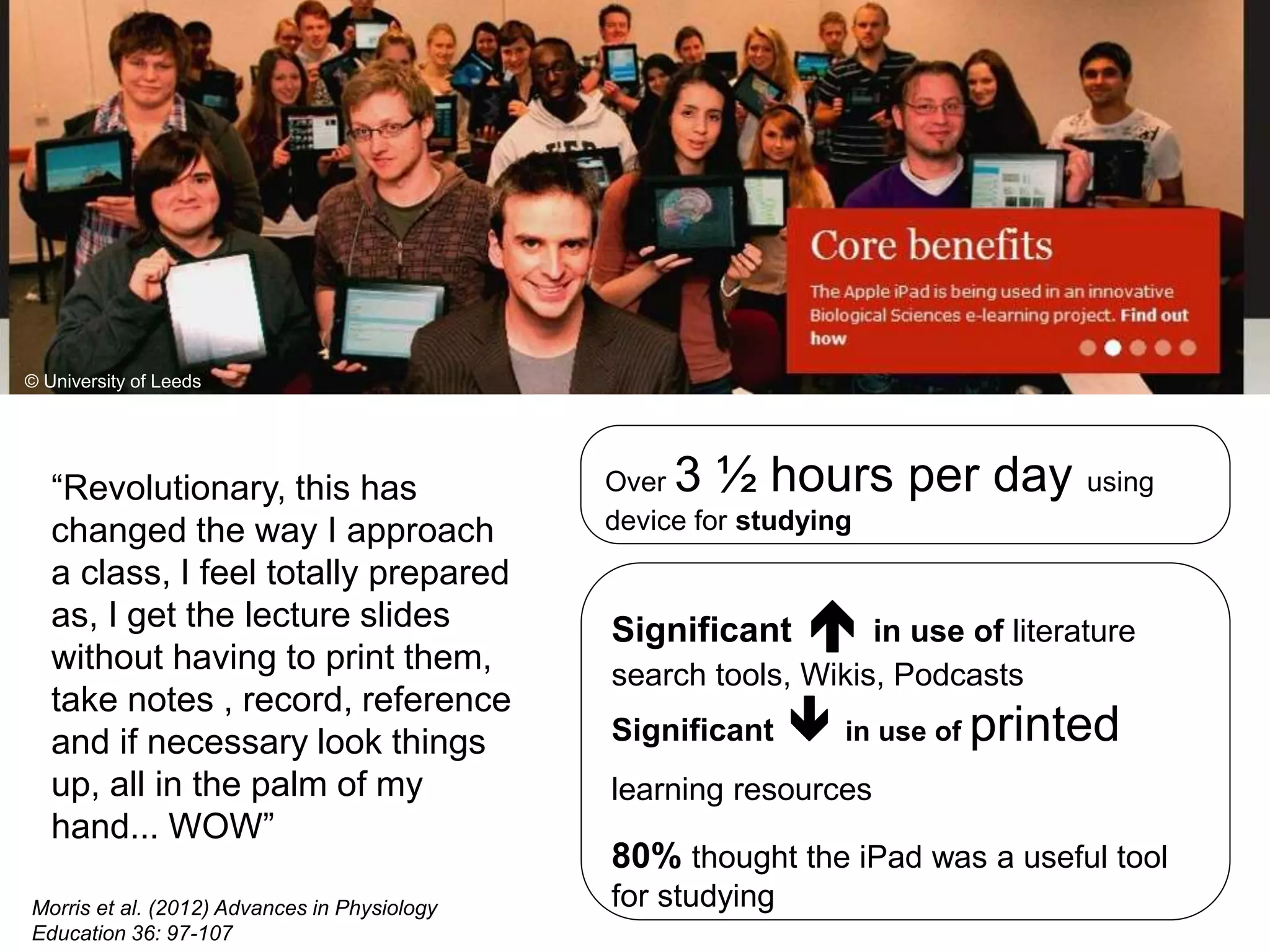
“Revolutionary, this has
changed the way I approach
a class, I feel totally prepared
as, I get the lecture slides
without having to print them,
take notes , record, reference
and if necessary look things
up, all in the palm of my
hand... WOW”
© University of Leeds
Over 3 ½ hours per day using
device for studying
Significant  in use of literature
search tools, Wikis, Podcasts
Significant  in use of printed
learning resources
80% thought the iPad was a useful tool
for studyingMorris et al. (2012) Advances in Physiology
Education 36: 97-107
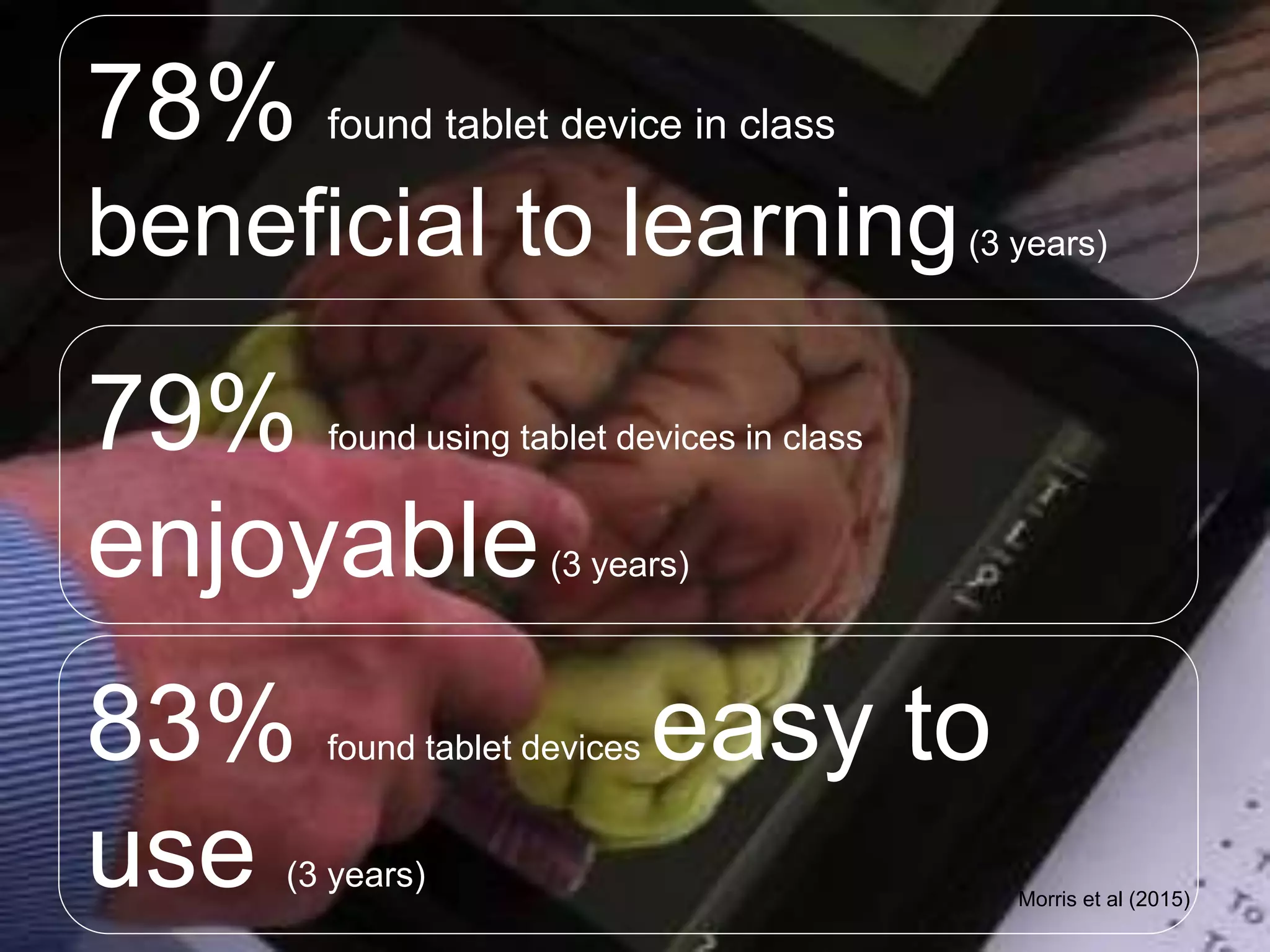
78% found tablet device in class
beneficial to learning(3 years)
79% found using tablet devices in class
enjoyable(3 years)
Morris et al (2015)
83% found tablet devices easy to
use (3 years)
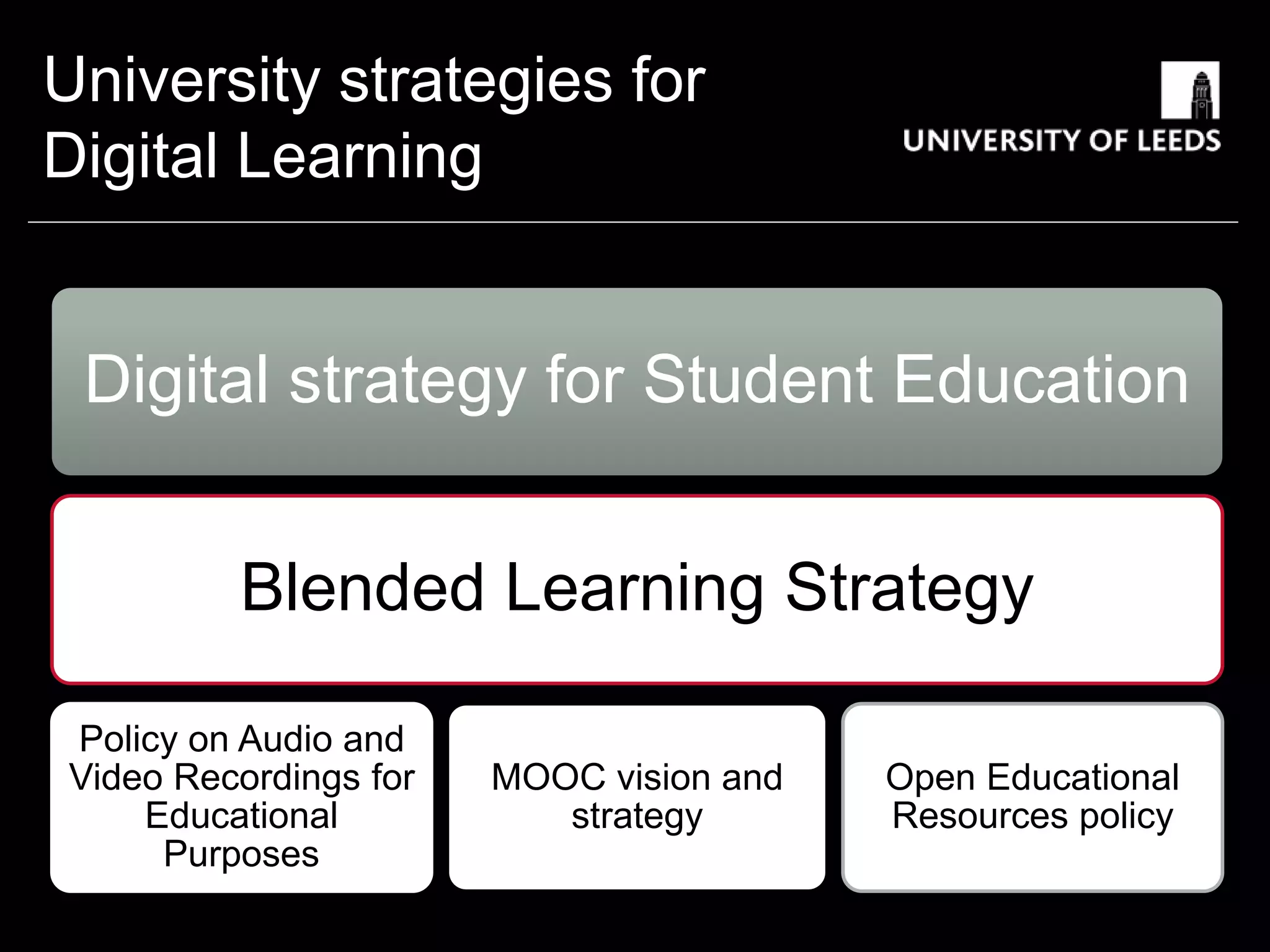
University strategies for
Digital Learning
Digital strategy for Student Education
Blended Learning Strategy
Policy on Audio and
Video Recordings for
Educational
Purposes
MOOC vision and
strategy
Open Educational
Resources policy
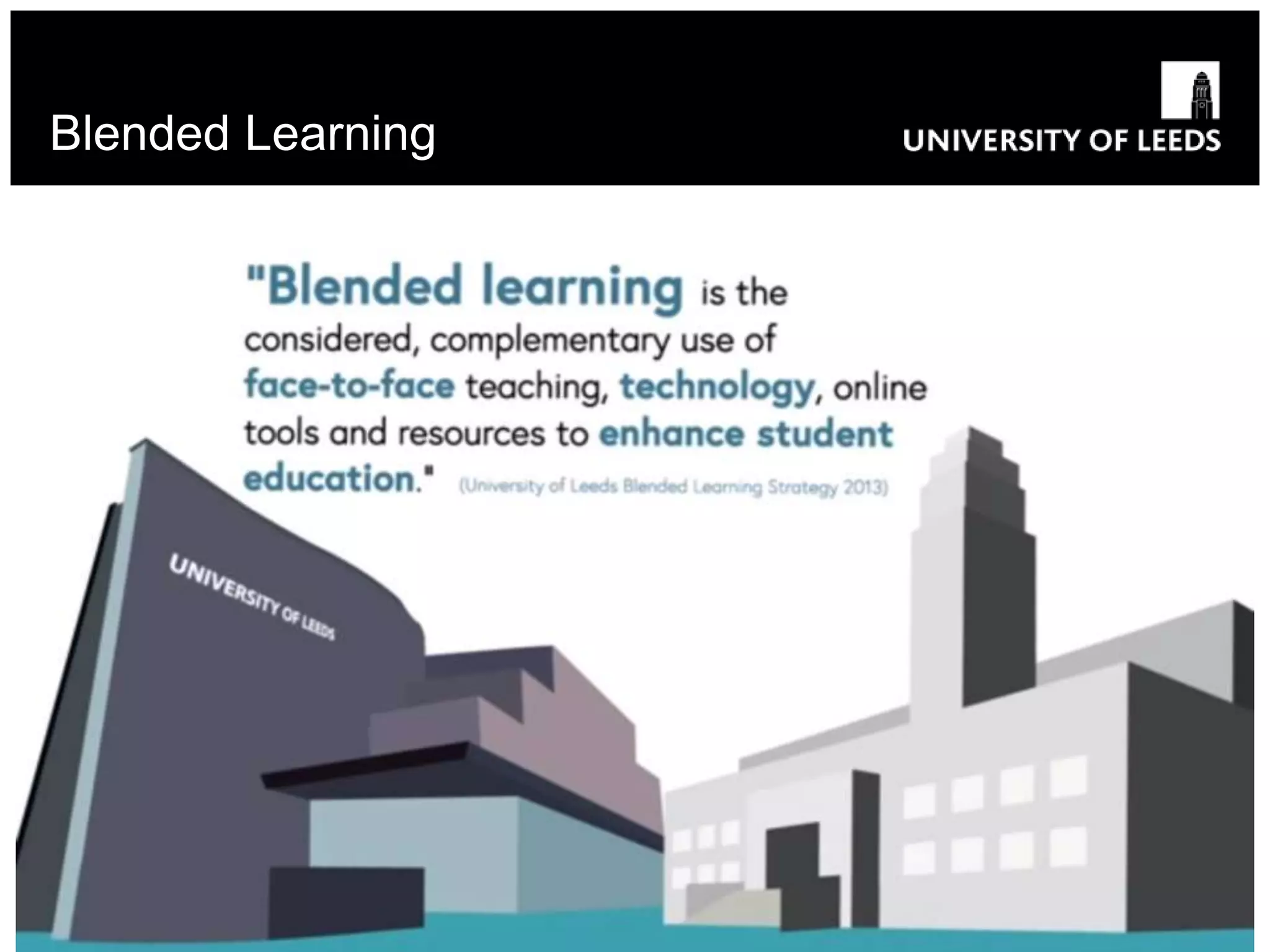
Blended Learning
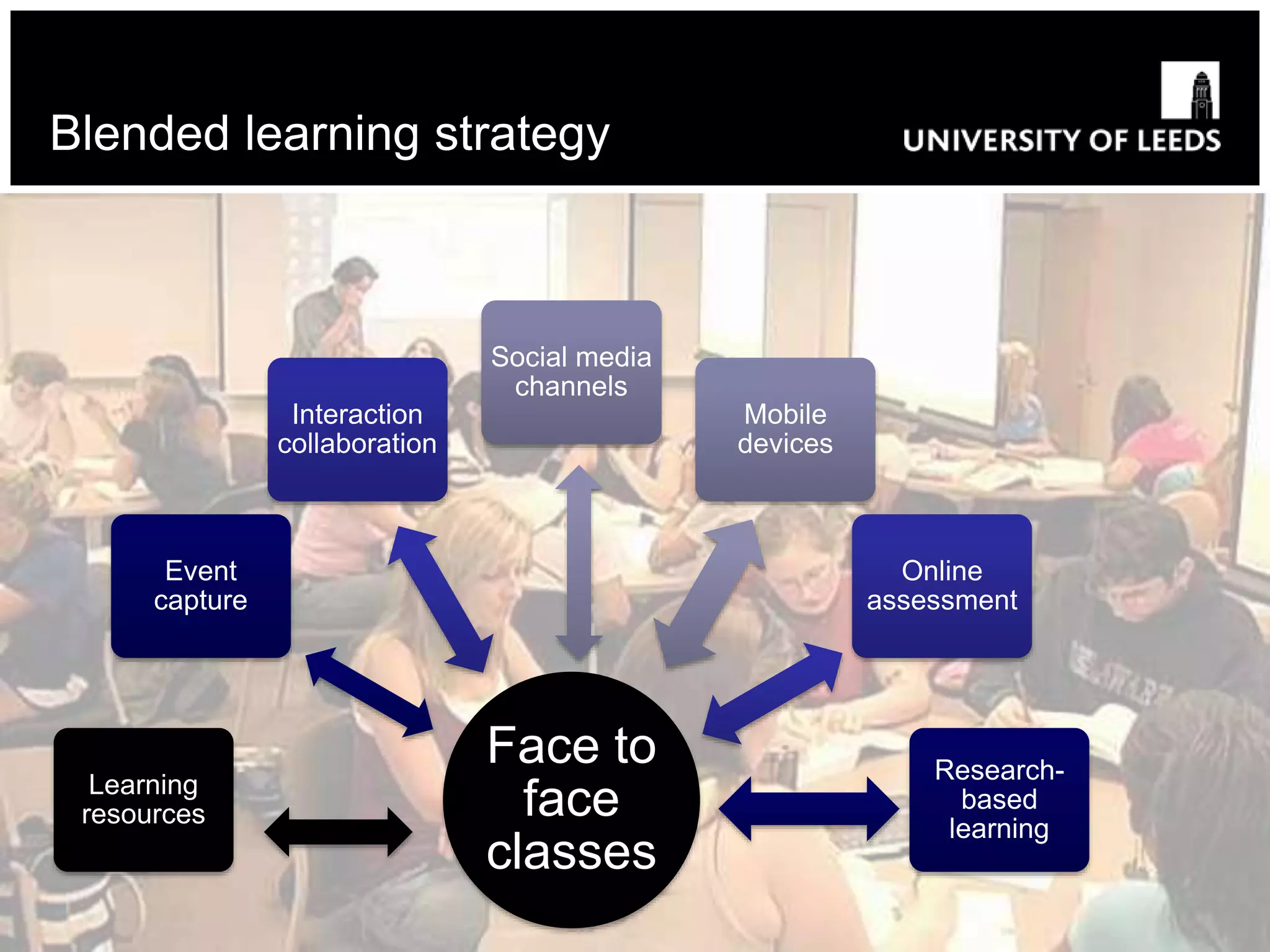
Blended learning strategy
Face to
face
classes
Learning
resources
Event
capture
Interaction
collaboration
Social media
channels
Mobile
devices
Online
assessment
Research-
based
learning
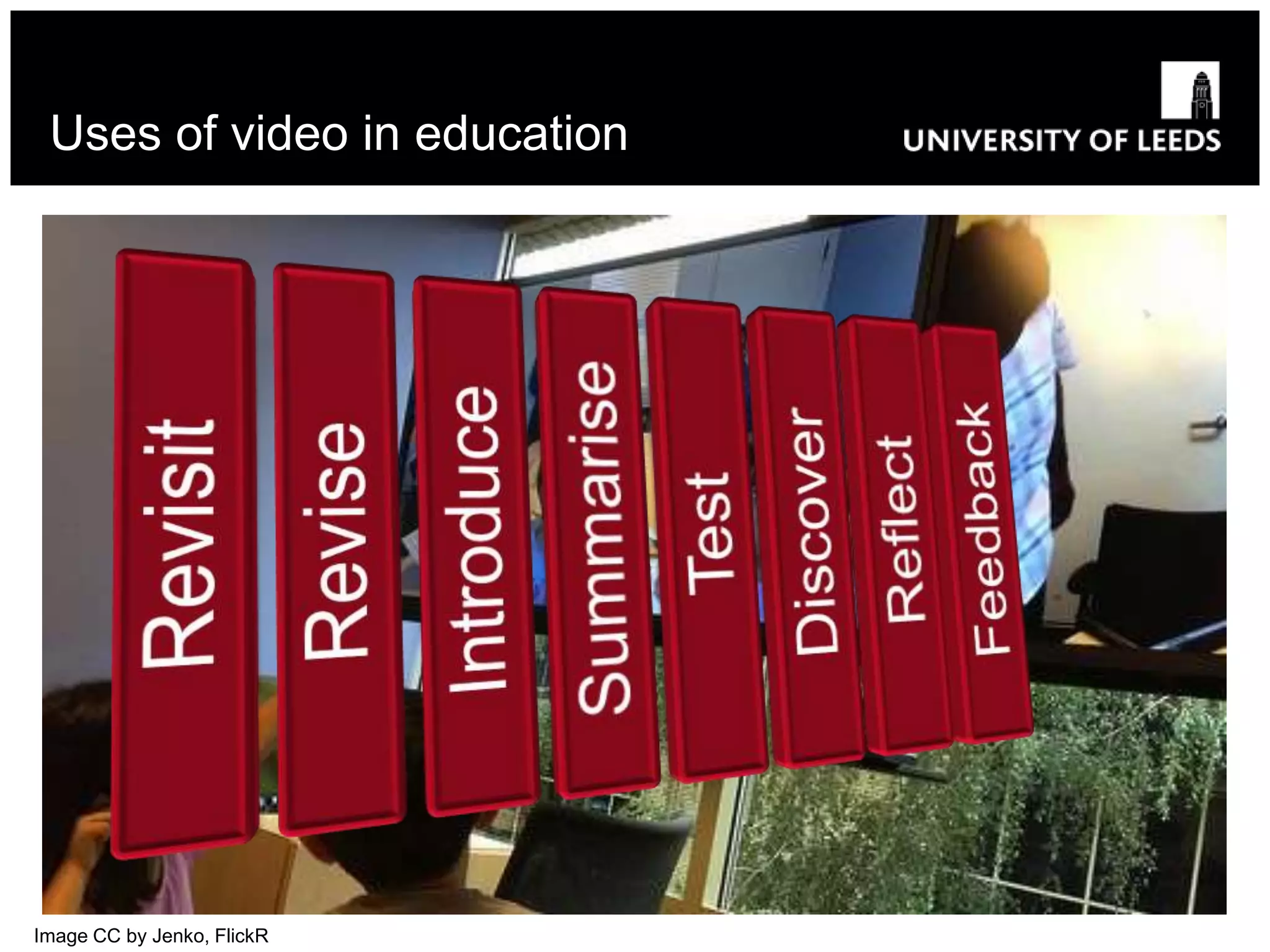
Uses of video in education
Image CC by Jenko, FlickR
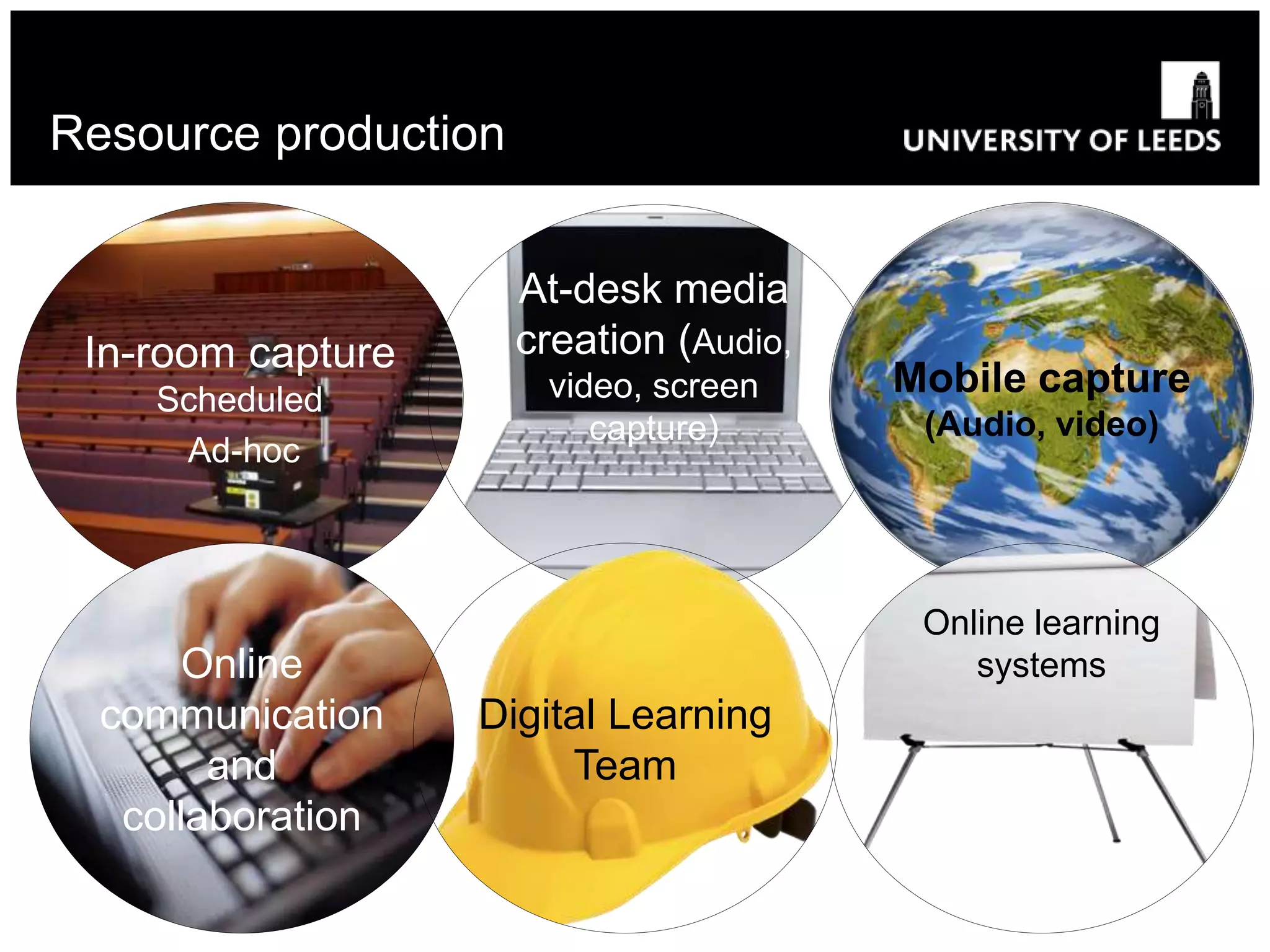
Resource production
In-room capture
Scheduled
Ad-hoc
At-desk media
creation (Audio,
video, screen
capture)
Mobile capture
(Audio, video)
Online
communication
and
collaboration
Online learning
systems
Digital Learning
Team
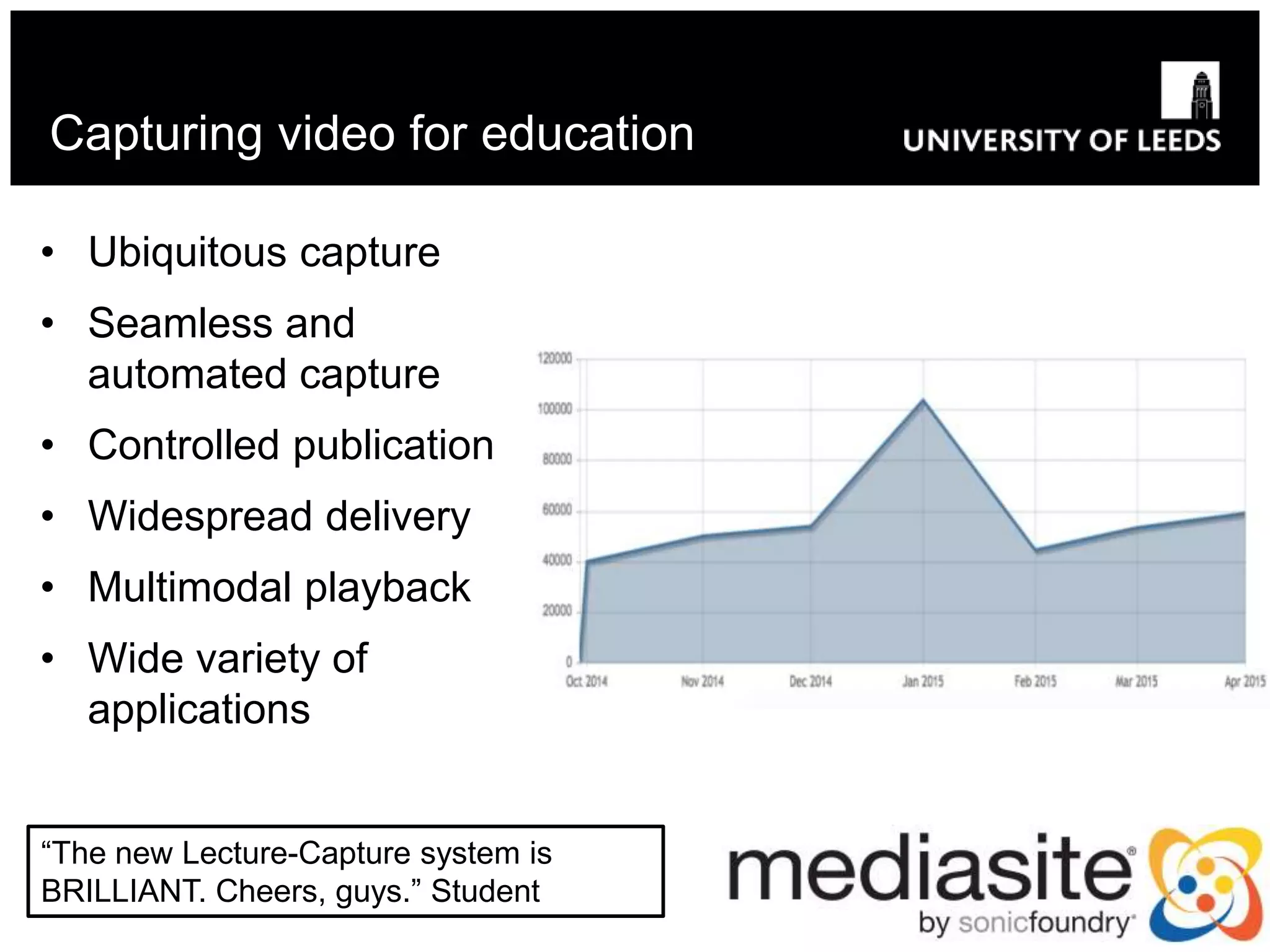
Capturing video for education
• Ubiquitous capture
• Seamless and
automated capture
• Controlled publication
• Widespread delivery
• Multimodal playback
• Wide variety of
applications
“The new Lecture-Capture system is
BRILLIANT. Cheers, guys.” Student
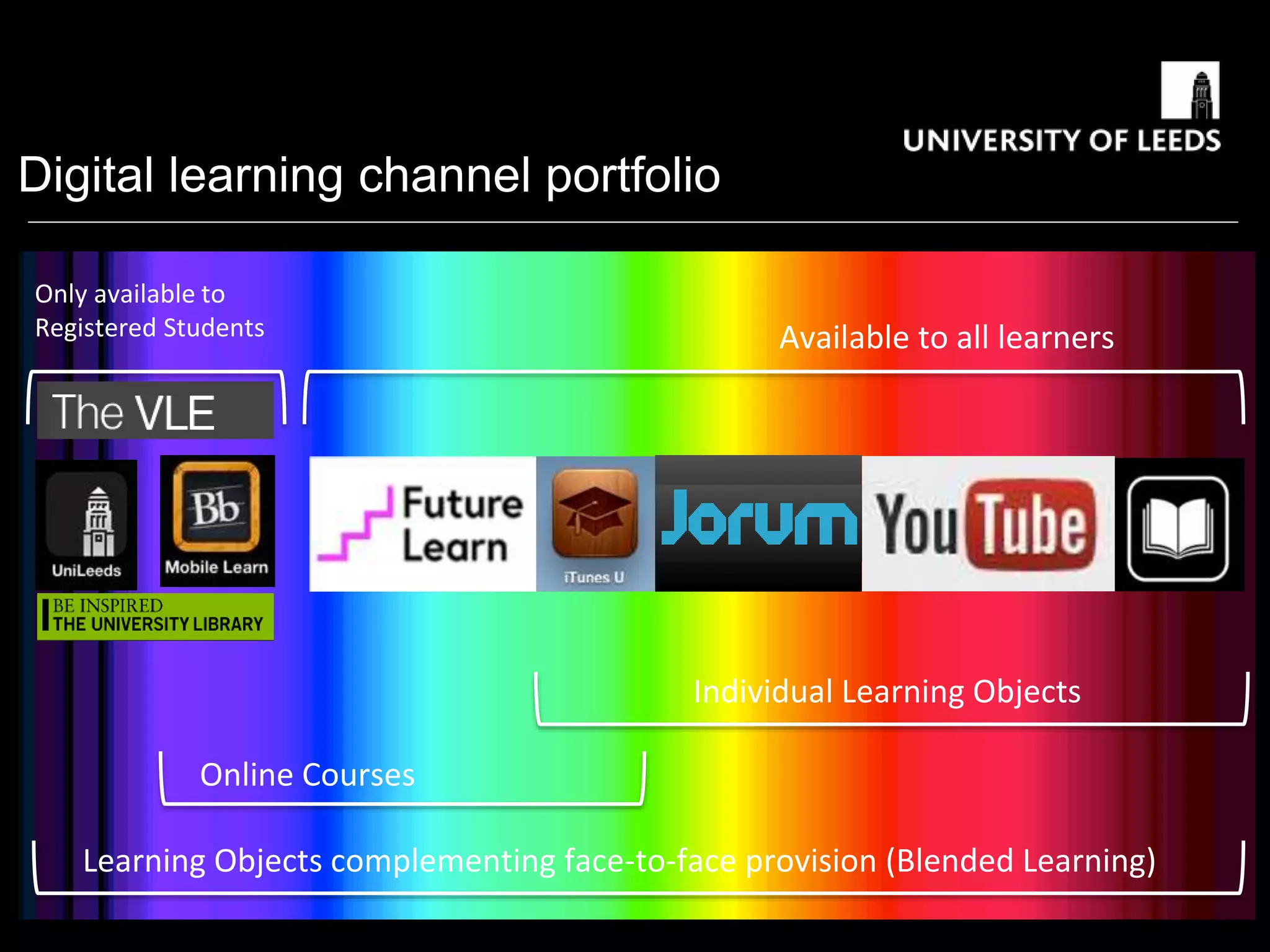
Digital learning channel portfolio
Only available to
Registered Students Available to all learners
Online Courses
Individual Learning Objects
Learning Objects complementing face-to-face provision (Blended Learning)
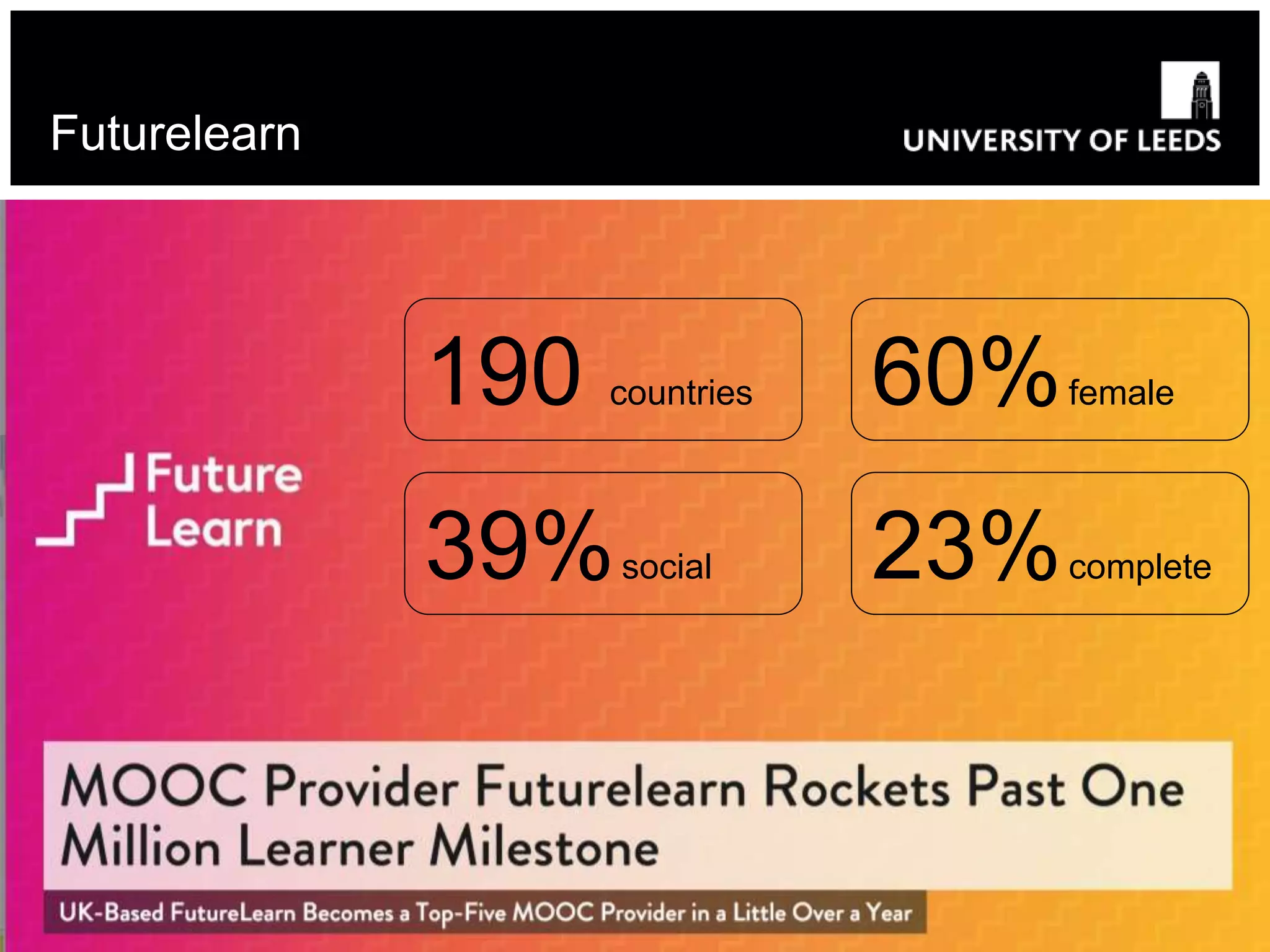
Futurelearn
Overall stats
190 countries 60%female
39%social 23%complete
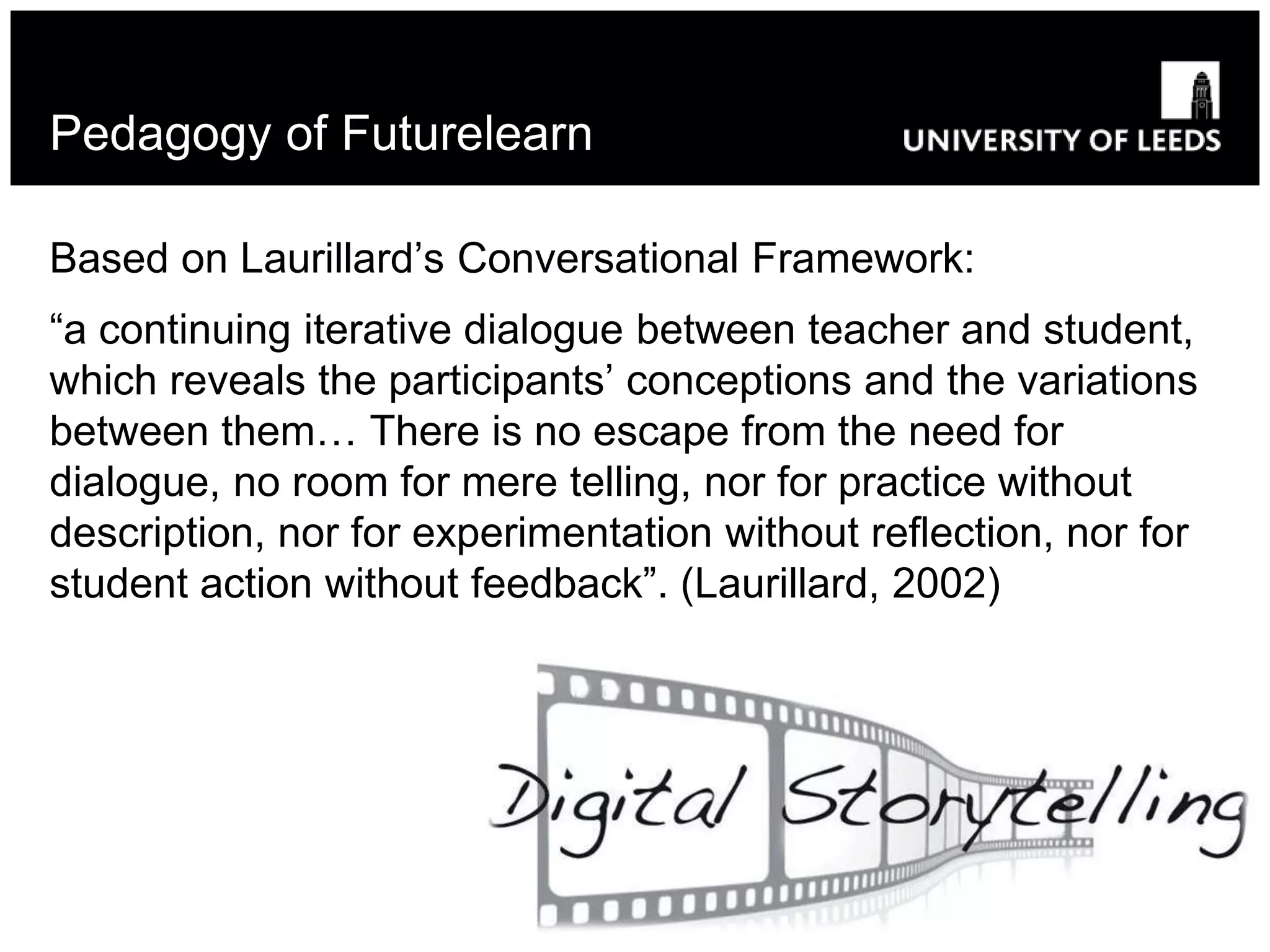
Pedagogy of Futurelearn
Based on Laurillard’s Conversational Framework:
“a continuing iterative dialogue between teacher and student,
which reveals the participants’ conceptions and the variations
between them… There is no escape from the need for
dialogue, no room for mere telling, nor for practice without
description, nor for experimentation without reflection, nor for
student action without feedback”. (Laurillard, 2002)
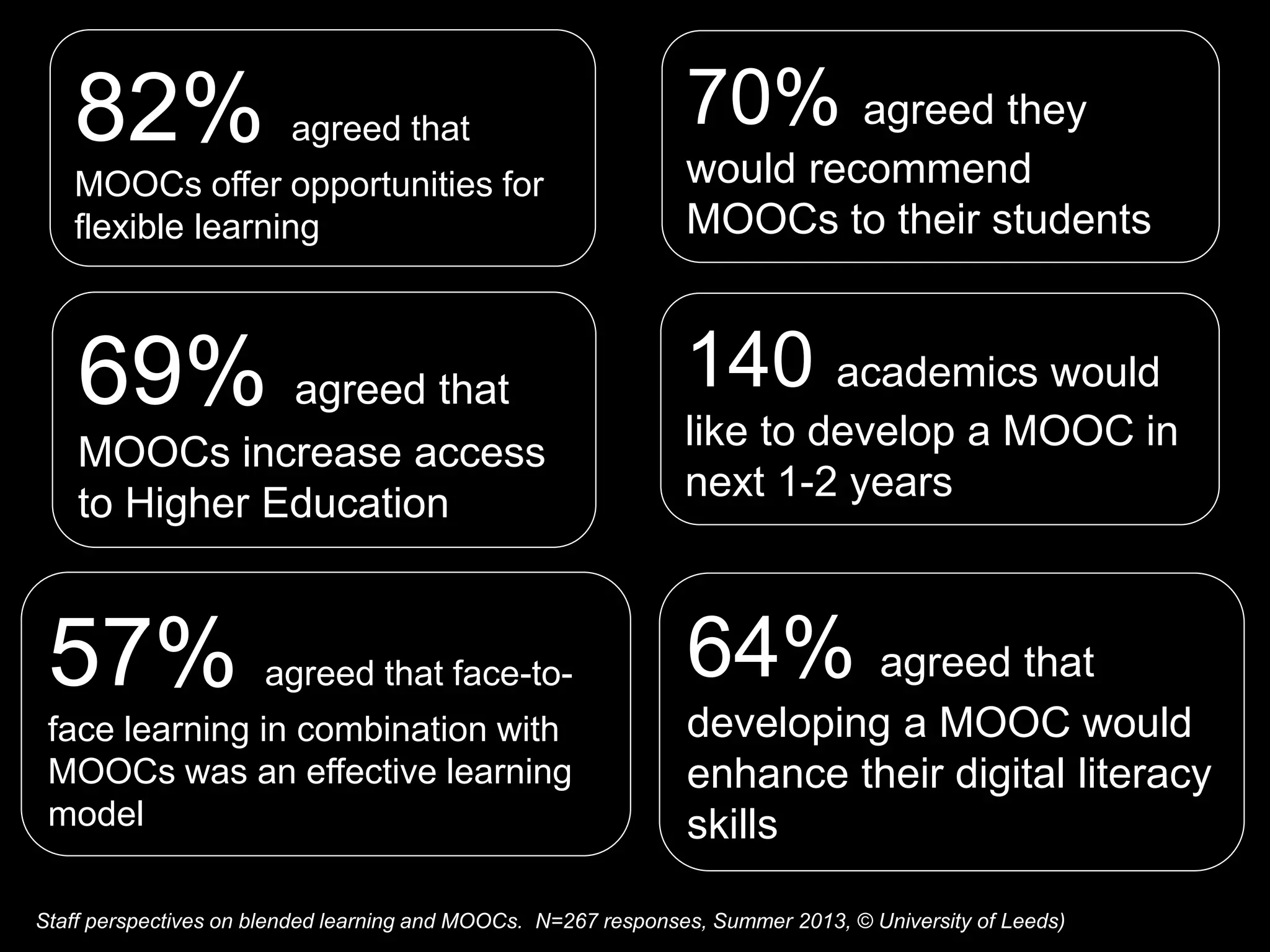
Staff perspectives on blended learning and MOOCs. N=267 responses, Summer 2013, © University of Leeds)
82% agreed that
MOOCs offer opportunities for
flexible learning
69% agreed that
MOOCs increase access
to Higher Education
140 academics would
like to develop a MOOC in
next 1-2 years
64% agreed that
developing a MOOC would
enhance their digital literacy
skills
57% agreed that face-to-
face learning in combination with
MOOCs was an effective learning
model
70% agreed they
would recommend
MOOCs to their students
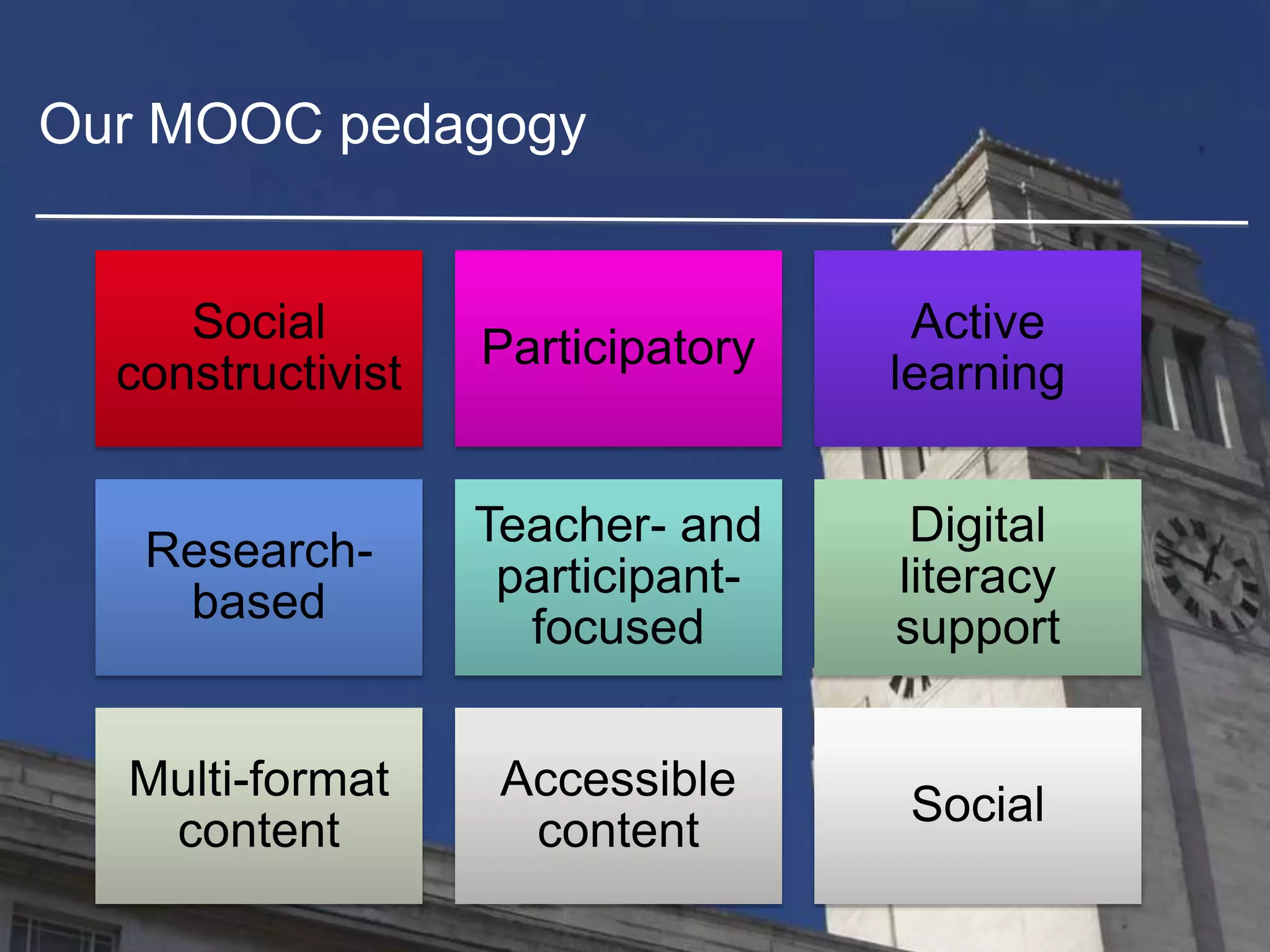
Social
constructivist
Participatory
Active
learning
Research-
based
Teacher- and
participant-
focused
Digital
literacy
support
Multi-format
content
Accessible
content
Social
Our MOOC pedagogy
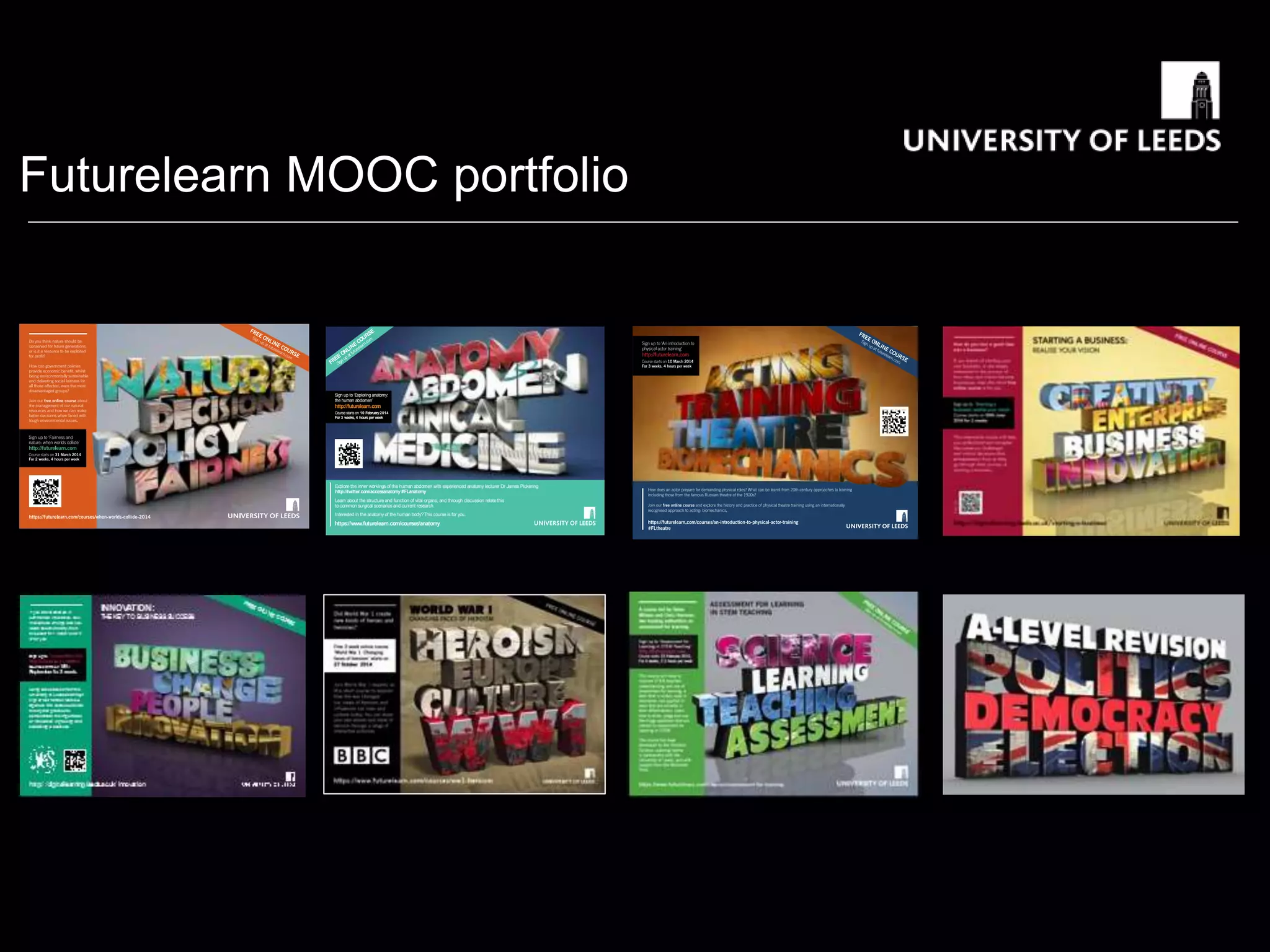
Futurelearn MOOC portfolio
FREE
ONLINE
COURSE
Sign up at futurelearn.com
https://futurelearn.com/courses/when-worlds-collide
Sign up to ‘Exploring anatomy:
the human abdomen’
http://futurelearn.com
Coursestartson 10 February2014
For 3 weeks, 4 hoursper week
Explore the inner workings of the human abdomen with experienced anatomy lecturer Dr James Pickering
http://twitter.com/accessanatomy #FLanatomy
Learn about the structure and function of vital organs, and through discussion relate this
to common surgical scenarios and current research.
Interested in the anatomy of the human body?This course is for you.
https://www.futurelearn.com/courses/anatomy
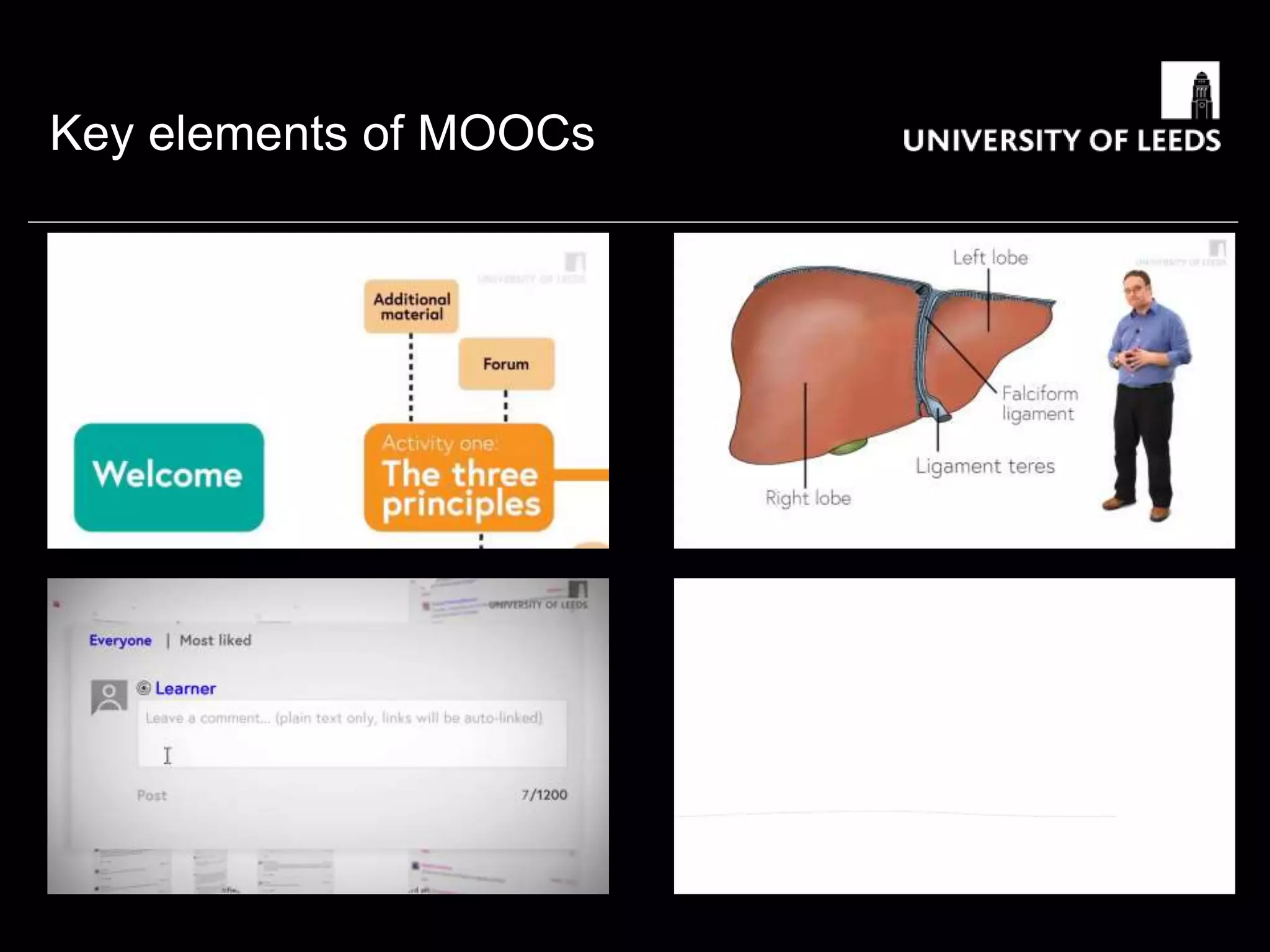
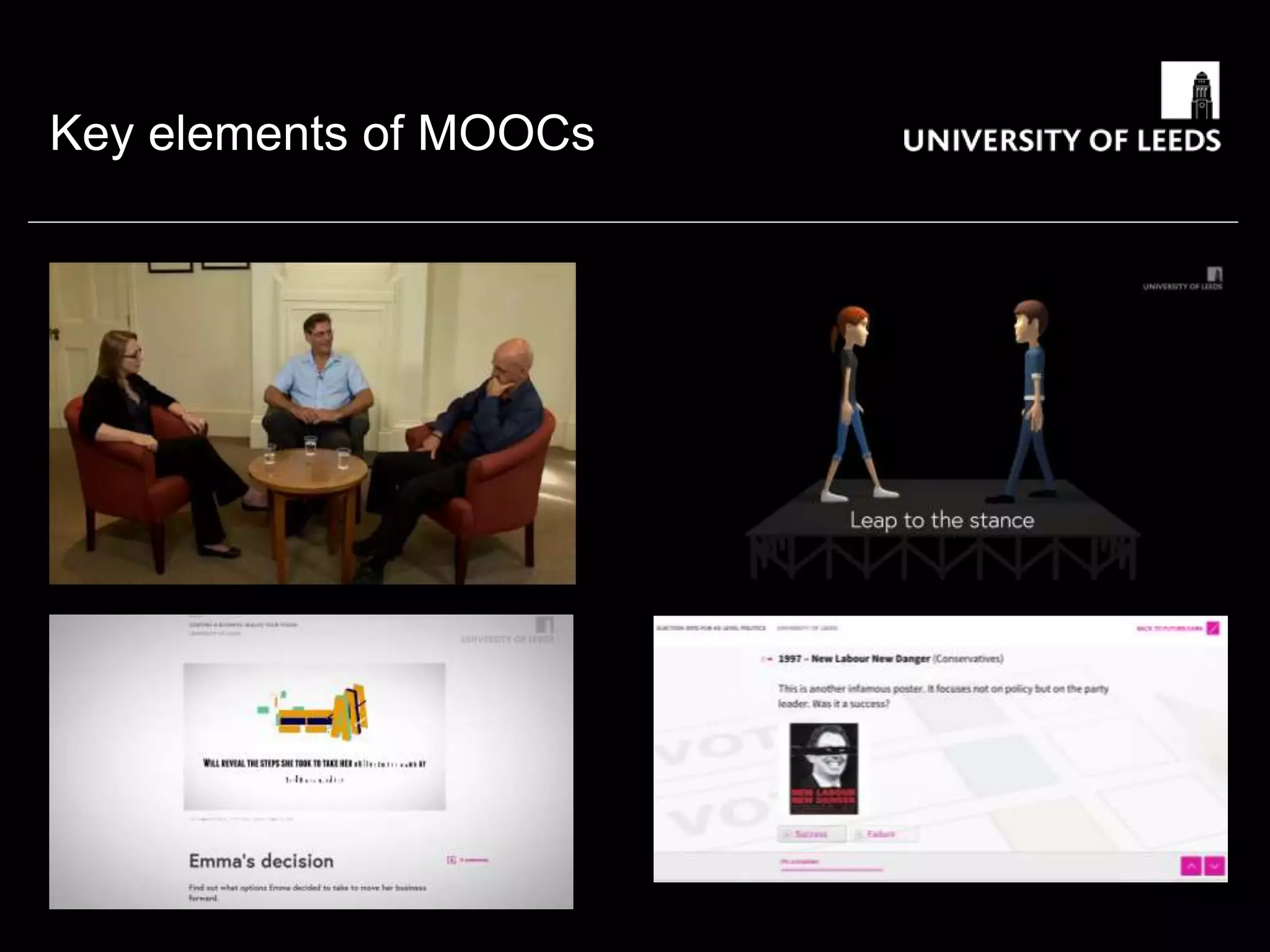
Key elements of MOOCs
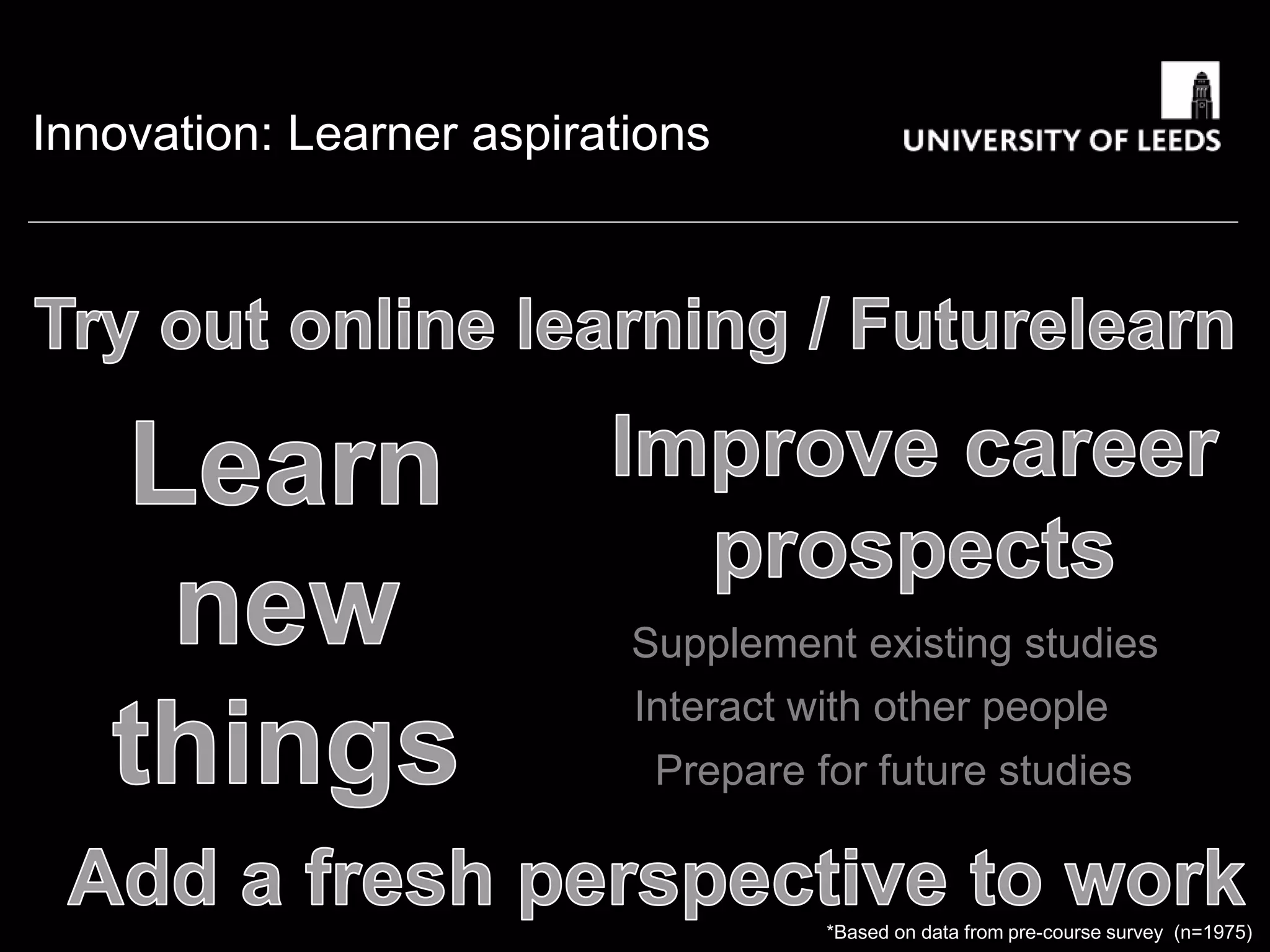
Innovation: Learner aspirations
Interact with other people
Prepare for future studies
Supplement existing studies
*Based on data from pre-course survey (n=1975)
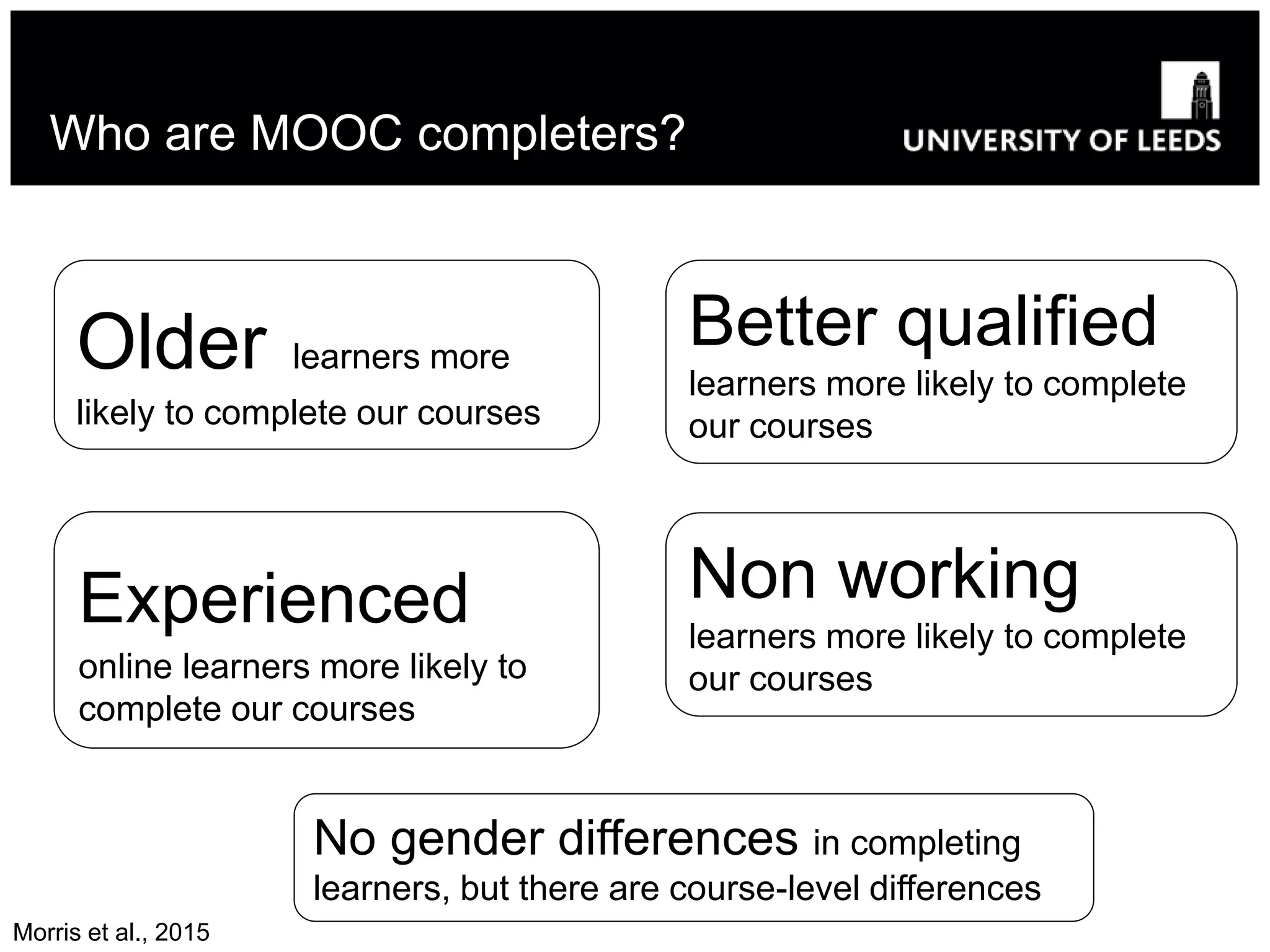
Who are MOOC completers?
Older learners more
likely to complete our courses
No gender differences in completing
learners, but there are course-level differences
Experienced
online learners more likely to
complete our courses
Better qualified
learners more likely to complete
our courses
Non working
learners more likely to complete
our courses
Morris et al., 2015
MOOCs on campus
FREE
ONLIN
E
COURSE
Sign
up
at
futurelearn.co
m
https://futurelearn.com/courses/when-worlds-collide
Sign up to ‘Exploring anatomy:
the human abdomen’
http://futurelearn.com
Coursestartson 10 February2014
For 3 weeks, 4 hoursper week
Explore the inner workings of the human abdomen with experienced anatomy lecturer Dr James Pickering
http://twitter.com/accessanatomy #FLanatomy
Learn about the structure and function of vital organs, and through discussion relate this
to common surgical scenarios and current research.
Interested in the anatomy of the human body?This course is for you.
https://www.futurelearn.com/courses/anatomy
MOOC content embedded
into module and
programmes
New MOOC style blended
modules created
MOOC content used to
create new distance
learning programmes
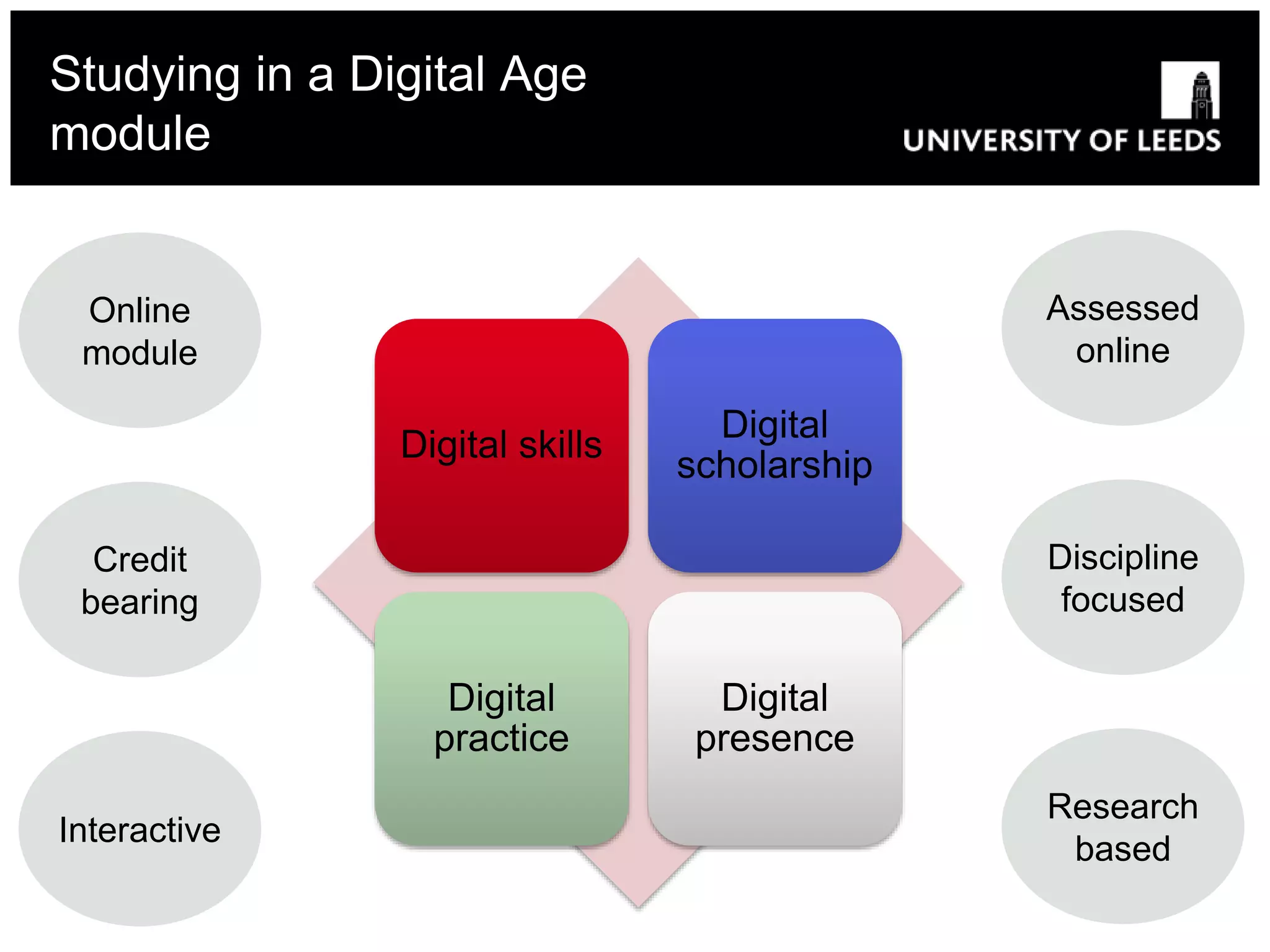
Studying in a Digital Age
module
Digital skills
Digital
scholarship
Digital
practice
Digital
presence
Online
module
Credit
bearing
Interactive
Assessed
online
Discipline
focused
Research
based
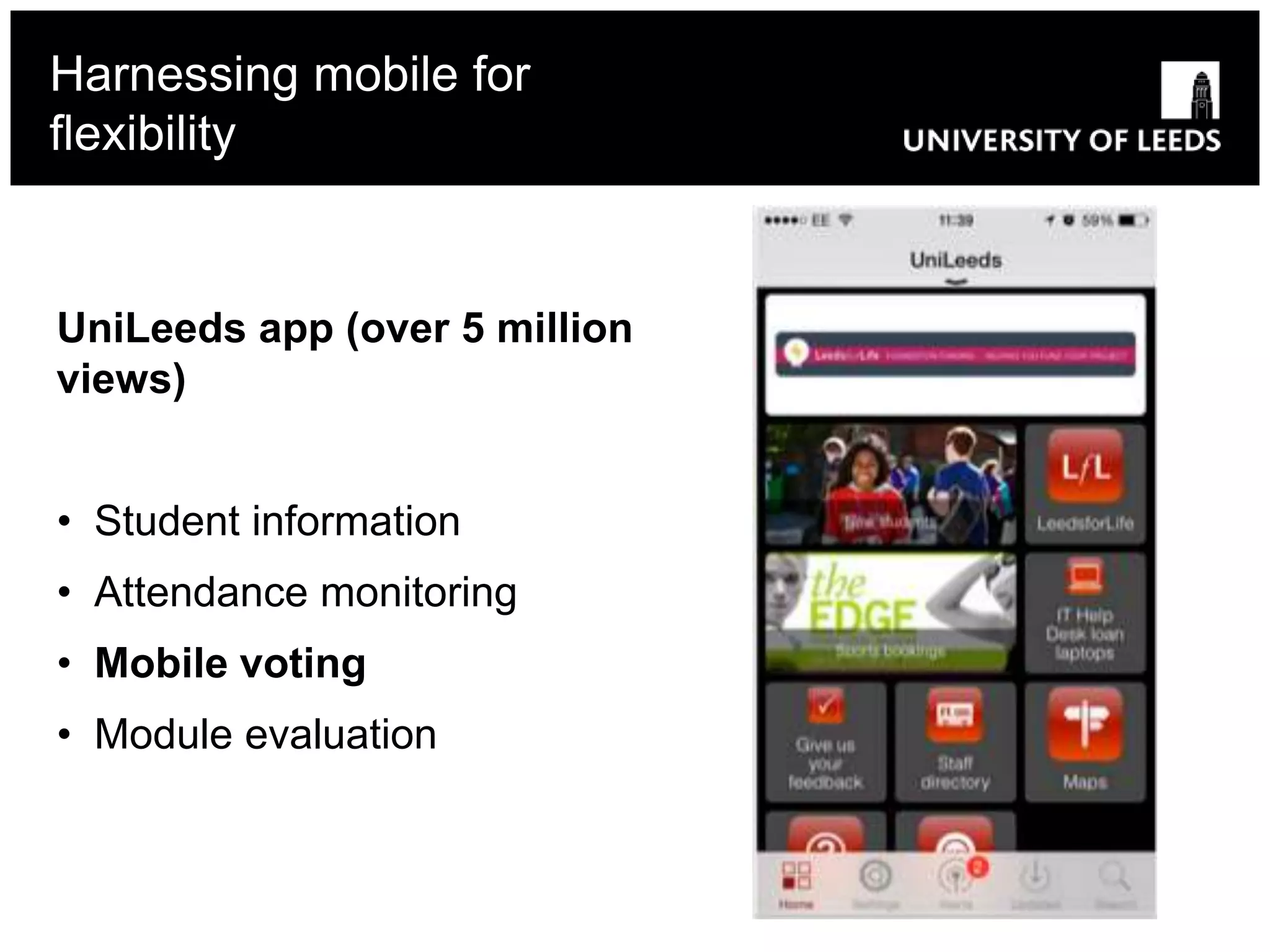
Harnessing mobile for
flexibility
UniLeeds app (over 5 million
views)
• Student information
• Attendance monitoring
• Mobile voting
• Module evaluation
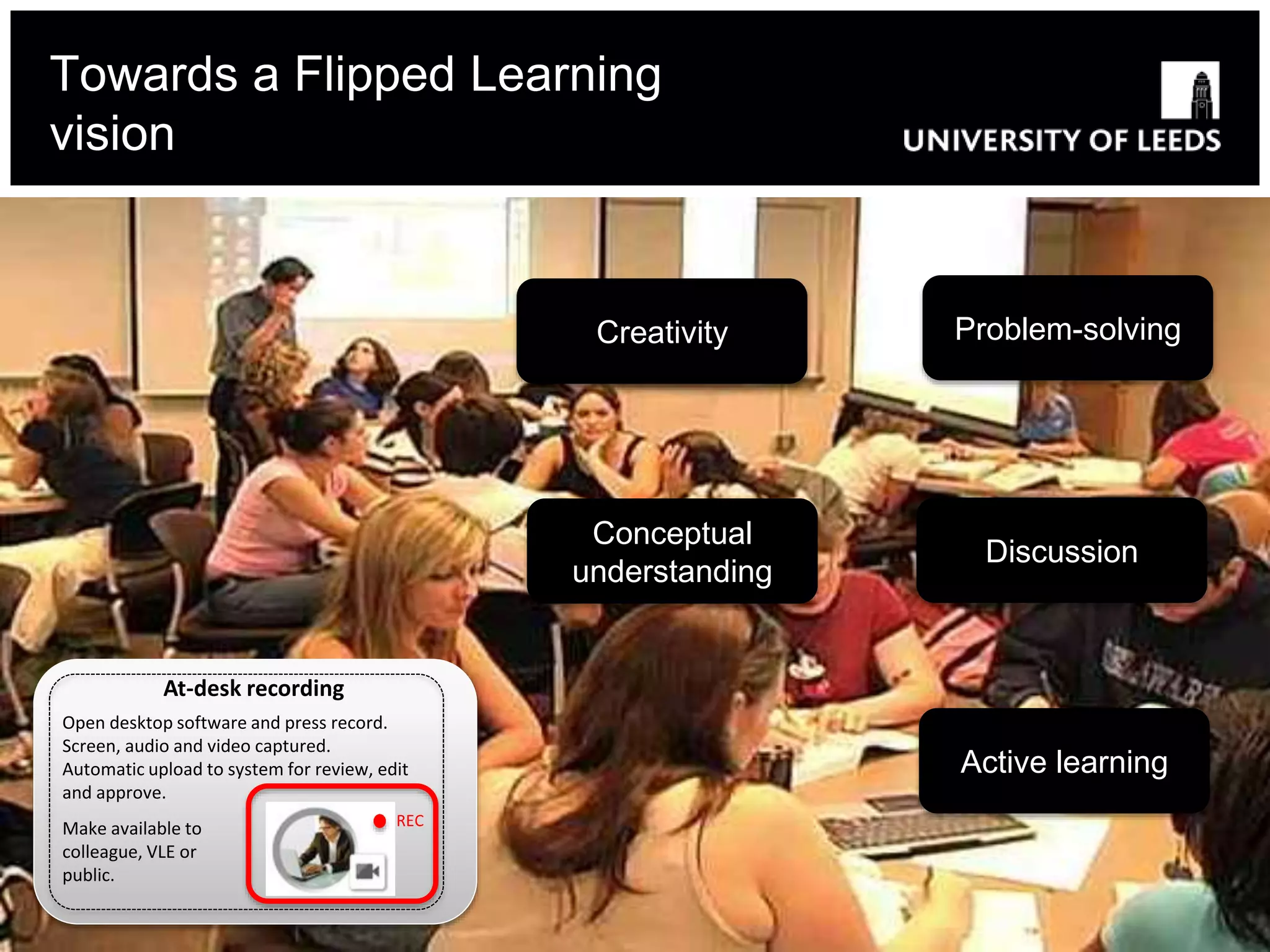
At-desk recording
REC
Open desktop software and press record.
Screen, audio and video captured.
Automatic upload to system for review, edit
and approve.
Make available to
colleague, VLE or
public.
Problem-solving
Discussion
Creativity
Conceptual
understanding
Active learning
Towards a Flipped Learning
vision
Content and images © University of Leeds
Email: n.p.morris@leeds.ac.uk
Twitter: @neilmorrisleeds, @unileedsonline

Mobile learning, blended learning and digital strategy in HE

  • 1.
    Neil Morris Director ofDigital Learning Professor of Educational Technology, Innovation and Change, School of Education University of Leeds Content and images © University of Leeds Email: n.p.morris@leeds.ac.uk Twitter: @neilmorrisleeds, @unileedsonline Digital technology and Higher Education: delivering benefits for student education
  • 2.
  • 3.
    Learning and Teaching “Tellme and I forget, teach me and I may remember, involve me and I learn.” Benjamin Franklin
  • 4.
  • 5.
  • 6.
    N=1363 (Nov 2012;Middleton and Caperon, 2013) 50% use a mobile device frequently for research or assignments 23% use a mobile device frequently to read e-books 86% own a smartphone 97%own a laptop. 20% own a tablet device 35% are planning to purchase a tablet device for academic and social reasons 70% likely to use a mobile device to read articles or books online 87% use a mobile device frequently to use a search engine University of Leeds students’ use of mobile devices
  • 7.
  • 8.
    “Revolutionary, this has changedthe way I approach a class, I feel totally prepared as, I get the lecture slides without having to print them, take notes , record, reference and if necessary look things up, all in the palm of my hand... WOW” © University of Leeds © University of Leeds Over 3 ½ hours per day using device for studying Significant  in use of literature search tools, Wikis, Podcasts Significant  in use of printed learning resources 80% thought the iPad was a useful tool for studyingMorris et al. (2012) Advances in Physiology Education 36: 97-107
  • 9.
    78% found tabletdevice in class beneficial to learning(3 years) 79% found using tablet devices in class enjoyable(3 years) Morris et al (2015) 83% found tablet devices easy to use (3 years)
  • 10.
    University strategies for DigitalLearning Digital strategy for Student Education Blended Learning Strategy Policy on Audio and Video Recordings for Educational Purposes MOOC vision and strategy Open Educational Resources policy
  • 11.
  • 12.
    Blended learning strategy Faceto face classes Learning resources Event capture Interaction collaboration Social media channels Mobile devices Online assessment Research- based learning
  • 13.
    Uses of videoin education Image CC by Jenko, FlickR
  • 14.
    Resource production In-room capture Scheduled Ad-hoc At-deskmedia creation (Audio, video, screen capture) Mobile capture (Audio, video) Online communication and collaboration Online learning systems Digital Learning Team
  • 15.
    Capturing video foreducation • Ubiquitous capture • Seamless and automated capture • Controlled publication • Widespread delivery • Multimodal playback • Wide variety of applications “The new Lecture-Capture system is BRILLIANT. Cheers, guys.” Student
  • 16.
    Digital learning channelportfolio Only available to Registered Students Available to all learners Online Courses Individual Learning Objects Learning Objects complementing face-to-face provision (Blended Learning)
  • 17.
    Futurelearn Overall stats 190 countries60%female 39%social 23%complete
  • 18.
    Pedagogy of Futurelearn Basedon Laurillard’s Conversational Framework: “a continuing iterative dialogue between teacher and student, which reveals the participants’ conceptions and the variations between them… There is no escape from the need for dialogue, no room for mere telling, nor for practice without description, nor for experimentation without reflection, nor for student action without feedback”. (Laurillard, 2002)
  • 19.
    Staff perspectives onblended learning and MOOCs. N=267 responses, Summer 2013, © University of Leeds) 82% agreed that MOOCs offer opportunities for flexible learning 69% agreed that MOOCs increase access to Higher Education 140 academics would like to develop a MOOC in next 1-2 years 64% agreed that developing a MOOC would enhance their digital literacy skills 57% agreed that face-to- face learning in combination with MOOCs was an effective learning model 70% agreed they would recommend MOOCs to their students
  • 20.
  • 21.
    Futurelearn MOOC portfolio FREE ONLINE COURSE Signup at futurelearn.com https://futurelearn.com/courses/when-worlds-collide Sign up to ‘Exploring anatomy: the human abdomen’ http://futurelearn.com Coursestartson 10 February2014 For 3 weeks, 4 hoursper week Explore the inner workings of the human abdomen with experienced anatomy lecturer Dr James Pickering http://twitter.com/accessanatomy #FLanatomy Learn about the structure and function of vital organs, and through discussion relate this to common surgical scenarios and current research. Interested in the anatomy of the human body?This course is for you. https://www.futurelearn.com/courses/anatomy
  • 22.
  • 23.
  • 24.
    Innovation: Learner aspirations Interactwith other people Prepare for future studies Supplement existing studies *Based on data from pre-course survey (n=1975)
  • 25.
    Who are MOOCcompleters? Older learners more likely to complete our courses No gender differences in completing learners, but there are course-level differences Experienced online learners more likely to complete our courses Better qualified learners more likely to complete our courses Non working learners more likely to complete our courses Morris et al., 2015
  • 26.
    MOOCs on campus FREE ONLIN E COURSE Sign up at futurelearn.co m https://futurelearn.com/courses/when-worlds-collide Signup to ‘Exploring anatomy: the human abdomen’ http://futurelearn.com Coursestartson 10 February2014 For 3 weeks, 4 hoursper week Explore the inner workings of the human abdomen with experienced anatomy lecturer Dr James Pickering http://twitter.com/accessanatomy #FLanatomy Learn about the structure and function of vital organs, and through discussion relate this to common surgical scenarios and current research. Interested in the anatomy of the human body?This course is for you. https://www.futurelearn.com/courses/anatomy MOOC content embedded into module and programmes New MOOC style blended modules created MOOC content used to create new distance learning programmes
  • 27.
    Studying in aDigital Age module Digital skills Digital scholarship Digital practice Digital presence Online module Credit bearing Interactive Assessed online Discipline focused Research based
  • 28.
    Harnessing mobile for flexibility UniLeedsapp (over 5 million views) • Student information • Attendance monitoring • Mobile voting • Module evaluation
  • 29.
    At-desk recording REC Open desktopsoftware and press record. Screen, audio and video captured. Automatic upload to system for review, edit and approve. Make available to colleague, VLE or public. Problem-solving Discussion Creativity Conceptual understanding Active learning Towards a Flipped Learning vision
  • 30.
    Content and images© University of Leeds Email: n.p.morris@leeds.ac.uk Twitter: @neilmorrisleeds, @unileedsonline