Improved engagement of Latino
students in a business curriculum
    Mary Kate Naatus, Assistant Professor
        Saint Peter’s College
Overview
• Background info & research on HSI’s &
  engagement
• Case Study: SPC is a Hispanic-serving Institution
  (HSI); 6 years
• Best practices for curriculum delivery & student
  engagement
• Strategies for engaging Latino students in
  business curriculum/specific courses
   – My experience & your suggestions?
• How to measure and track success? Suggestions?
My interest
• My first experience teaching was in El
  Salvador; worked with Hispanic community in
  Newark
• 27% of students at Saint Peter’s College have
  Hispanic ethnicity
  – Mexico, El Salvador, Honduras, Bolivia, Colombia,
    Panama, Dominican Republic, Puerto Rico
THE HISPANIC ASSOCIATION OF COLLEGES AND UNIVERSITIES
                                 (HACU)

      •   The Hispanic Association of Colleges and Universities (HACU) - established in 1986 – 18 schools

      •   Today - more than 400 colleges and universities committed to Hispanic higher education success in the
          U.S., Puerto Rico, Latin America, Spain and Portugal. Although our member institutions in the U. S.
          represent less than 10% of all higher education institutions nationwide, together they are home to more
          than two-thirds of all Hispanic college students. HACU is the only national educational association that
          represents Hispanic-Serving Institutions (HSIs).

      •   In 1992, HACU led the effort to convince Congress to formally recognize campuses with high Hispanic
          enrollment as federally designated HSIs and to begin targeting federal appropriations to those campuses.

      •   Soon after, HACU and its allies were instrumental in convincing Congress to appropriate money specifically
          for HSIs. For the first time ever
            –    HSIs were granted $12 million in 1995 from federal resources.
            –   In 2011, $104.3 million were appropriated for the HSI undergraduate program under Title V of Higher
                Education Act.
            –   HACU has recommended $175 million be appropriated for fiscal year 2012.

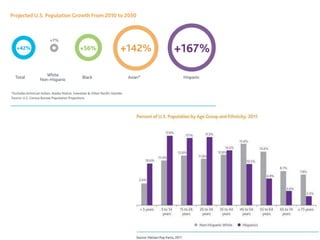
      •   Our nation's economic and social success rests on the level of skills and knowledge attained by Hispanics,
          now the nation's largest minority population. Education, indisputably, is the key.


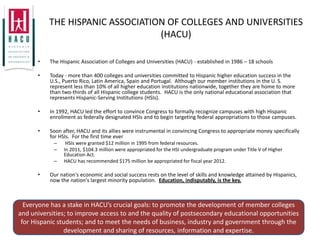
  Everyone has a stake in HACU’s crucial goals: to promote the development of member colleges
and universities; to improve access to and the quality of postsecondary educational opportunities
 for Hispanic students; and to meet the needs of business, industry and government through the
                development and sharing of resources, information and expertise.
Hispanic Serving Institutions (HSI)
African American and Hispanic Student Engagement at Minority Serving and Predominantly
White Institutions
While scholars have examined HBCUs in terms of their educational effectiveness for
African American students compared to PWIs, there is a lack of similar research on Hispanic
students at HSIs and PWIs. This study uses data from the 2003 administration of the National
Survey of Student Engagement (NSSE) to investigate whether HSIs appear to serve Hispanic
students in similar ways that HBCUs serve African American students. The results suggest that
the average Hispanic senior at an HSI looks quite similar to the average Hispanic senior at a PWI
in terms of engagement, satisfaction with college, and gains in overall development, in contrast
to the results for African American seniors who are more engaged at HBCUs than PWIs.
Challenges
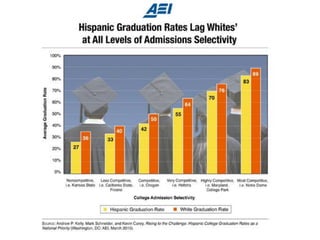
• Hispanic students graduate at lower rates than their
  white peers at universities and colleges of all levels. An
  average of 51 percent of Hispanic students complete a
  bachelor's degree in six years compared to 59 percent for
  white students.
• Hispanic students and their families often lack
  information about the true cost of college tuition
• An institutional commitment to high levels of retention
  and completion for all students is a crucial prerequisite
  to maintaining and improving the percentage of Hispanic
  students who complete a bachelor’s degree.
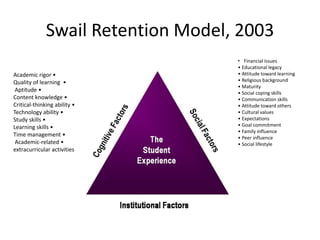
Swail Retention Model, 2003
                                    • Financial issues
                                    • Educational legacy
Academic rigor •                    • Attitude toward learning
Quality of learning •               • Religious background
                                    • Maturity
 Aptitude •                         • Social coping skills
Content knowledge •                 • Communication skills
Critical-thinking ability •         • Attitude toward others
Technology ability •                • Cultural values
Study skills •                      • Expectations
Learning skills •                   • Goal commitment
                                    • Family influence
Time management •                   • Peer influence
 Academic-related •                 • Social lifestyle
extracurricular activities
Opportunities
• Increase student engagement, student satisfaction,
  graduation rates and career opportunities
   – Examine why graduation rates lower; role of socio-economic
     status as relevant variable
• Better counseling about available financial aid and also paid
  internship opportunities would also help to lower the rate
  at which Hispanic students drop out of college for financial
  reasons.
• Government aid to colleges and universities for meeting
  the “Hispanic-Serving Institution” criteria should be tied to
  performance as measured by Hispanic student retention
  and graduation rates, rather than simply enrollment rates
  as is currently the case.
BEAMS project
• Collaborative project between the American Association of Higher
  Education (AAHE) and the National Survey of Student Engagement.
  Each BEAMS institution administers the National Survey of Student
  Engagement twice during the course of the project. At the
  conclusion of the project, the campus teams attended the AAHE
  Summer Academy to share results and propose interventions.
  Because NSSE focuses on student behavior, colleges can use the
  data in varying productive ways to 1) guide and monitor
  institutional improvement, 2) link information about student
  engagement and the teaching and learning environment, 3)
  promote student faculty interaction, 4) compare first-year and
  senior students experiences, using both cross-sectional and
  longitudinal approaches, 5) compare performance against peer
  institutions, and 6) verify the need for a first year experience.
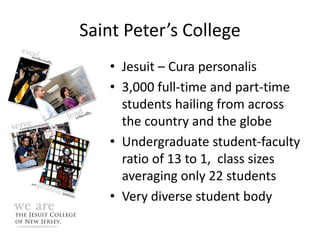
Saint Peter’s College
   • Jesuit – Cura personalis
   • 3,000 full-time and part-time
     students hailing from across
     the country and the globe
   • Undergraduate student-faculty
     ratio of 13 to 1, class sizes
     averaging only 22 students
   • Very diverse student body
Title V
• SPC received $2.8 million Title V federal grant in fall 2010 under the HSI
  Program,
    – expand and enhance academic offerings, program quality and institutional stability
      for Hispanic students, in addition to improving the attainment of Hispanic students.
• As part of the Title V federal grant, Saint Peter’s College opened the
  Center for English Language Acquisition and Culture this April 2012.
    – The Center is a full service resource center, which will provide an
      interactive study environment to better support ESL students in their
      language development.
• The Title V grant will also enable the expansion of thriving academic
  assistance programs and activities to successfully integrate Spanish-
  speaking students into the College community.
• The grant also involves faculty development on cultural competency and
  academic readiness programs in Jersey City high schools.
    – Campus climate (may be issue in Latino student persistence to graduation)
Characteristics of Latino Students
• Many are first generation college students
   – Tend to be loan-averse
   – Many work to pay for college, contribute to family income
   – Parental support? Understanding?
   – Less social capital - norms and social networks that assist in the transfer
     of education from one generation to the next (Lopez, ‘96)
   – generation to the next
   – May have lack of academic preparation; lower performing high schools
• Varied backgrounds – heterogeneous population
   – Different countries, cultures, families
   – Socio-economic background;
   – Hispanic as a demographic identifier vs. deeper
   psychological identifier (Argentine, Cuban, Mexican)            What is the relationship
                                                                 between ethnicity and higher
       -self-identify and how perceived by others                   education outcomes?
Best Practices
• Culturally Sensitive Instruction & Culturally
  responsive teaching
  – Defined by Gay (2002) as “using the cultural
    characteristics, experiences, and perspectives of
    ethnically diverse students as conduits for teaching
    them more effectively”
• Student-led Instruction (News Briefs)
Best Practices (continued)
• Participatory Action Research (PAR)
• Service Learning courses
• Learning Communities
  – Freshmen Interest Groups (Mentor/Advisor)
Institutional practices that can lead to high
                levels of student engagement
 1. Student-faculty interaction—inside & outside the classroom
          -one-on-one relationships
 2. Reciprocity and cooperation among students, such as having
 students work with each other and share ideas collaboratively.
 3. Active learning—making learning relate to the students’ daily lives.
 4. Prompt feedback- students receive frequent suggestions for
 improvement.
 5. Teaching students how to use their time effectively.
 6. High expectations—communicating to students that they are
 expected to perform well.
 7. Respect for diverse talents and ways of learning, including
 embracing various talents and styles students bring to college.


*Chickering and Gamson (1987)
Undergraduate Business Curriculum
• Ideas for engaging not only Hispanic students
  but all students
• Allowing individuals to explore and express
  identity, values, culture more fully, enhances
  learning for everyone
  – Mirrors reality of diverse workforce and global
    market
Culture
• International Marketing
• International Management
  – Country specific projects
  – Examining Hofstede’s cultural dimensions
     • Identifying personal & business examples
     • Role of women in societies, hierarchies, relationships-boss,
       subordinates = parents, children
• Organizational Behavior
  – Locus of control from a cultural perspective
     • “Si Dios quiere, primero dios”
Leadership
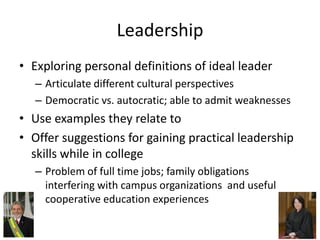
• Exploring personal definitions of ideal leader
   – Articulate different cultural perspectives
   – Democratic vs. autocratic; able to admit weaknesses
• Use examples they relate to
• Offer suggestions for gaining practical leadership
  skills while in college
   – Problem of full time jobs; family obligations
     interfering with campus organizations and useful
     cooperative education experiences
Marketing & Consumer Behavior
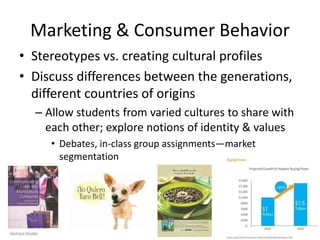
• Stereotypes vs. creating cultural profiles
• Discuss differences between the generations,
  different countries of origins
  – Allow students from varied cultures to share with
    each other; explore notions of identity & values
     • Debates, in-class group assignments—market
       segmentation
Individual Differences
• Engaging students from all backgrounds
   – Self-examination; personal SWOT or strategic plan
   – Use of identity maps in faculty training
        • Great exercise, understanding colleagues
        • Candid student discussions of college struggles
• What about the majority?

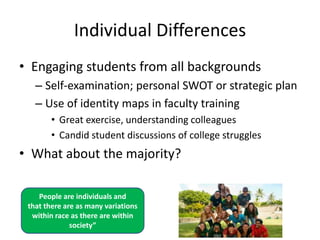
    People are individuals and
 that there are as many variations
  within race as there are within
              society”
Community
• Service Learning
  – My experience in Principles of Marketing
  – Problem-based model
• Co-ops & Internships
• Research team-Participatory Action Research
  – Community engagement, application of business
    concepts, professionalism
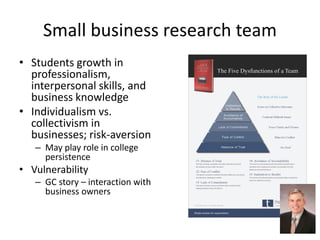
Small business research team
• Students growth in
  professionalism,
  interpersonal skills, and
  business knowledge
• Individualism vs.
  collectivism in
  businesses; risk-aversion
   – May play role in college
     persistence
• Vulnerability
   – GC story – interaction with
     business owners
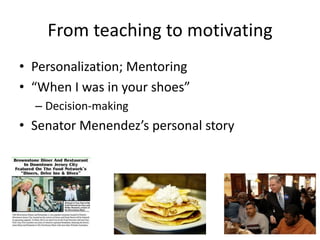
From teaching to motivating
• Personalization; Mentoring
• “When I was in your shoes”
  – Decision-making
• Senator Menendez’s personal story
Suggestions for Research
• Quantitative + Qualitative

• How to better engage Hispanic (and other
  multicultural students) in business courses?

• National Survey of Student Engagement
  – Suggested use of data for empirical study?

Mkn presentation drexel 2012

  • 1.
    Improved engagement ofLatino students in a business curriculum Mary Kate Naatus, Assistant Professor Saint Peter’s College
  • 2.
    Overview • Background info& research on HSI’s & engagement • Case Study: SPC is a Hispanic-serving Institution (HSI); 6 years • Best practices for curriculum delivery & student engagement • Strategies for engaging Latino students in business curriculum/specific courses – My experience & your suggestions? • How to measure and track success? Suggestions?
  • 3.
    My interest • Myfirst experience teaching was in El Salvador; worked with Hispanic community in Newark • 27% of students at Saint Peter’s College have Hispanic ethnicity – Mexico, El Salvador, Honduras, Bolivia, Colombia, Panama, Dominican Republic, Puerto Rico
  • 5.
    THE HISPANIC ASSOCIATIONOF COLLEGES AND UNIVERSITIES (HACU) • The Hispanic Association of Colleges and Universities (HACU) - established in 1986 – 18 schools • Today - more than 400 colleges and universities committed to Hispanic higher education success in the U.S., Puerto Rico, Latin America, Spain and Portugal. Although our member institutions in the U. S. represent less than 10% of all higher education institutions nationwide, together they are home to more than two-thirds of all Hispanic college students. HACU is the only national educational association that represents Hispanic-Serving Institutions (HSIs). • In 1992, HACU led the effort to convince Congress to formally recognize campuses with high Hispanic enrollment as federally designated HSIs and to begin targeting federal appropriations to those campuses. • Soon after, HACU and its allies were instrumental in convincing Congress to appropriate money specifically for HSIs. For the first time ever – HSIs were granted $12 million in 1995 from federal resources. – In 2011, $104.3 million were appropriated for the HSI undergraduate program under Title V of Higher Education Act. – HACU has recommended $175 million be appropriated for fiscal year 2012. • Our nation's economic and social success rests on the level of skills and knowledge attained by Hispanics, now the nation's largest minority population. Education, indisputably, is the key. Everyone has a stake in HACU’s crucial goals: to promote the development of member colleges and universities; to improve access to and the quality of postsecondary educational opportunities for Hispanic students; and to meet the needs of business, industry and government through the development and sharing of resources, information and expertise.
  • 6.
    Hispanic Serving Institutions(HSI) African American and Hispanic Student Engagement at Minority Serving and Predominantly White Institutions While scholars have examined HBCUs in terms of their educational effectiveness for African American students compared to PWIs, there is a lack of similar research on Hispanic students at HSIs and PWIs. This study uses data from the 2003 administration of the National Survey of Student Engagement (NSSE) to investigate whether HSIs appear to serve Hispanic students in similar ways that HBCUs serve African American students. The results suggest that the average Hispanic senior at an HSI looks quite similar to the average Hispanic senior at a PWI in terms of engagement, satisfaction with college, and gains in overall development, in contrast to the results for African American seniors who are more engaged at HBCUs than PWIs.
  • 7.
    Challenges • Hispanic studentsgraduate at lower rates than their white peers at universities and colleges of all levels. An average of 51 percent of Hispanic students complete a bachelor's degree in six years compared to 59 percent for white students. • Hispanic students and their families often lack information about the true cost of college tuition • An institutional commitment to high levels of retention and completion for all students is a crucial prerequisite to maintaining and improving the percentage of Hispanic students who complete a bachelor’s degree.
  • 8.
    Swail Retention Model,2003 • Financial issues • Educational legacy Academic rigor • • Attitude toward learning Quality of learning • • Religious background • Maturity Aptitude • • Social coping skills Content knowledge • • Communication skills Critical-thinking ability • • Attitude toward others Technology ability • • Cultural values Study skills • • Expectations Learning skills • • Goal commitment • Family influence Time management • • Peer influence Academic-related • • Social lifestyle extracurricular activities
  • 10.
    Opportunities • Increase studentengagement, student satisfaction, graduation rates and career opportunities – Examine why graduation rates lower; role of socio-economic status as relevant variable • Better counseling about available financial aid and also paid internship opportunities would also help to lower the rate at which Hispanic students drop out of college for financial reasons. • Government aid to colleges and universities for meeting the “Hispanic-Serving Institution” criteria should be tied to performance as measured by Hispanic student retention and graduation rates, rather than simply enrollment rates as is currently the case.
  • 11.
    BEAMS project • Collaborativeproject between the American Association of Higher Education (AAHE) and the National Survey of Student Engagement. Each BEAMS institution administers the National Survey of Student Engagement twice during the course of the project. At the conclusion of the project, the campus teams attended the AAHE Summer Academy to share results and propose interventions. Because NSSE focuses on student behavior, colleges can use the data in varying productive ways to 1) guide and monitor institutional improvement, 2) link information about student engagement and the teaching and learning environment, 3) promote student faculty interaction, 4) compare first-year and senior students experiences, using both cross-sectional and longitudinal approaches, 5) compare performance against peer institutions, and 6) verify the need for a first year experience.
  • 12.
    Saint Peter’s College • Jesuit – Cura personalis • 3,000 full-time and part-time students hailing from across the country and the globe • Undergraduate student-faculty ratio of 13 to 1, class sizes averaging only 22 students • Very diverse student body
  • 13.
    Title V • SPCreceived $2.8 million Title V federal grant in fall 2010 under the HSI Program, – expand and enhance academic offerings, program quality and institutional stability for Hispanic students, in addition to improving the attainment of Hispanic students. • As part of the Title V federal grant, Saint Peter’s College opened the Center for English Language Acquisition and Culture this April 2012. – The Center is a full service resource center, which will provide an interactive study environment to better support ESL students in their language development. • The Title V grant will also enable the expansion of thriving academic assistance programs and activities to successfully integrate Spanish- speaking students into the College community. • The grant also involves faculty development on cultural competency and academic readiness programs in Jersey City high schools. – Campus climate (may be issue in Latino student persistence to graduation)
  • 14.
    Characteristics of LatinoStudents • Many are first generation college students – Tend to be loan-averse – Many work to pay for college, contribute to family income – Parental support? Understanding? – Less social capital - norms and social networks that assist in the transfer of education from one generation to the next (Lopez, ‘96) – generation to the next – May have lack of academic preparation; lower performing high schools • Varied backgrounds – heterogeneous population – Different countries, cultures, families – Socio-economic background; – Hispanic as a demographic identifier vs. deeper psychological identifier (Argentine, Cuban, Mexican) What is the relationship between ethnicity and higher -self-identify and how perceived by others education outcomes?
  • 15.
    Best Practices • CulturallySensitive Instruction & Culturally responsive teaching – Defined by Gay (2002) as “using the cultural characteristics, experiences, and perspectives of ethnically diverse students as conduits for teaching them more effectively” • Student-led Instruction (News Briefs)
  • 16.
    Best Practices (continued) •Participatory Action Research (PAR) • Service Learning courses • Learning Communities – Freshmen Interest Groups (Mentor/Advisor)
  • 17.
    Institutional practices thatcan lead to high levels of student engagement 1. Student-faculty interaction—inside & outside the classroom -one-on-one relationships 2. Reciprocity and cooperation among students, such as having students work with each other and share ideas collaboratively. 3. Active learning—making learning relate to the students’ daily lives. 4. Prompt feedback- students receive frequent suggestions for improvement. 5. Teaching students how to use their time effectively. 6. High expectations—communicating to students that they are expected to perform well. 7. Respect for diverse talents and ways of learning, including embracing various talents and styles students bring to college. *Chickering and Gamson (1987)
  • 18.
    Undergraduate Business Curriculum •Ideas for engaging not only Hispanic students but all students • Allowing individuals to explore and express identity, values, culture more fully, enhances learning for everyone – Mirrors reality of diverse workforce and global market
  • 19.
    Culture • International Marketing •International Management – Country specific projects – Examining Hofstede’s cultural dimensions • Identifying personal & business examples • Role of women in societies, hierarchies, relationships-boss, subordinates = parents, children • Organizational Behavior – Locus of control from a cultural perspective • “Si Dios quiere, primero dios”
  • 20.
    Leadership • Exploring personaldefinitions of ideal leader – Articulate different cultural perspectives – Democratic vs. autocratic; able to admit weaknesses • Use examples they relate to • Offer suggestions for gaining practical leadership skills while in college – Problem of full time jobs; family obligations interfering with campus organizations and useful cooperative education experiences
  • 21.
    Marketing & ConsumerBehavior • Stereotypes vs. creating cultural profiles • Discuss differences between the generations, different countries of origins – Allow students from varied cultures to share with each other; explore notions of identity & values • Debates, in-class group assignments—market segmentation
  • 22.
    Individual Differences • Engagingstudents from all backgrounds – Self-examination; personal SWOT or strategic plan – Use of identity maps in faculty training • Great exercise, understanding colleagues • Candid student discussions of college struggles • What about the majority? People are individuals and that there are as many variations within race as there are within society”
  • 23.
    Community • Service Learning – My experience in Principles of Marketing – Problem-based model • Co-ops & Internships • Research team-Participatory Action Research – Community engagement, application of business concepts, professionalism
  • 24.
    Small business researchteam • Students growth in professionalism, interpersonal skills, and business knowledge • Individualism vs. collectivism in businesses; risk-aversion – May play role in college persistence • Vulnerability – GC story – interaction with business owners
  • 25.
    From teaching tomotivating • Personalization; Mentoring • “When I was in your shoes” – Decision-making • Senator Menendez’s personal story
  • 26.
    Suggestions for Research •Quantitative + Qualitative • How to better engage Hispanic (and other multicultural students) in business courses? • National Survey of Student Engagement – Suggested use of data for empirical study?