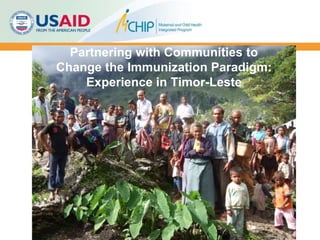
Partnering with Communities to
Change the Immunization Paradigm:
Experience in Timor-Leste
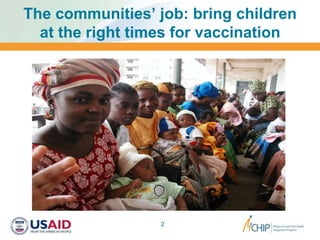
The communities’ job: bring children
at the right times for vaccination
2
The health services’ job:
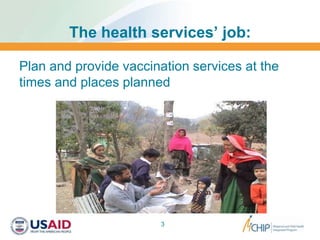
Plan and provide vaccination services at the
times and places planned
3
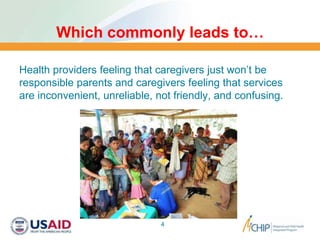
Which commonly leads to…
Health providers feeling that caregivers just won’t be
responsible parents and caregivers feeling that services
are inconvenient, unreliable, not friendly, and confusing.
4
A Proposed New Vision
Getting a community’s children vaccinated and
protected is a joint responsibility of health services
and the community. They should work together in
planning, providing, monitoring, and continuously
improving vaccination services and their utilization.
5
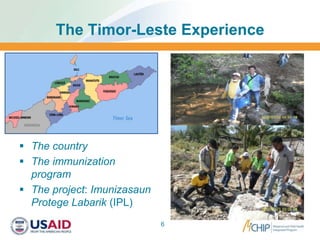
The Timor-Leste Experience
 The country
 The immunization
program
 The project: Imunizasaun
Protege Labarik (IPL)
6
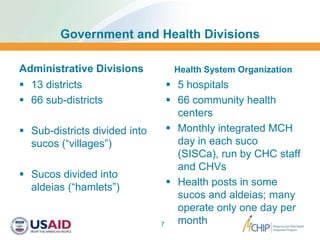
Government and Health Divisions
Administrative Divisions
 13 districts
 66 sub-districts
 Sub-districts divided into
sucos (“villages”)
 Sucos divided into
aldeias (“hamlets”)
Health System Organization
 5 hospitals
 66 community health
centers
 Monthly integrated MCH
day in each suco
(SISCa), run by CHC staff
and CHVs
 Health posts in some
sucos and aldeias; many
operate only one day per
month7
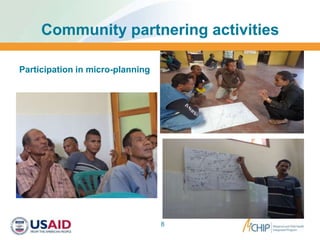
Community partnering activities
Participation in micro-planning
8
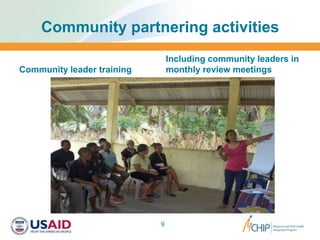
Community partnering activities
Community leader training
Including community leaders in
monthly review meetings
9
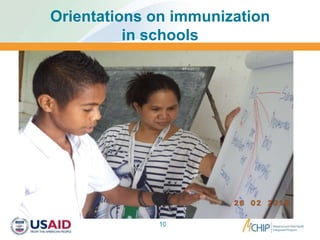
Orientations on immunization
in schools
10
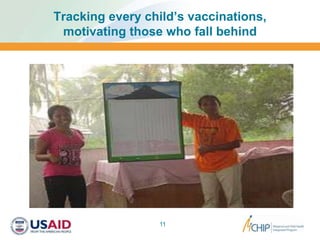
Tracking every child’s vaccinations,
motivating those who fall behind
11
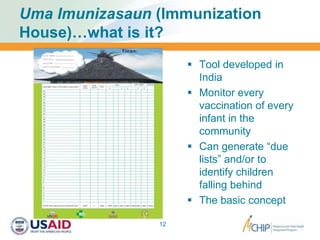
Uma Imunizasaun (Immunization
House)…what is it?
 Tool developed in
India
 Monitor every
vaccination of every
infant in the
community
 Can generate “due
lists” and/or to
identify children
falling behind
 The basic concept
12
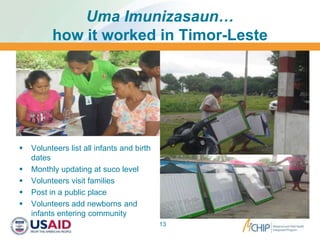
Uma Imunizasaun…
how it worked in Timor-Leste
 Volunteers list all infants and birth
dates
 Monthly updating at suco level
 Volunteers visit families
 Post in a public place
 Volunteers add newborns and
infants entering community
13
Brief History of UI in Timor-Leste
 Late 2011/early 2012: tool introduced in one
suco in each of seven focus districts
 Summer 2012: IPL partnered with Clinic Café
Timor to use UI in 26 additional sucos
 2013, expanded to 21 additional low-
performing sucos
 MOH intends to further expand via GAVI
funding
14
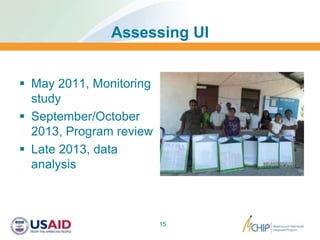
Assessing UI
 May 2011, Monitoring
study
 September/October
2013, Program review
 Late 2013, data
analysis
15
Impact in Immunization Coverage
 No clear effect; serious problems with data
completeness and accuracy
 Apparently more infants “in the system” (236
vs. 155), but data too incomplete to make a
firm conclusion.
16
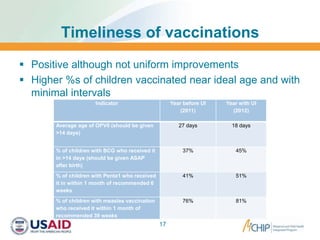
Timeliness of vaccinations
 Positive although not uniform improvements
 Higher %s of children vaccinated near ideal age and with
minimal intervals
17
Indicator Year before UI
(2011)
Year with UI
(2012)
Average age of OPV0 (should be given
>14 days)
27 days 18 days
% of children with BCG who received it
in >14 days (should be given ASAP
after birth)
37% 45%
% of children with Penta1 who received
it in within 1 month of recommended 6
weeks
41% 51%
% of children with measles vaccination
who received it within 1 month of
recommended 39 weeks
76% 81%
Other Useful Findings
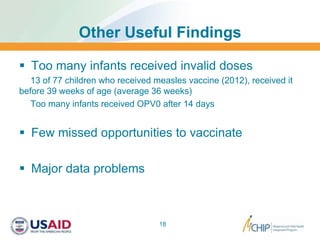
 Too many infants received invalid doses
13 of 77 children who received measles vaccine (2012), received it
before 39 weeks of age (average 36 weeks)
Too many infants received OPV0 after 14 days
 Few missed opportunities to vaccinate
 Major data problems
18
General Conclusions
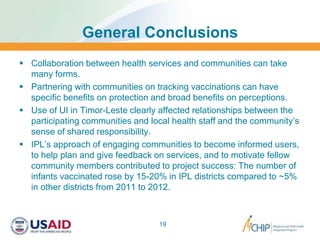
 Collaboration between health services and communities can take
many forms.
 Partnering with communities on tracking vaccinations can have
specific benefits on protection and broad benefits on perceptions.
 Use of UI in Timor-Leste clearly affected relationships between the
participating communities and local health staff and the community’s
sense of shared responsibility.
 IPL’s approach of engaging communities to become informed users,
to help plan and give feedback on services, and to motivate fellow
community members contributed to project success: The number of
infants vaccinated rose by 15-20% in IPL districts compared to ~5%
in other districts from 2011 to 2012.
19
Obrigadu barak!
20

Engaging Communities_Michael Favin_5.8.14

  • 1.
    Partnering with Communitiesto Change the Immunization Paradigm: Experience in Timor-Leste
  • 2.
    The communities’ job:bring children at the right times for vaccination 2
  • 3.
    The health services’job: Plan and provide vaccination services at the times and places planned 3
  • 4.
    Which commonly leadsto… Health providers feeling that caregivers just won’t be responsible parents and caregivers feeling that services are inconvenient, unreliable, not friendly, and confusing. 4
  • 5.
    A Proposed NewVision Getting a community’s children vaccinated and protected is a joint responsibility of health services and the community. They should work together in planning, providing, monitoring, and continuously improving vaccination services and their utilization. 5
  • 6.
    The Timor-Leste Experience The country  The immunization program  The project: Imunizasaun Protege Labarik (IPL) 6
  • 7.
    Government and HealthDivisions Administrative Divisions  13 districts  66 sub-districts  Sub-districts divided into sucos (“villages”)  Sucos divided into aldeias (“hamlets”) Health System Organization  5 hospitals  66 community health centers  Monthly integrated MCH day in each suco (SISCa), run by CHC staff and CHVs  Health posts in some sucos and aldeias; many operate only one day per month7
  • 8.
  • 9.
    Community partnering activities Communityleader training Including community leaders in monthly review meetings 9
  • 10.
  • 11.
    Tracking every child’svaccinations, motivating those who fall behind 11
  • 12.
    Uma Imunizasaun (Immunization House)…whatis it?  Tool developed in India  Monitor every vaccination of every infant in the community  Can generate “due lists” and/or to identify children falling behind  The basic concept 12
  • 13.
    Uma Imunizasaun… how itworked in Timor-Leste  Volunteers list all infants and birth dates  Monthly updating at suco level  Volunteers visit families  Post in a public place  Volunteers add newborns and infants entering community 13
  • 14.
    Brief History ofUI in Timor-Leste  Late 2011/early 2012: tool introduced in one suco in each of seven focus districts  Summer 2012: IPL partnered with Clinic Café Timor to use UI in 26 additional sucos  2013, expanded to 21 additional low- performing sucos  MOH intends to further expand via GAVI funding 14
  • 15.
    Assessing UI  May2011, Monitoring study  September/October 2013, Program review  Late 2013, data analysis 15
  • 16.
    Impact in ImmunizationCoverage  No clear effect; serious problems with data completeness and accuracy  Apparently more infants “in the system” (236 vs. 155), but data too incomplete to make a firm conclusion. 16
  • 17.
    Timeliness of vaccinations Positive although not uniform improvements  Higher %s of children vaccinated near ideal age and with minimal intervals 17 Indicator Year before UI (2011) Year with UI (2012) Average age of OPV0 (should be given >14 days) 27 days 18 days % of children with BCG who received it in >14 days (should be given ASAP after birth) 37% 45% % of children with Penta1 who received it in within 1 month of recommended 6 weeks 41% 51% % of children with measles vaccination who received it within 1 month of recommended 39 weeks 76% 81%
  • 18.
    Other Useful Findings Too many infants received invalid doses 13 of 77 children who received measles vaccine (2012), received it before 39 weeks of age (average 36 weeks) Too many infants received OPV0 after 14 days  Few missed opportunities to vaccinate  Major data problems 18
  • 19.
    General Conclusions  Collaborationbetween health services and communities can take many forms.  Partnering with communities on tracking vaccinations can have specific benefits on protection and broad benefits on perceptions.  Use of UI in Timor-Leste clearly affected relationships between the participating communities and local health staff and the community’s sense of shared responsibility.  IPL’s approach of engaging communities to become informed users, to help plan and give feedback on services, and to motivate fellow community members contributed to project success: The number of infants vaccinated rose by 15-20% in IPL districts compared to ~5% in other districts from 2011 to 2012. 19
  • 20.