SVILUPPO DI UN NODO DI UNA RETE DI
SENSORI WIRELESS ALIMENTATA MEDIANTE
TECNICHE DI ENERGY HARVESTING
Candidato:
Daniele Costarella
Matr. 884/000376
Tesi di Laurea Specialistica in Ingegneria Elettronica
Relatore:
Ch.mo prof. Antonio Strollo
Correlatore:
Ing. Mario Pucciarelli (Meditel)
Outline
•  Energy Harvesting Basics
•  What are the benefits? Where is it useful? Important aspects.
•  Piezoelectric, Thermoelectric and Solar Sources
•  Selecting the Right Transducers, piezogenerator models,
capabilities, limitations
•  Converting Harvested Energy into a Regulated Output
•  Rectification, start-up, efficiency, and over-voltage concerns
•  Integrated solution in a WSN
•  Challenges Design of a EH-WSN node, prototyping
•  Data analysis
June 24th, 2013 Energy Harvesting Demoboard 2
About my work
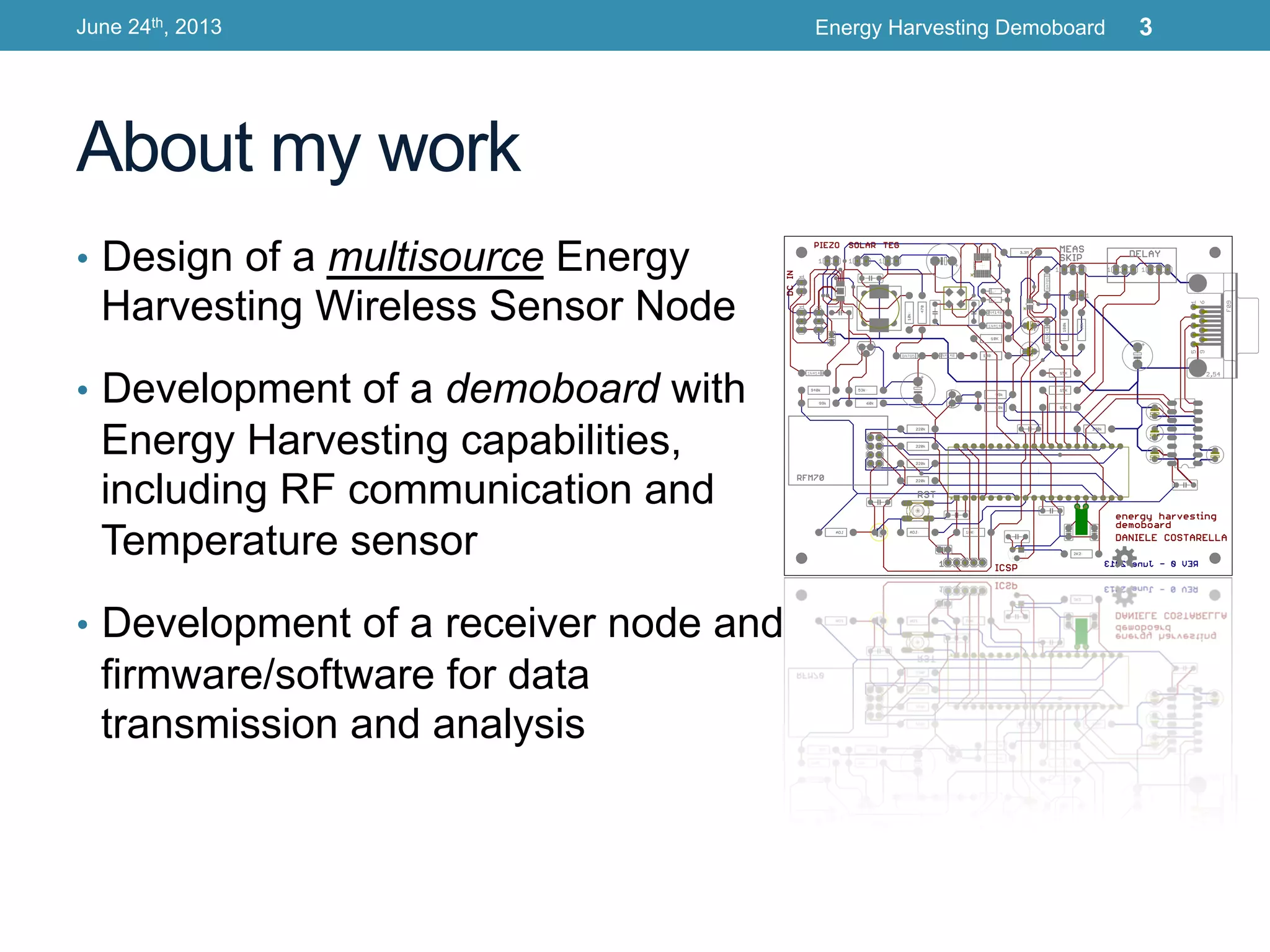
•  Design of a multisource Energy
Harvesting Wireless Sensor Node
•  Development of a demoboard with
Energy Harvesting capabilities,
including RF communication and
Temperature sensor
•  Development of a receiver node and
firmware/software for data
transmission and analysis
June 24th, 2013 Energy Harvesting Demoboard 3
Energy Harvesting Basics
•  Energy Harvesting is the process by which energy readily available
from the environment is captured and converted into usable electrical
energy
•  This term frequently refers to small autonomous devices, or micro
energy harvesting
•  Ideal for substituting for batteries that are impractical, costly, or
dangerous to replace.
June 24th, 2013 Energy Harvesting Demoboard 4
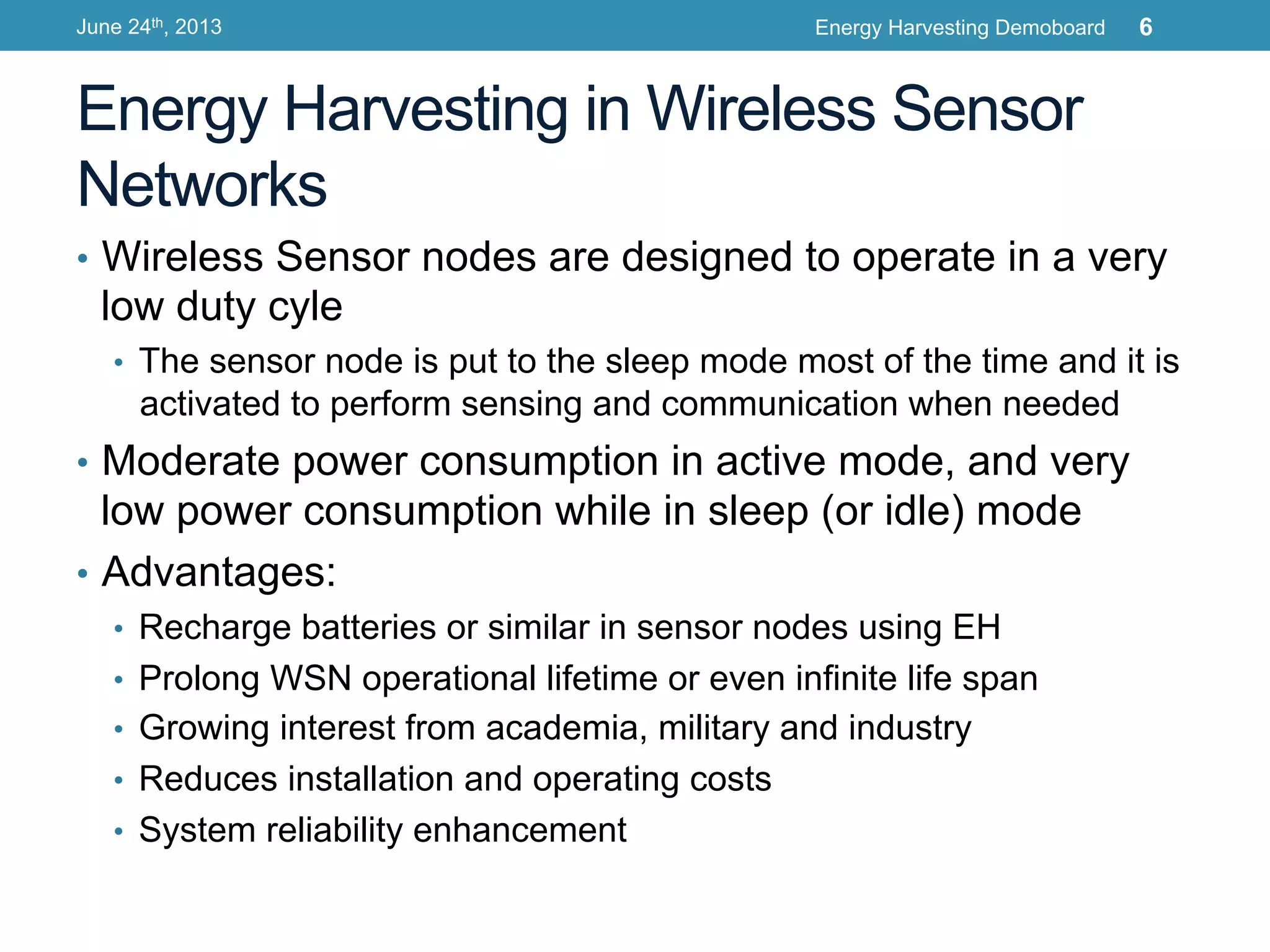
Design challenges in conventional WSN
•  Sensor node has limited energy supply
•  Hard to replace/recharge nodes’ batteries once deployed, due to
•  Number of nodes in network is high
•  Deployed in large area and difficult locations like hostile environments,
forests, inside walls, etc
•  Nodes are ad hoc deployed and distributed
•  No human intervention to interrupt nodes’ operations
•  WSN performances highly dependent on energy supply
•  Higher performances demand more energy supply
•  Bottleneck of Conventional WSN is ENERGY
June 24th, 2013 Energy Harvesting Demoboard 5
Energy Harvesting in Wireless Sensor
Networks
•  Wireless Sensor nodes are designed to operate in a very
low duty cyle
•  The sensor node is put to the sleep mode most of the time and it is
activated to perform sensing and communication when needed
•  Moderate power consumption in active mode, and very
low power consumption while in sleep (or idle) mode
•  Advantages:
•  Recharge batteries or similar in sensor nodes using EH
•  Prolong WSN operational lifetime or even infinite life span
•  Growing interest from academia, military and industry
•  Reduces installation and operating costs
•  System reliability enhancement
June 24th, 2013 Energy Harvesting Demoboard 6
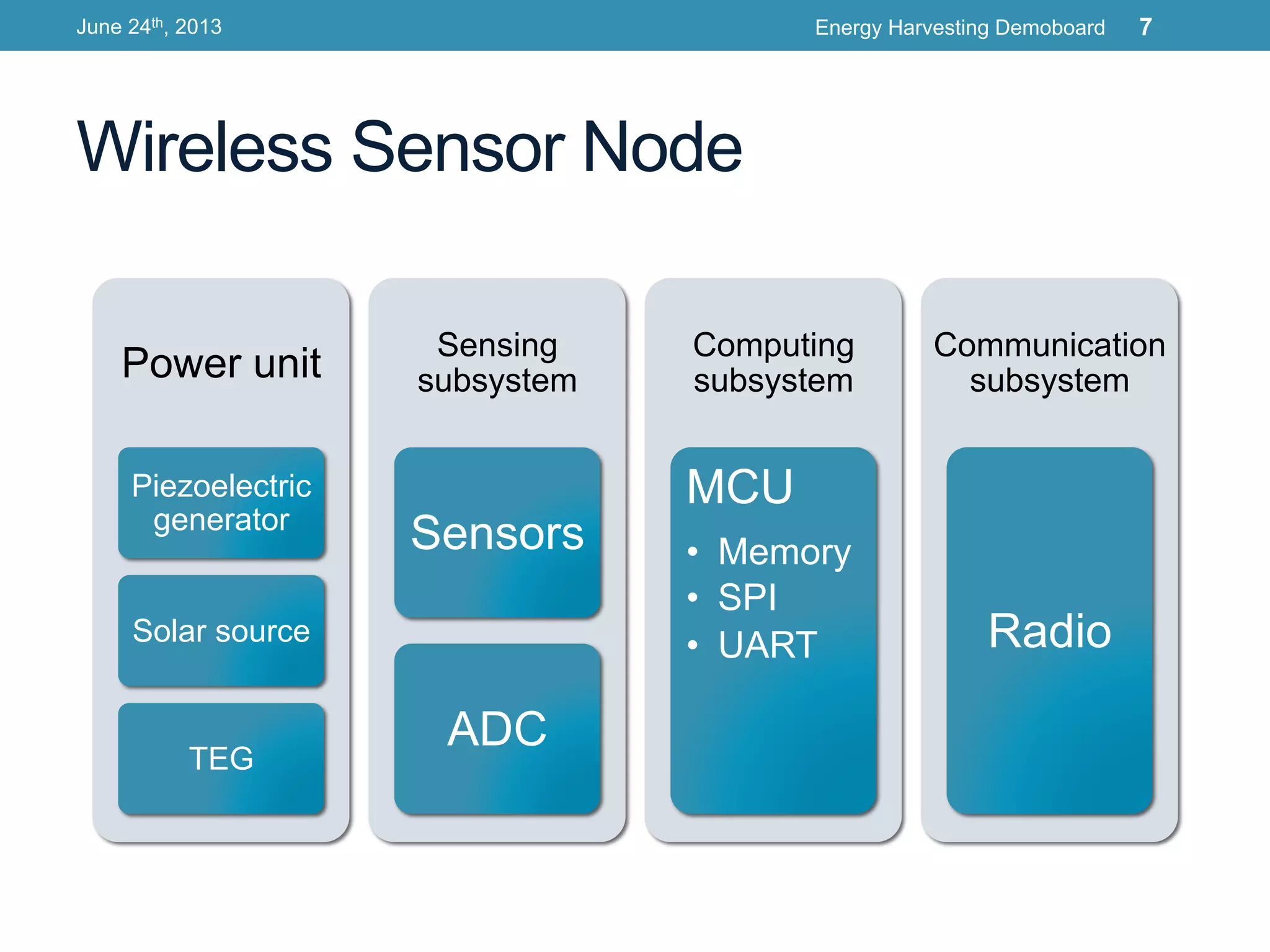
Wireless Sensor Node
June 24th, 2013 Energy Harvesting Demoboard 7
Power unit
Piezoelectric
generator
Solar source
TEG
Sensing
subsystem
Sensors
ADC
Computing
subsystem
MCU
•  Memory
•  SPI
•  UART
Communication
subsystem
Radio
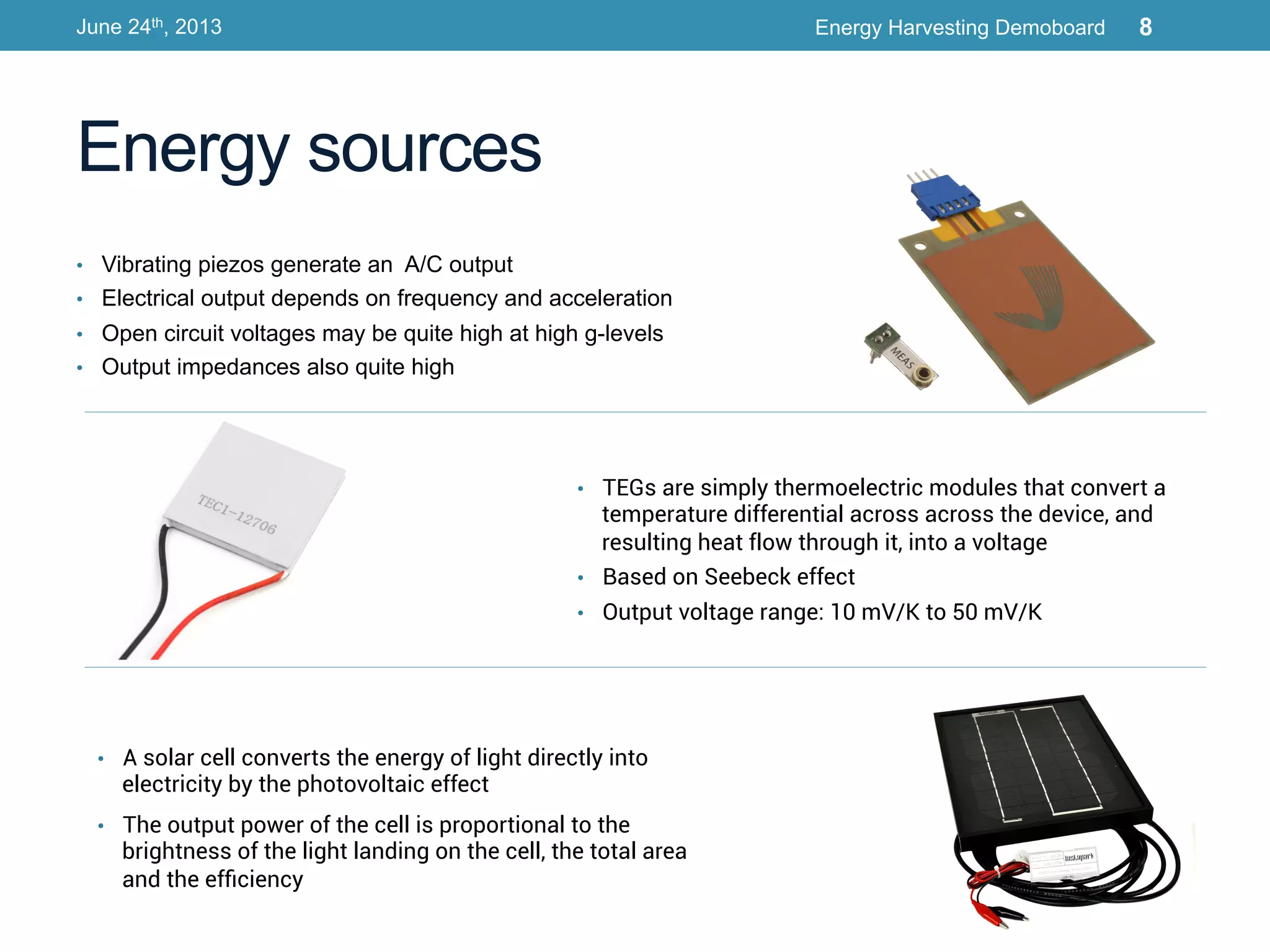
•  Vibrating piezos generate an A/C output
•  Electrical output depends on frequency and acceleration
•  Open circuit voltages may be quite high at high g-levels
•  Output impedances also quite high
Energy sources
June 24th, 2013 Energy Harvesting Demoboard 8
•  TEGs are simply thermoelectric modules that convert a
temperature differential across across the device, and
resulting heat flow through it, into a voltage
•  Based on Seebeck effect
•  Output voltage range: 10 mV/K to 50 mV/K
•  A solar cell converts the energy of light directly into
electricity by the photovoltaic effect
•  The output power of the cell is proportional to the
brightness of the light landing on the cell, the total area
and the efficiency
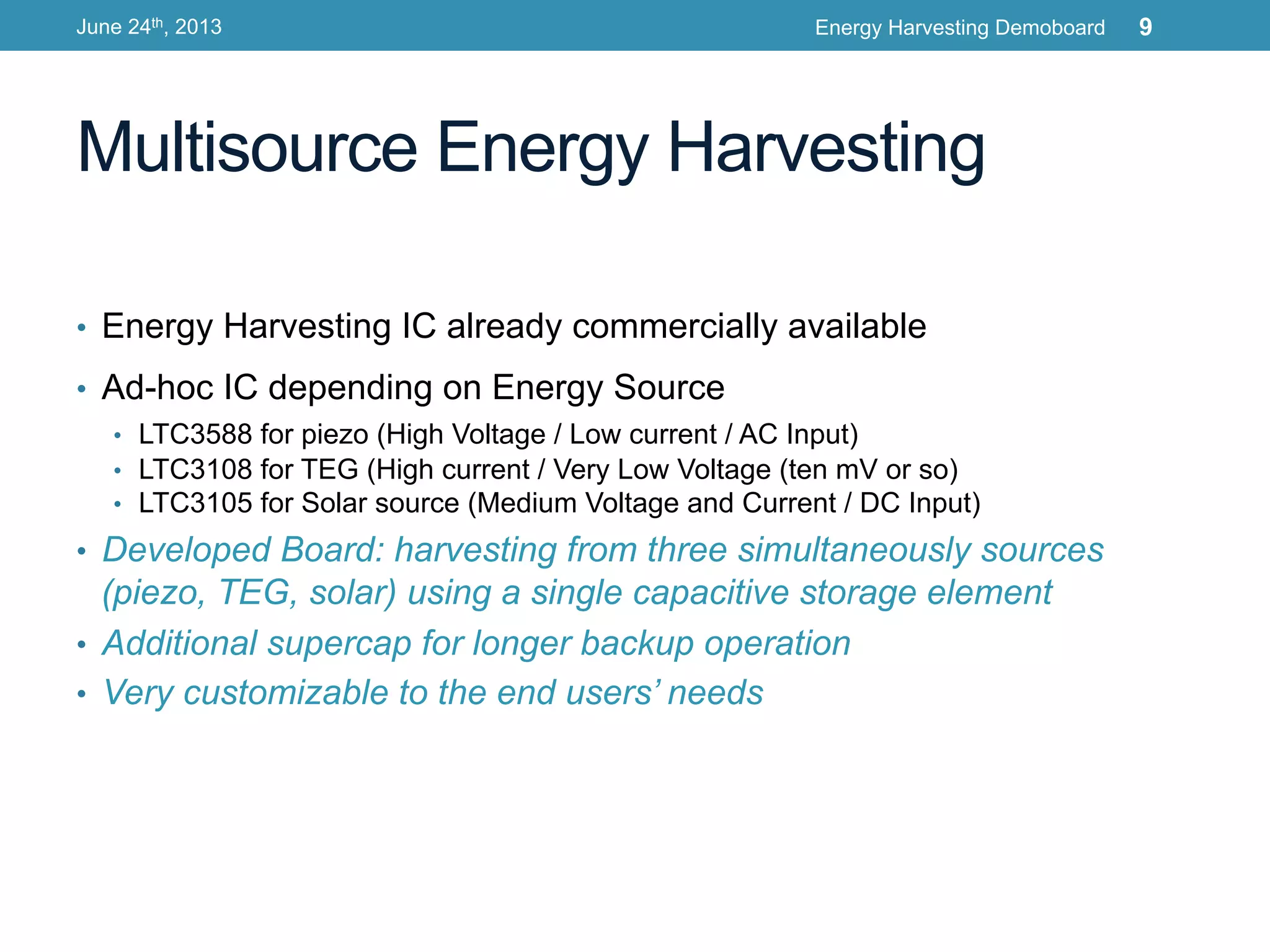
Multisource Energy Harvesting
•  Energy Harvesting IC already commercially available
•  Ad-hoc IC depending on Energy Source
•  LTC3588 for piezo (High Voltage / Low current / AC Input)
•  LTC3108 for TEG (High current / Very Low Voltage (ten mV or so)
•  LTC3105 for Solar source (Medium Voltage and Current / DC Input)
•  Developed Board: harvesting from three simultaneously sources
(piezo, TEG, solar) using a single capacitive storage element
•  Additional supercap for longer backup operation
•  Very customizable to the end users’ needs
June 24th, 2013 Energy Harvesting Demoboard 9
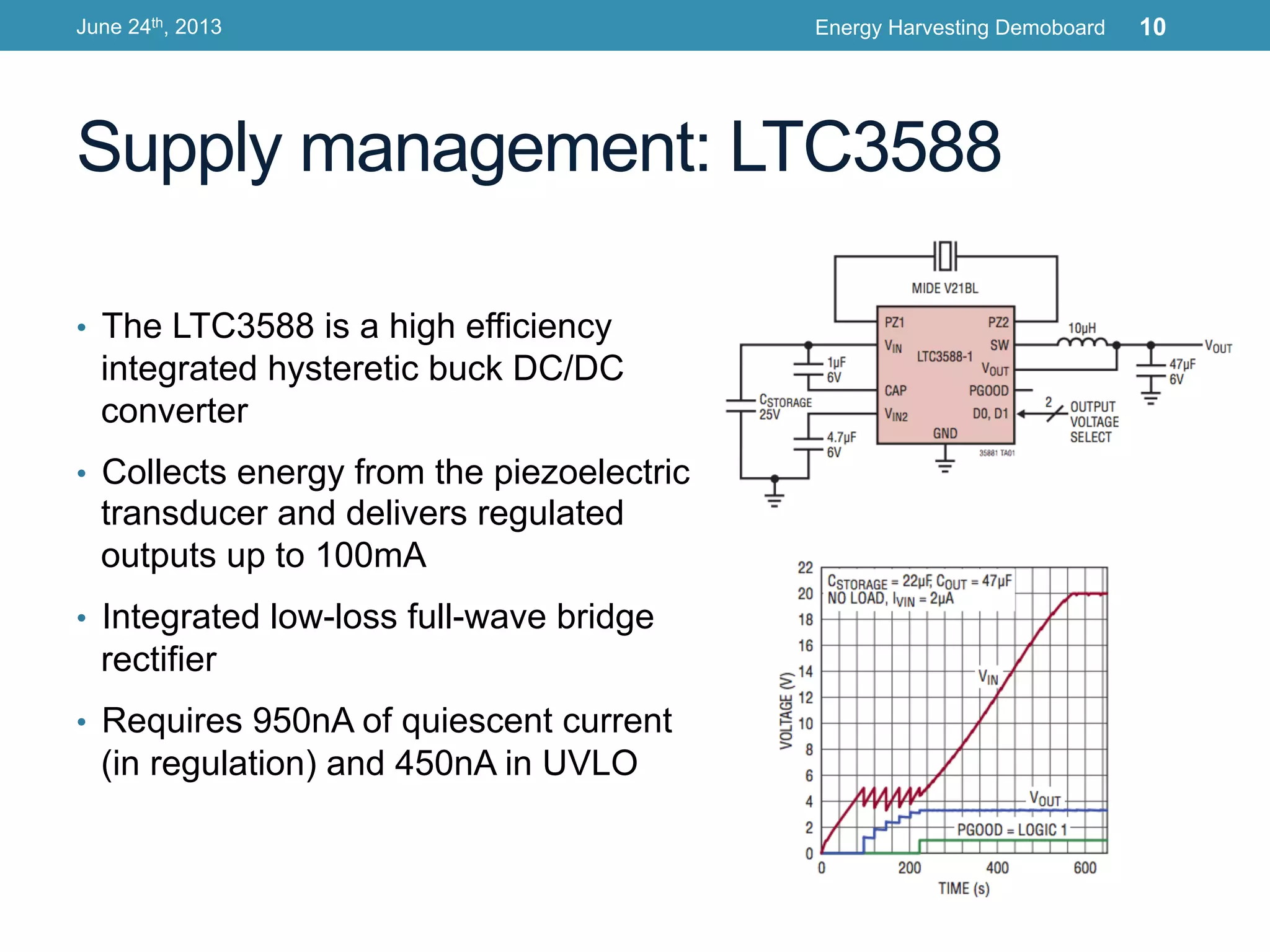
Supply management: LTC3588
•  The LTC3588 is a high efficiency
integrated hysteretic buck DC/DC
converter
•  Collects energy from the piezoelectric
transducer and delivers regulated
outputs up to 100mA
•  Integrated low-loss full-wave bridge
rectifier
•  Requires 950nA of quiescent current
(in regulation) and 450nA in UVLO
June 24th, 2013 Energy Harvesting Demoboard 10
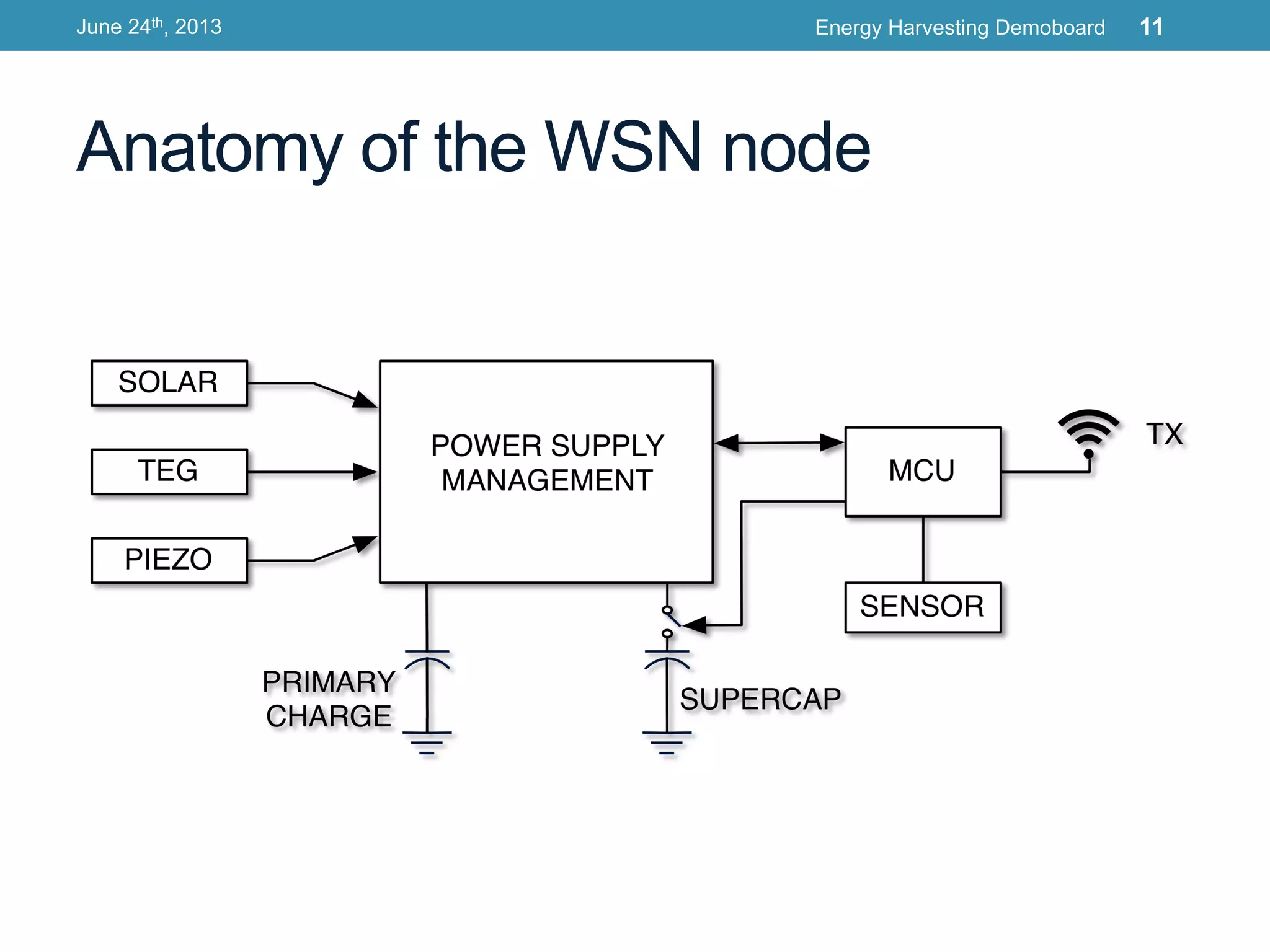
Anatomy of the WSN node
June 24th, 2013 Energy Harvesting Demoboard 11
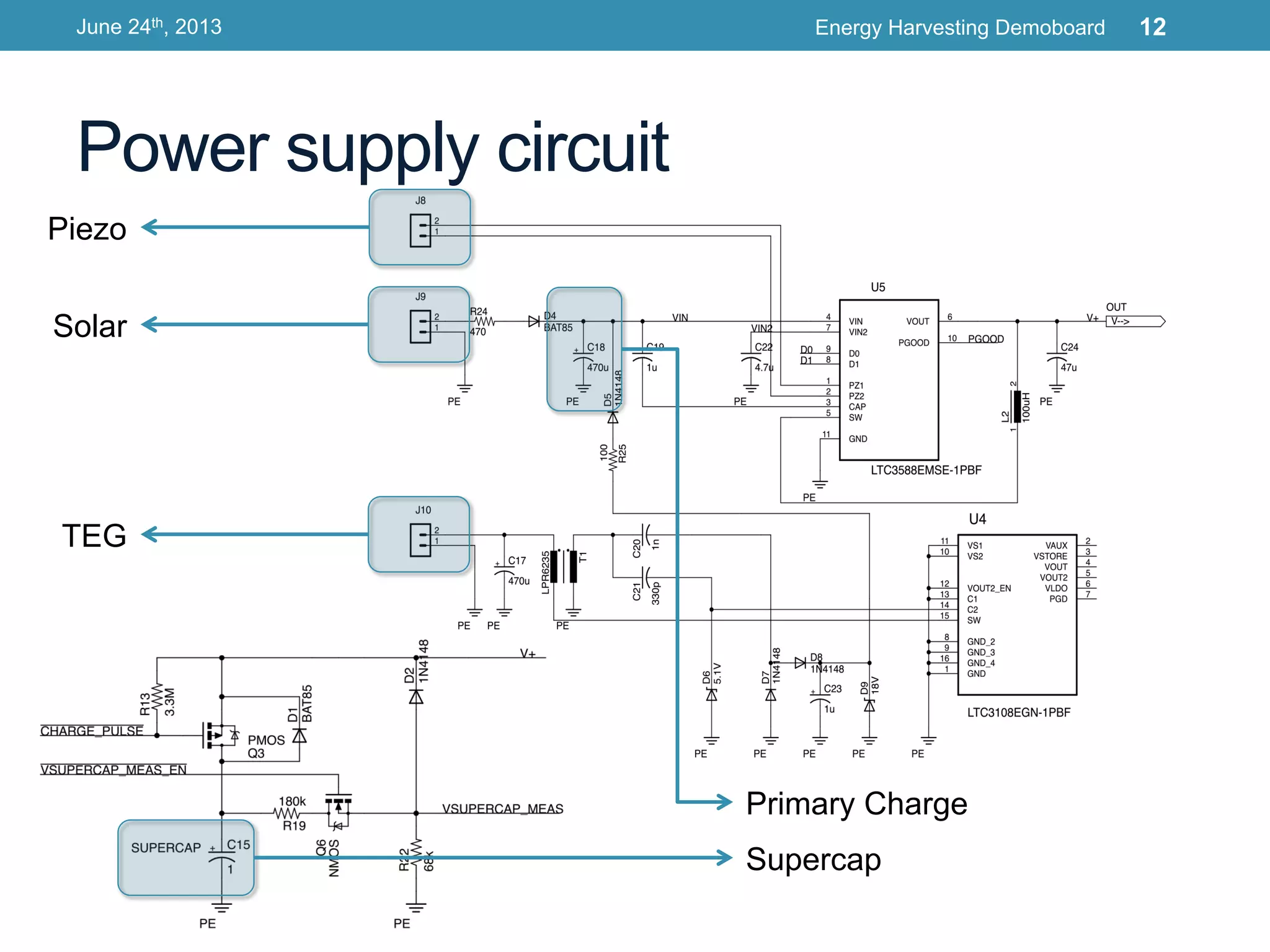
Power supply circuit
June 24th, 2013 Energy Harvesting Demoboard 12
Piezo
Solar
TEG
Supercap
Primary Charge
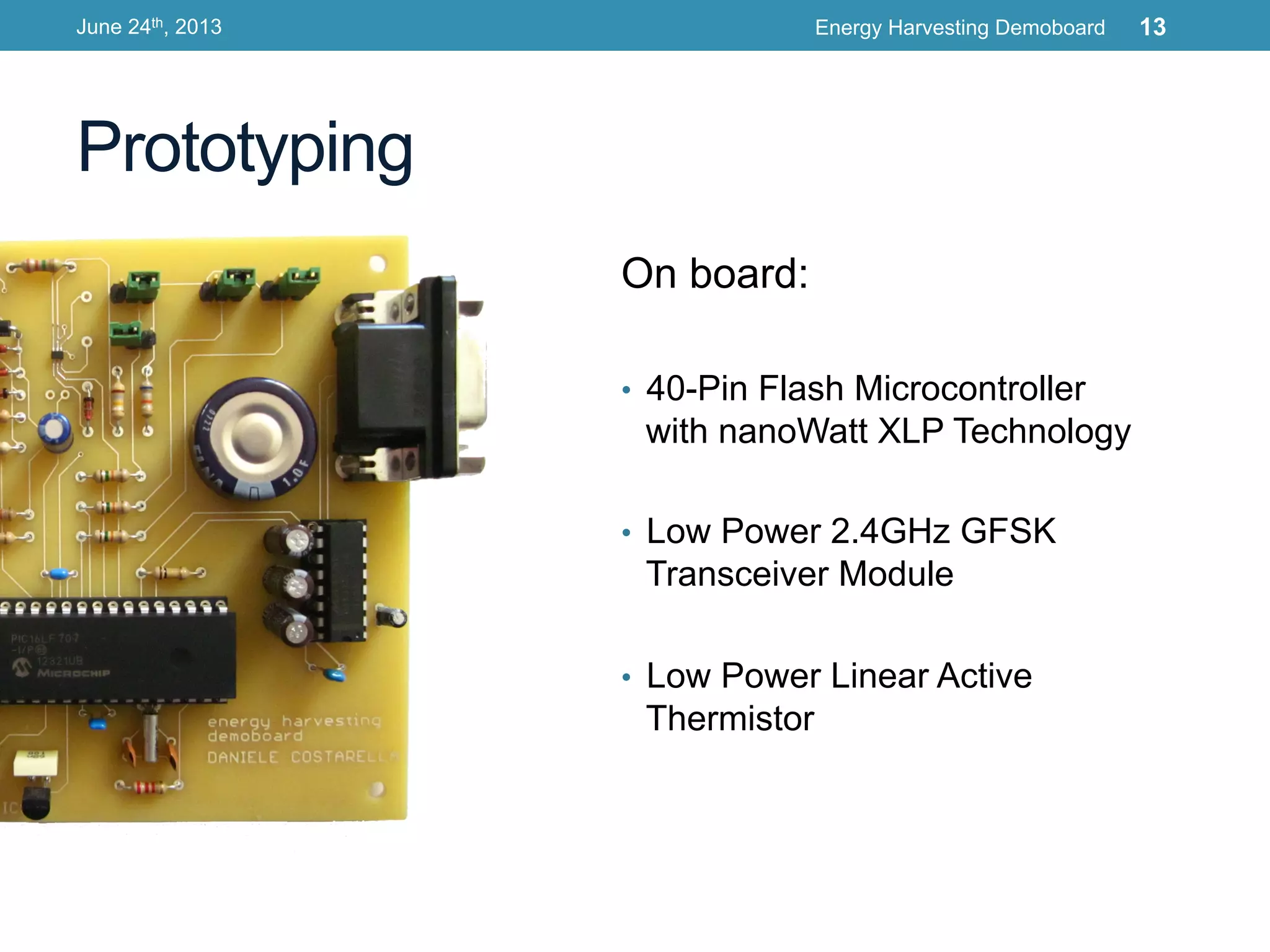
Prototyping
On board:
•  40-Pin Flash Microcontroller
with nanoWatt XLP Technology
•  Low Power 2.4GHz GFSK
Transceiver Module
•  Low Power Linear Active
Thermistor
June 24th, 2013 Energy Harvesting Demoboard 13
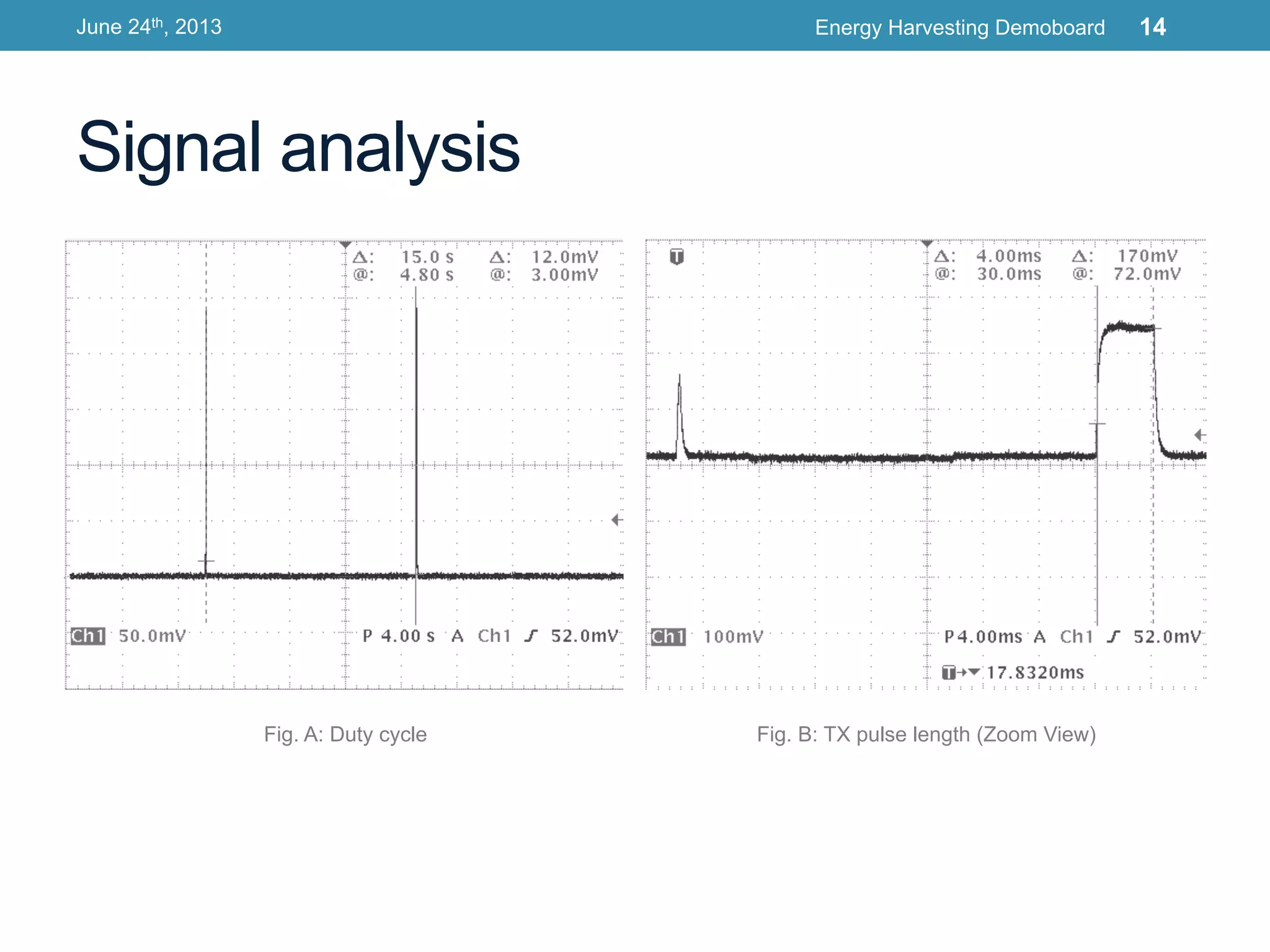
Signal analysis
June 24th, 2013 Energy Harvesting Demoboard 14
Fig. A: Duty cycle Fig. B: TX pulse length (Zoom View)
Data analysis
•  Web interface
•  Real time graphics
•  History
•  Views
•  Temperature
•  Supercapacitor Voltage
•  Input Voltage
•  Charging
•  Backup status
June 24th, 2013 Energy Harvesting Demoboard 15
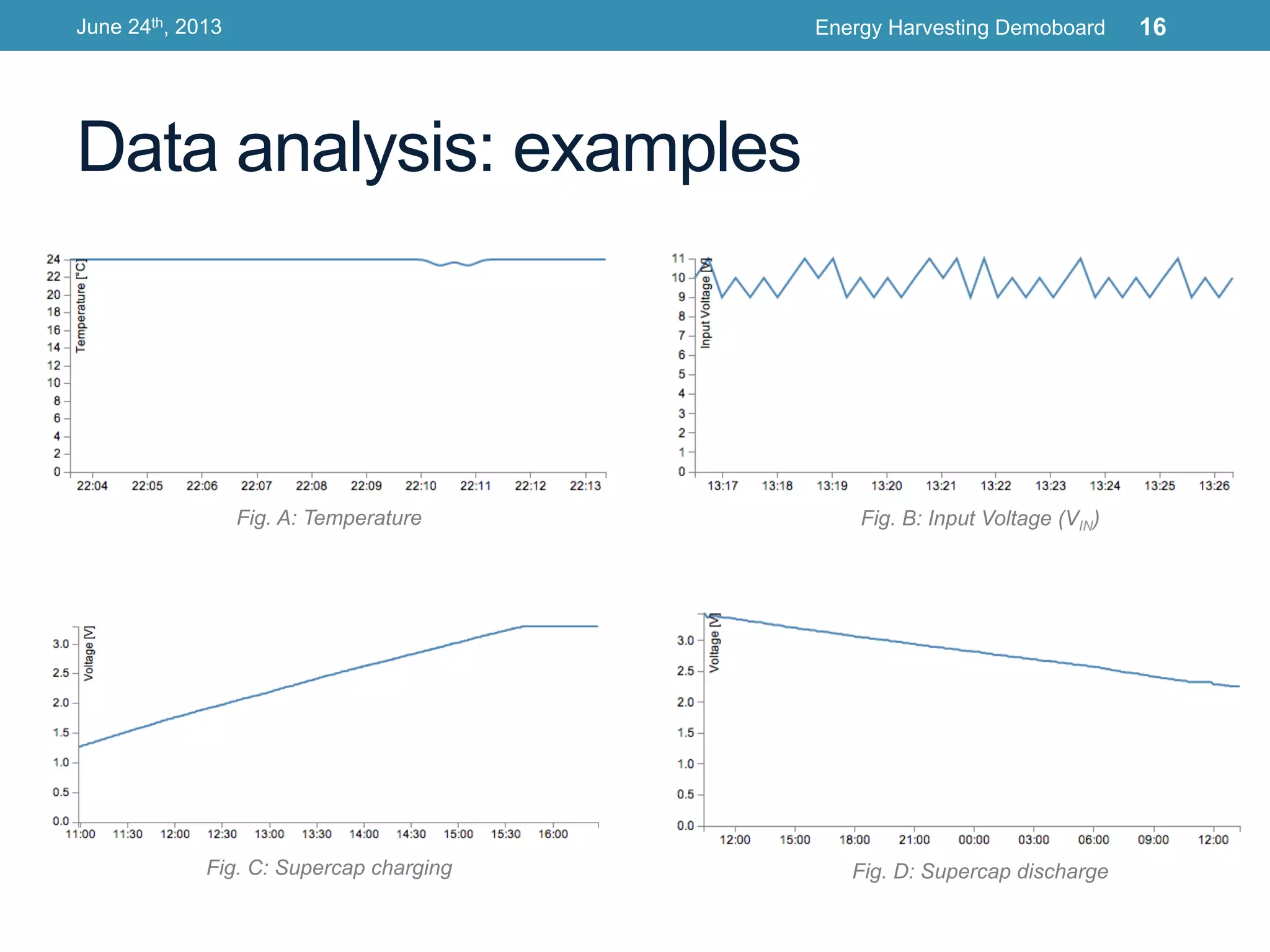
Data analysis: examples
June 24th, 2013 Energy Harvesting Demoboard 16
Fig. A: Temperature Fig. B: Input Voltage (VIN)
Fig. C: Supercap charging Fig. D: Supercap discharge
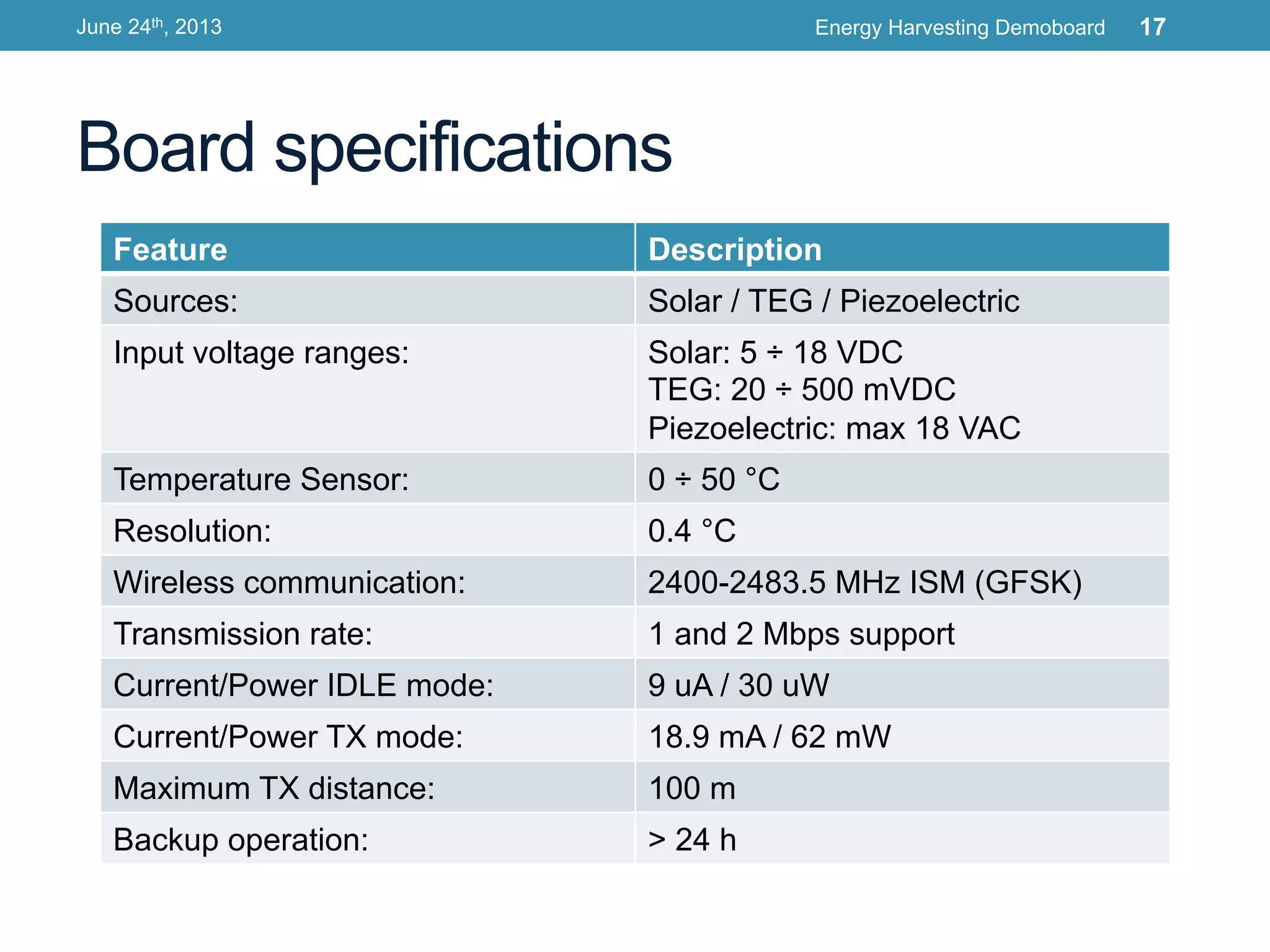
Board specifications
Feature Description
Sources: Solar / TEG / Piezoelectric
Input voltage ranges: Solar: 5 ÷ 18 VDC
TEG: 20 ÷ 500 mVDC
Piezoelectric: max 18 VAC
Temperature Sensor: 0 ÷ 50 °C
Resolution: 0.4 °C
Wireless communication: 2400-2483.5 MHz ISM (GFSK)
Transmission rate: 1 and 2 Mbps support
Current/Power IDLE mode: 9 uA / 30 uW
Current/Power TX mode: 18.9 mA / 62 mW
Maximum TX distance: 100 m
Backup operation: > 24 h
June 24th, 2013 Energy Harvesting Demoboard 17
DEMO
Thank you
June 24th, 2013 Energy Harvesting Demoboard 19

energy-harvesting-pres-final-std

  • 1.
    SVILUPPO DI UNNODO DI UNA RETE DI SENSORI WIRELESS ALIMENTATA MEDIANTE TECNICHE DI ENERGY HARVESTING Candidato: Daniele Costarella Matr. 884/000376 Tesi di Laurea Specialistica in Ingegneria Elettronica Relatore: Ch.mo prof. Antonio Strollo Correlatore: Ing. Mario Pucciarelli (Meditel)
  • 2.
    Outline •  Energy HarvestingBasics •  What are the benefits? Where is it useful? Important aspects. •  Piezoelectric, Thermoelectric and Solar Sources •  Selecting the Right Transducers, piezogenerator models, capabilities, limitations •  Converting Harvested Energy into a Regulated Output •  Rectification, start-up, efficiency, and over-voltage concerns •  Integrated solution in a WSN •  Challenges Design of a EH-WSN node, prototyping •  Data analysis June 24th, 2013 Energy Harvesting Demoboard 2
  • 3.
    About my work • Design of a multisource Energy Harvesting Wireless Sensor Node •  Development of a demoboard with Energy Harvesting capabilities, including RF communication and Temperature sensor •  Development of a receiver node and firmware/software for data transmission and analysis June 24th, 2013 Energy Harvesting Demoboard 3
  • 4.
    Energy Harvesting Basics • Energy Harvesting is the process by which energy readily available from the environment is captured and converted into usable electrical energy •  This term frequently refers to small autonomous devices, or micro energy harvesting •  Ideal for substituting for batteries that are impractical, costly, or dangerous to replace. June 24th, 2013 Energy Harvesting Demoboard 4
  • 5.
    Design challenges inconventional WSN •  Sensor node has limited energy supply •  Hard to replace/recharge nodes’ batteries once deployed, due to •  Number of nodes in network is high •  Deployed in large area and difficult locations like hostile environments, forests, inside walls, etc •  Nodes are ad hoc deployed and distributed •  No human intervention to interrupt nodes’ operations •  WSN performances highly dependent on energy supply •  Higher performances demand more energy supply •  Bottleneck of Conventional WSN is ENERGY June 24th, 2013 Energy Harvesting Demoboard 5
  • 6.
    Energy Harvesting inWireless Sensor Networks •  Wireless Sensor nodes are designed to operate in a very low duty cyle •  The sensor node is put to the sleep mode most of the time and it is activated to perform sensing and communication when needed •  Moderate power consumption in active mode, and very low power consumption while in sleep (or idle) mode •  Advantages: •  Recharge batteries or similar in sensor nodes using EH •  Prolong WSN operational lifetime or even infinite life span •  Growing interest from academia, military and industry •  Reduces installation and operating costs •  System reliability enhancement June 24th, 2013 Energy Harvesting Demoboard 6
  • 7.
    Wireless Sensor Node June24th, 2013 Energy Harvesting Demoboard 7 Power unit Piezoelectric generator Solar source TEG Sensing subsystem Sensors ADC Computing subsystem MCU •  Memory •  SPI •  UART Communication subsystem Radio
  • 8.
    •  Vibrating piezosgenerate an A/C output •  Electrical output depends on frequency and acceleration •  Open circuit voltages may be quite high at high g-levels •  Output impedances also quite high Energy sources June 24th, 2013 Energy Harvesting Demoboard 8 •  TEGs are simply thermoelectric modules that convert a temperature differential across across the device, and resulting heat flow through it, into a voltage •  Based on Seebeck effect •  Output voltage range: 10 mV/K to 50 mV/K •  A solar cell converts the energy of light directly into electricity by the photovoltaic effect •  The output power of the cell is proportional to the brightness of the light landing on the cell, the total area and the efficiency
  • 9.
    Multisource Energy Harvesting • Energy Harvesting IC already commercially available •  Ad-hoc IC depending on Energy Source •  LTC3588 for piezo (High Voltage / Low current / AC Input) •  LTC3108 for TEG (High current / Very Low Voltage (ten mV or so) •  LTC3105 for Solar source (Medium Voltage and Current / DC Input) •  Developed Board: harvesting from three simultaneously sources (piezo, TEG, solar) using a single capacitive storage element •  Additional supercap for longer backup operation •  Very customizable to the end users’ needs June 24th, 2013 Energy Harvesting Demoboard 9
  • 10.
    Supply management: LTC3588 • The LTC3588 is a high efficiency integrated hysteretic buck DC/DC converter •  Collects energy from the piezoelectric transducer and delivers regulated outputs up to 100mA •  Integrated low-loss full-wave bridge rectifier •  Requires 950nA of quiescent current (in regulation) and 450nA in UVLO June 24th, 2013 Energy Harvesting Demoboard 10
  • 11.
    Anatomy of theWSN node June 24th, 2013 Energy Harvesting Demoboard 11
  • 12.
    Power supply circuit June24th, 2013 Energy Harvesting Demoboard 12 Piezo Solar TEG Supercap Primary Charge
  • 13.
    Prototyping On board: •  40-PinFlash Microcontroller with nanoWatt XLP Technology •  Low Power 2.4GHz GFSK Transceiver Module •  Low Power Linear Active Thermistor June 24th, 2013 Energy Harvesting Demoboard 13
  • 14.
    Signal analysis June 24th,2013 Energy Harvesting Demoboard 14 Fig. A: Duty cycle Fig. B: TX pulse length (Zoom View)
  • 15.
    Data analysis •  Webinterface •  Real time graphics •  History •  Views •  Temperature •  Supercapacitor Voltage •  Input Voltage •  Charging •  Backup status June 24th, 2013 Energy Harvesting Demoboard 15
  • 16.
    Data analysis: examples June24th, 2013 Energy Harvesting Demoboard 16 Fig. A: Temperature Fig. B: Input Voltage (VIN) Fig. C: Supercap charging Fig. D: Supercap discharge
  • 17.
    Board specifications Feature Description Sources:Solar / TEG / Piezoelectric Input voltage ranges: Solar: 5 ÷ 18 VDC TEG: 20 ÷ 500 mVDC Piezoelectric: max 18 VAC Temperature Sensor: 0 ÷ 50 °C Resolution: 0.4 °C Wireless communication: 2400-2483.5 MHz ISM (GFSK) Transmission rate: 1 and 2 Mbps support Current/Power IDLE mode: 9 uA / 30 uW Current/Power TX mode: 18.9 mA / 62 mW Maximum TX distance: 100 m Backup operation: > 24 h June 24th, 2013 Energy Harvesting Demoboard 17
  • 18.
  • 19.
    Thank you June 24th,2013 Energy Harvesting Demoboard 19