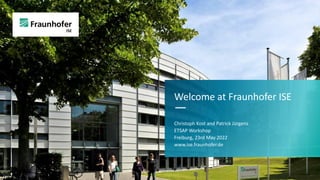
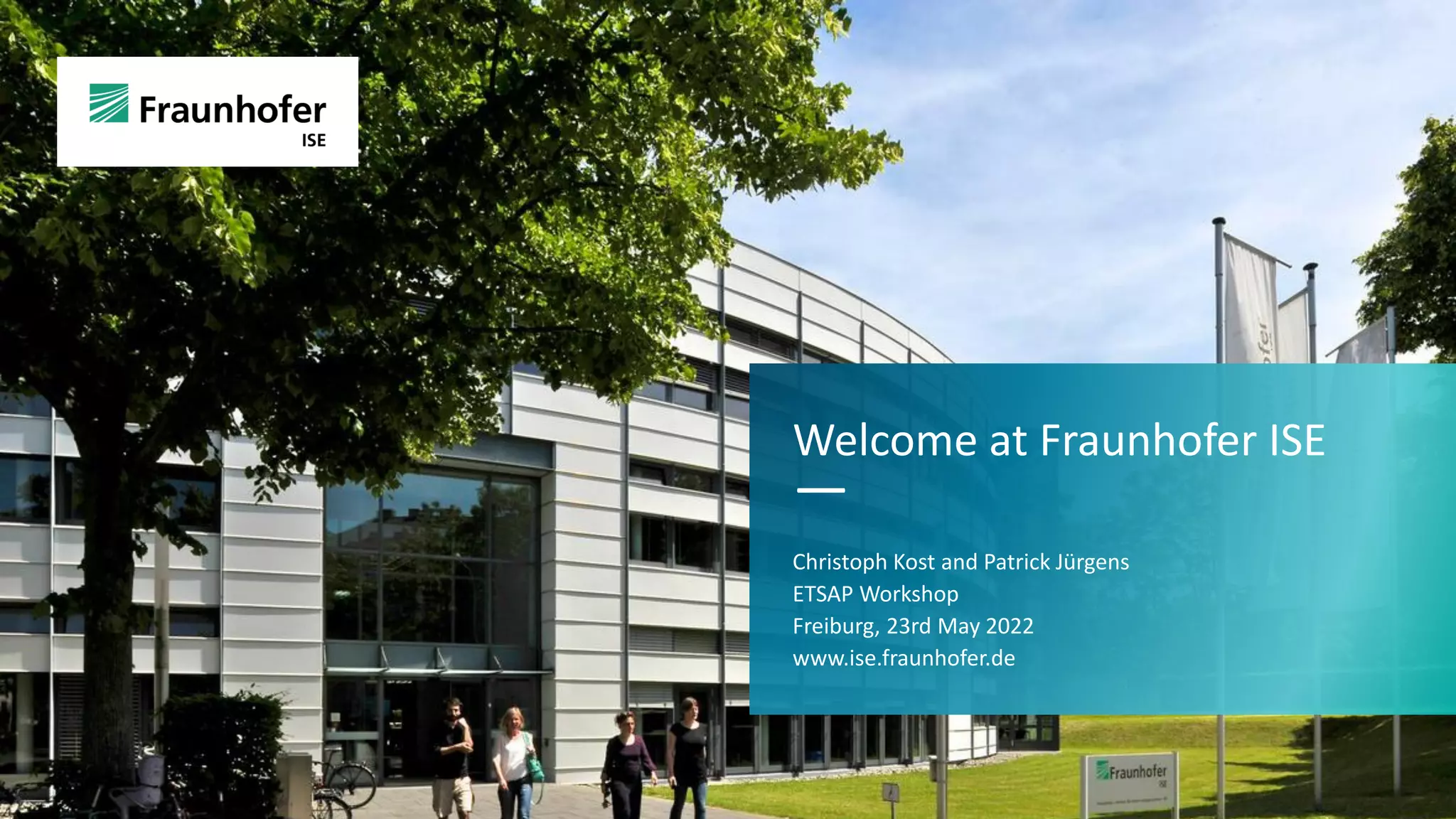
Welcome at Fraunhofer ISE
—
Christoph Kost and Patrick Jürgens
ETSAP Workshop
Freiburg, 23rd May 2022
www.ise.fraunhofer.de
FHG-SK: ISE-INTERNAL
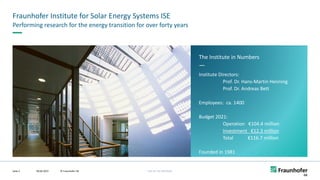
The Institute in Numbers
—
Institute Directors:
Prof. Dr. Hans-Martin Henning
Prof. Dr. Andreas Bett
Employees: ca. 1400
Budget 2021:
Operation €104.4 million
Investment €12.3 million
Total €116.7 million
Founded in 1981
Fraunhofer Institute for Solar Energy Systems ISE
09.06.2022 © Fraunhofer ISE
Seite 2
Performing research for the energy transition for over forty years
FHG-SK: ISE-INTERNAL
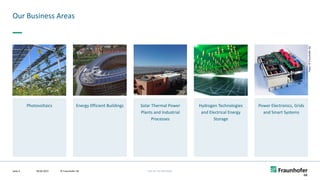
Our Business Areas
09.06.2022
Seite 3 © Fraunhofer ISE
Photovoltaics Energy Efficient Buildings Solar Thermal Power
Plants and Industrial
Processes
Hydrogen Technologies
and Electrical Energy
Storage
Power Electronics, Grids
and Smart Systems
Fotos:
©
Fraunhofer
ISE
FHG-SK: ISE-INTERNAL
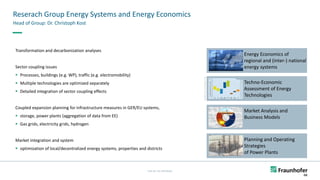
Reserach Group Energy Systems and Energy Economics
Head of Group: Dr. Christoph Kost
Planning and Operating
Strategies
of Power Plants
Energy Economics of
regional and (inter-) national
energy systems
Techno-Economic
Assessment of Energy
Technologies
Market Analysis and
Business Models
Photos
©
Fraunhofer
ISE
Transformation and decarbonization analyses
Sector coupling issues
▪ Processes, buildings (e.g. WP), traffic (e.g. electromobility)
▪ Multiple technologies are optimized separately
▪ Detailed integration of sector coupling effects
Coupled expansion planning for infrastructure measures in GER/EU systems,
▪ storage, power plants (aggregation of data from EE)
▪ Gas grids, electricity grids, hydrogen
Market integration and system
▪ optimization of local/decentralized energy systems, properties and districts
FHG-SK: ISE-INTERNAL
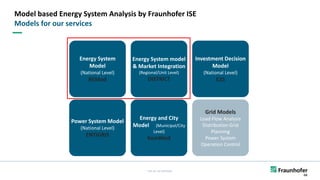
Power System Model
(National Level)
ENTIGRIS
Investment Decision
Model
(National Level)
E2S
Energy System
Model
(National Level)
REMod
Energy System model
& Market Integration
(Regional/Unit Level)
DISTRICT
Energy and City
Model (Municipal/City
Level)
KomMod
Model based Energy System Analysis by Fraunhofer ISE
Models for our services
Grid Models
Load Flow Analysis
Distribution Grid
Planning
Power System
Operation Control
Regionalization of the
integrated sector coupled
energy system model REMod
—
Patrick Jürgens
ETSAP Workshop
Freiburg, 23rd May 2022
www.ise.fraunhofer.de
FHG-SK: ISE-INTERNAL
Regionalization of the integrated sector coupled energy system model REMod
09.06.2022 © Fraunhofer ISE
Seite 7
Agenda
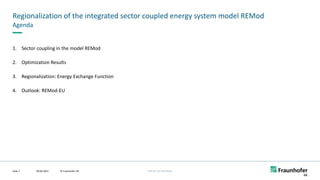
1. Sector coupling in the model REMod
2. Optimization Results
3. Regionalization: Energy Exchange Function
4. Outlook: REMod-EU
FHG-SK: ISE-INTERNAL
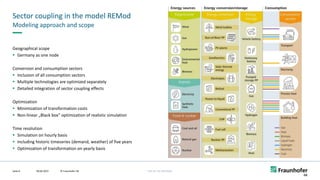
Sector coupling in the model REMod
09.06.2022
Seite 8
Modeling approach and scope
Geographical scope
▪ Germany as one node
Conversion and consumption sectors
▪ Inclusion of all consumption sectors
▪ Multiple technologies are optimized separately
▪ Detailed integration of sector coupling effects
Optimization
▪ Minimization of transformation costs
▪ Non-linear „Black box“ optimization of realistic simulation
Time resolution
▪ Simulation on hourly basis
▪ Including historic timeseries (demand, weather) of five years
▪ Optimization of transformation on yearly basis
©
Markus
Jürgens
© Fraunhofer ISE
FHG-SK: ISE-INTERNAL
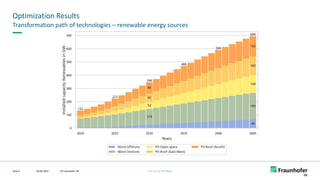
Optimization Results
09.06.2022
Seite 9
Transformation path of technologies – renewable energy sources
©
Markus
Jürgens
© Fraunhofer ISE
FHG-SK: ISE-INTERNAL
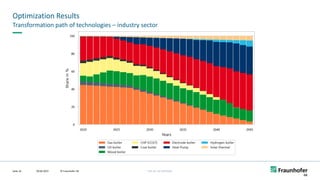
Optimization Results
09.06.2022
Seite 10
Transformation path of technologies – industry sector
©
Markus
Jürgens
© Fraunhofer ISE
FHG-SK: ISE-INTERNAL
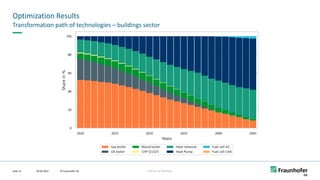
Optimization Results
09.06.2022
Seite 11
Transformation path of technologies – buildings sector
©
Markus
Jürgens
© Fraunhofer ISE
FHG-SK: ISE-INTERNAL
Optimization Results
09.06.2022
Seite 12
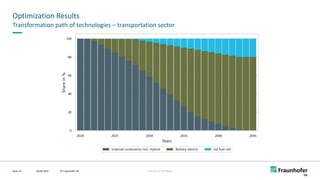
Transformation path of technologies – transportation sector
©
Markus
Jürgens
© Fraunhofer ISE
FHG-SK: ISE-INTERNAL
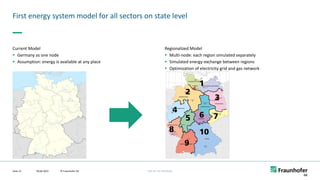
First energy system model for all sectors on state level
09.06.2022
Seite 15 © Fraunhofer ISE
Current Model
▪ Germany as one node
▪ Assumption: energy is available at any place
Regionalized Model
▪ Multi-node: each region simulated separately
▪ Simulated energy-exchange between regions
▪ Optimization of electricity grid and gas network
FHG-SK: ISE-INTERNAL
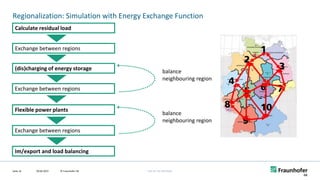
Regionalization: Simulation with Energy Exchange Function
09.06.2022
Seite 16
©
Markus
Jürgens
© Fraunhofer ISE
Calculate residual load
Exchange between regions
(dis)charging of energy storage
Flexible power plants
Im/export and load balancing
Exchange between regions
balance
neighbouring region
balance
neighbouring region
FHG-SK: ISE-INTERNAL
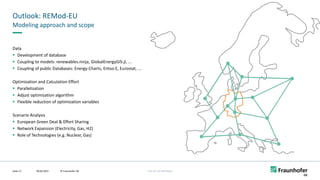
Outlook: REMod-EU
09.06.2022
Seite 17
Modeling approach and scope
Data
▪ Development of database
▪ Coupling to models: renewables.ninja, GlobalEnergyGIS.jl, ...
▪ Coupling of public Databases: Energy-Charts, Entso-E, Eurostat, ...
Optimization and Calculation Effort
▪ Parallelization
▪ Adjust optimization algorithm
▪ Flexible reduction of optimization variables
Scenario Analysis
▪ European Green Deal & Effort Sharing
▪ Network Expansion (Electricity, Gas, H2)
▪ Role of Technologies (e.g. Nuclear, Gas)
©
Markus
Jürgens
© Fraunhofer ISE
Thank You for Your Attention!
—
Dr. Christoph Kost, Patrick Jürgens
Energy Systems and Energy Economics
Tel. +49 761/4588-5750
christoph.kost@ise.fraunhofer.de
patrick.juergens@ise.fraunhofer.de
Thank You for Your Attention!
—
Dr. Christoph Kost, Patrick Jürgens
Energy Systems and Energy Economics
Tel. +49 761/4588-5750
christoph.kost@ise.fraunhofer.de
patrick.juergens@ise.fraunhofer.de
Fraunhofer ISE
Heidenhofstraße 2
79110 Freiburg
www.ise.fraunhofer.de

Energy System Analysis, Fraunhofer ISE

  • 1.
    Welcome at FraunhoferISE — Christoph Kost and Patrick Jürgens ETSAP Workshop Freiburg, 23rd May 2022 www.ise.fraunhofer.de
  • 2.
    FHG-SK: ISE-INTERNAL The Institutein Numbers — Institute Directors: Prof. Dr. Hans-Martin Henning Prof. Dr. Andreas Bett Employees: ca. 1400 Budget 2021: Operation €104.4 million Investment €12.3 million Total €116.7 million Founded in 1981 Fraunhofer Institute for Solar Energy Systems ISE 09.06.2022 © Fraunhofer ISE Seite 2 Performing research for the energy transition for over forty years
  • 3.
    FHG-SK: ISE-INTERNAL Our BusinessAreas 09.06.2022 Seite 3 © Fraunhofer ISE Photovoltaics Energy Efficient Buildings Solar Thermal Power Plants and Industrial Processes Hydrogen Technologies and Electrical Energy Storage Power Electronics, Grids and Smart Systems Fotos: © Fraunhofer ISE
  • 4.
    FHG-SK: ISE-INTERNAL Reserach GroupEnergy Systems and Energy Economics Head of Group: Dr. Christoph Kost Planning and Operating Strategies of Power Plants Energy Economics of regional and (inter-) national energy systems Techno-Economic Assessment of Energy Technologies Market Analysis and Business Models Photos © Fraunhofer ISE Transformation and decarbonization analyses Sector coupling issues ▪ Processes, buildings (e.g. WP), traffic (e.g. electromobility) ▪ Multiple technologies are optimized separately ▪ Detailed integration of sector coupling effects Coupled expansion planning for infrastructure measures in GER/EU systems, ▪ storage, power plants (aggregation of data from EE) ▪ Gas grids, electricity grids, hydrogen Market integration and system ▪ optimization of local/decentralized energy systems, properties and districts
  • 5.
    FHG-SK: ISE-INTERNAL Power SystemModel (National Level) ENTIGRIS Investment Decision Model (National Level) E2S Energy System Model (National Level) REMod Energy System model & Market Integration (Regional/Unit Level) DISTRICT Energy and City Model (Municipal/City Level) KomMod Model based Energy System Analysis by Fraunhofer ISE Models for our services Grid Models Load Flow Analysis Distribution Grid Planning Power System Operation Control
  • 6.
    Regionalization of the integratedsector coupled energy system model REMod — Patrick Jürgens ETSAP Workshop Freiburg, 23rd May 2022 www.ise.fraunhofer.de
  • 7.
    FHG-SK: ISE-INTERNAL Regionalization ofthe integrated sector coupled energy system model REMod 09.06.2022 © Fraunhofer ISE Seite 7 Agenda 1. Sector coupling in the model REMod 2. Optimization Results 3. Regionalization: Energy Exchange Function 4. Outlook: REMod-EU
  • 8.
    FHG-SK: ISE-INTERNAL Sector couplingin the model REMod 09.06.2022 Seite 8 Modeling approach and scope Geographical scope ▪ Germany as one node Conversion and consumption sectors ▪ Inclusion of all consumption sectors ▪ Multiple technologies are optimized separately ▪ Detailed integration of sector coupling effects Optimization ▪ Minimization of transformation costs ▪ Non-linear „Black box“ optimization of realistic simulation Time resolution ▪ Simulation on hourly basis ▪ Including historic timeseries (demand, weather) of five years ▪ Optimization of transformation on yearly basis © Markus Jürgens © Fraunhofer ISE
  • 9.
    FHG-SK: ISE-INTERNAL Optimization Results 09.06.2022 Seite9 Transformation path of technologies – renewable energy sources © Markus Jürgens © Fraunhofer ISE
  • 10.
    FHG-SK: ISE-INTERNAL Optimization Results 09.06.2022 Seite10 Transformation path of technologies – industry sector © Markus Jürgens © Fraunhofer ISE
  • 11.
    FHG-SK: ISE-INTERNAL Optimization Results 09.06.2022 Seite11 Transformation path of technologies – buildings sector © Markus Jürgens © Fraunhofer ISE
  • 12.
    FHG-SK: ISE-INTERNAL Optimization Results 09.06.2022 Seite12 Transformation path of technologies – transportation sector © Markus Jürgens © Fraunhofer ISE
  • 13.
    FHG-SK: ISE-INTERNAL First energysystem model for all sectors on state level 09.06.2022 Seite 15 © Fraunhofer ISE Current Model ▪ Germany as one node ▪ Assumption: energy is available at any place Regionalized Model ▪ Multi-node: each region simulated separately ▪ Simulated energy-exchange between regions ▪ Optimization of electricity grid and gas network
  • 14.
    FHG-SK: ISE-INTERNAL Regionalization: Simulationwith Energy Exchange Function 09.06.2022 Seite 16 © Markus Jürgens © Fraunhofer ISE Calculate residual load Exchange between regions (dis)charging of energy storage Flexible power plants Im/export and load balancing Exchange between regions Exchange between regions balance neighbouring region balance neighbouring region
  • 15.
    FHG-SK: ISE-INTERNAL Outlook: REMod-EU 09.06.2022 Seite17 Modeling approach and scope Data ▪ Development of database ▪ Coupling to models: renewables.ninja, GlobalEnergyGIS.jl, ... ▪ Coupling of public Databases: Energy-Charts, Entso-E, Eurostat, ... Optimization and Calculation Effort ▪ Parallelization ▪ Adjust optimization algorithm ▪ Flexible reduction of optimization variables Scenario Analysis ▪ European Green Deal & Effort Sharing ▪ Network Expansion (Electricity, Gas, H2) ▪ Role of Technologies (e.g. Nuclear, Gas) © Markus Jürgens © Fraunhofer ISE
  • 16.
    Thank You forYour Attention! — Dr. Christoph Kost, Patrick Jürgens Energy Systems and Energy Economics Tel. +49 761/4588-5750 christoph.kost@ise.fraunhofer.de patrick.juergens@ise.fraunhofer.de
  • 17.
    Thank You forYour Attention! — Dr. Christoph Kost, Patrick Jürgens Energy Systems and Energy Economics Tel. +49 761/4588-5750 christoph.kost@ise.fraunhofer.de patrick.juergens@ise.fraunhofer.de Fraunhofer ISE Heidenhofstraße 2 79110 Freiburg www.ise.fraunhofer.de