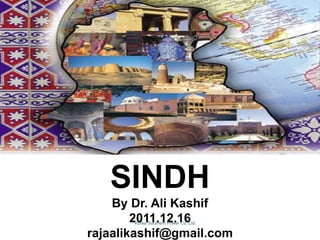
SINDH
By Dr. Ali Kashif
2011.12.16
rajaalikashif@gmail.com
Korea Southern Power Co. Ltd.
Introduction
 Sindh . It is also locally known as the "Mehran".
 Muslims in majority, but a good number of Christians, Zoroastrians
and Hindus .
 Population: 35,470,648
 Culturally rich with many forts and other historical buildings
 The name is derived from the Indus River
 In Sanskrit, síndhu means "river, stream",
Korea Southern Power Co. Ltd.
History
 Sindh's first settlements date as far back as 7000 BCE.
 Contemporary civilizations of Ancient Egypt and Mesopotamia
 Sindh was conquered by the Persian Empire in the sixth century BC.
 In the late 300s BC, Sindh was conquered by
Greeks under Alexander.
 In 711 AD, Muhammad ibn Qasim defeated the Raja Dahir
 Arab rule ended in 998
 In the year 1524, remaining Sindhi welcomed the Mughal Empire .
 A network of forts manned by cavalry and musketeers
 After 1853, the British divided Sindh into districts. In each district
they recognized a wadera or aristocrat.
Korea Southern Power Co. Ltd.
Geography
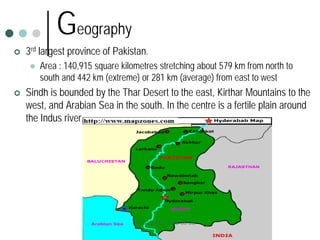
 3rd largest province of Pakistan.
 Area : 140,915 square kilometres stretching about 579 km from north to
south and 442 km (extreme) or 281 km (average) from east to west
 Sindh is bounded by the Thar Desert to the east, Kirthar Mountains to the
west, and Arabian Sea in the south. In the centre is a fertile plain around
the Indus river.
Korea Southern Power Co. Ltd.
Major Cities
List of major cities in Sindh
Rank City Population
1 Karachi 13,205,339
2 Hyderabad 1,578,367
3 Sukkur 493,438
4 Larkana 456,544
5 Nawabshah 272,598
6 Mirpur Khas 242,887
7 Jacobabad 200,815
8 Shikarpur 177,682
9 Dadu 146,179
10 Tando Adam 145,719
Korea Southern Power Co. Ltd.
Climate
 Sindh is hot (above 46 C, 115 F) in the summer and mild to warm in
winter (2C, 36 F)
 The average rainfall in Sindh is only 6–7 in (15–18 cm) per year.
 Sindh Province Geological Divisible in three main regions:
 Khirthar , Pab mountainous range in west.
 Thar Desert on East
 Arabian sea on its South
Korea Southern Power Co. Ltd.
Disaster Risks in Sindh
 Sindh has suffered from disasters.
 Flood/Rains (16 times since 1942)
 Drought,
 Sindh’s all districts in general suffer from drought / shortage of
irrigation and drinking water, besides poor quality water.
 Among the 23 district severally suffering the coastal districts-
Thatta and Badin, Tharparkar,
 Cyclones (8 times in last 100 years)
 Sea Intrusion,
 Frequent earth quack,
 Fires. Korea Southern Power Co. Ltd.
Demography and Society
 Second biggest populated province of Pakistan.
 About half of the population are living in cities, mainly found
in Karachi, Hyderabad, Sukkur, Mirpurkhas, Nawabshah
District, Umerkot and Larkana.
 Sindhi is the sole official language of Sindh.
 According to the 1998 Population Census of Pakistan
• Sindhi-speaking 59.7%;
• Urdu-speaking 21.1%.
• Punjabi 7.0%.
• Pashto 4.2%
• Balochi2.0%;
• Saraiki 1.0% .
• other languages 5.0%. Korea Southern Power Co. Ltd.
Demography and Society
Sindh Demographic Indicators
Indicator Statistic
Urban population 49.50%
Rural population 50.50%
Population growth rate 2.80%
Gender ratio (male per 100 female) 112.24
Economically active population 22.75%
Historical populations
Census Population Urban
1951 6,047,748 29.23%
1961 8,367,065 37.85%
1972 14,155,909 40.44%
1981 19,028,666 43.31%
1998 35,439,893 48.75%
2010 60,000,000 57.5%
Korea Southern Power Co. Ltd.
Religion
 Sindh's population is mainly Muslim (91.32%),
 Sindh is also home to nearly all (93%) of Pakistan's Hindus, who
form 7.5% of the province's population.
 A large number of Hindus migrated to India during the Partition of
India in response to the influx of Muhajirs from India.
 Many of the Shiites of Pakistan live in this province.
Korea Southern Power Co. Ltd.
Economy
 Sindh has the 2nd largest economy in Pakistan.
 Sindh's GDP per capita was $1,400 in 2010 which is 50 per cent
more than the rest of the nation or 35 per cent more than the
national average.
 Historically, Sindh's contribution to Pakistan's GDP has been
between 30% to 32.7%.
 Service sector has ranged from 21% to 27.8%
 agriculture sector from 21.4% to 27.7%.
 manufacturing sector, 36.7% to 46.5%.
Korea Southern Power Co. Ltd.
Economy….
 Industry: Manufacturing includes machine products, cement,
plastics, and various other goods.
 Sindh is Pakistan's most natural gas producing province.
 Agriculture is very important in Sindh with cotton, rice, wheat, sugar
cane, bananas, and mangoes as the most important crops.
 Sindh is the richest province in natural resources of gas, petrol, and
coal.
 Contributes 63 % of overall federal tax, 65 % income tax,
 39 % of country electricity is produced.
 63 % of country oil production.
Korea Southern Power Co. Ltd.
GDP
Korea Southern Power Co. Ltd.
Sindh Advantages
Karachi - Financial Capital of Pakistan
 Nucleus of Headquarters of major Banks, Financial Institutions &
Business houses
 Karachi Stock Exchange Market Capitalization of Rs. 2.561 trillion
(US$ 30.5 billion) & Listed Capital of Rs. 713.287 billion (Approx.
US$ 9 billion) as of March, 2010
Coastline – 350 KMs
 Two Major Ports
 Port Qasim
 Karachi Port
 Huge potential for Aquaculture
Korea Southern Power Co. Ltd.
Regional Power House of the Future
 Thar Coal – potential for 200,000 MW for 300 Years (185 bn Tons)
 Wind Corridor – 50,000 MW potential
 Huge potential for Solar Energy
 Oil – 56% of country’s production
 Gas – 71% of country’s production
Wide Network of Industrial Estates
 SITE Limited (Sukkur, Benazirabad, Nooriabad, Hyderabad, Kotri &
Karachi)
 Korangi Industrial Area
 National Industrial Parks (Bin Qasim & Korangi Industrial Parks)
 Export Processing Zone (EPZ) – Karachi
 Port Qasim Industrial Area
Korea Southern Power Co. Ltd.
Education by 1998
Year Literacy rate
1972 30.2%
1981 37.5%
1998 45.29%
2008 60.7%
2011 67.50%
Qualification Urban Rural Total Enrollment ratio (%)
— 14,839,862 15,600,031 30,439,893 —
Below Primary 1,984,089 3,332,166 5,316,255 100.00
Primary 3,503,691 5,687,771 9,191,462 82.53
Middle 3,073,335 2,369,644 5,442,979 52.33
Matriculation 2,847,769 2,227,684 5,075,453 34.45
Intermediate 1,473,598 1,018,682 2,492,280 17.78
BA, BSc... degrees 106,847 53,040 159,887 9.59
MA, MSc... degrees 1,320,747 552,241 1,872,988 9.07
Diploma, Certificate. 440,743 280,800 721,543 2.91
Other qualifications 89,043 78,003 167,046 0.54
Korea Southern Power Co. Ltd.
Sindh Politics
These all three parties are in governing partners.
Pakistan People Party (PPP)
 Major Seats (Most dominant party since 1971)
 Zulfiqar Ali Bhutto (Founder)
 Benazir Bhutto
 Asif Ali Zardari (Chairperson, current president)
 Syed Qaim Ali Shah (Chief Minister
Muhajir Qaumi Movement (MQM)
 Dominant in Karachi
 Altaf Hussain (Chairperson)
 Ishrat-ul-Ibaad (Governor)
Awami National Party (ANP)
 Few seats in Karachi
Korea Southern Power Co. Ltd.
THANKS
Ali Kashif.
Korea Southern Power Co. Ltd.

Sindh pakistan

  • 1.
    SINDH By Dr. AliKashif 2011.12.16 rajaalikashif@gmail.com Korea Southern Power Co. Ltd.
  • 2.
    Introduction  Sindh .It is also locally known as the "Mehran".  Muslims in majority, but a good number of Christians, Zoroastrians and Hindus .  Population: 35,470,648  Culturally rich with many forts and other historical buildings  The name is derived from the Indus River  In Sanskrit, síndhu means "river, stream", Korea Southern Power Co. Ltd.
  • 3.
    History  Sindh's firstsettlements date as far back as 7000 BCE.  Contemporary civilizations of Ancient Egypt and Mesopotamia  Sindh was conquered by the Persian Empire in the sixth century BC.  In the late 300s BC, Sindh was conquered by Greeks under Alexander.  In 711 AD, Muhammad ibn Qasim defeated the Raja Dahir  Arab rule ended in 998  In the year 1524, remaining Sindhi welcomed the Mughal Empire .  A network of forts manned by cavalry and musketeers  After 1853, the British divided Sindh into districts. In each district they recognized a wadera or aristocrat. Korea Southern Power Co. Ltd.
  • 4.
    Geography  3rd largestprovince of Pakistan.  Area : 140,915 square kilometres stretching about 579 km from north to south and 442 km (extreme) or 281 km (average) from east to west  Sindh is bounded by the Thar Desert to the east, Kirthar Mountains to the west, and Arabian Sea in the south. In the centre is a fertile plain around the Indus river. Korea Southern Power Co. Ltd.
  • 5.
    Major Cities List ofmajor cities in Sindh Rank City Population 1 Karachi 13,205,339 2 Hyderabad 1,578,367 3 Sukkur 493,438 4 Larkana 456,544 5 Nawabshah 272,598 6 Mirpur Khas 242,887 7 Jacobabad 200,815 8 Shikarpur 177,682 9 Dadu 146,179 10 Tando Adam 145,719 Korea Southern Power Co. Ltd.
  • 6.
    Climate  Sindh ishot (above 46 C, 115 F) in the summer and mild to warm in winter (2C, 36 F)  The average rainfall in Sindh is only 6–7 in (15–18 cm) per year.  Sindh Province Geological Divisible in three main regions:  Khirthar , Pab mountainous range in west.  Thar Desert on East  Arabian sea on its South Korea Southern Power Co. Ltd.
  • 7.
    Disaster Risks inSindh  Sindh has suffered from disasters.  Flood/Rains (16 times since 1942)  Drought,  Sindh’s all districts in general suffer from drought / shortage of irrigation and drinking water, besides poor quality water.  Among the 23 district severally suffering the coastal districts- Thatta and Badin, Tharparkar,  Cyclones (8 times in last 100 years)  Sea Intrusion,  Frequent earth quack,  Fires. Korea Southern Power Co. Ltd.
  • 8.
    Demography and Society Second biggest populated province of Pakistan.  About half of the population are living in cities, mainly found in Karachi, Hyderabad, Sukkur, Mirpurkhas, Nawabshah District, Umerkot and Larkana.  Sindhi is the sole official language of Sindh.  According to the 1998 Population Census of Pakistan • Sindhi-speaking 59.7%; • Urdu-speaking 21.1%. • Punjabi 7.0%. • Pashto 4.2% • Balochi2.0%; • Saraiki 1.0% . • other languages 5.0%. Korea Southern Power Co. Ltd.
  • 9.
    Demography and Society SindhDemographic Indicators Indicator Statistic Urban population 49.50% Rural population 50.50% Population growth rate 2.80% Gender ratio (male per 100 female) 112.24 Economically active population 22.75% Historical populations Census Population Urban 1951 6,047,748 29.23% 1961 8,367,065 37.85% 1972 14,155,909 40.44% 1981 19,028,666 43.31% 1998 35,439,893 48.75% 2010 60,000,000 57.5% Korea Southern Power Co. Ltd.
  • 10.
    Religion  Sindh's populationis mainly Muslim (91.32%),  Sindh is also home to nearly all (93%) of Pakistan's Hindus, who form 7.5% of the province's population.  A large number of Hindus migrated to India during the Partition of India in response to the influx of Muhajirs from India.  Many of the Shiites of Pakistan live in this province. Korea Southern Power Co. Ltd.
  • 11.
    Economy  Sindh hasthe 2nd largest economy in Pakistan.  Sindh's GDP per capita was $1,400 in 2010 which is 50 per cent more than the rest of the nation or 35 per cent more than the national average.  Historically, Sindh's contribution to Pakistan's GDP has been between 30% to 32.7%.  Service sector has ranged from 21% to 27.8%  agriculture sector from 21.4% to 27.7%.  manufacturing sector, 36.7% to 46.5%. Korea Southern Power Co. Ltd.
  • 12.
    Economy….  Industry: Manufacturingincludes machine products, cement, plastics, and various other goods.  Sindh is Pakistan's most natural gas producing province.  Agriculture is very important in Sindh with cotton, rice, wheat, sugar cane, bananas, and mangoes as the most important crops.  Sindh is the richest province in natural resources of gas, petrol, and coal.  Contributes 63 % of overall federal tax, 65 % income tax,  39 % of country electricity is produced.  63 % of country oil production. Korea Southern Power Co. Ltd.
  • 13.
  • 14.
    Sindh Advantages Karachi -Financial Capital of Pakistan  Nucleus of Headquarters of major Banks, Financial Institutions & Business houses  Karachi Stock Exchange Market Capitalization of Rs. 2.561 trillion (US$ 30.5 billion) & Listed Capital of Rs. 713.287 billion (Approx. US$ 9 billion) as of March, 2010 Coastline – 350 KMs  Two Major Ports  Port Qasim  Karachi Port  Huge potential for Aquaculture Korea Southern Power Co. Ltd.
  • 15.
    Regional Power Houseof the Future  Thar Coal – potential for 200,000 MW for 300 Years (185 bn Tons)  Wind Corridor – 50,000 MW potential  Huge potential for Solar Energy  Oil – 56% of country’s production  Gas – 71% of country’s production Wide Network of Industrial Estates  SITE Limited (Sukkur, Benazirabad, Nooriabad, Hyderabad, Kotri & Karachi)  Korangi Industrial Area  National Industrial Parks (Bin Qasim & Korangi Industrial Parks)  Export Processing Zone (EPZ) – Karachi  Port Qasim Industrial Area Korea Southern Power Co. Ltd.
  • 16.
    Education by 1998 YearLiteracy rate 1972 30.2% 1981 37.5% 1998 45.29% 2008 60.7% 2011 67.50% Qualification Urban Rural Total Enrollment ratio (%) — 14,839,862 15,600,031 30,439,893 — Below Primary 1,984,089 3,332,166 5,316,255 100.00 Primary 3,503,691 5,687,771 9,191,462 82.53 Middle 3,073,335 2,369,644 5,442,979 52.33 Matriculation 2,847,769 2,227,684 5,075,453 34.45 Intermediate 1,473,598 1,018,682 2,492,280 17.78 BA, BSc... degrees 106,847 53,040 159,887 9.59 MA, MSc... degrees 1,320,747 552,241 1,872,988 9.07 Diploma, Certificate. 440,743 280,800 721,543 2.91 Other qualifications 89,043 78,003 167,046 0.54 Korea Southern Power Co. Ltd.
  • 17.
    Sindh Politics These allthree parties are in governing partners. Pakistan People Party (PPP)  Major Seats (Most dominant party since 1971)  Zulfiqar Ali Bhutto (Founder)  Benazir Bhutto  Asif Ali Zardari (Chairperson, current president)  Syed Qaim Ali Shah (Chief Minister Muhajir Qaumi Movement (MQM)  Dominant in Karachi  Altaf Hussain (Chairperson)  Ishrat-ul-Ibaad (Governor) Awami National Party (ANP)  Few seats in Karachi Korea Southern Power Co. Ltd.
  • 18.