IJRET: International Journal of Research in Engineering and Technology ISSN: 2319-1163
__________________________________________________________________________________________
Volume: 02 Issue: 02 | Feb-2013, Available @ http://www.ijret.org 190
ENERGY SAVING OPPORTUNITIES IN OXYGEN PLANT–A CASE
STUDY
B.J.Sonani1
, J.K. Ratnadhariya2
1
L. M. E, GOVERNMENT POLYTECHNIC COLLEGE, WAGHAI
2
PRINCIPAL, ALPHA COLLEGE OF ENGINEERING, AHMEDABAD
Abstract
Energy saving is the one of the step of the energy management. The energy management is play vital role in the industrial as well as
domestic sector. The energy management concept was developed in USA and US since 1973, while in India and most Asian countries
this concept was adopted in 1990 and later. The wastage reduction should include energy efficiency drives using improved designs
and devices. The modification in components of the plant to increasing efficiency which is improved cycle performance. This Paper
presented survey of energy end use in cryogenic-industries, such as OXYGEN MANUFACTURING INDUSTRIES. The energy
required for the production of liquid and gaseous phase of oxygen. We had carried out energy saving opportunity in oxygen plant and
find the energy saving opportunities in various components of oxygen plant. This paper discussed the various parameters for the
energy saving in the plant components. We find opportunities of energy saving in plant with some modification and calculate the
actual power required in plant equipments.
Keywords : Energy saving , oxygen plant
---------------------------------------------------------------------***-------------------------------------------------------------------------
1. INTRODUCTION
Industrial gases perform varied and essential function in our
economy. Some are raw materials for the manufacturing of
other chemicals. This is particularly true of O2, N2 & H2, N2
which preserves the flavor of packaged food by reducing
chemical action leading to vancidity of conned fats. Some
gases are essential medicaments such as O2 & He. Oxygen is
used in Metal processing, Space application, Welding,
Cutting and Brazing processes, Oil and Gas sector, Oxidizer
in chemical industries Chemical and petrochemical industries,
Glass industry Fish farming and Waste management’.
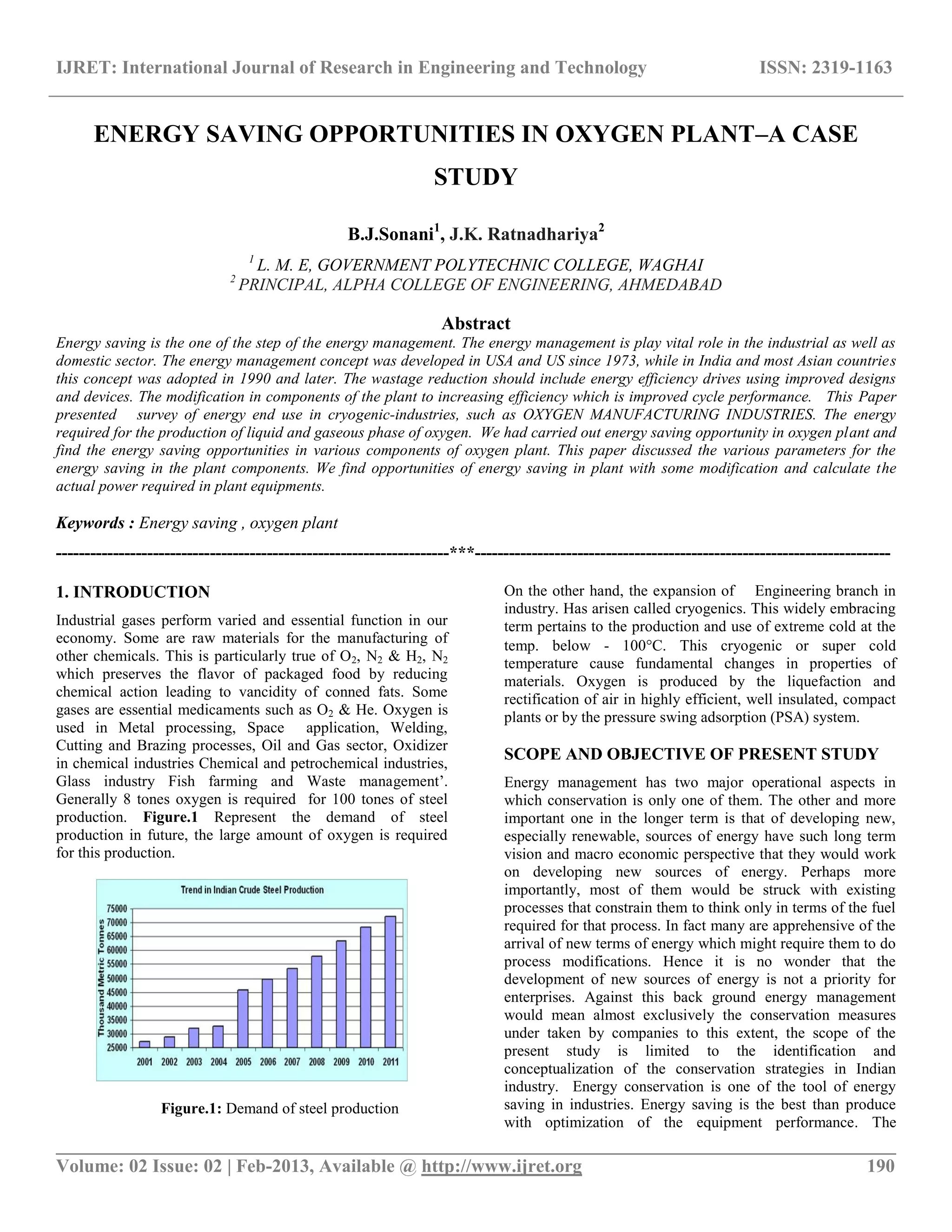
Generally 8 tones oxygen is required for 100 tones of steel
production. Figure.1 Represent the demand of steel
production in future, the large amount of oxygen is required
for this production.
Figure.1: Demand of steel production
On the other hand, the expansion of Engineering branch in
industry. Has arisen called cryogenics. This widely embracing
term pertains to the production and use of extreme cold at the
temp. below - 100C. This cryogenic or super cold
temperature cause fundamental changes in properties of
materials. Oxygen is produced by the liquefaction and
rectification of air in highly efficient, well insulated, compact
plants or by the pressure swing adsorption (PSA) system.
SCOPE AND OBJECTIVE OF PRESENT STUDY
Energy management has two major operational aspects in
which conservation is only one of them. The other and more
important one in the longer term is that of developing new,
especially renewable, sources of energy have such long term
vision and macro economic perspective that they would work
on developing new sources of energy. Perhaps more
importantly, most of them would be struck with existing
processes that constrain them to think only in terms of the fuel
required for that process. In fact many are apprehensive of the
arrival of new terms of energy which might require them to do
process modifications. Hence it is no wonder that the
development of new sources of energy is not a priority for
enterprises. Against this back ground energy management
would mean almost exclusively the conservation measures
under taken by companies to this extent, the scope of the
present study is limited to the identification and
conceptualization of the conservation strategies in Indian
industry. Energy conservation is one of the tool of energy
saving in industries. Energy saving is the best than produce
with optimization of the equipment performance. The
IJRET: International Journal of Research in Engineering and Technology ISSN: 2319-1163
__________________________________________________________________________________________
Volume: 02 Issue: 02 | Feb-2013, Available @ http://www.ijret.org 191
performance of the plant depends on various factors which are
effect the yield’, Work and figure of merit (FOM) .
1.1 OXYGEN REQUIRED FOR STEEL CUTTING
INDUSTRIES
This survey report is to study the oxygen manufacturing for
the steel cutting industries at ALANG SHIP BREAKING
YARD to cut the disposal ship. The requirements of oxygen
gas for the steel cutting industries shows in Table-1.
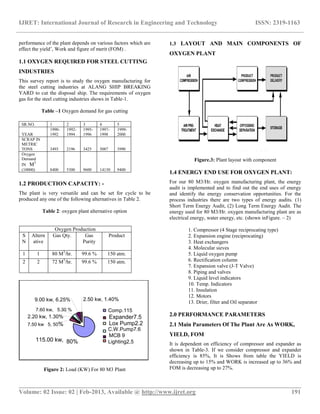
Table –1 Oxygen demand for gas cutting
1.2 PRODUCTION CAPACITY: -
The plant is very versatile and can be set for cycle to be
produced any one of the following alternatives in Table 2.
Table 2: oxygen plant alternative option
Figure 2: Load (KW) For 80 M3 Plant
1.3 LAYOUT AND MAIN COMPONENTS OF
OXYGEN PLANT
Figure.3: Plant layout with component
1.4 ENERGY END USE FOR OXYGEN PLANT:
For our 80 M3/Hr. oxygen manufacturing plant, the energy
audit is implemented and to find out the end uses of energy
and identify the energy conservation opportunities. For the
process industries there are two types of energy audits. (1)
Short Term Energy Audit, (2) Long Term Energy Audit. The
energy used for 80 M3/Hr. oxygen manufacturing plant are as
electrical energy, water energy, etc. (shown inFigure. – 2)
1. Compressor (4 Stage reciprocating type)
2. Expansion engine (reciprocating)
3. Heat exchangers
4. Molecular sieves
5. Liquid oxygen pump
6. Rectification column
7. Expansion valve (J-T Valve)
8. Piping and valves
9. Liquid level indicators
10. Temp. Indicators
11. Insulation
12. Motors
13. Drier, filter and Oil separator
2.0 PERFORMANCE PARAMETERS
2.1 Main Parameters Of The Plant Are As WORK,
YIELD, FOM
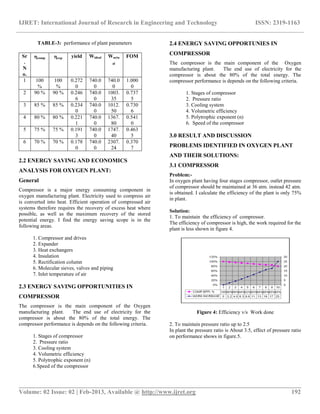
It is dependent on efficiency of compressor and expander as
shown in Table-3. If we consider compressor and expander
efficiency is 85%, It is Shows from table the YIELD is
decreasing up to 15% and WORK is increased up to 36% and
FOM is decreasing up to 27%.
SR.NO. 1 2 3 4 5
YEAR
1990-
1992
1992-
1994
1995-
1996
1997-
1998
1999-
2000
SCRAP IN
METRIC
TONS 3493 2196 3425 5087 3990
Oxygen
Demand
IN M3
(10000) 8400 5300 9600 14130 9400
Oxygen Production
S
N
Altern
ative
Gas Qty. Gas
Purity
Product
1 1 80 M3
/hr. 99.6 % 150 atm.
2 2 72 M3
/hr. 99.6 % 150 atm.
115.00 kw, 80%
7.50 kw 5, 50%
2.50 kw, 1.40%9.00 kw, 6.25%
7.60 kw, 5.30 %
2.20 kw, 1.30%
Comp.115
Expander7.5
Lox Pump2.2
C.W.Pump7.6
MCB 9
Lighting2,5
IJRET: International Journal of Research in Engineering and Technology ISSN: 2319-1163
__________________________________________________________________________________________
Volume: 02 Issue: 02 | Feb-2013, Available @ http://www.ijret.org 192
TABLE-3: performance of plant parameters
2.2 ENERGY SAVING AND ECONOMICS
ANALYSIS FOR OXYGEN PLANT:
General
Compressor is a major energy consuming component in
oxygen manufacturing plant. Electricity used to compress air
is converted into heat. Efficient operation of compressed air
systems therefore requires the recovery of excess heat where
possible, as well as the maximum recovery of the stored
potential energy. I find the energy saving scope is in the
following areas.
1. Compressor and drives
2. Expander
3. Heat exchangers
4. Insulation
5. Rectification column
6. Molecular sieves, valves and piping
7. Inlet temperature of air
2.3 ENERGY SAVING OPPORTUNITIES IN
COMPRESSOR
The compressor is the main component of the Oxygen
manufacturing plant. The end use of electricity for the
compressor is about the 80% of the total energy. The
compressor performance is depends on the following criteria.
1. Stages of compressor
2. Pressure ratio
3. Cooling system
4. Volumetric efficiency
5. Polytrophic exponent (n)
6.Speed of the compressor
2.4 ENERGY SAVING OPPORTUNIES IN
COMPRESSOR
The compressor is the main component of the Oxygen
manufacturing plant. The end use of electricity for the
compressor is about the 80% of the total energy. The
compressor performance is depends on the following criteria.
1. Stages of compressor
2. Pressure ratio
3. Cooling system
4. Volumetric efficiency
5. Polytrophic exponent (n)
6. Speed of the compressor
3.0 RESULT AND DISCUSSION
PROBLEMS IDENTIFIED IN OXYGEN PLANT
AND THEIR SOLUTIONS:
3.1 COMPRESSOR
Problem:-
In oxygen plant having four stages compressor, outlet pressure
of compressor should be maintained at 36 atm. instead 42 atm.
is obtained. I calculate the efficiency of the plant is only 75%
in plant.
Solution:
1. To maintain the efficiency of compressor.
The efficiency of compressor is high, the work required for the
plant is less shown in figure 4.
Figure 4: Efficiency v/s Work done
2. To maintain pressure ratio up to 2.5
In plant the pressure ratio is About 3.5, effect of pressure ratio
on performance shows in figure.5.
Sr
.
N
o.
comp exp yield Wideal Wactu
al
FOM
1 100
%
100
%
0.272
0
740.0
0
740.0
0
1.000
0
2 90 % 90 % 0.246
6
740.0
0
1003.
35
0.737
5
3 85 % 85 % 0.234
0
740.0
0
1012.
50
0.730
6
4 80 % 80 % 0.221
1
740.0
0
1367.
80
0.541
0
5 75 % 75 % 0.191
3
740.0
0
1747.
40
0.463
5
6 70 % 70 % 0.178
0
740.0
0
2307.
24
0.370
7
IJRET: International Journal of Research in Engineering and Technology ISSN: 2319-1163
__________________________________________________________________________________________
Volume: 02 Issue: 02 | Feb-2013, Available @ http://www.ijret.org 193
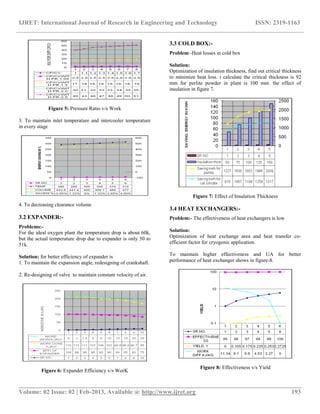
Figure 5: Pressure Ratio v/s Work
3. To maintain inlet temperature and intercooler temperature
in every stage
4. To decreasing clearance volume
3.2 EXPANDER:-
Problems:-
For the ideal oxygen plant the temperature drop is about 60k,
but the actual temperature drop due to expander is only 50 to
51k.
Solution: for better efficiency of expander is
1. To maintain the expansion angle, redesigning of crankshaft.
2. Re-designing of valve to maintain constant velocity of air.
Figure 6: Expander Efficiency v/s WorK
3.3 COLD BOX:-
Problem:-Heat losses in cold box
Solution:
Optimization of insulation thickness, find out critical thickness
to minimize heat loss. i calculate the critical thickness is 92
mm for perlite powder in plant is 100 mm. the effect of
insulation in figure 7.
Figure 7: Effect of Insulation Thickness
3.4 HEAT EXCHANGERS:-
Problem:- The effectiveness of heat exchangers is low
Solution:
Optimization of heat exchange area and heat transfer co-
efficient factor for cryogenic application.
To maintain higher effectiveness and UA for better
performance of heat exchanger shows in figure-8.
Figure 8: Effectiveness v/s Yield
IJRET: International Journal of Research in Engineering and Technology ISSN: 2319-1163
__________________________________________________________________________________________
Volume: 02 Issue: 02 | Feb-2013, Available @ http://www.ijret.org 194
3.5 MOLECULAR SIEVE:
Problem:- The Capacity of molecular sieve is more
Solution:
Optimization area and heat transfer co-efficient factor
Remove moisture particles from material save energy
Use cyclone separator for moisture removes.
4. FINDINGS: -
During my work I found various lack of proper operation in
working of plant. I collect findings and its solution for energy
saving in plant
1. First collect Energy use in plant equipments
2. Calculate unit price of oxygen in plant and compare with
ideal cycle I found that the ideal cost is 0.9 Kwh/ M3 while
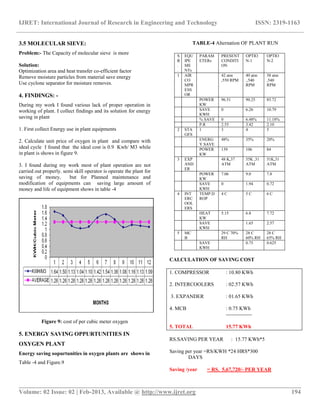
in plant is shows in figure 9.
3. I found during my work most of plant operation are not
carried out properly. semi skill operator is operate the plant for
saving of money, but for Planned maintenance and
modification of equipments can saving large amount of
money and life of equipment shows in table -4
Figure 9: cost of per cubic meter oxygen
5. ENERGY SAVING OPPURTUNITIES IN
OXYGEN PLANT
Energy saving oopurtunities in oxygen plants are shows in
Table -4 and Figure.9
TABLE-4 Alternation OF PLANT RUN
CALCULATION OF SAVING COST
1. COMPRESSOR : 10.80 KWh
2. INTERCOOLERS : 02.57 KWh
3. EXPANDER : 01.65 KWh
4. MCB : 0.75 KWh
---------------
5. TOTAL 15.77 KWh
RS.SAVING PER YEAR : 15.77 KWh*5
Saving per year =RS/KWH *24 HRS*300
DAYS
Saving /year = RS. 5,67,720/- PER YEAR
S
R
.
.
EQU
IPE
ME
NTs
PARAM
ETERs
PRESENT
CONDITI
ON
OPTIO
N-1
OPTIO
N-2
1 AIR
CO
MPR
ESS
OR
42 atm
,550 RPM
40 atm
.,540
RPM
38 atm
,540
RPM
POWER
KW
96.51 90.25 85.72
SAVE
KWH
0 6.26 10.79
% SAVE 0 6.48% 11.18%
P.R 2.55 3.42 2.10
2 STA
GES
1 3 4 5
ENERG
Y SAVE
48% 35% 20%
POWER
KW
139 106 84
3 EXP
AND
ER
48 K,37
ATM
55K ,31
ATM
51K,31
ATM
POWER
KW
7.06 9.0 7.8
SAVE
KWH
0 1.94 0.72
4 INT
ERC
OOL
ERS
TEMP.D
ROP
4 C 5 C 6 C
HEAT
KW
5.15 6.8 7.72
SAVE
KWH
1.65 2.57
5 MC
B
29 C 70%
RH
28 C
60% RH
28 C
65% RH
SAVE
KWH
0.75 0.625
IJRET: International Journal of Research in Engineering and Technology ISSN: 2319-1163
__________________________________________________________________________________________
Volume: 02 Issue: 02 | Feb-2013, Available @ http://www.ijret.org 195
Figure.10: ENERGY SAVING IN OXYGEN PLANT WITH
IMPROVEMENT OF THE EQUIPEMENTS
CONCLUSIONS
With increasing of oxygen demand in industries , everybody
want to reduce cost of production applying with energy
conservation concept. The maximum energy required for
compressor and expander , so it is required to minimized the
energy consumption per meter cube of oxygen. When I was
started the case study on 80 cubic meter plant run on 1.30 to
1.40 kwh/m3
, but theories said to required the energy for
production of oxygen is 0.90 kwh/m3
. I was stared the
various readings and find out the problems in various
components try to solve the problems. The possibilities for the
energy saving is 5 lacs per year. Finally I was attaining the
production cost of oxygen at 1.1-1.2 kWh/ m3..
Overall saving
14-15% of energy.
ACKNOLGEDGEMENTS
This work is carried out during my master of engineering
from1999-2001 at Mitt Gases Private Limited at Vartej ,
Bhavnagar Gujarat. and active support of plant owner and
staff.
REFERENCES
[1]. Ronald F. Barron “Cryogenics System “, Oxford Uni.
Press , NY. year 1985
[2]. Marshall Sitting & Stephen “Cryogenics Research and
Application “ Kidd, D. VAN Norstand Comp.INC , NJ
(1963)
[3] W.F. Kenney , ”Energy Conservation in the Process
Industries” Academic Press INC. FLORIDA.
[4]. W.C. Turner, ”Energy Management Handbook” John.
C Wiley Co. NY-1982
[5] .Heinz P. Bloch et al, “ Compressors and Expander
Selection & Application Chemical Industries Vol. VIII,
Mancel -Dekker Inc. NY-1979.
[6]. Petite, “Cryogenic Air Separation last20 Year” ,advance
in Cryogenic Engg. Vol. –31 ,1063.
[7]. P.K. Bose,.“Tonnage oxygen plant for process
Application for steel industries, “Indian journal of cryogenic
vol- 19,page 224.
[8] Stewart and A. Pavak Model Energy Audit Program
Guidelines- “USDOE Agreement DEFG-45-80R Page 24
(1980).
[9]. Shehadi – Cowan , ”Energy Use Evaluation” Symposium
-A184-8 ASHARE Tranctions Part-I 1984, Part-I).
[10]. Gujarat Ship Breaking Asso. Bhavnagar, “Oxygen
Requirement for Steel Cutting Industries “ JULY -1999
[11]’ Mitt oxygen Pvt . Ltd. Bhavnagar,“80 m3
/hr. oxygen
Plant Manuals “ JULY-1999
[12] Winter school on ”refrigeration at cryogenic temperature
and cryogenic for industrial gases”, IIT KANPUR Page -433
dec-1991

Energy saving opportunities in oxygen plant–a case study

  • 1.
    IJRET: International Journalof Research in Engineering and Technology ISSN: 2319-1163 __________________________________________________________________________________________ Volume: 02 Issue: 02 | Feb-2013, Available @ http://www.ijret.org 190 ENERGY SAVING OPPORTUNITIES IN OXYGEN PLANT–A CASE STUDY B.J.Sonani1 , J.K. Ratnadhariya2 1 L. M. E, GOVERNMENT POLYTECHNIC COLLEGE, WAGHAI 2 PRINCIPAL, ALPHA COLLEGE OF ENGINEERING, AHMEDABAD Abstract Energy saving is the one of the step of the energy management. The energy management is play vital role in the industrial as well as domestic sector. The energy management concept was developed in USA and US since 1973, while in India and most Asian countries this concept was adopted in 1990 and later. The wastage reduction should include energy efficiency drives using improved designs and devices. The modification in components of the plant to increasing efficiency which is improved cycle performance. This Paper presented survey of energy end use in cryogenic-industries, such as OXYGEN MANUFACTURING INDUSTRIES. The energy required for the production of liquid and gaseous phase of oxygen. We had carried out energy saving opportunity in oxygen plant and find the energy saving opportunities in various components of oxygen plant. This paper discussed the various parameters for the energy saving in the plant components. We find opportunities of energy saving in plant with some modification and calculate the actual power required in plant equipments. Keywords : Energy saving , oxygen plant ---------------------------------------------------------------------***------------------------------------------------------------------------- 1. INTRODUCTION Industrial gases perform varied and essential function in our economy. Some are raw materials for the manufacturing of other chemicals. This is particularly true of O2, N2 & H2, N2 which preserves the flavor of packaged food by reducing chemical action leading to vancidity of conned fats. Some gases are essential medicaments such as O2 & He. Oxygen is used in Metal processing, Space application, Welding, Cutting and Brazing processes, Oil and Gas sector, Oxidizer in chemical industries Chemical and petrochemical industries, Glass industry Fish farming and Waste management’. Generally 8 tones oxygen is required for 100 tones of steel production. Figure.1 Represent the demand of steel production in future, the large amount of oxygen is required for this production. Figure.1: Demand of steel production On the other hand, the expansion of Engineering branch in industry. Has arisen called cryogenics. This widely embracing term pertains to the production and use of extreme cold at the temp. below - 100C. This cryogenic or super cold temperature cause fundamental changes in properties of materials. Oxygen is produced by the liquefaction and rectification of air in highly efficient, well insulated, compact plants or by the pressure swing adsorption (PSA) system. SCOPE AND OBJECTIVE OF PRESENT STUDY Energy management has two major operational aspects in which conservation is only one of them. The other and more important one in the longer term is that of developing new, especially renewable, sources of energy have such long term vision and macro economic perspective that they would work on developing new sources of energy. Perhaps more importantly, most of them would be struck with existing processes that constrain them to think only in terms of the fuel required for that process. In fact many are apprehensive of the arrival of new terms of energy which might require them to do process modifications. Hence it is no wonder that the development of new sources of energy is not a priority for enterprises. Against this back ground energy management would mean almost exclusively the conservation measures under taken by companies to this extent, the scope of the present study is limited to the identification and conceptualization of the conservation strategies in Indian industry. Energy conservation is one of the tool of energy saving in industries. Energy saving is the best than produce with optimization of the equipment performance. The
  • 2.
    IJRET: International Journalof Research in Engineering and Technology ISSN: 2319-1163 __________________________________________________________________________________________ Volume: 02 Issue: 02 | Feb-2013, Available @ http://www.ijret.org 191 performance of the plant depends on various factors which are effect the yield’, Work and figure of merit (FOM) . 1.1 OXYGEN REQUIRED FOR STEEL CUTTING INDUSTRIES This survey report is to study the oxygen manufacturing for the steel cutting industries at ALANG SHIP BREAKING YARD to cut the disposal ship. The requirements of oxygen gas for the steel cutting industries shows in Table-1. Table –1 Oxygen demand for gas cutting 1.2 PRODUCTION CAPACITY: - The plant is very versatile and can be set for cycle to be produced any one of the following alternatives in Table 2. Table 2: oxygen plant alternative option Figure 2: Load (KW) For 80 M3 Plant 1.3 LAYOUT AND MAIN COMPONENTS OF OXYGEN PLANT Figure.3: Plant layout with component 1.4 ENERGY END USE FOR OXYGEN PLANT: For our 80 M3/Hr. oxygen manufacturing plant, the energy audit is implemented and to find out the end uses of energy and identify the energy conservation opportunities. For the process industries there are two types of energy audits. (1) Short Term Energy Audit, (2) Long Term Energy Audit. The energy used for 80 M3/Hr. oxygen manufacturing plant are as electrical energy, water energy, etc. (shown inFigure. – 2) 1. Compressor (4 Stage reciprocating type) 2. Expansion engine (reciprocating) 3. Heat exchangers 4. Molecular sieves 5. Liquid oxygen pump 6. Rectification column 7. Expansion valve (J-T Valve) 8. Piping and valves 9. Liquid level indicators 10. Temp. Indicators 11. Insulation 12. Motors 13. Drier, filter and Oil separator 2.0 PERFORMANCE PARAMETERS 2.1 Main Parameters Of The Plant Are As WORK, YIELD, FOM It is dependent on efficiency of compressor and expander as shown in Table-3. If we consider compressor and expander efficiency is 85%, It is Shows from table the YIELD is decreasing up to 15% and WORK is increased up to 36% and FOM is decreasing up to 27%. SR.NO. 1 2 3 4 5 YEAR 1990- 1992 1992- 1994 1995- 1996 1997- 1998 1999- 2000 SCRAP IN METRIC TONS 3493 2196 3425 5087 3990 Oxygen Demand IN M3 (10000) 8400 5300 9600 14130 9400 Oxygen Production S N Altern ative Gas Qty. Gas Purity Product 1 1 80 M3 /hr. 99.6 % 150 atm. 2 2 72 M3 /hr. 99.6 % 150 atm. 115.00 kw, 80% 7.50 kw 5, 50% 2.50 kw, 1.40%9.00 kw, 6.25% 7.60 kw, 5.30 % 2.20 kw, 1.30% Comp.115 Expander7.5 Lox Pump2.2 C.W.Pump7.6 MCB 9 Lighting2,5
  • 3.
    IJRET: International Journalof Research in Engineering and Technology ISSN: 2319-1163 __________________________________________________________________________________________ Volume: 02 Issue: 02 | Feb-2013, Available @ http://www.ijret.org 192 TABLE-3: performance of plant parameters 2.2 ENERGY SAVING AND ECONOMICS ANALYSIS FOR OXYGEN PLANT: General Compressor is a major energy consuming component in oxygen manufacturing plant. Electricity used to compress air is converted into heat. Efficient operation of compressed air systems therefore requires the recovery of excess heat where possible, as well as the maximum recovery of the stored potential energy. I find the energy saving scope is in the following areas. 1. Compressor and drives 2. Expander 3. Heat exchangers 4. Insulation 5. Rectification column 6. Molecular sieves, valves and piping 7. Inlet temperature of air 2.3 ENERGY SAVING OPPORTUNITIES IN COMPRESSOR The compressor is the main component of the Oxygen manufacturing plant. The end use of electricity for the compressor is about the 80% of the total energy. The compressor performance is depends on the following criteria. 1. Stages of compressor 2. Pressure ratio 3. Cooling system 4. Volumetric efficiency 5. Polytrophic exponent (n) 6.Speed of the compressor 2.4 ENERGY SAVING OPPORTUNIES IN COMPRESSOR The compressor is the main component of the Oxygen manufacturing plant. The end use of electricity for the compressor is about the 80% of the total energy. The compressor performance is depends on the following criteria. 1. Stages of compressor 2. Pressure ratio 3. Cooling system 4. Volumetric efficiency 5. Polytrophic exponent (n) 6. Speed of the compressor 3.0 RESULT AND DISCUSSION PROBLEMS IDENTIFIED IN OXYGEN PLANT AND THEIR SOLUTIONS: 3.1 COMPRESSOR Problem:- In oxygen plant having four stages compressor, outlet pressure of compressor should be maintained at 36 atm. instead 42 atm. is obtained. I calculate the efficiency of the plant is only 75% in plant. Solution: 1. To maintain the efficiency of compressor. The efficiency of compressor is high, the work required for the plant is less shown in figure 4. Figure 4: Efficiency v/s Work done 2. To maintain pressure ratio up to 2.5 In plant the pressure ratio is About 3.5, effect of pressure ratio on performance shows in figure.5. Sr . N o. comp exp yield Wideal Wactu al FOM 1 100 % 100 % 0.272 0 740.0 0 740.0 0 1.000 0 2 90 % 90 % 0.246 6 740.0 0 1003. 35 0.737 5 3 85 % 85 % 0.234 0 740.0 0 1012. 50 0.730 6 4 80 % 80 % 0.221 1 740.0 0 1367. 80 0.541 0 5 75 % 75 % 0.191 3 740.0 0 1747. 40 0.463 5 6 70 % 70 % 0.178 0 740.0 0 2307. 24 0.370 7
  • 4.
    IJRET: International Journalof Research in Engineering and Technology ISSN: 2319-1163 __________________________________________________________________________________________ Volume: 02 Issue: 02 | Feb-2013, Available @ http://www.ijret.org 193 Figure 5: Pressure Ratio v/s Work 3. To maintain inlet temperature and intercooler temperature in every stage 4. To decreasing clearance volume 3.2 EXPANDER:- Problems:- For the ideal oxygen plant the temperature drop is about 60k, but the actual temperature drop due to expander is only 50 to 51k. Solution: for better efficiency of expander is 1. To maintain the expansion angle, redesigning of crankshaft. 2. Re-designing of valve to maintain constant velocity of air. Figure 6: Expander Efficiency v/s WorK 3.3 COLD BOX:- Problem:-Heat losses in cold box Solution: Optimization of insulation thickness, find out critical thickness to minimize heat loss. i calculate the critical thickness is 92 mm for perlite powder in plant is 100 mm. the effect of insulation in figure 7. Figure 7: Effect of Insulation Thickness 3.4 HEAT EXCHANGERS:- Problem:- The effectiveness of heat exchangers is low Solution: Optimization of heat exchange area and heat transfer co- efficient factor for cryogenic application. To maintain higher effectiveness and UA for better performance of heat exchanger shows in figure-8. Figure 8: Effectiveness v/s Yield
  • 5.
    IJRET: International Journalof Research in Engineering and Technology ISSN: 2319-1163 __________________________________________________________________________________________ Volume: 02 Issue: 02 | Feb-2013, Available @ http://www.ijret.org 194 3.5 MOLECULAR SIEVE: Problem:- The Capacity of molecular sieve is more Solution: Optimization area and heat transfer co-efficient factor Remove moisture particles from material save energy Use cyclone separator for moisture removes. 4. FINDINGS: - During my work I found various lack of proper operation in working of plant. I collect findings and its solution for energy saving in plant 1. First collect Energy use in plant equipments 2. Calculate unit price of oxygen in plant and compare with ideal cycle I found that the ideal cost is 0.9 Kwh/ M3 while in plant is shows in figure 9. 3. I found during my work most of plant operation are not carried out properly. semi skill operator is operate the plant for saving of money, but for Planned maintenance and modification of equipments can saving large amount of money and life of equipment shows in table -4 Figure 9: cost of per cubic meter oxygen 5. ENERGY SAVING OPPURTUNITIES IN OXYGEN PLANT Energy saving oopurtunities in oxygen plants are shows in Table -4 and Figure.9 TABLE-4 Alternation OF PLANT RUN CALCULATION OF SAVING COST 1. COMPRESSOR : 10.80 KWh 2. INTERCOOLERS : 02.57 KWh 3. EXPANDER : 01.65 KWh 4. MCB : 0.75 KWh --------------- 5. TOTAL 15.77 KWh RS.SAVING PER YEAR : 15.77 KWh*5 Saving per year =RS/KWH *24 HRS*300 DAYS Saving /year = RS. 5,67,720/- PER YEAR S R . . EQU IPE ME NTs PARAM ETERs PRESENT CONDITI ON OPTIO N-1 OPTIO N-2 1 AIR CO MPR ESS OR 42 atm ,550 RPM 40 atm .,540 RPM 38 atm ,540 RPM POWER KW 96.51 90.25 85.72 SAVE KWH 0 6.26 10.79 % SAVE 0 6.48% 11.18% P.R 2.55 3.42 2.10 2 STA GES 1 3 4 5 ENERG Y SAVE 48% 35% 20% POWER KW 139 106 84 3 EXP AND ER 48 K,37 ATM 55K ,31 ATM 51K,31 ATM POWER KW 7.06 9.0 7.8 SAVE KWH 0 1.94 0.72 4 INT ERC OOL ERS TEMP.D ROP 4 C 5 C 6 C HEAT KW 5.15 6.8 7.72 SAVE KWH 1.65 2.57 5 MC B 29 C 70% RH 28 C 60% RH 28 C 65% RH SAVE KWH 0.75 0.625
  • 6.
    IJRET: International Journalof Research in Engineering and Technology ISSN: 2319-1163 __________________________________________________________________________________________ Volume: 02 Issue: 02 | Feb-2013, Available @ http://www.ijret.org 195 Figure.10: ENERGY SAVING IN OXYGEN PLANT WITH IMPROVEMENT OF THE EQUIPEMENTS CONCLUSIONS With increasing of oxygen demand in industries , everybody want to reduce cost of production applying with energy conservation concept. The maximum energy required for compressor and expander , so it is required to minimized the energy consumption per meter cube of oxygen. When I was started the case study on 80 cubic meter plant run on 1.30 to 1.40 kwh/m3 , but theories said to required the energy for production of oxygen is 0.90 kwh/m3 . I was stared the various readings and find out the problems in various components try to solve the problems. The possibilities for the energy saving is 5 lacs per year. Finally I was attaining the production cost of oxygen at 1.1-1.2 kWh/ m3.. Overall saving 14-15% of energy. ACKNOLGEDGEMENTS This work is carried out during my master of engineering from1999-2001 at Mitt Gases Private Limited at Vartej , Bhavnagar Gujarat. and active support of plant owner and staff. REFERENCES [1]. Ronald F. Barron “Cryogenics System “, Oxford Uni. Press , NY. year 1985 [2]. Marshall Sitting & Stephen “Cryogenics Research and Application “ Kidd, D. VAN Norstand Comp.INC , NJ (1963) [3] W.F. Kenney , ”Energy Conservation in the Process Industries” Academic Press INC. FLORIDA. [4]. W.C. Turner, ”Energy Management Handbook” John. C Wiley Co. NY-1982 [5] .Heinz P. Bloch et al, “ Compressors and Expander Selection & Application Chemical Industries Vol. VIII, Mancel -Dekker Inc. NY-1979. [6]. Petite, “Cryogenic Air Separation last20 Year” ,advance in Cryogenic Engg. Vol. –31 ,1063. [7]. P.K. Bose,.“Tonnage oxygen plant for process Application for steel industries, “Indian journal of cryogenic vol- 19,page 224. [8] Stewart and A. Pavak Model Energy Audit Program Guidelines- “USDOE Agreement DEFG-45-80R Page 24 (1980). [9]. Shehadi – Cowan , ”Energy Use Evaluation” Symposium -A184-8 ASHARE Tranctions Part-I 1984, Part-I). [10]. Gujarat Ship Breaking Asso. Bhavnagar, “Oxygen Requirement for Steel Cutting Industries “ JULY -1999 [11]’ Mitt oxygen Pvt . Ltd. Bhavnagar,“80 m3 /hr. oxygen Plant Manuals “ JULY-1999 [12] Winter school on ”refrigeration at cryogenic temperature and cryogenic for industrial gases”, IIT KANPUR Page -433 dec-1991