Energy Efficiency Policy at
CESGA
Javier García Tobío , Ignacio López Cabído, Carlos
Fernández Sánchez, Javier Cacheiro López
Centro de Supercomputación de Galicia
Zaragoza, January 2013
INDEX
CESGA:
- Institution
- Infrastructures
- Evolution of uses
- Activities and Services
- Some Projects
INDEX
CESGA:
- Energy Efficiency Policy:
- Reasons and Objective
- Before the Plan
- The Plan:
- Acivities
- Metrics
- Results
- Next Actions
CESGA MISSION STATEMENT
To provide high performance computing and advanced
communications resources and services to the
scientific community of Galicia and to the Spanish
National Research Council (CSIC), as well as, to
institutions and enterprises with RTD activity.
To promote high quality research in Computational
Science in close collaboration with the research
community from Galicia as well as from other
regions or countries all over the world; contributing in
this way to the advancement of science, to transfer
technology to industry and administrations, and
as consequence, to the wellbeing of society as a
whole.
CESGA BOARD OF TRUSTEES
• Non Profit Foundation
• Regional Government of Galicia
• National Reseach Council of Spain
PARTNERS
CESGA USER COMMUNITY
 Universities of Galicia
 Regional Research Centres
 Spanish National Research Council Centres
 Other National and Foreign Institutions:
 Hospitals: RTD Departments
 Private Companies
 Technological Centres
 Other Non Profit RTD Centres
Excellence in Management
ISO
9001:2008
Quality Management
UNE166002
R&D Management
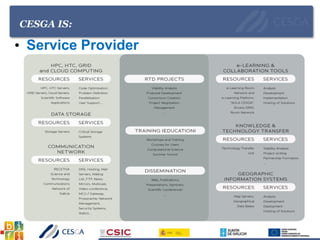
CESGA IS:
• Service Provider
CESGA IS:
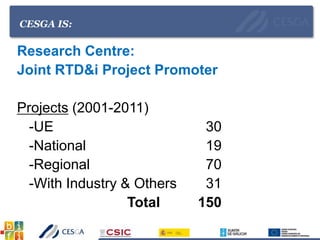
Research Centre:
Joint RTD&i Project Promoter
Projects (2001-2011)
-UE 30
-National 19
-Regional 70
-With Industry & Others 31
Total 150
CESGA IS:
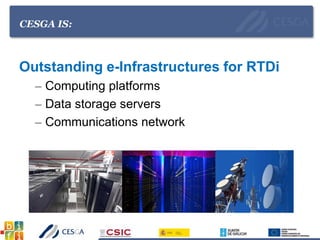
Outstanding e-Infrastructures for RTDi
– Computing platforms
– Data storage servers
– Communications network
CESGA IS:
Government Advisor
-Participation in EC prospective activities
-Co-author of the Spanish e-Science White Paper
-Galician Representative in Spanish e-Science Initiative
-Galician Representative in IBERGRID
-Galician Representative in RedIRIS
-Galician Representative in National Grid Initiative (Spanish NGI)
-Promoter of the Galician Universities Library Consortium (BUGALICIA)
-Promoter of the Galician Open Software Initiative (Mancomun)
-Advisor in the drafting of Galician Research Technological Development &
Innovation Plans
-Advisor in the drafting of Galician Information Society Plans
- …
CESGA IS:
Promoter of Scientific Thematic Networks &
Technological Platforms
-Promoter of Galician Technology Centres Network (RETGALIA)
-Promoter of Galician ICT Technology Platform (Vindeira)
-Partner & Promoter of “Instituto Tecnológico de Matemática Industrial (ITMATI)”
-Partner & Promoter of various scientific thematic networks:
• Galician Colorectal Cancer Research Network
• Galician Bioinformatics Network
• Galician Network of High Perfomance Computing
• Mathematica Consulting: Transfering Math to Industry
• Galician e-learning Thematic Network
• …
CESGA IS:
European Project Best Practice
– eBSN: European e-Business Support Network (e-MINDER Project).
– Lifelong Learning Initiatives (e-HOSPITAL Project).
– Youth Employment Support, New Skills Network (YES Project).
– European Grid for e-Science Production Site 2008 (EGEE Project).
– European Grid Initiative (EGI Project)
CESGA IS:
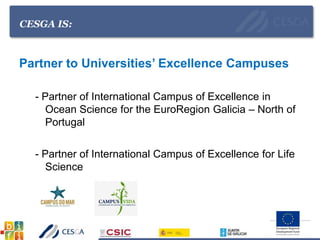
Partner to Universities’ Excellence Campuses
- Partner of International Campus of Excellence in
Ocean Science for the EuroRegion Galicia – North of
Portugal
- Partner of International Campus of Excellence for Life
Science
CESGA IS:
Promoter of e-Infrastructure Knowledge
- Partner of Official Post Graduate Programmes
74 Ph.D. Theses defended using CESGA computing
resources (2003 – 2011)
- Masters Programme in Mathematical Methods and
Numerical Simulation in Engineering and Applied
Sciences.
- Masters Programme in High Performance Computing
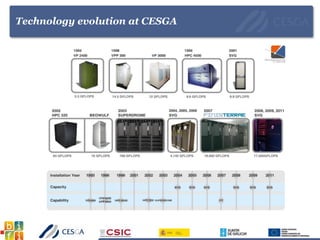
Technology evolution at CESGA
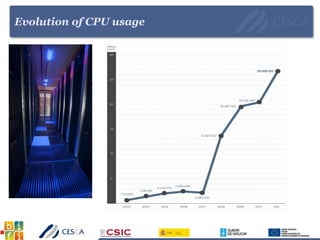
Evolution of CPU usage
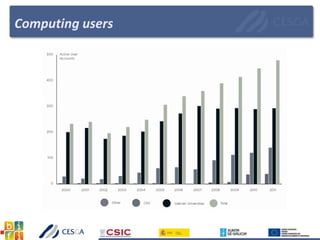
Computing users
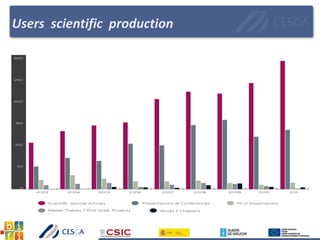
Users scientific production
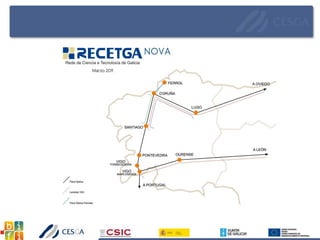
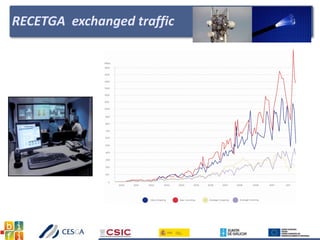
RECETGA exchanged traffic
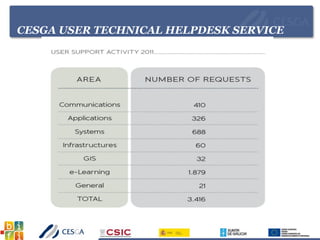
CESGA USER TECHNICAL HELPDESK SERVICE
REQUEST IN 2011
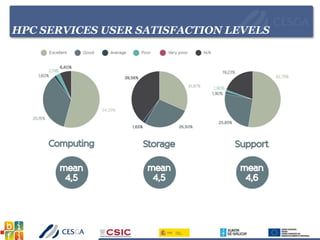
HPC SERVICES USER SATISFACTION LEVELS
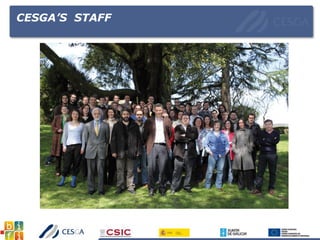
CESGA’S STAFF
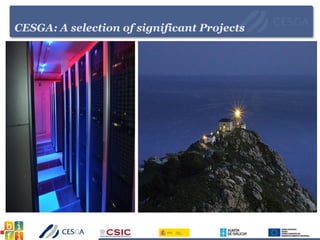
CESGA: A selection of significant Projects
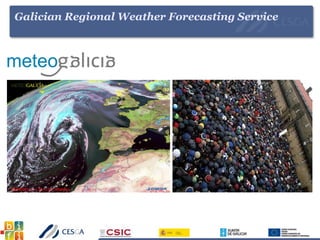
Galician Regional Weather Forecasting Service
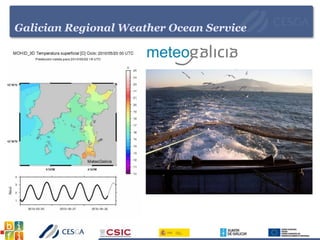
Galician Regional Weather Ocean Service
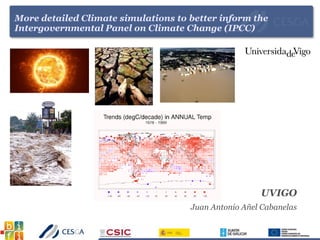
More detailed Climate simulations to better inform the
Intergovernmental Panel on Climate Change (IPCC)
UVIGO
Juan Antonio Añel Cabanelas
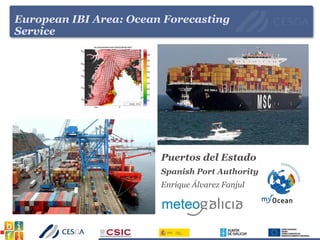
Puertos del Estado
Spanish Port Authority
Enrique Álvarez Fanjul
European IBI Area: Ocean Forecasting
Service
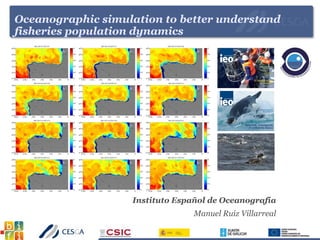
Oceanographic simulation to better understand
fisheries population dynamics
Instituto Español de Oceanografía
Manuel Ruiz Villarreal
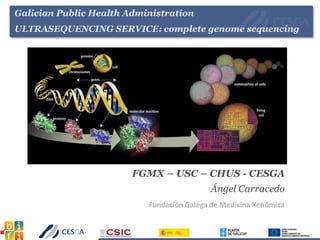
Galician Public Health Administration
ULTRASEQUENCING SERVICE: complete genome sequencing
FGMX – USC – CHUS - CESGA
Ángel Carracedo
Fundación Galega de Medicina Xenómica
Molecular Docking for fast track malaria drug
design
Scientists Against Malaria
Hugo Gutierrez de Terán
Fundación Galega de
Medicina Xenómica
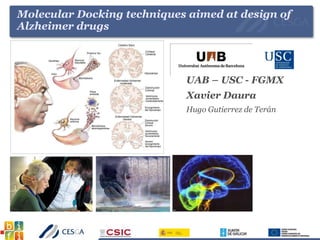
Molecular Docking techniques aimed at design of
Alzheimer drugs
UAB – USC - FGMX
Xavier Daura
Hugo Gutierrez de Terán
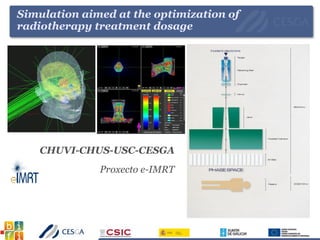
Simulation aimed at the optimization of
radiotherapy treatment dosage
CHUVI-CHUS-USC-CESGA
Proxecto e-IMRT
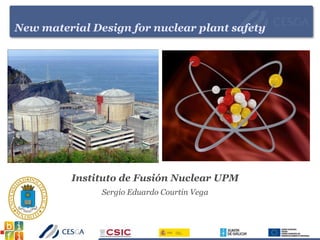
New material Design for nuclear plant safety
Instituto de Fusión Nuclear UPM
Sergio Eduardo Courtin Vega
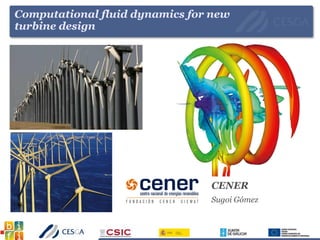
Computational fluid dynamics for new
turbine design
CENER
Sugoi Gómez
CTAG : Galician Automotive Technology Centre
Numerical Simulation
for Engineering
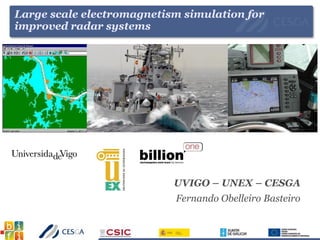
Large scale electromagnetism simulation for
improved radar systems
UVIGO – UNEX – CESGA
Fernando Obelleiro Basteiro
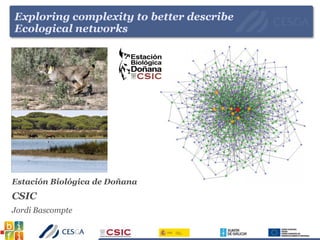
Exploring complexity to better describe
Ecological networks
Estación Biológica de Doñana
CSIC
Jordi Bascompte
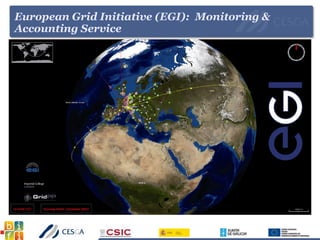
European Grid Initiative (EGI): Monitoring &
Accounting Service
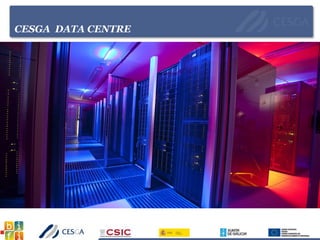
CESGA DATA CENTRE
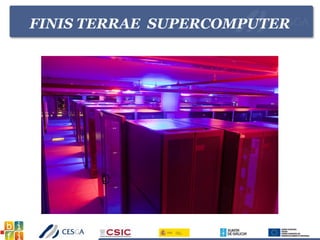
FINIS TERRAE SUPERCOMPUTER
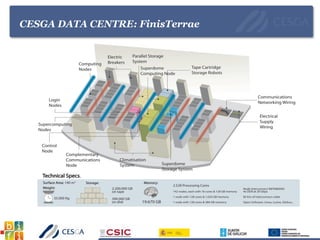
CESGA DATA CENTRE: FinisTerrae
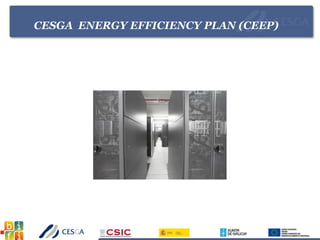
CESGA ENERGY EFFICIENCY PLAN (CEEP)
CEEP: REASONS
THE MOST IMPORTANT COSTS AT CESGA:
- PERSONNEL
- ELECTRICITY
- MAINTENANCE
CEEP: REASONS
IMPACT OF COST OF ENERGY AT CESGA:
- INCREASING OF IT RESOURCES
- INCREASING OF KW COST
- BUDGET RESTRICITIONS
- CONTRIBUTION TO REDUCTION OF CO2 EMISION
CEEP: OBJECTIVE
OBJECTIVE OF THE ENERGY EFFCIENCY PLAN:
ACHIEVE SIMILAR INDICATORS TO THE MOST
EFFICIENT SUPERCOMPUTING CENTRES
CEEP: BEFORE THE PLAN
SOME CONDITIONS:
- PLAN DEVELOPED AN MANAGED BY SYSTEMS DPT.
- SPECIAL SUPPORT BY THE DIRECTION
- IMPLICATION OF ALL DPTS.
- ROI IN SHORT-MEDIUM TERM
- SPECIAL ATTENTION TO RAS
- TIME PERIOD: 2010-2015
CEEP: BEFORE THE PLAN
SOME PREVIOUS ACTIONS:
- TECHNOLOGY OBSERVATION.
- ANALYSIS THERMOGRAPHIC OF COMPUTERS
ROOM AND INFRASTRUCTURES.
- INITIAL STUDY MADE BY AN EXTERNAL AUDITOR
CEEP: BEFORE THE PLAN
- INITIAL STUDY MADE BY AN EXTERNAL AUDITOR
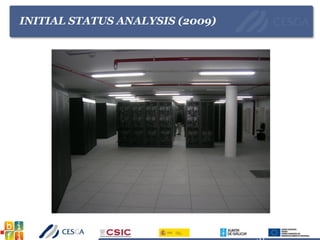
INITIAL STATUS ANALYSIS (2009)
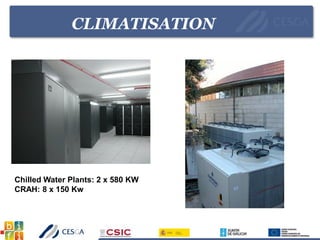
CLIMATISATION
Chilled Water Plants: 2 x 580 KW8
CRAH: 8 x 150 Kw
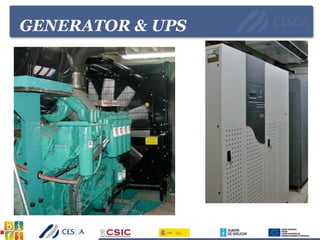
GENERATOR & UPS
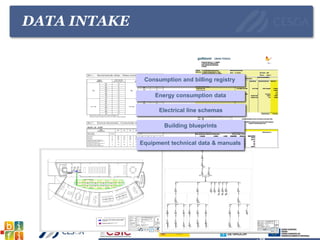
DATA INTAKE
Electrical line schemas
Building blueprints
Equipment technical data & manuals
Energy consumption data
Consumption and billing registry
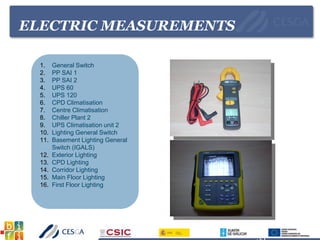
ELECTRIC MEASUREMENTS
1. General Switch
2. PP SAI 1
3. PP SAI 2
4. UPS 60
5. UPS 120
6. CPD Climatisation
7. Centre Climatisation
8. Chiller Plant 2
9. UPS Climatisation unit 2
10. Lighting General Switch
11. Basement Lighting General
Switch (IGALS)
12. Exterior Lighting
13. CPD Lighting
14. Corridor Lighting
15. Main Floor Lighting
16. First Floor Lighting
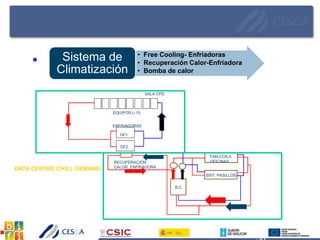
 Puntos existentes que favorecen el ahorro energético
• Free Cooling- Enfriadoras
• Recuperación Calor-Enfriadora
• Bomba de calor
Sistema de
Climatización
1 2 3 4 5 6 7 8
EQUIPOS L-15
ENFRIADORAS
RECUPERACIÓN
CALOR ENFRIADORA
SALA CPD
GF1
GF2
FAN-COILS
OFICINAS
SIST. PASILLOS
B.C
DATA CENTRE CHILL DEMAND
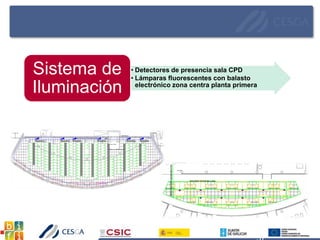
• Detectores de presencia sala CPD
• Lámparas fluorescentes con balasto
electrónico zona centra planta primera
Sistema de
Iluminación
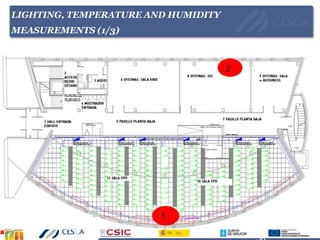
LIGHTING, TEMPERATURE AND HUMIDITY
MEASUREMENTS (1/3)
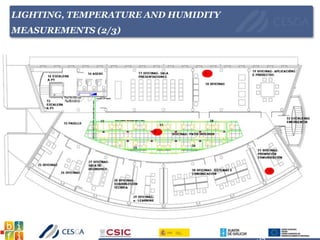
LIGHTING, TEMPERATURE AND HUMIDITY
MEASUREMENTS (2/3)
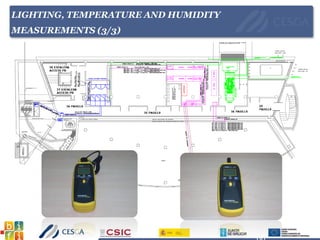
LIGHTING, TEMPERATURE AND HUMIDITY
MEASUREMENTS (3/3)
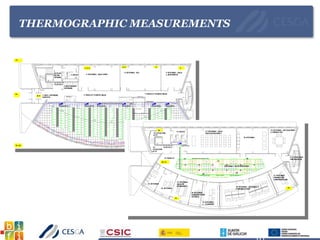
THERMOGRAPHIC MEASUREMENTS
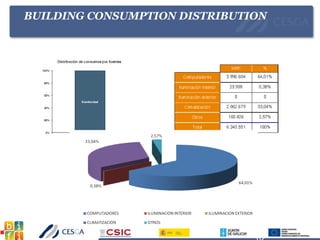
BUILDING CONSUMPTION DISTRIBUTION
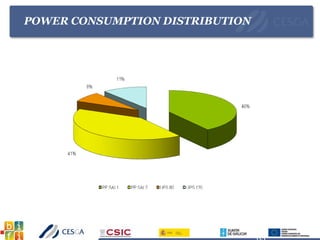
POWER CONSUMPTION DISTRIBUTION
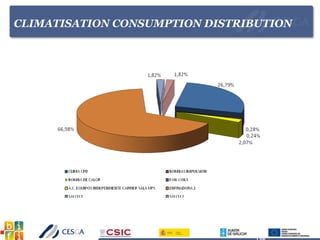
CLIMATISATION CONSUMPTION DISTRIBUTION
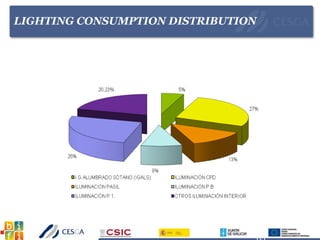
LIGHTING CONSUMPTION DISTRIBUTION
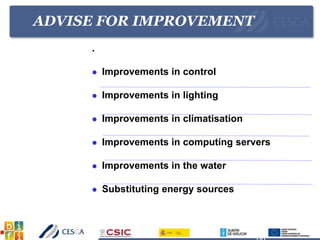
ADVISE FOR IMPROVEMENT
.
 Improvements in control
 Improvements in lighting
 Improvements in climatisation
 Improvements in computing servers
 Improvements in the water
 Substituting energy sources
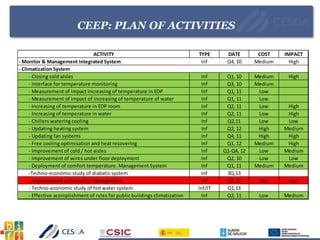
CEEP: PLAN OF ACTIVITIES
ACTIVITY TYPE DATE COST IMPACT
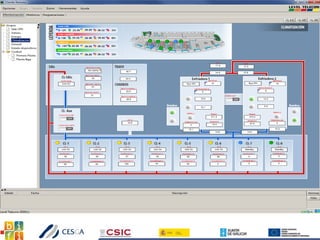
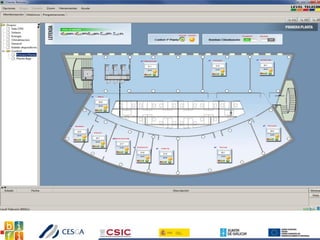
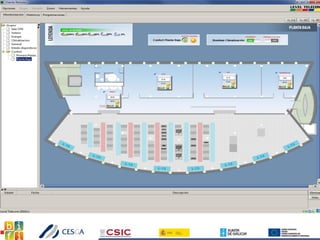
- Monitor & Management integrated System Inf Q4, 10 Medium High
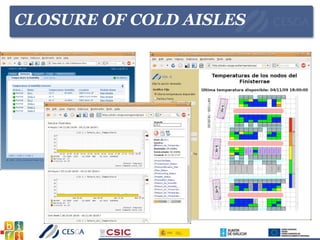
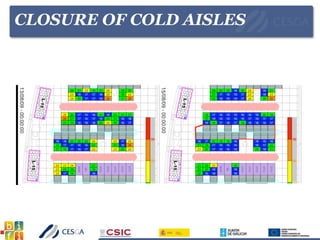
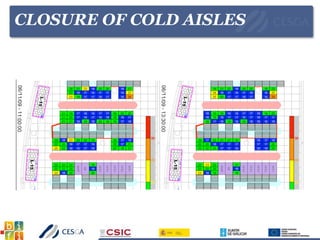
- Closing cold aisles Inf Q1, 10 Medium High
- Interface for temperature monitoring Inf Q3, 10 Medium
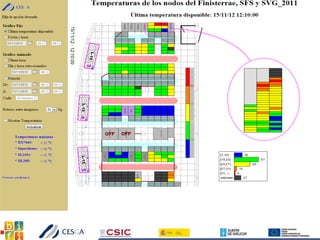
- Measurement of impact increasing of temperature in EDP Inf Q1, 11 Low
- Measurement of impact of increasing of temperature of water Inf Q1, 11 Low
- Increasing of temperature in EDP room Inf Q2, 11 Low High
- Increasing of temperature in water Inf Q2, 11 Low High
- Chillers watering cooling Inf Q2,11 Low Low
- Updating heating system Inf Q2, 12 High Medium
- Updating fan systems Inf Q4, 11 High High
- Free cooling optimisation and heat recovering Inf Q1, 12 Medium High
- Improvement of cold / hot aisles Inf Q1-Q4, 12 Low Medium
- Improvement of wires under floor deployment Inf Q2, 10 Low Low
- Deployment of comfort temperature. Management System Inf Q1, 11 Medium Medium
-Techno-económic study of diabatic system Inf 3Q,13
- Improvement of Humidity Management Inf Q3,12 Low Low
- Techno-economic study of hot water system Inf/IT Q1,13
- Effective acomplishment of rules for public buildings climatization Inf Q2, 11 Low Medium
- Climatization System
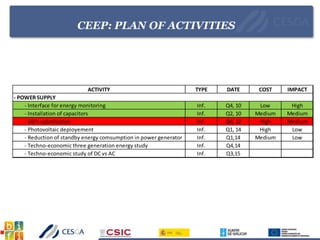
CEEP: PLAN OF ACTIVITIES
ACTIVITY TYPE DATE COST IMPACT
- Interface for energy monitoring Inf. Q4, 10 Low High
- Installation of capacitors Inf. Q2, 10 Medium Medium
- SAI's substitution Inf. Q4, 12 High Medium
- Photovoltaic deployement Inf. Q1, 14 High Low
- Reduction of standby energy comsumption in power generator Inf. Q1,14 Medium Low
- Techno-economic three generation energy study Inf. Q4,14
- Techno-economic study of DC vs AC Inf. Q3,15
- POWER SUPPLY
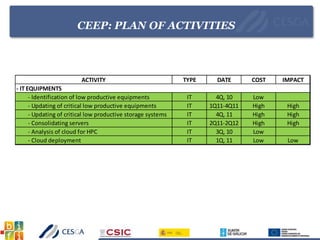
CEEP: PLAN OF ACTIVITIES
ACTIVITY TYPE DATE COST IMPACT
- Identification of low productive equipments IT 4Q, 10 Low
- Updating of critical low productive equipments IT 1Q11-4Q11 High High
- Updating of critical low productive storage systems IT 4Q, 11 High High
- Consolidating servers IT 2Q11-2Q12 High High
- Analysis of cloud for HPC IT 3Q, 10 Low
- Cloud deployment IT 1Q, 11 Low Low
- IT EQUIPMENTS
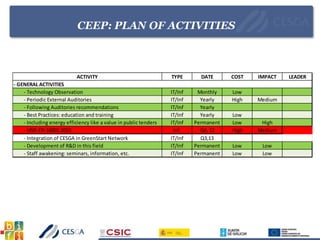
CEEP: PLAN OF ACTIVITIES
ACTIVITY TYPE DATE COST IMPACT LEADER
- Technology Observation IT/Inf Monthly Low
- Periodic External Auditories IT/Inf Yearly High Medium
- Following Auditories recommendations IT/Inf Yearly
- Best Practices: education and training IT/Inf Yearly Low
- Including energy efficiency like a value in public tenders IT/Inf Permanent Low High
- UNE-EN 16001:2010 Inf. Q4, 12 High Medium
- Integration of CESGA in GreenStart Network IT/Inf Q3,13
- Development of R&D in this field IT/Inf Permanent Low Low
- Staff awakening: seminars, information, etc. IT/Inf Permanent Low Low
- GENERAL ACTIVITIES
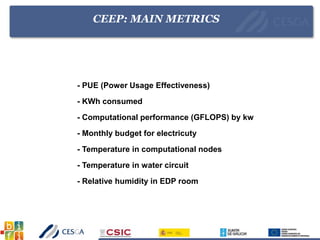
CEEP: MAIN METRICS
- PUE (Power Usage Effectiveness)
- KWh consumed
- Computational performance (GFLOPS) by kw
- Monthly budget for electricuty
- Temperature in computational nodes
- Temperature in water circuit
- Relative humidity in EDP room
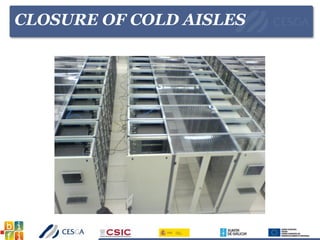
CLOSURE OF COLD AISLES
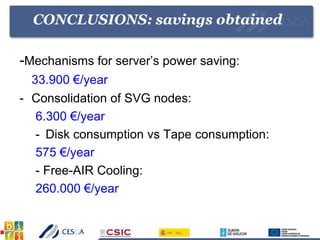
CONCLUSIONS: savings obtained
-Mechanisms for server’s power saving:
33.900 €/year
- Consolidation of SVG nodes:
6.300 €/year
- Disk consumption vs Tape consumption:
575 €/year
- Free-AIR Cooling:
260.000 €/year
- Enclosing of cold aisles: 6 ºC temperature decrease
and increase of cold aisle temperature up to 27ºC
105.000 €/year
- CRAHs: variable speed fans
30.000 €/year
- Automatic suspension/turn off of inactive nodes:
22.000 €/year
- Partial renovation of FinisTerrae nodes
70.000 €/year
CONCLUSIONS: savings obtained
CURRENT AND FUTURE WORK
- Optimisation of the use of memories
internal hierarchy.
- Job planner that takes into account the
cost of KWh depending on the hour and
date.
- Renewable energy supply.
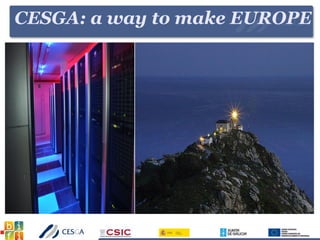
CESGA: a way to make EUROPE

Energy Efficiency Policy at CESGA

  • 1.
    Energy Efficiency Policyat CESGA Javier García Tobío , Ignacio López Cabído, Carlos Fernández Sánchez, Javier Cacheiro López Centro de Supercomputación de Galicia Zaragoza, January 2013
  • 2.
    INDEX CESGA: - Institution - Infrastructures -Evolution of uses - Activities and Services - Some Projects
  • 3.
    INDEX CESGA: - Energy EfficiencyPolicy: - Reasons and Objective - Before the Plan - The Plan: - Acivities - Metrics - Results - Next Actions
  • 5.
    CESGA MISSION STATEMENT Toprovide high performance computing and advanced communications resources and services to the scientific community of Galicia and to the Spanish National Research Council (CSIC), as well as, to institutions and enterprises with RTD activity. To promote high quality research in Computational Science in close collaboration with the research community from Galicia as well as from other regions or countries all over the world; contributing in this way to the advancement of science, to transfer technology to industry and administrations, and as consequence, to the wellbeing of society as a whole.
  • 6.
    CESGA BOARD OFTRUSTEES • Non Profit Foundation • Regional Government of Galicia • National Reseach Council of Spain PARTNERS
  • 7.
    CESGA USER COMMUNITY Universities of Galicia  Regional Research Centres  Spanish National Research Council Centres  Other National and Foreign Institutions:  Hospitals: RTD Departments  Private Companies  Technological Centres  Other Non Profit RTD Centres Excellence in Management ISO 9001:2008 Quality Management UNE166002 R&D Management
  • 8.
  • 9.
    CESGA IS: Research Centre: JointRTD&i Project Promoter Projects (2001-2011) -UE 30 -National 19 -Regional 70 -With Industry & Others 31 Total 150
  • 10.
    CESGA IS: Outstanding e-Infrastructuresfor RTDi – Computing platforms – Data storage servers – Communications network
  • 11.
    CESGA IS: Government Advisor -Participationin EC prospective activities -Co-author of the Spanish e-Science White Paper -Galician Representative in Spanish e-Science Initiative -Galician Representative in IBERGRID -Galician Representative in RedIRIS -Galician Representative in National Grid Initiative (Spanish NGI) -Promoter of the Galician Universities Library Consortium (BUGALICIA) -Promoter of the Galician Open Software Initiative (Mancomun) -Advisor in the drafting of Galician Research Technological Development & Innovation Plans -Advisor in the drafting of Galician Information Society Plans - …
  • 12.
    CESGA IS: Promoter ofScientific Thematic Networks & Technological Platforms -Promoter of Galician Technology Centres Network (RETGALIA) -Promoter of Galician ICT Technology Platform (Vindeira) -Partner & Promoter of “Instituto Tecnológico de Matemática Industrial (ITMATI)” -Partner & Promoter of various scientific thematic networks: • Galician Colorectal Cancer Research Network • Galician Bioinformatics Network • Galician Network of High Perfomance Computing • Mathematica Consulting: Transfering Math to Industry • Galician e-learning Thematic Network • …
  • 13.
    CESGA IS: European ProjectBest Practice – eBSN: European e-Business Support Network (e-MINDER Project). – Lifelong Learning Initiatives (e-HOSPITAL Project). – Youth Employment Support, New Skills Network (YES Project). – European Grid for e-Science Production Site 2008 (EGEE Project). – European Grid Initiative (EGI Project)
  • 14.
    CESGA IS: Partner toUniversities’ Excellence Campuses - Partner of International Campus of Excellence in Ocean Science for the EuroRegion Galicia – North of Portugal - Partner of International Campus of Excellence for Life Science
  • 15.
    CESGA IS: Promoter ofe-Infrastructure Knowledge - Partner of Official Post Graduate Programmes 74 Ph.D. Theses defended using CESGA computing resources (2003 – 2011) - Masters Programme in Mathematical Methods and Numerical Simulation in Engineering and Applied Sciences. - Masters Programme in High Performance Computing
  • 16.
  • 17.
  • 19.
  • 20.
  • 21.
  • 22.
    CESGA USER TECHNICALHELPDESK SERVICE REQUEST IN 2011
  • 23.
    HPC SERVICES USERSATISFACTION LEVELS
  • 24.
  • 25.
    CESGA: A selectionof significant Projects
  • 26.
    Galician Regional WeatherForecasting Service
  • 27.
  • 28.
    More detailed Climatesimulations to better inform the Intergovernmental Panel on Climate Change (IPCC) UVIGO Juan Antonio Añel Cabanelas
  • 29.
    Puertos del Estado SpanishPort Authority Enrique Álvarez Fanjul European IBI Area: Ocean Forecasting Service
  • 30.
    Oceanographic simulation tobetter understand fisheries population dynamics Instituto Español de Oceanografía Manuel Ruiz Villarreal
  • 31.
    Galician Public HealthAdministration ULTRASEQUENCING SERVICE: complete genome sequencing FGMX – USC – CHUS - CESGA Ángel Carracedo Fundación Galega de Medicina Xenómica
  • 32.
    Molecular Docking forfast track malaria drug design Scientists Against Malaria Hugo Gutierrez de Terán Fundación Galega de Medicina Xenómica
  • 33.
    Molecular Docking techniquesaimed at design of Alzheimer drugs UAB – USC - FGMX Xavier Daura Hugo Gutierrez de Terán
  • 34.
    Simulation aimed atthe optimization of radiotherapy treatment dosage CHUVI-CHUS-USC-CESGA Proxecto e-IMRT
  • 35.
    New material Designfor nuclear plant safety Instituto de Fusión Nuclear UPM Sergio Eduardo Courtin Vega
  • 36.
    Computational fluid dynamicsfor new turbine design CENER Sugoi Gómez
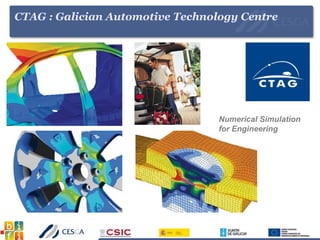
  • 37.
    CTAG : GalicianAutomotive Technology Centre Numerical Simulation for Engineering
  • 38.
    Large scale electromagnetismsimulation for improved radar systems UVIGO – UNEX – CESGA Fernando Obelleiro Basteiro
  • 39.
    Exploring complexity tobetter describe Ecological networks Estación Biológica de Doñana CSIC Jordi Bascompte
  • 40.
    European Grid Initiative(EGI): Monitoring & Accounting Service
  • 41.
  • 42.
  • 43.
    CESGA DATA CENTRE:FinisTerrae
  • 44.
  • 45.
    CEEP: REASONS THE MOSTIMPORTANT COSTS AT CESGA: - PERSONNEL - ELECTRICITY - MAINTENANCE
  • 46.
    CEEP: REASONS IMPACT OFCOST OF ENERGY AT CESGA: - INCREASING OF IT RESOURCES - INCREASING OF KW COST - BUDGET RESTRICITIONS - CONTRIBUTION TO REDUCTION OF CO2 EMISION
  • 47.
    CEEP: OBJECTIVE OBJECTIVE OFTHE ENERGY EFFCIENCY PLAN: ACHIEVE SIMILAR INDICATORS TO THE MOST EFFICIENT SUPERCOMPUTING CENTRES
  • 48.
    CEEP: BEFORE THEPLAN SOME CONDITIONS: - PLAN DEVELOPED AN MANAGED BY SYSTEMS DPT. - SPECIAL SUPPORT BY THE DIRECTION - IMPLICATION OF ALL DPTS. - ROI IN SHORT-MEDIUM TERM - SPECIAL ATTENTION TO RAS - TIME PERIOD: 2010-2015
  • 49.
    CEEP: BEFORE THEPLAN SOME PREVIOUS ACTIONS: - TECHNOLOGY OBSERVATION. - ANALYSIS THERMOGRAPHIC OF COMPUTERS ROOM AND INFRASTRUCTURES. - INITIAL STUDY MADE BY AN EXTERNAL AUDITOR
  • 50.
    CEEP: BEFORE THEPLAN - INITIAL STUDY MADE BY AN EXTERNAL AUDITOR
  • 51.
  • 52.
    CLIMATISATION Chilled Water Plants:2 x 580 KW8 CRAH: 8 x 150 Kw
  • 53.
  • 54.
    DATA INTAKE Electrical lineschemas Building blueprints Equipment technical data & manuals Energy consumption data Consumption and billing registry
  • 55.
    ELECTRIC MEASUREMENTS 1. GeneralSwitch 2. PP SAI 1 3. PP SAI 2 4. UPS 60 5. UPS 120 6. CPD Climatisation 7. Centre Climatisation 8. Chiller Plant 2 9. UPS Climatisation unit 2 10. Lighting General Switch 11. Basement Lighting General Switch (IGALS) 12. Exterior Lighting 13. CPD Lighting 14. Corridor Lighting 15. Main Floor Lighting 16. First Floor Lighting
  • 56.
     Puntos existentesque favorecen el ahorro energético • Free Cooling- Enfriadoras • Recuperación Calor-Enfriadora • Bomba de calor Sistema de Climatización 1 2 3 4 5 6 7 8 EQUIPOS L-15 ENFRIADORAS RECUPERACIÓN CALOR ENFRIADORA SALA CPD GF1 GF2 FAN-COILS OFICINAS SIST. PASILLOS B.C DATA CENTRE CHILL DEMAND
  • 57.
    • Detectores depresencia sala CPD • Lámparas fluorescentes con balasto electrónico zona centra planta primera Sistema de Iluminación
  • 58.
    LIGHTING, TEMPERATURE ANDHUMIDITY MEASUREMENTS (1/3)
  • 59.
    LIGHTING, TEMPERATURE ANDHUMIDITY MEASUREMENTS (2/3)
  • 60.
    LIGHTING, TEMPERATURE ANDHUMIDITY MEASUREMENTS (3/3)
  • 61.
  • 62.
  • 63.
  • 64.
  • 65.
  • 66.
    ADVISE FOR IMPROVEMENT . Improvements in control  Improvements in lighting  Improvements in climatisation  Improvements in computing servers  Improvements in the water  Substituting energy sources
  • 67.
    CEEP: PLAN OFACTIVITIES ACTIVITY TYPE DATE COST IMPACT - Monitor & Management integrated System Inf Q4, 10 Medium High - Closing cold aisles Inf Q1, 10 Medium High - Interface for temperature monitoring Inf Q3, 10 Medium - Measurement of impact increasing of temperature in EDP Inf Q1, 11 Low - Measurement of impact of increasing of temperature of water Inf Q1, 11 Low - Increasing of temperature in EDP room Inf Q2, 11 Low High - Increasing of temperature in water Inf Q2, 11 Low High - Chillers watering cooling Inf Q2,11 Low Low - Updating heating system Inf Q2, 12 High Medium - Updating fan systems Inf Q4, 11 High High - Free cooling optimisation and heat recovering Inf Q1, 12 Medium High - Improvement of cold / hot aisles Inf Q1-Q4, 12 Low Medium - Improvement of wires under floor deployment Inf Q2, 10 Low Low - Deployment of comfort temperature. Management System Inf Q1, 11 Medium Medium -Techno-económic study of diabatic system Inf 3Q,13 - Improvement of Humidity Management Inf Q3,12 Low Low - Techno-economic study of hot water system Inf/IT Q1,13 - Effective acomplishment of rules for public buildings climatization Inf Q2, 11 Low Medium - Climatization System
  • 68.
    CEEP: PLAN OFACTIVITIES ACTIVITY TYPE DATE COST IMPACT - Interface for energy monitoring Inf. Q4, 10 Low High - Installation of capacitors Inf. Q2, 10 Medium Medium - SAI's substitution Inf. Q4, 12 High Medium - Photovoltaic deployement Inf. Q1, 14 High Low - Reduction of standby energy comsumption in power generator Inf. Q1,14 Medium Low - Techno-economic three generation energy study Inf. Q4,14 - Techno-economic study of DC vs AC Inf. Q3,15 - POWER SUPPLY
  • 69.
    CEEP: PLAN OFACTIVITIES ACTIVITY TYPE DATE COST IMPACT - Identification of low productive equipments IT 4Q, 10 Low - Updating of critical low productive equipments IT 1Q11-4Q11 High High - Updating of critical low productive storage systems IT 4Q, 11 High High - Consolidating servers IT 2Q11-2Q12 High High - Analysis of cloud for HPC IT 3Q, 10 Low - Cloud deployment IT 1Q, 11 Low Low - IT EQUIPMENTS
  • 70.
    CEEP: PLAN OFACTIVITIES ACTIVITY TYPE DATE COST IMPACT LEADER - Technology Observation IT/Inf Monthly Low - Periodic External Auditories IT/Inf Yearly High Medium - Following Auditories recommendations IT/Inf Yearly - Best Practices: education and training IT/Inf Yearly Low - Including energy efficiency like a value in public tenders IT/Inf Permanent Low High - UNE-EN 16001:2010 Inf. Q4, 12 High Medium - Integration of CESGA in GreenStart Network IT/Inf Q3,13 - Development of R&D in this field IT/Inf Permanent Low Low - Staff awakening: seminars, information, etc. IT/Inf Permanent Low Low - GENERAL ACTIVITIES
  • 71.
    CEEP: MAIN METRICS -PUE (Power Usage Effectiveness) - KWh consumed - Computational performance (GFLOPS) by kw - Monthly budget for electricuty - Temperature in computational nodes - Temperature in water circuit - Relative humidity in EDP room
  • 72.
  • 73.
  • 74.
  • 75.
  • 84.
    CONCLUSIONS: savings obtained -Mechanismsfor server’s power saving: 33.900 €/year - Consolidation of SVG nodes: 6.300 €/year - Disk consumption vs Tape consumption: 575 €/year - Free-AIR Cooling: 260.000 €/year
  • 85.
    - Enclosing ofcold aisles: 6 ºC temperature decrease and increase of cold aisle temperature up to 27ºC 105.000 €/year - CRAHs: variable speed fans 30.000 €/year - Automatic suspension/turn off of inactive nodes: 22.000 €/year - Partial renovation of FinisTerrae nodes 70.000 €/year CONCLUSIONS: savings obtained
  • 86.
    CURRENT AND FUTUREWORK - Optimisation of the use of memories internal hierarchy. - Job planner that takes into account the cost of KWh depending on the hour and date. - Renewable energy supply.
  • 87.
    CESGA: a wayto make EUROPE