Spatial Data Infrastructure of
Cultural Heritage
30 June 2014 Emilio Abad Vidal
Senior Technician GIS
CESGA
Spatial Data Infrastructure of
Cultural Heritage
Spatial Data Infrastructure of Cultural Heritage IDEPATRI
by Emilio Abad Vidal is licensed under a Creative Commons Reconocimiento-CompartirIgual 4.0 Internacional License.
“An SDI is a standardized system composed of
a set of computing resources whose aim is to
visualize and manage Geographic Information
available online.”
“This system enables, through a simple Web
browser or services, users can find, view, use
and combine Geographic Information
according to your needs.”
Spatial Data Infraestructure (SDI)
“An SDI is a standardized system composed of
a set of computing resources whose aim is to
visualize and manage Archaeological
Information available online.”
“This system enables, through a simple Web
browser or services, users can find, view, use
and combine Archaeological Information
according to your needs.”
Spatial Data Infraestructure (SDI)
Archaeological Information
looks a lot like
Geographic Information
GEPN and SDI
Primary need to provide the research group a
system that allows all members to contribute
and have accessible information, and agreed on
a COMMON BACKGROUND
http://gepn.jimdo.com/
REQUIREMENTS
Need for updated information
The Archaeological Information is highly changeable
The Archaeological Information is costly, therefore it must
be able to be reused the largest possible number of times
Need for updated information
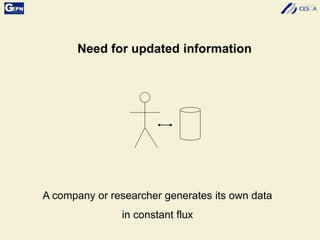
A company or researcher generates its own data
in constant flux
Need for updated information
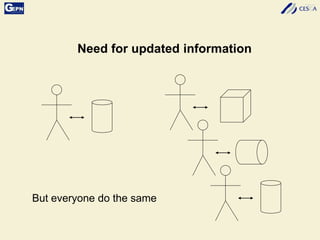
But everyone do the same
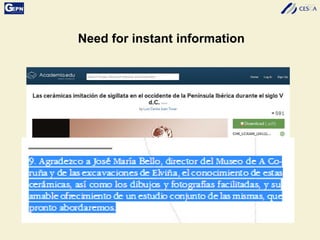
Need for instant information
Information needs to be available on demand
immediately, which means saving time and effort
This implies that information distribution centers must have
agility in delivery
Need for instant information
?
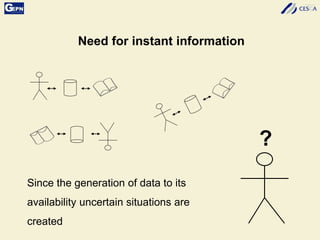
Since the generation of data to its
availability uncertain situations are
created
Need for instant information
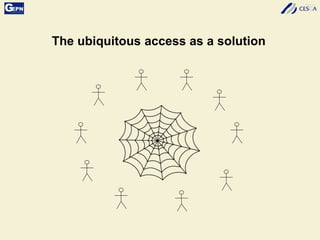
The ubiquitous access as a solution
The information is in the hands of who produces or distributes
(institutions, organizations, companies, universities, ...)
and more rapid, broad and ubiquitous access is being
performed via Internet networks
The ubiquitous access as a solution
ARCHAEOLOGICAL INFORMATION
IN SDI SPIRIT
Principles
Establishment of agreements between data producers to maintain basic
information considered
Using standards in the creation of archaeological information
Technological agreements to achieve interoperable information
Establishment of policies, partnerships and agreements to increase data
availability
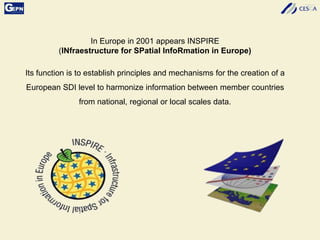
In Europe in 2001 appears INSPIRE
(INfraestructure for SPatial InfoRmation in Europe)
Its function is to establish principles and mechanisms for the creation of a
European SDI level to harmonize information between member countries
from national, regional or local scales data.
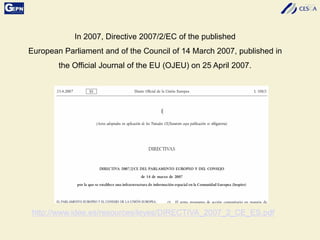
In 2007, Directive 2007/2/EC of the published
European Parliament and of the Council of 14 March 2007, published in
the Official Journal of the EU (OJEU) on 25 April 2007.
http://www.idee.es/resources/leyes/DIRECTIVA_2007_2_CE_ES.pdf
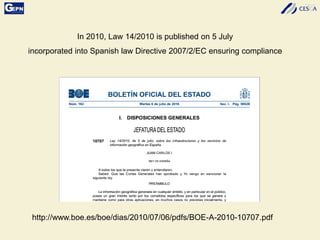
In 2010, Law 14/2010 is published on 5 July
incorporated into Spanish law Directive 2007/2/EC ensuring compliance
http://www.boe.es/boe/dias/2010/07/06/pdfs/BOE-A-2010-10707.pdf
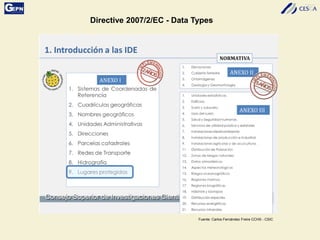
Directive 2007/2/EC - Data Types
Fuente: Carlos Fernández Freire CCHS - CSIC
2009 - 2012
2009 - 2012
Desenvolvemento dun modelo de datos
Arqueolóxico para a Idade de Ferro en Galicia
Programa Sectorial de Investigación Aplicada, PEME I+D
Suma. Tecnoloxía Sociedade e Cultura (SEC), financiado por
el programa PGIDIT de la Dirección Xeral de I+D, Consellería
de Economía e Industria de la Xunta de Galicia (proyecto
09SEC002CT)
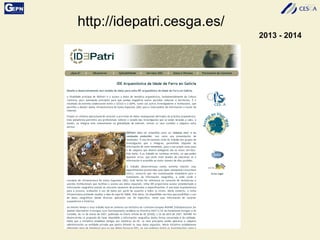
http://idepatri.cesga.es/
2013 - 2014
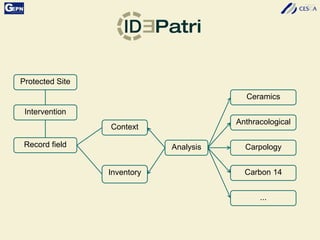
Protected Site
Inventory
Context
Analysis
Ceramics
Anthracological
Carpology
Carbon 14
...
Intervention
Record field
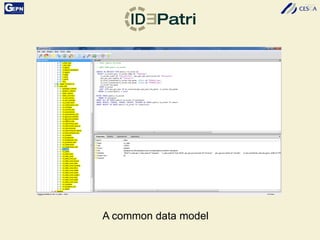
A common data model
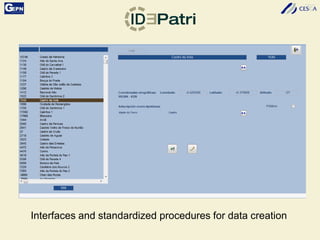
Interfaces and standardized procedures for data creation
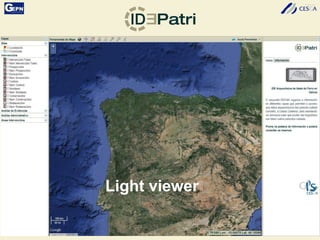
Light viewer
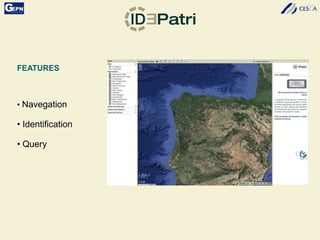
FEATURES
• Navegation
• Identification
• Query
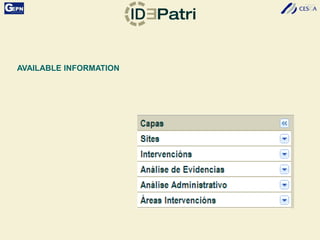
AVAILABLE INFORMATION
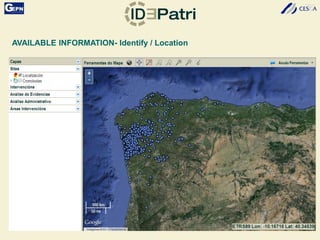
AVAILABLE INFORMATION- Identify / Location
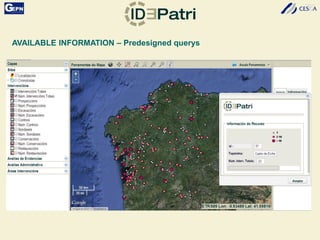
AVAILABLE INFORMATION – Predesigned querys
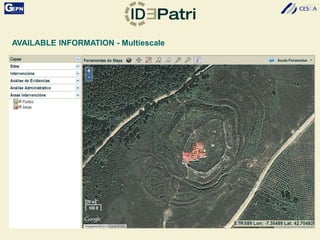
AVAILABLE INFORMATION - Multiescale
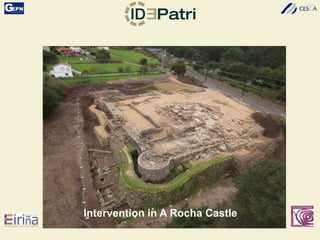
Intervention in A Rocha Castle
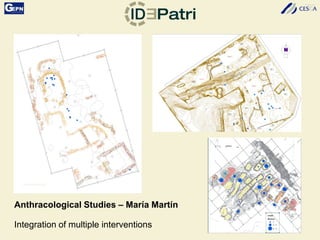
Anthracological Studies – María Martín
Integration of multiple interventions
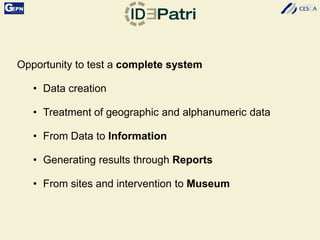
Opportunity to test a complete system
• Data creation
• Treatment of geographic and alphanumeric data
• From Data to Information
• Generating results through Reports
• From sites and intervention to Museum
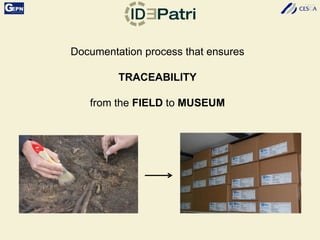
Documentation process that ensures
TRACEABILITY
from the FIELD to MUSEUM
Intervention in A Rocha Castle
REQUIREMENTS
Fieldwork. Direct documentation on the Site.
Different teams with different physical locations.
Shared information.
Preparation of monthly reports.
Preparation of final report.
Access via the Web.
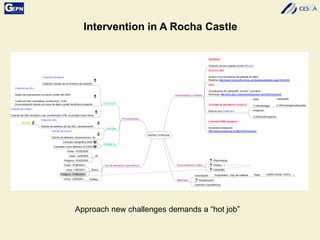
Intervention in A Rocha Castle
Approach new challenges demands a “hot job”
Intervention in A Rocha Castle
PROCESSES
Take direct data on the site
Readings with total station. ETRS89
Stratigraphic contexts
Gathering materials
Analytical evidence
Study materials
Study samples
Intervention in A Rocha Castle
PROCESSES
Restoration
Structures
Materials
Reporting and memories
(Trapped information)
Intervention in A Rocha Castle
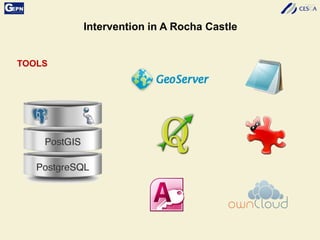
TOOLS
Intervention in A Rocha Castle
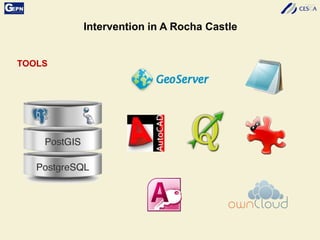
TOOLS
Intervention in A Rocha Castle
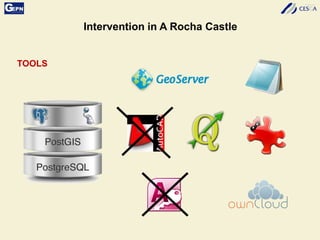
TOOLS
Intervention in A Rocha Castle
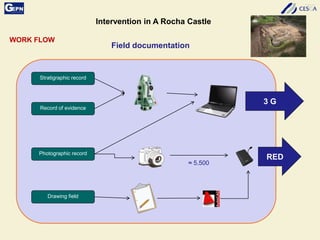
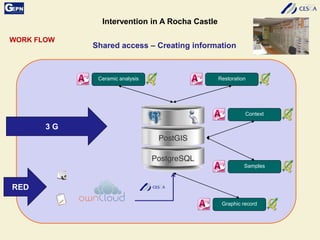
WORK FLOW
Stratigraphic record
Record of evidence
Drawing field
Photographic record
Field documentation
3 G
≈ 5.500
RED
Intervention in A Rocha Castle
WORK FLOW
Shared access – Creating information
3 G
RED
Ceramic analysis Restoration
Context
Samples
Graphic record
Intervention in A Rocha Castle
WORK FLOW
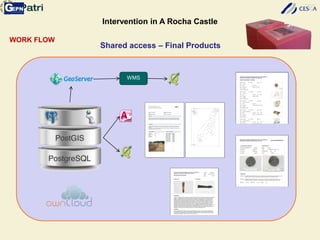
Shared access – Final Products
WMS
Intervention in A Rocha Castle
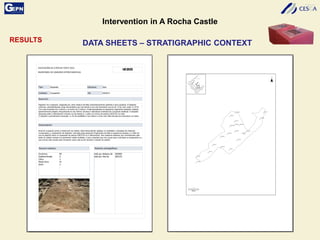
RESULTS DATA SHEETS – STRATIGRAPHIC CONTEXT
Intervention in A Rocha Castle
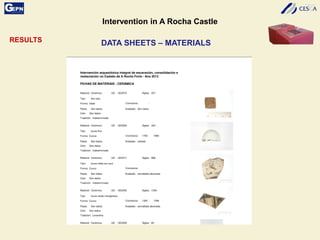
RESULTS DATA SHEETS – MATERIALS
Intervention in A Rocha Castle
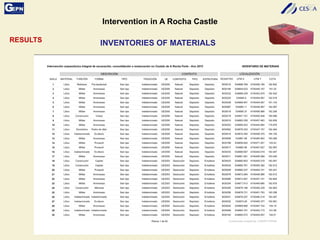
RESULTS INVENTORIES OF MATERIALS
Intervention in A Rocha Castle
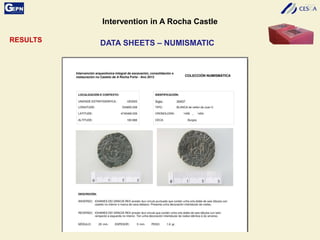
RESULTS DATA SHEETS – NUMISMATIC
Intervention in A Rocha Castle
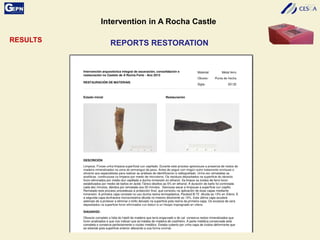
RESULTS REPORTS RESTORATION
Intervention in A Rocha Castle
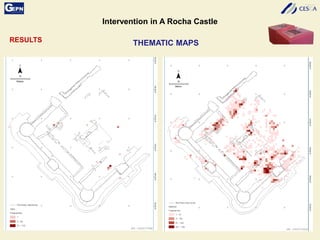
RESULTS THEMATIC MAPS
Intervention in A Rocha Castle
CONCLUSIONS
COLLABORATIVE WORK
Intervention in A Rocha Castle
CONCLUSIONS
COLLABORATIVE WORK
WORKING FULL CYCLE
Intervention in A Rocha Castle
CONCLUSIONS
COLLABORATIVE WORK
WORKING FULL CYCLE
SHARED DATA
Intervention in A Rocha Castle
CONCLUSIONS
COLLABORATIVE WORK
WORKING FULL CYCLE
SHARED DATA
SYSTEM TESTED
Intervention in A Rocha Castle
CONCLUSIONS
COLLABORATIVE WORK
WORKING FULL CYCLE
SHARED DATA
SYSTEM TESTED
4 MONTHS OF WORK FIELD
Intervention in A Rocha Castle
CONCLUSIONS
COLLABORATIVE WORK
WORKING FULL CYCLE
SHARED DATA
SYSTEM TESTED
4 MONTHS OF WORK FIELD
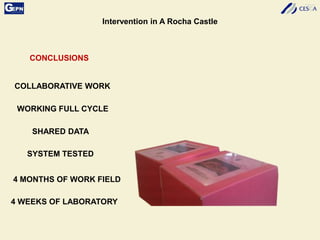
4 WEEKS OF LABORATORY
Intervention in A Rocha Castle
CONCLUSIONS
COLLABORATIVE WORK
WORKING FULL CYCLE
SHARED DATA
SYSTEM TESTED
4 MONTHS OF WORK FIELD
4 WEEKS OF LABORATORY
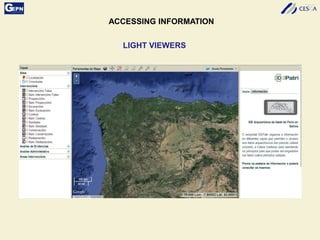
LIGHT VIEWERS
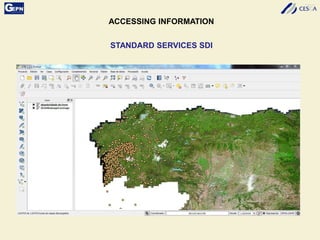
ACCESSING INFORMATION
STANDARD SERVICES SDI
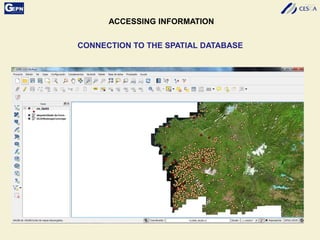
ACCESSING INFORMATION
CONNECTION TO THE SPATIAL DATABASE
ACCESSING INFORMATION

Spatial data infraestructure ID-Patri

  • 1.
    Spatial Data Infrastructureof Cultural Heritage 30 June 2014 Emilio Abad Vidal Senior Technician GIS CESGA
  • 2.
    Spatial Data Infrastructureof Cultural Heritage Spatial Data Infrastructure of Cultural Heritage IDEPATRI by Emilio Abad Vidal is licensed under a Creative Commons Reconocimiento-CompartirIgual 4.0 Internacional License.
  • 3.
    “An SDI isa standardized system composed of a set of computing resources whose aim is to visualize and manage Geographic Information available online.” “This system enables, through a simple Web browser or services, users can find, view, use and combine Geographic Information according to your needs.” Spatial Data Infraestructure (SDI)
  • 4.
    “An SDI isa standardized system composed of a set of computing resources whose aim is to visualize and manage Archaeological Information available online.” “This system enables, through a simple Web browser or services, users can find, view, use and combine Archaeological Information according to your needs.” Spatial Data Infraestructure (SDI)
  • 5.
    Archaeological Information looks alot like Geographic Information
  • 6.
    GEPN and SDI Primaryneed to provide the research group a system that allows all members to contribute and have accessible information, and agreed on a COMMON BACKGROUND http://gepn.jimdo.com/
  • 7.
  • 8.
    Need for updatedinformation The Archaeological Information is highly changeable The Archaeological Information is costly, therefore it must be able to be reused the largest possible number of times
  • 9.
    Need for updatedinformation A company or researcher generates its own data in constant flux
  • 10.
    Need for updatedinformation But everyone do the same
  • 11.
    Need for instantinformation Information needs to be available on demand immediately, which means saving time and effort This implies that information distribution centers must have agility in delivery
  • 12.
    Need for instantinformation ? Since the generation of data to its availability uncertain situations are created
  • 13.
    Need for instantinformation
  • 14.
    The ubiquitous accessas a solution The information is in the hands of who produces or distributes (institutions, organizations, companies, universities, ...) and more rapid, broad and ubiquitous access is being performed via Internet networks
  • 15.
    The ubiquitous accessas a solution
  • 16.
    ARCHAEOLOGICAL INFORMATION IN SDISPIRIT Principles Establishment of agreements between data producers to maintain basic information considered Using standards in the creation of archaeological information Technological agreements to achieve interoperable information Establishment of policies, partnerships and agreements to increase data availability
  • 17.
    In Europe in2001 appears INSPIRE (INfraestructure for SPatial InfoRmation in Europe) Its function is to establish principles and mechanisms for the creation of a European SDI level to harmonize information between member countries from national, regional or local scales data.
  • 18.
    In 2007, Directive2007/2/EC of the published European Parliament and of the Council of 14 March 2007, published in the Official Journal of the EU (OJEU) on 25 April 2007. http://www.idee.es/resources/leyes/DIRECTIVA_2007_2_CE_ES.pdf
  • 19.
    In 2010, Law14/2010 is published on 5 July incorporated into Spanish law Directive 2007/2/EC ensuring compliance http://www.boe.es/boe/dias/2010/07/06/pdfs/BOE-A-2010-10707.pdf
  • 20.
    Directive 2007/2/EC -Data Types Fuente: Carlos Fernández Freire CCHS - CSIC
  • 22.
  • 23.
    2009 - 2012 Desenvolvementodun modelo de datos Arqueolóxico para a Idade de Ferro en Galicia Programa Sectorial de Investigación Aplicada, PEME I+D Suma. Tecnoloxía Sociedade e Cultura (SEC), financiado por el programa PGIDIT de la Dirección Xeral de I+D, Consellería de Economía e Industria de la Xunta de Galicia (proyecto 09SEC002CT)
  • 24.
  • 25.
  • 26.
  • 27.
    Interfaces and standardizedprocedures for data creation
  • 28.
  • 29.
  • 30.
  • 31.
  • 32.
    AVAILABLE INFORMATION –Predesigned querys
  • 33.
  • 34.
    Intervention in ARocha Castle
  • 35.
    Anthracological Studies –María Martín Integration of multiple interventions
  • 36.
    Opportunity to testa complete system • Data creation • Treatment of geographic and alphanumeric data • From Data to Information • Generating results through Reports • From sites and intervention to Museum
  • 37.
    Documentation process thatensures TRACEABILITY from the FIELD to MUSEUM
  • 38.
    Intervention in ARocha Castle REQUIREMENTS Fieldwork. Direct documentation on the Site. Different teams with different physical locations. Shared information. Preparation of monthly reports. Preparation of final report. Access via the Web.
  • 39.
    Intervention in ARocha Castle Approach new challenges demands a “hot job”
  • 40.
    Intervention in ARocha Castle PROCESSES Take direct data on the site Readings with total station. ETRS89 Stratigraphic contexts Gathering materials Analytical evidence Study materials Study samples
  • 41.
    Intervention in ARocha Castle PROCESSES Restoration Structures Materials Reporting and memories (Trapped information)
  • 42.
    Intervention in ARocha Castle TOOLS
  • 43.
    Intervention in ARocha Castle TOOLS
  • 44.
    Intervention in ARocha Castle TOOLS
  • 45.
    Intervention in ARocha Castle WORK FLOW Stratigraphic record Record of evidence Drawing field Photographic record Field documentation 3 G ≈ 5.500 RED
  • 46.
    Intervention in ARocha Castle WORK FLOW Shared access – Creating information 3 G RED Ceramic analysis Restoration Context Samples Graphic record
  • 47.
    Intervention in ARocha Castle WORK FLOW Shared access – Final Products WMS
  • 48.
    Intervention in ARocha Castle RESULTS DATA SHEETS – STRATIGRAPHIC CONTEXT
  • 49.
    Intervention in ARocha Castle RESULTS DATA SHEETS – MATERIALS
  • 50.
    Intervention in ARocha Castle RESULTS INVENTORIES OF MATERIALS
  • 51.
    Intervention in ARocha Castle RESULTS DATA SHEETS – NUMISMATIC
  • 52.
    Intervention in ARocha Castle RESULTS REPORTS RESTORATION
  • 53.
    Intervention in ARocha Castle RESULTS THEMATIC MAPS
  • 54.
    Intervention in ARocha Castle CONCLUSIONS COLLABORATIVE WORK
  • 55.
    Intervention in ARocha Castle CONCLUSIONS COLLABORATIVE WORK WORKING FULL CYCLE
  • 56.
    Intervention in ARocha Castle CONCLUSIONS COLLABORATIVE WORK WORKING FULL CYCLE SHARED DATA
  • 57.
    Intervention in ARocha Castle CONCLUSIONS COLLABORATIVE WORK WORKING FULL CYCLE SHARED DATA SYSTEM TESTED
  • 58.
    Intervention in ARocha Castle CONCLUSIONS COLLABORATIVE WORK WORKING FULL CYCLE SHARED DATA SYSTEM TESTED 4 MONTHS OF WORK FIELD
  • 59.
    Intervention in ARocha Castle CONCLUSIONS COLLABORATIVE WORK WORKING FULL CYCLE SHARED DATA SYSTEM TESTED 4 MONTHS OF WORK FIELD 4 WEEKS OF LABORATORY
  • 60.
    Intervention in ARocha Castle CONCLUSIONS COLLABORATIVE WORK WORKING FULL CYCLE SHARED DATA SYSTEM TESTED 4 MONTHS OF WORK FIELD 4 WEEKS OF LABORATORY
  • 61.
  • 62.
  • 63.
    CONNECTION TO THESPATIAL DATABASE ACCESSING INFORMATION