The chamoisThe chamois
(Rupicapra rupicapra)(Rupicapra rupicapra)
• The chamois is a goat-like animalThe chamois is a goat-like animal
native to the Carpathiannative to the Carpathian
Mountains of Romania. ChamoisMountains of Romania. Chamois
are strictly protected animalsare strictly protected animals
under the European Habitatsunder the European Habitats
Directive.Directive.
• Chamois live at moderately highChamois live at moderately high
altitudes and are adapted to livingaltitudes and are adapted to living
in steep, rugged, rocky terrain. Ain steep, rugged, rocky terrain. A
fully grown chamois reaches afully grown chamois reaches a
height of about 75 cm and weighsheight of about 75 cm and weighs
about 50 kg. Males and femalesabout 50 kg. Males and females
have short horns which are slightlyhave short horns which are slightly
curled in the posterior direction.curled in the posterior direction.
The chamois is chestnut brown toThe chamois is chestnut brown to
black in winter and pale brown inblack in winter and pale brown in
summer.summer.
Carpathian brown bear
Ursus arctos
It is a big animal, that generally
weight between 300 and 600
kilograms
Brown bears have thick fur, much
appreciated, with two rows of hairs,
ear and fluff. Although base color is
brown, it has got large colour
variations from red to almost black
bears. Some specimens have white
spots on the neck, sometimes
forming a real collar, similar to the
collared bear the Himalayas.
 Dentition is typical of
omnivorous, with strong canines
and molars rounded.
In Romania fallow deerIn Romania fallow deer
is tryingis trying to re-adapt toto re-adapt to
complex naturalcomplex natural
ecosystem, gainingecosystem, gaining thethe
strength needed forstrength needed for
survival. The mostsurvival. The most
importantimportant number ofnumber of
fallow deerfallow deer is recordedis recorded
in the west and southin the west and south..
Fallow deerFallow deer
(Dama dama)(Dama dama)
 its wits weight varieseight varies
dependingdepending on age, areaon age, area
and quality of foodand quality of food
 hhair coloair colouur is lightr is light
brown with yellowishbrown with yellowish
white spots arranged inwhite spots arranged in
longitudinallongitudinal rowsrows
abdomen areaabdomen area..
its foodits food consist ofconsist of
herbaceous plants andherbaceous plants and
leaves of trees, includingleaves of trees, including
growinggrowing stems,stems, cloverclover,,
acorns, In general, theacorns, In general, the
food is less pretentious.food is less pretentious.
Salt it is absolutelySalt it is absolutely
necessary.necessary.
Bison is the heaviest land animalBison is the heaviest land animal inin
Europe. A typical individual has a lengthEurope. A typical individual has a length
of 2.9 to 3 meters and a height of 1.9of 2.9 to 3 meters and a height of 1.9
meters, weighing from 300 to 920 kg.meters, weighing from 300 to 920 kg.
BisonsBisons live in forests, with very fewlive in forests, with very few
natural enemiesnatural enemies
Bison is a herbivore.Bison is a herbivore.
BisonsBisons livlivee 28 years in28 years in
captivity, but in the wildcaptivity, but in the wild
live less.live less.
BisonsBisons (Bison bonasus bonasus)(Bison bonasus bonasus)
LynxLynx isis currently the largestcurrently the largest
cat in the wild fauna ofcat in the wild fauna of
Romania.Romania. Also calledAlso called
Carpathians panther, lynx isCarpathians panther, lynx is
spread naturally from alpinespread naturally from alpine
to the Danube Deltato the Danube Delta..
LynxLynx is a powerful andis a powerful and
strong animal,strong animal, withwith aann
amazingamazing agility andagility and
quickness.quickness.
TheThe furfur is typical of big cats,is typical of big cats,
consisting ofconsisting of yellowish-redyellowish-red
hairhair on the sides and backon the sides and back
with black spots andwith black spots and
yellowish white on the ventralyellowish white on the ventral
side.side.
Reported maximum weights areReported maximum weights are
different, ranging between 50 and 58 kg.different, ranging between 50 and 58 kg.
It cIt can live 25 years.an live 25 years.
It is a cIt is a carnivore animalarnivore animal, a, a
bloodblood loverlover,, consumingconsuming
organsorgans with significantwith significant
blood meal (heart, liver,blood meal (heart, liver,
lungs). Extremely agile, goeslungs). Extremely agile, goes
unheard, is extremelyunheard, is extremely
difficult to seedifficult to see.. It hIt huntuntss
mainly at dusk, beingmainly at dusk, being
advantagedadvantaged by the fur asby the fur as anan
excellent camouflage, asexcellent camouflage, as
well as its special senses.well as its special senses.
Lynx (Lynx lynx)
Red aigretteRed aigrette-Ardea purpurea-Ardea purpurea
It is a summer guest in
Romania, and is
endangered on a global
scale. Can be found in
swampy areas and
marshes of the Danube
Delta. In fall it migrates in
Asia or Africa.
It has reddish brown color, a
very long thin neck. Neck
is slightly rounded curve
shaped S.
As size, it is less than the stork.
It feeds with fish and
amphibians.
Little egret-Egretta garzetta
It is a species that is increasing
because it isn’t hunted
anymore by humans for its
ornamental feathers
It is rare bird, living especially in the
Danube Delta in mixed colonies, especially
in dwarf willows. With the arrival of autumn,
it migrates to the Mediterranean.
The color of the feathers is pure
white and on the head has beautiful
ornamental feathers, as well as on
its back, more popular in the past as
fashion jewelry.
In the months of April-May, the
female lays 3 to 5 greenish-blue eggs
that are boiled together with the
partner. Chicks leave the nest before
they can fly having a great skill in
climbing through the branches.
Hoopoe-Upupa epops
It is a migratory bird, found in allIt is a migratory bird, found in all
the plains.the plains.
It is easily recognized by theIt is easily recognized by the
orange crest on the head,orange crest on the head,
tighten or loosen it. It has atighten or loosen it. It has a
long beak and slightly curvedlong beak and slightly curved
down. Hoopoe produces adown. Hoopoe produces a
sound unmistakable,sound unmistakable,
Pu-pu-pu''.Pu-pu-pu''.
It makes its nest in hollows ofIt makes its nest in hollows of
trees, using fecal lining,trees, using fecal lining,
which serve as defensewhich serve as defense
against predatorsagainst predators
Red shelduck-Tadorna ferrugineaRed shelduck-Tadorna ferruginea
It makes the nest in the eastern part of
Dobrogea, in holes, where the female lays
8-10 eggs, light cream in late May and it
hatches about 28 days. Both sexes were
representatives of scarlet plumage, the
male is more colorful and with a bright
white ring of feathers around the neck. In
fall migrates north-west Africa and the Nile
Delta. Due to its deepening scarcity, it is
placed under the protection of law to be
protected from extinction.
Dropia-otis tarDa
It is a bird that lives in south-eastern
Europe and temperate areas of Asia. In
Romania some years ago was found in
Bărăgan and in natural reservation of
Beba Veche, Timis county, but is
endangered.
Red duck-Aythya nyroca
It is the most common duck species in
the country, and especially in the
Danube Delta, met in all pools
surrounded by vegetation. It makes 8-
10 pink eggs in May-June, female
hatches for 24-26 days. The male is
reddish brown with white iris, and the
female brown. In winter can be found
in North Africa, Nile Valley, northern
Arabia and India. Some of them can
be seen in unfrozen waters from
Romania..
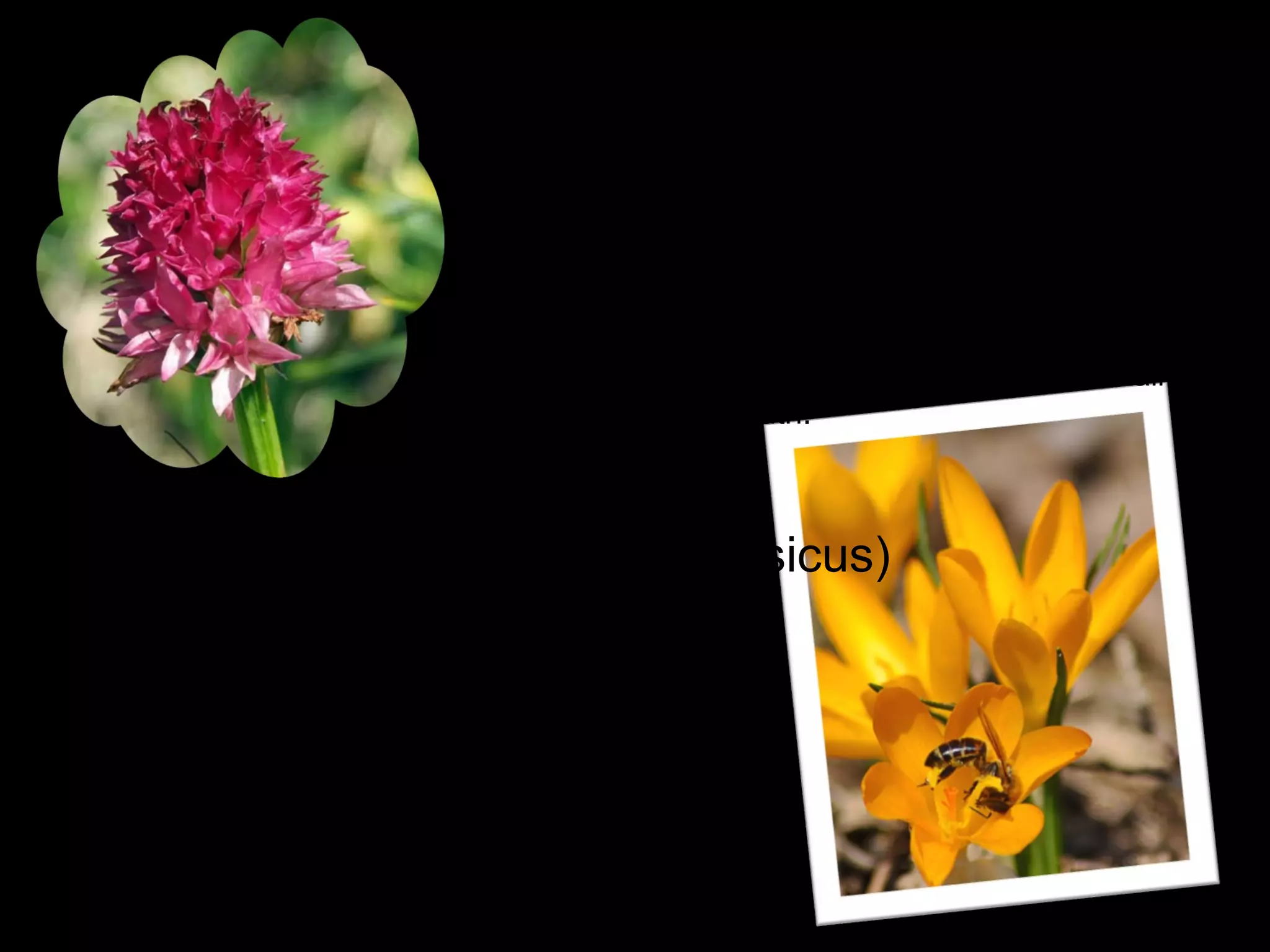
Sângele voinicului (Nigritella rubra)
Blood pea is a plant from Orchidaceae family. It has the
right strain, 8-14 cm high. Leaves are numerous and
narrow, elongated, pointing to the sky. The flowers are
small and numerous. The flowers are dark red-purple,
fragrant vanilla. The root is composed of tubers. It
flowers in June and August.
In Romania is very rare in the Carpathian mountains in
the north-east and south.
Brându a galbenăș (Crocus moesicus)
Yellow crocus is a herbaceous plant, 10-13 cm
high, with long and delicate stem, having
around her a circle of leaves thin and long. It
has yellow pear-shaped flower. The fruit is a
capsule that matures long next spring, brown,
which opens by three valves and containing
numerous seeds.
Garofi a Pietrei Craiuluiț
(Dianthus callizonus)
Papucul doamnei (Cypripeidum calceolus)
Garofita Pietrei Craiului produced by
its rarity surprise among scientists, the
plant is not found in any of the
neighboring mountain massifs and
does not resemble any of dianthus in
Europe.
The stem is short, 5-10 cm high, bearing
a single flower on top corolla about 3 cm
in diameter, composed of five wide
petals.
Lady slipper (Cypripedium calceolus) is a
species of orchid genus Cypripedium. This
species is very rare and is found in the
flora of Romania.
Edelweiss (Leontopodium alpinum Cass.)
It grows in meadows on limestone mountains, sunny
slopes or cliffs. In Romania it grows in the
Carpathians and was declared a natural monument
in 1933 and protected.
In Romania the plant reaches only up to a height of
20 cm.
Inflorescence is clothed with hairy leaves, some bigger,
some smaller and which take the form of stars.
Motley tulip (Fritillaria meleagris)
What distinguishes it from
other tulips is its purple color
with white spots, but also how
it spreads, because it grows
spontaneously in moist
places near the forest. It is
picked abusive for its beauty
in some areas of the country
so it became extinct.
Romanian peony is a peony species present in
lowland forests or their edge in Dobrogea,
Wallachia and southern Moldavia. Red flower
petals are less than garden peony. It is a plant
protected by law, must not be destroyed or
collected. It is found in national parks forest
Comana in sunny places.
Romanian peony
(Paeonia peregrina Mill. Var. Roman)
It is also known as thermal water lily or lotus flower.
This species lives in stream waters, near Bath "May 1“
Oradea. Stream water feature is a high temperature
(hot springs). The species was discovered in 1789 by
botanist P. Kitaibel. Because of its uniqueness (Felix is
the only area where this species is found), Nymphaea
lotus var. thermalis has been declared since 1931, a
natural monument.
Lotus/Water lily (Nymphaea lotus var. thermalis)
The authorsThe authors
Pupils:Pupils:
Militar Mihai (chapterMilitar Mihai (chapter ”Animals”)”Animals”)
Iacob Mădălina (chapter ”Birds”)Iacob Mădălina (chapter ”Birds”)
Presecan Alexandra (chapter ”Plants”)Presecan Alexandra (chapter ”Plants”)
Căbău Cosmin- designCăbău Cosmin- design
Negru Roxana-designNegru Roxana-design
Coordinating teachers:Coordinating teachers:
Ladariu DianaLadariu Diana
Pascalau MariaPascalau Maria
Sources:Sources:
wikipediawikipedia
conf. univ. dr. Carmen Gache (”Al. I. Cuza” University Iasi)-picturesconf. univ. dr. Carmen Gache (”Al. I. Cuza” University Iasi)-pictures
Atlas zoologic, Atlas botanicAtlas zoologic, Atlas botanic
This project has been funded with support from the European Commission.
This publication reflects the views only of the author, and the Commission cannot be held responsible
for any use which may be made of the information contained therein.

Endangered species romania

  • 3.
    The chamoisThe chamois (Rupicaprarupicapra)(Rupicapra rupicapra) • The chamois is a goat-like animalThe chamois is a goat-like animal native to the Carpathiannative to the Carpathian Mountains of Romania. ChamoisMountains of Romania. Chamois are strictly protected animalsare strictly protected animals under the European Habitatsunder the European Habitats Directive.Directive. • Chamois live at moderately highChamois live at moderately high altitudes and are adapted to livingaltitudes and are adapted to living in steep, rugged, rocky terrain. Ain steep, rugged, rocky terrain. A fully grown chamois reaches afully grown chamois reaches a height of about 75 cm and weighsheight of about 75 cm and weighs about 50 kg. Males and femalesabout 50 kg. Males and females have short horns which are slightlyhave short horns which are slightly curled in the posterior direction.curled in the posterior direction. The chamois is chestnut brown toThe chamois is chestnut brown to black in winter and pale brown inblack in winter and pale brown in summer.summer.
  • 4.
    Carpathian brown bear Ursusarctos It is a big animal, that generally weight between 300 and 600 kilograms Brown bears have thick fur, much appreciated, with two rows of hairs, ear and fluff. Although base color is brown, it has got large colour variations from red to almost black bears. Some specimens have white spots on the neck, sometimes forming a real collar, similar to the collared bear the Himalayas.  Dentition is typical of omnivorous, with strong canines and molars rounded.
  • 5.
    In Romania fallowdeerIn Romania fallow deer is tryingis trying to re-adapt toto re-adapt to complex naturalcomplex natural ecosystem, gainingecosystem, gaining thethe strength needed forstrength needed for survival. The mostsurvival. The most importantimportant number ofnumber of fallow deerfallow deer is recordedis recorded in the west and southin the west and south.. Fallow deerFallow deer (Dama dama)(Dama dama)  its wits weight varieseight varies dependingdepending on age, areaon age, area and quality of foodand quality of food  hhair coloair colouur is lightr is light brown with yellowishbrown with yellowish white spots arranged inwhite spots arranged in longitudinallongitudinal rowsrows abdomen areaabdomen area.. its foodits food consist ofconsist of herbaceous plants andherbaceous plants and leaves of trees, includingleaves of trees, including growinggrowing stems,stems, cloverclover,, acorns, In general, theacorns, In general, the food is less pretentious.food is less pretentious. Salt it is absolutelySalt it is absolutely necessary.necessary.
  • 6.
    Bison is theheaviest land animalBison is the heaviest land animal inin Europe. A typical individual has a lengthEurope. A typical individual has a length of 2.9 to 3 meters and a height of 1.9of 2.9 to 3 meters and a height of 1.9 meters, weighing from 300 to 920 kg.meters, weighing from 300 to 920 kg. BisonsBisons live in forests, with very fewlive in forests, with very few natural enemiesnatural enemies Bison is a herbivore.Bison is a herbivore. BisonsBisons livlivee 28 years in28 years in captivity, but in the wildcaptivity, but in the wild live less.live less. BisonsBisons (Bison bonasus bonasus)(Bison bonasus bonasus)
  • 7.
    LynxLynx isis currentlythe largestcurrently the largest cat in the wild fauna ofcat in the wild fauna of Romania.Romania. Also calledAlso called Carpathians panther, lynx isCarpathians panther, lynx is spread naturally from alpinespread naturally from alpine to the Danube Deltato the Danube Delta.. LynxLynx is a powerful andis a powerful and strong animal,strong animal, withwith aann amazingamazing agility andagility and quickness.quickness. TheThe furfur is typical of big cats,is typical of big cats, consisting ofconsisting of yellowish-redyellowish-red hairhair on the sides and backon the sides and back with black spots andwith black spots and yellowish white on the ventralyellowish white on the ventral side.side. Reported maximum weights areReported maximum weights are different, ranging between 50 and 58 kg.different, ranging between 50 and 58 kg. It cIt can live 25 years.an live 25 years. It is a cIt is a carnivore animalarnivore animal, a, a bloodblood loverlover,, consumingconsuming organsorgans with significantwith significant blood meal (heart, liver,blood meal (heart, liver, lungs). Extremely agile, goeslungs). Extremely agile, goes unheard, is extremelyunheard, is extremely difficult to seedifficult to see.. It hIt huntuntss mainly at dusk, beingmainly at dusk, being advantagedadvantaged by the fur asby the fur as anan excellent camouflage, asexcellent camouflage, as well as its special senses.well as its special senses. Lynx (Lynx lynx)
  • 9.
    Red aigretteRed aigrette-Ardeapurpurea-Ardea purpurea It is a summer guest in Romania, and is endangered on a global scale. Can be found in swampy areas and marshes of the Danube Delta. In fall it migrates in Asia or Africa. It has reddish brown color, a very long thin neck. Neck is slightly rounded curve shaped S. As size, it is less than the stork. It feeds with fish and amphibians.
  • 10.
    Little egret-Egretta garzetta Itis a species that is increasing because it isn’t hunted anymore by humans for its ornamental feathers It is rare bird, living especially in the Danube Delta in mixed colonies, especially in dwarf willows. With the arrival of autumn, it migrates to the Mediterranean. The color of the feathers is pure white and on the head has beautiful ornamental feathers, as well as on its back, more popular in the past as fashion jewelry. In the months of April-May, the female lays 3 to 5 greenish-blue eggs that are boiled together with the partner. Chicks leave the nest before they can fly having a great skill in climbing through the branches.
  • 11.
    Hoopoe-Upupa epops It isa migratory bird, found in allIt is a migratory bird, found in all the plains.the plains. It is easily recognized by theIt is easily recognized by the orange crest on the head,orange crest on the head, tighten or loosen it. It has atighten or loosen it. It has a long beak and slightly curvedlong beak and slightly curved down. Hoopoe produces adown. Hoopoe produces a sound unmistakable,sound unmistakable, Pu-pu-pu''.Pu-pu-pu''. It makes its nest in hollows ofIt makes its nest in hollows of trees, using fecal lining,trees, using fecal lining, which serve as defensewhich serve as defense against predatorsagainst predators
  • 12.
    Red shelduck-Tadorna ferrugineaRedshelduck-Tadorna ferruginea It makes the nest in the eastern part of Dobrogea, in holes, where the female lays 8-10 eggs, light cream in late May and it hatches about 28 days. Both sexes were representatives of scarlet plumage, the male is more colorful and with a bright white ring of feathers around the neck. In fall migrates north-west Africa and the Nile Delta. Due to its deepening scarcity, it is placed under the protection of law to be protected from extinction.
  • 13.
    Dropia-otis tarDa It isa bird that lives in south-eastern Europe and temperate areas of Asia. In Romania some years ago was found in Bărăgan and in natural reservation of Beba Veche, Timis county, but is endangered.
  • 14.
    Red duck-Aythya nyroca Itis the most common duck species in the country, and especially in the Danube Delta, met in all pools surrounded by vegetation. It makes 8- 10 pink eggs in May-June, female hatches for 24-26 days. The male is reddish brown with white iris, and the female brown. In winter can be found in North Africa, Nile Valley, northern Arabia and India. Some of them can be seen in unfrozen waters from Romania..
  • 16.
    Sângele voinicului (Nigritellarubra) Blood pea is a plant from Orchidaceae family. It has the right strain, 8-14 cm high. Leaves are numerous and narrow, elongated, pointing to the sky. The flowers are small and numerous. The flowers are dark red-purple, fragrant vanilla. The root is composed of tubers. It flowers in June and August. In Romania is very rare in the Carpathian mountains in the north-east and south. Brându a galbenăș (Crocus moesicus) Yellow crocus is a herbaceous plant, 10-13 cm high, with long and delicate stem, having around her a circle of leaves thin and long. It has yellow pear-shaped flower. The fruit is a capsule that matures long next spring, brown, which opens by three valves and containing numerous seeds.
  • 17.
    Garofi a PietreiCraiuluiț (Dianthus callizonus) Papucul doamnei (Cypripeidum calceolus) Garofita Pietrei Craiului produced by its rarity surprise among scientists, the plant is not found in any of the neighboring mountain massifs and does not resemble any of dianthus in Europe. The stem is short, 5-10 cm high, bearing a single flower on top corolla about 3 cm in diameter, composed of five wide petals. Lady slipper (Cypripedium calceolus) is a species of orchid genus Cypripedium. This species is very rare and is found in the flora of Romania.
  • 18.
    Edelweiss (Leontopodium alpinumCass.) It grows in meadows on limestone mountains, sunny slopes or cliffs. In Romania it grows in the Carpathians and was declared a natural monument in 1933 and protected. In Romania the plant reaches only up to a height of 20 cm. Inflorescence is clothed with hairy leaves, some bigger, some smaller and which take the form of stars. Motley tulip (Fritillaria meleagris) What distinguishes it from other tulips is its purple color with white spots, but also how it spreads, because it grows spontaneously in moist places near the forest. It is picked abusive for its beauty in some areas of the country so it became extinct.
  • 19.
    Romanian peony isa peony species present in lowland forests or their edge in Dobrogea, Wallachia and southern Moldavia. Red flower petals are less than garden peony. It is a plant protected by law, must not be destroyed or collected. It is found in national parks forest Comana in sunny places. Romanian peony (Paeonia peregrina Mill. Var. Roman) It is also known as thermal water lily or lotus flower. This species lives in stream waters, near Bath "May 1“ Oradea. Stream water feature is a high temperature (hot springs). The species was discovered in 1789 by botanist P. Kitaibel. Because of its uniqueness (Felix is the only area where this species is found), Nymphaea lotus var. thermalis has been declared since 1931, a natural monument. Lotus/Water lily (Nymphaea lotus var. thermalis)
  • 20.
    The authorsThe authors Pupils:Pupils: MilitarMihai (chapterMilitar Mihai (chapter ”Animals”)”Animals”) Iacob Mădălina (chapter ”Birds”)Iacob Mădălina (chapter ”Birds”) Presecan Alexandra (chapter ”Plants”)Presecan Alexandra (chapter ”Plants”) Căbău Cosmin- designCăbău Cosmin- design Negru Roxana-designNegru Roxana-design Coordinating teachers:Coordinating teachers: Ladariu DianaLadariu Diana Pascalau MariaPascalau Maria Sources:Sources: wikipediawikipedia conf. univ. dr. Carmen Gache (”Al. I. Cuza” University Iasi)-picturesconf. univ. dr. Carmen Gache (”Al. I. Cuza” University Iasi)-pictures Atlas zoologic, Atlas botanicAtlas zoologic, Atlas botanic This project has been funded with support from the European Commission. This publication reflects the views only of the author, and the Commission cannot be held responsible for any use which may be made of the information contained therein.