Emulating a combo organ
      using Faust
      Sampo Savolainen
         LAC 2010
          Utrecht
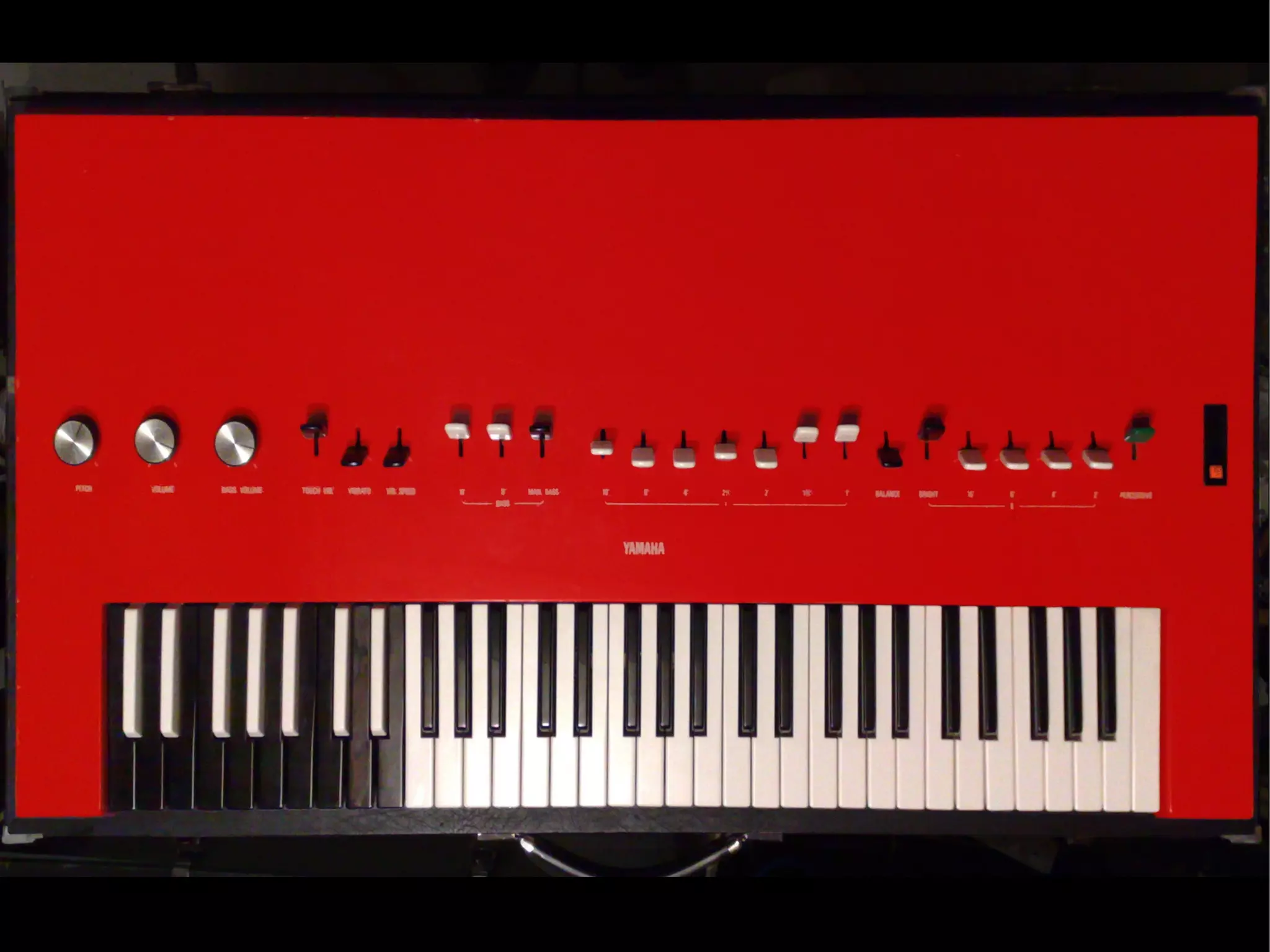
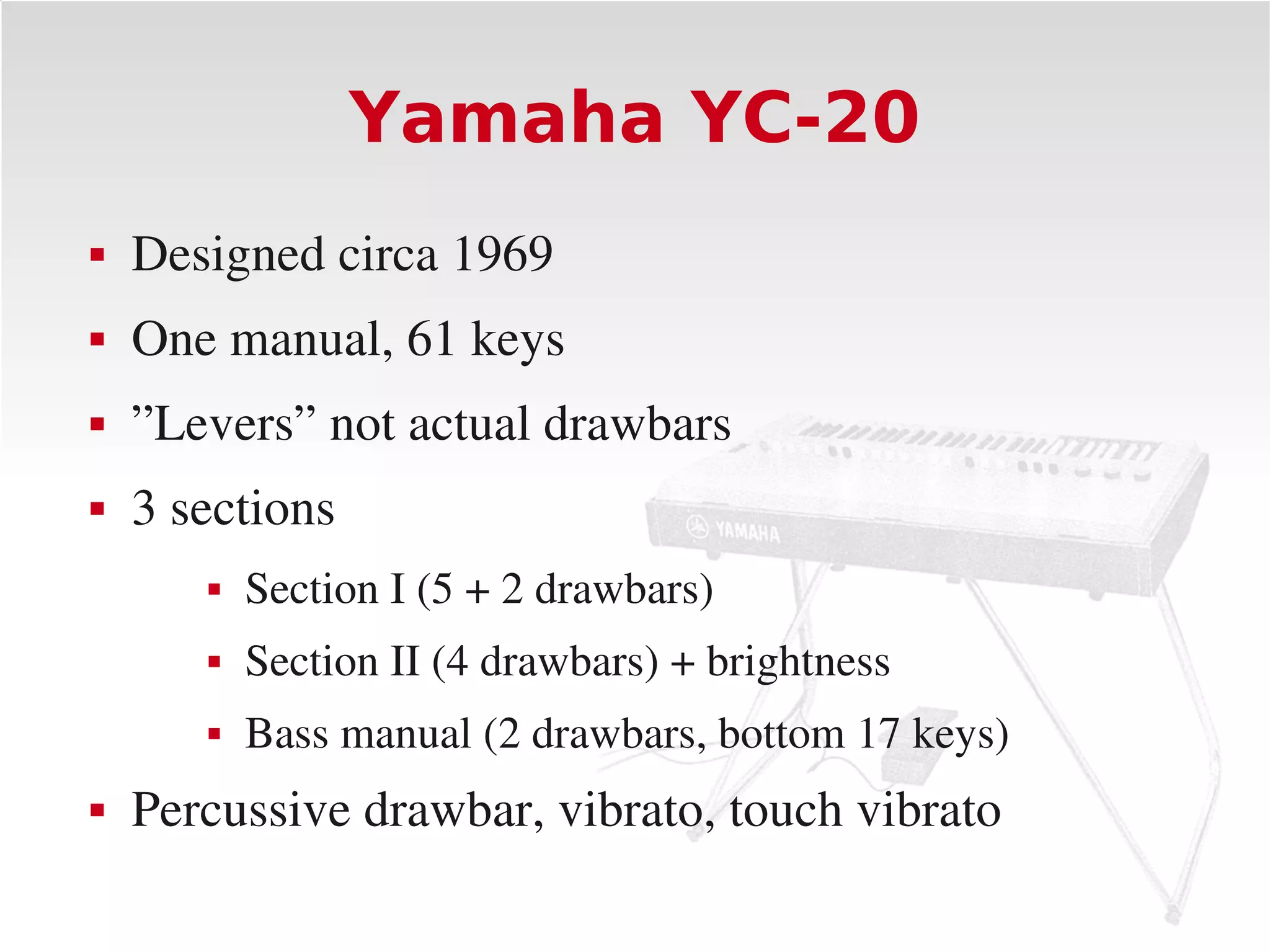
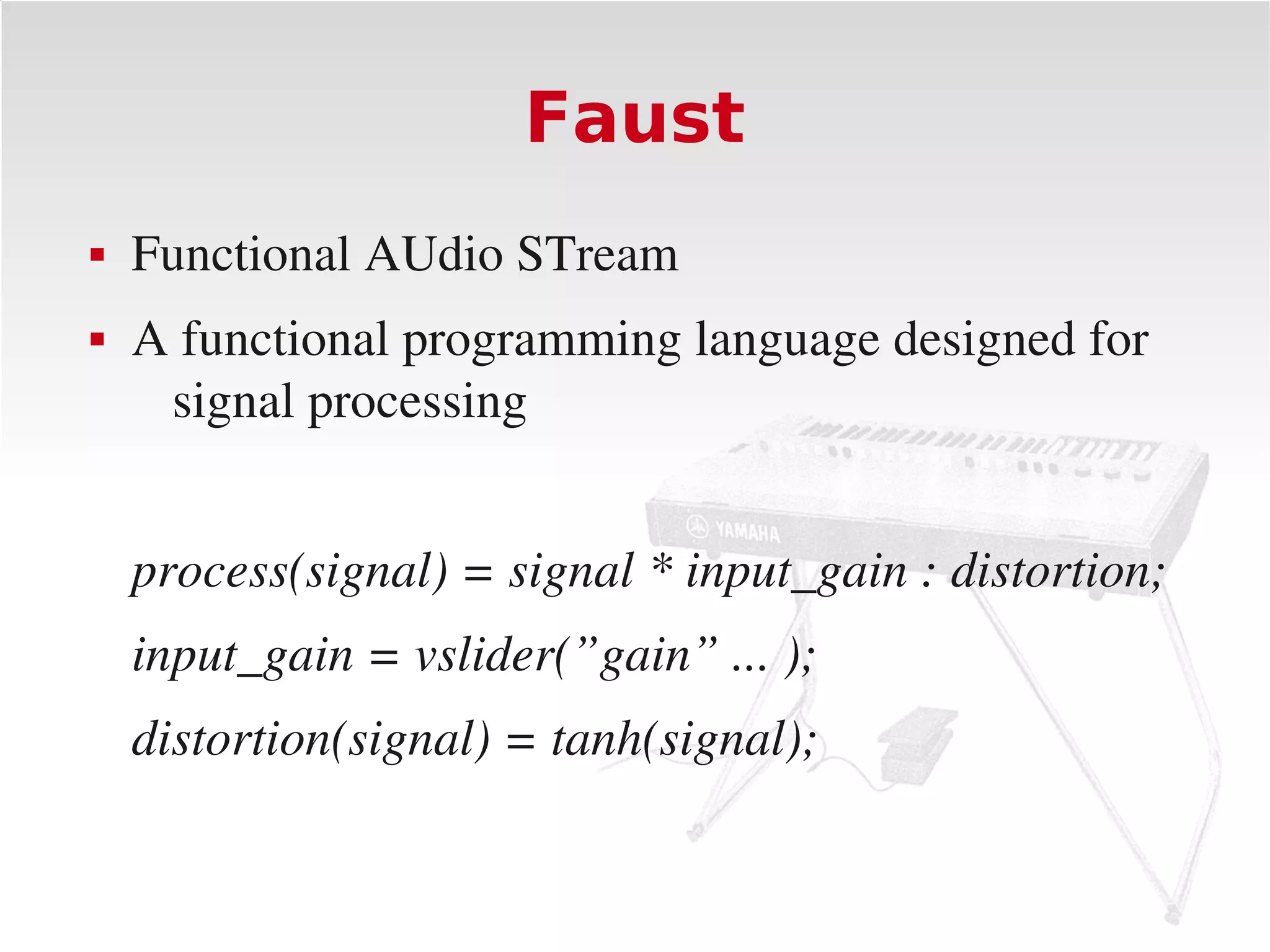
Yamaha YC-20
   Designed circa 1969
   One manual, 61 keys
   ”Levers” not actual drawbars
   3 sections
          Section I (5 + 2 drawbars)
          Section II (4 drawbars) + brightness
          Bass manual (2 drawbars, bottom 17 keys)
   Percussive drawbar, vibrato, touch vibrato
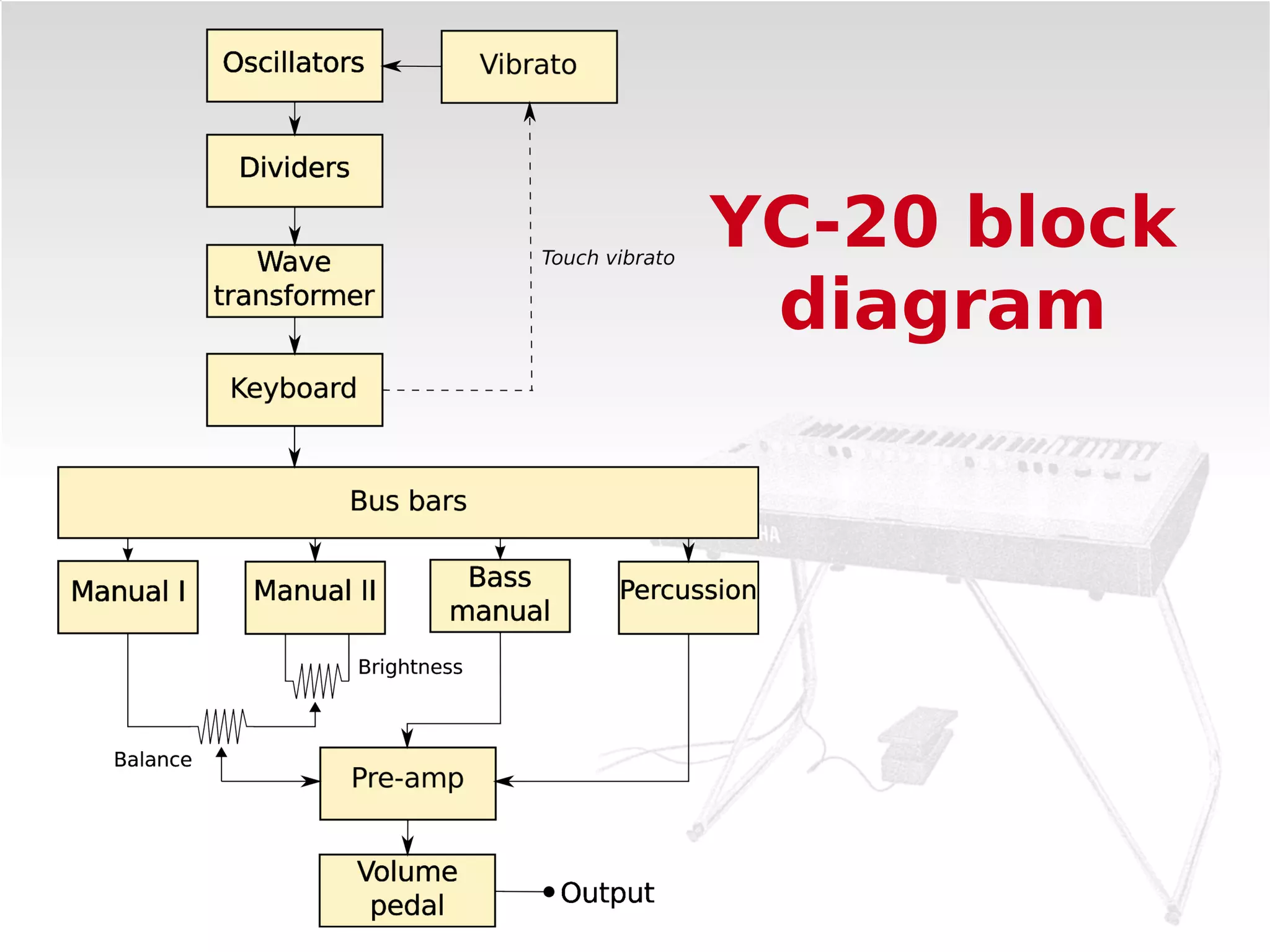
YC-20 block
 diagram
Faust
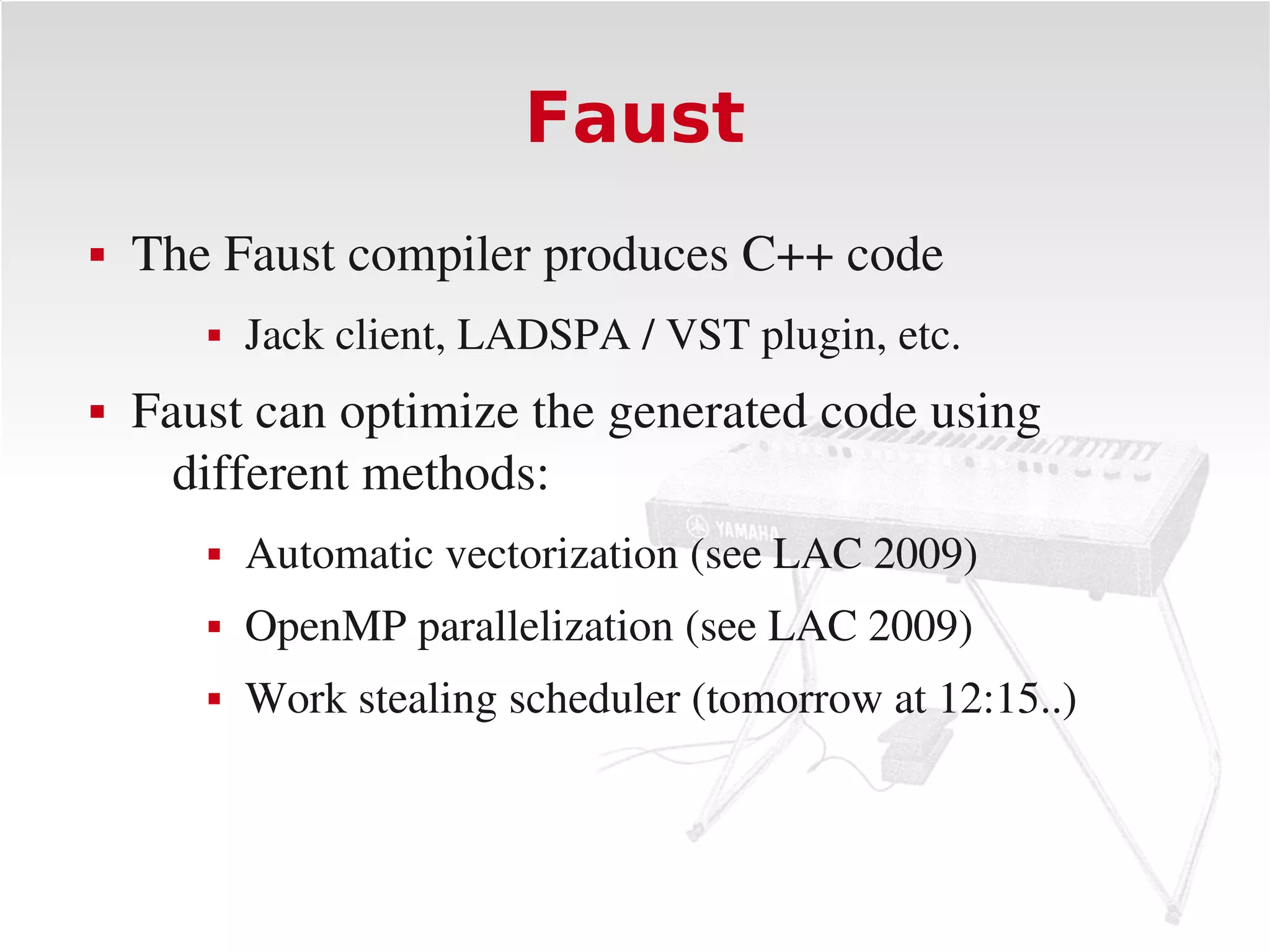
   Functional AUdio STream
   A functional programming language designed for 
     signal processing


    process(signal) = signal * input_gain : distortion;
    input_gain = vslider(”gain” ... );
    distortion(signal) = tanh(signal);
Faust
   The Faust compiler produces C++ code
          Jack client, LADSPA / VST plugin, etc.
   Faust can optimize the generated code using 
      different methods:
          Automatic vectorization (see LAC 2009)
          OpenMP parallelization (see LAC 2009)
          Work stealing scheduler (tomorrow at 12:15..)
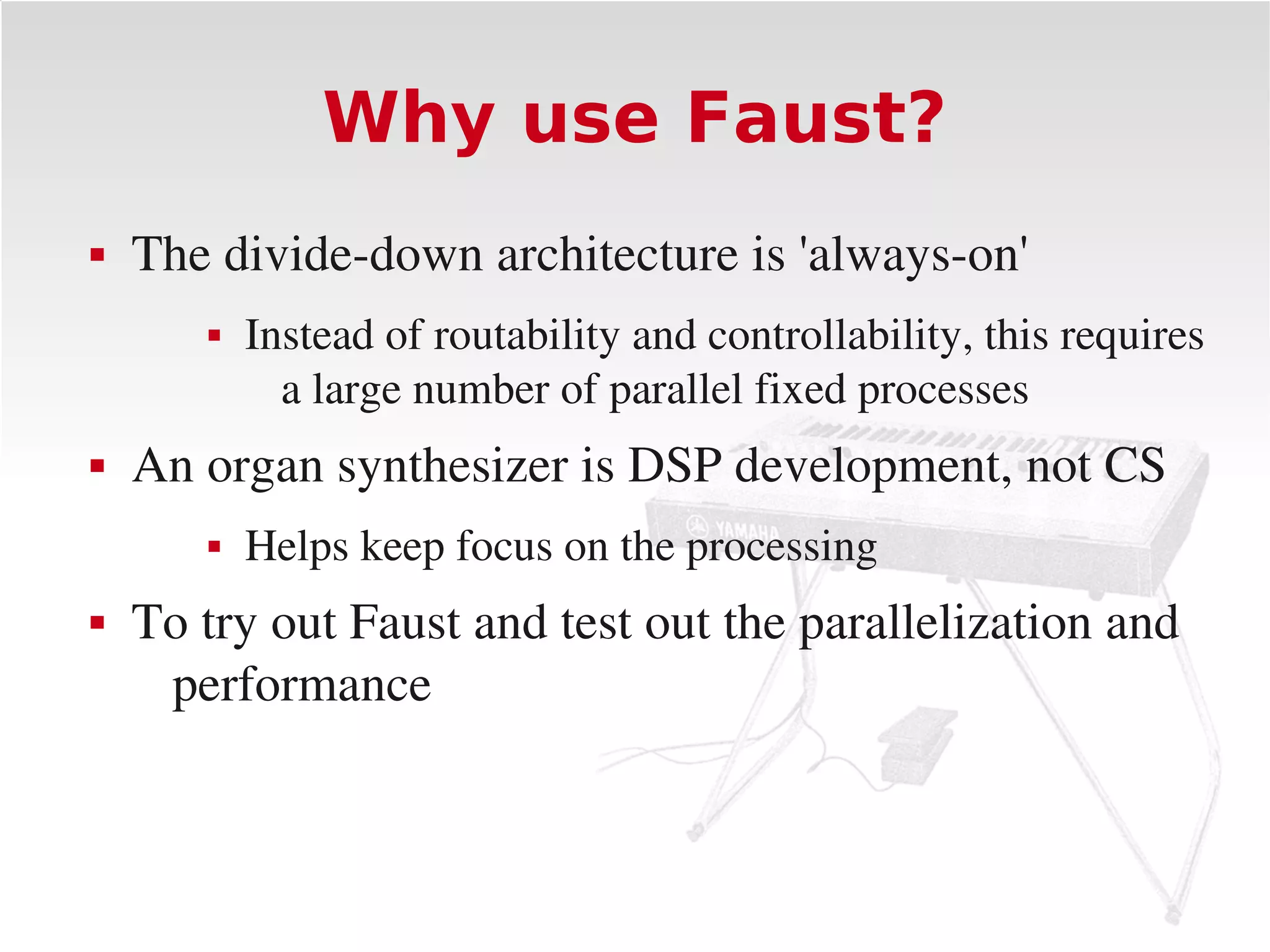
Why use Faust?
   The divide­down architecture is 'always­on'
          Instead of routability and controllability, this requires 
             a large number of parallel fixed processes
   An organ synthesizer is DSP development, not CS
          Helps keep focus on the processing
   To try out Faust and test out the parallelization and 
     performance
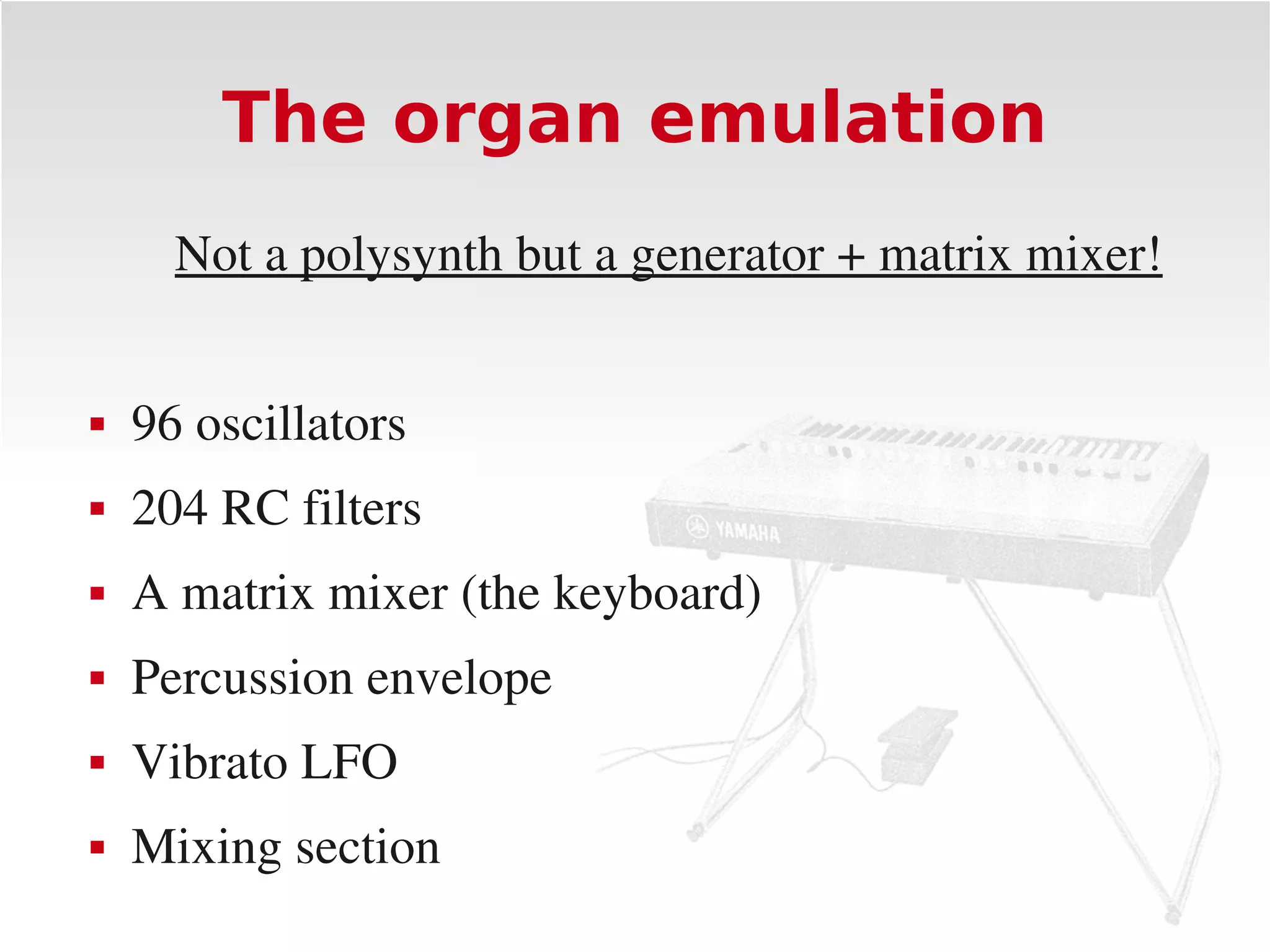
The organ emulation
      Not a polysynth but a generator + matrix mixer!


   96 oscillators
   204 RC filters
   A matrix mixer (the keyboard)
   Percussion envelope
   Vibrato LFO
   Mixing section
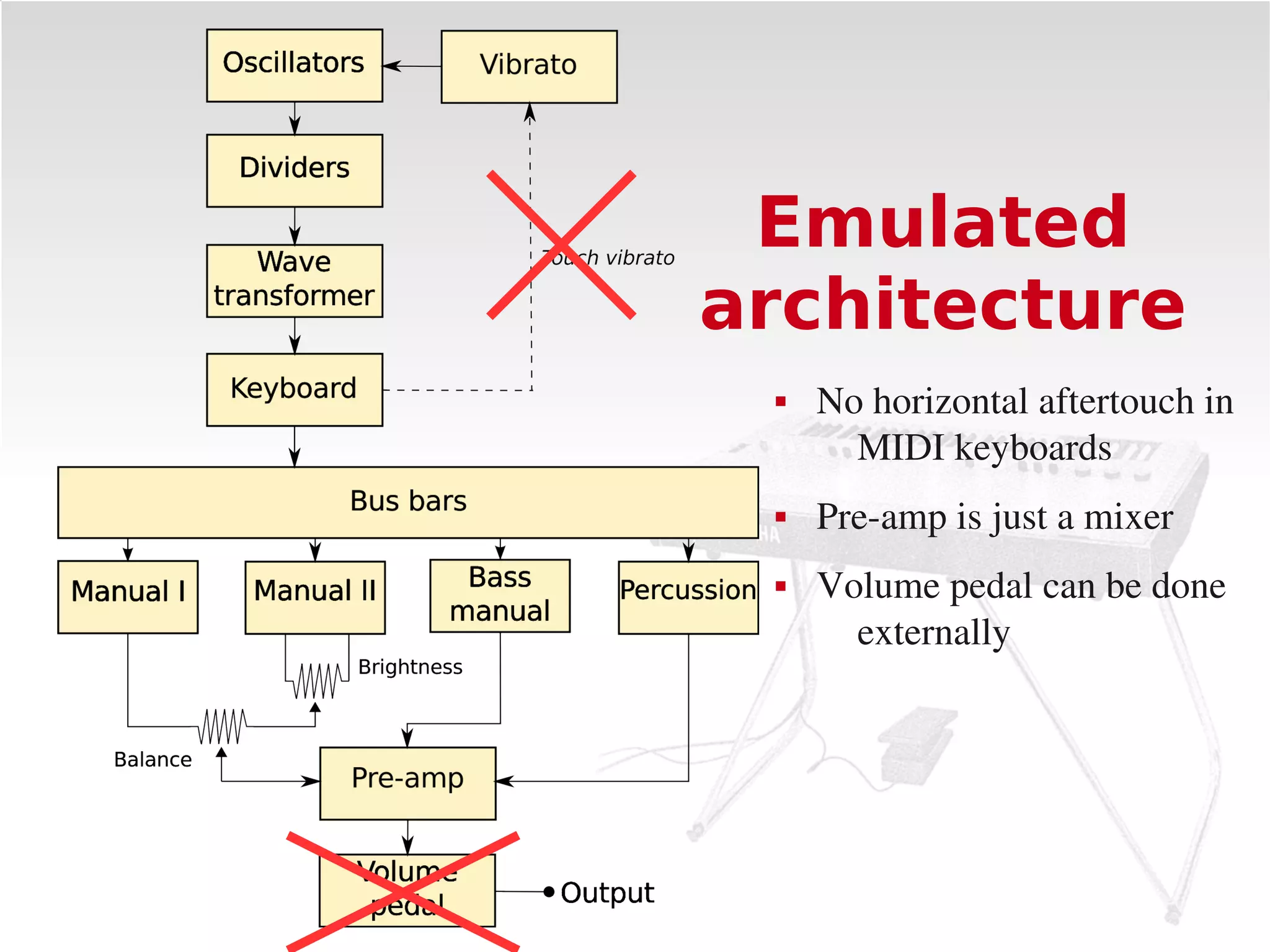
Emulated
architecture
    No horizontal aftertouch in 
       MIDI keyboards
    Pre­amp is just a mixer
    Volume pedal can be done 
       externally
Oscillators
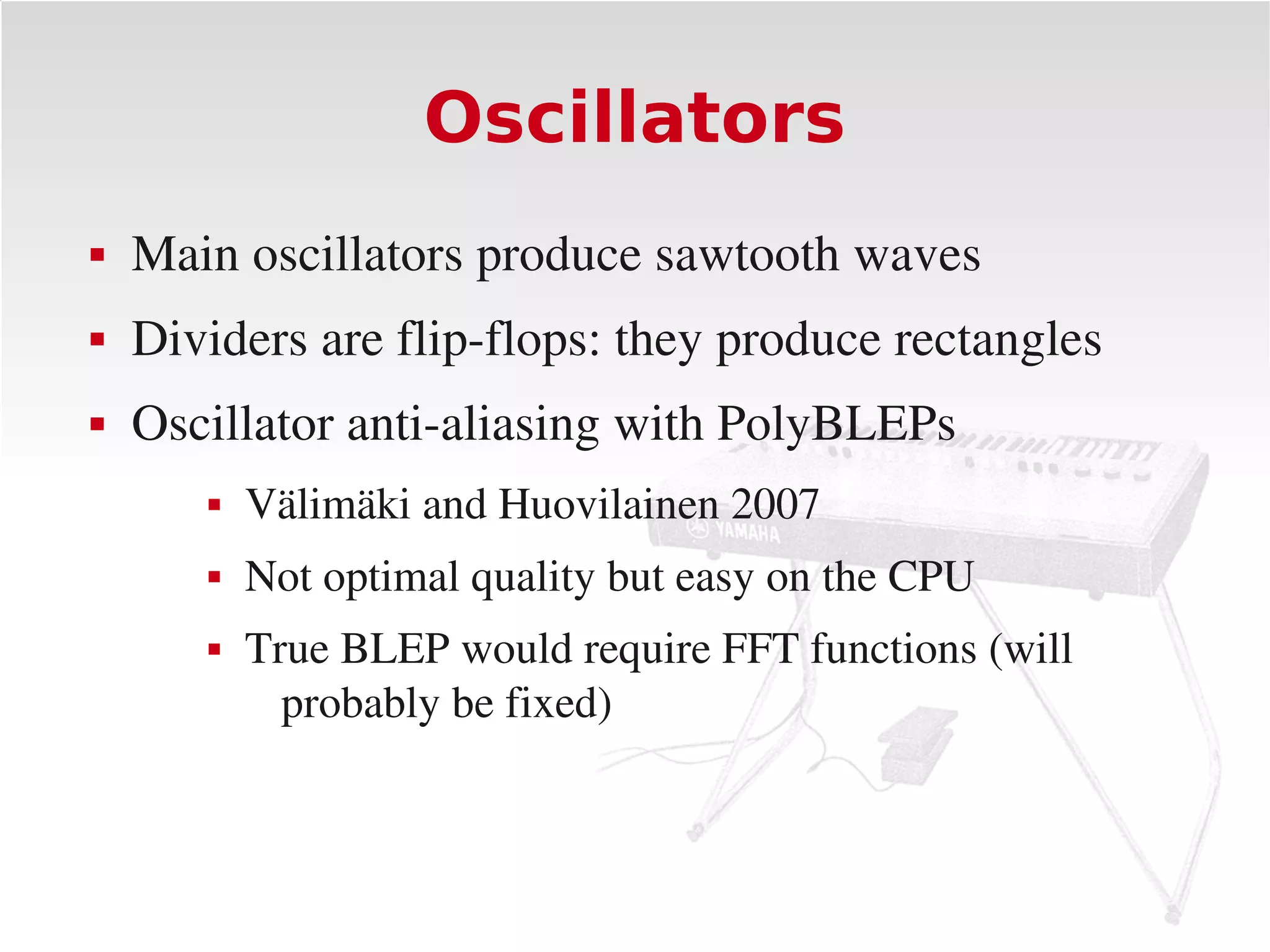
   Main oscillators produce sawtooth waves
   Dividers are flip­flops: they produce rectangles
   Oscillator anti­aliasing with PolyBLEPs
          Välimäki and Huovilainen 2007
          Not optimal quality but easy on the CPU
          True BLEP would require FFT functions (will 
             probably be fixed)
PolyBLEP and branching
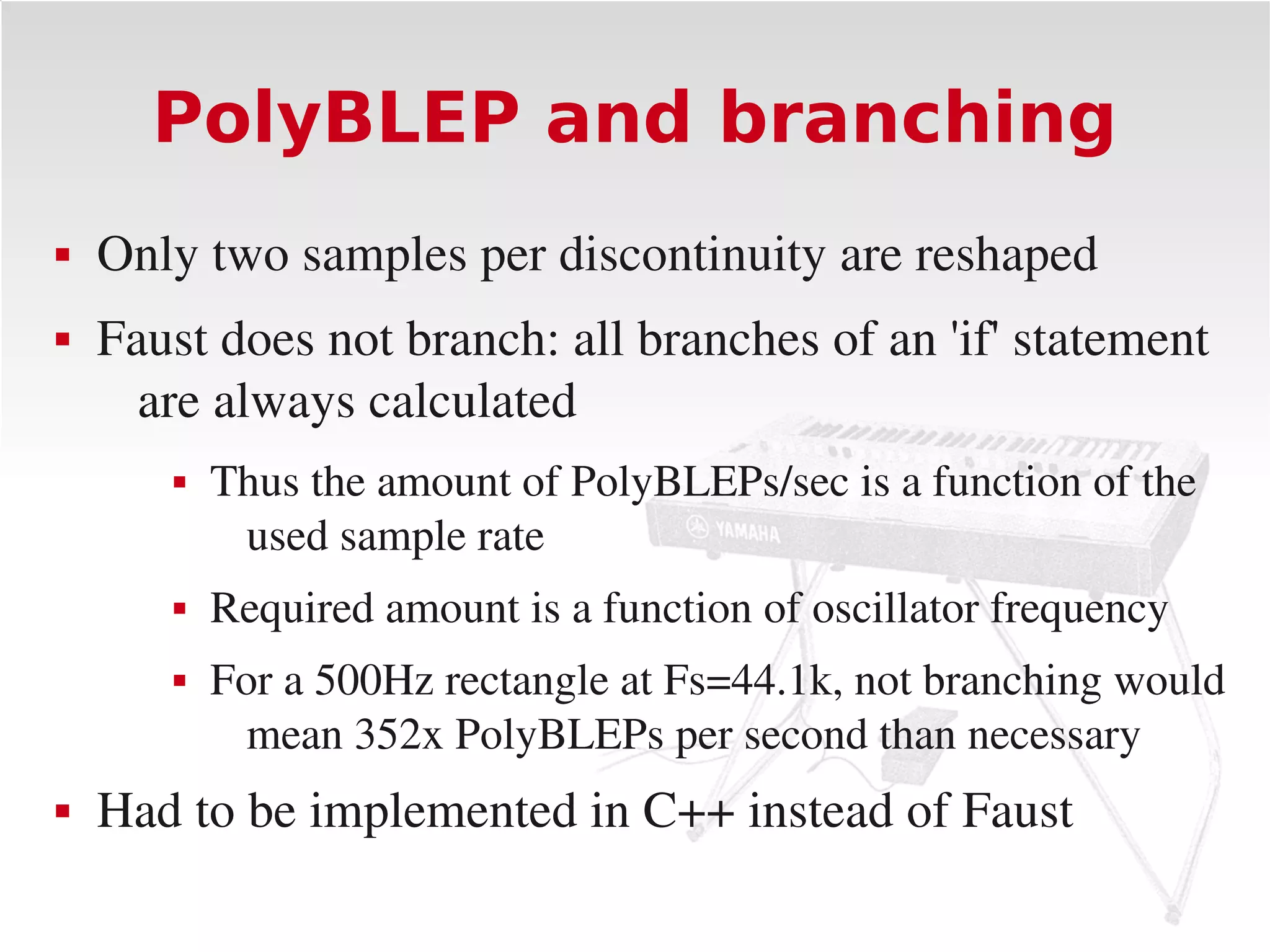
   Only two samples per discontinuity are reshaped
   Faust does not branch: all branches of an 'if' statement 
      are always calculated
          Thus the amount of PolyBLEPs/sec is a function of the 
            used sample rate
          Required amount is a function of oscillator frequency
          For a 500Hz rectangle at Fs=44.1k, not branching would 
             mean 352x PolyBLEPs per second than necessary
   Had to be implemented in C++ instead of Faust
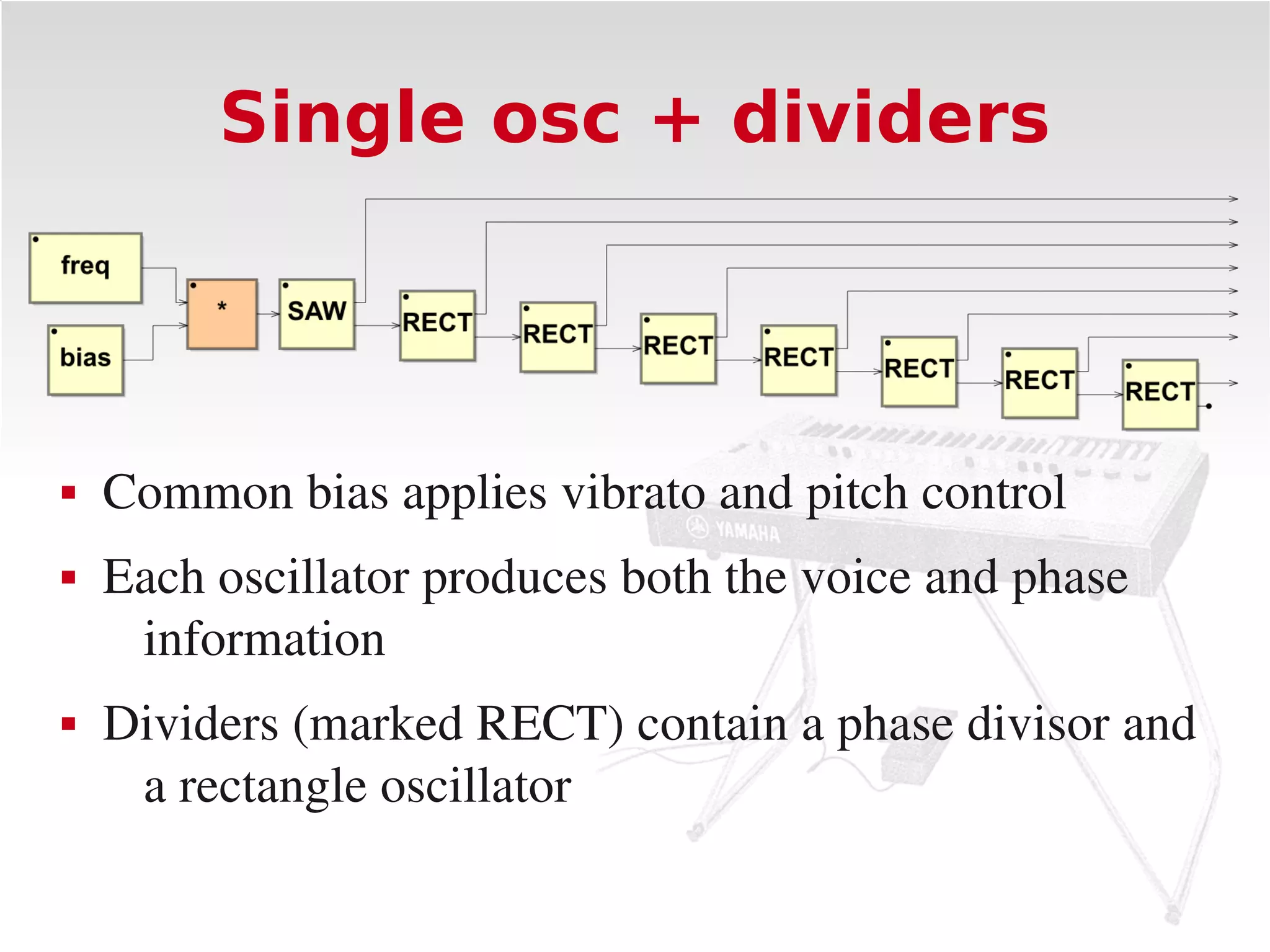
Single osc + dividers


   Common bias applies vibrato and pitch control
   Each oscillator produces both the voice and phase 
     information
   Dividers (marked RECT) contain a phase divisor and 
     a rectangle oscillator
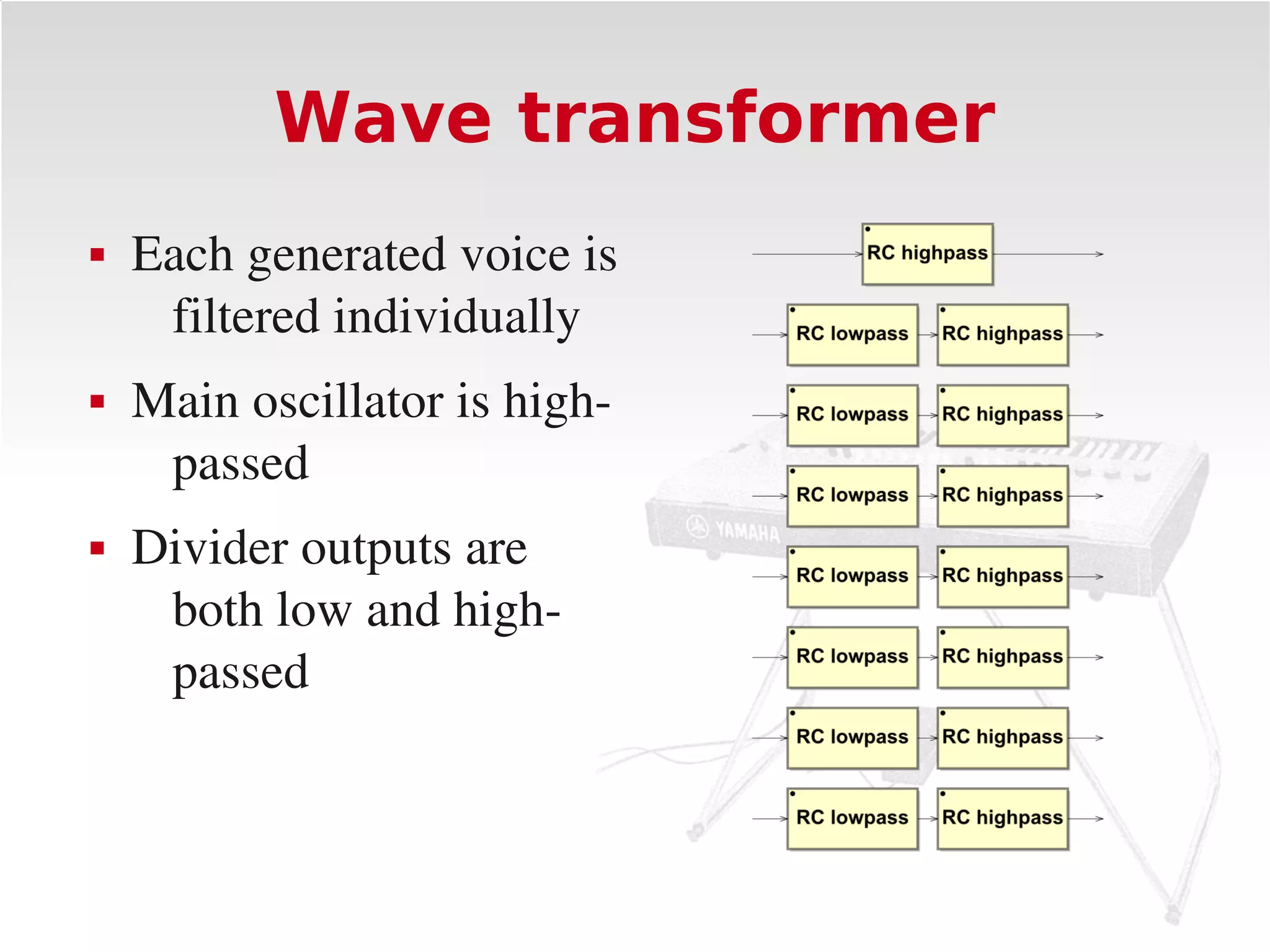
Wave transformer
   Each generated voice is 
     filtered individually
   Main oscillator is high­
     passed
   Divider outputs are 
     both low and high­
     passed
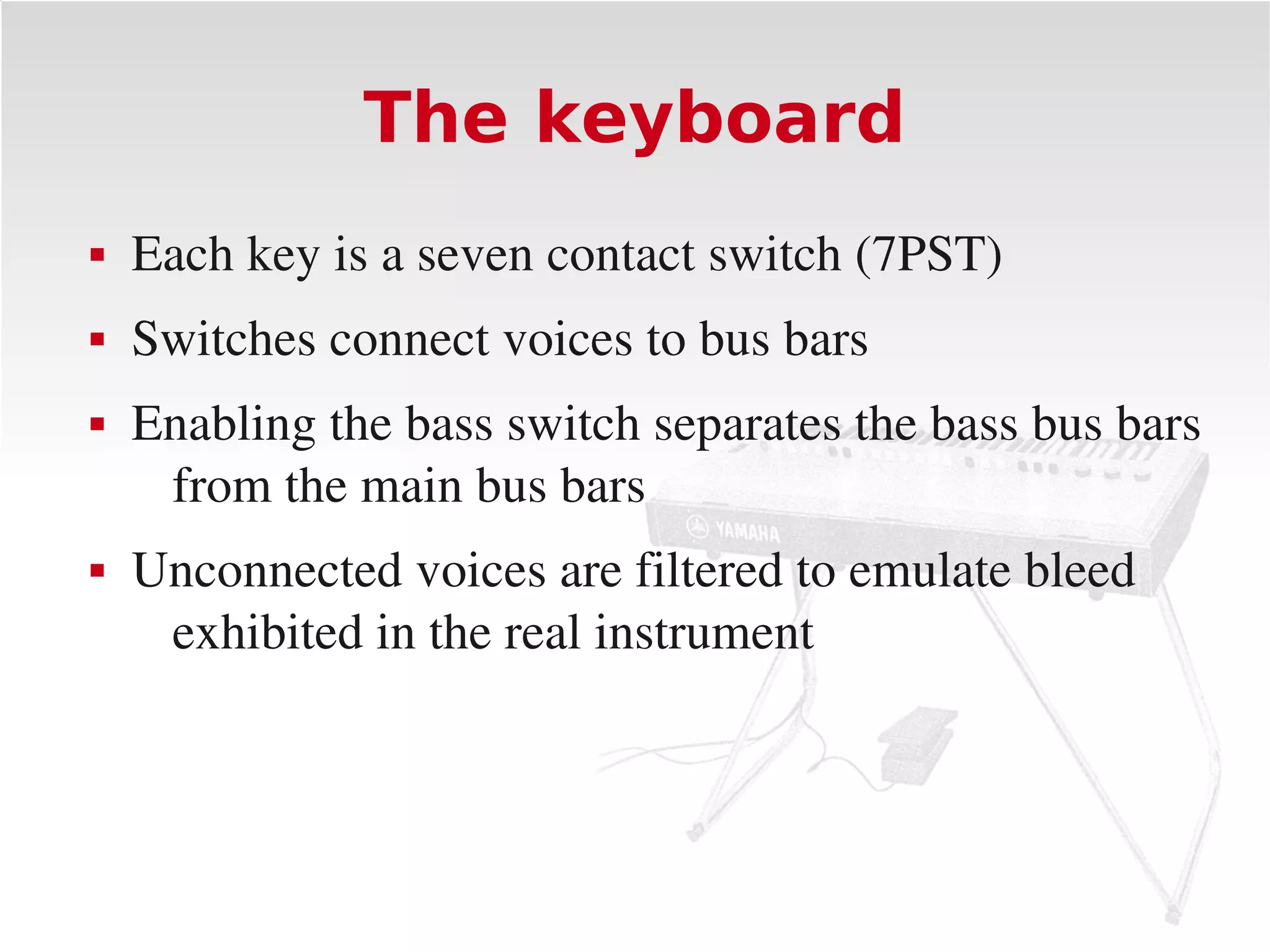
The keyboard
   Each key is a seven contact switch (7PST)
   Switches connect voices to bus bars
   Enabling the bass switch separates the bass bus bars 
     from the main bus bars
   Unconnected voices are filtered to emulate bleed 
     exhibited in the real instrument
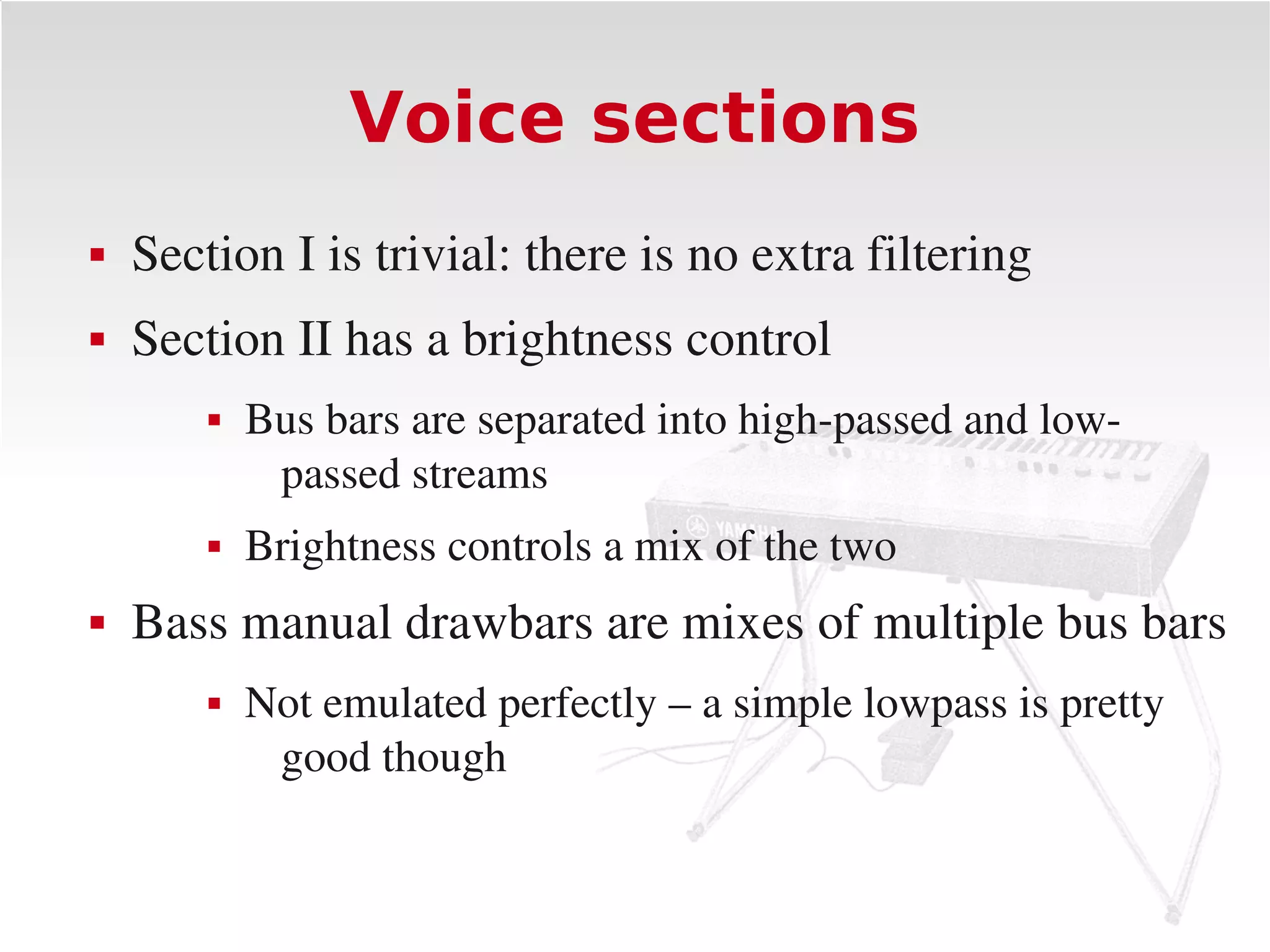
Voice sections
   Section I is trivial: there is no extra filtering
   Section II has a brightness control
           Bus bars are separated into high­passed and low­
             passed streams
           Brightness controls a mix of the two
   Bass manual drawbars are mixes of multiple bus bars
           Not emulated perfectly – a simple lowpass is pretty 
             good though
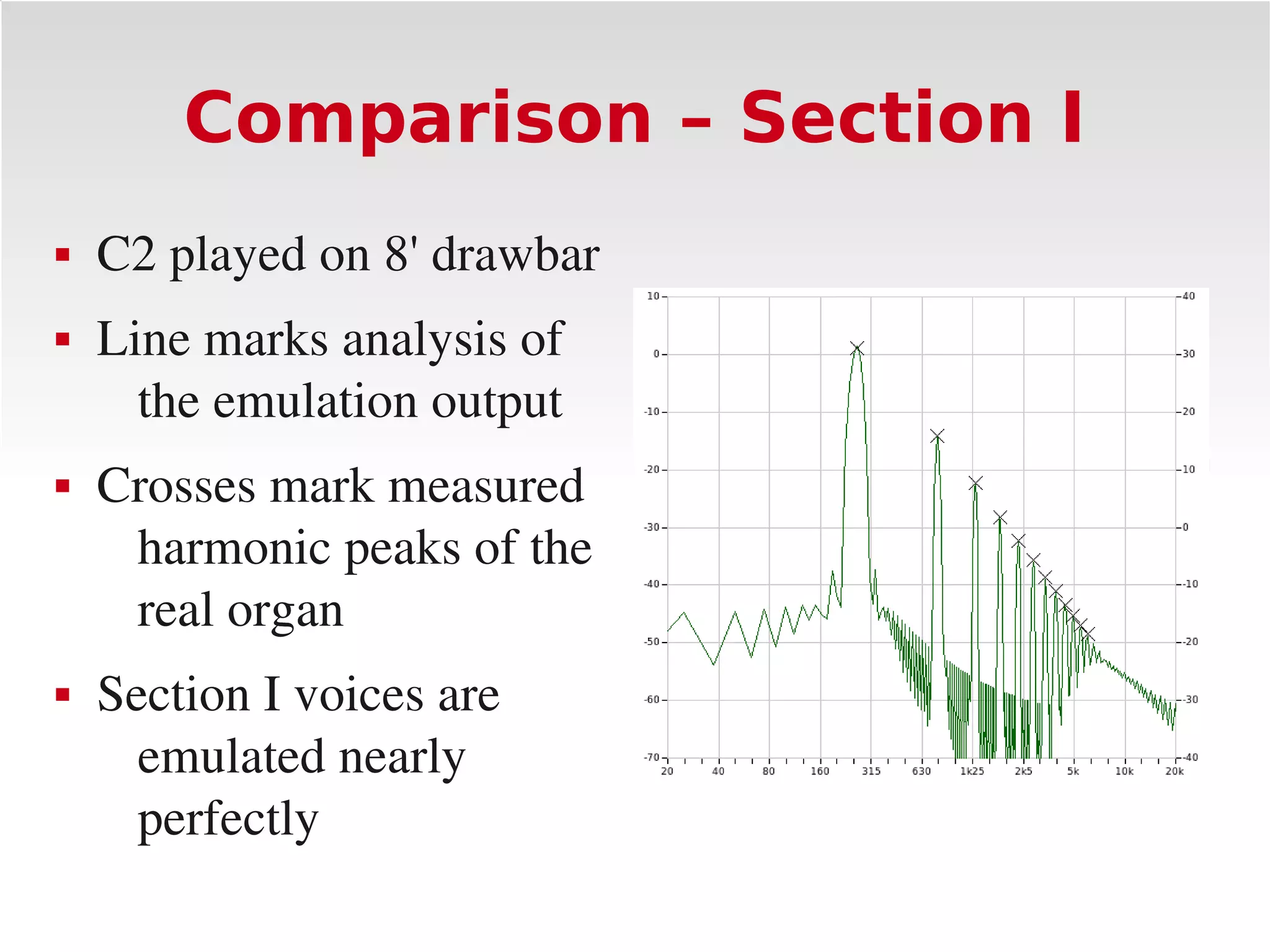
Comparison – Section I
   C2 played on 8' drawbar
   Line marks analysis of 
      the emulation output
   Crosses mark measured 
     harmonic peaks of the 
     real organ
   Section I voices are 
      emulated nearly 
      perfectly
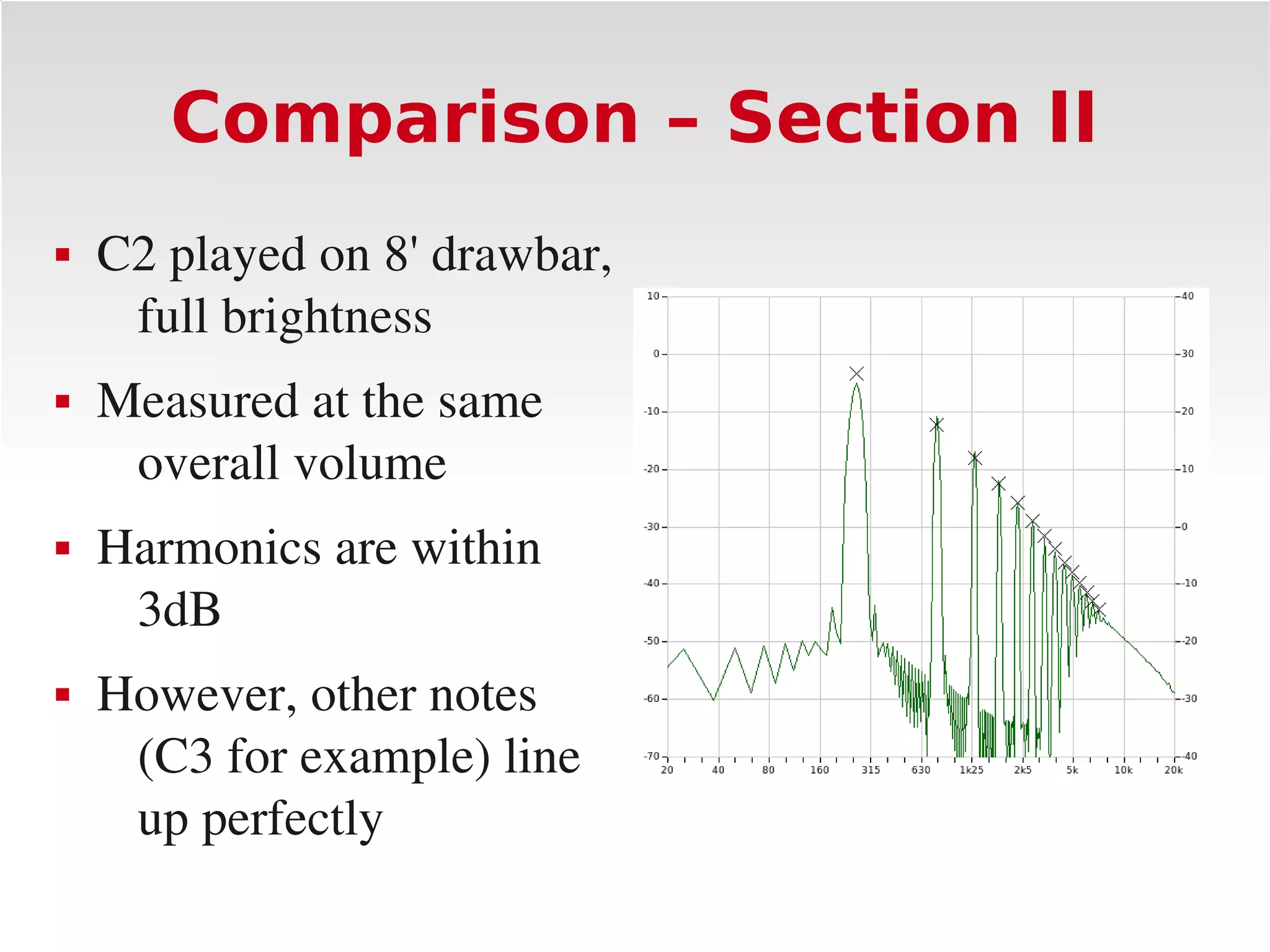
Comparison – Section II
   C2 played on 8' drawbar, 
     full brightness
   Measured at the same 
     overall volume
   Harmonics are within 
     3dB
   However, other notes 
     (C3 for example) line 
     up perfectly
Performance
   This much processing is inherently slow
   But the design leaves much room for parallelization
          … which Faust should be good at
   Performance is sensitive to GCC flags
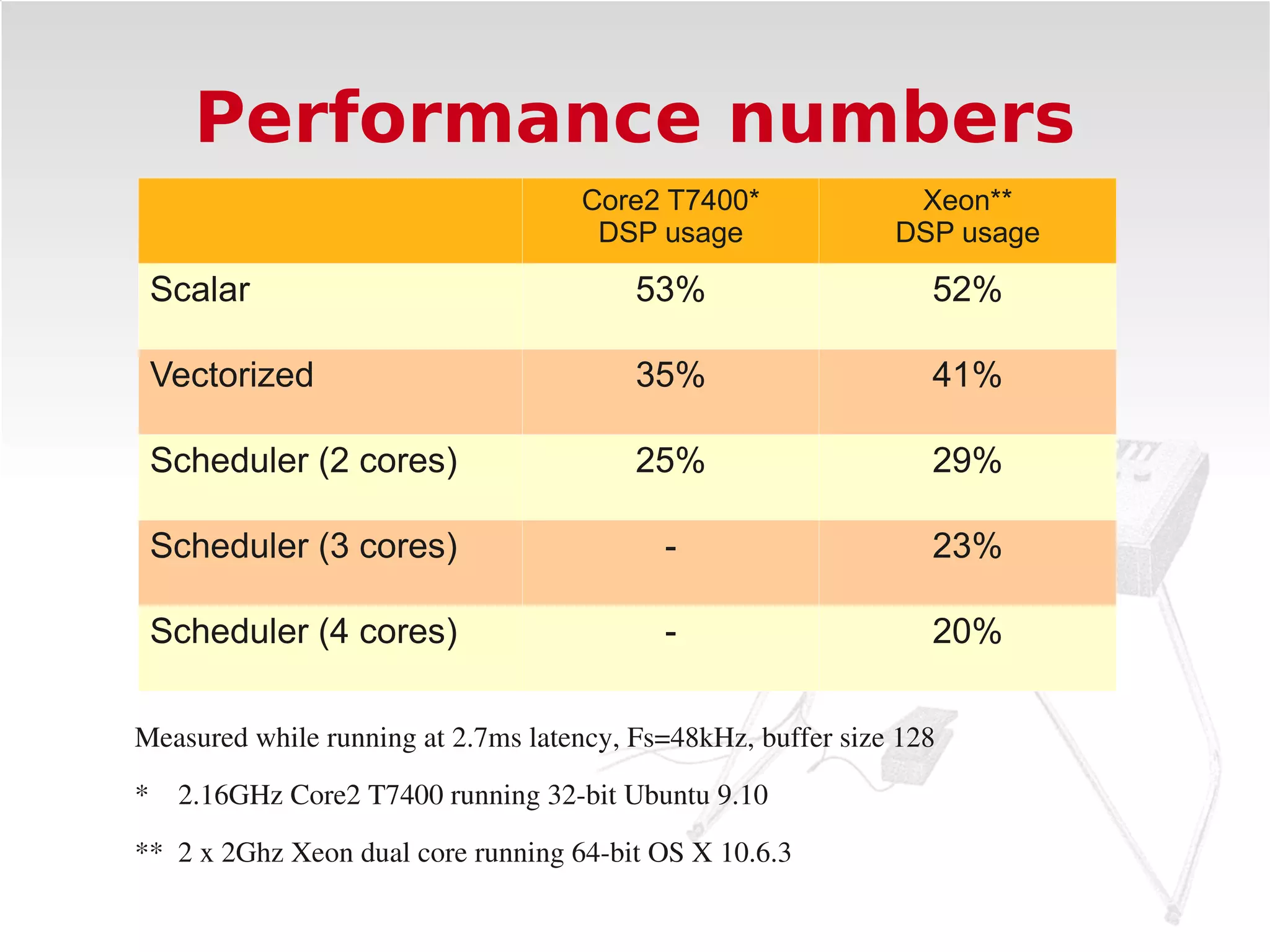
Performance numbers
                                    Core2 T7400*               Xeon**
                                     DSP usage                DSP usage

 Scalar                                  53%                     52%

 Vectorized                              35%                     41%

 Scheduler (2 cores)                     25%                     29%

 Scheduler (3 cores)                       -                     23%

 Scheduler (4 cores)                       -                     20%

Measured while running at 2.7ms latency, Fs=48kHz, buffer size 128
*    2.16GHz Core2 T7400 running 32­bit Ubuntu 9.10

**  2 x 2Ghz Xeon dual core running 64­bit OS X 10.6.3
Things to improve
   Section II filters are not perfect
   Bass manual circuit is not truly emulated
   The keyboard matrix should emulate passive mixing
           Voices connected to multiple bus bars
           Voices connected to a single bus bar through many key 
             switches (for example harmonics)
   Streamlining
           Some filters might be unnecessary
           Use lookup tables for oscillators
Challenges with Faust
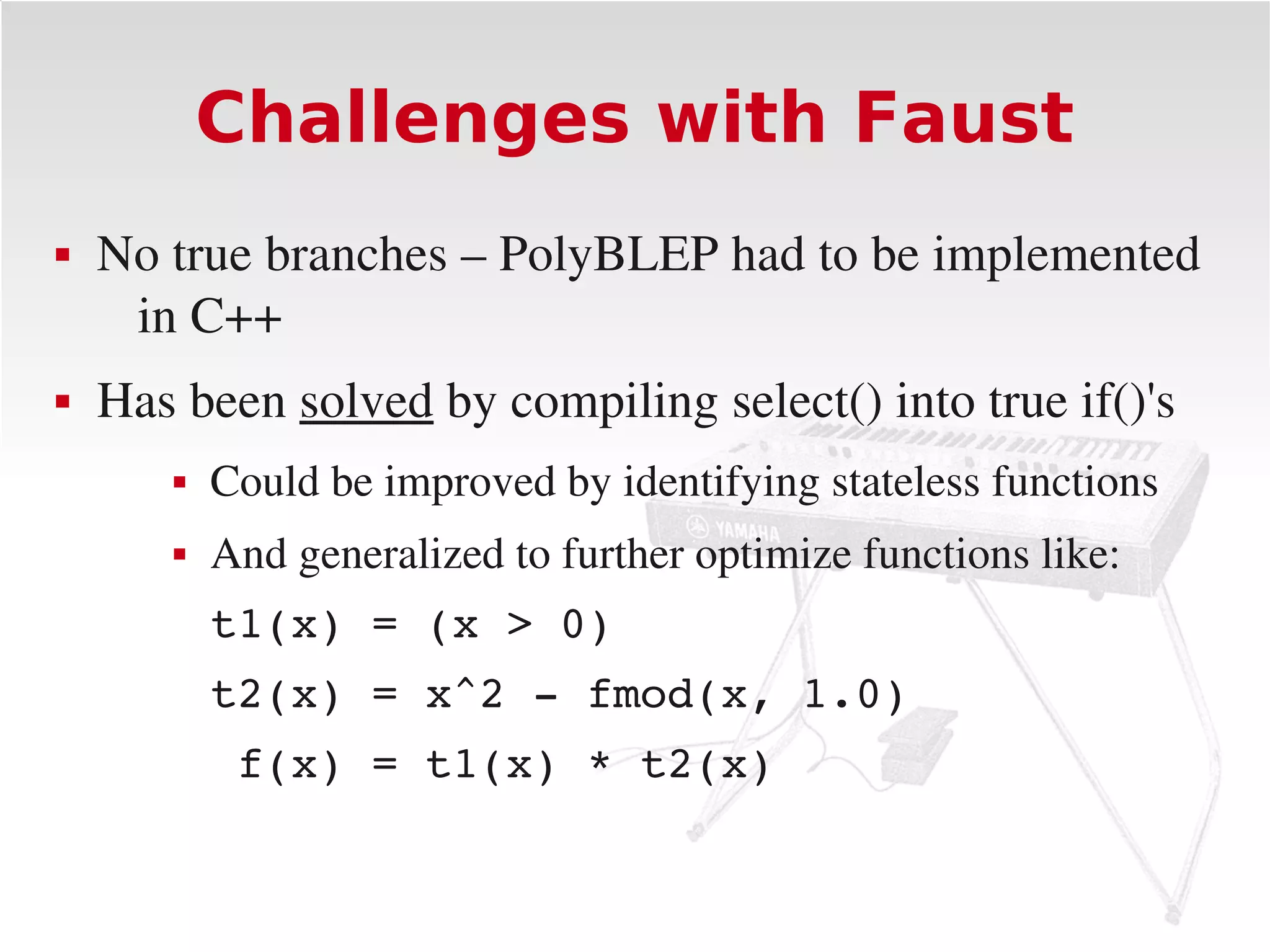
   No true branches – PolyBLEP had to be implemented 
     in C++
   Has been solved by compiling select() into true if()'s
          Could be improved by identifying stateless functions
          And generalized to further optimize functions like:
           t1(x) = (x > 0)
           t2(x) = x^2 ­ fmod(x, 1.0)
            f(x) = t1(x) * t2(x)
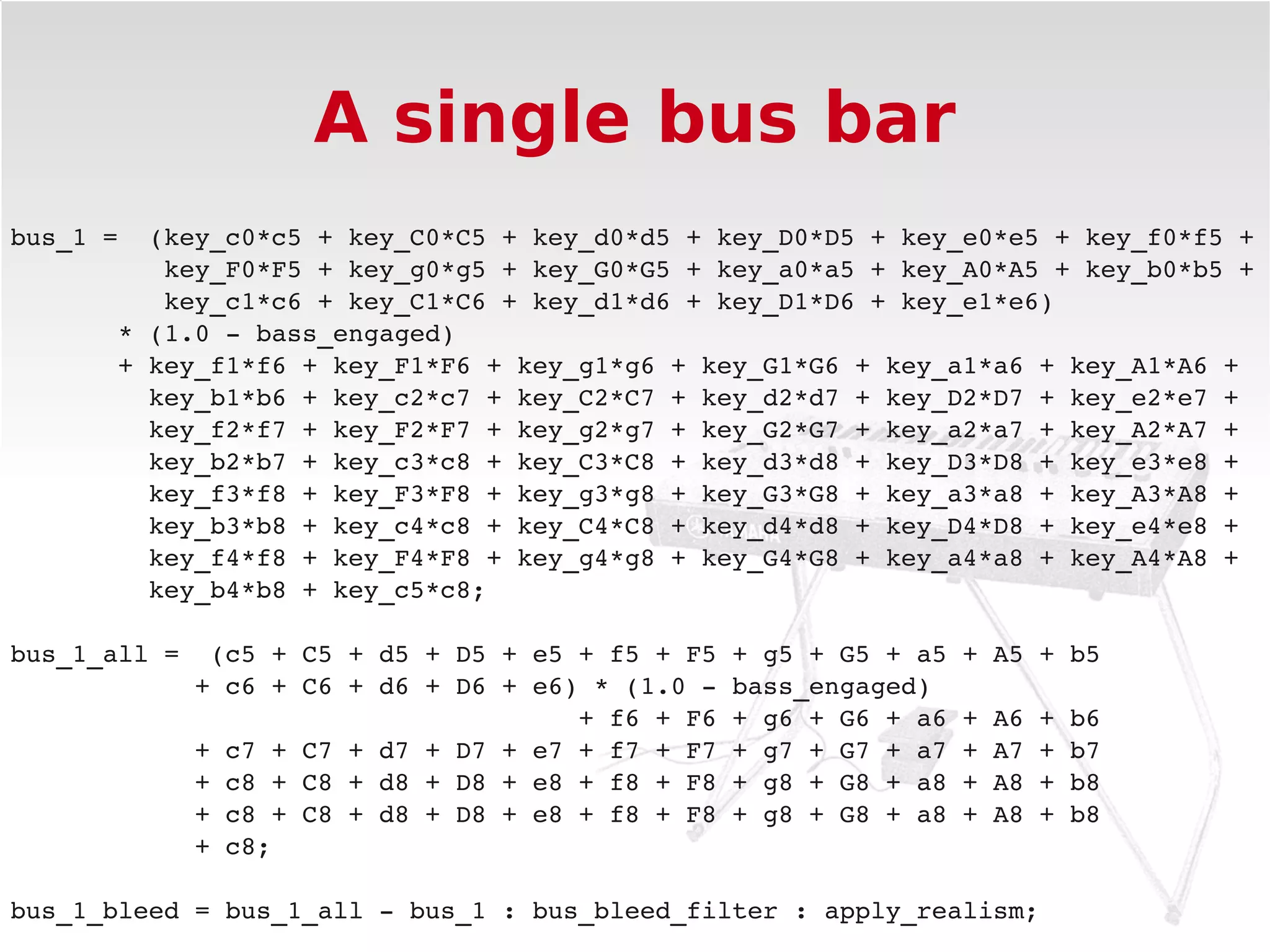
A single bus bar
bus_1 =  (key_c0*c5 + key_C0*C5 + key_d0*d5 + key_D0*D5 + key_e0*e5 + key_f0*f5 +
          key_F0*F5 + key_g0*g5 + key_G0*G5 + key_a0*a5 + key_A0*A5 + key_b0*b5 +
          key_c1*c6 + key_C1*C6 + key_d1*d6 + key_D1*D6 + key_e1*e6) 
       * (1.0 ­ bass_engaged)
       + key_f1*f6 + key_F1*F6 + key_g1*g6 + key_G1*G6 + key_a1*a6 + key_A1*A6 +
         key_b1*b6 + key_c2*c7 + key_C2*C7 + key_d2*d7 + key_D2*D7 + key_e2*e7 +
         key_f2*f7 + key_F2*F7 + key_g2*g7 + key_G2*G7 + key_a2*a7 + key_A2*A7 +
         key_b2*b7 + key_c3*c8 + key_C3*C8 + key_d3*d8 + key_D3*D8 + key_e3*e8 +
         key_f3*f8 + key_F3*F8 + key_g3*g8 + key_G3*G8 + key_a3*a8 + key_A3*A8 +
         key_b3*b8 + key_c4*c8 + key_C4*C8 + key_d4*d8 + key_D4*D8 + key_e4*e8 +
         key_f4*f8 + key_F4*F8 + key_g4*g8 + key_G4*G8 + key_a4*a8 + key_A4*A8 +
         key_b4*b8 + key_c5*c8;

bus_1_all =  (c5 + C5 + d5 + D5 + e5 + f5 + F5 + g5 + G5 + a5 + A5 + b5
            + c6 + C6 + d6 + D6 + e6) * (1.0 ­ bass_engaged)
                                     + f6 + F6 + g6 + G6 + a6 + A6 + b6
            + c7 + C7 + d7 + D7 + e7 + f7 + F7 + g7 + G7 + a7 + A7 + b7
            + c8 + C8 + d8 + D8 + e8 + f8 + F8 + g8 + G8 + a8 + A8 + b8
            + c8 + C8 + d8 + D8 + e8 + f8 + F8 + g8 + G8 + a8 + A8 + b8
            + c8;

bus_1_bleed = bus_1_all ­ bus_1 : bus_bleed_filter : apply_realism;
.. Challenges with Faust
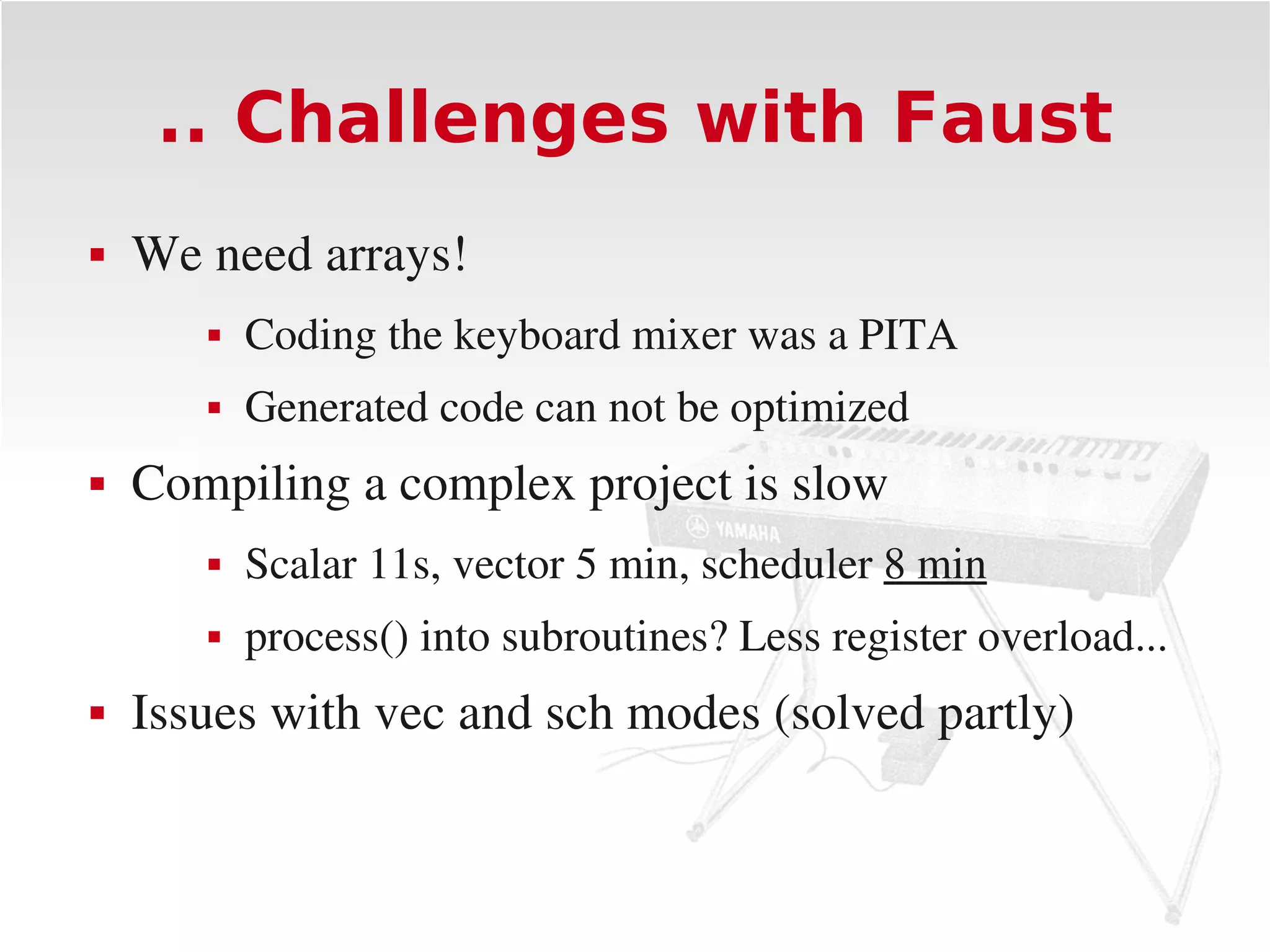
   We need arrays!
          Coding the keyboard mixer was a PITA
          Generated code can not be optimized
   Compiling a complex project is slow
          Scalar 11s, vector 5 min, scheduler 8 min
          process() into subroutines? Less register overload...
   Issues with vec and sch modes (solved partly)
.. Challenges with Faust
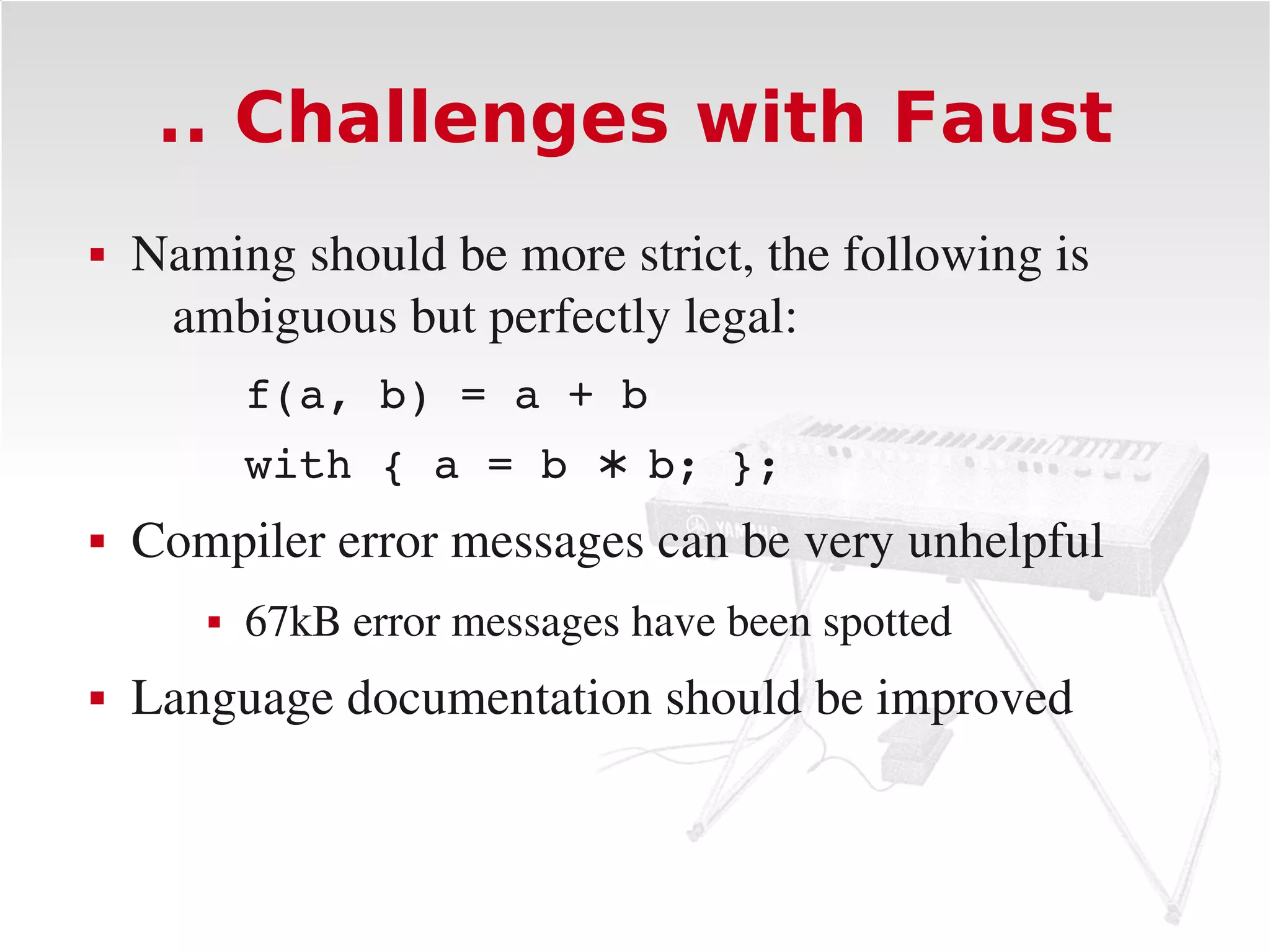
   Naming should be more strict, the following is 
     ambiguous but perfectly legal:
           f(a, b) = a + b
           with { a = b ∗ b; };
   Compiler error messages can be very unhelpful
          67kB error messages have been spotted
   Language documentation should be improved
Benefits of using Faust
   Functional programming is an excellent model for 
     signal processing
   Parallelization is the future!
   .. but realtime parallel programming requires a level 
       of expertise uncommon even for seasoned 
       programmers
           Let alone people whose career focus is in what these 
             programs actually do (the DSP)!
.. Benefits of using Faust
   Faust code is readable
   SVG output is a very helpful tool
   Code re­use is a reality
          Combining C/C++ modules from different sources 
            often requires refactoring or runtime data 
            conversion
… introducing
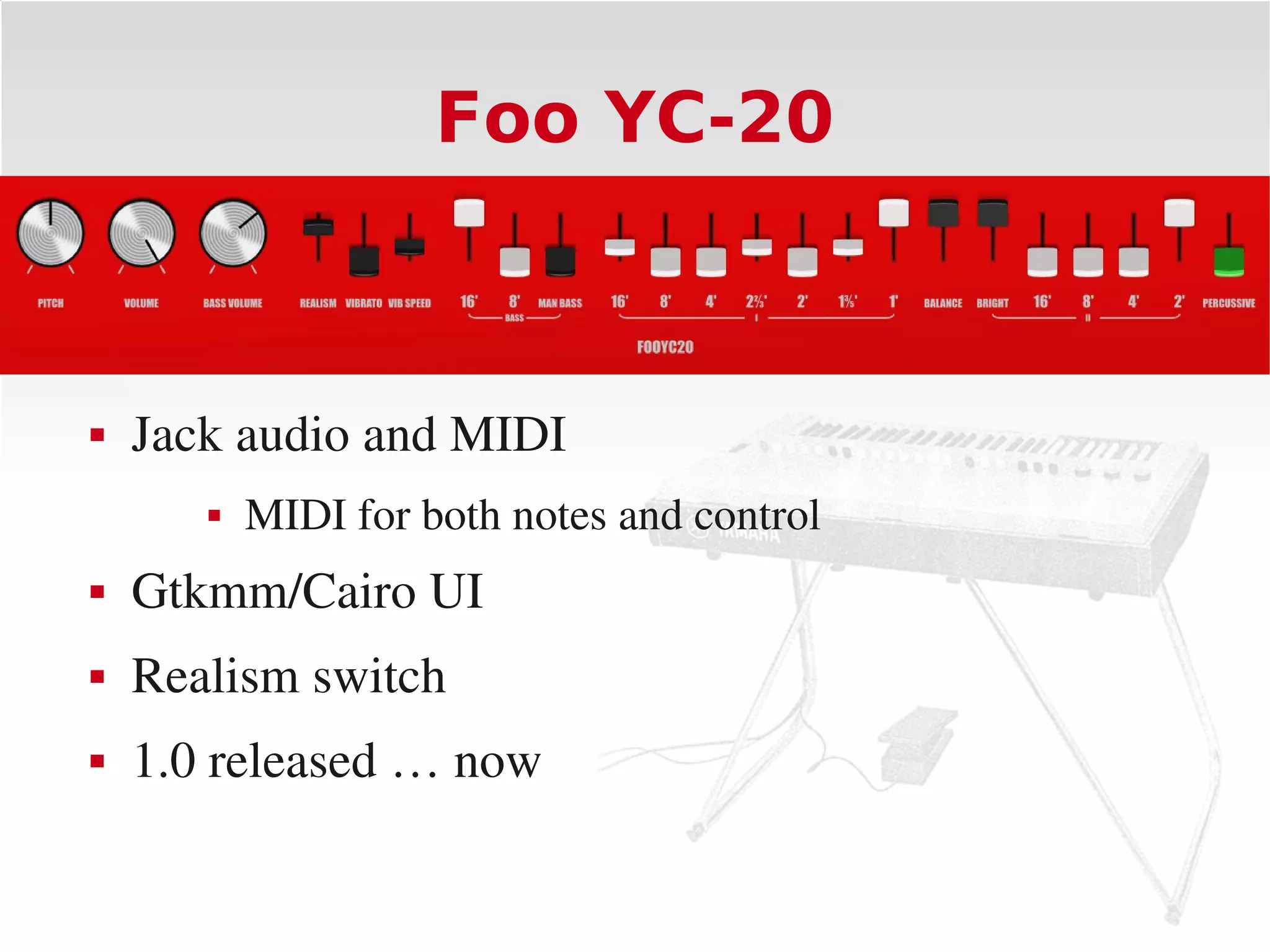
Foo YC-20


   Jack audio and MIDI
          MIDI for both notes and control
   Gtkmm/Cairo UI
   Realism switch
   1.0 released … now
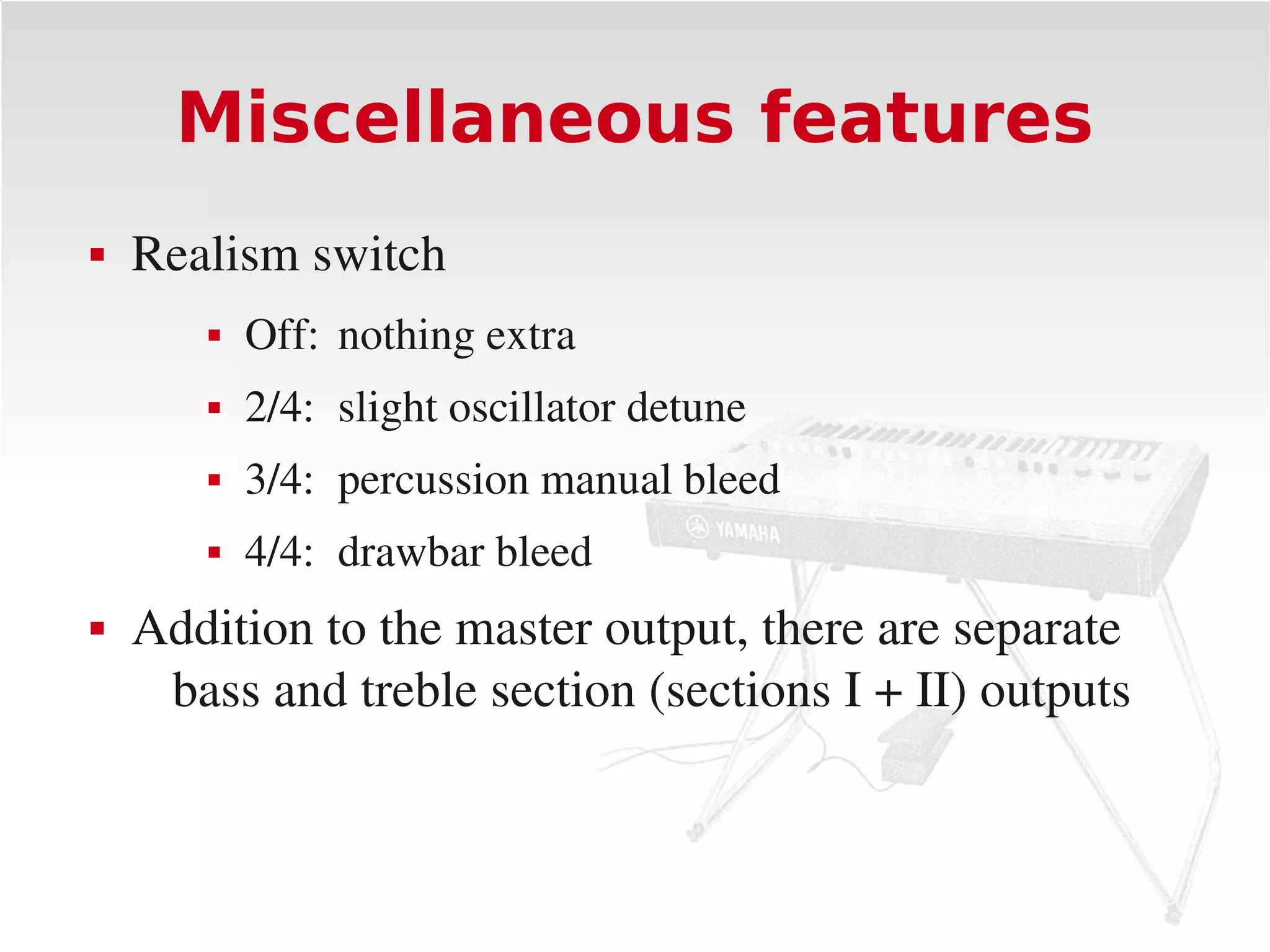
Miscellaneous features
   Realism switch
          Off: nothing extra
          2/4: slight oscillator detune
          3/4: percussion manual bleed
          4/4: drawbar bleed
   Addition to the master output, there are separate 
     bass and treble section (sections I + II) outputs
demo
Thanks for listening
   I would like to thank Petri Junno, Stéphane Letz, 
      Yann Orlarey, Thorsten Wilms, Torben Hohn, 
      Sakari Bergen, Edgar Aichinger


    http://code.google.com/p/foo­yc20

Emulating a Combo Organ Using Faust

  • 1.
    Emulating a comboorgan using Faust Sampo Savolainen LAC 2010 Utrecht
  • 3.
    Yamaha YC-20  Designed circa 1969  One manual, 61 keys  ”Levers” not actual drawbars  3 sections  Section I (5 + 2 drawbars)  Section II (4 drawbars) + brightness  Bass manual (2 drawbars, bottom 17 keys)  Percussive drawbar, vibrato, touch vibrato
  • 4.
  • 5.
    Faust  Functional AUdio STream  A functional programming language designed for  signal processing process(signal) = signal * input_gain : distortion; input_gain = vslider(”gain” ... ); distortion(signal) = tanh(signal);
  • 6.
    Faust  The Faust compiler produces C++ code  Jack client, LADSPA / VST plugin, etc.  Faust can optimize the generated code using  different methods:  Automatic vectorization (see LAC 2009)  OpenMP parallelization (see LAC 2009)  Work stealing scheduler (tomorrow at 12:15..)
  • 7.
    Why use Faust?  The divide­down architecture is 'always­on'  Instead of routability and controllability, this requires  a large number of parallel fixed processes  An organ synthesizer is DSP development, not CS  Helps keep focus on the processing  To try out Faust and test out the parallelization and  performance
  • 8.
    The organ emulation Not a polysynth but a generator + matrix mixer!  96 oscillators  204 RC filters  A matrix mixer (the keyboard)  Percussion envelope  Vibrato LFO  Mixing section
  • 9.
    Emulated architecture  No horizontal aftertouch in  MIDI keyboards  Pre­amp is just a mixer  Volume pedal can be done  externally
  • 10.
    Oscillators  Main oscillators produce sawtooth waves  Dividers are flip­flops: they produce rectangles  Oscillator anti­aliasing with PolyBLEPs  Välimäki and Huovilainen 2007  Not optimal quality but easy on the CPU  True BLEP would require FFT functions (will  probably be fixed)
  • 11.
    PolyBLEP and branching  Only two samples per discontinuity are reshaped  Faust does not branch: all branches of an 'if' statement  are always calculated  Thus the amount of PolyBLEPs/sec is a function of the  used sample rate  Required amount is a function of oscillator frequency  For a 500Hz rectangle at Fs=44.1k, not branching would  mean 352x PolyBLEPs per second than necessary  Had to be implemented in C++ instead of Faust
  • 12.
    Single osc +dividers  Common bias applies vibrato and pitch control  Each oscillator produces both the voice and phase  information  Dividers (marked RECT) contain a phase divisor and  a rectangle oscillator
  • 13.
    Wave transformer  Each generated voice is  filtered individually  Main oscillator is high­ passed  Divider outputs are  both low and high­ passed
  • 14.
    The keyboard  Each key is a seven contact switch (7PST)  Switches connect voices to bus bars  Enabling the bass switch separates the bass bus bars  from the main bus bars  Unconnected voices are filtered to emulate bleed  exhibited in the real instrument
  • 15.
    Voice sections  Section I is trivial: there is no extra filtering  Section II has a brightness control  Bus bars are separated into high­passed and low­ passed streams  Brightness controls a mix of the two  Bass manual drawbars are mixes of multiple bus bars  Not emulated perfectly – a simple lowpass is pretty  good though
  • 16.
    Comparison – SectionI  C2 played on 8' drawbar  Line marks analysis of  the emulation output  Crosses mark measured  harmonic peaks of the  real organ  Section I voices are  emulated nearly  perfectly
  • 17.
    Comparison – SectionII  C2 played on 8' drawbar,  full brightness  Measured at the same  overall volume  Harmonics are within  3dB  However, other notes  (C3 for example) line  up perfectly
  • 18.
    Performance  This much processing is inherently slow  But the design leaves much room for parallelization  … which Faust should be good at  Performance is sensitive to GCC flags
  • 19.
    Performance numbers Core2 T7400* Xeon** DSP usage DSP usage Scalar 53% 52% Vectorized 35% 41% Scheduler (2 cores) 25% 29% Scheduler (3 cores) - 23% Scheduler (4 cores) - 20% Measured while running at 2.7ms latency, Fs=48kHz, buffer size 128 *    2.16GHz Core2 T7400 running 32­bit Ubuntu 9.10 **  2 x 2Ghz Xeon dual core running 64­bit OS X 10.6.3
  • 20.
    Things to improve  Section II filters are not perfect  Bass manual circuit is not truly emulated  The keyboard matrix should emulate passive mixing  Voices connected to multiple bus bars  Voices connected to a single bus bar through many key  switches (for example harmonics)  Streamlining  Some filters might be unnecessary  Use lookup tables for oscillators
  • 21.
    Challenges with Faust  No true branches – PolyBLEP had to be implemented  in C++  Has been solved by compiling select() into true if()'s  Could be improved by identifying stateless functions  And generalized to further optimize functions like: t1(x) = (x > 0) t2(x) = x^2 ­ fmod(x, 1.0)  f(x) = t1(x) * t2(x)
  • 22.
    A single busbar bus_1 =  (key_c0*c5 + key_C0*C5 + key_d0*d5 + key_D0*D5 + key_e0*e5 + key_f0*f5 +           key_F0*F5 + key_g0*g5 + key_G0*G5 + key_a0*a5 + key_A0*A5 + key_b0*b5 +           key_c1*c6 + key_C1*C6 + key_d1*d6 + key_D1*D6 + key_e1*e6)         * (1.0 ­ bass_engaged)        + key_f1*f6 + key_F1*F6 + key_g1*g6 + key_G1*G6 + key_a1*a6 + key_A1*A6 +          key_b1*b6 + key_c2*c7 + key_C2*C7 + key_d2*d7 + key_D2*D7 + key_e2*e7 +          key_f2*f7 + key_F2*F7 + key_g2*g7 + key_G2*G7 + key_a2*a7 + key_A2*A7 +          key_b2*b7 + key_c3*c8 + key_C3*C8 + key_d3*d8 + key_D3*D8 + key_e3*e8 +          key_f3*f8 + key_F3*F8 + key_g3*g8 + key_G3*G8 + key_a3*a8 + key_A3*A8 +          key_b3*b8 + key_c4*c8 + key_C4*C8 + key_d4*d8 + key_D4*D8 + key_e4*e8 +          key_f4*f8 + key_F4*F8 + key_g4*g8 + key_G4*G8 + key_a4*a8 + key_A4*A8 +          key_b4*b8 + key_c5*c8; bus_1_all =  (c5 + C5 + d5 + D5 + e5 + f5 + F5 + g5 + G5 + a5 + A5 + b5             + c6 + C6 + d6 + D6 + e6) * (1.0 ­ bass_engaged)                                      + f6 + F6 + g6 + G6 + a6 + A6 + b6             + c7 + C7 + d7 + D7 + e7 + f7 + F7 + g7 + G7 + a7 + A7 + b7             + c8 + C8 + d8 + D8 + e8 + f8 + F8 + g8 + G8 + a8 + A8 + b8             + c8 + C8 + d8 + D8 + e8 + f8 + F8 + g8 + G8 + a8 + A8 + b8             + c8; bus_1_bleed = bus_1_all ­ bus_1 : bus_bleed_filter : apply_realism;
  • 23.
    .. Challenges withFaust  We need arrays!  Coding the keyboard mixer was a PITA  Generated code can not be optimized  Compiling a complex project is slow  Scalar 11s, vector 5 min, scheduler 8 min  process() into subroutines? Less register overload...  Issues with vec and sch modes (solved partly)
  • 24.
    .. Challenges withFaust  Naming should be more strict, the following is  ambiguous but perfectly legal: f(a, b) = a + b with { a = b ∗ b; };  Compiler error messages can be very unhelpful  67kB error messages have been spotted  Language documentation should be improved
  • 25.
    Benefits of usingFaust  Functional programming is an excellent model for  signal processing  Parallelization is the future!  .. but realtime parallel programming requires a level  of expertise uncommon even for seasoned  programmers  Let alone people whose career focus is in what these  programs actually do (the DSP)!
  • 26.
    .. Benefits ofusing Faust  Faust code is readable  SVG output is a very helpful tool  Code re­use is a reality  Combining C/C++ modules from different sources  often requires refactoring or runtime data  conversion
  • 27.
  • 28.
    Foo YC-20  Jack audio and MIDI  MIDI for both notes and control  Gtkmm/Cairo UI  Realism switch  1.0 released … now
  • 29.
    Miscellaneous features  Realism switch  Off: nothing extra  2/4: slight oscillator detune  3/4: percussion manual bleed  4/4: drawbar bleed  Addition to the master output, there are separate  bass and treble section (sections I + II) outputs
  • 30.
  • 31.
    Thanks for listening  I would like to thank Petri Junno, Stéphane Letz,  Yann Orlarey, Thorsten Wilms, Torben Hohn,  Sakari Bergen, Edgar Aichinger http://code.google.com/p/foo­yc20