ELECTRICAL CURRENT
MS. DIAH
ELECTRICAL CURRENT
• We cannot see electricity but we can
observe its effects
• Think about the circuit you have built.
When the circuit is closed the light
bulb glows
• The fact that the lamp lights up
shows us that the electricity has to
travel from the battery along the
wires and through the lamp in order
to make it work
ELECTRICAL CURRENT
• THE FLOW of electricity through the circuit is called
an electric current.
• We cannot see the current , so we have to use
models to describe how it flows.
• You can think of an electric current as a flow of tiny
PARTICLES (CALLED ELECTRONS) though the
wire
• If you were small enough to stand inside the wire,
you would experience the current as a movement of
many tiny particles flying past you. You and the
particles that make up the wire would be still while
the current flowed past.
ELECTRICAL CURRENT
• The circuit is a loop.
• The current travels around the circuit continuously
until you break the circuit.
• This means that the current flows from the battery,
around the circuit and back to the battery.
• The battery acts like a pump to push electrons
around the circuit
ELECTRICAL CURRENT - BASIC
• The basic concept of current is that it is the movement of
electrons within a substance. Electrons are minute particles that
exist as part of the molecular structure of materials. Sometimes
these electrons are held tightly within the molecules and other
times they are held loosely and they are able to move around the
structure relatively freely.
• One very important point to note about the electrons is that they
are charged particles - they carry a negative charge. If they move
then an amount of charge moves and this is called current.
• It is also worth noting that the number of electrons that able to
move governs the ability of a particular substance to conduct
electricity. Some materials allow current to move better than
others.
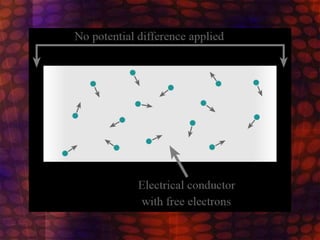
• The motion of the free electrons is normally very haphazard - it
is random - as many electrons move in one direction as in
another and as a result there is no overall movement of charge.
ELECTRICAL CURRENT - BASIC
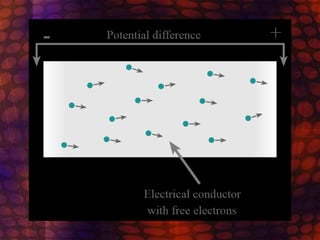
• If a force acts on the electrons to move them in a particular direction,
then they will all drift in the same direction, although still in a
somewhat haphazard fashion, but there is an overall movement in
one direction.
• The force that acts on the electrons is called and electromotive force,
or EMF, and its quantity is voltage measured in volts.
• To gain a little more understanding about what current is and how it
acts in a conductor, it can be compared to water flow in a pipe. There
are limitations to this comparison, but it serves as a very basic
illustration of current and current flow.
• The current can be considered to be like water flowing through a pipe.
When pressure is placed on one end it forces the water to move in
one direction and flow through the pipe. The amount of water flow is
proportional to the pressure placed on the end. The pressure or force
placed on the end can be likened to the electro-motive force.
Conventional current and electron flow
• There is often a lot of misunderstanding
about conventional current flow and electron
flow. This can be a little confusing at first but
it is really quite straightforward.
• The particles that carry charge along
conductors are free electrons. The electric
field direction within a circuit is by definition
the direction that positive test charges are
pushed. Thus, these negatively charged
electrons move in the direction opposite the
electric field.
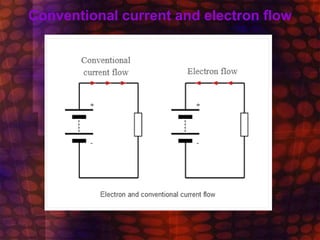
Conventional current and electron flow
IN SUMMARY
• Conventional current flow: The
conventional current flow is from positive
to the negative terminal and indicates the
direction that positive charges would flow.
• Electron flow: The electron flow is from
negative to positive terminal. Electrons are
negatively charged and are therefore
attracted to the positive terminal as unlike
charges attract.
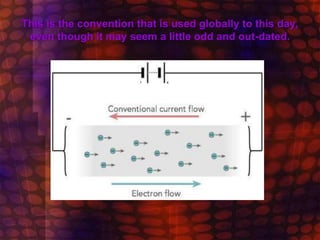
This is the convention that is used globally to this day,
even though it may seem a little odd and out-dated.

17. electrical current p4

  • 1.
  • 2.
    ELECTRICAL CURRENT • Wecannot see electricity but we can observe its effects • Think about the circuit you have built. When the circuit is closed the light bulb glows • The fact that the lamp lights up shows us that the electricity has to travel from the battery along the wires and through the lamp in order to make it work
  • 3.
    ELECTRICAL CURRENT • THEFLOW of electricity through the circuit is called an electric current. • We cannot see the current , so we have to use models to describe how it flows. • You can think of an electric current as a flow of tiny PARTICLES (CALLED ELECTRONS) though the wire • If you were small enough to stand inside the wire, you would experience the current as a movement of many tiny particles flying past you. You and the particles that make up the wire would be still while the current flowed past.
  • 4.
    ELECTRICAL CURRENT • Thecircuit is a loop. • The current travels around the circuit continuously until you break the circuit. • This means that the current flows from the battery, around the circuit and back to the battery. • The battery acts like a pump to push electrons around the circuit
  • 5.
    ELECTRICAL CURRENT -BASIC • The basic concept of current is that it is the movement of electrons within a substance. Electrons are minute particles that exist as part of the molecular structure of materials. Sometimes these electrons are held tightly within the molecules and other times they are held loosely and they are able to move around the structure relatively freely. • One very important point to note about the electrons is that they are charged particles - they carry a negative charge. If they move then an amount of charge moves and this is called current. • It is also worth noting that the number of electrons that able to move governs the ability of a particular substance to conduct electricity. Some materials allow current to move better than others. • The motion of the free electrons is normally very haphazard - it is random - as many electrons move in one direction as in another and as a result there is no overall movement of charge.
  • 7.
    ELECTRICAL CURRENT -BASIC • If a force acts on the electrons to move them in a particular direction, then they will all drift in the same direction, although still in a somewhat haphazard fashion, but there is an overall movement in one direction. • The force that acts on the electrons is called and electromotive force, or EMF, and its quantity is voltage measured in volts. • To gain a little more understanding about what current is and how it acts in a conductor, it can be compared to water flow in a pipe. There are limitations to this comparison, but it serves as a very basic illustration of current and current flow. • The current can be considered to be like water flowing through a pipe. When pressure is placed on one end it forces the water to move in one direction and flow through the pipe. The amount of water flow is proportional to the pressure placed on the end. The pressure or force placed on the end can be likened to the electro-motive force.
  • 9.
    Conventional current andelectron flow • There is often a lot of misunderstanding about conventional current flow and electron flow. This can be a little confusing at first but it is really quite straightforward. • The particles that carry charge along conductors are free electrons. The electric field direction within a circuit is by definition the direction that positive test charges are pushed. Thus, these negatively charged electrons move in the direction opposite the electric field.
  • 10.
  • 11.
    IN SUMMARY • Conventionalcurrent flow: The conventional current flow is from positive to the negative terminal and indicates the direction that positive charges would flow. • Electron flow: The electron flow is from negative to positive terminal. Electrons are negatively charged and are therefore attracted to the positive terminal as unlike charges attract.
  • 12.
    This is theconvention that is used globally to this day, even though it may seem a little odd and out-dated.