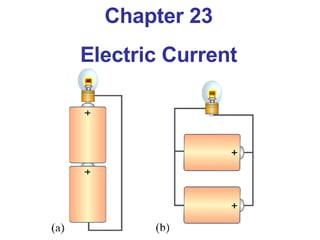
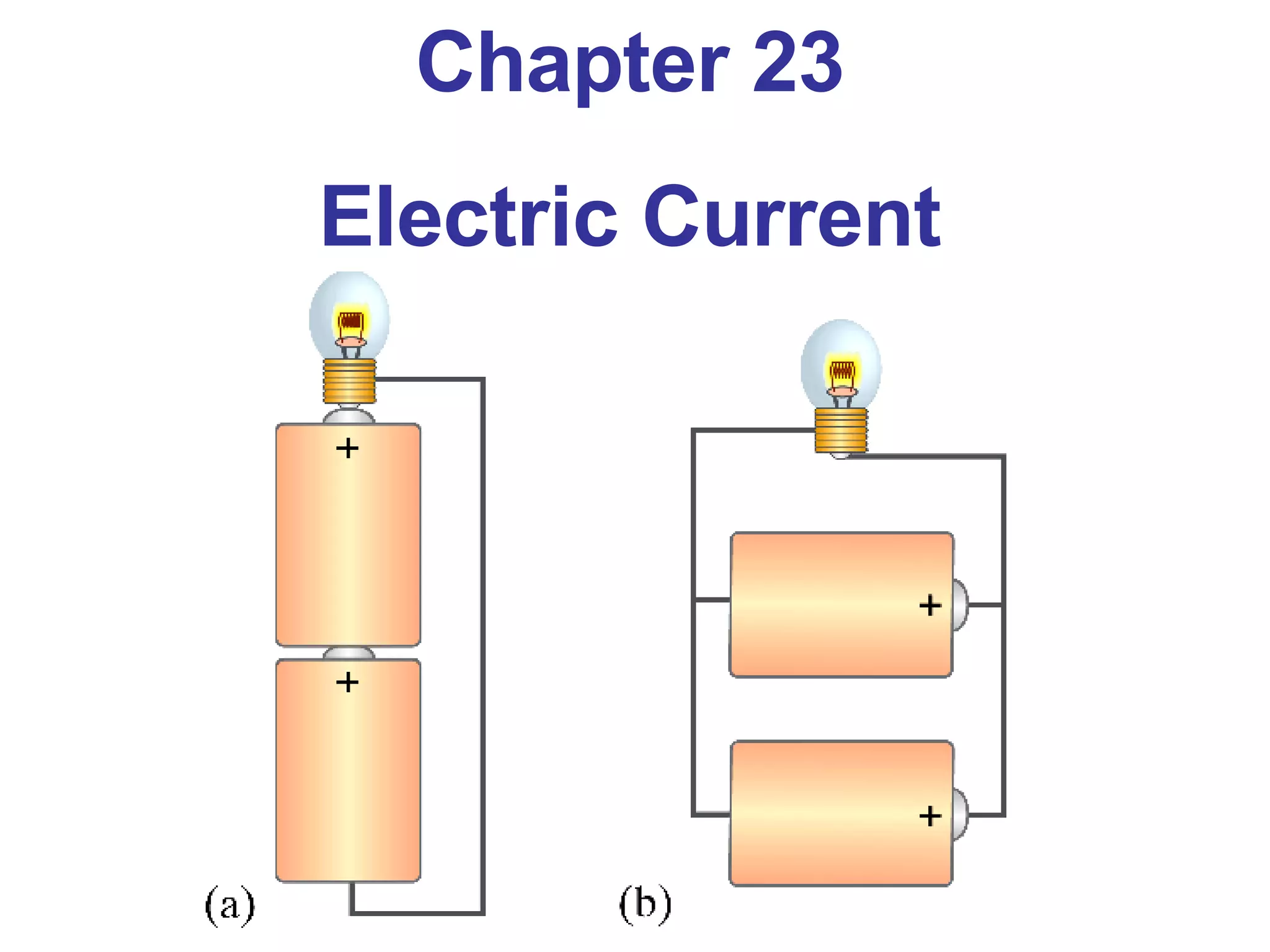
Chapter 23 Electric Current
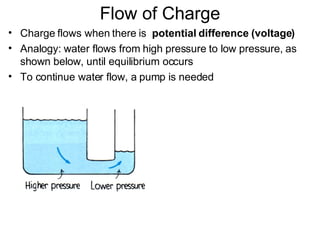
Flow of Charge Charge flows when there is  potential difference (voltage) Analogy: water flows from high pressure to low pressure, as shown below, until equilibrium occurs To continue water flow, a pump is needed
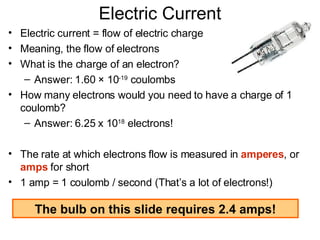
Electric Current Electric current = flow of electric charge Meaning, the flow of electrons What is the charge of an electron? Answer: 1.60 × 10 -19  coulombs How many electrons would you need to have a charge of 1 coulomb? Answer: 6.25 x 10 18  electrons! The rate at which electrons flow is measured in  amperes , or  amps  for short 1 amp = 1 coulomb / second (That’s a lot of electrons!) The bulb on this slide requires 2.4 amps!
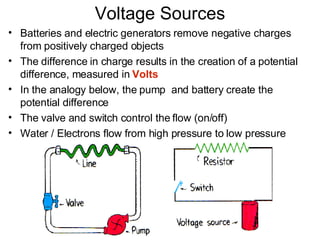
Voltage Sources Batteries and electric generators remove negative charges from positively charged objects The difference in charge results in the creation of a potential difference, measured in  Volts In the analogy below, the pump  and battery create the potential difference The valve and switch control the flow (on/off) Water / Electrons flow from high pressure to low pressure
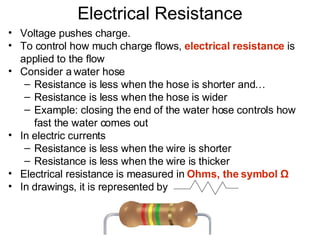
Electrical Resistance Voltage pushes charge. To control how much charge flows,  electrical resistance  is applied to the flow Consider a water hose Resistance is less when the hose is shorter and… Resistance is less when the hose is wider Example: closing the end of the water hose controls how fast the water comes out In electric currents Resistance is less when the wire is shorter Resistance is less when the wire is thicker Electrical resistance is measured in  Ohms, the symbol  Ω In drawings, it is represented by
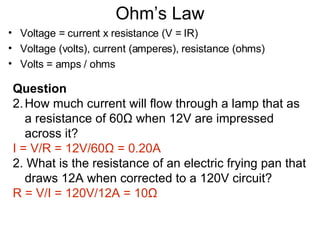
Ohm’s Law Voltage = current x resistance (V = IR) Voltage (volts), current (amperes), resistance (ohms) Volts = amps / ohms Question How much current will flow through a lamp that as a resistance of 60 Ω  when 12V are impressed across it? I = V/R = 12V/60 Ω  = 0.20A 2. What is the resistance of an electric frying pan that draws 12A when corrected to a 120V circuit? R = V/I = 120V/12A = 10 Ω
End of Part 1

Electric Current

  • 1.
  • 2.
    Flow of ChargeCharge flows when there is potential difference (voltage) Analogy: water flows from high pressure to low pressure, as shown below, until equilibrium occurs To continue water flow, a pump is needed
  • 3.
    Electric Current Electriccurrent = flow of electric charge Meaning, the flow of electrons What is the charge of an electron? Answer: 1.60 × 10 -19 coulombs How many electrons would you need to have a charge of 1 coulomb? Answer: 6.25 x 10 18 electrons! The rate at which electrons flow is measured in amperes , or amps for short 1 amp = 1 coulomb / second (That’s a lot of electrons!) The bulb on this slide requires 2.4 amps!
  • 4.
    Voltage Sources Batteriesand electric generators remove negative charges from positively charged objects The difference in charge results in the creation of a potential difference, measured in Volts In the analogy below, the pump and battery create the potential difference The valve and switch control the flow (on/off) Water / Electrons flow from high pressure to low pressure
  • 5.
    Electrical Resistance Voltagepushes charge. To control how much charge flows, electrical resistance is applied to the flow Consider a water hose Resistance is less when the hose is shorter and… Resistance is less when the hose is wider Example: closing the end of the water hose controls how fast the water comes out In electric currents Resistance is less when the wire is shorter Resistance is less when the wire is thicker Electrical resistance is measured in Ohms, the symbol Ω In drawings, it is represented by
  • 6.
    Ohm’s Law Voltage= current x resistance (V = IR) Voltage (volts), current (amperes), resistance (ohms) Volts = amps / ohms Question How much current will flow through a lamp that as a resistance of 60 Ω when 12V are impressed across it? I = V/R = 12V/60 Ω = 0.20A 2. What is the resistance of an electric frying pan that draws 12A when corrected to a 120V circuit? R = V/I = 120V/12A = 10 Ω
  • 7.