Employee Welfare
Introduction
The Oxford Dictionary defines labour welfare as “efforts to make life worth
living for worker.”
Employee or labour welfare is a comprehensive term including various
services, benefits and facilities offered to employees by the employer.
According to Dr Parandikar, “Labour welfare work is work for improving
the health, safety and general well-being and the industrial efficiency of
the workers beyond the minimum standard laid down by labour
legislation”.
Agencies for Welfare Work
Labour welfare work may be statutory, voluntary or mutual.
There are several agencies involved in labour welfare work.
Central Government
State Governments
Employers
Trade Unions
Other Agencies
Types of Welfare Facilities Given by
ILO
Intramural
Intramural
Drinking water
Toilets
Crèches
Washing and bathing facilities
Rest shelters
Uniforms and protective clothing
Recreation facilities
Canteens
Subsidised food
Medical aid
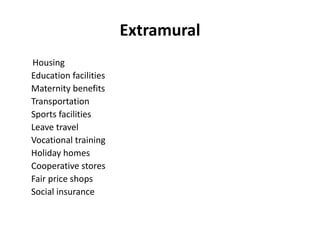
Extramural
Housing
Education facilities
Maternity benefits
Transportation
Sports facilities
Leave travel
Vocational training
Holiday homes
Cooperative stores
Fair price shops
Social insurance
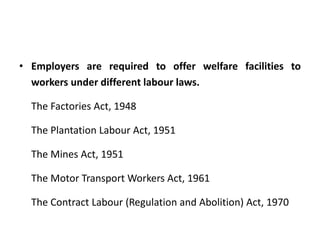
• Employers are required to offer welfare facilities to
workers under different labour laws.
The Factories Act, 1948
The Plantation Labour Act, 1951
The Mines Act, 1951
The Motor Transport Workers Act, 1961
The Contract Labour (Regulation and Abolition) Act, 1970
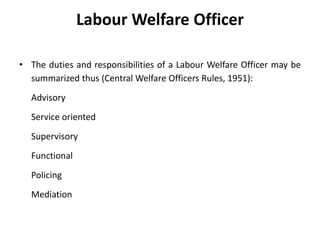
Labour Welfare Officer
• The duties and responsibilities of a Labour Welfare Officer may be
summarized thus (Central Welfare Officers Rules, 1951):
Advisory
Service oriented
Supervisory
Functional
Policing
Mediation

Employee welfare l18

  • 1.
  • 2.
    Introduction The Oxford Dictionarydefines labour welfare as “efforts to make life worth living for worker.” Employee or labour welfare is a comprehensive term including various services, benefits and facilities offered to employees by the employer. According to Dr Parandikar, “Labour welfare work is work for improving the health, safety and general well-being and the industrial efficiency of the workers beyond the minimum standard laid down by labour legislation”.
  • 3.
    Agencies for WelfareWork Labour welfare work may be statutory, voluntary or mutual. There are several agencies involved in labour welfare work. Central Government State Governments Employers Trade Unions Other Agencies
  • 4.
    Types of WelfareFacilities Given by ILO Intramural Intramural Drinking water Toilets Crèches Washing and bathing facilities Rest shelters Uniforms and protective clothing Recreation facilities Canteens Subsidised food Medical aid
  • 5.
    Extramural Housing Education facilities Maternity benefits Transportation Sportsfacilities Leave travel Vocational training Holiday homes Cooperative stores Fair price shops Social insurance
  • 6.
    • Employers arerequired to offer welfare facilities to workers under different labour laws. The Factories Act, 1948 The Plantation Labour Act, 1951 The Mines Act, 1951 The Motor Transport Workers Act, 1961 The Contract Labour (Regulation and Abolition) Act, 1970
  • 7.
    Labour Welfare Officer •The duties and responsibilities of a Labour Welfare Officer may be summarized thus (Central Welfare Officers Rules, 1951): Advisory Service oriented Supervisory Functional Policing Mediation