


What is Employee Engagement?
ď‚— William Kahn provided the first formal definition of
employee engagement as "the harnessing of organisation
members' selves to their work roles; in engagement, people
employ and express themselves physically, cognitively, and
emotionally during role performances." Kahn (1990).
ď‚— Employee engagement is a property of the
relationship between an organization and its employees.
An "engaged employee" is one who is fully absorbed by and
enthusiastic about their work and so takes positive action
to further the organisation's reputation and interests.
Definitions
ď‚— In 1993, Schmidt et al. proposed a bridge between the pre-
existing concept of 'job satisfaction' and employee engagement
with the definition: "an employee's involvement with,
commitment to, and satisfaction with work. Employee
engagement is a part of employee retention." This definition
integrates the classic constructs of job satisfaction (Smith et al.,
1969), and organizational commitment (Meyer & Allen, 1991).
ď‚— Definitions of engagement vary in the weight they give to the
individual vs the organisation in creating engagement. Recent
practice has situated the drivers of engagement across this
spectrum, from within the psyche of the individual employee to
focusing mainly on the actions and investments the organisation
makes to support engagement.
According to legend, an engaged janitorial employee at NASA,
when asked what he was doing, is said to have replied "I'm helping
to put a man on the Moon".
Correlates
ď‚— Prior to the mid-1990s, a series of concepts relating to
employee morale, work ethic, productivity and motivation
had been investigated in management theory, in a line
dating back to the work of Mary Parker Follett in the early
1920s. See for example the work of Frederick Herzberg, who
concluded that positive motivation is driven by managers
giving their employees developmental opportunities,
activity he termed 'vertical enrichment'.
ď‚— With the wide range of definitions of employee
engagement come a wide range of identified causes and
effects.
Involvement
ď‚— Eileen Appelbaum and her colleagues (2000) studied 15 steel mills, 17
apparel manufacturers, and 10 electronic instrument and imaging
equipment producers. Their purpose was to compare traditional
production systems with flexible high-performance production
systems involving teams, training, and incentive pay systems. In all
three industries, the plants utilizing high-involvement practices
showed superior performance. The concept has gained popularity as
various studies have demonstrated links with productivity. It is often
linked to the notion of employee voice and empowerment.
Commitment
ď‚— Employees with the highest level of commitment
perform 20% better and are 87% less likely to leave the
organization, which indicates that engagement is
linked to organizational performance.
Productivity
ď‚— In a study of professional service firms, the Hay Group
found that offices with engaged employees were up to
43% more productive. Job satisfaction is also linked to
productivity.
Generating engagement
ď‚— Some points from research into drivers of engagement are
presented below:
ď‚— Employee perceptions of job importance
ď‚— Employee clarity of job expectations
ď‚— Career advancement / improvement opportunities
ď‚— Regular feedback and dialogue with superiors
ď‚— Quality of working relationships with peers,
superiors, and subordinates
ď‚— Effective internal employee communications
ď‚— Perceptions of the ethos and values of the
organization
Hazards
ď‚— Methodological
ď‚— Ethical
ď‚— Externalities
ď‚— Administrative
How is employee engagement measured?
Employee engagement is typically measured using an
employee engagement survey that has been developed
specifically for this purpose. Employee engagement
surveys must be statistically validated and
benchmarked against other organizations if they are
going to provide useful results.
Engagement can be accurately measured with short
surveys that contain just a few questions, but such
short surveys can only provide an indication of
whether employees are engaged. They have a hard
time explaining why employees are engaged or
disengaged because they lack detail.
Components of employee
engagement
ď‚— There are two primary factors that drive employee
engagement. These factors are based on statistical analysis
and widely supported by industry research.
ď‚— Engagement with The Organization measures how
engaged employees are with the organization as a whole,
and by extension, how they feel about senior management.
This factor has to do with confidence in organizational
leadership as well as trust, fairness, values, and respect - i.e.
how people like to be treated by others, both at work and
outside of work.
Beyond Engagement
ď‚— An organization needs more than just engaged
employees in order to succeed. There are two
additional areas that relate to employee
performance and that are closely linked to
engagement.
ď‚— Competency: Do managers have the skills needed to
get the job done? Do they display the behaviors
needed to motivate employees?
Competency is measured as part of the employee
survey using our “upward feedback” module, or it can
be measured via360 Degree Feedback.
WHAT IS EMPLOYEE ENGAGEMENT?
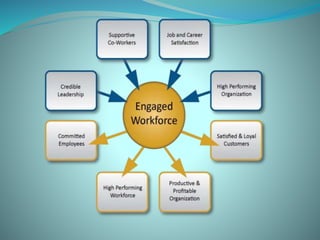
ď‚— Employee engagement is a workplace approach designed to
ensure that employees are committed to their
organisation’s goals and values, motivated to contribute to
organisational success, and are able at the same time to
enhance their own sense of well-being.
 “This is about how we create the conditions in which
employees offer more of their capability and potential.” –
David Macleod.
ď‚— There are differences between attitude, behaviour and
outcomes in terms of engagement. An employee might feel
pride and loyalty ; be a great advocate of their company to
clients, or go the extra mile to finish a piece of work.
THANK YOU

Employee Engagement

  • 1.
    What is EmployeeEngagement? ď‚— William Kahn provided the first formal definition of employee engagement as "the harnessing of organisation members' selves to their work roles; in engagement, people employ and express themselves physically, cognitively, and emotionally during role performances." Kahn (1990). ď‚— Employee engagement is a property of the relationship between an organization and its employees. An "engaged employee" is one who is fully absorbed by and enthusiastic about their work and so takes positive action to further the organisation's reputation and interests.
  • 2.
    Definitions ď‚— In 1993,Schmidt et al. proposed a bridge between the pre- existing concept of 'job satisfaction' and employee engagement with the definition: "an employee's involvement with, commitment to, and satisfaction with work. Employee engagement is a part of employee retention." This definition integrates the classic constructs of job satisfaction (Smith et al., 1969), and organizational commitment (Meyer & Allen, 1991). ď‚— Definitions of engagement vary in the weight they give to the individual vs the organisation in creating engagement. Recent practice has situated the drivers of engagement across this spectrum, from within the psyche of the individual employee to focusing mainly on the actions and investments the organisation makes to support engagement.
  • 3.
    According to legend,an engaged janitorial employee at NASA, when asked what he was doing, is said to have replied "I'm helping to put a man on the Moon".
  • 4.
    Correlates ď‚— Prior tothe mid-1990s, a series of concepts relating to employee morale, work ethic, productivity and motivation had been investigated in management theory, in a line dating back to the work of Mary Parker Follett in the early 1920s. See for example the work of Frederick Herzberg, who concluded that positive motivation is driven by managers giving their employees developmental opportunities, activity he termed 'vertical enrichment'. ď‚— With the wide range of definitions of employee engagement come a wide range of identified causes and effects.
  • 5.
    Involvement ď‚— Eileen Appelbaumand her colleagues (2000) studied 15 steel mills, 17 apparel manufacturers, and 10 electronic instrument and imaging equipment producers. Their purpose was to compare traditional production systems with flexible high-performance production systems involving teams, training, and incentive pay systems. In all three industries, the plants utilizing high-involvement practices showed superior performance. The concept has gained popularity as various studies have demonstrated links with productivity. It is often linked to the notion of employee voice and empowerment.
  • 6.
    Commitment ď‚— Employees withthe highest level of commitment perform 20% better and are 87% less likely to leave the organization, which indicates that engagement is linked to organizational performance.
  • 7.
    Productivity ď‚— In astudy of professional service firms, the Hay Group found that offices with engaged employees were up to 43% more productive. Job satisfaction is also linked to productivity.
  • 8.
    Generating engagement ď‚— Somepoints from research into drivers of engagement are presented below: ď‚— Employee perceptions of job importance ď‚— Employee clarity of job expectations ď‚— Career advancement / improvement opportunities ď‚— Regular feedback and dialogue with superiors ď‚— Quality of working relationships with peers, superiors, and subordinates ď‚— Effective internal employee communications ď‚— Perceptions of the ethos and values of the organization
  • 9.
    Hazards ď‚— Methodological ď‚— Ethical ď‚—Externalities ď‚— Administrative
  • 11.
    How is employeeengagement measured? Employee engagement is typically measured using an employee engagement survey that has been developed specifically for this purpose. Employee engagement surveys must be statistically validated and benchmarked against other organizations if they are going to provide useful results. Engagement can be accurately measured with short surveys that contain just a few questions, but such short surveys can only provide an indication of whether employees are engaged. They have a hard time explaining why employees are engaged or disengaged because they lack detail.
  • 12.
    Components of employee engagement ď‚—There are two primary factors that drive employee engagement. These factors are based on statistical analysis and widely supported by industry research. ď‚— Engagement with The Organization measures how engaged employees are with the organization as a whole, and by extension, how they feel about senior management. This factor has to do with confidence in organizational leadership as well as trust, fairness, values, and respect - i.e. how people like to be treated by others, both at work and outside of work.
  • 13.
    Beyond Engagement  Anorganization needs more than just engaged employees in order to succeed. There are two additional areas that relate to employee performance and that are closely linked to engagement.  Competency: Do managers have the skills needed to get the job done? Do they display the behaviors needed to motivate employees? Competency is measured as part of the employee survey using our “upward feedback” module, or it can be measured via360 Degree Feedback.
  • 14.
    WHAT IS EMPLOYEEENGAGEMENT?  Employee engagement is a workplace approach designed to ensure that employees are committed to their organisation’s goals and values, motivated to contribute to organisational success, and are able at the same time to enhance their own sense of well-being.  “This is about how we create the conditions in which employees offer more of their capability and potential.” – David Macleod.  There are differences between attitude, behaviour and outcomes in terms of engagement. An employee might feel pride and loyalty ; be a great advocate of their company to clients, or go the extra mile to finish a piece of work.
  • 15.