Emotions
What is Emotion?
Internal conscious states that we infer in
ourselves and others.
• Emotions are private experiences.
• We use operational definitions
because we cannot actually see
feelings.
• We infer observable behavior
associated with emotion.
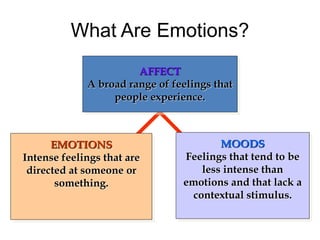
What Are Emotions?
MOODS
Feelings that tend to be
less intense than
emotions and that lack a
contextual stimulus.
EMOTIONS
Intense feelings that are
directed at someone or
something.
AFFECT
A broad range of feelings that
people experience.
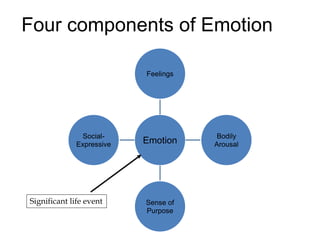
Four components of Emotion
Emotion
Feelings
Bodily
Arousal
Sense of
Purpose
Social-
Expressive
Significant life event
Feeling component
• Emotions are subjective feelings
• Make us feel in a particular way.
• Anger or joy.
• Meaning and personal significance.
• Vary in intensity and quality.
• Rooted in mental processes (labeling).
Bodily Arousal
• Biological activation.
• Autonomic and hormonal systems.
• Prepare and activate adaptive coping behavior
during emotion.
• Body prepared for action.
• Alert posture, clenched fists.
Purposive component
• Give emotion its goal-directed force.
• Motivation to take action.
• Cope with emotion-causing circumstances.
• Why people benefit from emotions.
• Social and evolutionary advantage.
Social-Expressive component
• Emotion’s communicative aspect.
• Postures, gestures, vocalizations, facial
expressions make our emotions public.
• Verbal and nonverbal communication.
• Helps us interpret the situation.
• How person reacts to event.
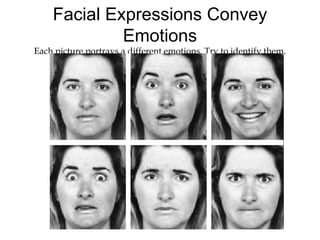
Facial Expressions Convey
Emotions
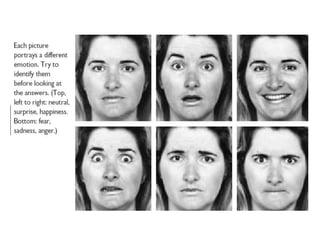
Each picture portrays a different emotions. Try to identify them.
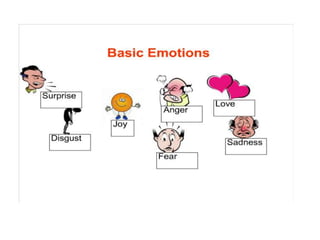
Types of emotion-
• Anticipatory emotions- Desire, fear
• Outcome emotions-Happiness, sadness, anxiety,
regret, relief
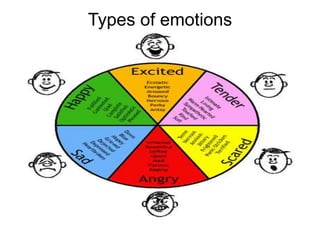
Types of emotions
EMOTION DIMENSIONS
• VARIETY OF EMOTIONS:
– POSITIVE HUMAN EMOTIONS
– NEGATIVE HUMAN EMOTIONS
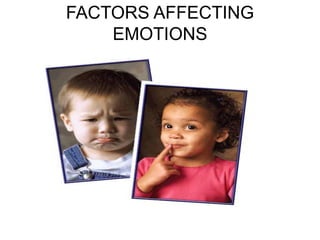
FACTORS AFFECTING
EMOTIONS
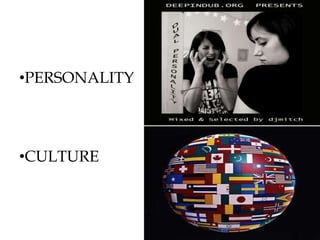
•PERSONALITY
•CULTURE
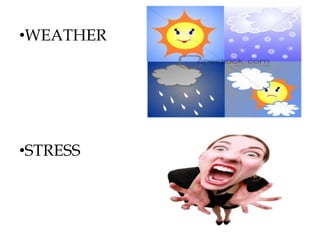
•WEATHER
•STRESS
•AGE
•GENDER
•ENVIRONMENTAL
•MARITAL RELATION
•ORGANIZATIONAL
•SOCIAL
Emotional labor
• Emotional labor is a form of emotional regulation
wherein workers are expected to display certain
emotions as part of their job, and to promote
organizational goals.
• The intended effects of these emotional displays
are on other, targeted people, who can be clients,
customers, subordinates or co-workers
Emotional intelligence
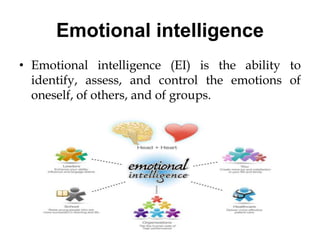
• Emotional intelligence (EI) is the ability to
identify, assess, and control the emotions of
oneself, of others, and of groups.
Four Components of Emotional
Intelligence
• There are four fundamental aspects of EI
– Self-Awareness,
– Self-Management,
– Social Awareness and
– Relationship Management.
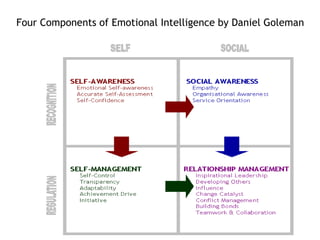
Four Components of Emotional Intelligence by Daniel Goleman
Components of EI
• Self-awareness – The ability to recognize your own
emotions and how they affect your thoughts and
behavior, know your strengths and weaknesses, and
have self-confidence.
• Self-management – The ability to control impulsive
feelings and behaviors, manage your emotions in
healthy ways, take initiative, follow through on
commitments, and adapt to changing circumstances.
Components of EI
• Social awareness – The ability to understand the emotions,
needs, and concerns of other people, pick up on emotional
cues, feel comfortable socially, and recognize the power
dynamics in a group or organization.
• Relationship management – The ability to develop and
maintain good relationships, communicate clearly, inspire
and influence others, work well in a team, and manage
conflict.
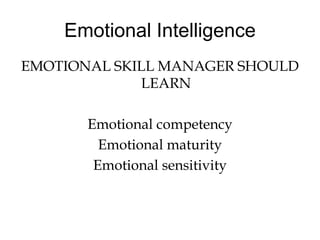
Emotional Intelligence
EMOTIONAL SKILL MANAGER SHOULD
LEARN
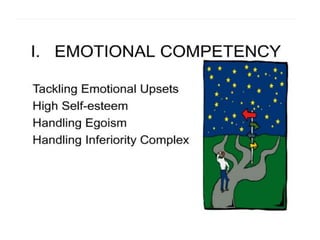
Emotional competency
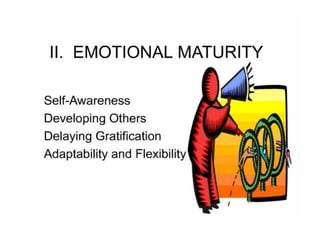
Emotional maturity
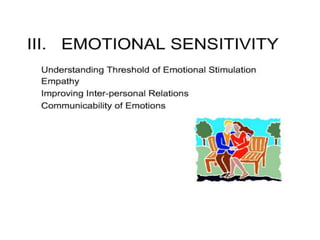
Emotional sensitivity
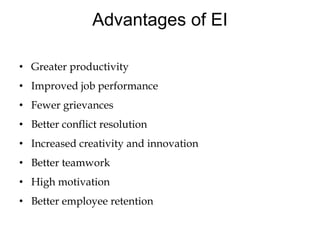
Advantages of EI
• Greater productivity
• Improved job performance
• Fewer grievances
• Better conflict resolution
• Increased creativity and innovation
• Better teamwork
• High motivation
• Better employee retention
Arguments of Emotional
Intelligence
For
• Intuitive appeal
• Emotional intelligence predicts criteria that
matters
• Emotional intelligence is biologically based
Against
• Emotional intelligence is too vague
• Emotional intelligence can’t be measured
• The validity of emotional intelligence is suspect
Thank U…….

5.5 Emotions & Moods.pptx

  • 1.
  • 2.
    What is Emotion? Internalconscious states that we infer in ourselves and others. • Emotions are private experiences. • We use operational definitions because we cannot actually see feelings. • We infer observable behavior associated with emotion.
  • 3.
    What Are Emotions? MOODS Feelingsthat tend to be less intense than emotions and that lack a contextual stimulus. EMOTIONS Intense feelings that are directed at someone or something. AFFECT A broad range of feelings that people experience.
  • 4.
    Four components ofEmotion Emotion Feelings Bodily Arousal Sense of Purpose Social- Expressive Significant life event
  • 5.
    Feeling component • Emotionsare subjective feelings • Make us feel in a particular way. • Anger or joy. • Meaning and personal significance. • Vary in intensity and quality. • Rooted in mental processes (labeling).
  • 6.
    Bodily Arousal • Biologicalactivation. • Autonomic and hormonal systems. • Prepare and activate adaptive coping behavior during emotion. • Body prepared for action. • Alert posture, clenched fists.
  • 7.
    Purposive component • Giveemotion its goal-directed force. • Motivation to take action. • Cope with emotion-causing circumstances. • Why people benefit from emotions. • Social and evolutionary advantage.
  • 8.
    Social-Expressive component • Emotion’scommunicative aspect. • Postures, gestures, vocalizations, facial expressions make our emotions public. • Verbal and nonverbal communication. • Helps us interpret the situation. • How person reacts to event.
  • 9.
    Facial Expressions Convey Emotions Eachpicture portrays a different emotions. Try to identify them.
  • 11.
    Types of emotion- •Anticipatory emotions- Desire, fear • Outcome emotions-Happiness, sadness, anxiety, regret, relief
  • 12.
  • 14.
    EMOTION DIMENSIONS • VARIETYOF EMOTIONS: – POSITIVE HUMAN EMOTIONS – NEGATIVE HUMAN EMOTIONS
  • 15.
  • 16.
  • 17.
  • 18.
  • 19.
  • 20.
  • 21.
    Emotional labor • Emotionallabor is a form of emotional regulation wherein workers are expected to display certain emotions as part of their job, and to promote organizational goals. • The intended effects of these emotional displays are on other, targeted people, who can be clients, customers, subordinates or co-workers
  • 22.
    Emotional intelligence • Emotionalintelligence (EI) is the ability to identify, assess, and control the emotions of oneself, of others, and of groups.
  • 23.
    Four Components ofEmotional Intelligence • There are four fundamental aspects of EI – Self-Awareness, – Self-Management, – Social Awareness and – Relationship Management.
  • 24.
    Four Components ofEmotional Intelligence by Daniel Goleman
  • 25.
    Components of EI •Self-awareness – The ability to recognize your own emotions and how they affect your thoughts and behavior, know your strengths and weaknesses, and have self-confidence. • Self-management – The ability to control impulsive feelings and behaviors, manage your emotions in healthy ways, take initiative, follow through on commitments, and adapt to changing circumstances.
  • 26.
    Components of EI •Social awareness – The ability to understand the emotions, needs, and concerns of other people, pick up on emotional cues, feel comfortable socially, and recognize the power dynamics in a group or organization. • Relationship management – The ability to develop and maintain good relationships, communicate clearly, inspire and influence others, work well in a team, and manage conflict.
  • 27.
    Emotional Intelligence EMOTIONAL SKILLMANAGER SHOULD LEARN Emotional competency Emotional maturity Emotional sensitivity
  • 34.
    Advantages of EI •Greater productivity • Improved job performance • Fewer grievances • Better conflict resolution • Increased creativity and innovation • Better teamwork • High motivation • Better employee retention
  • 35.
    Arguments of Emotional Intelligence For •Intuitive appeal • Emotional intelligence predicts criteria that matters • Emotional intelligence is biologically based Against • Emotional intelligence is too vague • Emotional intelligence can’t be measured • The validity of emotional intelligence is suspect
  • 36.