///////////////////////////////////////////////////////////////////////////////////////////////////////////////////////////////////
SUGAR RUSH: UNDERSTANDING EMOTIONAL VALUES IN
UTILITARIAN PRODUCTS
AKIYOSHI, Ricardo/ BITTENCOURT, Paulo/ GRAÚDO, Margarida/ SCHÜLER, Gabriel/ COSTA, Filipe,
Universidade do Vale do Rio dos Sinos - Unisinos. São Leopoldo, Rio Grande do Sul, Brasil.
ricardo.yudi@gmail.com/ paulo@saraucom.com.br/ margarida.graudo@ig.com.br/
gabrielkschuler@gmail.com/ filipecxc@gmail.com.
ABSTRACT
Search for innovation, from a socioeconomic point
of view, has been an interesting area of study for
many fields – including Design. Traditionally
focused on form and function, now the Design
research field has targeted the experience
(aesthetic, symbolic and emotional) as one of its
main topics. This challenge becomes more complex
when we try to understand the emotional values
and meanings that can possibly coexist within a
utilitarian type of product. Therefore, this article
studied the sugar and its emotional values by using
the laddering technique along with stimuli
application during the interviews. We will conclude
that there’s potential to achieve innovation if we
can establish attachment bonds and improve the
contexts of user experience.
Keywords: emotional design, laddering, sugar.
INTRODUCTION
In the last decades, Design has been through
important changes when we talk about research
and product development. The traditional
approach towards form and function is now
focused on user-centered ideals, which happen
when the user is the main focus in the research
and development process.
The premise of product development is that every
product is designed to perform a certain task or to
attend a certain goal. A car, for instance, is used
to transport people. However, along with this
utilitarian perspective, a product could also
acquire a distinctive meaning according to which
brand it belongs to, its characteristics and so on.
Therefore whoever drives a certain vehicle could
be associated with a certain socioeconomic class.
This concept of adding connotative attributes to a
certain object, service, people, is studied by
Barthes (1972). The author presents us a
“function-meaning” concept, which deals with the
possibility of a certain object sustaining multiple
meanings. Nowadays variables such as needs,
emotions, desire and experiences, which result
from the interaction between users and a product
or service, are much more noticed than they used
to be.
This change can be explained by Cross’ (1999)
concepts where he states that Design research
must be encouraged through development,
articulation and communication of Design
knowledge.
Knowledge may be firstly perceived in people, on
how designers are represented or in human
abilities when they are used to transform nature
into artifacts. It might also be perceived through
Design processes, tactics and strategies; and on
how products, services, shapes and materials are
used to represent or serve a function.
Therefore, it is understandable that many fields
and study areas may benefit from Design’s
academic research expansion. It is also natural
that the issues to be found in such researches
increase dramatically. The process of evolution of
a problem is described by Dorst and Cross (2001)
when they suggest problem solving through the use
of Design’s creative processes, which could be
either while developing and refining both the
problem and the solution. The definition and
solution of a problem – called co-evolutionary
processes – embrace study moments which are
DIVERSITY AND UNITY
described as never being still during the
development processes.
The definition and solution of a problem might
build the main foundation when designing a
product, service or experience. Brown (2009)
emphasizes how important a united team is, who
work together from the problem’s definition until
the product or service’s final concept.
Furthermore, the author points out that the ideas
are only achieved when the professionals involved
are reflexive, creative and capable of
communicating fast and effectively.
The importance of Design research can reflect on
a socioeconomic scope where marketing
differentiation is settled through processes,
products and innovative experiences.
In a society in which products are more valuable
for what they represent other than its value of use
(Baudrillard, 2007), it’s relatively easy to
comprehend how a product, like a car, is capable
of triggering meanings and emotions that could
also drive people’s perceptions towards
differentiation in a market perspective. However
when talking about products that are mainly
utilitarian or pragmatic, we are presented with a
tougher challenge: meanings and emotional values
are not that simple to recognize and be dealt
with.
Therefore, how can Design research contribute to
identify and define these types of products’
meanings and emotional values?
In order to answer that question, but without
being conclusive, this article aims for a study
about the use of sugar in its many ways of
consumption. Our main goal is to comprehend how
the emotional values and meanings could be
identified in order to be brought into the Design
processes of product or services developments.
Thereunto, we will try to deepen ourselves
through to the methodologies used in Design and
other fields of study to support our data
collection, mainly with an exploratory and
interpretative research and analysis. In this case,
we are using laddering techniques and applying
visual stimulus in order to obtain more complex
data – through ideas associations - from our
interviewees.
EXPERIENCE ECONOMY
Lipovetsky (2004) theorizes about the current
consumerist and hedonic society which is in
constantly pursuit of well-being and renewal
experience through adventure simulacra. The
individual situated in this context searches for
objects which, when converted to symbols,
become meaningful – making feelings such as
insecurity, disability and dissatisfaction to be
surpassed when facing the egalitarian myth
(Baudrillard, 2007).
As previously mentioned, adventure simulacra can
be defined as experience. According to Pine and
Gilmore (1998), they are part of a new modern
consumerist era which the authors call Experience
Economy.
This new economic direction is ruled by theories
suggesting ventures’ success through creation and
simulation of experiences that are pleasant for the
consumers (McLellan, 2009).
Studies surrounding experience have been
enriched by a number of factors. Since there has
been a need to review the role of a designer and
to comprehend life and users’ culture in a deeper
manner, previously left aside fields of study have
begun to be researched. One of these fields is
called Design Emotion, highlighted throughout this
article as it can be used to produce meanings or
emotional values for utilitarian products or for
products which have a low symbolic value.
DESIGN EMOTION
In order to better understand why we chose the
Design Emotion field of study as our main theme,
first we need to discuss what are and how
emotions are conceived.
Izard (1977) discusses that emotions cannot be
studied as a single phenomenon, they also cannot
be defined by a single act of emotional experience
or an electrophysiological reaction on the nervous
system. According to Tomkins (1962), Tomkins and
Izard (1971), a definition of emotion needs to take
into account the aspects of experience of the
emotion, brain and nervous system processes and
expressive patterns of emotions (facial
expressions, for example).
2
PRODEEDINGS IASDR2011
According to Donald Norman (2009), human beings
are complex animals with complex structures,
they are conscient about their roles in the world
and are able to reflect on past experiences so they
can learn and be successful in the future. Norman
categorizes three levels of cognitive emotional
processing: visceral, behavioral and reflexive.
These levels of cognitive processing ranges from
validating simple sensory aspects of a specific
object using our “gut” feeling to reflecting about
a certain aspect of an object based on past
experiences and only then react (emotionally)
accordingly.
Several other factors could influence the
elucidation of emotions, Cattel and Scheier
(1961), Spielberger (1966) tell us that in order to
better understand these types of reactions first we
need to deepen our efforts and studies at the
state and traits of emotional states.
Researchers like Pieter Desmet and Paul Hekkert
(2002), discuss that there are no emotionally
neutral products. Any design evokes emotion
through either the design itself or because of its
designers, even if the project is not intended to
provoke. A design’s interfaces could be planned to
be neutral, but it does not mean that their effects
on the users will be so.
Studying the users’ emotional reactions might
bring benefits to designers, since it is then
possible to understand the most efficient variables
when evaluating a product. By noticing the way
people interact with and experience a product,
the designer will have the necessary input so that
innovative results may be achieved successfully
and more often.
Desmet and Hekkert (2007) discuss about the
interaction experience levels between a user and
a product, according to the picture below (Figure
1):
Figure 1: Product Experience Framework. Source: Desmet and
Hekkert (2007)
AESTHETIC EXPERIENCE
A product’s ability to waken one or more body
senses may be called an aesthetic experience.
According to Desmet and Hekkert, a product can
be pleasant to look at, touch or even smell.
It can be related to the visceral level (Norman,
2009), which can establish the user’s first opinions
and emotions towards an object. At the same
time, the first feelings of desire can occur if the
user gets a positive first impression from the
product.
EXPERIENCE OF MEANING
While accessing the user’s memory and making
associations and interpreting signs, the experience
of meaning depends mainly on cognition. By doing
so, the individual is able to make connections
between metaphors and determine characteristics
and personalities symbolically to a product.
Experience of meaning can develop attachment
links (Desmet and Hekkert, 2007) and through
interactions it is also possible to build identity
connections.
EMOTIONAL EXPERIENCE
Emotions are evoked by an appraisal, interpreting
a certain event, product or experience. The
experience itself is directly related to beliefs and
to the individual’s personal and cultural
memories. That way, an object or experience may
provoke different emotions to different people, as
represented in Figure 2.
Figure 2: Emotion production flowchart. Source: Desmet, 2002.
We were also motivated by the studies of
Lindstrom (2005), in which the author suggests
that improving the experience by engaging the
five senses could be determinant to build a
stronger, better brand or product. The studied
done by Lindstrom reveals that the perceived
value of a product in relation to the bond between
the brand/product x consumer can be highly
3
DIVERSITY AND UNITY
influenced by the emotional experience and
senses engaging.
PROBLEM SETTING
According to the scenario described so far, it is
possible to notice that niche marketing works
through products, services and experiences
innovation. Baudrillard (2007) emphasizes that
products are part of a system of symbols, just as
much as a language does. It is, therefore, quite
accurate to say that the individuals access and
build reality by consuming products and, at the
same time, they builds their own identity when
socially sharing what the products mean.
Baudrillard’s statement gets even harder to be
understood when we talk about neutral or
utilitarian products. Products such as salt, paper,
fuel, batteries and so on fit in this category.
That is where lays the biggest challenge to
designers and professionals who work in product
development: how to add emotional value to
utilitarian products?
Sugar was the main commodity product in Europe
during the XVIII century (Ponting, 2000). Mintz
(1986) analyzes how much its value has changed -
from being an exotic and pricy spice to being
present at everybody’s homes on a regular basis.
[...] to learn the anthropology of sugar,
we need to explore the meanings of its
uses, to discover the early and more
limited uses of sugar, and to learn where
and for what original purposes sugar was
produced. This means examining the
sources of supply, the chronology of uses,
and the combinations of sugar with other
foods in the making of new dietary
patterns”. (Mintz, 1986, p. 6)
Throughout history, sugar has always been linked
to a number of situations: though the period of
slavery in the colonial period, to change or
disguise the taste of different meats, to preserve
fruits and even as a rival ingredient when used
instead of honey as an example. Still related to
food consumption, it is usually associated to
different contexts depending on how it was used,
such as in coffees, chocolates and teas – contexts
which were exclusively available to higher
economic classes during the XVII and XVIII
centuries. We can usually find many types of sugar
in the supermarkets nowadays, each one being the
result of a specific extraction process that may
contain different nutritional properties. (Figure 3)
Figure 3: Types of sugar: Cristal, refined, brown, sugar cubes,
demerara sugar. Source: Authors
What would take the consumer to choose a type
over another? Is it because of the sugar’s
nutritional properties or something else? Would it
be possible to identify emotional or meaningful
attachments when the product is used? Could
Design help develop the necessary contextual
conditions for emotional and meaningful values to
be attached to the product?
The research we present searches for these
answers through data collection and analysis along
with bibliographic review by the authors we have
mentioned so far.
METHODOLOGY
This phenomenological research will investigate
and describe particular phenomena, defined by
Dartigues (2008) as experiences lived through life,
using a qualitative method. Before we started our
data gathering, we built a persona framework,
which is represented by four types of potential
sugar buyers and consumers. We selected eight
individuals that fitted in our persona groups and
distributed them according to our framework.
Then to achieve our specific and general
objectives, interviews were conducted applying
the laddering technique. During our interviews we
also applied several visual stimuli: moodboards
and videos. We believed that these types of
stimuli could improve the quality and depth of the
interview, providing the interviewer and the
research team better data to develop later on.
PERSONAS
Norman (2006) defines Personas as “artificial
4
PRODEEDINGS IASDR2011
people”, traditionally created with the purpose of
helping the designer understand better who is
going to use a product. The creation of these
artificial individuals enables empathy and
understanding between the user and the designer.
Cooper (1999) states that Personas represent
human beings during Design processes. They are
hypothetical individuals, prototypes of an actual
user. Norman emphasizes that Personas are tools
and are able to improve focus and communication
on the project, since they provide a common
language surrounding experience. Future scenarios
or conclusions can be developed through the
persona originally designed.
In this study personas were created to categorize
our interviewees, this measure has widen our
potential consumers groups giving us a safer
ground in order to make sure that several types of
sugar consumers would be interviewed and
represented in this research.
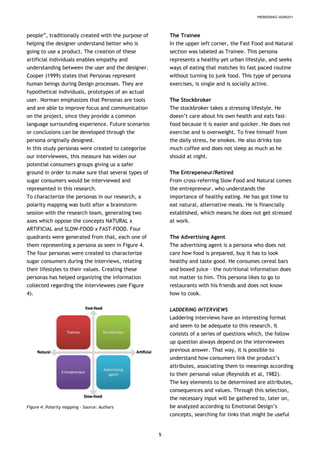
To characterize the personas in our research, a
polarity mapping was built after a brainstorm
session with the research team, generating two
axes which oppose the concepts NATURAL x
ARTIFICIAL and SLOW-FOOD x FAST-FOOD. Four
quadrants were generated from that, each one of
them representing a persona as seen in Figure 4.
The four personas were created to characterize
sugar consumers during the interviews, relating
their lifestyles to their values. Creating these
personas has helped organizing the information
collected regarding the interviewees (see Figure
4).
Figure 4: Polarity mapping – Source: Authors
The Trainee
In the upper left corner, the Fast Food and Natural
section was labeled as Trainee. This persona
represents a healthy yet urban lifestyle, and seeks
ways of eating that matches its fast paced routine
without turning to junk food. This type of persona
exercises, is single and is socially active.
The Stockbroker
The stockbroker takes a stressing lifestyle. He
doesn’t care about his own health and eats fast-
food because it is easier and quicker. He does not
exercise and is overweight. To free himself from
the daily stress, he smokes. He also drinks too
much coffee and does not sleep as much as he
should at night.
The Entrepeneur/Retired
From cross-referring Slow Food and Natural comes
the entrepreneur, who understands the
importance of healthy eating. He has got time to
eat natural, alternative meals. He is financially
established, which means he does not get stressed
at work.
The Advertising Agent
The advertising agent is a persona who does not
care how food is prepared, buy it has to look
healthy and taste good. He consumes cereal bars
and boxed juice – the nutritional information does
not matter to him. This persona likes to go to
restaurants with his friends and does not know
how to cook.
LADDERING INTERVIEWS
Laddering interviews have an interesting format
and seem to be adequate to this research. It
consists of a series of questions which, the follow
up question always depend on the interviewees
previous answer. That way, it is possible to
understand how consumers link the product’s
attributes, associating them to meanings according
to their personal value (Reynolds et al, 1982).
The key elements to be determined are attributes,
consequences and values. Through this selection,
the necessary input will be gathered to, later on,
be analyzed according to Emotional Design’s
concepts, searching for links that might be useful
5
DIVERSITY AND UNITY
when building meaning and emotional value to
utilitarian products.
When using this type of method, it is necessary
for the interviewer to be able to ask proper
questions to the interviewee, identifying elements
that could be useful. The main objective is to
keep a natural conversation with the interviewee
and, at the same time, look for answers by asking
unpretentious questions. From the data collected
during the interviews, chains of value will be
built, representing the key elements about sugar
acquisition and consumption.
STIMULI
During our interviews pictures were shown to the
interviewees, followed by questions regarding the
content and about their experiences and emotions
surrounding sugar. It is relevant to point out that
the images were not the only source for data
collection – they were used merely as a way to
immerse in the subject, evoking feelings and
memories.
Moodboards and videos were also shown, making
the interviewees associate through analogies and
metaphors.
According to Casakin (2007), metaphors are
perceived as cognitive strategies that may be
useful while organizing design thinking. They
might interfere in the way we see reality, organize
our experiences and thoughts.
Visual stimuli can be used to help creative
thinking, which enables an individual to see
through a problem using innovative and non-
traditional points of view (Casakin & Kreitler,
2005a APUD Casakin 2007). Csikszentmihalyi
(1997) states that creative thinking is also related
to the ability of analyzing reality, exploring
alternative ways and understanding situations
through innovative perspectives. This way of
thinking can be related to Dorst and Cross’ (2001)
theories when they describe how creative
processes are essential to develop ideas and solve
problems.
Along with the interviews, the visual stimuli were
carefully applied in order to make sure that the
given answers were not guided in any way. Our
motivation by using the stimuli was to provoke
emotional reactions on our interviewees. By doing
this, we believe that we were given more complex
answers and thoughtful information regarding the
products’ meanings and emotional values during
the interview process.
Moodboards
To help stimulate the answers, the interviewees
were shown two movies and moodboards – which
contained images of candies - related to the
theme “sugar”. After a brainstorm session the
research team determined that the key themes
would be: self-esteem, indulgence and affection
/companionship – elements that are related to
sugar consumption. During the brainstorm session
the team focused on how, when and why people
might consume sugar related products. Several
topics were addressed and it was noticed that
people might consume these types of products
when they feel down or when they are amongst
friends/family. They also might consume them as
an act of indulgence, as a reward or even as an
act of affection, such as gifting to a beloved
person. We had to make sure that positive, neutral
and negative elements were present in our
moodboards, in order to keep the visual stimuli
balanced.
Movies
Two movies were selected from a list that
contained “sweet” and “sugar” as a theme: Lasse
Hallström’s Chocolat and Sofia Coppola’s Marie
Antoinette. The objective was to stimulate the
interviewees to truthfully answer the interview,
enriching it with memories and feelings.
That way, applying stimuli from moodboards and
videos was useful and innovative as it helped
stimulate creative thinking which may result in
rich and complex answers. As previously stated
earlier, the chosen images and movies were used
to provoke the metaphorical thinking of the
interviewee without limiting the associative area
of interview, to make sure that the given
information were not tampered in any way.
DATA COLLECTION
Data collection was done through exploratory and
descriptive qualitative research, helping the group
understand the main problem and collecting
6
PRODEEDINGS IASDR2011
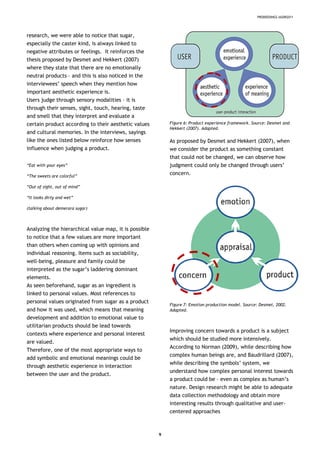
Figure 5 – Hierarchic value map. Source: Authors
information regarding the context and people
involved.
As it uses a qualitative approach, the selection
was based on the researchers’ judgment. A total
of eight individuals were interviewed and a few
questions were asked to try and identify each one
of them as a persona.
Data collection followed the steps briefly
described below:
1. Personas and polarity chart making;
2. Visual stimuli material selection (moodboards,
videos and images);
3. Questions to identify and categorize personas
preparation;
4. Laddering interviews implementation.
DATA ANALYSIS
Data analysis followed these rules: a) content
analysis and b) hierarchical value map
construction (HVM).
CONTENT ANALYSIS
After data collection, the results were interpreted
through content analysis. The process consisted of
reading the interviews and identifying a clause
that would better summarize each of them. In the
clauses, we were able to identify attributes,
consequences and personal values (A-C-V), which
might express how an individual reasons (Veludo-
de-Oliveira and Ikeda, 2004).
Gengler, Mulvey and Oglethorpe (1999) alert that
the objective when analyzing content is not to
describe each person’s ladders but to develop
portraits which are similar to the way the
interviewees reason. In this case, the importance
of the interviewers’ role is once more highlighted.
In this step of our research, intensive and careful
work is done, mainly because the results obtained
here originate serve as a basis for follow-up
analysis. Gengler, Mulvey e Oglethorpe (1999) IN:
(Veludo-de-Oliveira and Ikeda, 2004 , p. 206).
Variables analysis can be related to how a problem
evolves, as described by Cross and Dorst (2001).
The problem – defining A-C-V – lets the researcher
re-encode data and combine categories until the
final result suits the final objective. (Gengler;
Reynolds, 1995, p.22)
A-C-V example collected from one of the
interviews:
After seeing images related to sweets, the
interviewee answered:
7
DIVERSITY AND UNITY
> What do you think about these images?
Wow. So many candies! But you know... I don’t really like
looking at them.
> Why?
Too much sugar. No way. That’s bad for you.
> Why do you think it’s bad for you?
Because this is all sugar. And sugar isn’t good for you, I
mean... Having a few every now and then it’s ok, but all of it,
no way.
> From these candies, which ones do you think are O.K. to eat?
Gumdrops. I love gumdrops. Chocolate. But this (points to the
cotton candy), no way.
> What’s wrong with cotton candy?
That’s really artificial. Imagine what kind of product they use
to get it colored that way. These drops as well.
> And aren’t gumdrops artificial?
(laughs...). Alright. They are, right? But I like having
gumdrops.
> Why do you prefer gumdrops over cotton candy considering
they’re both artificial?
You caught me... I think it’s because gumdrops remind me of
my childhood, of going to school. Or going to the movies.
> Reminds you of good things?
Yes. Who doesn’t like being a kid?
> What do you miss the most about being a child?
Not having much to do. And we could be honest.
> So now you can’t be like that anymore?
I can, but it’s difficult sometimes. Especially at work.
> Are having nothing to do and honesty important to you?
Yes. Very important.
> What is “not having much to do”? When can you do that?
When I don’t have a fixed schedule, for example. Those days
are like a dream. To be able to sleep until late... To have
breakfast calmly...
By analyzing the above dialogue, we can notice
that:
Cotton candy: artificial product (sugar’s
attribute), is bad for you (consequence).
It becomes acceptable when nostalgia (childhood
memories) is taken into consideration, a time
where not having to engage to commitments
generates good memories. The interviewee reveals
the value of this product which originated from
sugar: freedom.
HIERARCHICAL VALUE MAP (HVM)
As previously seen, a hierarchical value map was
build based on the items mentioned in a). (HVM -
Figure 5). This representation shows the – directly
or indirectly - existing links between the analyzed
elements. According to Veludo-de-Oliveira and
Ikeda (2004), not every link between attributes,
consequences and personal values can be
considered since they might be irrelevant to
answer the general or specific objectives of this
research.
HVM representation can structure variables
through means-end chains, starting from the
attributes, passing through consequences until it
gets to personal values. It is possible, by linking
these chains, to establish which parameters are
more important for each level. This step is crucial
as it directs the researcher to specific
objects/problems, making the research process
smoother.
We are able to notice now that caster sugar, as it
is presented at the supermarkets, carry negative
consequences. The interviewees link this product
to obesity, fat, temptation, nausea and excess.
These consequences are not taken into
consideration, though, when talking about
products made from sugar. The interviewees
related sweets and candies to affection,
relaxation, honesty and parties; which carry
values of freedom, well-being, leisure, family and
pleasure.
FINAL CONSIDERATIONS
According to Pine and Gilmore (1998) and McLellan
(2000), experience innovation offered to users can
be of great value inside of a socioeconomic
context. Through new and catchy experiences,
emotion shows as an important aspect to be
observed while developing or improving new
products
The problem gains another dimension when we
take into consideration emotionally low valued
products which are merely utilitarian. Through this
8
PRODEEDINGS IASDR2011
research, we were able to notice that sugar,
especially the caster kind, is always linked to
negative attributes or feelings. It reinforces the
thesis proposed by Desmet and Hekkert (2007)
where they state that there are no emotionally
neutral products – and this is also noticed in the
interviewees’ speech when they mention how
important aesthetic experience is.
Users judge through sensory modalities – it is
through their senses, sight, touch, hearing, taste
and smell that they interpret and evaluate a
certain product according to their aesthetic values
and cultural memories. In the interviews, sayings
like the ones listed below reinforce how senses
influence when judging a product.
“Eat with your eyes”
“The sweets are colorful”
“Out of sight, out of mind”
“It looks dirty and wet”
(talking about demerara sugar)
Analyzing the hierarchical value map, it is possible
to notice that a few values are more important
than others when coming up with opinions and
individual reasoning. Items such as sociability,
well-being, pleasure and family could be
interpreted as the sugar’s laddering dominant
elements.
As seen beforehand, sugar as an ingredient is
linked to personal values. Most references to
personal values originated from sugar as a product
and how it was used, which means that meaning
development and addition to emotional value to
utilitarian products should be lead towards
contexts where experience and personal interest
are valued.
Therefore, one of the most appropriate ways to
add symbolic and emotional meanings could be
through aesthetic experience in interaction
between the user and the product.
Figure 6: Product experience framework. Source: Desmet and
Hekkert (2007). Adapted.
As proposed by Desmet and Hekkert (2007), when
we consider the product as something constant
that could not be changed, we can observe how
judgment could only be changed through users’
concern.
Figure 7: Emotion production model. Source: Desmet, 2002.
Adapted.
Improving concern towards a product is a subject
which should be studied more intensively.
According to Norman (2009), while describing how
complex human beings are, and Baudrillard (2007),
while describing the symbols’ system, we
understand how complex personal interest towards
a product could be – even as complex as human’s
nature. Design research might be able to adequate
data collection methodology and obtain more
interesting results through qualitative and user-
centered approaches
9
DIVERSITY AND UNITY
10
BROWN, Tim. Change by Design: How Design Thinking
Transforms Organizations and Inspires Innovation.
HarperBusiness; First Edition edition. 2009
Research methodology along with visual stimuli
seemed to be useful and effective while collecting
data from the interviewees. Stimuli allowed the
interviewees’ to reason through metaphor linking.
That brings us better results, especially because
the information given by the interviewees are
quite complex; and identifying personal values was
faster and more effective.
CASAKIN, Hernan Pablo. Metaphors in Design Problem Solving:
Implications for Creativity. In: International Journal of Design.
Vol. 1, Nº 2, Taipei:NTUST, 2007.
COOPER, A. (1999). The inmates are running the asylum.
Macmillan.
CROSS, Nigel. Natural intelligence in design. In: Design Studies.
Vol 20, n° 1, Kidlington: Elsevier, p. 141-157, 1999.
CSIKSZENTMIHALYI, M. Finding Flow. The Psychology of
engagement with everyday life. Nova Iorque: BasicBooks, 1997.
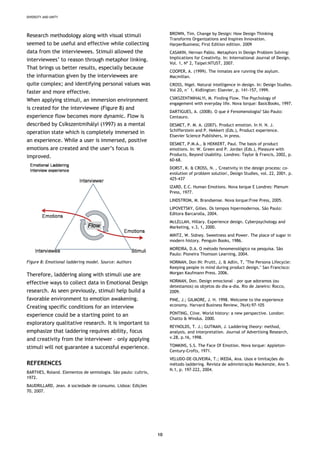
When applying stimuli, an immersion environment
is created for the interviewee (Figure 8) and
experience flow becomes more dynamic. Flow is
described by Csíkszentmihályi (1997) as a mental
operation state which is completely immersed in
an experience. While a user is immersed, positive
emotions are created and the user’s focus is
improved.
DARTIGUES, A. (2008). O que é Fenomenologia? São Paulo:
Centauro.
DESMET, P. M. A. (2007). Product emotion. In H. N. J.
Schifferstein and P. Hekkert (Eds.), Product experience.
Elsevier Science Publishers, in press.
DESMET, P.M.A., & HEKKERT, Paul. The basis of product
emotions. In: W. Green and P. Jordan (Eds.), Pleasure with
Products, Beyond Usability. Londres: Taylor & Francis, 2002, p.
60-68.
DORST, K. & CROSS, N. , 'Creativity in the design process: co-
evolution of problem solution', Design Studies, vol. 22, 2001. p.
425-437
IZARD, E.C. Human Emotions. Nova Iorque E Londres: Plenum
Press, 1977.
LINDSTROM, M. Brandsense. Nova Iorque:Free Press, 2005.
LIPOVETSKY, Gilles. Os tempos hipermodernos. São Paulo:
Editora Barcarolla, 2004.
McLELLAN, Hillary. Experience design. Cyberpsychology and
Marketing, v.3, 1, 2000.
MINTZ, W. Sidney. Sweetness and Power. The place of sugar in
modern history. Penguin Books, 1986.
MOREIRA, D.A. O método fenomenológico na pesquisa. São
Paulo: Pioneira Thomson Learning, 2004.
Figure 8: Emotional laddering model. Source: Authors NORMAN, Don IN: Pruitt, J, & Adlin, T, "The Persona Lifecycle:
Keeping people in mind during product design." San Francisco:
Morgan Kaufmann Press. 2006.Therefore, laddering along with stimuli use are
effective ways to collect data in Emotional Design
research. As seen previously, stimuli help build a
favorable environment to emotion awakening.
Creating specific conditions for an interview
experience could be a starting point to an
exploratory qualitative research. It is important to
emphasize that laddering requires ability, focus
and creativity from the interviewer – only applying
stimuli will not guarantee a successful experience.
NORMAN, Don. Design emocional – por que adoramos (ou
detestamos) os objetos do dia-a-dia. Rio de Janeiro: Rocco,
2009.
PINE, J.; GILMORE, J. H. 1998. Welcome to the experience
economy. Harvard Business Review, 76(4):97-105
PONTING, Clive. World history: a new perspective. London:
Chatto & Windus. 2000.
REYNOLDS, T. J.; GUTMAN, J. Laddering theory: method,
analysis, and interpretation. Journal of Advertising Research,
v.28, p.16, 1998.
TOMKINS, S.S. The Face Of Emotion. Nova Iorque: Appleton-
Century-Crofts, 1971.
VELUDO-DE-OLIVEIRA, T.; IKEDA, Ana. Usos e limitações do
método laddering. Revista de admnistração Mackenzie, Ano 5.
N.1, p. 197-222, 2004.
REFERENCES
BARTHES, Roland. Elementos de semiologia. São paulo: cultrix,
1972.
BAUDRILLARD, Jean. A sociedade de consumo. Lisboa: Edições
70, 2007.

Sweet emotions -_akiyoshy__2011

  • 1.
    /////////////////////////////////////////////////////////////////////////////////////////////////////////////////////////////////// SUGAR RUSH: UNDERSTANDINGEMOTIONAL VALUES IN UTILITARIAN PRODUCTS AKIYOSHI, Ricardo/ BITTENCOURT, Paulo/ GRAÚDO, Margarida/ SCHÜLER, Gabriel/ COSTA, Filipe, Universidade do Vale do Rio dos Sinos - Unisinos. São Leopoldo, Rio Grande do Sul, Brasil. ricardo.yudi@gmail.com/ paulo@saraucom.com.br/ margarida.graudo@ig.com.br/ gabrielkschuler@gmail.com/ filipecxc@gmail.com. ABSTRACT Search for innovation, from a socioeconomic point of view, has been an interesting area of study for many fields – including Design. Traditionally focused on form and function, now the Design research field has targeted the experience (aesthetic, symbolic and emotional) as one of its main topics. This challenge becomes more complex when we try to understand the emotional values and meanings that can possibly coexist within a utilitarian type of product. Therefore, this article studied the sugar and its emotional values by using the laddering technique along with stimuli application during the interviews. We will conclude that there’s potential to achieve innovation if we can establish attachment bonds and improve the contexts of user experience. Keywords: emotional design, laddering, sugar. INTRODUCTION In the last decades, Design has been through important changes when we talk about research and product development. The traditional approach towards form and function is now focused on user-centered ideals, which happen when the user is the main focus in the research and development process. The premise of product development is that every product is designed to perform a certain task or to attend a certain goal. A car, for instance, is used to transport people. However, along with this utilitarian perspective, a product could also acquire a distinctive meaning according to which brand it belongs to, its characteristics and so on. Therefore whoever drives a certain vehicle could be associated with a certain socioeconomic class. This concept of adding connotative attributes to a certain object, service, people, is studied by Barthes (1972). The author presents us a “function-meaning” concept, which deals with the possibility of a certain object sustaining multiple meanings. Nowadays variables such as needs, emotions, desire and experiences, which result from the interaction between users and a product or service, are much more noticed than they used to be. This change can be explained by Cross’ (1999) concepts where he states that Design research must be encouraged through development, articulation and communication of Design knowledge. Knowledge may be firstly perceived in people, on how designers are represented or in human abilities when they are used to transform nature into artifacts. It might also be perceived through Design processes, tactics and strategies; and on how products, services, shapes and materials are used to represent or serve a function. Therefore, it is understandable that many fields and study areas may benefit from Design’s academic research expansion. It is also natural that the issues to be found in such researches increase dramatically. The process of evolution of a problem is described by Dorst and Cross (2001) when they suggest problem solving through the use of Design’s creative processes, which could be either while developing and refining both the problem and the solution. The definition and solution of a problem – called co-evolutionary processes – embrace study moments which are
  • 2.
    DIVERSITY AND UNITY describedas never being still during the development processes. The definition and solution of a problem might build the main foundation when designing a product, service or experience. Brown (2009) emphasizes how important a united team is, who work together from the problem’s definition until the product or service’s final concept. Furthermore, the author points out that the ideas are only achieved when the professionals involved are reflexive, creative and capable of communicating fast and effectively. The importance of Design research can reflect on a socioeconomic scope where marketing differentiation is settled through processes, products and innovative experiences. In a society in which products are more valuable for what they represent other than its value of use (Baudrillard, 2007), it’s relatively easy to comprehend how a product, like a car, is capable of triggering meanings and emotions that could also drive people’s perceptions towards differentiation in a market perspective. However when talking about products that are mainly utilitarian or pragmatic, we are presented with a tougher challenge: meanings and emotional values are not that simple to recognize and be dealt with. Therefore, how can Design research contribute to identify and define these types of products’ meanings and emotional values? In order to answer that question, but without being conclusive, this article aims for a study about the use of sugar in its many ways of consumption. Our main goal is to comprehend how the emotional values and meanings could be identified in order to be brought into the Design processes of product or services developments. Thereunto, we will try to deepen ourselves through to the methodologies used in Design and other fields of study to support our data collection, mainly with an exploratory and interpretative research and analysis. In this case, we are using laddering techniques and applying visual stimulus in order to obtain more complex data – through ideas associations - from our interviewees. EXPERIENCE ECONOMY Lipovetsky (2004) theorizes about the current consumerist and hedonic society which is in constantly pursuit of well-being and renewal experience through adventure simulacra. The individual situated in this context searches for objects which, when converted to symbols, become meaningful – making feelings such as insecurity, disability and dissatisfaction to be surpassed when facing the egalitarian myth (Baudrillard, 2007). As previously mentioned, adventure simulacra can be defined as experience. According to Pine and Gilmore (1998), they are part of a new modern consumerist era which the authors call Experience Economy. This new economic direction is ruled by theories suggesting ventures’ success through creation and simulation of experiences that are pleasant for the consumers (McLellan, 2009). Studies surrounding experience have been enriched by a number of factors. Since there has been a need to review the role of a designer and to comprehend life and users’ culture in a deeper manner, previously left aside fields of study have begun to be researched. One of these fields is called Design Emotion, highlighted throughout this article as it can be used to produce meanings or emotional values for utilitarian products or for products which have a low symbolic value. DESIGN EMOTION In order to better understand why we chose the Design Emotion field of study as our main theme, first we need to discuss what are and how emotions are conceived. Izard (1977) discusses that emotions cannot be studied as a single phenomenon, they also cannot be defined by a single act of emotional experience or an electrophysiological reaction on the nervous system. According to Tomkins (1962), Tomkins and Izard (1971), a definition of emotion needs to take into account the aspects of experience of the emotion, brain and nervous system processes and expressive patterns of emotions (facial expressions, for example). 2
  • 3.
    PRODEEDINGS IASDR2011 According toDonald Norman (2009), human beings are complex animals with complex structures, they are conscient about their roles in the world and are able to reflect on past experiences so they can learn and be successful in the future. Norman categorizes three levels of cognitive emotional processing: visceral, behavioral and reflexive. These levels of cognitive processing ranges from validating simple sensory aspects of a specific object using our “gut” feeling to reflecting about a certain aspect of an object based on past experiences and only then react (emotionally) accordingly. Several other factors could influence the elucidation of emotions, Cattel and Scheier (1961), Spielberger (1966) tell us that in order to better understand these types of reactions first we need to deepen our efforts and studies at the state and traits of emotional states. Researchers like Pieter Desmet and Paul Hekkert (2002), discuss that there are no emotionally neutral products. Any design evokes emotion through either the design itself or because of its designers, even if the project is not intended to provoke. A design’s interfaces could be planned to be neutral, but it does not mean that their effects on the users will be so. Studying the users’ emotional reactions might bring benefits to designers, since it is then possible to understand the most efficient variables when evaluating a product. By noticing the way people interact with and experience a product, the designer will have the necessary input so that innovative results may be achieved successfully and more often. Desmet and Hekkert (2007) discuss about the interaction experience levels between a user and a product, according to the picture below (Figure 1): Figure 1: Product Experience Framework. Source: Desmet and Hekkert (2007) AESTHETIC EXPERIENCE A product’s ability to waken one or more body senses may be called an aesthetic experience. According to Desmet and Hekkert, a product can be pleasant to look at, touch or even smell. It can be related to the visceral level (Norman, 2009), which can establish the user’s first opinions and emotions towards an object. At the same time, the first feelings of desire can occur if the user gets a positive first impression from the product. EXPERIENCE OF MEANING While accessing the user’s memory and making associations and interpreting signs, the experience of meaning depends mainly on cognition. By doing so, the individual is able to make connections between metaphors and determine characteristics and personalities symbolically to a product. Experience of meaning can develop attachment links (Desmet and Hekkert, 2007) and through interactions it is also possible to build identity connections. EMOTIONAL EXPERIENCE Emotions are evoked by an appraisal, interpreting a certain event, product or experience. The experience itself is directly related to beliefs and to the individual’s personal and cultural memories. That way, an object or experience may provoke different emotions to different people, as represented in Figure 2. Figure 2: Emotion production flowchart. Source: Desmet, 2002. We were also motivated by the studies of Lindstrom (2005), in which the author suggests that improving the experience by engaging the five senses could be determinant to build a stronger, better brand or product. The studied done by Lindstrom reveals that the perceived value of a product in relation to the bond between the brand/product x consumer can be highly 3
  • 4.
    DIVERSITY AND UNITY influencedby the emotional experience and senses engaging. PROBLEM SETTING According to the scenario described so far, it is possible to notice that niche marketing works through products, services and experiences innovation. Baudrillard (2007) emphasizes that products are part of a system of symbols, just as much as a language does. It is, therefore, quite accurate to say that the individuals access and build reality by consuming products and, at the same time, they builds their own identity when socially sharing what the products mean. Baudrillard’s statement gets even harder to be understood when we talk about neutral or utilitarian products. Products such as salt, paper, fuel, batteries and so on fit in this category. That is where lays the biggest challenge to designers and professionals who work in product development: how to add emotional value to utilitarian products? Sugar was the main commodity product in Europe during the XVIII century (Ponting, 2000). Mintz (1986) analyzes how much its value has changed - from being an exotic and pricy spice to being present at everybody’s homes on a regular basis. [...] to learn the anthropology of sugar, we need to explore the meanings of its uses, to discover the early and more limited uses of sugar, and to learn where and for what original purposes sugar was produced. This means examining the sources of supply, the chronology of uses, and the combinations of sugar with other foods in the making of new dietary patterns”. (Mintz, 1986, p. 6) Throughout history, sugar has always been linked to a number of situations: though the period of slavery in the colonial period, to change or disguise the taste of different meats, to preserve fruits and even as a rival ingredient when used instead of honey as an example. Still related to food consumption, it is usually associated to different contexts depending on how it was used, such as in coffees, chocolates and teas – contexts which were exclusively available to higher economic classes during the XVII and XVIII centuries. We can usually find many types of sugar in the supermarkets nowadays, each one being the result of a specific extraction process that may contain different nutritional properties. (Figure 3) Figure 3: Types of sugar: Cristal, refined, brown, sugar cubes, demerara sugar. Source: Authors What would take the consumer to choose a type over another? Is it because of the sugar’s nutritional properties or something else? Would it be possible to identify emotional or meaningful attachments when the product is used? Could Design help develop the necessary contextual conditions for emotional and meaningful values to be attached to the product? The research we present searches for these answers through data collection and analysis along with bibliographic review by the authors we have mentioned so far. METHODOLOGY This phenomenological research will investigate and describe particular phenomena, defined by Dartigues (2008) as experiences lived through life, using a qualitative method. Before we started our data gathering, we built a persona framework, which is represented by four types of potential sugar buyers and consumers. We selected eight individuals that fitted in our persona groups and distributed them according to our framework. Then to achieve our specific and general objectives, interviews were conducted applying the laddering technique. During our interviews we also applied several visual stimuli: moodboards and videos. We believed that these types of stimuli could improve the quality and depth of the interview, providing the interviewer and the research team better data to develop later on. PERSONAS Norman (2006) defines Personas as “artificial 4
  • 5.
    PRODEEDINGS IASDR2011 people”, traditionallycreated with the purpose of helping the designer understand better who is going to use a product. The creation of these artificial individuals enables empathy and understanding between the user and the designer. Cooper (1999) states that Personas represent human beings during Design processes. They are hypothetical individuals, prototypes of an actual user. Norman emphasizes that Personas are tools and are able to improve focus and communication on the project, since they provide a common language surrounding experience. Future scenarios or conclusions can be developed through the persona originally designed. In this study personas were created to categorize our interviewees, this measure has widen our potential consumers groups giving us a safer ground in order to make sure that several types of sugar consumers would be interviewed and represented in this research. To characterize the personas in our research, a polarity mapping was built after a brainstorm session with the research team, generating two axes which oppose the concepts NATURAL x ARTIFICIAL and SLOW-FOOD x FAST-FOOD. Four quadrants were generated from that, each one of them representing a persona as seen in Figure 4. The four personas were created to characterize sugar consumers during the interviews, relating their lifestyles to their values. Creating these personas has helped organizing the information collected regarding the interviewees (see Figure 4). Figure 4: Polarity mapping – Source: Authors The Trainee In the upper left corner, the Fast Food and Natural section was labeled as Trainee. This persona represents a healthy yet urban lifestyle, and seeks ways of eating that matches its fast paced routine without turning to junk food. This type of persona exercises, is single and is socially active. The Stockbroker The stockbroker takes a stressing lifestyle. He doesn’t care about his own health and eats fast- food because it is easier and quicker. He does not exercise and is overweight. To free himself from the daily stress, he smokes. He also drinks too much coffee and does not sleep as much as he should at night. The Entrepeneur/Retired From cross-referring Slow Food and Natural comes the entrepreneur, who understands the importance of healthy eating. He has got time to eat natural, alternative meals. He is financially established, which means he does not get stressed at work. The Advertising Agent The advertising agent is a persona who does not care how food is prepared, buy it has to look healthy and taste good. He consumes cereal bars and boxed juice – the nutritional information does not matter to him. This persona likes to go to restaurants with his friends and does not know how to cook. LADDERING INTERVIEWS Laddering interviews have an interesting format and seem to be adequate to this research. It consists of a series of questions which, the follow up question always depend on the interviewees previous answer. That way, it is possible to understand how consumers link the product’s attributes, associating them to meanings according to their personal value (Reynolds et al, 1982). The key elements to be determined are attributes, consequences and values. Through this selection, the necessary input will be gathered to, later on, be analyzed according to Emotional Design’s concepts, searching for links that might be useful 5
  • 6.
    DIVERSITY AND UNITY whenbuilding meaning and emotional value to utilitarian products. When using this type of method, it is necessary for the interviewer to be able to ask proper questions to the interviewee, identifying elements that could be useful. The main objective is to keep a natural conversation with the interviewee and, at the same time, look for answers by asking unpretentious questions. From the data collected during the interviews, chains of value will be built, representing the key elements about sugar acquisition and consumption. STIMULI During our interviews pictures were shown to the interviewees, followed by questions regarding the content and about their experiences and emotions surrounding sugar. It is relevant to point out that the images were not the only source for data collection – they were used merely as a way to immerse in the subject, evoking feelings and memories. Moodboards and videos were also shown, making the interviewees associate through analogies and metaphors. According to Casakin (2007), metaphors are perceived as cognitive strategies that may be useful while organizing design thinking. They might interfere in the way we see reality, organize our experiences and thoughts. Visual stimuli can be used to help creative thinking, which enables an individual to see through a problem using innovative and non- traditional points of view (Casakin & Kreitler, 2005a APUD Casakin 2007). Csikszentmihalyi (1997) states that creative thinking is also related to the ability of analyzing reality, exploring alternative ways and understanding situations through innovative perspectives. This way of thinking can be related to Dorst and Cross’ (2001) theories when they describe how creative processes are essential to develop ideas and solve problems. Along with the interviews, the visual stimuli were carefully applied in order to make sure that the given answers were not guided in any way. Our motivation by using the stimuli was to provoke emotional reactions on our interviewees. By doing this, we believe that we were given more complex answers and thoughtful information regarding the products’ meanings and emotional values during the interview process. Moodboards To help stimulate the answers, the interviewees were shown two movies and moodboards – which contained images of candies - related to the theme “sugar”. After a brainstorm session the research team determined that the key themes would be: self-esteem, indulgence and affection /companionship – elements that are related to sugar consumption. During the brainstorm session the team focused on how, when and why people might consume sugar related products. Several topics were addressed and it was noticed that people might consume these types of products when they feel down or when they are amongst friends/family. They also might consume them as an act of indulgence, as a reward or even as an act of affection, such as gifting to a beloved person. We had to make sure that positive, neutral and negative elements were present in our moodboards, in order to keep the visual stimuli balanced. Movies Two movies were selected from a list that contained “sweet” and “sugar” as a theme: Lasse Hallström’s Chocolat and Sofia Coppola’s Marie Antoinette. The objective was to stimulate the interviewees to truthfully answer the interview, enriching it with memories and feelings. That way, applying stimuli from moodboards and videos was useful and innovative as it helped stimulate creative thinking which may result in rich and complex answers. As previously stated earlier, the chosen images and movies were used to provoke the metaphorical thinking of the interviewee without limiting the associative area of interview, to make sure that the given information were not tampered in any way. DATA COLLECTION Data collection was done through exploratory and descriptive qualitative research, helping the group understand the main problem and collecting 6
  • 7.
    PRODEEDINGS IASDR2011 Figure 5– Hierarchic value map. Source: Authors information regarding the context and people involved. As it uses a qualitative approach, the selection was based on the researchers’ judgment. A total of eight individuals were interviewed and a few questions were asked to try and identify each one of them as a persona. Data collection followed the steps briefly described below: 1. Personas and polarity chart making; 2. Visual stimuli material selection (moodboards, videos and images); 3. Questions to identify and categorize personas preparation; 4. Laddering interviews implementation. DATA ANALYSIS Data analysis followed these rules: a) content analysis and b) hierarchical value map construction (HVM). CONTENT ANALYSIS After data collection, the results were interpreted through content analysis. The process consisted of reading the interviews and identifying a clause that would better summarize each of them. In the clauses, we were able to identify attributes, consequences and personal values (A-C-V), which might express how an individual reasons (Veludo- de-Oliveira and Ikeda, 2004). Gengler, Mulvey and Oglethorpe (1999) alert that the objective when analyzing content is not to describe each person’s ladders but to develop portraits which are similar to the way the interviewees reason. In this case, the importance of the interviewers’ role is once more highlighted. In this step of our research, intensive and careful work is done, mainly because the results obtained here originate serve as a basis for follow-up analysis. Gengler, Mulvey e Oglethorpe (1999) IN: (Veludo-de-Oliveira and Ikeda, 2004 , p. 206). Variables analysis can be related to how a problem evolves, as described by Cross and Dorst (2001). The problem – defining A-C-V – lets the researcher re-encode data and combine categories until the final result suits the final objective. (Gengler; Reynolds, 1995, p.22) A-C-V example collected from one of the interviews: After seeing images related to sweets, the interviewee answered: 7
  • 8.
    DIVERSITY AND UNITY >What do you think about these images? Wow. So many candies! But you know... I don’t really like looking at them. > Why? Too much sugar. No way. That’s bad for you. > Why do you think it’s bad for you? Because this is all sugar. And sugar isn’t good for you, I mean... Having a few every now and then it’s ok, but all of it, no way. > From these candies, which ones do you think are O.K. to eat? Gumdrops. I love gumdrops. Chocolate. But this (points to the cotton candy), no way. > What’s wrong with cotton candy? That’s really artificial. Imagine what kind of product they use to get it colored that way. These drops as well. > And aren’t gumdrops artificial? (laughs...). Alright. They are, right? But I like having gumdrops. > Why do you prefer gumdrops over cotton candy considering they’re both artificial? You caught me... I think it’s because gumdrops remind me of my childhood, of going to school. Or going to the movies. > Reminds you of good things? Yes. Who doesn’t like being a kid? > What do you miss the most about being a child? Not having much to do. And we could be honest. > So now you can’t be like that anymore? I can, but it’s difficult sometimes. Especially at work. > Are having nothing to do and honesty important to you? Yes. Very important. > What is “not having much to do”? When can you do that? When I don’t have a fixed schedule, for example. Those days are like a dream. To be able to sleep until late... To have breakfast calmly... By analyzing the above dialogue, we can notice that: Cotton candy: artificial product (sugar’s attribute), is bad for you (consequence). It becomes acceptable when nostalgia (childhood memories) is taken into consideration, a time where not having to engage to commitments generates good memories. The interviewee reveals the value of this product which originated from sugar: freedom. HIERARCHICAL VALUE MAP (HVM) As previously seen, a hierarchical value map was build based on the items mentioned in a). (HVM - Figure 5). This representation shows the – directly or indirectly - existing links between the analyzed elements. According to Veludo-de-Oliveira and Ikeda (2004), not every link between attributes, consequences and personal values can be considered since they might be irrelevant to answer the general or specific objectives of this research. HVM representation can structure variables through means-end chains, starting from the attributes, passing through consequences until it gets to personal values. It is possible, by linking these chains, to establish which parameters are more important for each level. This step is crucial as it directs the researcher to specific objects/problems, making the research process smoother. We are able to notice now that caster sugar, as it is presented at the supermarkets, carry negative consequences. The interviewees link this product to obesity, fat, temptation, nausea and excess. These consequences are not taken into consideration, though, when talking about products made from sugar. The interviewees related sweets and candies to affection, relaxation, honesty and parties; which carry values of freedom, well-being, leisure, family and pleasure. FINAL CONSIDERATIONS According to Pine and Gilmore (1998) and McLellan (2000), experience innovation offered to users can be of great value inside of a socioeconomic context. Through new and catchy experiences, emotion shows as an important aspect to be observed while developing or improving new products The problem gains another dimension when we take into consideration emotionally low valued products which are merely utilitarian. Through this 8
  • 9.
    PRODEEDINGS IASDR2011 research, wewere able to notice that sugar, especially the caster kind, is always linked to negative attributes or feelings. It reinforces the thesis proposed by Desmet and Hekkert (2007) where they state that there are no emotionally neutral products – and this is also noticed in the interviewees’ speech when they mention how important aesthetic experience is. Users judge through sensory modalities – it is through their senses, sight, touch, hearing, taste and smell that they interpret and evaluate a certain product according to their aesthetic values and cultural memories. In the interviews, sayings like the ones listed below reinforce how senses influence when judging a product. “Eat with your eyes” “The sweets are colorful” “Out of sight, out of mind” “It looks dirty and wet” (talking about demerara sugar) Analyzing the hierarchical value map, it is possible to notice that a few values are more important than others when coming up with opinions and individual reasoning. Items such as sociability, well-being, pleasure and family could be interpreted as the sugar’s laddering dominant elements. As seen beforehand, sugar as an ingredient is linked to personal values. Most references to personal values originated from sugar as a product and how it was used, which means that meaning development and addition to emotional value to utilitarian products should be lead towards contexts where experience and personal interest are valued. Therefore, one of the most appropriate ways to add symbolic and emotional meanings could be through aesthetic experience in interaction between the user and the product. Figure 6: Product experience framework. Source: Desmet and Hekkert (2007). Adapted. As proposed by Desmet and Hekkert (2007), when we consider the product as something constant that could not be changed, we can observe how judgment could only be changed through users’ concern. Figure 7: Emotion production model. Source: Desmet, 2002. Adapted. Improving concern towards a product is a subject which should be studied more intensively. According to Norman (2009), while describing how complex human beings are, and Baudrillard (2007), while describing the symbols’ system, we understand how complex personal interest towards a product could be – even as complex as human’s nature. Design research might be able to adequate data collection methodology and obtain more interesting results through qualitative and user- centered approaches 9
  • 10.
    DIVERSITY AND UNITY 10 BROWN,Tim. Change by Design: How Design Thinking Transforms Organizations and Inspires Innovation. HarperBusiness; First Edition edition. 2009 Research methodology along with visual stimuli seemed to be useful and effective while collecting data from the interviewees. Stimuli allowed the interviewees’ to reason through metaphor linking. That brings us better results, especially because the information given by the interviewees are quite complex; and identifying personal values was faster and more effective. CASAKIN, Hernan Pablo. Metaphors in Design Problem Solving: Implications for Creativity. In: International Journal of Design. Vol. 1, Nº 2, Taipei:NTUST, 2007. COOPER, A. (1999). The inmates are running the asylum. Macmillan. CROSS, Nigel. Natural intelligence in design. In: Design Studies. Vol 20, n° 1, Kidlington: Elsevier, p. 141-157, 1999. CSIKSZENTMIHALYI, M. Finding Flow. The Psychology of engagement with everyday life. Nova Iorque: BasicBooks, 1997. When applying stimuli, an immersion environment is created for the interviewee (Figure 8) and experience flow becomes more dynamic. Flow is described by Csíkszentmihályi (1997) as a mental operation state which is completely immersed in an experience. While a user is immersed, positive emotions are created and the user’s focus is improved. DARTIGUES, A. (2008). O que é Fenomenologia? São Paulo: Centauro. DESMET, P. M. A. (2007). Product emotion. In H. N. J. Schifferstein and P. Hekkert (Eds.), Product experience. Elsevier Science Publishers, in press. DESMET, P.M.A., & HEKKERT, Paul. The basis of product emotions. In: W. Green and P. Jordan (Eds.), Pleasure with Products, Beyond Usability. Londres: Taylor & Francis, 2002, p. 60-68. DORST, K. & CROSS, N. , 'Creativity in the design process: co- evolution of problem solution', Design Studies, vol. 22, 2001. p. 425-437 IZARD, E.C. Human Emotions. Nova Iorque E Londres: Plenum Press, 1977. LINDSTROM, M. Brandsense. Nova Iorque:Free Press, 2005. LIPOVETSKY, Gilles. Os tempos hipermodernos. São Paulo: Editora Barcarolla, 2004. McLELLAN, Hillary. Experience design. Cyberpsychology and Marketing, v.3, 1, 2000. MINTZ, W. Sidney. Sweetness and Power. The place of sugar in modern history. Penguin Books, 1986. MOREIRA, D.A. O método fenomenológico na pesquisa. São Paulo: Pioneira Thomson Learning, 2004. Figure 8: Emotional laddering model. Source: Authors NORMAN, Don IN: Pruitt, J, & Adlin, T, "The Persona Lifecycle: Keeping people in mind during product design." San Francisco: Morgan Kaufmann Press. 2006.Therefore, laddering along with stimuli use are effective ways to collect data in Emotional Design research. As seen previously, stimuli help build a favorable environment to emotion awakening. Creating specific conditions for an interview experience could be a starting point to an exploratory qualitative research. It is important to emphasize that laddering requires ability, focus and creativity from the interviewer – only applying stimuli will not guarantee a successful experience. NORMAN, Don. Design emocional – por que adoramos (ou detestamos) os objetos do dia-a-dia. Rio de Janeiro: Rocco, 2009. PINE, J.; GILMORE, J. H. 1998. Welcome to the experience economy. Harvard Business Review, 76(4):97-105 PONTING, Clive. World history: a new perspective. London: Chatto & Windus. 2000. REYNOLDS, T. J.; GUTMAN, J. Laddering theory: method, analysis, and interpretation. Journal of Advertising Research, v.28, p.16, 1998. TOMKINS, S.S. The Face Of Emotion. Nova Iorque: Appleton- Century-Crofts, 1971. VELUDO-DE-OLIVEIRA, T.; IKEDA, Ana. Usos e limitações do método laddering. Revista de admnistração Mackenzie, Ano 5. N.1, p. 197-222, 2004. REFERENCES BARTHES, Roland. Elementos de semiologia. São paulo: cultrix, 1972. BAUDRILLARD, Jean. A sociedade de consumo. Lisboa: Edições 70, 2007.