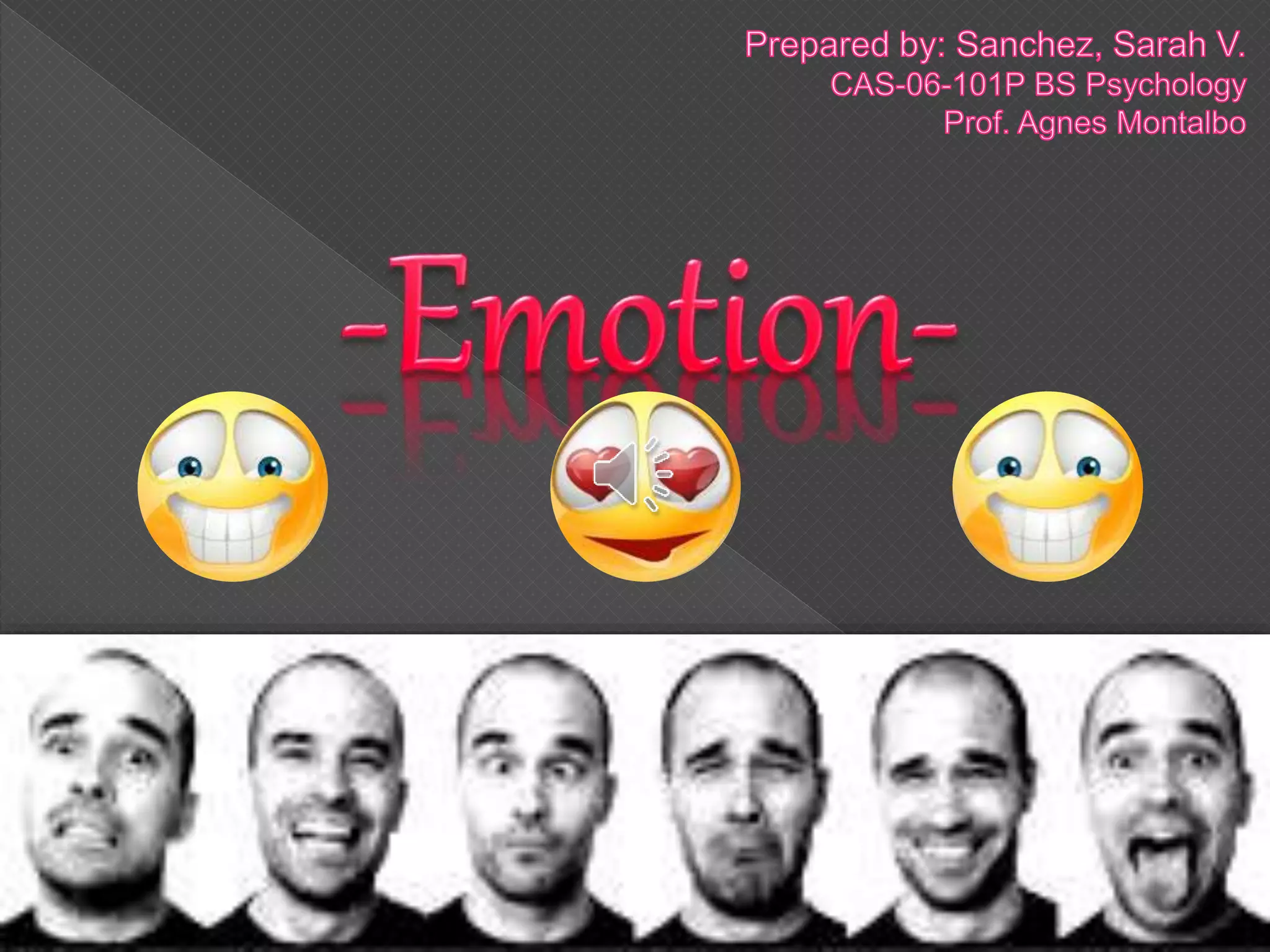
 A complex psycho-physiological
experience of an individual as a result of
his interactions with the environment.
 Is an individual response involving
physiological arousal, expressive
behaviors and conscious experience.
The word "emotion"
dates back to 1579,
when it was adapted
from the French word
émouvoir, which means
"to stir up".
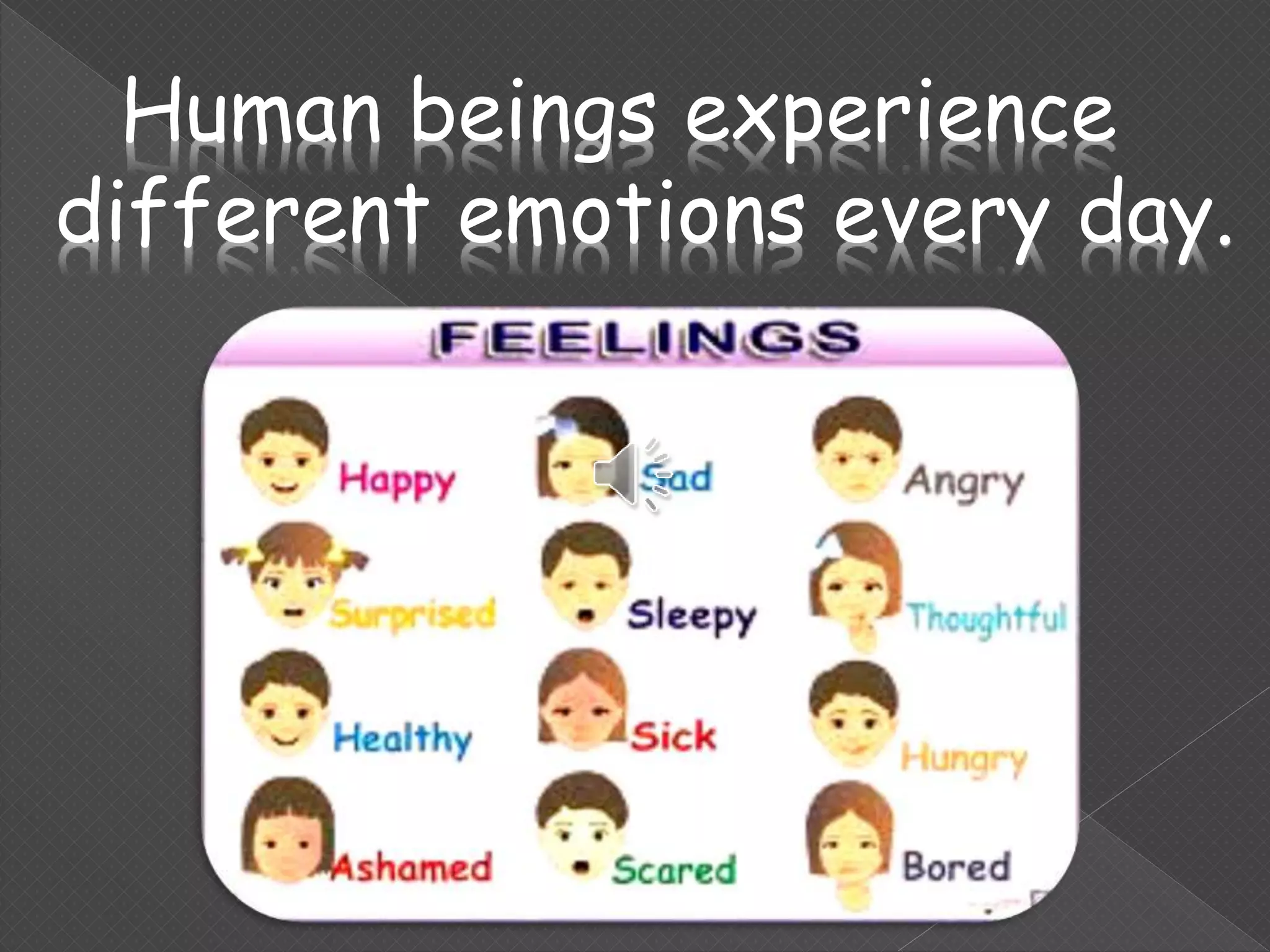
Human beings experience
different emotions every day.
Emotions can be Positive or Negative;
Pleasant or unpleasant.
- Which are innate at birth.
- Through experience or role modeling.
MIKA SANTOS
CAS-06-102P
MS.MONTALBO
EMOTION HAVE THREE
BASIC COMPONENTS:
COGNITIVE
PHYSIOLOGICAL
BEHAVIORAL
THANK YOU VERY MUCH! 
-Santos, Mika
Marzia Lele Viven A. Santos
CAS-06-101P
Ms. Agnes Montalbo
William James and Carl Lange
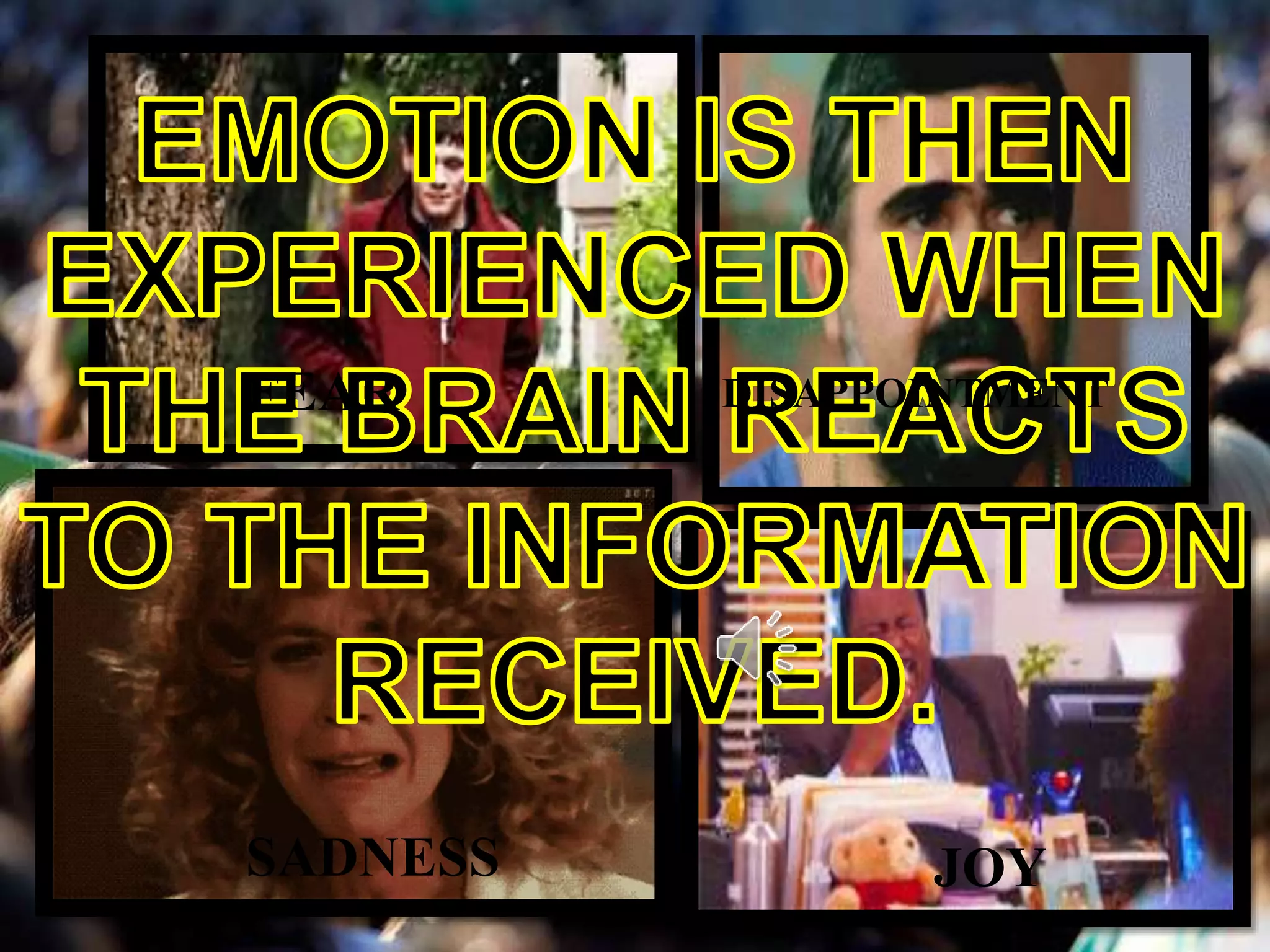
FEAR
JOYSADNESS
DISAPPOINTMENT
THE THEORY STATES
THAT ALL EMOTION IS
DERIVED FROM THE
PRESENCE OF
A STIMULUS,
WHICH EVOKES A
PHYSIOLOGICAL
RESPONSE.
( END OF REPORT )
THANK YOU!
-SANTOS, MARZIA
Ms. Aiza Santos
BS Psychology CAS102p
Prof. Agnes Montalbo
WALTER BRADFORD
CANNON: EXPERIMENTAL
PHYSIOLOGIST
1871-1945
ARCHIBALD PHILIP BARD
OCTOBER 25, 1898 —
APRIL 5, 1977
BY TIMOTHY S. HARRISON
Emotions are not reactions of
physiological responses rather,
emotions and physiological responses
are actually separate /independent
processes that occur at the same time.
In 1927, the famous American
physiologist Walter challenged
the James-Lange theory.
First, Cannon pointed that body
reactions are similar for many
emotions, yet our subjective
experience of various emotions is
very different. For both fear and
rage are accompanied by
increased heart rate, but we have
no difficulty distinguishing
between two emotions.
Second, Cannon (1927) argued that our
emotional reaction to a stimulus is
faster than our physiological reaction.
Cannon correctly noted that it can take
several seconds for the physiological
changes caused by activation of the
sympathetic nervous system to take
effect, but the subjective experience of
emotion is often virtually
instantaneous.
Third, artificially inducing
physiological changes does not
necessarily produce a related
emotional experience.
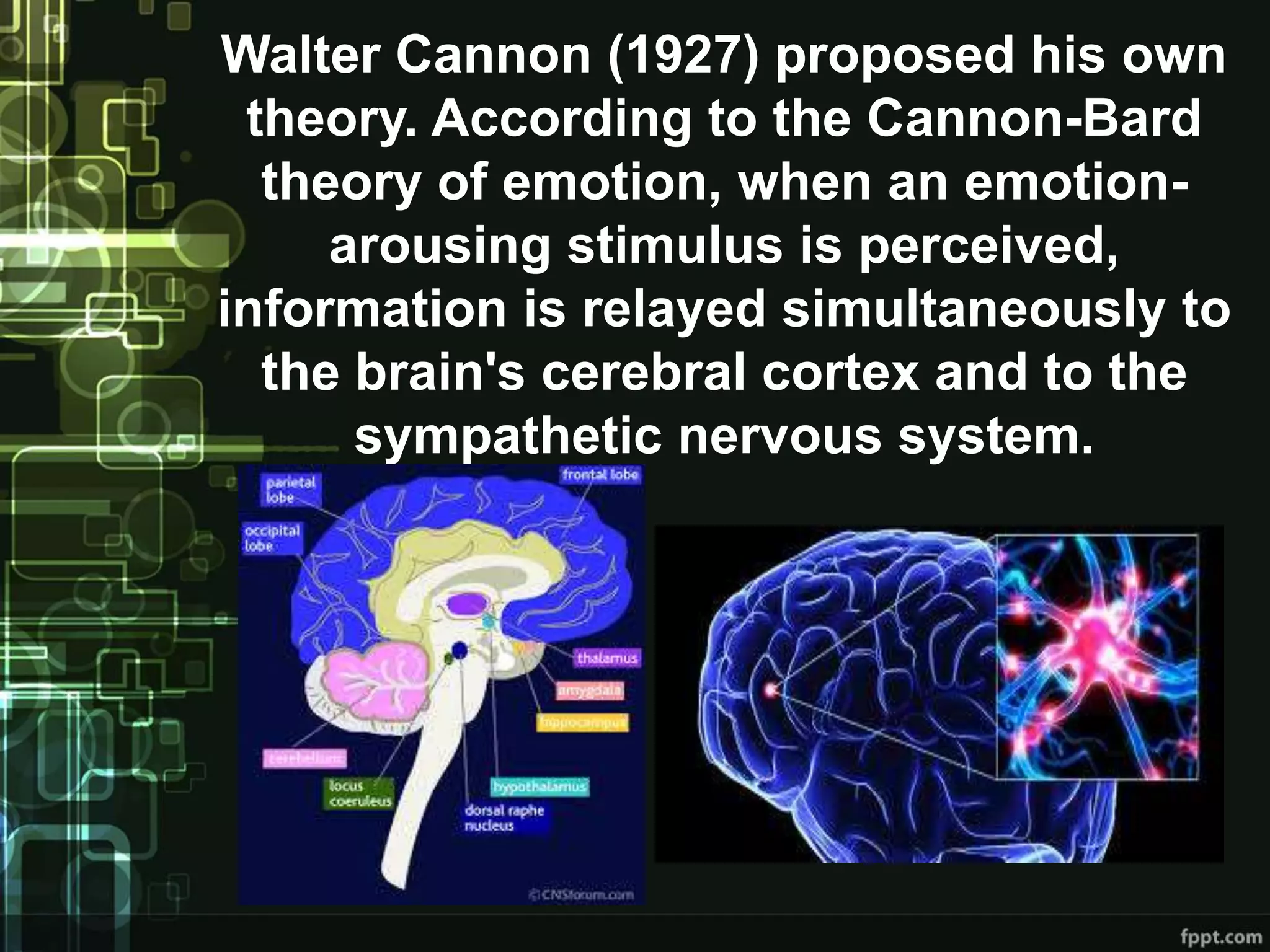
Walter Cannon (1927) proposed his own
theory. According to the Cannon-Bard
theory of emotion, when an emotion-
arousing stimulus is perceived,
information is relayed simultaneously to
the brain's cerebral cortex and to the
sympathetic nervous system.
Cortical activation causes the
subjective emotional experience, and
sympathetic nervous system activation
causes the physical response, which
lags by a few seconds. Thus, according
to Cannon and Bard, subjective
experience and physiological arousal
are triggered at the same time: neither
causes the other.
HERE’S THE SUMMARY.
Please click the Hyperlink above. 
JEROME SINGER
(1934–2010) Was the founding
chair of the Medical and Clinical
Psychology Department
at Uniformed Services University.
He is best known for his
contributions to the Two-factor
theory of emotion. He also served
as one of the fourteen members on
the National Research Council
(NRC) committee on human
performance in 1985. Singer
played a role in the cognitive
revival of modern psychology. His
main area of expertise was the
psychological and physiological
effects of various types of stress.
STANLEY SCHACHTER
(April 15, 1922 – June 7, 1997) was
an American psychologist.
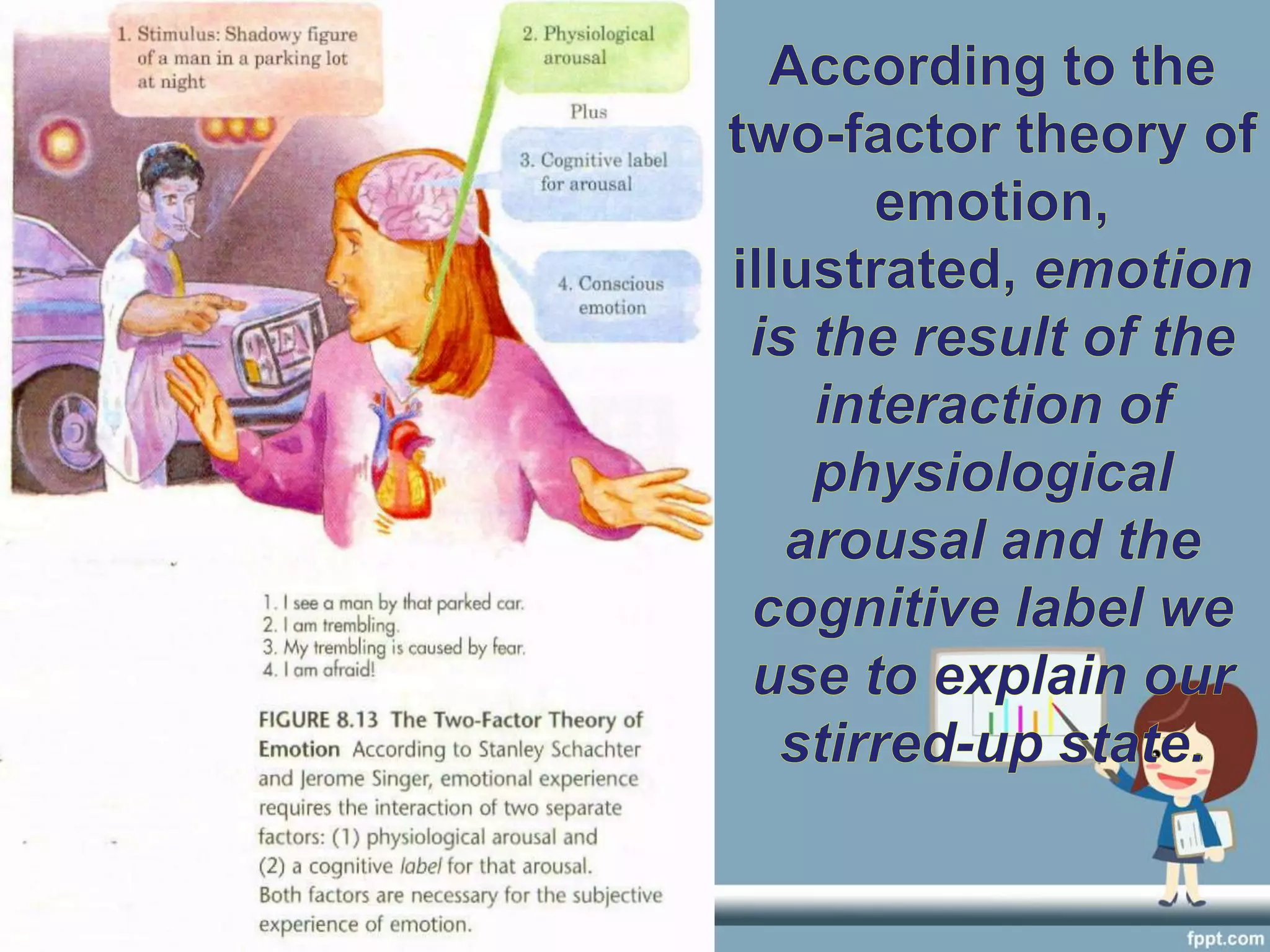
Schachter proposed the two factor theory of
emotion. He said emotions have two ingredients:
physiological
arousal and a cognitive
label.
A person's
experience of an emotion
stems from
the mental
awareness of the body's
physical arousal.
Schachter-Singer Two Factor Theory
of Emotion is also known as
AROUSAL INTERPRETATION.
A third theory of emotion,
proposed by Stanley Schachter
and Jerome was influential for a
short time. Schachter and Singer
(1962) agreed with that
PHYSIOLOGICAL AROUSAL IS A
CENTRAL ELEMENT IN EMOTION.
But they also with Cannon that
physiological arousal is very similar for
different Thus, arousal alone would not
produce an emotional response. Instead,
Schachter and Singer proposed that we
cognitively label physiological arousal
as A GIVEN EMOTION BASED ON OUR
APPRAISAL OF A SITUATION.
HERE’S THE SUMMARY.
Please click the Hyperlink above. 
SAEZ, CLYDE ERJOHN
BS PSYCHOLOGY CAS102P
PROF. AGNES MONTALBO
The Autonomic
Nervous System
(ANS) from the body’s
physiological system
such as breathing,
respiration, digestion
Sympathetic
Nervous
System
It’s responsible for rapid
reaction to a stressor
sometimes referred to as fight
or flight response and
immediately causes an increase
in blood pressure, faster heart
rate and high blood pressure
Parasympathetic
Nervous
System
Parasympathetic
nervous system (PNS)
calms the body. Maintains the
ordinary process of life. When PNS
activated the heart rate and blood
pressure drop and breathing slows
down.
Other Emotional
Reactions
An increase in the activity
of sweat gland result to the
Galvanic Skin
Response (GSR) a
rise in skin conductivity.
Polygraph (lie detector)
A machine used to
determine whether someone
is telling a lie, monitors
changes in body like heart
rate, pulse and breathing.
That’s all
Thank You!
-Clyde


Emotion

  • 3.
     A complexpsycho-physiological experience of an individual as a result of his interactions with the environment.  Is an individual response involving physiological arousal, expressive behaviors and conscious experience.
  • 4.
    The word "emotion" datesback to 1579, when it was adapted from the French word émouvoir, which means "to stir up".
  • 5.
  • 6.
    Emotions can bePositive or Negative; Pleasant or unpleasant.
  • 7.
    - Which areinnate at birth.
  • 8.
    - Through experienceor role modeling.
  • 10.
  • 12.
    EMOTION HAVE THREE BASICCOMPONENTS: COGNITIVE PHYSIOLOGICAL BEHAVIORAL
  • 16.
    THANK YOU VERYMUCH!  -Santos, Mika
  • 17.
    Marzia Lele VivenA. Santos CAS-06-101P Ms. Agnes Montalbo
  • 19.
  • 21.
  • 22.
    THE THEORY STATES THATALL EMOTION IS DERIVED FROM THE PRESENCE OF A STIMULUS, WHICH EVOKES A PHYSIOLOGICAL RESPONSE.
  • 25.
    ( END OFREPORT ) THANK YOU! -SANTOS, MARZIA
  • 26.
    Ms. Aiza Santos BSPsychology CAS102p Prof. Agnes Montalbo
  • 27.
    WALTER BRADFORD CANNON: EXPERIMENTAL PHYSIOLOGIST 1871-1945 ARCHIBALDPHILIP BARD OCTOBER 25, 1898 — APRIL 5, 1977 BY TIMOTHY S. HARRISON
  • 28.
    Emotions are notreactions of physiological responses rather, emotions and physiological responses are actually separate /independent processes that occur at the same time.
  • 29.
    In 1927, thefamous American physiologist Walter challenged the James-Lange theory. First, Cannon pointed that body reactions are similar for many emotions, yet our subjective experience of various emotions is very different. For both fear and rage are accompanied by increased heart rate, but we have no difficulty distinguishing between two emotions.
  • 30.
    Second, Cannon (1927)argued that our emotional reaction to a stimulus is faster than our physiological reaction. Cannon correctly noted that it can take several seconds for the physiological changes caused by activation of the sympathetic nervous system to take effect, but the subjective experience of emotion is often virtually instantaneous. Third, artificially inducing physiological changes does not necessarily produce a related emotional experience.
  • 31.
    Walter Cannon (1927)proposed his own theory. According to the Cannon-Bard theory of emotion, when an emotion- arousing stimulus is perceived, information is relayed simultaneously to the brain's cerebral cortex and to the sympathetic nervous system.
  • 32.
    Cortical activation causesthe subjective emotional experience, and sympathetic nervous system activation causes the physical response, which lags by a few seconds. Thus, according to Cannon and Bard, subjective experience and physiological arousal are triggered at the same time: neither causes the other.
  • 33.
    HERE’S THE SUMMARY. Pleaseclick the Hyperlink above. 
  • 35.
    JEROME SINGER (1934–2010) Wasthe founding chair of the Medical and Clinical Psychology Department at Uniformed Services University. He is best known for his contributions to the Two-factor theory of emotion. He also served as one of the fourteen members on the National Research Council (NRC) committee on human performance in 1985. Singer played a role in the cognitive revival of modern psychology. His main area of expertise was the psychological and physiological effects of various types of stress.
  • 36.
    STANLEY SCHACHTER (April 15,1922 – June 7, 1997) was an American psychologist. Schachter proposed the two factor theory of emotion. He said emotions have two ingredients: physiological arousal and a cognitive label. A person's experience of an emotion stems from the mental awareness of the body's physical arousal.
  • 37.
    Schachter-Singer Two FactorTheory of Emotion is also known as AROUSAL INTERPRETATION. A third theory of emotion, proposed by Stanley Schachter and Jerome was influential for a short time. Schachter and Singer (1962) agreed with that PHYSIOLOGICAL AROUSAL IS A CENTRAL ELEMENT IN EMOTION.
  • 38.
    But they alsowith Cannon that physiological arousal is very similar for different Thus, arousal alone would not produce an emotional response. Instead, Schachter and Singer proposed that we cognitively label physiological arousal as A GIVEN EMOTION BASED ON OUR APPRAISAL OF A SITUATION.
  • 40.
    HERE’S THE SUMMARY. Pleaseclick the Hyperlink above. 
  • 42.
    SAEZ, CLYDE ERJOHN BSPSYCHOLOGY CAS102P PROF. AGNES MONTALBO
  • 44.
    The Autonomic Nervous System (ANS)from the body’s physiological system such as breathing, respiration, digestion
  • 45.
  • 46.
    It’s responsible forrapid reaction to a stressor sometimes referred to as fight or flight response and immediately causes an increase in blood pressure, faster heart rate and high blood pressure
  • 47.
  • 48.
    Parasympathetic nervous system (PNS) calmsthe body. Maintains the ordinary process of life. When PNS activated the heart rate and blood pressure drop and breathing slows down.
  • 49.
  • 50.
    An increase inthe activity of sweat gland result to the Galvanic Skin Response (GSR) a rise in skin conductivity.
  • 51.
    Polygraph (lie detector) Amachine used to determine whether someone is telling a lie, monitors changes in body like heart rate, pulse and breathing.
  • 54.