Games and Storytelling Emma Westecott, IFSW & University of Wales, Newport
Play as Performance This lecture will interleave a retrospective of my work over the past 10 years in commercial games, web and research projects with my current thinking on games as a performance media. I will develop a narrative of my work to communicate an ongoing interest in playfulness in the creation of digital experience. A key dynamic of the field of game studies in our post-modern climate is the active involvement of the player in the ongoing evolution of form; the player collides with the game system to create the media experience.  This performance blurs the boundaries between producer and consumer in that the player simultaneously takes on both roles within the game. As a player I am both producing my experience in the ways in which I express my skill within a particular game play moment whilst simultaneously consuming the results of my actions.
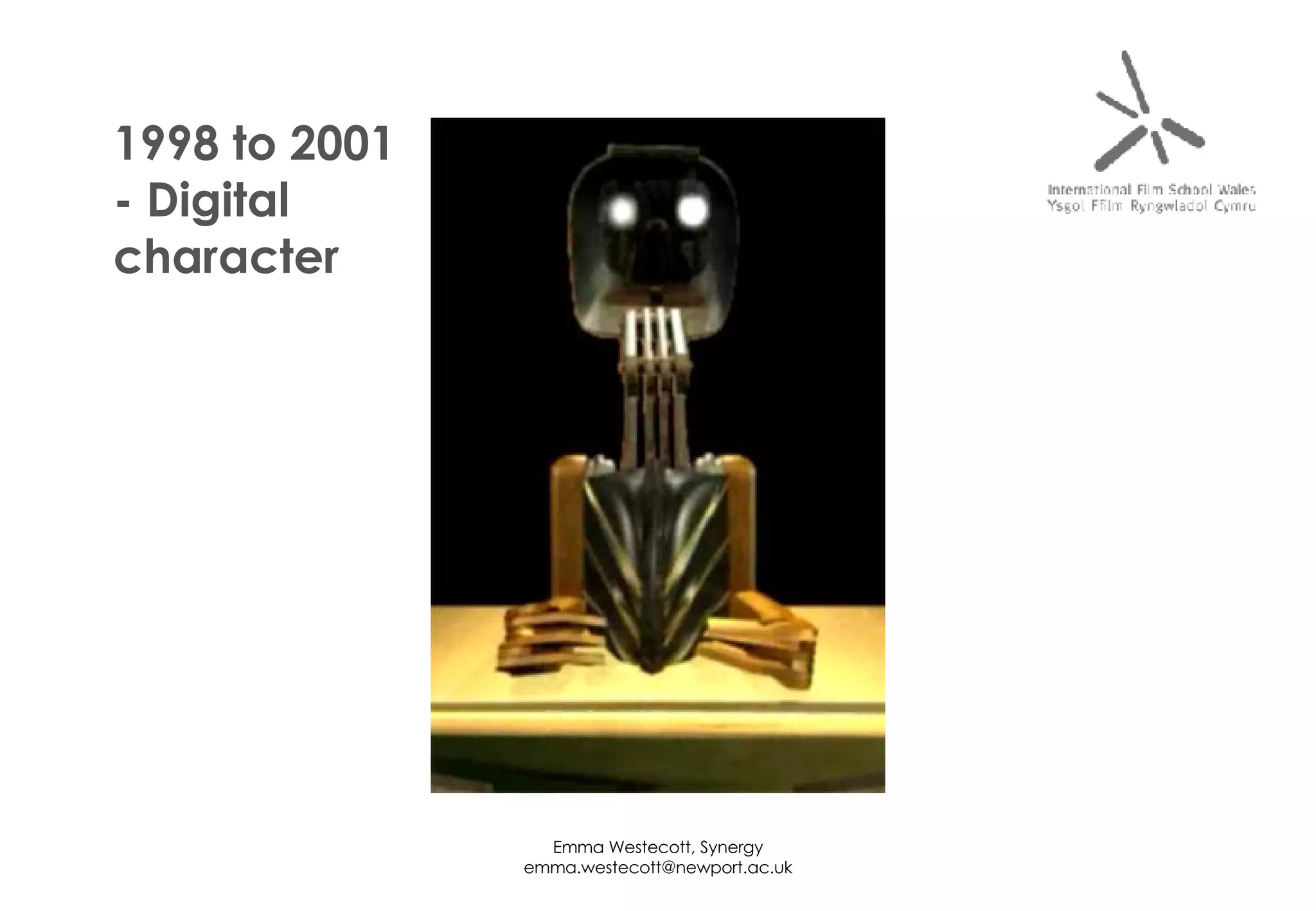
1998 to 2001  - Digital  character
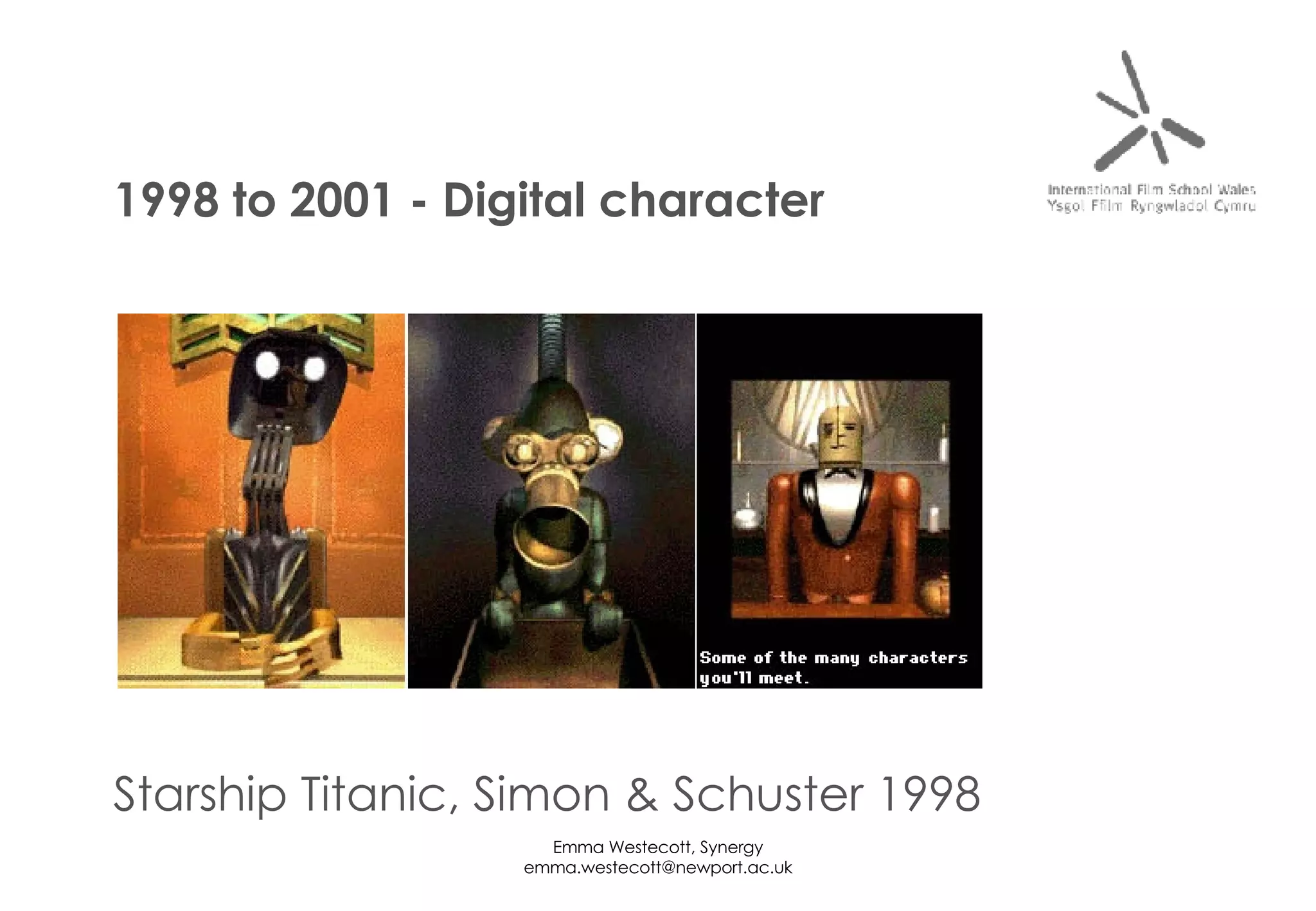
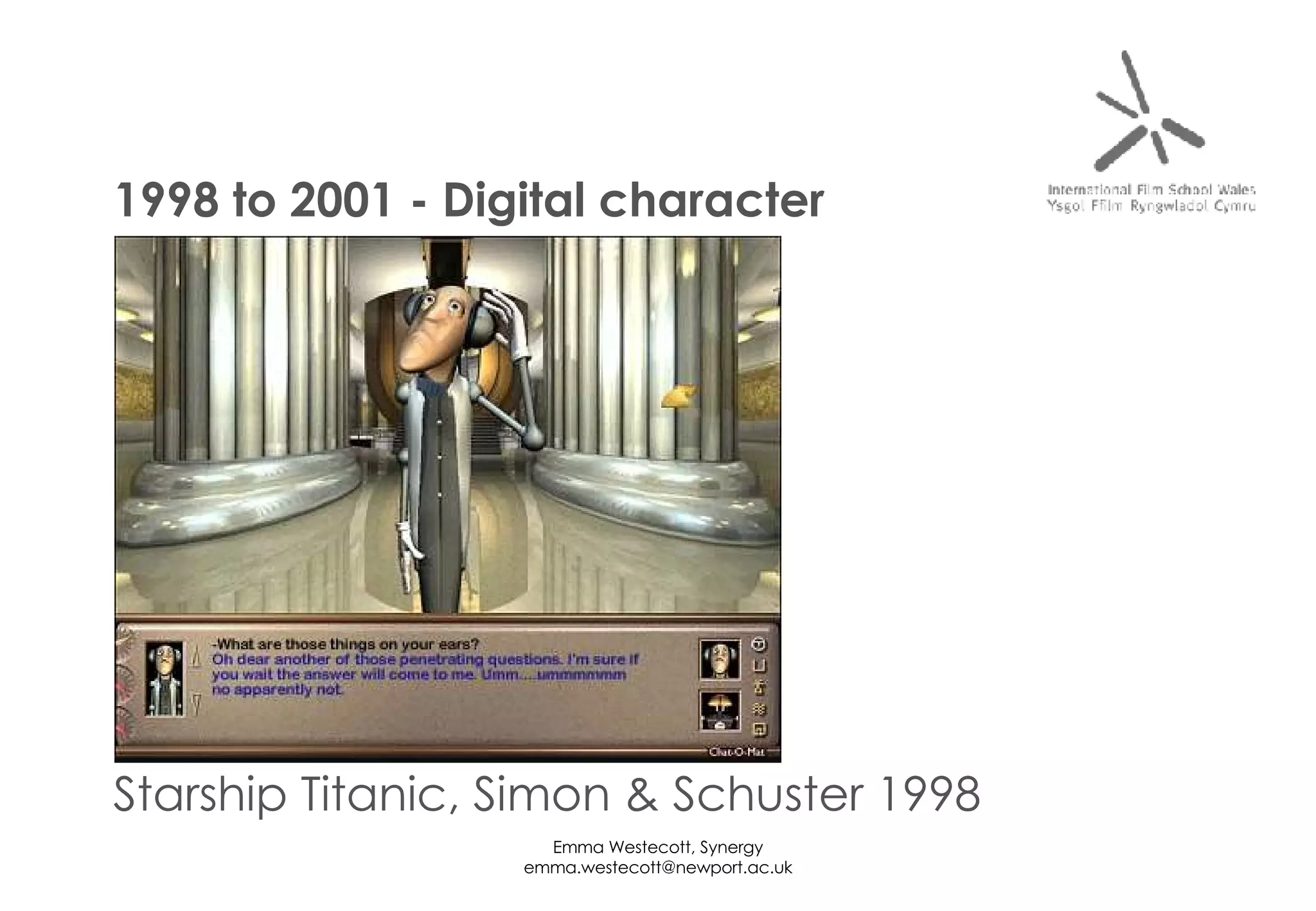
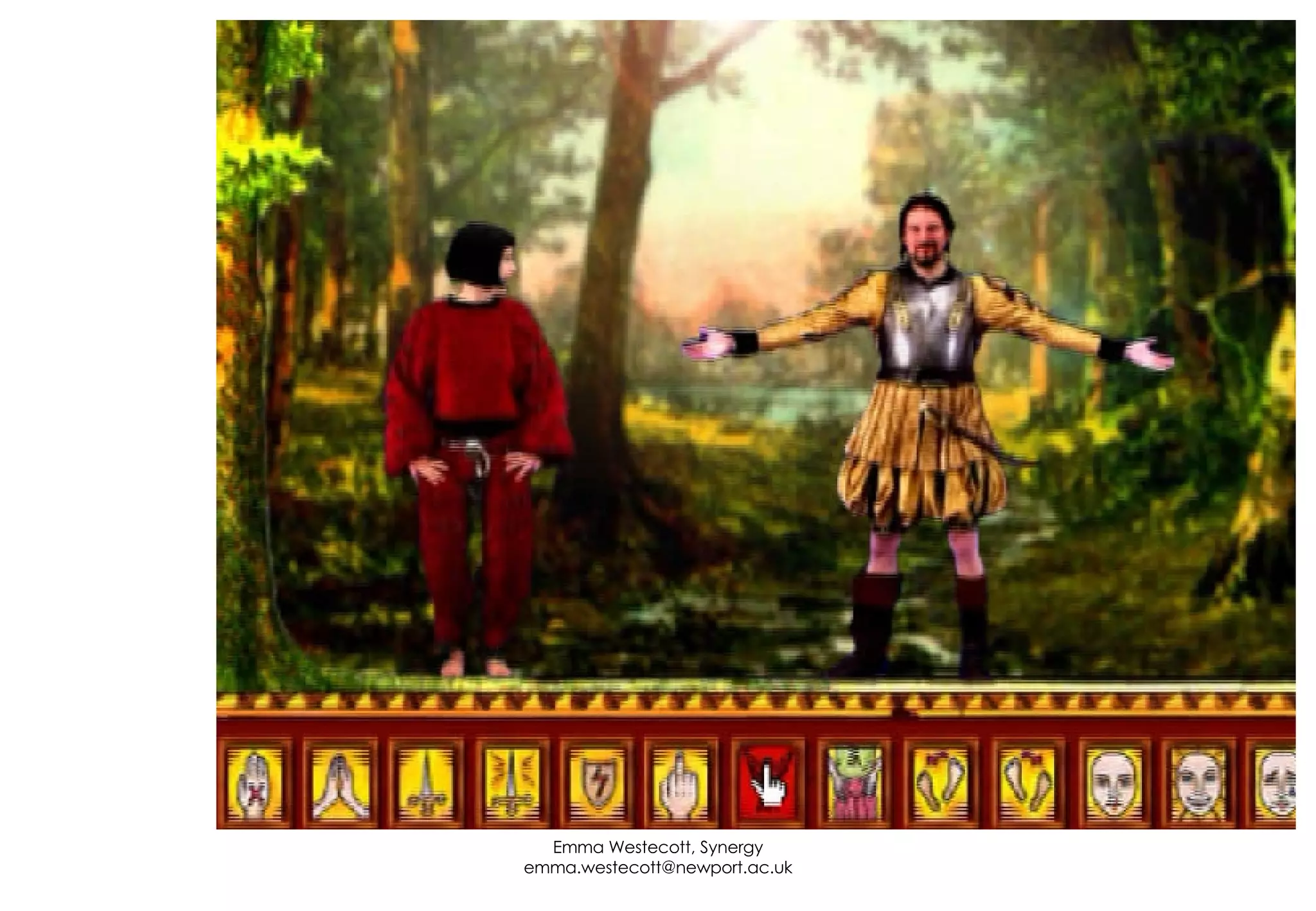
Starship Titanic, Simon & Schuster 1998 1998 to 2001 - Digital character
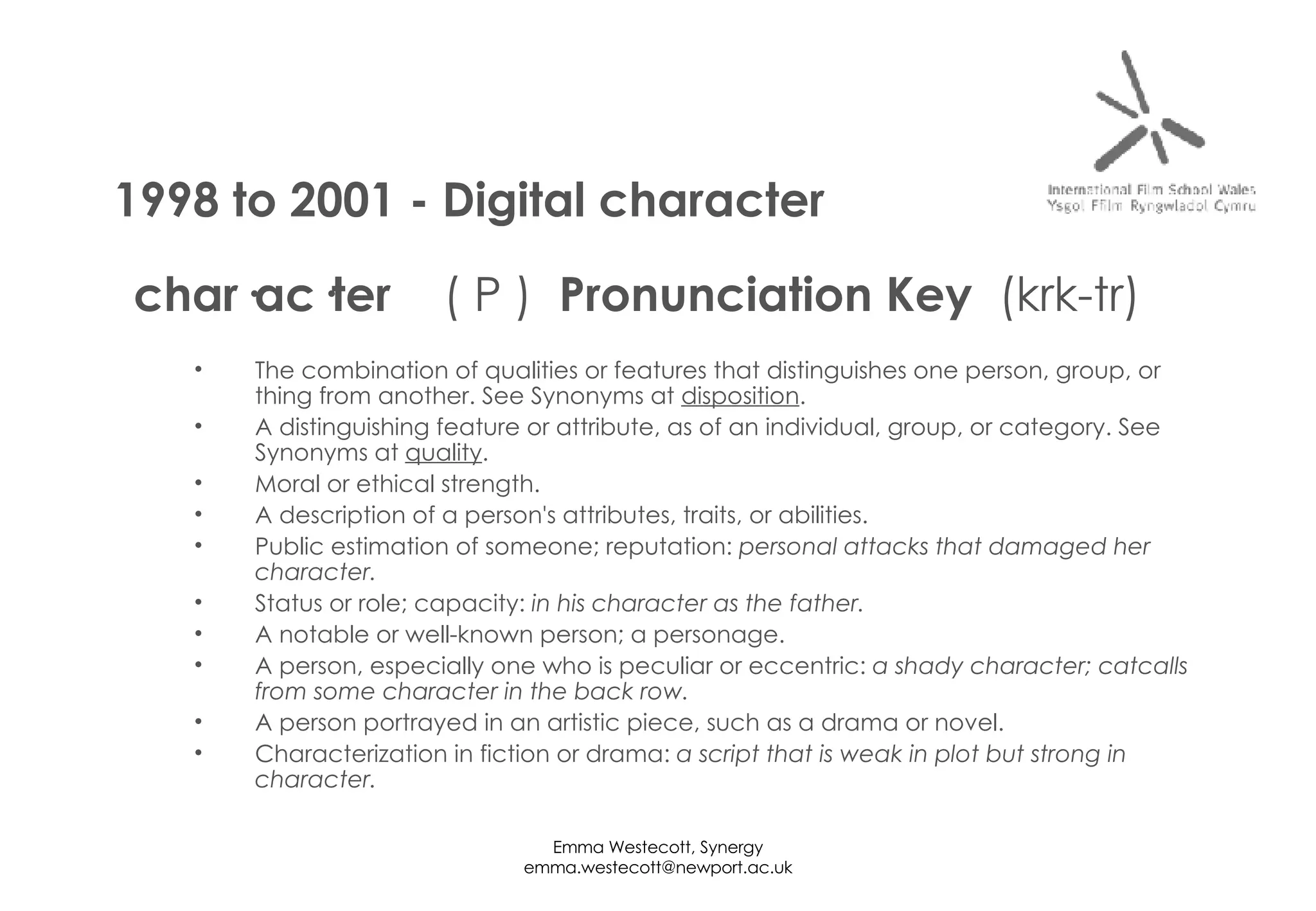
char·ac·ter     ( P )   Pronunciation Key   (krk-tr) The combination of qualities or features that distinguishes one person, group, or thing from another. See Synonyms at  disposition . A distinguishing feature or attribute, as of an individual, group, or category. See Synonyms at  quality . Moral or ethical strength. A description of a person's attributes, traits, or abilities. Public estimation of someone; reputation:  personal attacks that damaged her character.   Status or role; capacity:  in his character as the father.   A notable or well-known person; a personage. A person, especially one who is peculiar or eccentric:  a shady character; catcalls from some character in the back row.   A person portrayed in an artistic piece, such as a drama or novel. Characterization in fiction or drama:  a script that is weak in plot but strong in character.   1998 to 2001 - Digital character
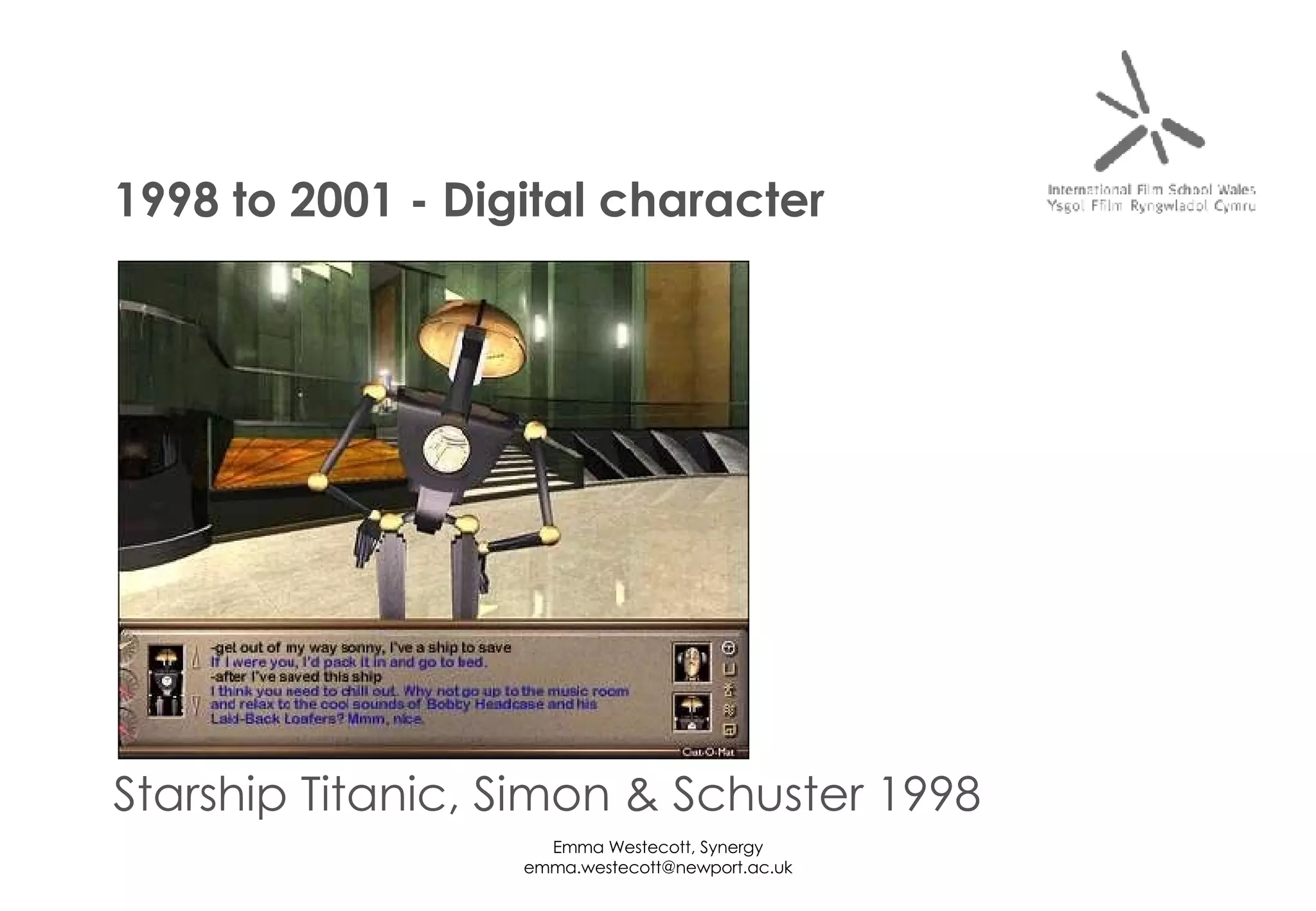
Starship Titanic, Simon & Schuster 1998 1998 to 2001 - Digital character
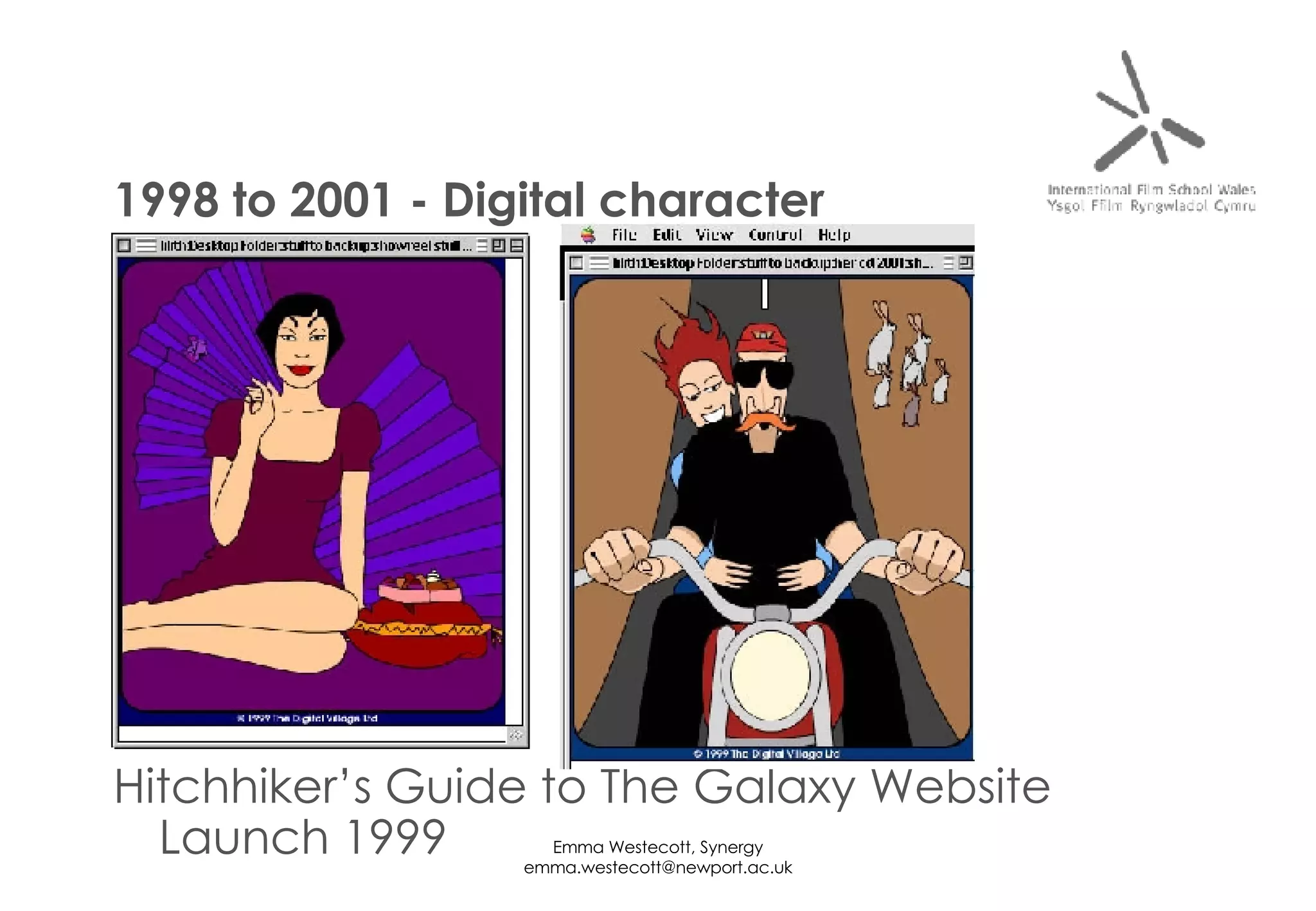
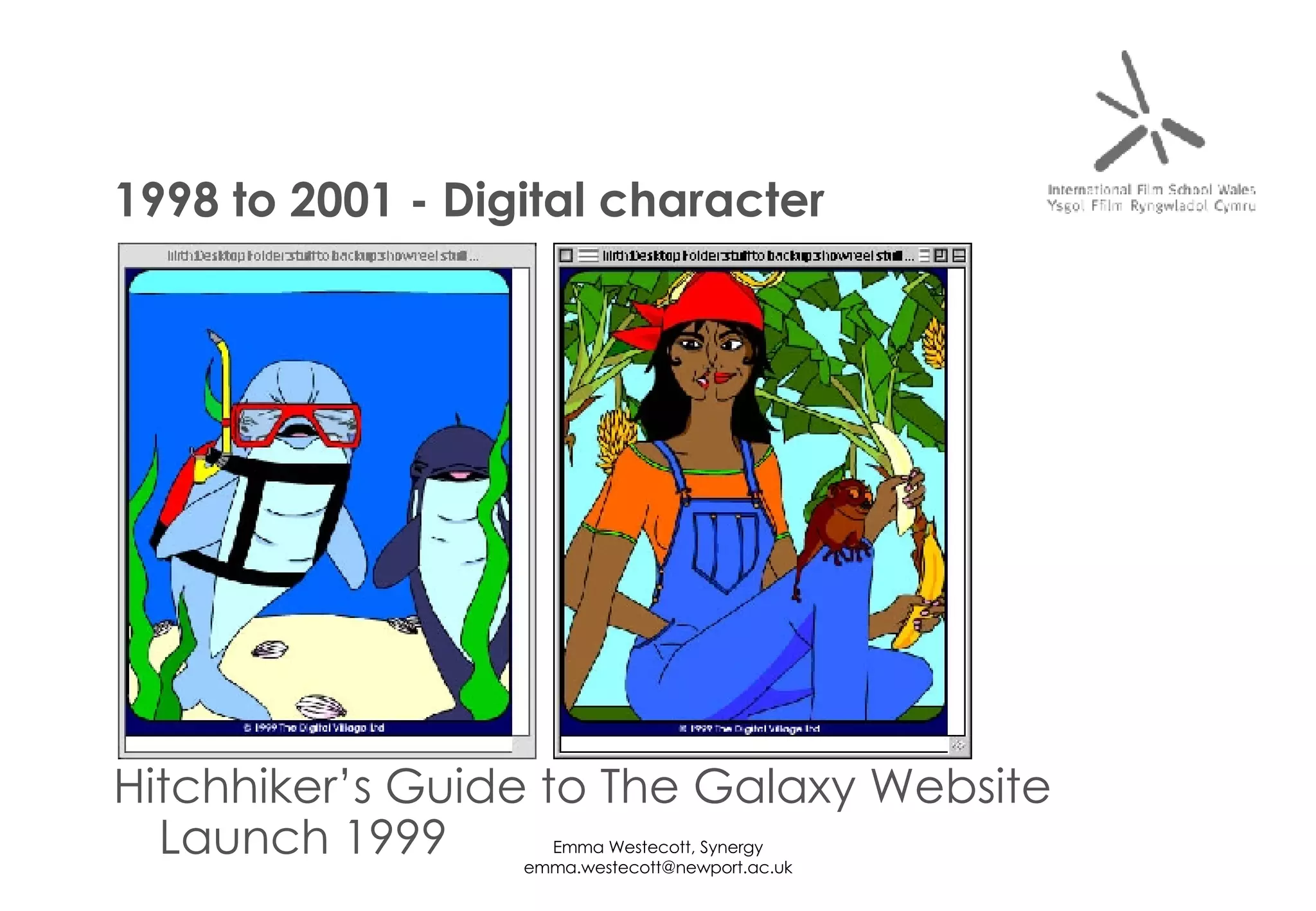
Hitchhiker’s Guide to The Galaxy Website Launch 1999 1998 to 2001 - Digital character
History Long line of academic study arising from the notion of artificial intelligence. This has turned out to be a hard problem. Field has moved on to look into mechanics to simulate artificial life and emotion. 1998 to 2001 - Digital character
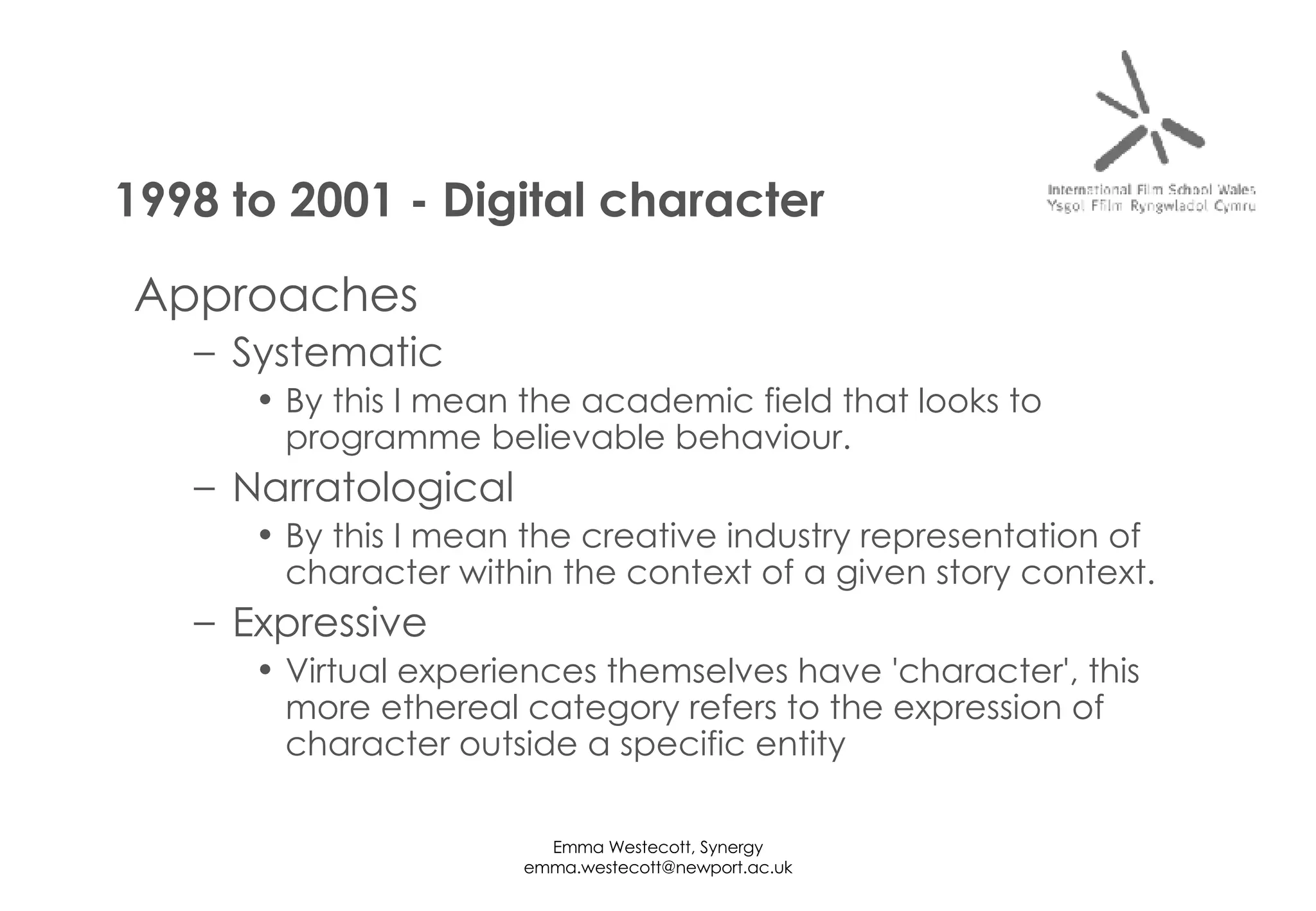
Approaches Systematic By this I mean the academic field that looks to programme believable behaviour. Narratological By this I mean the creative industry representation of character within the context of a given story context. Expressive Virtual experiences themselves have 'character', this more ethereal category refers to the expression of character outside a specific entity 1998 to 2001 - Digital character
 
Key to emotional attachment It is about adopting a multi-faceted approach Richness of characterisation engenders emotional connection with game characters Multiple media eg visual, aural, physical Holistic experience Digital character - Design criteria
Key to emotional attachment Bruce Blumberg’s (Synthetic Characters Group, MIT Media Lab) work on anticipatory AI : Low level expressive motion and behaviour used to create sense of inner life Revealing characters perception Showing expectations Signal impending change Digital character - Research
The Zero-Game Studio -  2001 to 2004  The Zero-Game Studio of The Interactive Institute is an advanced applied research laboratory specialising in games, located within The Interactive Island cluster in Visby, Gotland, Sweden. The purpose of our project-led activity is to extend the nature, scope and reach of game form to a wider audience in innovative and creative ways.  Our goal is to initiate and conduct novel and innovative research that explores and shares new visions of games and gameplay. The Zero-Game Studio http://zerogame.interactiveinstitute.se
The Zero-Game Studio http://zerogame.interactiveinstitute.se
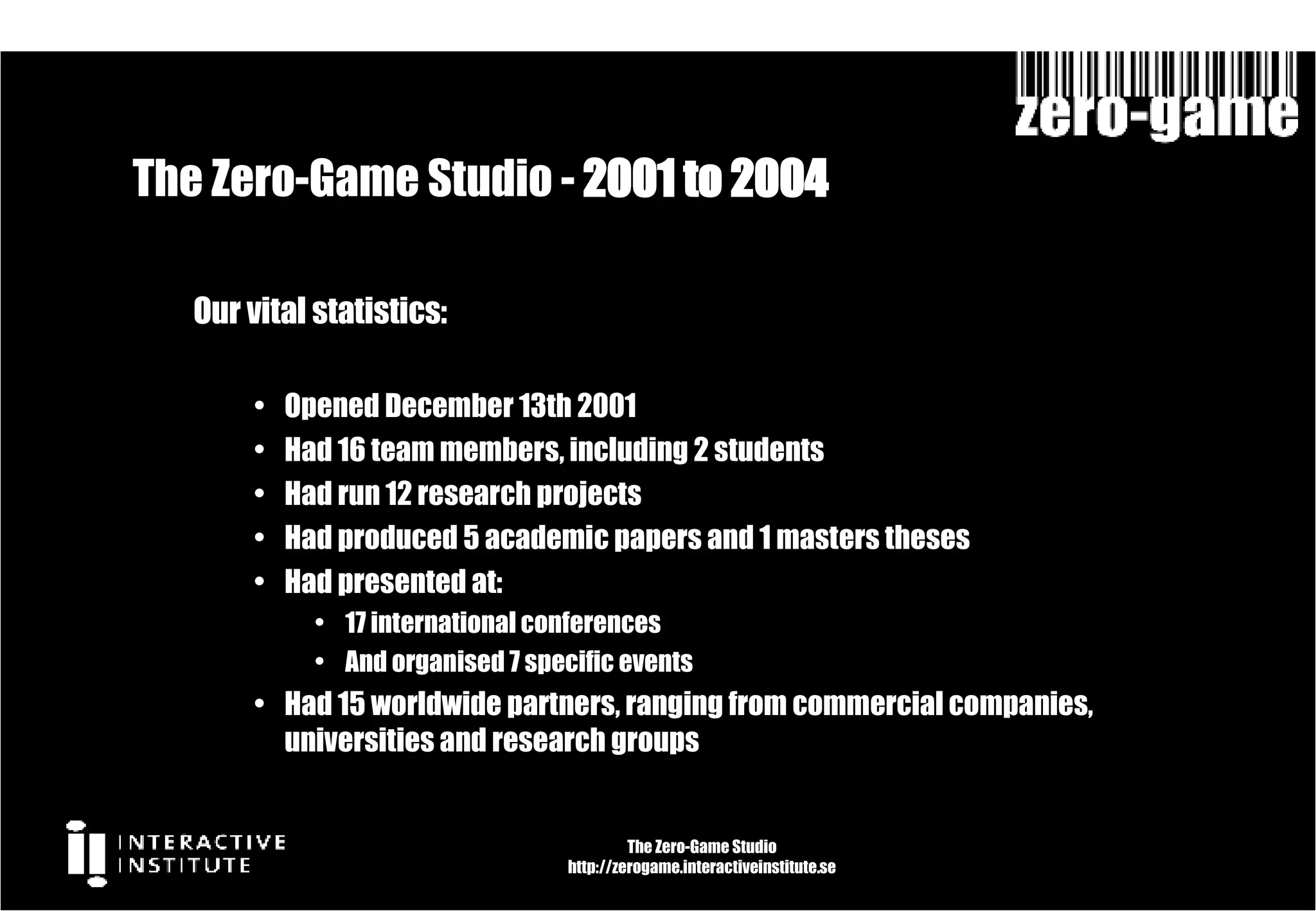
The Zero-Game Studio -  2001 to 2004  Our vital statistics: Opened December 13th 2001 Had 16 team members, including 2 students Had run 12 research projects Had produced 5 academic papers and 1 masters theses Had presented at: 17 international conferences And organised 7 specific events Had 15 worldwide partners, ranging from commercial companies, universities and research groups The Zero-Game Studio http://zerogame.interactiveinstitute.se
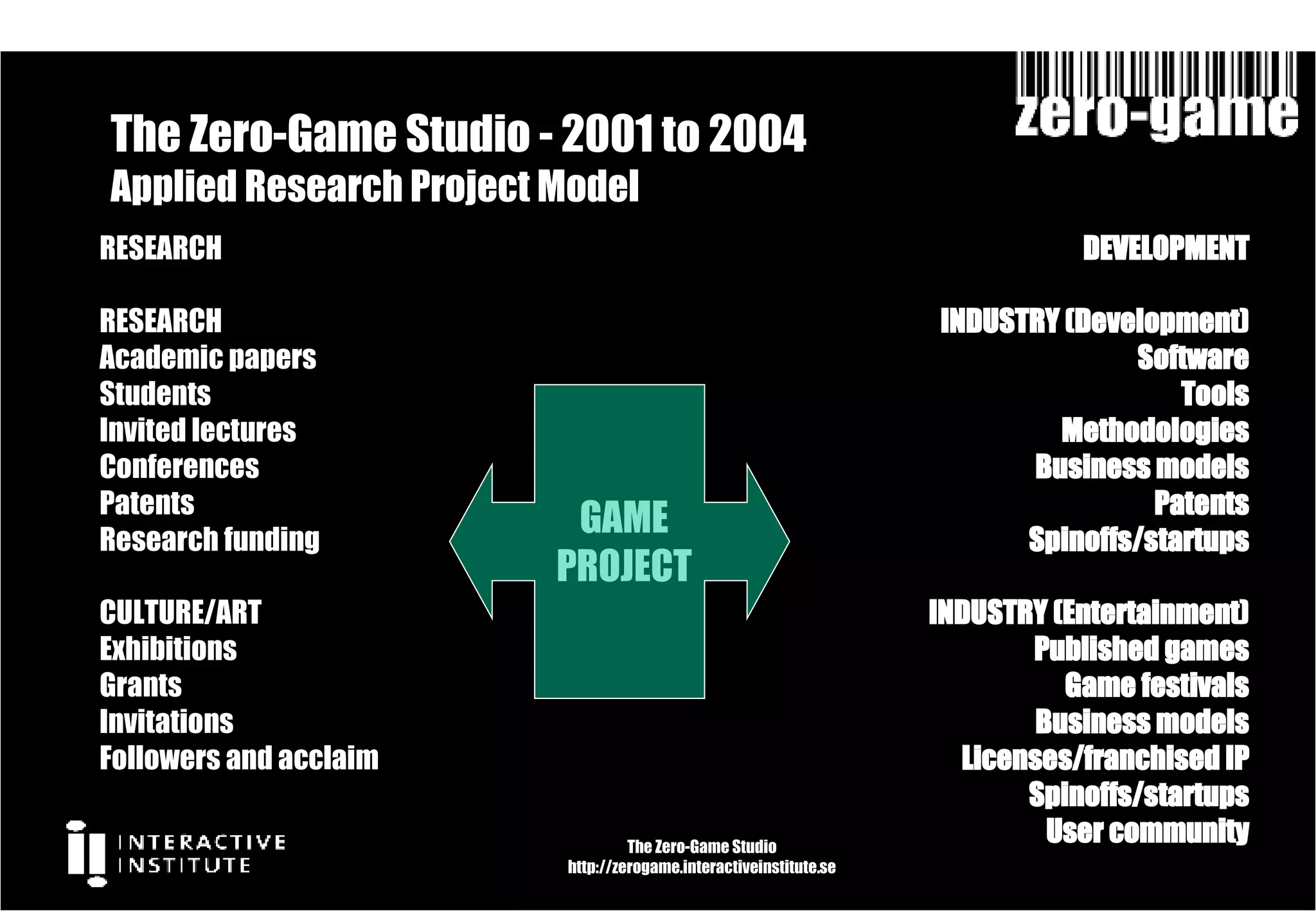
The Zero-Game Studio -  2001 to 2004  Applied Research Project Model The Zero-Game Studio http://zerogame.interactiveinstitute.se DEVELOPMENT INDUSTRY (Development) Software Tools Methodologies Business models Patents Spinoffs/startups INDUSTRY (Entertainment) Published games Game festivals Business models Licenses/franchised IP Spinoffs/startups User community RESEARCH RESEARCH Academic papers Students Invited lectures Conferences Patents Research funding CULTURE/ART Exhibitions Grants Invitations Followers and acclaim GAME PROJECT
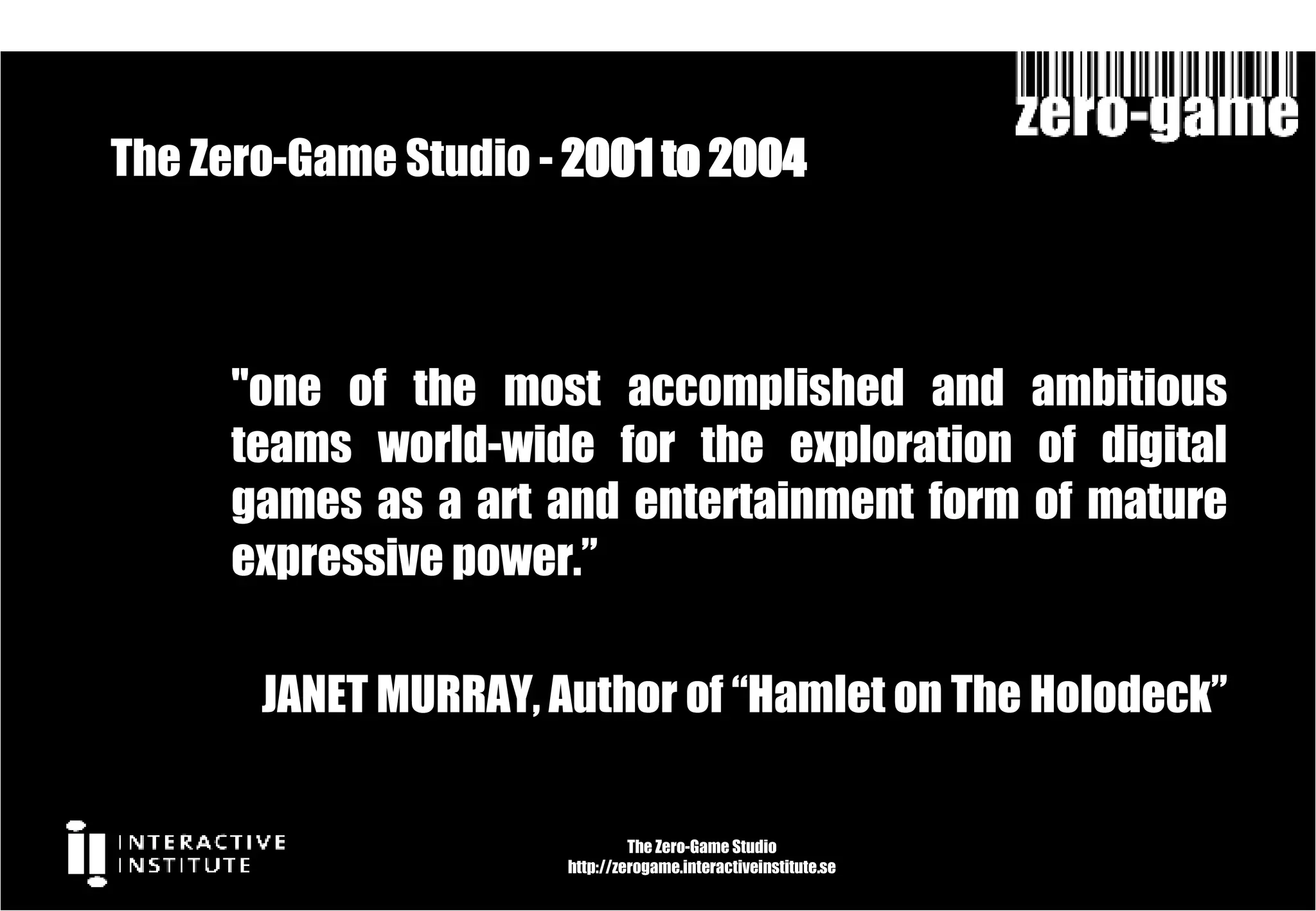
The Zero-Game Studio -  2001 to 2004  The Zero-Game Studio http://zerogame.interactiveinstitute.se "one of the most accomplished and ambitious teams world-wide for the exploration of digital games as a art and entertainment form of mature expressive power.” JANET MURRAY, Author of “Hamlet on The Holodeck”
 
2003 to date
Synergy is a games research group investigating the space between game and art, based at the International Film School of Wales within the University of Wales, Newport. Synergy operates as an interdisciplinary collective; artists, practitioners, and theorists who celebrate the edges, and thereby the connections between our multifarious media form. Our members are united along a common desire to explore in-depth the artistic potential of contemporary digital game form. 2004 to date - Synergy
 
 
Blank
THE BIG GAME THE BIG GAME NON-GAMES OTHER PLAYERS THE PERFORMANCE OF PLAY SITUATED PLAYERS
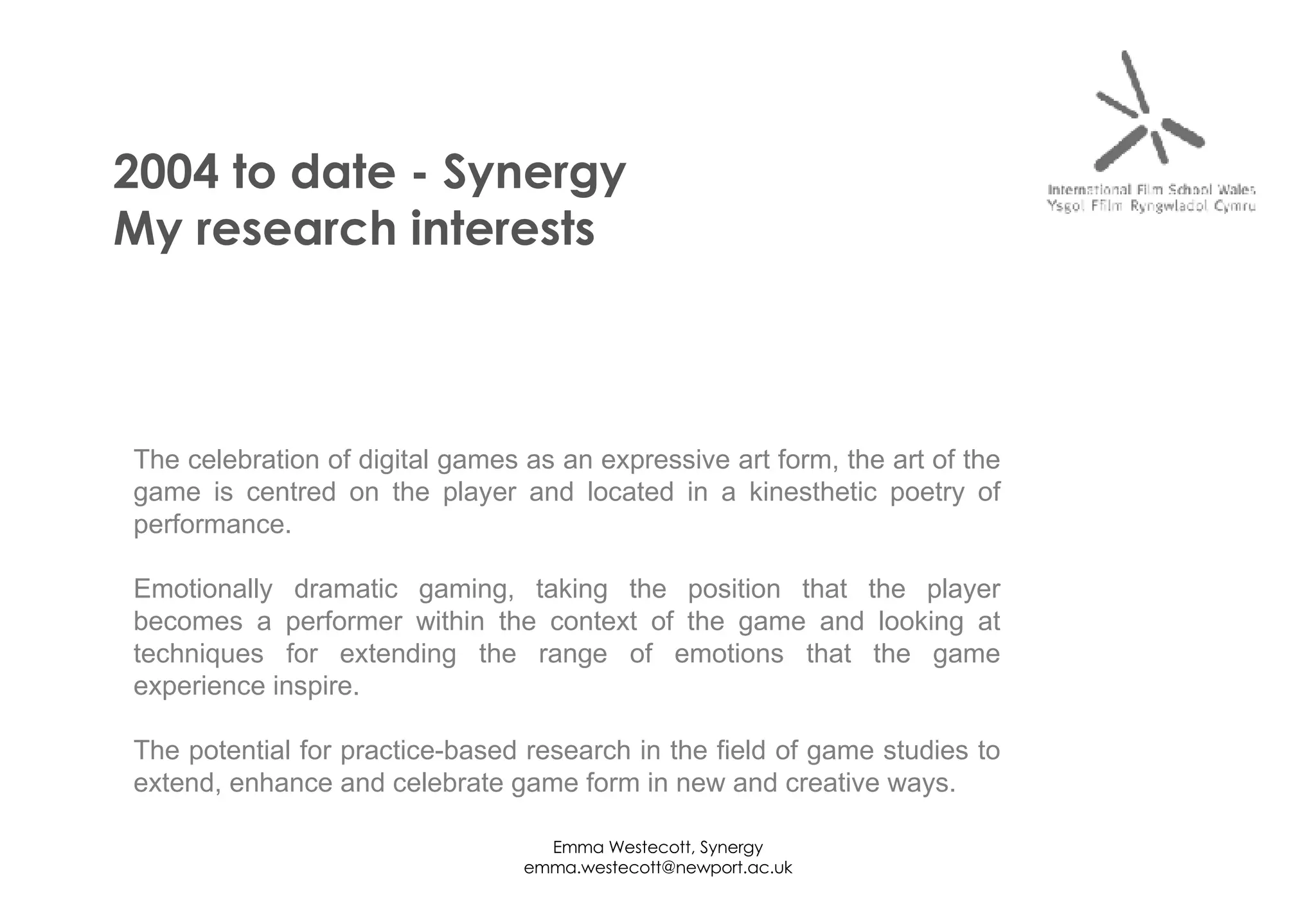
2004 to date - Synergy My research interests The celebration of digital games as an expressive art form, the art of the game is centred on the player and located in a kinesthetic poetry of performance. Emotionally dramatic gaming, taking the position that the player becomes a performer within the context of the game and looking at techniques for extending the range of emotions that the game experience inspire. The potential for practice-based research in the field of game studies to extend, enhance and celebrate game form in new and creative ways.
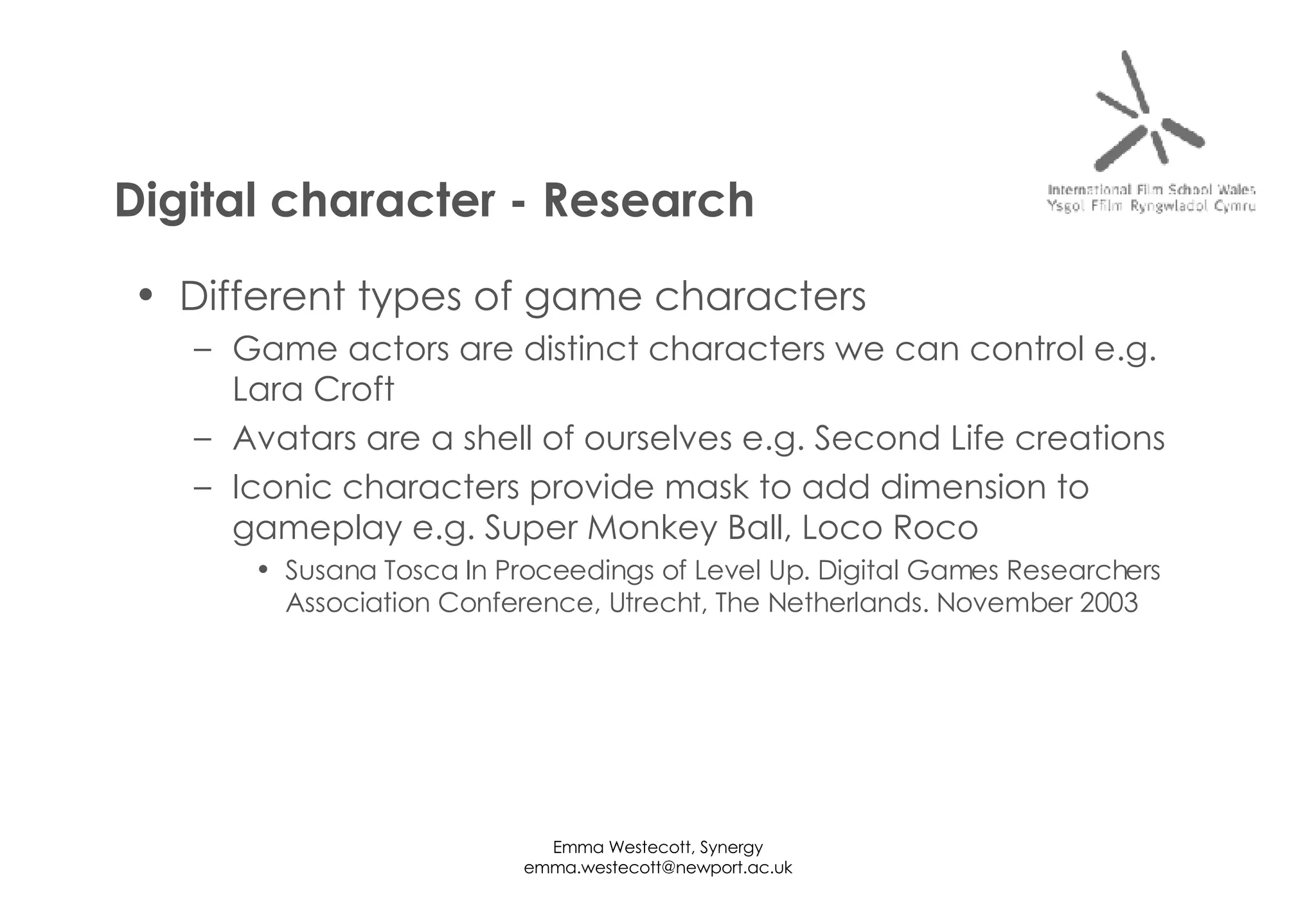
Different types of game characters Game actors are distinct characters we can control e.g. Lara Croft Avatars are a shell of ourselves e.g. Second Life creations Iconic characters provide mask to add dimension to gameplay e.g. Super Monkey Ball, Loco Roco Susana Tosca In Proceedings of Level Up. Digital Games Researchers Association Conference, Utrecht, The Netherlands. November 2003 Digital character - Research
Digital character - Industry
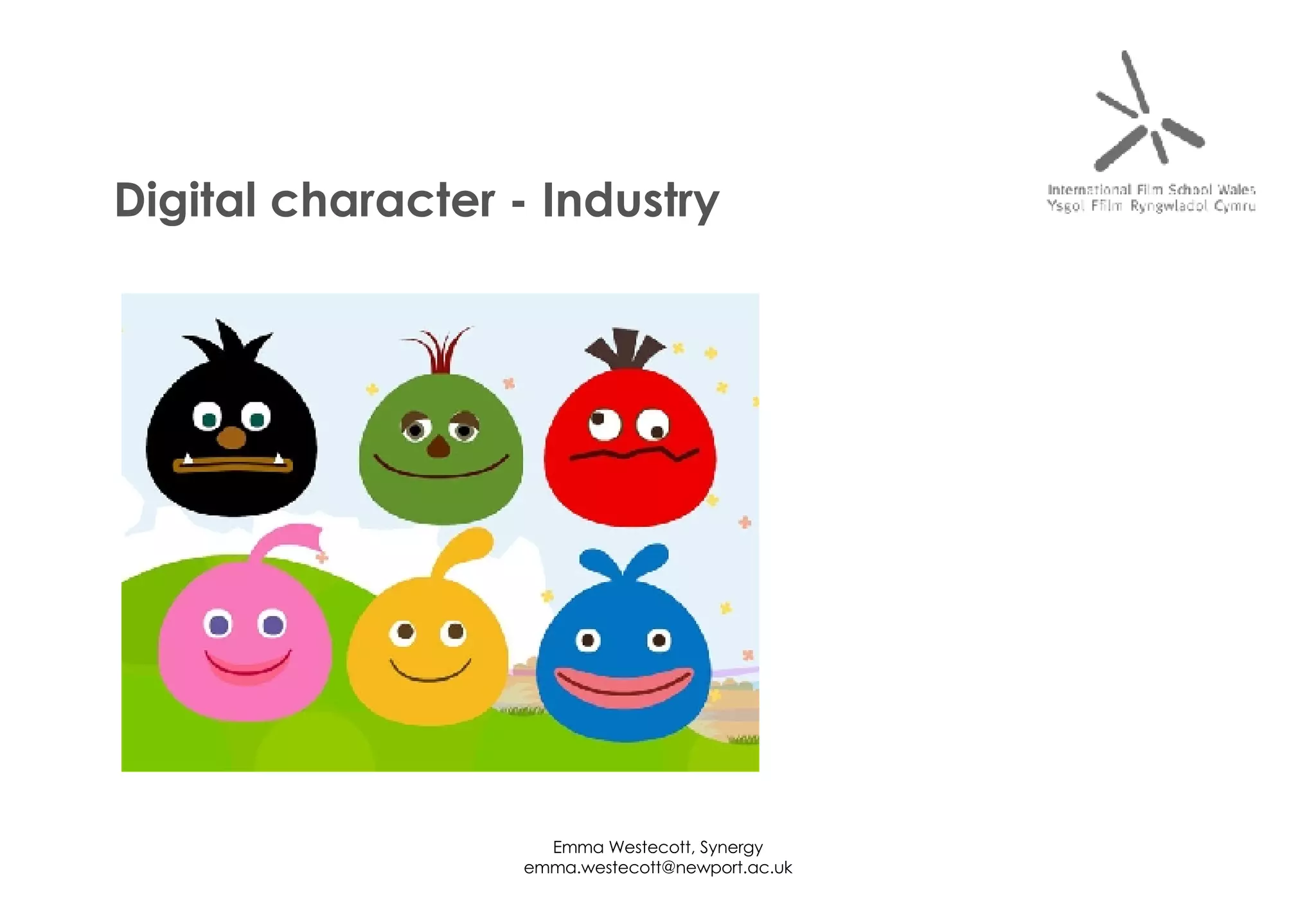
Loco Roco Use of cute aesthetic globalises appeal  Cute creates empathy  e.g. a bstraction makes it easier to project emotions onto an object , so  simplicity enables player identification Digital character - Industry

Emma's Games and Storytelling public lecture

  • 1.
    Games and StorytellingEmma Westecott, IFSW & University of Wales, Newport
  • 2.
    Play as PerformanceThis lecture will interleave a retrospective of my work over the past 10 years in commercial games, web and research projects with my current thinking on games as a performance media. I will develop a narrative of my work to communicate an ongoing interest in playfulness in the creation of digital experience. A key dynamic of the field of game studies in our post-modern climate is the active involvement of the player in the ongoing evolution of form; the player collides with the game system to create the media experience. This performance blurs the boundaries between producer and consumer in that the player simultaneously takes on both roles within the game. As a player I am both producing my experience in the ways in which I express my skill within a particular game play moment whilst simultaneously consuming the results of my actions.
  • 3.
    1998 to 2001 - Digital character
  • 4.
    Starship Titanic, Simon& Schuster 1998 1998 to 2001 - Digital character
  • 5.
    char·ac·ter   ( P )   Pronunciation Key   (krk-tr) The combination of qualities or features that distinguishes one person, group, or thing from another. See Synonyms at disposition . A distinguishing feature or attribute, as of an individual, group, or category. See Synonyms at quality . Moral or ethical strength. A description of a person's attributes, traits, or abilities. Public estimation of someone; reputation: personal attacks that damaged her character. Status or role; capacity: in his character as the father. A notable or well-known person; a personage. A person, especially one who is peculiar or eccentric: a shady character; catcalls from some character in the back row. A person portrayed in an artistic piece, such as a drama or novel. Characterization in fiction or drama: a script that is weak in plot but strong in character. 1998 to 2001 - Digital character
  • 6.
    Starship Titanic, Simon& Schuster 1998 1998 to 2001 - Digital character
  • 7.
    Starship Titanic, Simon& Schuster 1998 1998 to 2001 - Digital character
  • 8.
    Hitchhiker’s Guide toThe Galaxy Website Launch 1999 1998 to 2001 - Digital character
  • 9.
    Hitchhiker’s Guide toThe Galaxy Website Launch 1999 1998 to 2001 - Digital character
  • 10.
    History Long lineof academic study arising from the notion of artificial intelligence. This has turned out to be a hard problem. Field has moved on to look into mechanics to simulate artificial life and emotion. 1998 to 2001 - Digital character
  • 11.
    Approaches Systematic Bythis I mean the academic field that looks to programme believable behaviour. Narratological By this I mean the creative industry representation of character within the context of a given story context. Expressive Virtual experiences themselves have 'character', this more ethereal category refers to the expression of character outside a specific entity 1998 to 2001 - Digital character
  • 12.
  • 13.
    Key to emotionalattachment It is about adopting a multi-faceted approach Richness of characterisation engenders emotional connection with game characters Multiple media eg visual, aural, physical Holistic experience Digital character - Design criteria
  • 14.
    Key to emotionalattachment Bruce Blumberg’s (Synthetic Characters Group, MIT Media Lab) work on anticipatory AI : Low level expressive motion and behaviour used to create sense of inner life Revealing characters perception Showing expectations Signal impending change Digital character - Research
  • 15.
    The Zero-Game Studio- 2001 to 2004 The Zero-Game Studio of The Interactive Institute is an advanced applied research laboratory specialising in games, located within The Interactive Island cluster in Visby, Gotland, Sweden. The purpose of our project-led activity is to extend the nature, scope and reach of game form to a wider audience in innovative and creative ways. Our goal is to initiate and conduct novel and innovative research that explores and shares new visions of games and gameplay. The Zero-Game Studio http://zerogame.interactiveinstitute.se
  • 16.
    The Zero-Game Studiohttp://zerogame.interactiveinstitute.se
  • 17.
    The Zero-Game Studio- 2001 to 2004 Our vital statistics: Opened December 13th 2001 Had 16 team members, including 2 students Had run 12 research projects Had produced 5 academic papers and 1 masters theses Had presented at: 17 international conferences And organised 7 specific events Had 15 worldwide partners, ranging from commercial companies, universities and research groups The Zero-Game Studio http://zerogame.interactiveinstitute.se
  • 18.
    The Zero-Game Studio- 2001 to 2004 Applied Research Project Model The Zero-Game Studio http://zerogame.interactiveinstitute.se DEVELOPMENT INDUSTRY (Development) Software Tools Methodologies Business models Patents Spinoffs/startups INDUSTRY (Entertainment) Published games Game festivals Business models Licenses/franchised IP Spinoffs/startups User community RESEARCH RESEARCH Academic papers Students Invited lectures Conferences Patents Research funding CULTURE/ART Exhibitions Grants Invitations Followers and acclaim GAME PROJECT
  • 19.
    The Zero-Game Studio- 2001 to 2004 The Zero-Game Studio http://zerogame.interactiveinstitute.se "one of the most accomplished and ambitious teams world-wide for the exploration of digital games as a art and entertainment form of mature expressive power.” JANET MURRAY, Author of “Hamlet on The Holodeck”
  • 20.
  • 21.
  • 22.
    Synergy is agames research group investigating the space between game and art, based at the International Film School of Wales within the University of Wales, Newport. Synergy operates as an interdisciplinary collective; artists, practitioners, and theorists who celebrate the edges, and thereby the connections between our multifarious media form. Our members are united along a common desire to explore in-depth the artistic potential of contemporary digital game form. 2004 to date - Synergy
  • 23.
  • 24.
  • 25.
  • 26.
    THE BIG GAMETHE BIG GAME NON-GAMES OTHER PLAYERS THE PERFORMANCE OF PLAY SITUATED PLAYERS
  • 27.
    2004 to date- Synergy My research interests The celebration of digital games as an expressive art form, the art of the game is centred on the player and located in a kinesthetic poetry of performance. Emotionally dramatic gaming, taking the position that the player becomes a performer within the context of the game and looking at techniques for extending the range of emotions that the game experience inspire. The potential for practice-based research in the field of game studies to extend, enhance and celebrate game form in new and creative ways.
  • 28.
    Different types ofgame characters Game actors are distinct characters we can control e.g. Lara Croft Avatars are a shell of ourselves e.g. Second Life creations Iconic characters provide mask to add dimension to gameplay e.g. Super Monkey Ball, Loco Roco Susana Tosca In Proceedings of Level Up. Digital Games Researchers Association Conference, Utrecht, The Netherlands. November 2003 Digital character - Research
  • 29.
  • 30.
    Loco Roco Useof cute aesthetic globalises appeal Cute creates empathy e.g. a bstraction makes it easier to project emotions onto an object , so simplicity enables player identification Digital character - Industry