LUDIC INTERFACES AND DESIGN
Semana do Design -Novembro de 2011
Prof. MSc. Vicente Martin Mastrocola
About the speaker

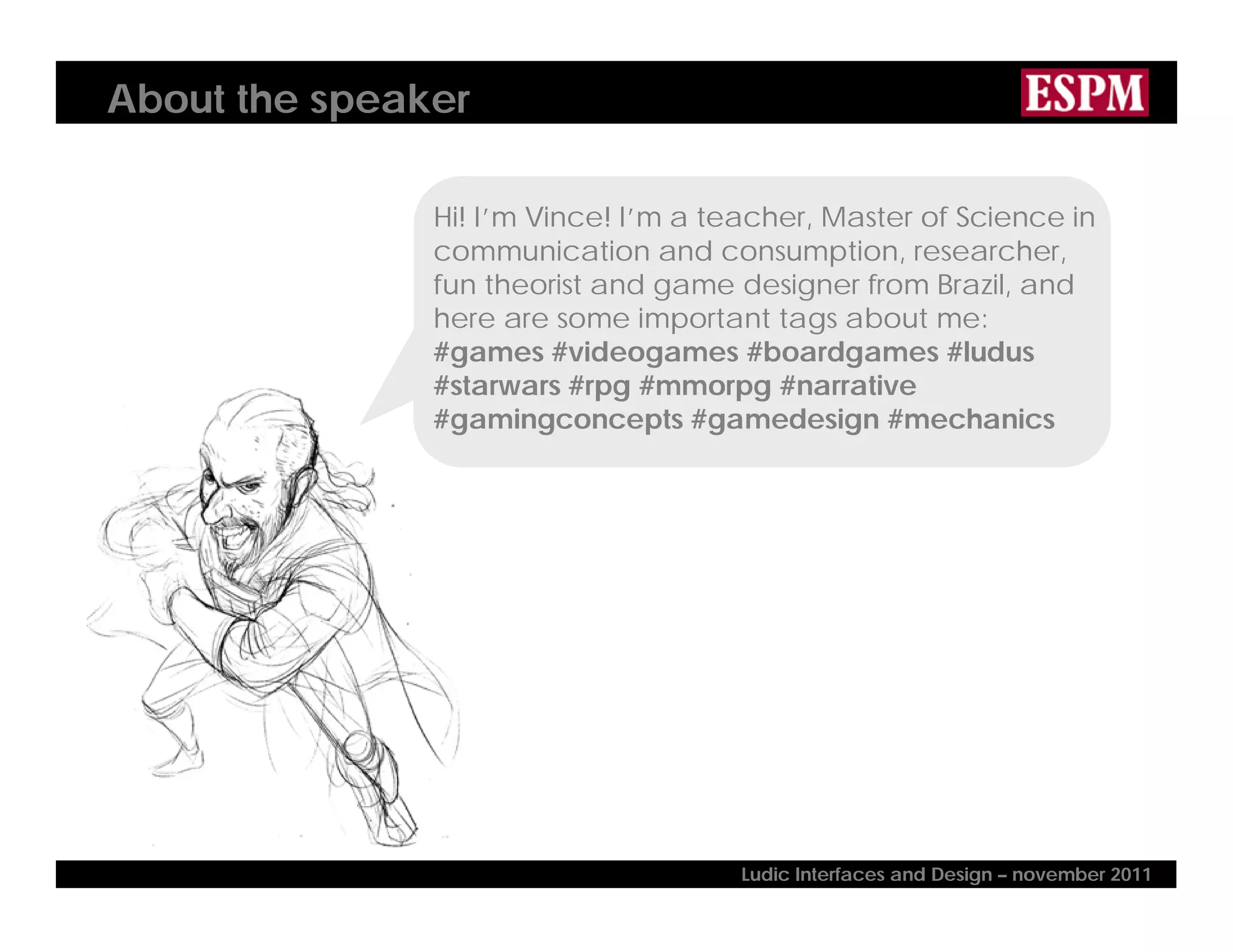
               Hi! I’m Vince! I’m a teacher, Master of Science in
               communication and consumption, researcher,
               fun theorist and game designer from Brazil, and
               here are some important tags about me:
               #games #videogames #boardgames #ludus
               #starwars #rpg #mmorpg #narrative
               #gamingconcepts #gamedesign #mechanics


                                      Ludic Interfaces and Design – november 2011
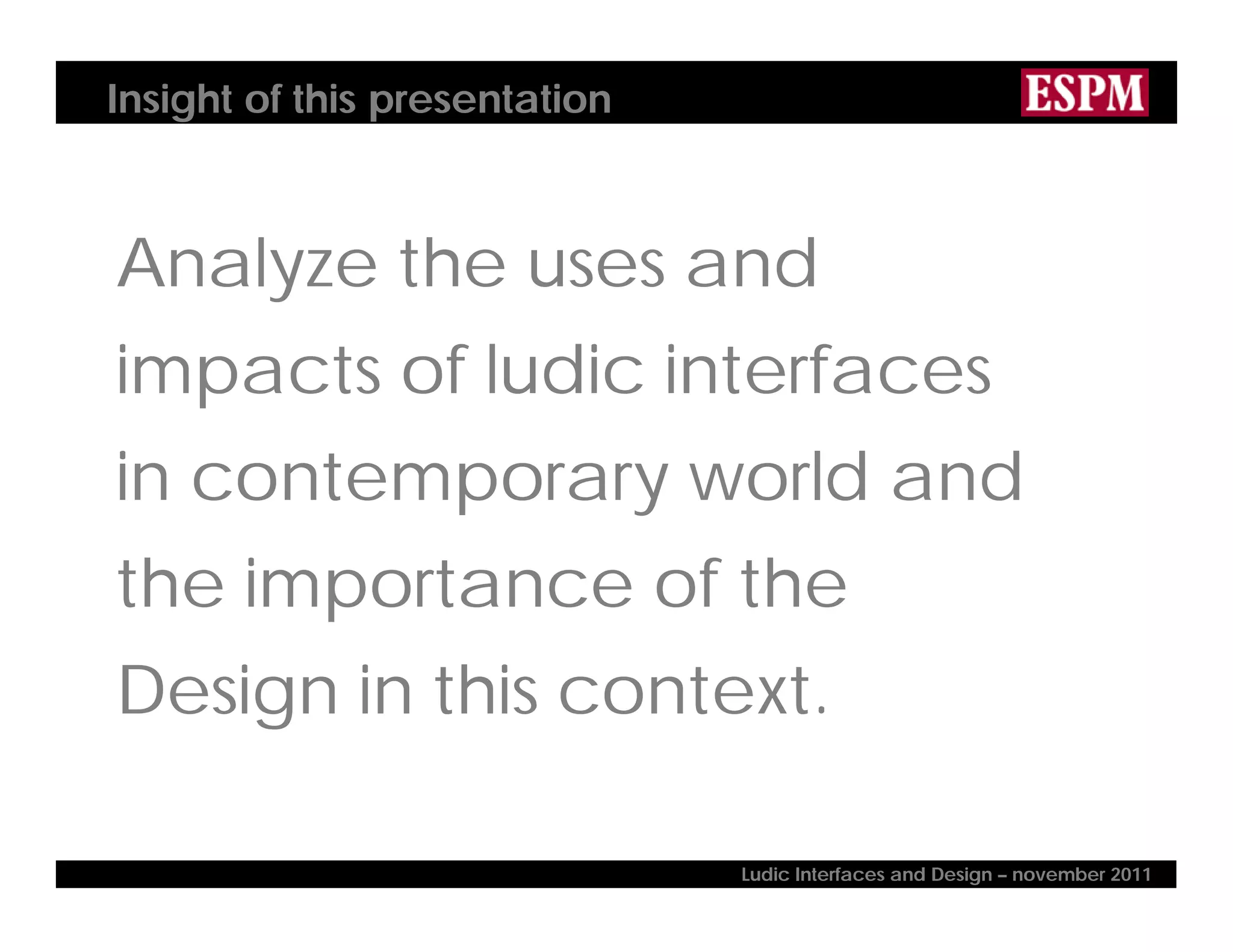
Insight of this presentation


Analyze the uses and
impacts of ludic interfaces
in contemporary world and
the importance of the
Design in this context.

                               Ludic Interfaces and Design – november 2011
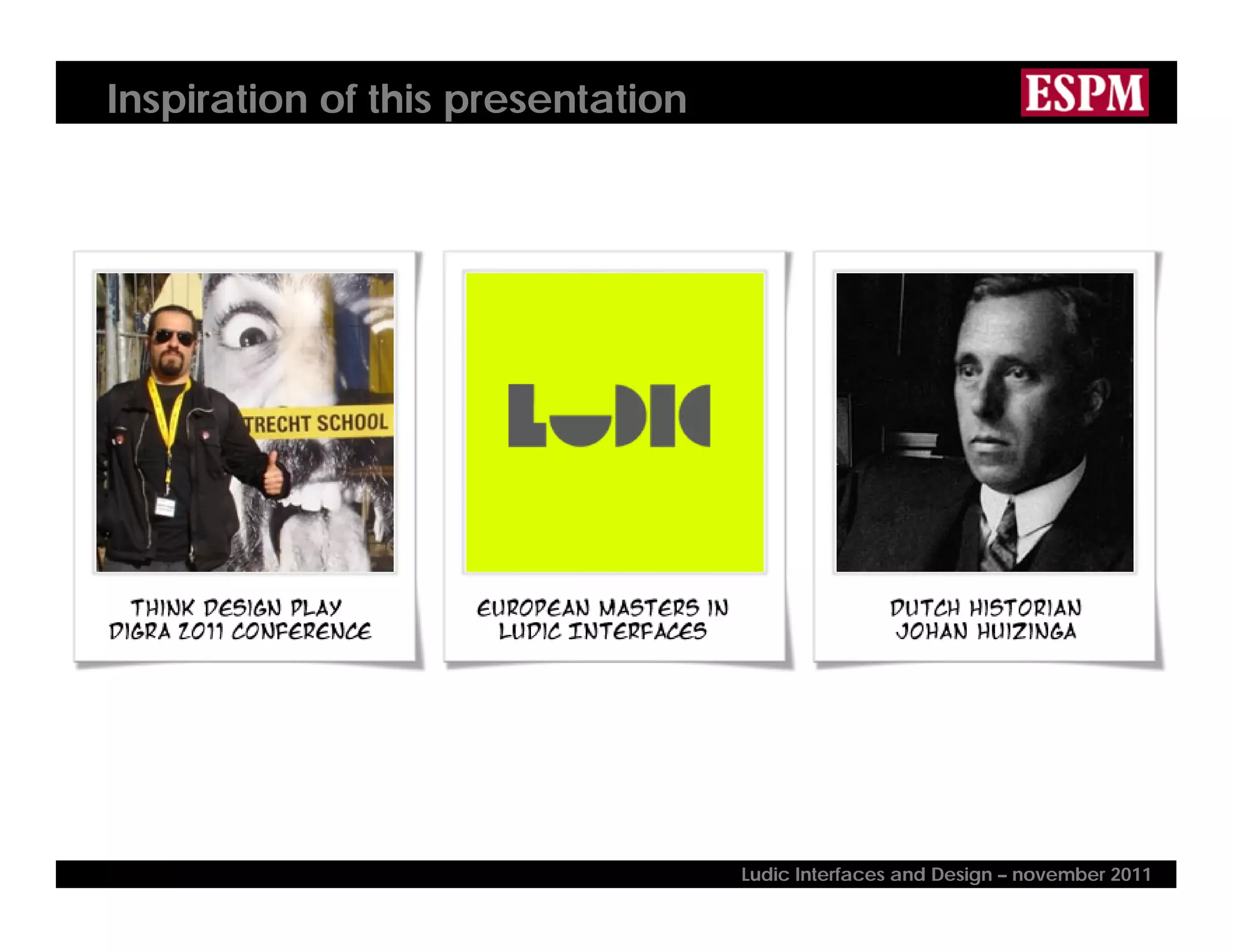
Inspiration of this presentation


                                   Ludic Interfaces and Design – november 2011
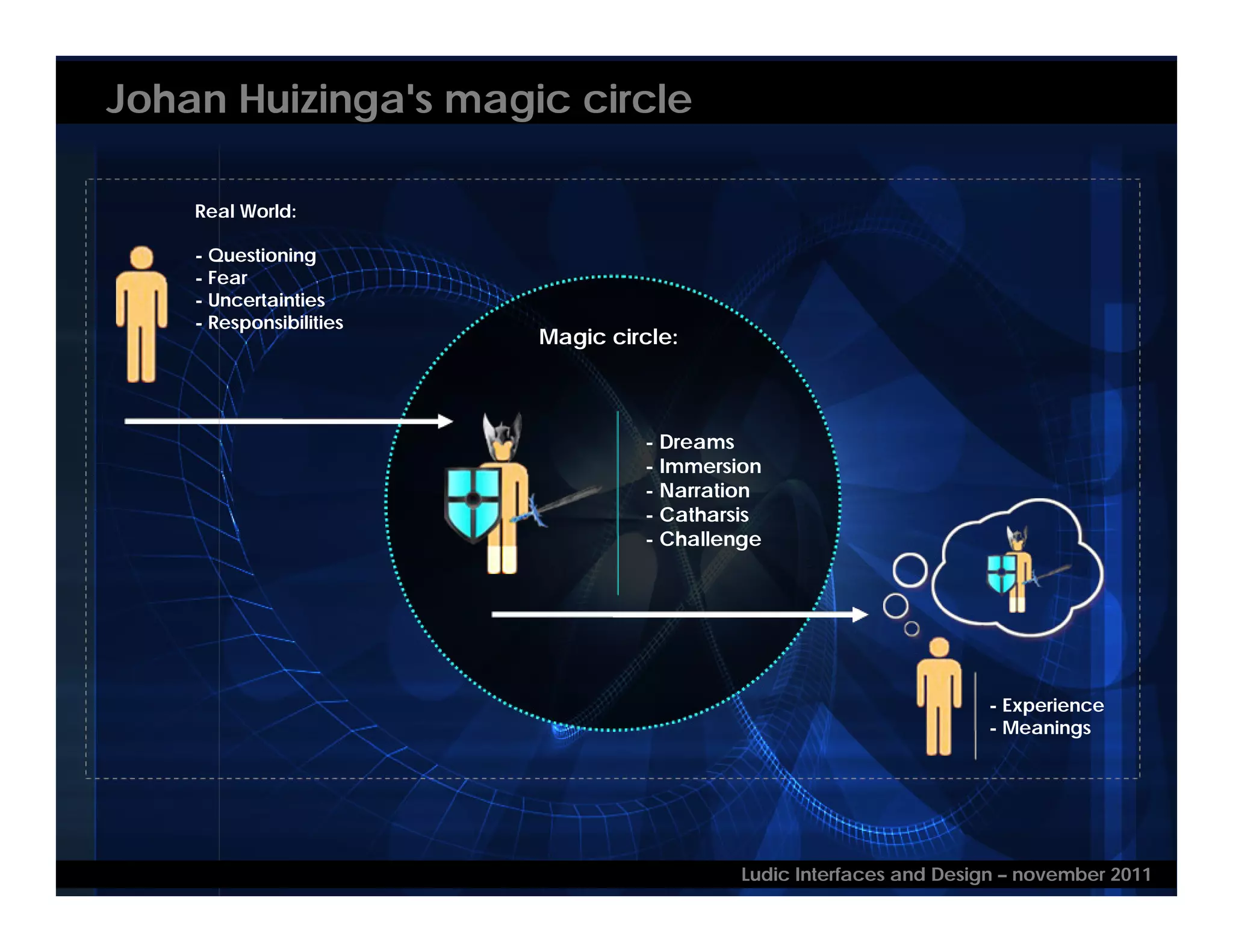
Johan Huizinga's magic circle

    Real World:

    - Questioning
    - Fear
    - Uncertainties
    - Responsibilities
                         Magic circle:


                                  - Dreams
                                  - Immersion
                                  - Narration
                                  - Catharsis
                                  - Challenge


                                                                    - Experience
                                                                    - Meanings


                                           Ludic Interfaces and Design – november 2011
What is ludic interfaces?


According to European Masters in Ludic Interfaces program:


“Ludic interfaces are playful interfaces. The notion of a
homo ludens, introduced by Johan Huizinga, is the
conceptual backbone of the tools we are looking at.
Think of devices like the Wii console, solar power operated
building facades, unconventional musical instrument
controllers, game art devices...”.


Source: http://creativegames.org.uk/LUDICI/masters/what-is   Ludic Interfaces and Design – november 2011
What is ludic interfaces?


“The tools and concepts applied with the concept of ludic
interfaces differ from traditional technological systems
as they are playful, user-generated and user-driven, flexible,
low-cost and cooperative. Ludic interfaces take the best
from computer games, artistic experiment, interactive
media, media conversion, social networks and modding
cultures and result in tools that offer an ease of use
and playfulness to cope with a rapidly changing society”.


Source: http://creativegames.org.uk/LUDICI/masters/what-is   Ludic Interfaces and Design – november 2011
What is ludic interfaces?


“At its core, "ludic interfaces" is a subcategory of interfaces
in general. The notion is not restricted to electronics or HCI,
even if the terminology was developed in respect to digital
technology. Various authors suggest to use the term "ludic
interfaces" for non-digital phenomena, e.g. architectural
facades, skins, wearable computers, media art”.


Source: http://en.wikipedia.org/wiki/Ludic_Interfaces   Ludic Interfaces and Design – november 2011
So...


The idea is to put games everywhere.
I think this is “Gamification”. Right?

                             humm... i've
                             heard about it in
                             a site or a
                             magazine...


Source: http://creativegames.org.uk/LUDICI/masters/what-is   Ludic Interfaces and Design – november 2011
What about gamification?


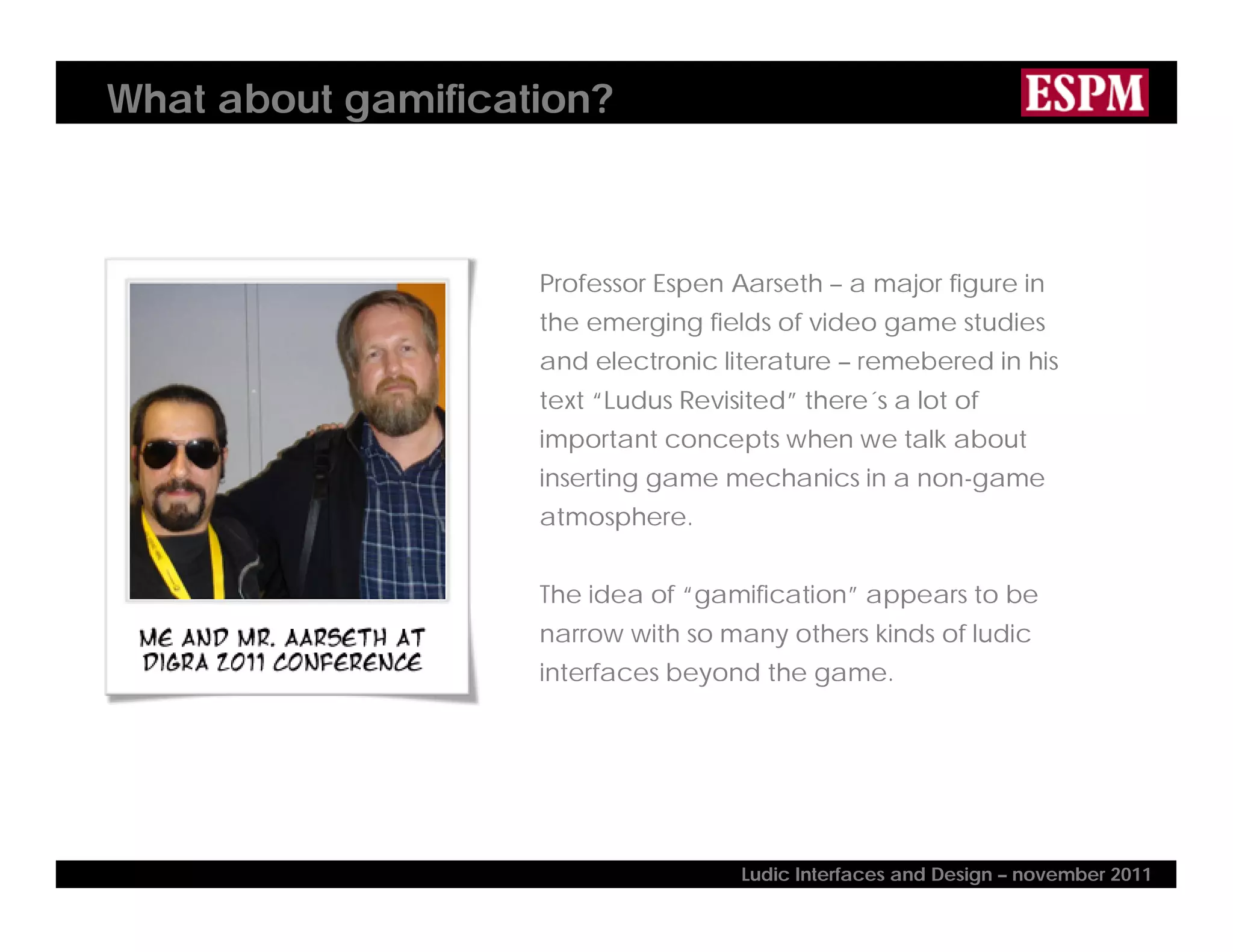
                    Professor Espen Aarseth – a major figure in
                    the emerging fields of video game studies
                    and electronic literature – remebered in his
                    text “Ludus Revisited” there´s a lot of
                    important concepts when we talk about
                    inserting game mechanics in a non-game
                    atmosphere.


                    The idea of “gamification” appears to be
                    narrow with so many others kinds of ludic
                    interfaces beyond the game.


                                     Ludic Interfaces and Design – november 2011
What about ludification?


In order to continue this argument, I propose a term to
dwell on: "ludification", instead of "gamification". When
we discuss "gamification", we are only talking about
games, and I believe the idea is to go beyond that.
When we use the word ludus – latin for “play” – we
realize that the idea is to instert much more than just
game mechanics for processes that are not games.


                                    Ludic Interfaces and Design – november 2011
What about ludification?


I believe that, when talking about "ludification", we are
thinking of playful interfaces in a broader way.
It can be a game mechanic, as well as a deeper way
of telling a story.


                                    Ludic Interfaces and Design – november 2011
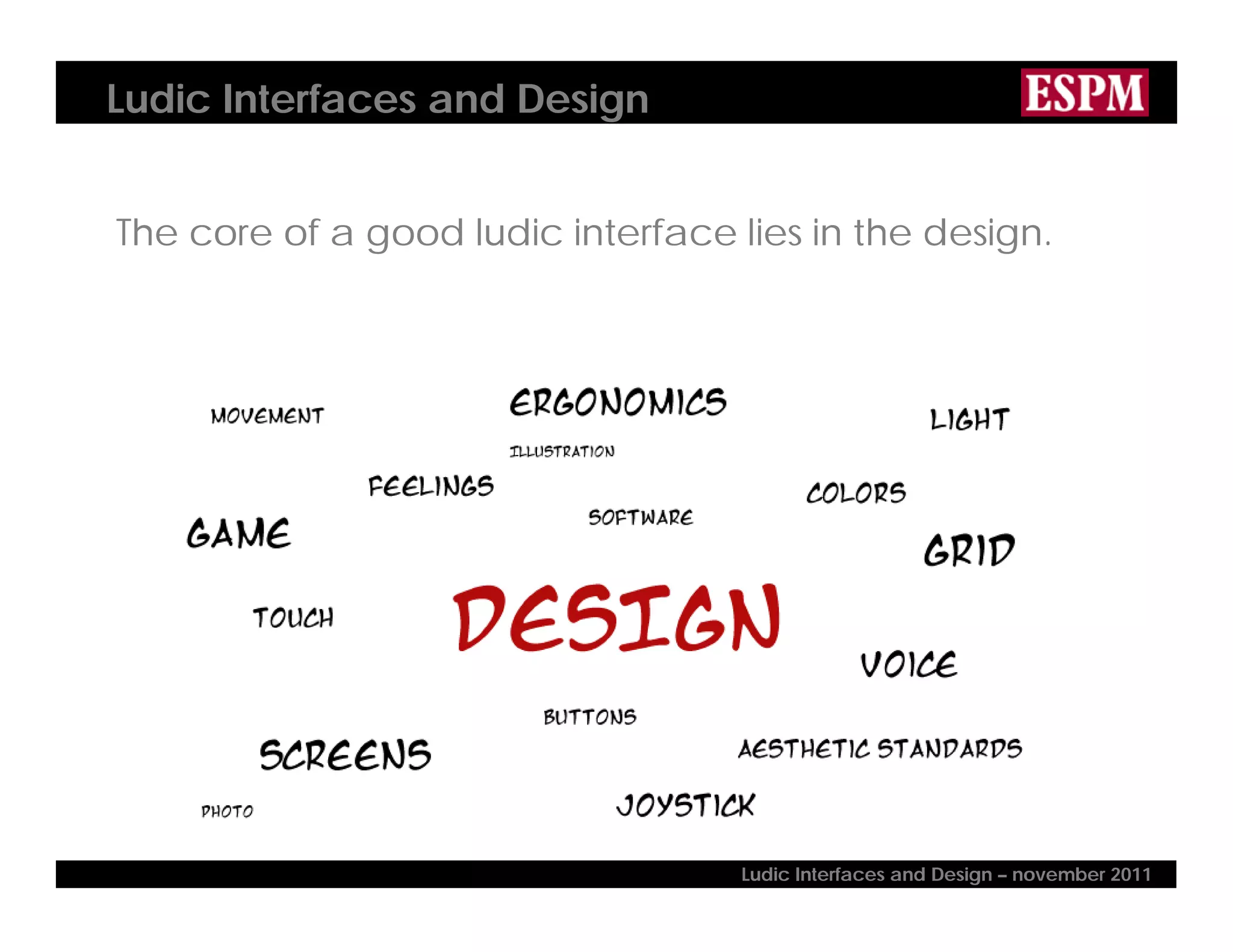
Ludic Interfaces and Design


The core of a good ludic interface lies in the design.


                                    Ludic Interfaces and Design – november 2011
Cases & examples

Quest to Learn

Quest to Learn is an exciting new school designed using
gaming principles to increase student engagement with
the curriculum as well as the real world.

Students learn by “taking on” the behaviors and
practices of the people in real-life knowledge domains.
Students learn to be biologists, historians and
mathematicians instead of learning about biology or
history or math. By using the structure of games, Quest to
Learn creates powerful educational tools to teach [to]
6th-12th graders. Games works as rule-based learning
systems, creating worlds in which players actively
participate, use strategic thinking to make choice, solve
complex problems, seek content knowledge and
consider the point of view of others.


Source: http://tinyurl.com/5wtj7z9 & http://q2l.org/         Ludic Interfaces and Design – november 2011
Cases & examples

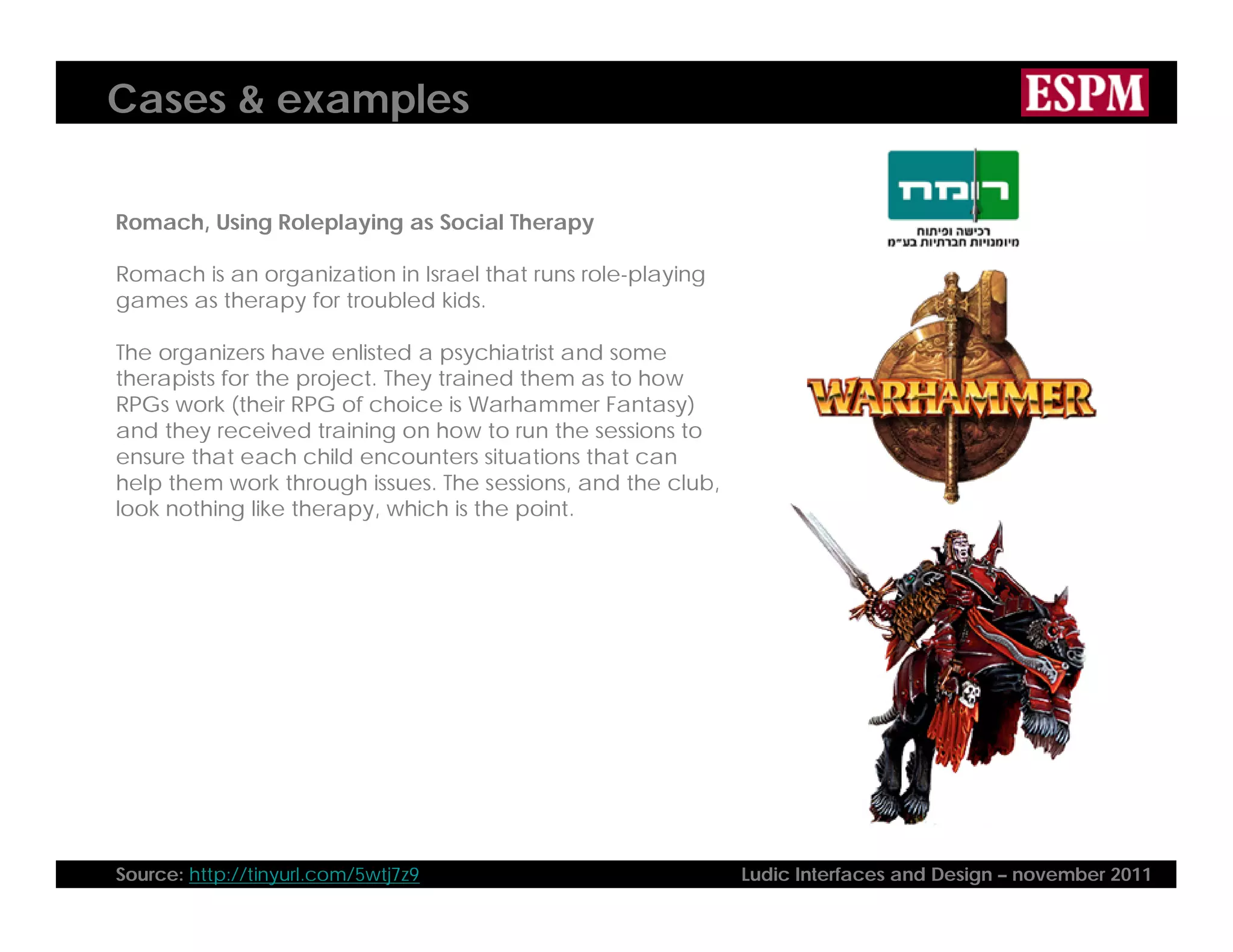
Romach, Using Roleplaying as Social Therapy

Romach is an organization in Israel that runs role-playing
games as therapy for troubled kids.

The organizers have enlisted a psychiatrist and some
therapists for the project. They trained them as to how
RPGs work (their RPG of choice is Warhammer Fantasy)
and they received training on how to run the sessions to
ensure that each child encounters situations that can
help them work through issues. The sessions, and the club,
look nothing like therapy, which is the point.


Source: http://tinyurl.com/5wtj7z9                           Ludic Interfaces and Design – november 2011
Cases & examples

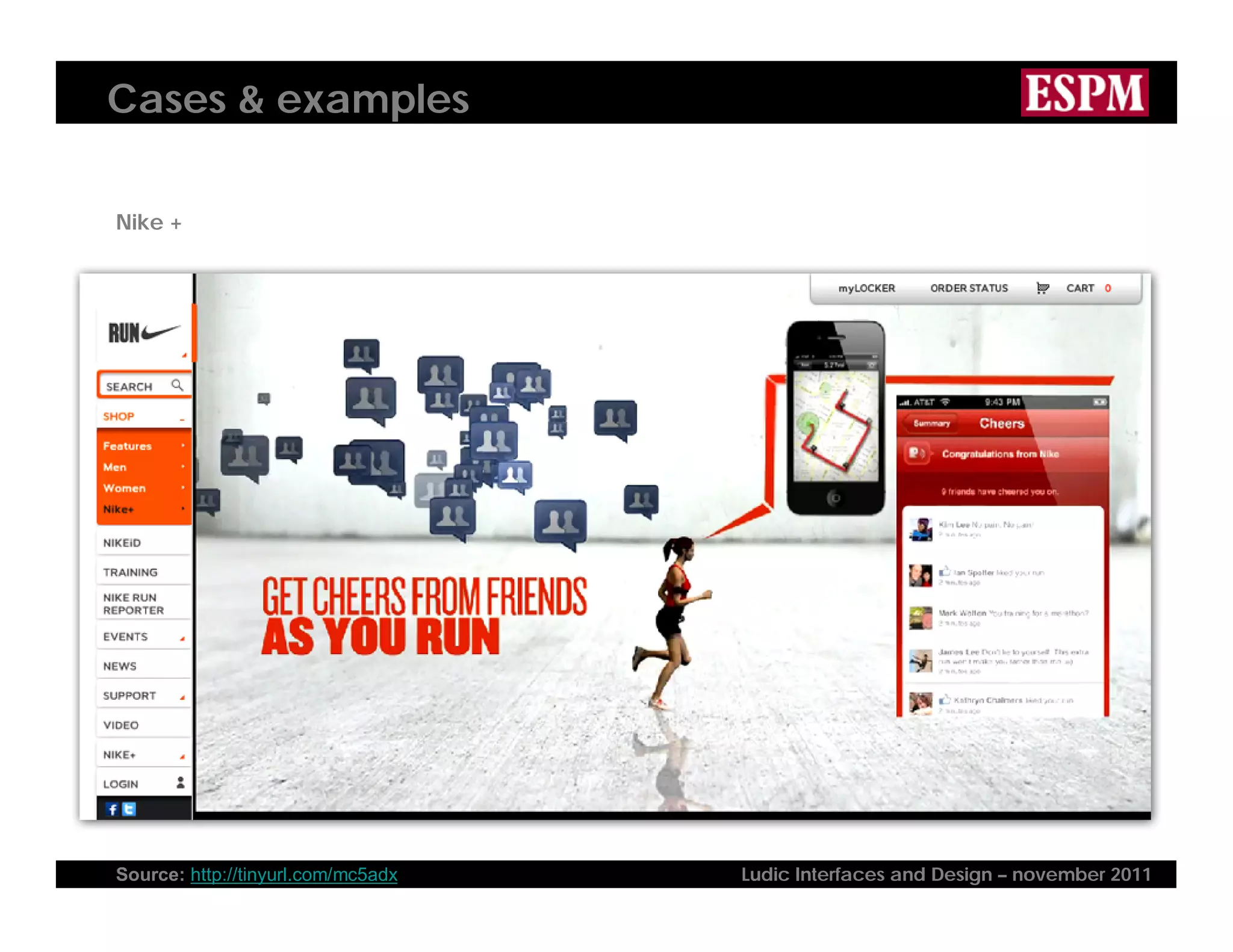
Nike +


Source: http://tinyurl.com/mc5adx   Ludic Interfaces and Design – november 2011
Cases & examples

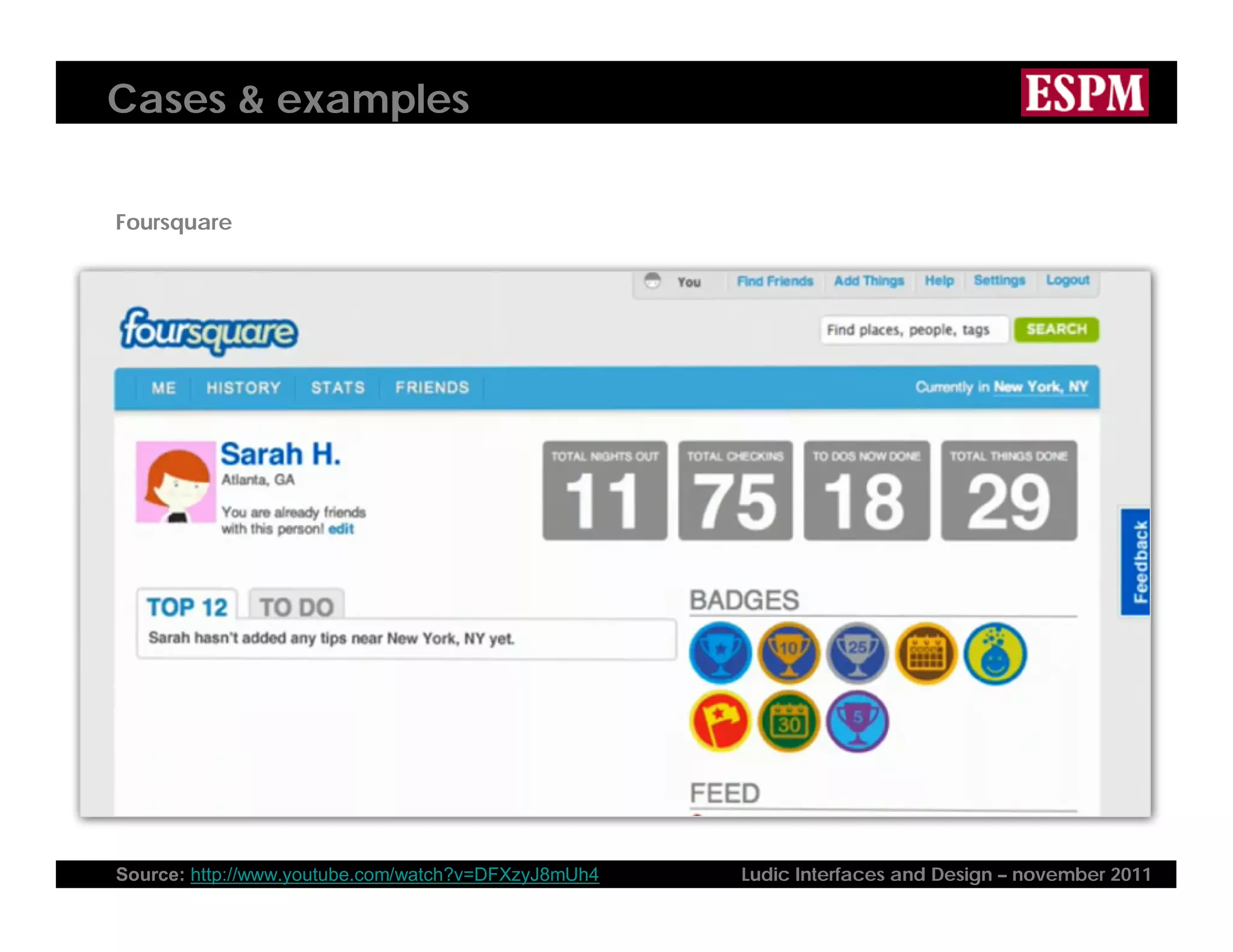
Foursquare


Source: http://www.youtube.com/watch?v=DFXzyJ8mUh4   Ludic Interfaces and Design – november 2011
Cases & examples

Music + game + sport


Source: http://www.youtube.com/watch?v=0XjwoVqM_qE   Ludic Interfaces and Design – november 2011
Cases & examples

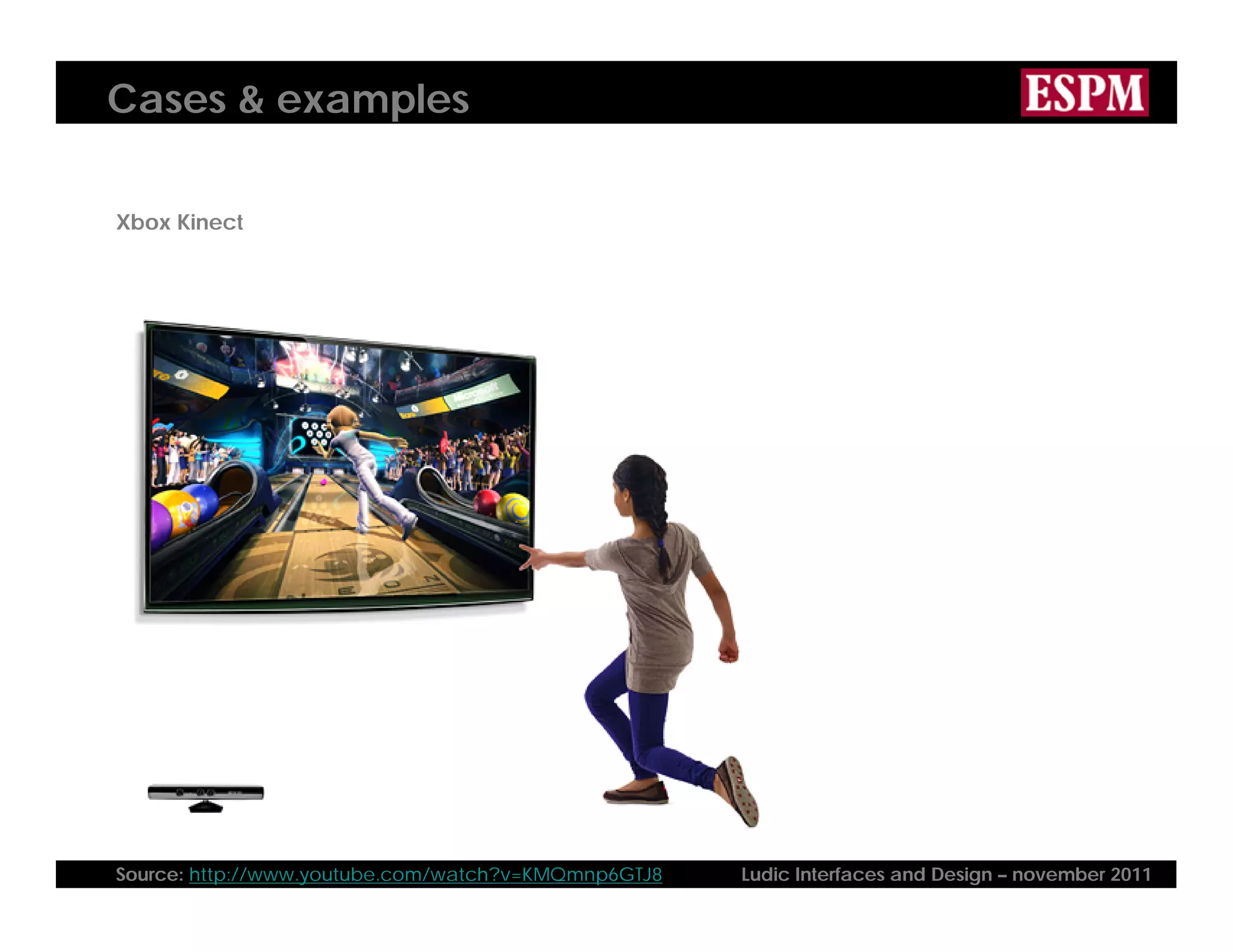
Xbox Kinect


Source: http://www.youtube.com/watch?v=KMQmnp6GTJ8   Ludic Interfaces and Design – november 2011
Cases & examples

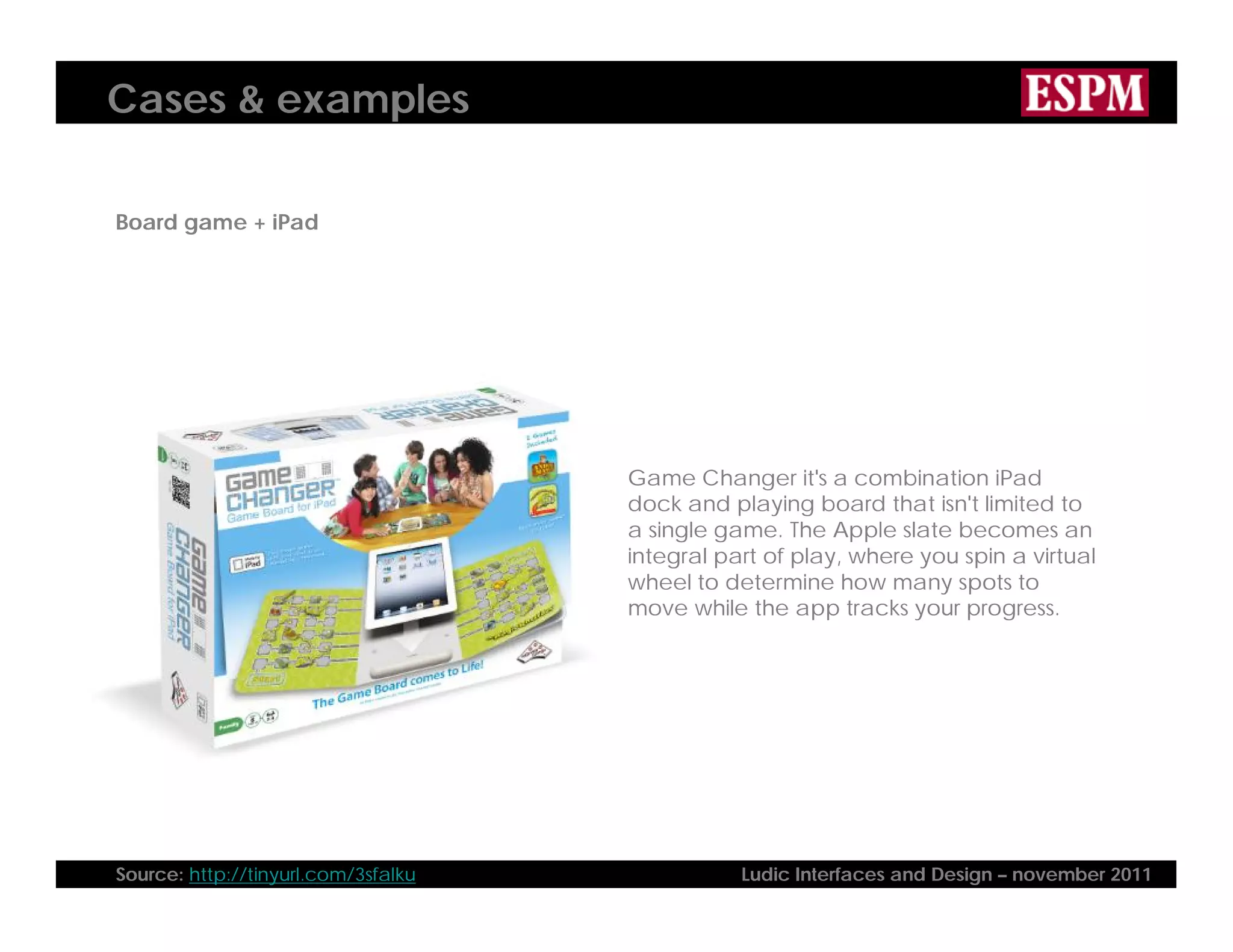
Board game + iPad


                                     Game Changer it's a combination iPad
                                     dock and playing board that isn't limited to
                                     a single game. The Apple slate becomes an
                                     integral part of play, where you spin a virtual
                                     wheel to determine how many spots to
                                     move while the app tracks your progress.


Source: http://tinyurl.com/3sfalku              Ludic Interfaces and Design – november 2011
Conclusion

             We can design ludic interfaces in publicity/promotion.
                A ludic interface could be a brand experience.
  A ludic interface could be an advertising space for companies and people.
  We can design ludic interfaces to teach, to learn and to create experiences.


                                                  Ludic Interfaces and Design – november 2011
THANK YOU!


E-mail: vincevader@gmail.com
Facebook: Vince Vader
Site: www.vincevader.net
Blog: gamingconceptz.blogspot.com


May the force be with you!

                               Ludic Interfaces and Design – november 2011

Ludic Interfaces

  • 1.
    LUDIC INTERFACES ANDDESIGN Semana do Design -Novembro de 2011 Prof. MSc. Vicente Martin Mastrocola
  • 2.
    About the speaker Hi! I’m Vince! I’m a teacher, Master of Science in communication and consumption, researcher, fun theorist and game designer from Brazil, and here are some important tags about me: #games #videogames #boardgames #ludus #starwars #rpg #mmorpg #narrative #gamingconcepts #gamedesign #mechanics Ludic Interfaces and Design – november 2011
  • 3.
    Insight of thispresentation Analyze the uses and impacts of ludic interfaces in contemporary world and the importance of the Design in this context. Ludic Interfaces and Design – november 2011
  • 4.
    Inspiration of thispresentation Ludic Interfaces and Design – november 2011
  • 5.
    Johan Huizinga's magiccircle Real World: - Questioning - Fear - Uncertainties - Responsibilities Magic circle: - Dreams - Immersion - Narration - Catharsis - Challenge - Experience - Meanings Ludic Interfaces and Design – november 2011
  • 6.
    What is ludicinterfaces? According to European Masters in Ludic Interfaces program: “Ludic interfaces are playful interfaces. The notion of a homo ludens, introduced by Johan Huizinga, is the conceptual backbone of the tools we are looking at. Think of devices like the Wii console, solar power operated building facades, unconventional musical instrument controllers, game art devices...”. Source: http://creativegames.org.uk/LUDICI/masters/what-is Ludic Interfaces and Design – november 2011
  • 7.
    What is ludicinterfaces? “The tools and concepts applied with the concept of ludic interfaces differ from traditional technological systems as they are playful, user-generated and user-driven, flexible, low-cost and cooperative. Ludic interfaces take the best from computer games, artistic experiment, interactive media, media conversion, social networks and modding cultures and result in tools that offer an ease of use and playfulness to cope with a rapidly changing society”. Source: http://creativegames.org.uk/LUDICI/masters/what-is Ludic Interfaces and Design – november 2011
  • 8.
    What is ludicinterfaces? “At its core, "ludic interfaces" is a subcategory of interfaces in general. The notion is not restricted to electronics or HCI, even if the terminology was developed in respect to digital technology. Various authors suggest to use the term "ludic interfaces" for non-digital phenomena, e.g. architectural facades, skins, wearable computers, media art”. Source: http://en.wikipedia.org/wiki/Ludic_Interfaces Ludic Interfaces and Design – november 2011
  • 9.
    So... The idea isto put games everywhere. I think this is “Gamification”. Right? humm... i've heard about it in a site or a magazine... Source: http://creativegames.org.uk/LUDICI/masters/what-is Ludic Interfaces and Design – november 2011
  • 10.
    What about gamification? Professor Espen Aarseth – a major figure in the emerging fields of video game studies and electronic literature – remebered in his text “Ludus Revisited” there´s a lot of important concepts when we talk about inserting game mechanics in a non-game atmosphere. The idea of “gamification” appears to be narrow with so many others kinds of ludic interfaces beyond the game. Ludic Interfaces and Design – november 2011
  • 11.
    What about ludification? Inorder to continue this argument, I propose a term to dwell on: "ludification", instead of "gamification". When we discuss "gamification", we are only talking about games, and I believe the idea is to go beyond that. When we use the word ludus – latin for “play” – we realize that the idea is to instert much more than just game mechanics for processes that are not games. Ludic Interfaces and Design – november 2011
  • 12.
    What about ludification? Ibelieve that, when talking about "ludification", we are thinking of playful interfaces in a broader way. It can be a game mechanic, as well as a deeper way of telling a story. Ludic Interfaces and Design – november 2011
  • 13.
    Ludic Interfaces andDesign The core of a good ludic interface lies in the design. Ludic Interfaces and Design – november 2011
  • 14.
    Cases & examples Questto Learn Quest to Learn is an exciting new school designed using gaming principles to increase student engagement with the curriculum as well as the real world. Students learn by “taking on” the behaviors and practices of the people in real-life knowledge domains. Students learn to be biologists, historians and mathematicians instead of learning about biology or history or math. By using the structure of games, Quest to Learn creates powerful educational tools to teach [to] 6th-12th graders. Games works as rule-based learning systems, creating worlds in which players actively participate, use strategic thinking to make choice, solve complex problems, seek content knowledge and consider the point of view of others. Source: http://tinyurl.com/5wtj7z9 & http://q2l.org/ Ludic Interfaces and Design – november 2011
  • 15.
    Cases & examples Romach,Using Roleplaying as Social Therapy Romach is an organization in Israel that runs role-playing games as therapy for troubled kids. The organizers have enlisted a psychiatrist and some therapists for the project. They trained them as to how RPGs work (their RPG of choice is Warhammer Fantasy) and they received training on how to run the sessions to ensure that each child encounters situations that can help them work through issues. The sessions, and the club, look nothing like therapy, which is the point. Source: http://tinyurl.com/5wtj7z9 Ludic Interfaces and Design – november 2011
  • 16.
    Cases & examples Nike+ Source: http://tinyurl.com/mc5adx Ludic Interfaces and Design – november 2011
  • 17.
    Cases & examples Foursquare Source:http://www.youtube.com/watch?v=DFXzyJ8mUh4 Ludic Interfaces and Design – november 2011
  • 18.
    Cases & examples Music+ game + sport Source: http://www.youtube.com/watch?v=0XjwoVqM_qE Ludic Interfaces and Design – november 2011
  • 19.
    Cases & examples XboxKinect Source: http://www.youtube.com/watch?v=KMQmnp6GTJ8 Ludic Interfaces and Design – november 2011
  • 20.
    Cases & examples Boardgame + iPad Game Changer it's a combination iPad dock and playing board that isn't limited to a single game. The Apple slate becomes an integral part of play, where you spin a virtual wheel to determine how many spots to move while the app tracks your progress. Source: http://tinyurl.com/3sfalku Ludic Interfaces and Design – november 2011
  • 21.
    Conclusion We can design ludic interfaces in publicity/promotion. A ludic interface could be a brand experience. A ludic interface could be an advertising space for companies and people. We can design ludic interfaces to teach, to learn and to create experiences. Ludic Interfaces and Design – november 2011
  • 22.
    THANK YOU! E-mail: vincevader@gmail.com Facebook:Vince Vader Site: www.vincevader.net Blog: gamingconceptz.blogspot.com May the force be with you! Ludic Interfaces and Design – november 2011