• Business Driven • Technology Oriented • Sustainable Development • Environmental Friendly
EMM 3104 : Dynamics 1
APPLICATIONS
Race tracks are often banked in the turns to reduce the frictional
forces required to keep the cars from sliding up to the outer rail at
high speeds.
If the car’s maximum velocity and a minimum coefficient of friction
between the tires and track are specified, how can we determine the
minimum banking angle (q) required to prevent the car from sliding
up the track?
EQUATIONS OF MOTION:
NORMALAND TANGENTIAL
COORDINATES
• Business Driven • Technology Oriented • Sustainable Development • Environmental Friendly
EMM 3104 : Dynamics 2
APPLICATIONS (continued)
The picture shows a ride at the amusement park. The hydraulically-
powered arms turn at a constant rate, which creates a centrifugal force
on the riders.
We need to determine the smallest angular velocity of the cars A
and B so that the passengers do not loose contact with the seat.
What parameters do we need for this calculation?
• Business Driven • Technology Oriented • Sustainable Development • Environmental Friendly
EMM 3104 : Dynamics 3
APPLICATIONS (continued)
Satellites are held in orbit around the earth by using the earth’s
gravitational pull as the centripetal force – the force acting to change
the direction of the satellite’s velocity.
Knowing the radius of orbit of the satellite, we need to determine the
required speed of the satellite to maintain this orbit. What equation
governs this situation?
• Business Driven • Technology Oriented • Sustainable Development • Environmental Friendly
EMM 3104 : Dynamics 4
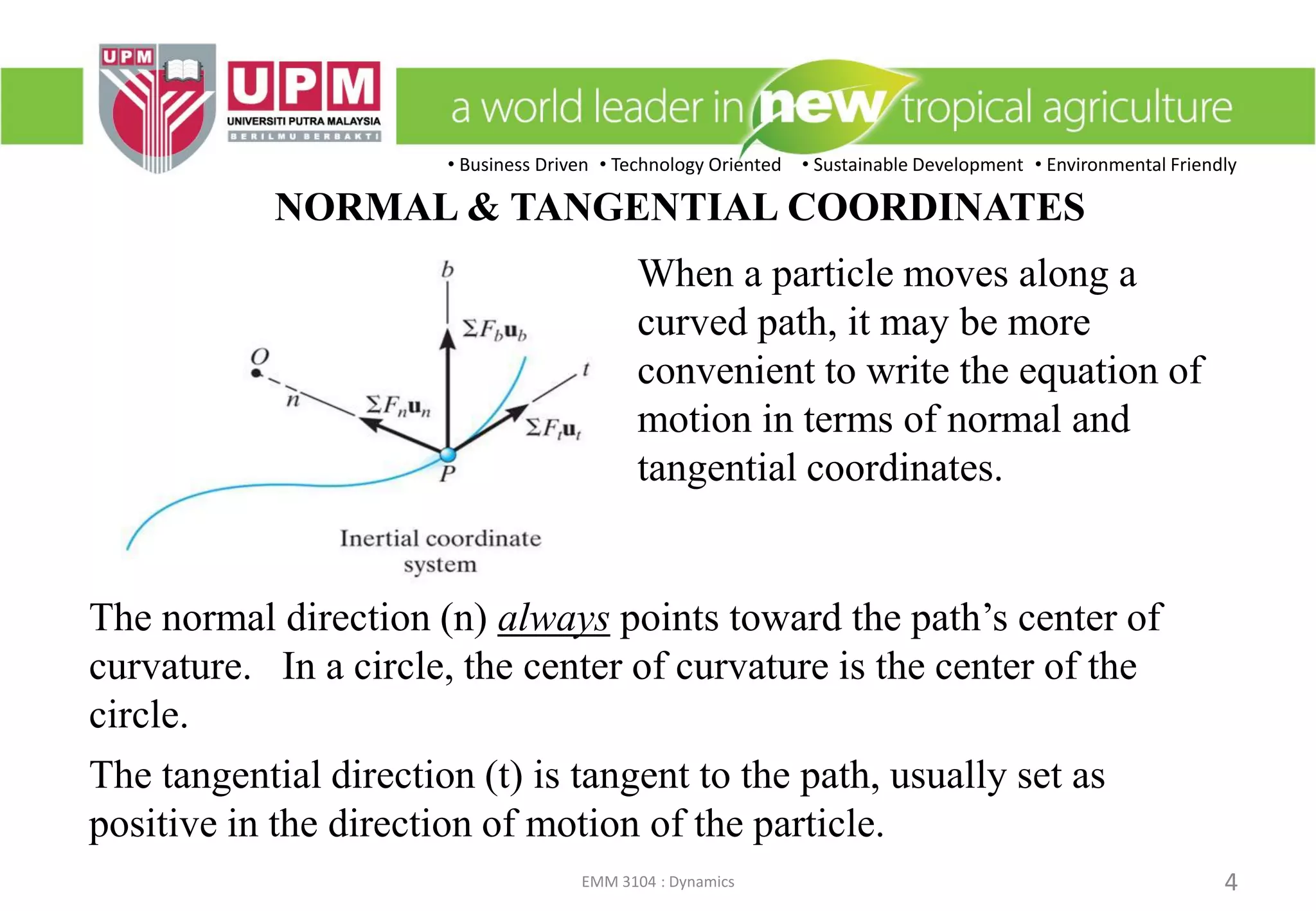
NORMAL & TANGENTIAL COORDINATES
When a particle moves along a
curved path, it may be more
convenient to write the equation of
motion in terms of normal and
tangential coordinates.
The normal direction (n) always points toward the path’s center of
curvature. In a circle, the center of curvature is the center of the
circle.
The tangential direction (t) is tangent to the path, usually set as
positive in the direction of motion of the particle.
• Business Driven • Technology Oriented • Sustainable Development • Environmental Friendly
EMM 3104 : Dynamics 5
This vector equation will be satisfied provided the individual
components on each side of the equation are equal, resulting in the two
scalar equations: Ft = mat and Fn = man .
Here Ft & Fn are the sums of the force components acting in the t &
n directions, respectively.
Since the equation of motion is a
vector equation , F = ma,
it may be written in terms of the n & t
coordinates as
Ftut + Fnun+ Fbub = mat+man
Since there is no motion in the binormal (b) direction, we can also
write Fb = 0.
EQUATIONS OF MOTION
• Business Driven • Technology Oriented • Sustainable Development • Environmental Friendly
EMM 3104 : Dynamics 6
NORMALAND TANGENTIAL ACCERLERATIONS
The tangential acceleration, at = dv/dt, represents the time rate of change in
the magnitude of the velocity. Depending on the direction of Ft, the
particle’s speed will either be increasing or decreasing.
The normal acceleration, an = v2/r, represents the time rate of change in the
direction of the velocity vector. Remember, an always acts toward the
path’s center of curvature. Thus, Fn will always be directed toward the
center of the path. For this reason, it is often referred to as centripetal force.
Recall, if the path of motion is defined as
y = f(x), the radius of curvature at any
point can be obtained from
r =
[1 + ( )2]3/2
dy
dx
d2y
dx2
• Business Driven • Technology Oriented • Sustainable Development • Environmental Friendly
EMM 3104 : Dynamics 7
SOLVING PROBLEMS WITH n-t COORDINATES
• Use n-t coordinates when a particle is moving along a known,
curved path.
• Establish the n-t coordinate system on the particle.
• Draw free-body and kinetic diagrams of the particle. The normal
acceleration (an) always acts “inward” (the positive n-direction). The
tangential acceleration (at) may act in either the positive or negative t
direction.
• Apply the equations of motion in scalar form and solve.
• It may be necessary to employ the kinematic relations:
at = dv/dt = v dv/ds an = v2/r
• Business Driven • Technology Oriented • Sustainable Development • Environmental Friendly
EMM 3104 : Dynamics 8
EXAMPLE
Given:At the instant q = 45°, the boy with a
mass of 75 kg, moves a speed of 6 m/s,
which is increasing at 0.5 m/s2.
Neglect his size and the mass of the seat
and cords. The seat is pin connected to
the frame BC.
Find: Horizontal and vertical reactions of
the seat on the boy.
1) Since the problem involves a curved path and requires finding
the force perpendicular to the path, use n-t coordinates. Draw the
boy’s free-body and kinetic diagrams.
2) Apply the equation of motion in the n-t directions.
Plan:
• Business Driven • Technology Oriented • Sustainable Development • Environmental Friendly
EMM 3104 : Dynamics 9
EXAMPLE (continued)Solution:
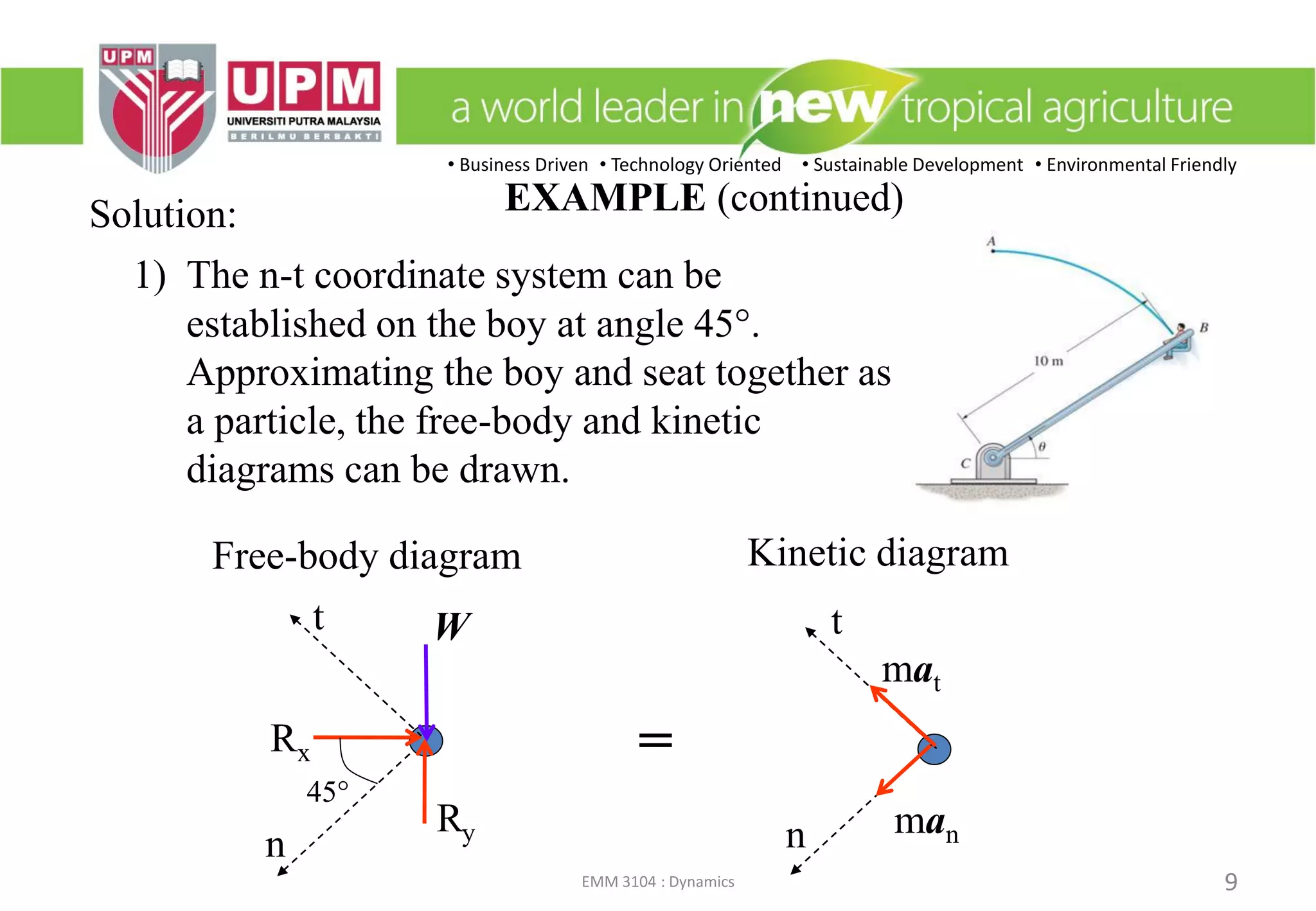
1) The n-t coordinate system can be
established on the boy at angle 45°.
Approximating the boy and seat together as
a particle, the free-body and kinetic
diagrams can be drawn.
n
t
man
mat
Kinetic diagram
W
n
t
45
Free-body diagram
=Rx
Ry
• Business Driven • Technology Oriented • Sustainable Development • Environmental Friendly
EMM 3104 : Dynamics 10
EXAMPLE (continued)
2) Apply the equations of motion in the n-t directions.
Using equations (1) and (2), solve for Rx, Ry.
Rx= –217 N, Ry=572 N
Using an = v2/r = 62/10, W = 75(9.81) N, and m = 75 kg,
we get: – Rx cos 45° – Ry sin 45° + 520.3 = (75)(62/10) (1)
(b) Ft = mat => – Rx sin 45° + Ry cos 45° – W cos 45° = mat
we get: – Rx sin 45° + Ry cos 45° – 520.3= 75 (0.5) (2)
(a) Fn = man => – Rx cos 45° – Ry sin 45° +W sin 45° = man
• Business Driven • Technology Oriented • Sustainable Development • Environmental Friendly
EMM 3104 : Dynamics 11
Given: A 800 kg car is traveling over the
hill having the shape of a
parabola. When it is at point A,
it is traveling at 9 m/s and
increasing its speed at 3 m/s2.
Find: The resultant normal force and resultant frictional force
exerted on the road at point A.
Plan:
1) Treat the car as a particle. Draw the free-body and kinetic
diagrams.
2) Apply the equations of motion in the n-t directions.
3) Use calculus to determine the slope and radius of curvature
of the path at point A.
EXAMPLE
• Business Driven • Technology Oriented • Sustainable Development • Environmental Friendly
EMM 3104 : Dynamics 12
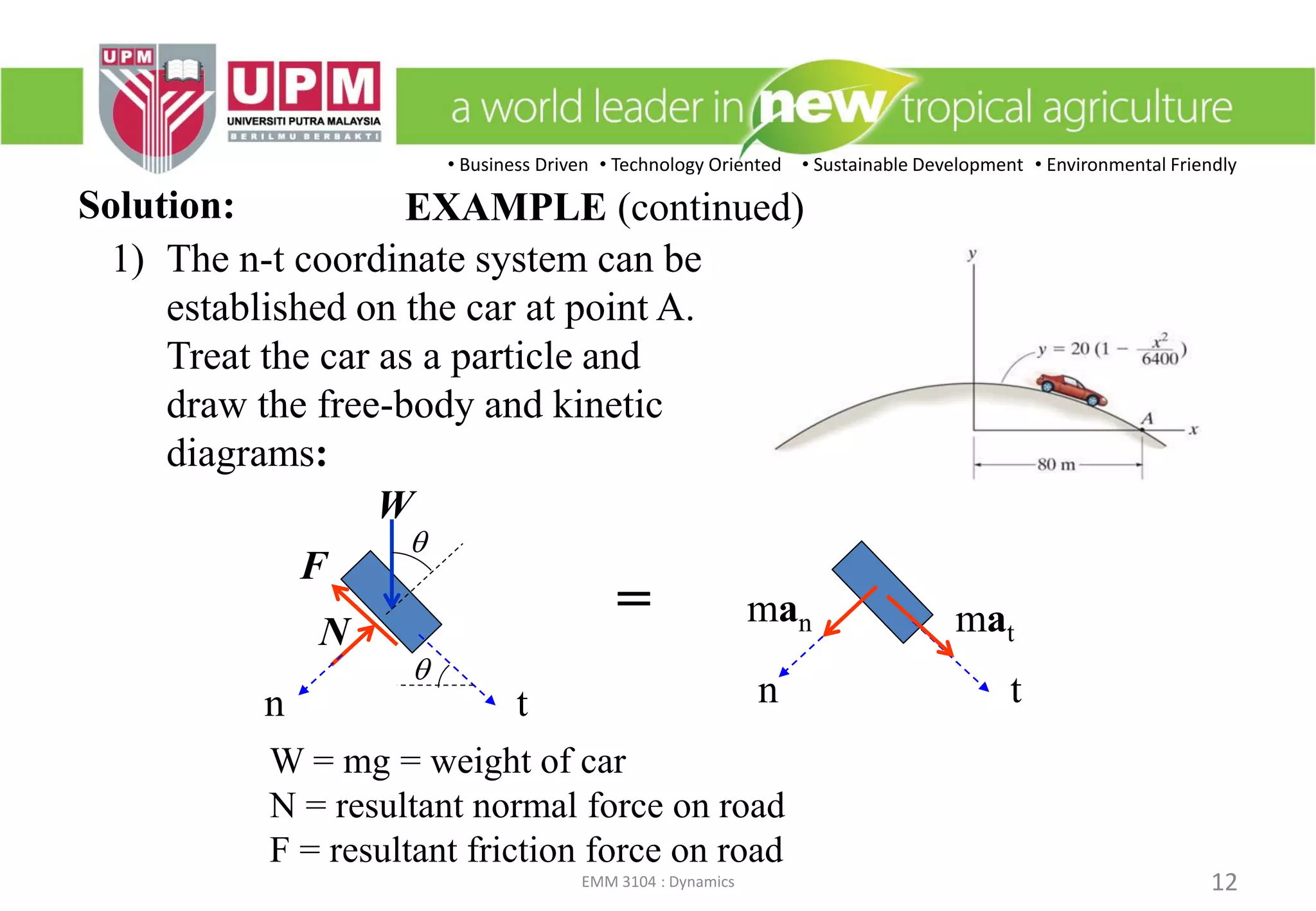
Solution:
W = mg = weight of car
N = resultant normal force on road
F = resultant friction force on road
1) The n-t coordinate system can be
established on the car at point A.
Treat the car as a particle and
draw the free-body and kinetic
diagrams:
tn
mat
man
t
q
q
n
N
F
W
=
EXAMPLE (continued)
• Business Driven • Technology Oriented • Sustainable Development • Environmental Friendly
EMM 3104 : Dynamics 13
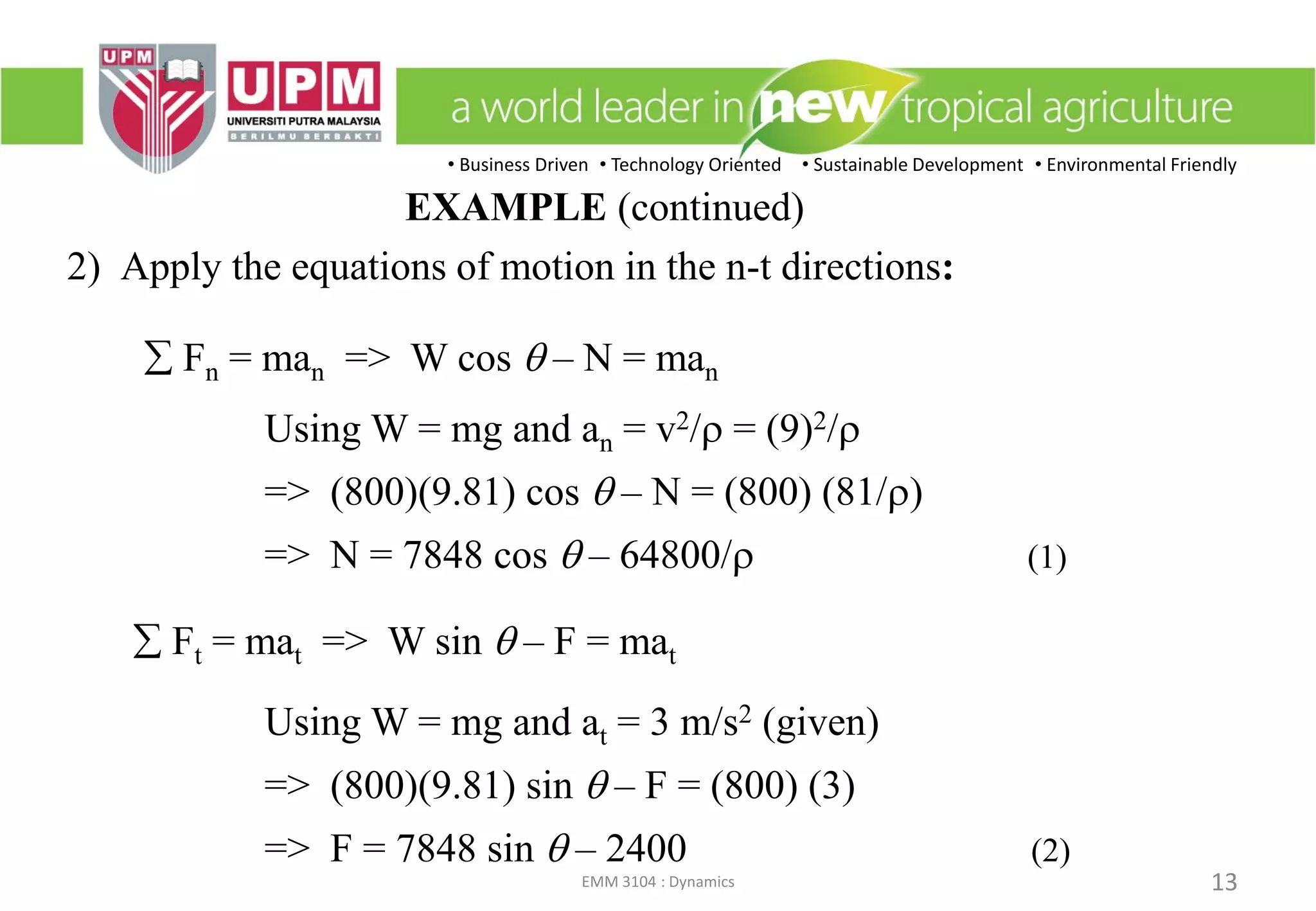
2) Apply the equations of motion in the n-t directions:
 Ft = mat => W sin q – F = mat
 Fn = man => W cos q – N = man
Using W = mg and an = v2/r = (9)2/r
=> (800)(9.81) cos q – N = (800) (81/r)
=> N = 7848 cos q – 64800/r (1)
Using W = mg and at = 3 m/s2 (given)
=> (800)(9.81) sin q – F = (800) (3)
=> F = 7848 sin q – 2400 (2)
EXAMPLE (continued)
• Business Driven • Technology Oriented • Sustainable Development • Environmental Friendly
EMM 3104 : Dynamics 14
3) Determine r by differentiating y = f(x) at x = 80 m:
Determine q from the slope of the curve at A:
y = 20(1 – x2/6400) => dy/dx = (–40) x / 6400
=> d2y/dx2 = (–40) / 6400
tan q = dy/dx
q = tan-1 (dy/dx) = tan-1 (-0.5) = 26.6°
x = 80 m
q
dy
dx
r = =
[1 + ( )2]3/2
dy
dx
d2y
dx2
[1 + (–0.5)2]3/2
0.00625x = 80 m
= 223.6 m
EXAMPLE (continued)
• Business Driven • Technology Oriented • Sustainable Development • Environmental Friendly
EMM 3104 : Dynamics 15
From Eq.(1): N = 7848 cos q – 64800 / r
= 7848 cos (26.6°) – 64800 / 223.6 = 6728 N
From Eq.(2): F = 7848 sin q – 2400
= 7848 sin (26.6°) – 2400 = 1114 N
EXAMPLE (continued)
• Business Driven • Technology Oriented • Sustainable Development • Environmental Friendly
EMM 3104 : Dynamics 16
Exercise 2.2
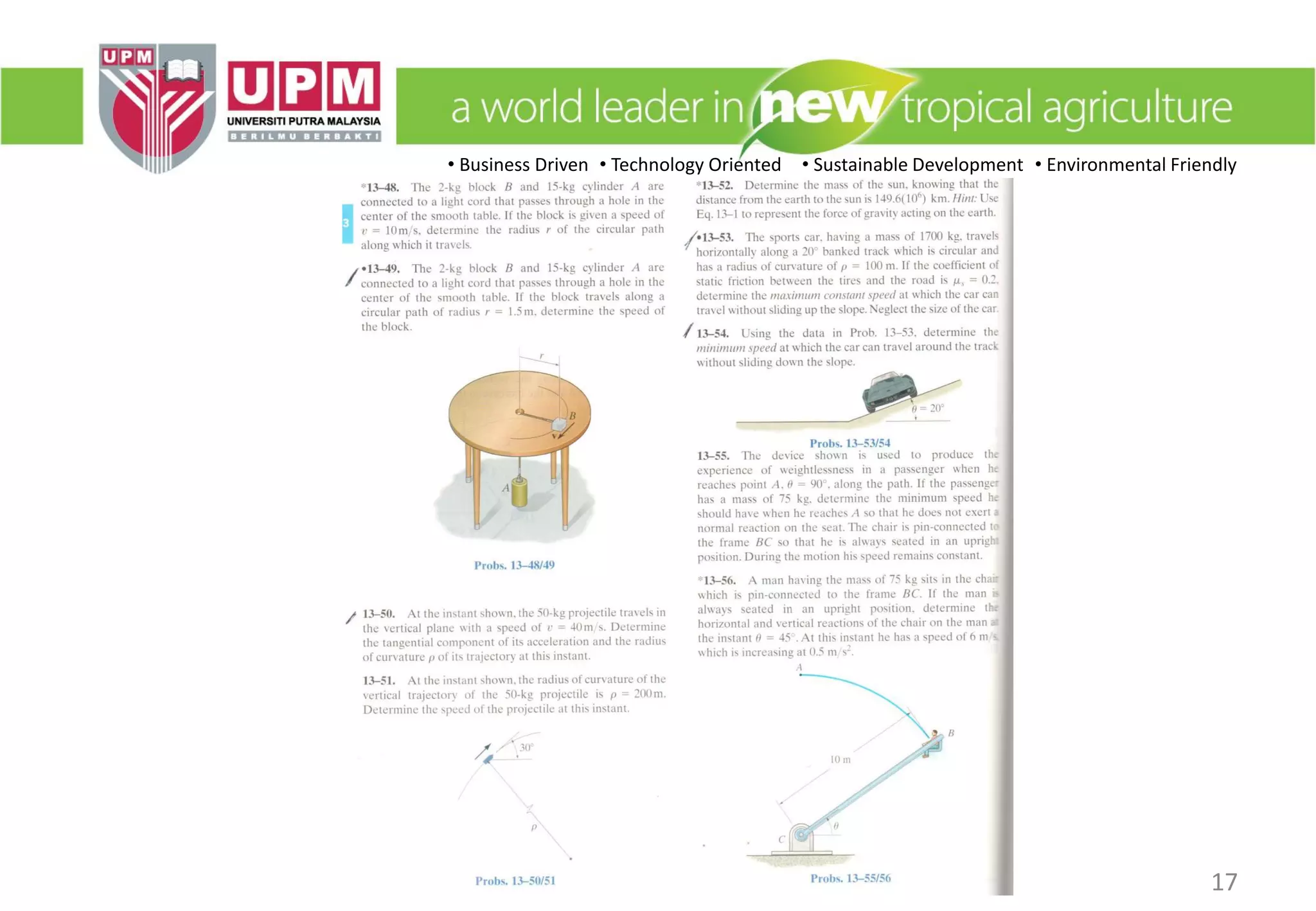
• Problems no (page 138):
– 13.49, 13.50, 13.53, 13.54, 13.58, 13.65, 13.66, 13.67,
13.69.
• Business Driven • Technology Oriented • Sustainable Development • Environmental Friendly
EMM 3104 : Dynamics 17
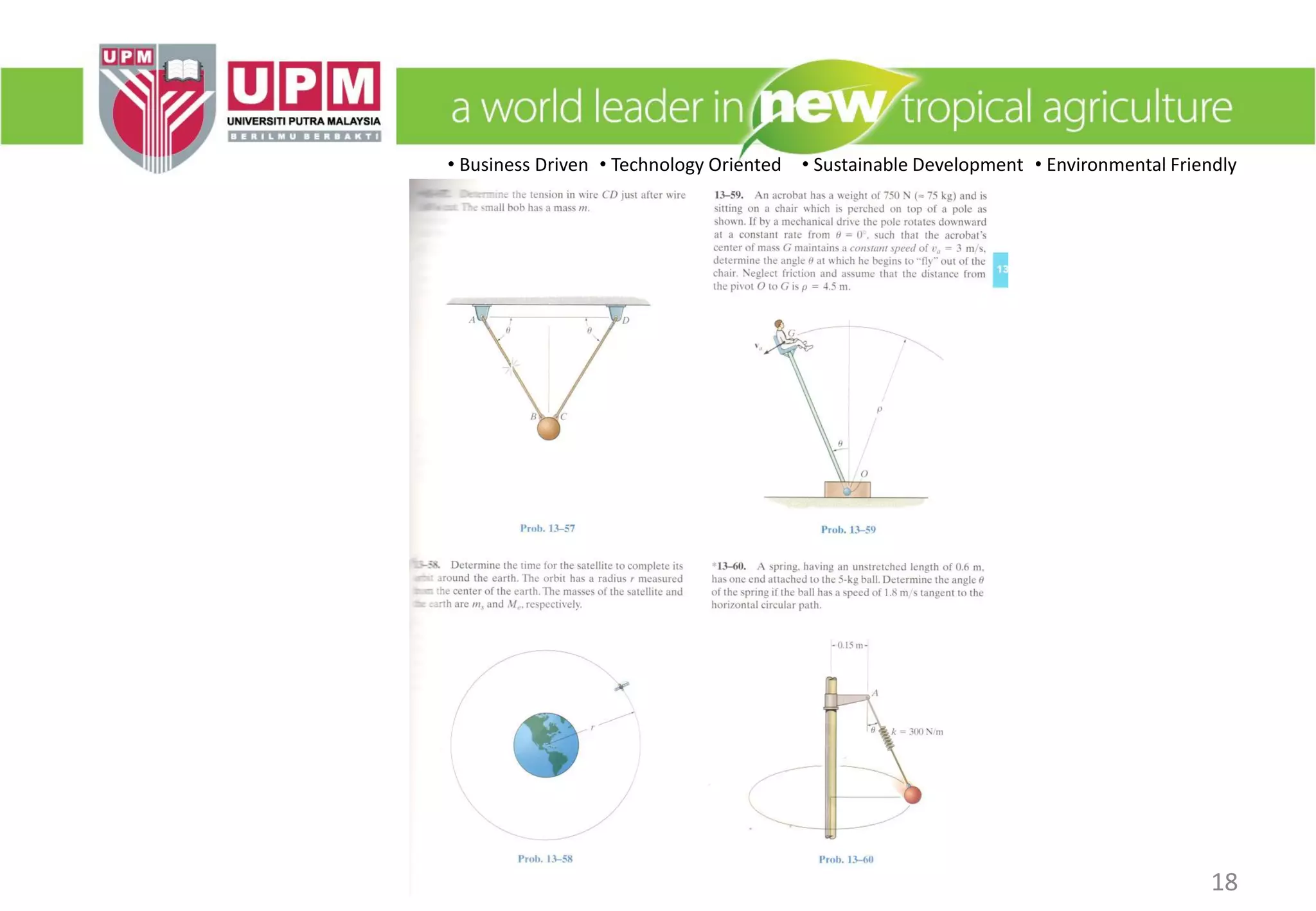
• Business Driven • Technology Oriented • Sustainable Development • Environmental Friendly
EMM 3104 : Dynamics 18
• Business Driven • Technology Oriented • Sustainable Development • Environmental Friendly
EMM 3104 : Dynamics 19
• Business Driven • Technology Oriented • Sustainable Development • Environmental Friendly
EMM 3104 : Dynamics 20
• Business Driven • Technology Oriented • Sustainable Development • Environmental Friendly
EMM 3104 : Dynamics 21
APPLICATIONS
The forces acting on the 100-lb
boy can be analyzed using the
cylindrical coordinate system.
How would you write the
equation describing the
frictional force on the boy as
he slides down this helical
slide?
• Business Driven • Technology Oriented • Sustainable Development • Environmental Friendly
EMM 3104 : Dynamics 22
APPLICATIONS (continued)
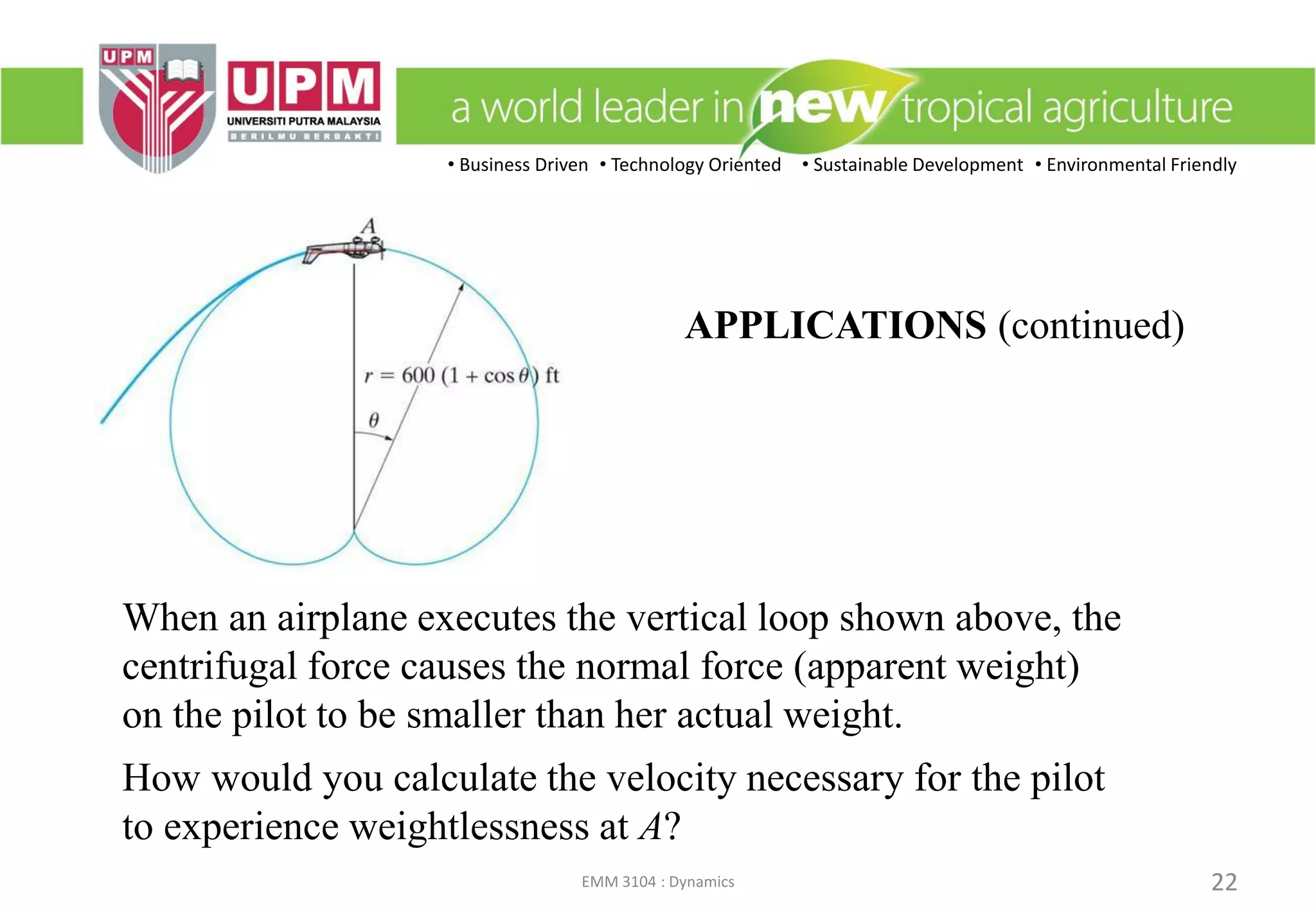
When an airplane executes the vertical loop shown above, the
centrifugal force causes the normal force (apparent weight)
on the pilot to be smaller than her actual weight.
How would you calculate the velocity necessary for the pilot
to experience weightlessness at A?
• Business Driven • Technology Oriented • Sustainable Development • Environmental Friendly
EMM 3104 : Dynamics 23
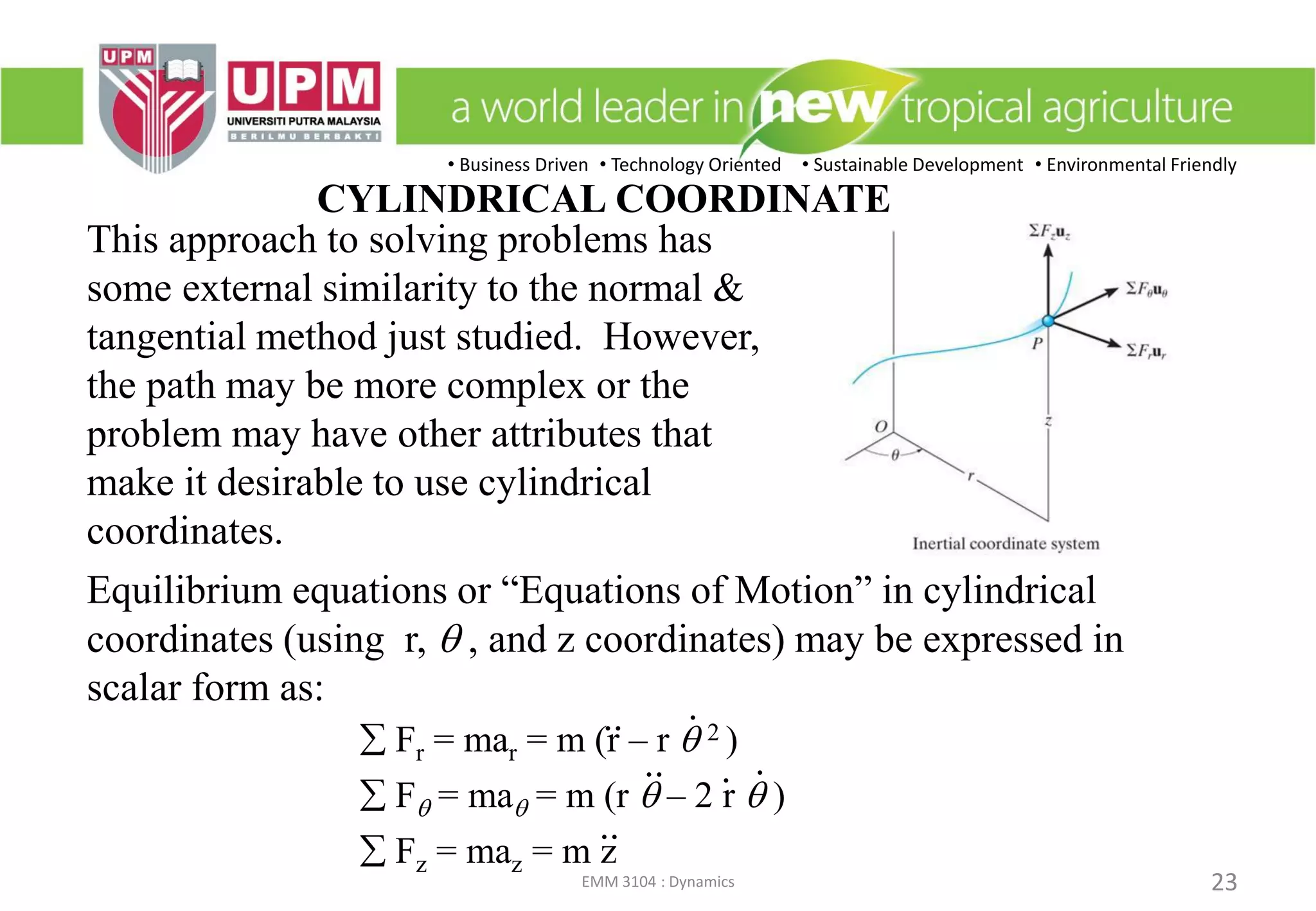
CYLINDRICAL COORDINATE
This approach to solving problems has
some external similarity to the normal &
tangential method just studied. However,
the path may be more complex or the
problem may have other attributes that
make it desirable to use cylindrical
coordinates.
Equilibrium equations or “Equations of Motion” in cylindrical
coordinates (using r, q , and z coordinates) may be expressed in
scalar form as:
 Fr = mar = m (r – r q 2 )
 Fq = maq = m (r q – 2 r q )
 Fz = maz = m z
.
. .
..
..
..
• Business Driven • Technology Oriented • Sustainable Development • Environmental Friendly
EMM 3104 : Dynamics 24
Note that a fixed coordinate system is used, not a “body-
centered” system as used in the n – t approach.
If the particle is constrained to move only in the r – q
plane (i.e., the z coordinate is constant), then only the first
two equations are used (as shown below). The coordinate
system in such a case becomes a polar coordinate system.
In this case, the path is only a function of q.
 Fr = mar = m(r – rq 2 )
 Fq = maq = m(rq – 2rq )
.
. .
..
..
CYLINDRICAL COORDINATES
• Business Driven • Technology Oriented • Sustainable Development • Environmental Friendly
25
TANGENTIAL AND NORMAL FORCES
If a force P causes the particle to move along a path defined
by r = f (q ), the normal force N exerted by the path on the
particle is always perpendicular to the path’s tangent. The
frictional force F always acts along the tangent in the opposite
direction of motion. The directions of N and F can be
specified relative to the radial coordinate by using angle y .
• Business Driven • Technology Oriented • Sustainable Development • Environmental Friendly
EMM 3104 : Dynamics 26
DETERMINATION OF ANGLE y
The angle y, defined as the angle
between the extended radial line
and the tangent to the curve, can be
required to solve some problems. It
can be determined from the
following relationship.
dr/dq
r
dr
r dq
==tan y
If y is positive, it is measured counterclockwise from the radial
line to the tangent. If it is negative, it is measured clockwise.
• Business Driven • Technology Oriented • Sustainable Development • Environmental Friendly
EMM 3104 : Dynamics 27
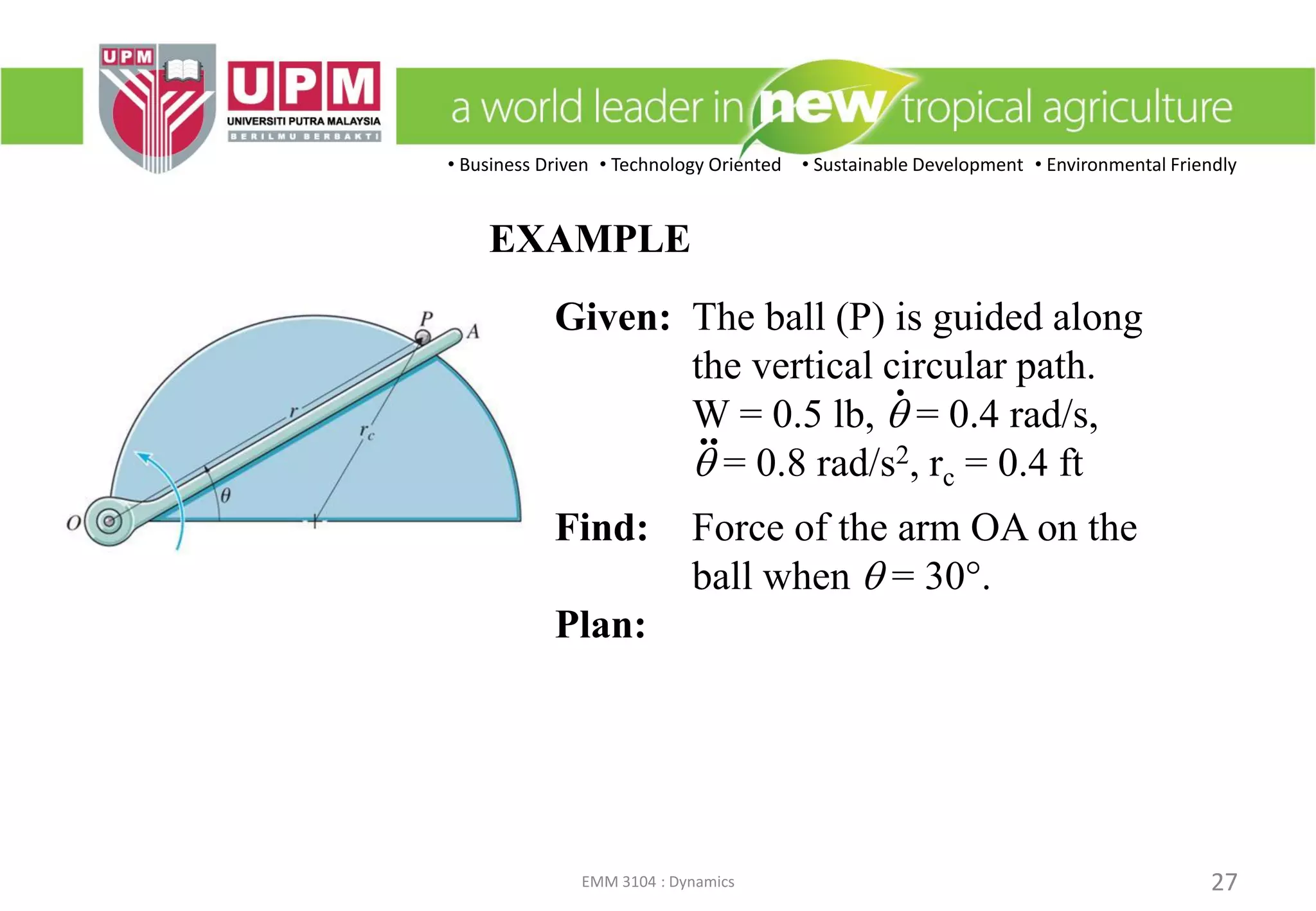
EXAMPLE
Given: The ball (P) is guided along
the vertical circular path.
W = 0.5 lb, q = 0.4 rad/s,
q = 0.8 rad/s2, rc = 0.4 ft
Find: Force of the arm OA on the
ball when q = 30.
Plan:
.
..
• Business Driven • Technology Oriented • Sustainable Development • Environmental Friendly
EMM 3104 : Dynamics 28
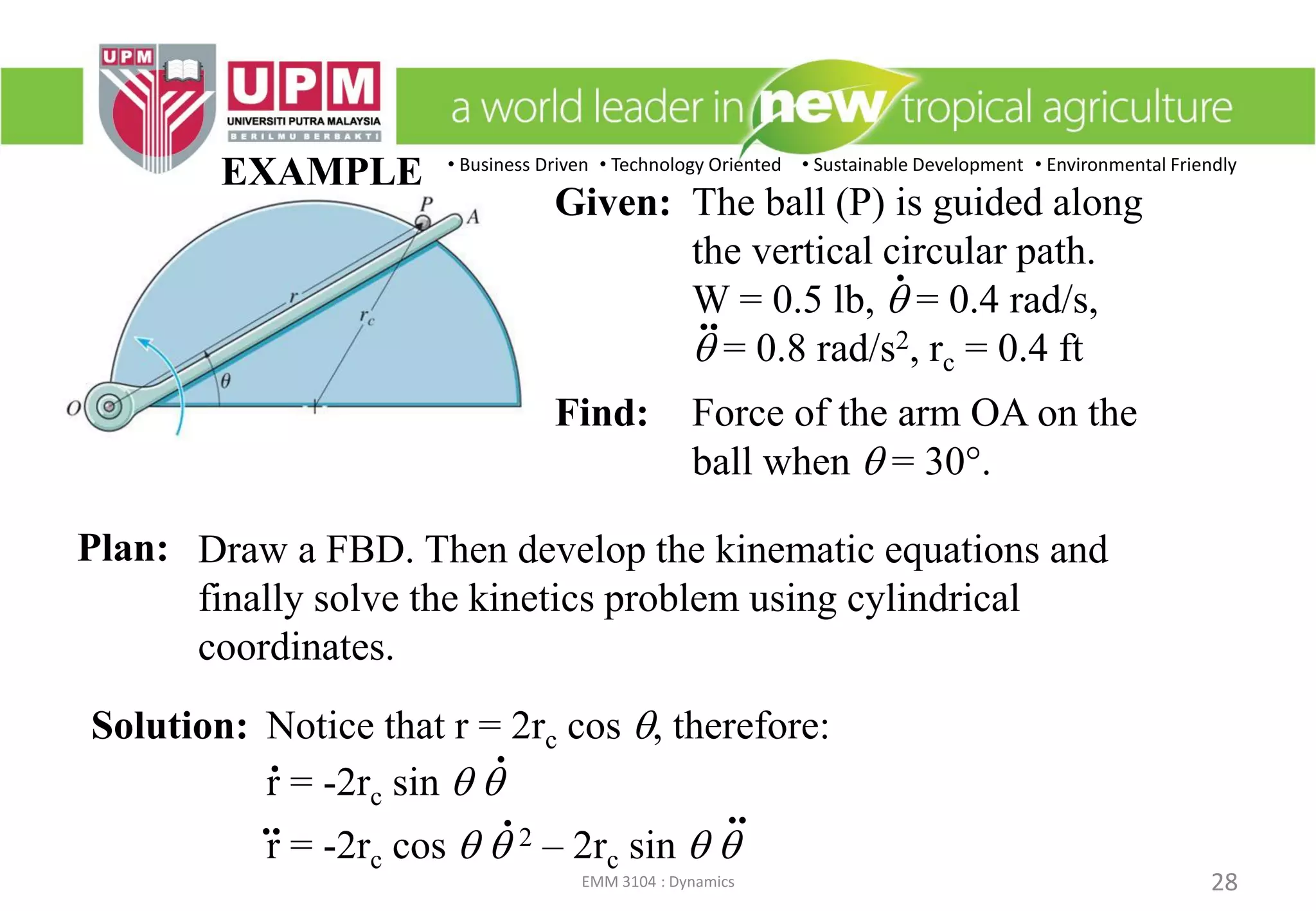
EXAMPLE
Draw a FBD. Then develop the kinematic equations and
finally solve the kinetics problem using cylindrical
coordinates.
Solution: Notice that r = 2rc cos q, therefore:
r = -2rc sin q q
r = -2rc cos q q 2 – 2rc sin q q
.
.. ..
.
.
Given: The ball (P) is guided along
the vertical circular path.
W = 0.5 lb, q = 0.4 rad/s,
q = 0.8 rad/s2, rc = 0.4 ft
Find: Force of the arm OA on the
ball when q = 30.
.
..
Plan:
• Business Driven • Technology Oriented • Sustainable Development • Environmental Friendly
EMM 3104 : Dynamics 29
EXAMPLE
(continued)
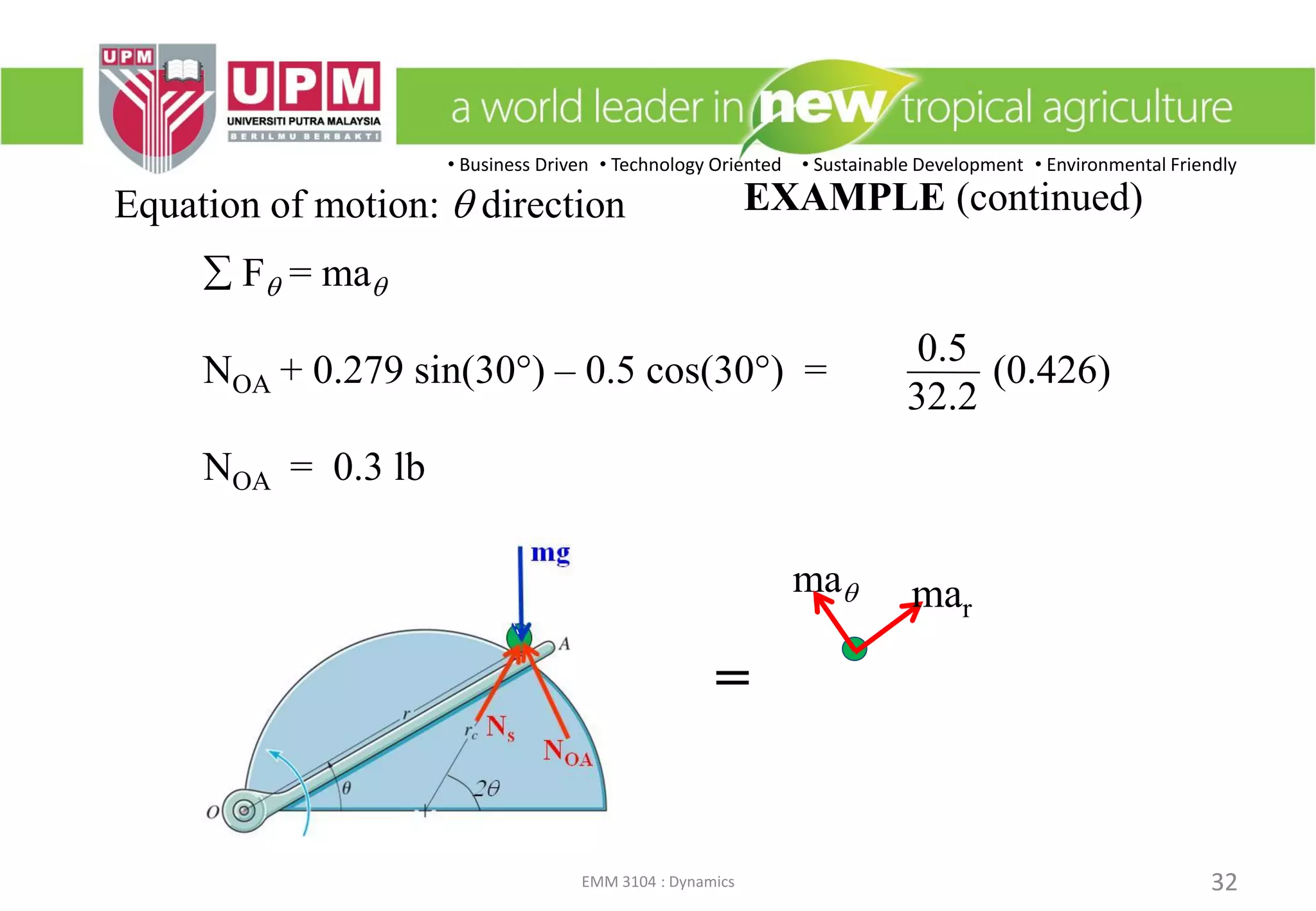
Free Body Diagram and Kinetic Diagram : Establish the r, q
inertial coordinate system and draw the particle’s free body
diagram.
=
maq mar
mg
Ns
NOA
2q
• Business Driven • Technology Oriented • Sustainable Development • Environmental Friendly
EMM 3104 : Dynamics 30
Kinematics: at q = 30
r = 2(0.4) cos(30) = 0.693 ft
r = - 2(0.4) sin(30)(0.4) = - 0.16 ft/s
r = - 2(0.4) cos(30)(0.4)2 – 2(0.4) sin(30)(0.8) = - 0.431 ft/s2
..
.
Acceleration components are
ar = r – rq 2 = - 0.431 – (0.693)(0.4)2 = - 0.542 ft/s2
aq = rq + 2rq = (0.693)(0.8) + 2(-0.16)(0.4) = 0.426 ft/s2
.. .
....
EXAMPLE
(continued)
• Business Driven • Technology Oriented • Sustainable Development • Environmental Friendly
EMM 3104 : Dynamics 31
 Fr = mar
Ns cos(30) – 0.5 sin(30) = (-0.542)
Ns = 0.279 lb
0.5
32.2
EXAMPLE (continued)
=
maq mar
Equation of motion: r direction
• Business Driven • Technology Oriented • Sustainable Development • Environmental Friendly
EMM 3104 : Dynamics 32
 Fq = maq
NOA + 0.279 sin(30) – 0.5 cos(30) = (0.426)
NOA = 0.3 lb
0.5
32.2
EXAMPLE (continued)Equation of motion: q direction
=
maq mar
• Business Driven • Technology Oriented • Sustainable Development • Environmental Friendly
EMM 3104 : Dynamics 33
Exercise 2.3
• Problems no (page 150):
– 13.85, 13.87, 13.88, 13.92, 13.94, 13.95
• Business Driven • Technology Oriented • Sustainable Development • Environmental Friendly
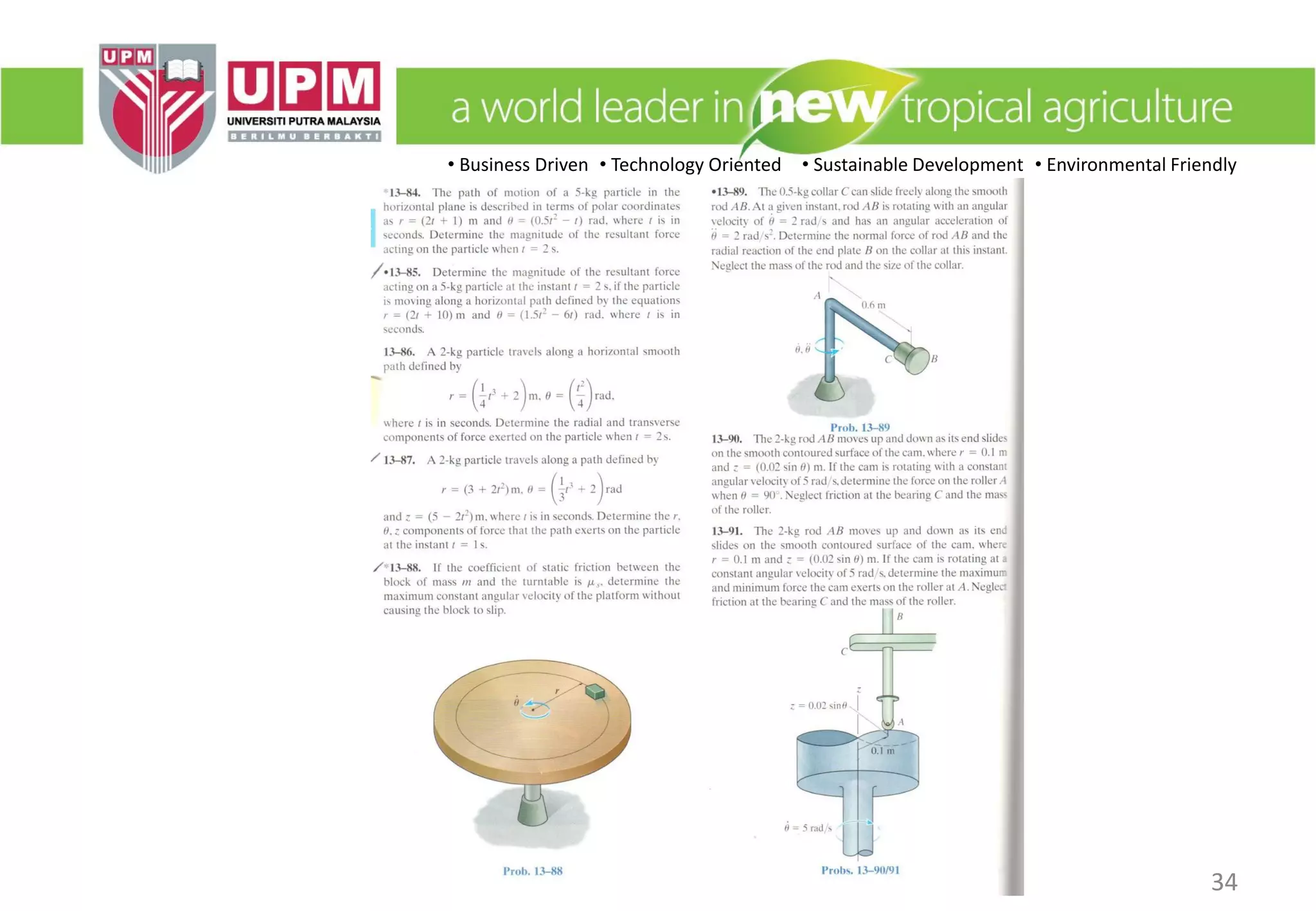
EMM 3104 : Dynamics 34
• Business Driven • Technology Oriented • Sustainable Development • Environmental Friendly
EMM 3104 : Dynamics 35
36
NEXT CHAPTER PLEASE!

Emm3104 chapter 2 part2

  • 1.
    • Business Driven• Technology Oriented • Sustainable Development • Environmental Friendly EMM 3104 : Dynamics 1 APPLICATIONS Race tracks are often banked in the turns to reduce the frictional forces required to keep the cars from sliding up to the outer rail at high speeds. If the car’s maximum velocity and a minimum coefficient of friction between the tires and track are specified, how can we determine the minimum banking angle (q) required to prevent the car from sliding up the track? EQUATIONS OF MOTION: NORMALAND TANGENTIAL COORDINATES
  • 2.
    • Business Driven• Technology Oriented • Sustainable Development • Environmental Friendly EMM 3104 : Dynamics 2 APPLICATIONS (continued) The picture shows a ride at the amusement park. The hydraulically- powered arms turn at a constant rate, which creates a centrifugal force on the riders. We need to determine the smallest angular velocity of the cars A and B so that the passengers do not loose contact with the seat. What parameters do we need for this calculation?
  • 3.
    • Business Driven• Technology Oriented • Sustainable Development • Environmental Friendly EMM 3104 : Dynamics 3 APPLICATIONS (continued) Satellites are held in orbit around the earth by using the earth’s gravitational pull as the centripetal force – the force acting to change the direction of the satellite’s velocity. Knowing the radius of orbit of the satellite, we need to determine the required speed of the satellite to maintain this orbit. What equation governs this situation?
  • 4.
    • Business Driven• Technology Oriented • Sustainable Development • Environmental Friendly EMM 3104 : Dynamics 4 NORMAL & TANGENTIAL COORDINATES When a particle moves along a curved path, it may be more convenient to write the equation of motion in terms of normal and tangential coordinates. The normal direction (n) always points toward the path’s center of curvature. In a circle, the center of curvature is the center of the circle. The tangential direction (t) is tangent to the path, usually set as positive in the direction of motion of the particle.
  • 5.
    • Business Driven• Technology Oriented • Sustainable Development • Environmental Friendly EMM 3104 : Dynamics 5 This vector equation will be satisfied provided the individual components on each side of the equation are equal, resulting in the two scalar equations: Ft = mat and Fn = man . Here Ft & Fn are the sums of the force components acting in the t & n directions, respectively. Since the equation of motion is a vector equation , F = ma, it may be written in terms of the n & t coordinates as Ftut + Fnun+ Fbub = mat+man Since there is no motion in the binormal (b) direction, we can also write Fb = 0. EQUATIONS OF MOTION
  • 6.
    • Business Driven• Technology Oriented • Sustainable Development • Environmental Friendly EMM 3104 : Dynamics 6 NORMALAND TANGENTIAL ACCERLERATIONS The tangential acceleration, at = dv/dt, represents the time rate of change in the magnitude of the velocity. Depending on the direction of Ft, the particle’s speed will either be increasing or decreasing. The normal acceleration, an = v2/r, represents the time rate of change in the direction of the velocity vector. Remember, an always acts toward the path’s center of curvature. Thus, Fn will always be directed toward the center of the path. For this reason, it is often referred to as centripetal force. Recall, if the path of motion is defined as y = f(x), the radius of curvature at any point can be obtained from r = [1 + ( )2]3/2 dy dx d2y dx2
  • 7.
    • Business Driven• Technology Oriented • Sustainable Development • Environmental Friendly EMM 3104 : Dynamics 7 SOLVING PROBLEMS WITH n-t COORDINATES • Use n-t coordinates when a particle is moving along a known, curved path. • Establish the n-t coordinate system on the particle. • Draw free-body and kinetic diagrams of the particle. The normal acceleration (an) always acts “inward” (the positive n-direction). The tangential acceleration (at) may act in either the positive or negative t direction. • Apply the equations of motion in scalar form and solve. • It may be necessary to employ the kinematic relations: at = dv/dt = v dv/ds an = v2/r
  • 8.
    • Business Driven• Technology Oriented • Sustainable Development • Environmental Friendly EMM 3104 : Dynamics 8 EXAMPLE Given:At the instant q = 45°, the boy with a mass of 75 kg, moves a speed of 6 m/s, which is increasing at 0.5 m/s2. Neglect his size and the mass of the seat and cords. The seat is pin connected to the frame BC. Find: Horizontal and vertical reactions of the seat on the boy. 1) Since the problem involves a curved path and requires finding the force perpendicular to the path, use n-t coordinates. Draw the boy’s free-body and kinetic diagrams. 2) Apply the equation of motion in the n-t directions. Plan:
  • 9.
    • Business Driven• Technology Oriented • Sustainable Development • Environmental Friendly EMM 3104 : Dynamics 9 EXAMPLE (continued)Solution: 1) The n-t coordinate system can be established on the boy at angle 45°. Approximating the boy and seat together as a particle, the free-body and kinetic diagrams can be drawn. n t man mat Kinetic diagram W n t 45 Free-body diagram =Rx Ry
  • 10.
    • Business Driven• Technology Oriented • Sustainable Development • Environmental Friendly EMM 3104 : Dynamics 10 EXAMPLE (continued) 2) Apply the equations of motion in the n-t directions. Using equations (1) and (2), solve for Rx, Ry. Rx= –217 N, Ry=572 N Using an = v2/r = 62/10, W = 75(9.81) N, and m = 75 kg, we get: – Rx cos 45° – Ry sin 45° + 520.3 = (75)(62/10) (1) (b) Ft = mat => – Rx sin 45° + Ry cos 45° – W cos 45° = mat we get: – Rx sin 45° + Ry cos 45° – 520.3= 75 (0.5) (2) (a) Fn = man => – Rx cos 45° – Ry sin 45° +W sin 45° = man
  • 11.
    • Business Driven• Technology Oriented • Sustainable Development • Environmental Friendly EMM 3104 : Dynamics 11 Given: A 800 kg car is traveling over the hill having the shape of a parabola. When it is at point A, it is traveling at 9 m/s and increasing its speed at 3 m/s2. Find: The resultant normal force and resultant frictional force exerted on the road at point A. Plan: 1) Treat the car as a particle. Draw the free-body and kinetic diagrams. 2) Apply the equations of motion in the n-t directions. 3) Use calculus to determine the slope and radius of curvature of the path at point A. EXAMPLE
  • 12.
    • Business Driven• Technology Oriented • Sustainable Development • Environmental Friendly EMM 3104 : Dynamics 12 Solution: W = mg = weight of car N = resultant normal force on road F = resultant friction force on road 1) The n-t coordinate system can be established on the car at point A. Treat the car as a particle and draw the free-body and kinetic diagrams: tn mat man t q q n N F W = EXAMPLE (continued)
  • 13.
    • Business Driven• Technology Oriented • Sustainable Development • Environmental Friendly EMM 3104 : Dynamics 13 2) Apply the equations of motion in the n-t directions:  Ft = mat => W sin q – F = mat  Fn = man => W cos q – N = man Using W = mg and an = v2/r = (9)2/r => (800)(9.81) cos q – N = (800) (81/r) => N = 7848 cos q – 64800/r (1) Using W = mg and at = 3 m/s2 (given) => (800)(9.81) sin q – F = (800) (3) => F = 7848 sin q – 2400 (2) EXAMPLE (continued)
  • 14.
    • Business Driven• Technology Oriented • Sustainable Development • Environmental Friendly EMM 3104 : Dynamics 14 3) Determine r by differentiating y = f(x) at x = 80 m: Determine q from the slope of the curve at A: y = 20(1 – x2/6400) => dy/dx = (–40) x / 6400 => d2y/dx2 = (–40) / 6400 tan q = dy/dx q = tan-1 (dy/dx) = tan-1 (-0.5) = 26.6° x = 80 m q dy dx r = = [1 + ( )2]3/2 dy dx d2y dx2 [1 + (–0.5)2]3/2 0.00625x = 80 m = 223.6 m EXAMPLE (continued)
  • 15.
    • Business Driven• Technology Oriented • Sustainable Development • Environmental Friendly EMM 3104 : Dynamics 15 From Eq.(1): N = 7848 cos q – 64800 / r = 7848 cos (26.6°) – 64800 / 223.6 = 6728 N From Eq.(2): F = 7848 sin q – 2400 = 7848 sin (26.6°) – 2400 = 1114 N EXAMPLE (continued)
  • 16.
    • Business Driven• Technology Oriented • Sustainable Development • Environmental Friendly EMM 3104 : Dynamics 16 Exercise 2.2 • Problems no (page 138): – 13.49, 13.50, 13.53, 13.54, 13.58, 13.65, 13.66, 13.67, 13.69.
  • 17.
    • Business Driven• Technology Oriented • Sustainable Development • Environmental Friendly EMM 3104 : Dynamics 17
  • 18.
    • Business Driven• Technology Oriented • Sustainable Development • Environmental Friendly EMM 3104 : Dynamics 18
  • 19.
    • Business Driven• Technology Oriented • Sustainable Development • Environmental Friendly EMM 3104 : Dynamics 19
  • 20.
    • Business Driven• Technology Oriented • Sustainable Development • Environmental Friendly EMM 3104 : Dynamics 20
  • 21.
    • Business Driven• Technology Oriented • Sustainable Development • Environmental Friendly EMM 3104 : Dynamics 21 APPLICATIONS The forces acting on the 100-lb boy can be analyzed using the cylindrical coordinate system. How would you write the equation describing the frictional force on the boy as he slides down this helical slide?
  • 22.
    • Business Driven• Technology Oriented • Sustainable Development • Environmental Friendly EMM 3104 : Dynamics 22 APPLICATIONS (continued) When an airplane executes the vertical loop shown above, the centrifugal force causes the normal force (apparent weight) on the pilot to be smaller than her actual weight. How would you calculate the velocity necessary for the pilot to experience weightlessness at A?
  • 23.
    • Business Driven• Technology Oriented • Sustainable Development • Environmental Friendly EMM 3104 : Dynamics 23 CYLINDRICAL COORDINATE This approach to solving problems has some external similarity to the normal & tangential method just studied. However, the path may be more complex or the problem may have other attributes that make it desirable to use cylindrical coordinates. Equilibrium equations or “Equations of Motion” in cylindrical coordinates (using r, q , and z coordinates) may be expressed in scalar form as:  Fr = mar = m (r – r q 2 )  Fq = maq = m (r q – 2 r q )  Fz = maz = m z . . . .. .. ..
  • 24.
    • Business Driven• Technology Oriented • Sustainable Development • Environmental Friendly EMM 3104 : Dynamics 24 Note that a fixed coordinate system is used, not a “body- centered” system as used in the n – t approach. If the particle is constrained to move only in the r – q plane (i.e., the z coordinate is constant), then only the first two equations are used (as shown below). The coordinate system in such a case becomes a polar coordinate system. In this case, the path is only a function of q.  Fr = mar = m(r – rq 2 )  Fq = maq = m(rq – 2rq ) . . . .. .. CYLINDRICAL COORDINATES
  • 25.
    • Business Driven• Technology Oriented • Sustainable Development • Environmental Friendly 25 TANGENTIAL AND NORMAL FORCES If a force P causes the particle to move along a path defined by r = f (q ), the normal force N exerted by the path on the particle is always perpendicular to the path’s tangent. The frictional force F always acts along the tangent in the opposite direction of motion. The directions of N and F can be specified relative to the radial coordinate by using angle y .
  • 26.
    • Business Driven• Technology Oriented • Sustainable Development • Environmental Friendly EMM 3104 : Dynamics 26 DETERMINATION OF ANGLE y The angle y, defined as the angle between the extended radial line and the tangent to the curve, can be required to solve some problems. It can be determined from the following relationship. dr/dq r dr r dq ==tan y If y is positive, it is measured counterclockwise from the radial line to the tangent. If it is negative, it is measured clockwise.
  • 27.
    • Business Driven• Technology Oriented • Sustainable Development • Environmental Friendly EMM 3104 : Dynamics 27 EXAMPLE Given: The ball (P) is guided along the vertical circular path. W = 0.5 lb, q = 0.4 rad/s, q = 0.8 rad/s2, rc = 0.4 ft Find: Force of the arm OA on the ball when q = 30. Plan: . ..
  • 28.
    • Business Driven• Technology Oriented • Sustainable Development • Environmental Friendly EMM 3104 : Dynamics 28 EXAMPLE Draw a FBD. Then develop the kinematic equations and finally solve the kinetics problem using cylindrical coordinates. Solution: Notice that r = 2rc cos q, therefore: r = -2rc sin q q r = -2rc cos q q 2 – 2rc sin q q . .. .. . . Given: The ball (P) is guided along the vertical circular path. W = 0.5 lb, q = 0.4 rad/s, q = 0.8 rad/s2, rc = 0.4 ft Find: Force of the arm OA on the ball when q = 30. . .. Plan:
  • 29.
    • Business Driven• Technology Oriented • Sustainable Development • Environmental Friendly EMM 3104 : Dynamics 29 EXAMPLE (continued) Free Body Diagram and Kinetic Diagram : Establish the r, q inertial coordinate system and draw the particle’s free body diagram. = maq mar mg Ns NOA 2q
  • 30.
    • Business Driven• Technology Oriented • Sustainable Development • Environmental Friendly EMM 3104 : Dynamics 30 Kinematics: at q = 30 r = 2(0.4) cos(30) = 0.693 ft r = - 2(0.4) sin(30)(0.4) = - 0.16 ft/s r = - 2(0.4) cos(30)(0.4)2 – 2(0.4) sin(30)(0.8) = - 0.431 ft/s2 .. . Acceleration components are ar = r – rq 2 = - 0.431 – (0.693)(0.4)2 = - 0.542 ft/s2 aq = rq + 2rq = (0.693)(0.8) + 2(-0.16)(0.4) = 0.426 ft/s2 .. . .... EXAMPLE (continued)
  • 31.
    • Business Driven• Technology Oriented • Sustainable Development • Environmental Friendly EMM 3104 : Dynamics 31  Fr = mar Ns cos(30) – 0.5 sin(30) = (-0.542) Ns = 0.279 lb 0.5 32.2 EXAMPLE (continued) = maq mar Equation of motion: r direction
  • 32.
    • Business Driven• Technology Oriented • Sustainable Development • Environmental Friendly EMM 3104 : Dynamics 32  Fq = maq NOA + 0.279 sin(30) – 0.5 cos(30) = (0.426) NOA = 0.3 lb 0.5 32.2 EXAMPLE (continued)Equation of motion: q direction = maq mar
  • 33.
    • Business Driven• Technology Oriented • Sustainable Development • Environmental Friendly EMM 3104 : Dynamics 33 Exercise 2.3 • Problems no (page 150): – 13.85, 13.87, 13.88, 13.92, 13.94, 13.95
  • 34.
    • Business Driven• Technology Oriented • Sustainable Development • Environmental Friendly EMM 3104 : Dynamics 34
  • 35.
    • Business Driven• Technology Oriented • Sustainable Development • Environmental Friendly EMM 3104 : Dynamics 35
  • 36.