1
BBI2424 ACADEMIC WRITING
SEMESTER 1, 2017/2018
LECTURE NOTES 3 (WEEK 5-6)
Topics:
1. Criteria for a good paraphrase
2. Strategies for paraphrasing
3. Technique for paraphrasing
2
PARAPHRASING
When you describe something you have heard, you often repeat the same idea but
use different words. For example, if you hear the TV announcer say, “There is an
80% chance of rain tomorrow,” you may tell a friend, “It will probably rain tomorrow.”
This last statement is a paraphrase. A paraphrase is a restatement of another
person’s ideas using your own words.
You can use paraphrasing in writing as well. Repeating the author’s ideas in your
own words shows that you truly comprehend the original ideas.
Three criteria for a good paraphrase:
1. A good paraphrase has the same meaning as the original.
 All main ideas included
 No new ideas added
2. A good paraphrase is different enough from the original to be
considered your own writing.
 Uses own words or phrases that are different from the original
 Changes grammar, vocabulary and sentence structure from the
original as much as possible
3. A good paraphrase refers directly to (or cites) the original source.
 Includes the name of the author and/or the name of the source
and the year of publication
3
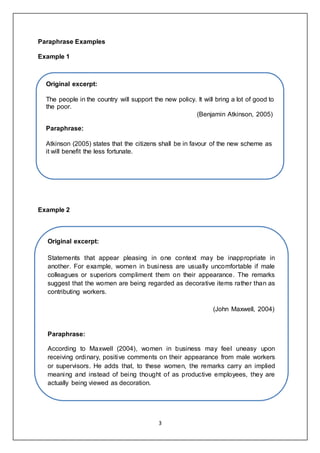
Paraphrase Examples
Example 1
Example 2
Original excerpt:
The people in the country will support the new policy. It will bring a lot of good to
the poor.
(Benjamin Atkinson, 2005)
Paraphrase:
Atkinson (2005) states that the citizens shall be in favour of the new scheme as
it will benefit the less fortunate.
Original excerpt:
Statements that appear pleasing in one context may be inappropriate in
another. For example, women in business are usually uncomfortable if male
colleagues or superiors compliment them on their appearance. The remarks
suggest that the women are being regarded as decorative items rather than as
contributing workers.
(John Maxwell, 2004)
Paraphrase:
According to Maxwell (2004), women in business may feel uneasy upon
receiving ordinary, positive comments on their appearance from male workers
or supervisors. He adds that, to these women, the remarks carry an implied
meaning and instead of being thought of as productive employees, they are
actually being viewed as decoration.
4
PARAPHRASING STRATEGIES
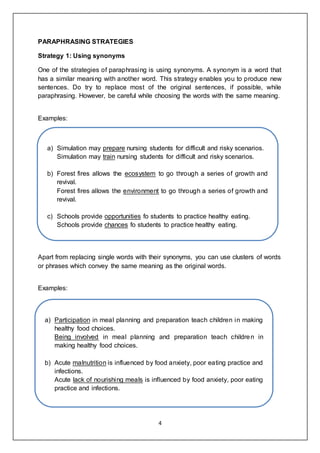
Strategy 1: Using synonyms
One of the strategies of paraphrasing is using synonyms. A synonym is a word that
has a similar meaning with another word. This strategy enables you to produce new
sentences. Do try to replace most of the original sentences, if possible, while
paraphrasing. However, be careful while choosing the words with the same meaning.
Examples:
Apart from replacing single words with their synonyms, you can use clusters of words
or phrases which convey the same meaning as the original words.
Examples:
a) Simulation may prepare nursing students for difficult and risky scenarios.
Simulation may train nursing students for difficult and risky scenarios.
b) Forest fires allows the ecosystem to go through a series of growth and
revival.
Forest fires allows the environment to go through a series of growth and
revival.
c) Schools provide opportunities fo students to practice healthy eating.
Schools provide chances fo students to practice healthy eating.
a) Participation in meal planning and preparation teach children in making
healthy food choices.
Being involved in meal planning and preparation teach children in
making healthy food choices.
b) Acute malnutrition is influenced by food anxiety, poor eating practice and
infections.
Acute lack of nourishing meals is influenced by food anxiety, poor eating
practice and infections.
5
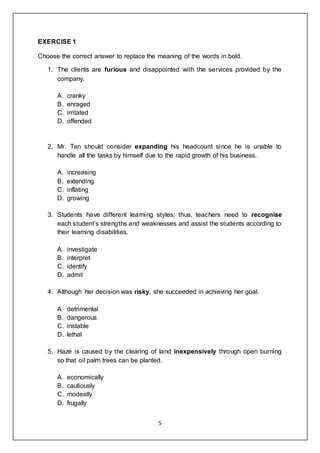
EXERCISE 1
Choose the correct answer to replace the meaning of the words in bold.
1. The clients are furious and disappointed with the services provided by the
company.
A. cranky
B. enraged
C. irritated
D. offended
2. Mr. Tan should consider expanding his headcount since he is unable to
handle all the tasks by himself due to the rapid growth of his business.
A. increasing
B. extending
C. inflating
D. growing
3. Students have different learning styles; thus, teachers need to recognise
each student’s strengths and weaknesses and assist the students according to
their learning disabilities.
A. investigate
B. interpret
C. identify
D. admit
4. Although her decision was risky, she succeeded in achieving her goal.
A. detrimental
B. dangerous
C. instable
D. lethal
5. Haze is caused by the clearing of land inexpensively through open burning
so that oil palm trees can be planted.
A. economically
B. cautiously
C. modestly
D. frugally
6
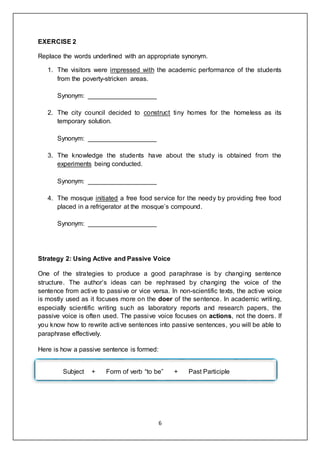
EXERCISE 2
Replace the words underlined with an appropriate synonym.
1. The visitors were impressed with the academic performance of the students
from the poverty-stricken areas.
Synonym: ___________________
2. The city council decided to construct tiny homes for the homeless as its
temporary solution.
Synonym: ___________________
3. The knowledge the students have about the study is obtained from the
experiments being conducted.
Synonym: ___________________
4. The mosque initiated a free food service for the needy by providing free food
placed in a refrigerator at the mosque’s compound.
Synonym: ___________________
Strategy 2: Using Active and Passive Voice
One of the strategies to produce a good paraphrase is by changing sentence
structure. The author’s ideas can be rephrased by changing the voice of the
sentence from active to passive or vice versa. In non-scientific texts, the active voice
is mostly used as it focuses more on the doer of the sentence. In academic writing,
especially scientific writing such as laboratory reports and research papers, the
passive voice is often used. The passive voice focuses on actions, not the doers. If
you know how to rewrite active sentences into passive sentences, you will be able to
paraphrase effectively.
Here is how a passive sentence is formed:
Subject + Form of verb “to be” + Past Participle
7
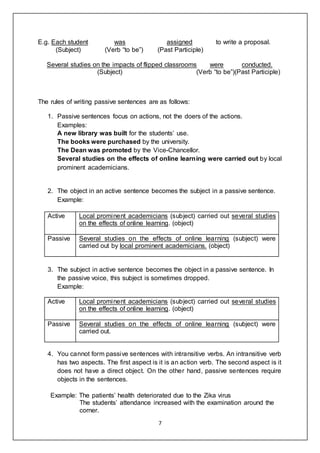
E.g. Each student was assigned to write a proposal.
(Subject) (Verb “to be”) (Past Participle)
Several studies on the impacts of flipped classrooms were conducted.
(Subject) (Verb “to be”)(Past Participle)
The rules of writing passive sentences are as follows:
1. Passive sentences focus on actions, not the doers of the actions.
Examples:
A new library was built for the students’ use.
The books were purchased by the university.
The Dean was promoted by the Vice-Chancellor.
Several studies on the effects of online learning were carried out by local
prominent academicians.
2. The object in an active sentence becomes the subject in a passive sentence.
Example:
Active Local prominent academicians (subject) carried out several studies
on the effects of online learning. (object)
Passive Several studies on the effects of online learning (subject) were
carried out by local prominent academicians. (object)
3. The subject in active sentence becomes the object in a passive sentence. In
the passive voice, this subject is sometimes dropped.
Example:
Active Local prominent academicians (subject) carried out several studies
on the effects of online learning. (object)
Passive Several studies on the effects of online learning (subject) were
carried out.
4. You cannot form passive sentences with intransitive verbs. An intransitive verb
has two aspects. The first aspect is it is an action verb. The second aspect is it
does not have a direct object. On the other hand, passive sentences require
objects in the sentences.
Example: The patients’ health deteriorated due to the Zika virus
The students’ attendance increased with the examination around the
corner.
8
5. An example of paraphrasing a sentence by changing the active voice to
passive voice:
Active sentence: Dr. Umar conducted a research on dyslexia.
Passive sentence: A study on the learning disability, dyslexia, was carried out
by Dr. Umar.
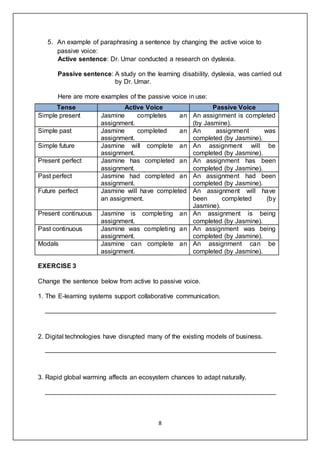
Here are more examples of the passive voice in use:
Tense Active Voice Passive Voice
Simple present Jasmine completes an
assignment.
An assignment is completed
(by Jasmine).
Simple past Jasmine completed an
assignment.
An assignment was
completed (by Jasmine).
Simple future Jasmine will complete an
assignment.
An assignment will be
completed (by Jasmine).
Present perfect Jasmine has completed an
assignment.
An assignment has been
completed (by Jasmine).
Past perfect Jasmine had completed an
assignment.
An assignment had been
completed (by Jasmine).
Future perfect Jasmine will have completed
an assignment.
An assignment will have
been completed (by
Jasmine).
Present continuous Jasmine is completing an
assignment.
An assignment is being
completed (by Jasmine).
Past continuous Jasmine was completing an
assignment.
An assignment was being
completed (by Jasmine).
Modals Jasmine can complete an
assignment.
An assignment can be
completed (by Jasmine).
EXERCISE 3
Change the sentence below from active to passive voice.
1. The E-learning systems support collaborative communication.
________________________________________________________________
2. Digital technologies have disrupted many of the existing models of business.
________________________________________________________________
3. Rapid global warming affects an ecosystem chances to adapt naturally.
________________________________________________________________
9
EXERCISE 4
Change the sentence below from passive to active voice.
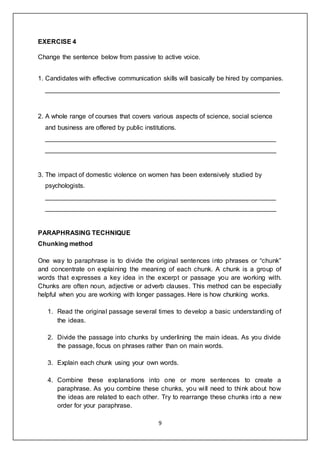
1. Candidates with effective communication skills will basically be hired by companies.
_________________________________________________________________
2. A whole range of courses that covers various aspects of science, social science
and business are offered by public institutions.
________________________________________________________________
________________________________________________________________
3. The impact of domestic violence on women has been extensively studied by
psychologists.
________________________________________________________________
________________________________________________________________
PARAPHRASING TECHNIQUE
Chunking method
One way to paraphrase is to divide the original sentences into phrases or “chunk”
and concentrate on explaining the meaning of each chunk. A chunk is a group of
words that expresses a key idea in the excerpt or passage you are working with.
Chunks are often noun, adjective or adverb clauses. This method can be especially
helpful when you are working with longer passages. Here is how chunking works.
1. Read the original passage several times to develop a basic understanding of
the ideas.
2. Divide the passage into chunks by underlining the main ideas. As you divide
the passage, focus on phrases rather than on main words.
3. Explain each chunk using your own words.
4. Combine these explanations into one or more sentences to create a
paraphrase. As you combine these chunks, you will need to think about how
the ideas are related to each other. Try to rearrange these chunks into a new
order for your paraphrase.
10
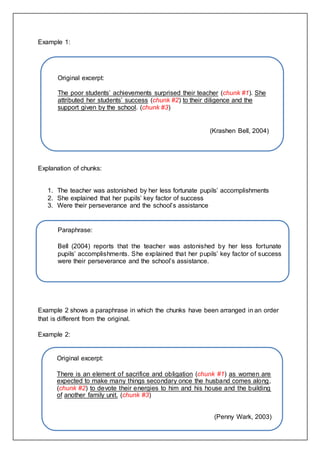
Example 1:
Explanation of chunks:
1. The teacher was astonished by her less fortunate pupils’ accomplishments
2. She explained that her pupils’ key factor of success
3. Were their perseverance and the school’s assistance
Example 2 shows a paraphrase in which the chunks have been arranged in an order
that is different from the original.
Example 2:
Original excerpt:
The poor students’ achievements surprised their teacher (chunk #1). She
attributed her students’ success (chunk #2) to their diligence and the
support given by the school. (chunk #3)
(Krashen Bell, 2004)
Paraphrase:
Bell (2004) reports that the teacher was astonished by her less fortunate
pupils’ accomplishments. She explained that her pupils’ key factor of success
were their perseverance and the school’s assistance.
Original excerpt:
There is an element of sacrifice and obligation (chunk #1) as women are
expected to make many things secondary once the husband comes along,
(chunk #2) to devote their energies to him and his house and the building
of another family unit. (chunk #3)
(Penny Wark, 2003)
11
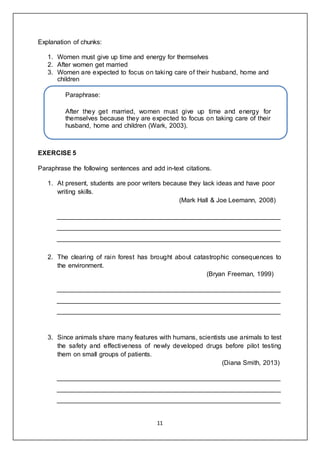
Explanation of chunks:
1. Women must give up time and energy for themselves
2. After women get married
3. Women are expected to focus on taking care of their husband, home and
children
EXERCISE 5
Paraphrase the following sentences and add in-text citations.
1. At present, students are poor writers because they lack ideas and have poor
writing skills.
(Mark Hall & Joe Leemann, 2008)
______________________________________________________________
______________________________________________________________
______________________________________________________________
2. The clearing of rain forest has brought about catastrophic consequences to
the environment.
(Bryan Freeman, 1999)
______________________________________________________________
______________________________________________________________
______________________________________________________________
3. Since animals share many features with humans, scientists use animals to test
the safety and effectiveness of newly developed drugs before pilot testing
them on small groups of patients.
(Diana Smith, 2013)
______________________________________________________________
______________________________________________________________
______________________________________________________________
Paraphrase:
After they get married, women must give up time and energy for
themselves because they are expected to focus on taking care of their
husband, home and children (Wark, 2003).
12
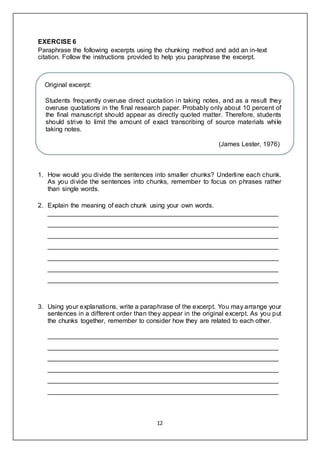
EXERCISE 6
Paraphrase the following excerpts using the chunking method and add an in-text
citation. Follow the instructions provided to help you paraphrase the excerpt.
Original excerpt:
Students frequently overuse direct quotation in taking notes, and as a result they
overuse quotations in the final research paper. Probably only about 10 percent of
the final manuscript should appear as directly quoted matter. Therefore, students
should strive to limit the amount of exact transcribing of source materials while
taking notes.
(James Lester, 1976)
1. How would you divide the sentences into smaller chunks? Underline each chunk.
As you divide the sentences into chunks, remember to focus on phrases rather
than single words.
2. Explain the meaning of each chunk using your own words.
________________________________________________________________
________________________________________________________________
________________________________________________________________
________________________________________________________________
________________________________________________________________
________________________________________________________________
________________________________________________________________
3. Using your explanations, write a paraphrase of the excerpt. You may arrange your
sentences in a different order than they appear in the original excerpt. As you put
the chunks together, remember to consider how they are related to each other.
________________________________________________________________
________________________________________________________________
________________________________________________________________
________________________________________________________________
________________________________________________________________
________________________________________________________________
13
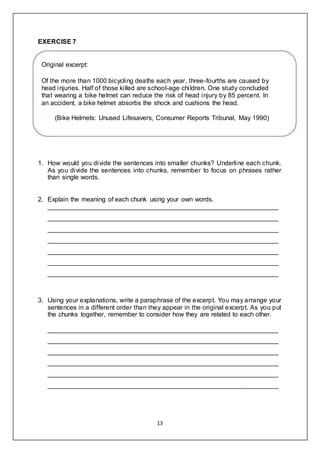
EXERCISE 7
Original excerpt:
Of the more than 1000 bicycling deaths each year, three-fourths are caused by
head injuries. Half of those killed are school-age children. One study concluded
that wearing a bike helmet can reduce the risk of head injury by 85 percent. In
an accident, a bike helmet absorbs the shock and cushions the head.
(Bike Helmets: Unused Lifesavers, Consumer Reports Tribunal, May 1990)
1. How would you divide the sentences into smaller chunks? Underline each chunk.
As you divide the sentences into chunks, remember to focus on phrases rather
than single words.
2. Explain the meaning of each chunk using your own words.
________________________________________________________________
________________________________________________________________
________________________________________________________________
________________________________________________________________
________________________________________________________________
________________________________________________________________
________________________________________________________________
3. Using your explanations, write a paraphrase of the excerpt. You may arrange your
sentences in a different order than they appear in the original excerpt. As you put
the chunks together, remember to consider how they are related to each other.
________________________________________________________________
________________________________________________________________
________________________________________________________________
________________________________________________________________
________________________________________________________________
________________________________________________________________

paraphrasing

  • 1.
    1 BBI2424 ACADEMIC WRITING SEMESTER1, 2017/2018 LECTURE NOTES 3 (WEEK 5-6) Topics: 1. Criteria for a good paraphrase 2. Strategies for paraphrasing 3. Technique for paraphrasing
  • 2.
    2 PARAPHRASING When you describesomething you have heard, you often repeat the same idea but use different words. For example, if you hear the TV announcer say, “There is an 80% chance of rain tomorrow,” you may tell a friend, “It will probably rain tomorrow.” This last statement is a paraphrase. A paraphrase is a restatement of another person’s ideas using your own words. You can use paraphrasing in writing as well. Repeating the author’s ideas in your own words shows that you truly comprehend the original ideas. Three criteria for a good paraphrase: 1. A good paraphrase has the same meaning as the original.  All main ideas included  No new ideas added 2. A good paraphrase is different enough from the original to be considered your own writing.  Uses own words or phrases that are different from the original  Changes grammar, vocabulary and sentence structure from the original as much as possible 3. A good paraphrase refers directly to (or cites) the original source.  Includes the name of the author and/or the name of the source and the year of publication
  • 3.
    3 Paraphrase Examples Example 1 Example2 Original excerpt: The people in the country will support the new policy. It will bring a lot of good to the poor. (Benjamin Atkinson, 2005) Paraphrase: Atkinson (2005) states that the citizens shall be in favour of the new scheme as it will benefit the less fortunate. Original excerpt: Statements that appear pleasing in one context may be inappropriate in another. For example, women in business are usually uncomfortable if male colleagues or superiors compliment them on their appearance. The remarks suggest that the women are being regarded as decorative items rather than as contributing workers. (John Maxwell, 2004) Paraphrase: According to Maxwell (2004), women in business may feel uneasy upon receiving ordinary, positive comments on their appearance from male workers or supervisors. He adds that, to these women, the remarks carry an implied meaning and instead of being thought of as productive employees, they are actually being viewed as decoration.
  • 4.
    4 PARAPHRASING STRATEGIES Strategy 1:Using synonyms One of the strategies of paraphrasing is using synonyms. A synonym is a word that has a similar meaning with another word. This strategy enables you to produce new sentences. Do try to replace most of the original sentences, if possible, while paraphrasing. However, be careful while choosing the words with the same meaning. Examples: Apart from replacing single words with their synonyms, you can use clusters of words or phrases which convey the same meaning as the original words. Examples: a) Simulation may prepare nursing students for difficult and risky scenarios. Simulation may train nursing students for difficult and risky scenarios. b) Forest fires allows the ecosystem to go through a series of growth and revival. Forest fires allows the environment to go through a series of growth and revival. c) Schools provide opportunities fo students to practice healthy eating. Schools provide chances fo students to practice healthy eating. a) Participation in meal planning and preparation teach children in making healthy food choices. Being involved in meal planning and preparation teach children in making healthy food choices. b) Acute malnutrition is influenced by food anxiety, poor eating practice and infections. Acute lack of nourishing meals is influenced by food anxiety, poor eating practice and infections.
  • 5.
    5 EXERCISE 1 Choose thecorrect answer to replace the meaning of the words in bold. 1. The clients are furious and disappointed with the services provided by the company. A. cranky B. enraged C. irritated D. offended 2. Mr. Tan should consider expanding his headcount since he is unable to handle all the tasks by himself due to the rapid growth of his business. A. increasing B. extending C. inflating D. growing 3. Students have different learning styles; thus, teachers need to recognise each student’s strengths and weaknesses and assist the students according to their learning disabilities. A. investigate B. interpret C. identify D. admit 4. Although her decision was risky, she succeeded in achieving her goal. A. detrimental B. dangerous C. instable D. lethal 5. Haze is caused by the clearing of land inexpensively through open burning so that oil palm trees can be planted. A. economically B. cautiously C. modestly D. frugally
  • 6.
    6 EXERCISE 2 Replace thewords underlined with an appropriate synonym. 1. The visitors were impressed with the academic performance of the students from the poverty-stricken areas. Synonym: ___________________ 2. The city council decided to construct tiny homes for the homeless as its temporary solution. Synonym: ___________________ 3. The knowledge the students have about the study is obtained from the experiments being conducted. Synonym: ___________________ 4. The mosque initiated a free food service for the needy by providing free food placed in a refrigerator at the mosque’s compound. Synonym: ___________________ Strategy 2: Using Active and Passive Voice One of the strategies to produce a good paraphrase is by changing sentence structure. The author’s ideas can be rephrased by changing the voice of the sentence from active to passive or vice versa. In non-scientific texts, the active voice is mostly used as it focuses more on the doer of the sentence. In academic writing, especially scientific writing such as laboratory reports and research papers, the passive voice is often used. The passive voice focuses on actions, not the doers. If you know how to rewrite active sentences into passive sentences, you will be able to paraphrase effectively. Here is how a passive sentence is formed: Subject + Form of verb “to be” + Past Participle
  • 7.
    7 E.g. Each studentwas assigned to write a proposal. (Subject) (Verb “to be”) (Past Participle) Several studies on the impacts of flipped classrooms were conducted. (Subject) (Verb “to be”)(Past Participle) The rules of writing passive sentences are as follows: 1. Passive sentences focus on actions, not the doers of the actions. Examples: A new library was built for the students’ use. The books were purchased by the university. The Dean was promoted by the Vice-Chancellor. Several studies on the effects of online learning were carried out by local prominent academicians. 2. The object in an active sentence becomes the subject in a passive sentence. Example: Active Local prominent academicians (subject) carried out several studies on the effects of online learning. (object) Passive Several studies on the effects of online learning (subject) were carried out by local prominent academicians. (object) 3. The subject in active sentence becomes the object in a passive sentence. In the passive voice, this subject is sometimes dropped. Example: Active Local prominent academicians (subject) carried out several studies on the effects of online learning. (object) Passive Several studies on the effects of online learning (subject) were carried out. 4. You cannot form passive sentences with intransitive verbs. An intransitive verb has two aspects. The first aspect is it is an action verb. The second aspect is it does not have a direct object. On the other hand, passive sentences require objects in the sentences. Example: The patients’ health deteriorated due to the Zika virus The students’ attendance increased with the examination around the corner.
  • 8.
    8 5. An exampleof paraphrasing a sentence by changing the active voice to passive voice: Active sentence: Dr. Umar conducted a research on dyslexia. Passive sentence: A study on the learning disability, dyslexia, was carried out by Dr. Umar. Here are more examples of the passive voice in use: Tense Active Voice Passive Voice Simple present Jasmine completes an assignment. An assignment is completed (by Jasmine). Simple past Jasmine completed an assignment. An assignment was completed (by Jasmine). Simple future Jasmine will complete an assignment. An assignment will be completed (by Jasmine). Present perfect Jasmine has completed an assignment. An assignment has been completed (by Jasmine). Past perfect Jasmine had completed an assignment. An assignment had been completed (by Jasmine). Future perfect Jasmine will have completed an assignment. An assignment will have been completed (by Jasmine). Present continuous Jasmine is completing an assignment. An assignment is being completed (by Jasmine). Past continuous Jasmine was completing an assignment. An assignment was being completed (by Jasmine). Modals Jasmine can complete an assignment. An assignment can be completed (by Jasmine). EXERCISE 3 Change the sentence below from active to passive voice. 1. The E-learning systems support collaborative communication. ________________________________________________________________ 2. Digital technologies have disrupted many of the existing models of business. ________________________________________________________________ 3. Rapid global warming affects an ecosystem chances to adapt naturally. ________________________________________________________________
  • 9.
    9 EXERCISE 4 Change thesentence below from passive to active voice. 1. Candidates with effective communication skills will basically be hired by companies. _________________________________________________________________ 2. A whole range of courses that covers various aspects of science, social science and business are offered by public institutions. ________________________________________________________________ ________________________________________________________________ 3. The impact of domestic violence on women has been extensively studied by psychologists. ________________________________________________________________ ________________________________________________________________ PARAPHRASING TECHNIQUE Chunking method One way to paraphrase is to divide the original sentences into phrases or “chunk” and concentrate on explaining the meaning of each chunk. A chunk is a group of words that expresses a key idea in the excerpt or passage you are working with. Chunks are often noun, adjective or adverb clauses. This method can be especially helpful when you are working with longer passages. Here is how chunking works. 1. Read the original passage several times to develop a basic understanding of the ideas. 2. Divide the passage into chunks by underlining the main ideas. As you divide the passage, focus on phrases rather than on main words. 3. Explain each chunk using your own words. 4. Combine these explanations into one or more sentences to create a paraphrase. As you combine these chunks, you will need to think about how the ideas are related to each other. Try to rearrange these chunks into a new order for your paraphrase.
  • 10.
    10 Example 1: Explanation ofchunks: 1. The teacher was astonished by her less fortunate pupils’ accomplishments 2. She explained that her pupils’ key factor of success 3. Were their perseverance and the school’s assistance Example 2 shows a paraphrase in which the chunks have been arranged in an order that is different from the original. Example 2: Original excerpt: The poor students’ achievements surprised their teacher (chunk #1). She attributed her students’ success (chunk #2) to their diligence and the support given by the school. (chunk #3) (Krashen Bell, 2004) Paraphrase: Bell (2004) reports that the teacher was astonished by her less fortunate pupils’ accomplishments. She explained that her pupils’ key factor of success were their perseverance and the school’s assistance. Original excerpt: There is an element of sacrifice and obligation (chunk #1) as women are expected to make many things secondary once the husband comes along, (chunk #2) to devote their energies to him and his house and the building of another family unit. (chunk #3) (Penny Wark, 2003)
  • 11.
    11 Explanation of chunks: 1.Women must give up time and energy for themselves 2. After women get married 3. Women are expected to focus on taking care of their husband, home and children EXERCISE 5 Paraphrase the following sentences and add in-text citations. 1. At present, students are poor writers because they lack ideas and have poor writing skills. (Mark Hall & Joe Leemann, 2008) ______________________________________________________________ ______________________________________________________________ ______________________________________________________________ 2. The clearing of rain forest has brought about catastrophic consequences to the environment. (Bryan Freeman, 1999) ______________________________________________________________ ______________________________________________________________ ______________________________________________________________ 3. Since animals share many features with humans, scientists use animals to test the safety and effectiveness of newly developed drugs before pilot testing them on small groups of patients. (Diana Smith, 2013) ______________________________________________________________ ______________________________________________________________ ______________________________________________________________ Paraphrase: After they get married, women must give up time and energy for themselves because they are expected to focus on taking care of their husband, home and children (Wark, 2003).
  • 12.
    12 EXERCISE 6 Paraphrase thefollowing excerpts using the chunking method and add an in-text citation. Follow the instructions provided to help you paraphrase the excerpt. Original excerpt: Students frequently overuse direct quotation in taking notes, and as a result they overuse quotations in the final research paper. Probably only about 10 percent of the final manuscript should appear as directly quoted matter. Therefore, students should strive to limit the amount of exact transcribing of source materials while taking notes. (James Lester, 1976) 1. How would you divide the sentences into smaller chunks? Underline each chunk. As you divide the sentences into chunks, remember to focus on phrases rather than single words. 2. Explain the meaning of each chunk using your own words. ________________________________________________________________ ________________________________________________________________ ________________________________________________________________ ________________________________________________________________ ________________________________________________________________ ________________________________________________________________ ________________________________________________________________ 3. Using your explanations, write a paraphrase of the excerpt. You may arrange your sentences in a different order than they appear in the original excerpt. As you put the chunks together, remember to consider how they are related to each other. ________________________________________________________________ ________________________________________________________________ ________________________________________________________________ ________________________________________________________________ ________________________________________________________________ ________________________________________________________________
  • 13.
    13 EXERCISE 7 Original excerpt: Ofthe more than 1000 bicycling deaths each year, three-fourths are caused by head injuries. Half of those killed are school-age children. One study concluded that wearing a bike helmet can reduce the risk of head injury by 85 percent. In an accident, a bike helmet absorbs the shock and cushions the head. (Bike Helmets: Unused Lifesavers, Consumer Reports Tribunal, May 1990) 1. How would you divide the sentences into smaller chunks? Underline each chunk. As you divide the sentences into chunks, remember to focus on phrases rather than single words. 2. Explain the meaning of each chunk using your own words. ________________________________________________________________ ________________________________________________________________ ________________________________________________________________ ________________________________________________________________ ________________________________________________________________ ________________________________________________________________ ________________________________________________________________ 3. Using your explanations, write a paraphrase of the excerpt. You may arrange your sentences in a different order than they appear in the original excerpt. As you put the chunks together, remember to consider how they are related to each other. ________________________________________________________________ ________________________________________________________________ ________________________________________________________________ ________________________________________________________________ ________________________________________________________________ ________________________________________________________________