ELECTROMAGNETIC INDUCTION
1. Magnetic Flux
2. Faraday’s Experiments
3. Faraday’s Laws of Electromagnetic Induction
4. Lenz’s Law and Law of Conservation of Energy
5. Expression for Induced emf based on both laws
6. Methods of producing induced emf
a) By changing Magnetic Field
b) By changing the Area of the Coil (Motional emf)
c) By changing the Relative Orientation of the coil with
the Magnetic Field
7. Eddy Currents
8. Self Induction and Self Inductance
9. Mutual Induction and Mutual Inductance
10. Additional Information
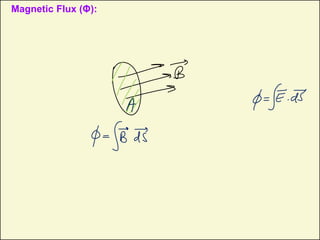
Magnetic Flux (Φ):
θ
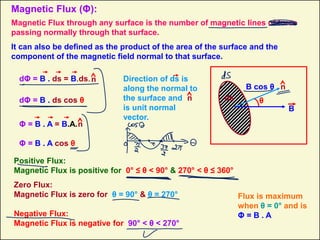
Magnetic Flux (Φ):
Magnetic Flux through any surface is the number of magnetic lines of force
passing normally through that surface.
It can also be defined as the product of the area of the surface and the
component of the magnetic field normal to that surface.
ds
n
B
B cos θ
dΦ = B . ds cos θ
Φ = B . A = B.A.n
Φ = B . A cos θ
Positive Flux:
Magnetic Flux is positive for 0° ≤ θ < 90° & 270° < θ ≤ 360°
Zero Flux:
Magnetic Flux is zero for θ = 90° & θ = 270°
Negative Flux:
Magnetic Flux is negative for 90° < θ < 270°
Direction of ds is
along the normal to
the surface and
is unit normal
vector.
n
n
dΦ = B . ds = B.ds.
Flux is maximum
when θ = 0° and is
Φ = B . A
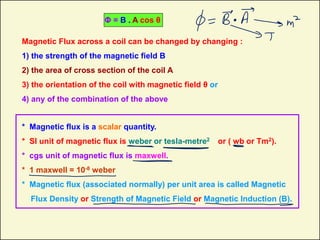
* Magnetic flux is a scalar quantity.
* SI unit of magnetic flux is weber or tesla-metre2 or ( wb or Tm2).
* cgs unit of magnetic flux is maxwell.
* 1 maxwell = 10-8 weber
* Magnetic flux (associated normally) per unit area is called Magnetic
Flux Density or Strength of Magnetic Field or Magnetic Induction (B).
Magnetic Flux across a coil can be changed by changing :
1) the strength of the magnetic field B
2) the area of cross section of the coil A
3) the orientation of the coil with magnetic field θ or
4) any of the combination of the above
Φ = B . A cos θ
N S
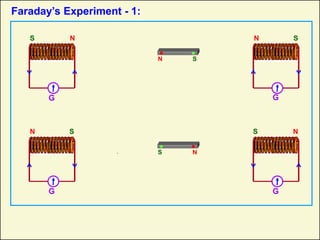
Faraday’s Experiment - 1:
G
N
S
G G
G
N
S N S
N
S
N S
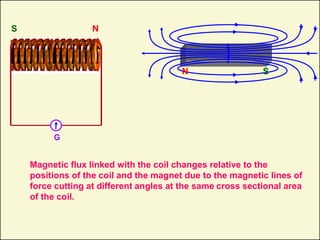
Magnetic flux linked with the coil changes relative to the
positions of the coil and the magnet due to the magnetic lines of
force cutting at different angles at the same cross sectional area
of the coil.
N
S
N S
G
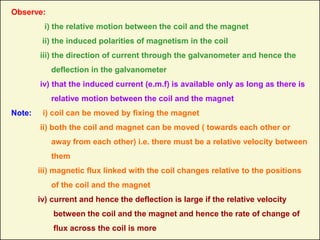
Observe:
i) the relative motion between the coil and the magnet
ii) the induced polarities of magnetism in the coil
iii) the direction of current through the galvanometer and hence the
deflection in the galvanometer
iv) that the induced current (e.m.f) is available only as long as there is
relative motion between the coil and the magnet
Note: i) coil can be moved by fixing the magnet
ii) both the coil and magnet can be moved ( towards each other or
away from each other) i.e. there must be a relative velocity between
them
iii) magnetic flux linked with the coil changes relative to the positions
of the coil and the magnet
iv) current and hence the deflection is large if the relative velocity
between the coil and the magnet and hence the rate of change of
flux across the coil is more
E G
N S N
S
K
Faraday’s Experiment - 2:
E G
N S
K
N S
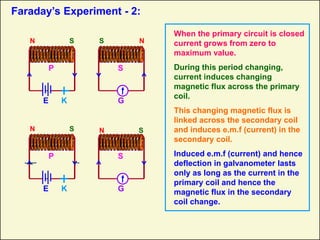
When the primary circuit is closed
current grows from zero to
maximum value.
During this period changing,
current induces changing
magnetic flux across the primary
coil.
This changing magnetic flux is
linked across the secondary coil
and induces e.m.f (current) in the
secondary coil.
Induced e.m.f (current) and hence
deflection in galvanometer lasts
only as long as the current in the
primary coil and hence the
magnetic flux in the secondary
coil change.
P
P
S
S
When the primary circuit is open current decreases from maximum value to
zero.
During this period changing current induces changing magnetic flux across the
primary coil.
This changing magnetic flux is linked across the secondary coil and induces
current (e.m.f) in the secondary coil.
However, note that the direction of current in the secondary coil is reversed
and hence the deflection in the galvanometer is opposite to the previous case.
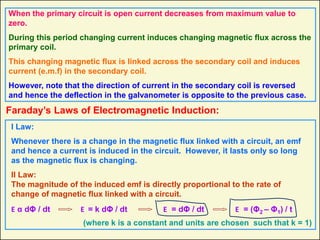
Faraday’s Laws of Electromagnetic Induction:
I Law:
Whenever there is a change in the magnetic flux linked with a circuit, an emf
and hence a current is induced in the circuit. However, it lasts only so long
as the magnetic flux is changing.
II Law:
The magnitude of the induced emf is directly proportional to the rate of
change of magnetic flux linked with a circuit.
E α dΦ / dt E = k dΦ / dt
(where k is a constant and units are chosen such that k = 1)
E = dΦ / dt E = (Φ2 – Φ1) / t
Lenz’s Law:
The direction of the induced emf or induced current is such that it opposes
the change that is producing it.
i.e. If the current is induced due to motion of the magnet, then the induced
current in the coil sets itself to stop the motion of the magnet.
If the current is induced due to change in current in the primary coil, then
induced current is such that it tends to stop the change.
Lenz’s Law and Law of Conservation of Energy:
According to Lenz’s law, the induced emf opposes the change that produces
it. It is this opposition against which we perform mechanical work in causing
the change in magnetic flux. Therefore, mechanical energy is converted into
electrical energy. Thus, Lenz’s law is in accordance with the law of
conservation of energy.
If, however, the reverse would happen (i.e. the induced emf does not oppose
or aids the change), then a little change in magnetic flux would produce an
induced current which would help the change of flux further thereby
producing more current. The increased emf would then cause further change
of flux and it would further increase the current and so on. This would create
energy out of nothing which would violate the law of conservation of energy.

EMI physics (premuim content)

  • 1.
    ELECTROMAGNETIC INDUCTION 1. MagneticFlux 2. Faraday’s Experiments 3. Faraday’s Laws of Electromagnetic Induction 4. Lenz’s Law and Law of Conservation of Energy 5. Expression for Induced emf based on both laws 6. Methods of producing induced emf a) By changing Magnetic Field b) By changing the Area of the Coil (Motional emf) c) By changing the Relative Orientation of the coil with the Magnetic Field 7. Eddy Currents 8. Self Induction and Self Inductance 9. Mutual Induction and Mutual Inductance 10. Additional Information
  • 2.
  • 3.
    θ Magnetic Flux (Φ): MagneticFlux through any surface is the number of magnetic lines of force passing normally through that surface. It can also be defined as the product of the area of the surface and the component of the magnetic field normal to that surface. ds n B B cos θ dΦ = B . ds cos θ Φ = B . A = B.A.n Φ = B . A cos θ Positive Flux: Magnetic Flux is positive for 0° ≤ θ < 90° & 270° < θ ≤ 360° Zero Flux: Magnetic Flux is zero for θ = 90° & θ = 270° Negative Flux: Magnetic Flux is negative for 90° < θ < 270° Direction of ds is along the normal to the surface and is unit normal vector. n n dΦ = B . ds = B.ds. Flux is maximum when θ = 0° and is Φ = B . A
  • 4.
    * Magnetic fluxis a scalar quantity. * SI unit of magnetic flux is weber or tesla-metre2 or ( wb or Tm2). * cgs unit of magnetic flux is maxwell. * 1 maxwell = 10-8 weber * Magnetic flux (associated normally) per unit area is called Magnetic Flux Density or Strength of Magnetic Field or Magnetic Induction (B). Magnetic Flux across a coil can be changed by changing : 1) the strength of the magnetic field B 2) the area of cross section of the coil A 3) the orientation of the coil with magnetic field θ or 4) any of the combination of the above Φ = B . A cos θ
  • 5.
    N S Faraday’s Experiment- 1: G N S G G G N S N S N S N S
  • 6.
    Magnetic flux linkedwith the coil changes relative to the positions of the coil and the magnet due to the magnetic lines of force cutting at different angles at the same cross sectional area of the coil. N S N S G
  • 7.
    Observe: i) the relativemotion between the coil and the magnet ii) the induced polarities of magnetism in the coil iii) the direction of current through the galvanometer and hence the deflection in the galvanometer iv) that the induced current (e.m.f) is available only as long as there is relative motion between the coil and the magnet Note: i) coil can be moved by fixing the magnet ii) both the coil and magnet can be moved ( towards each other or away from each other) i.e. there must be a relative velocity between them iii) magnetic flux linked with the coil changes relative to the positions of the coil and the magnet iv) current and hence the deflection is large if the relative velocity between the coil and the magnet and hence the rate of change of flux across the coil is more
  • 8.
    E G N SN S K Faraday’s Experiment - 2: E G N S K N S When the primary circuit is closed current grows from zero to maximum value. During this period changing, current induces changing magnetic flux across the primary coil. This changing magnetic flux is linked across the secondary coil and induces e.m.f (current) in the secondary coil. Induced e.m.f (current) and hence deflection in galvanometer lasts only as long as the current in the primary coil and hence the magnetic flux in the secondary coil change. P P S S
  • 9.
    When the primarycircuit is open current decreases from maximum value to zero. During this period changing current induces changing magnetic flux across the primary coil. This changing magnetic flux is linked across the secondary coil and induces current (e.m.f) in the secondary coil. However, note that the direction of current in the secondary coil is reversed and hence the deflection in the galvanometer is opposite to the previous case. Faraday’s Laws of Electromagnetic Induction: I Law: Whenever there is a change in the magnetic flux linked with a circuit, an emf and hence a current is induced in the circuit. However, it lasts only so long as the magnetic flux is changing. II Law: The magnitude of the induced emf is directly proportional to the rate of change of magnetic flux linked with a circuit. E α dΦ / dt E = k dΦ / dt (where k is a constant and units are chosen such that k = 1) E = dΦ / dt E = (Φ2 – Φ1) / t
  • 10.
    Lenz’s Law: The directionof the induced emf or induced current is such that it opposes the change that is producing it. i.e. If the current is induced due to motion of the magnet, then the induced current in the coil sets itself to stop the motion of the magnet. If the current is induced due to change in current in the primary coil, then induced current is such that it tends to stop the change. Lenz’s Law and Law of Conservation of Energy: According to Lenz’s law, the induced emf opposes the change that produces it. It is this opposition against which we perform mechanical work in causing the change in magnetic flux. Therefore, mechanical energy is converted into electrical energy. Thus, Lenz’s law is in accordance with the law of conservation of energy. If, however, the reverse would happen (i.e. the induced emf does not oppose or aids the change), then a little change in magnetic flux would produce an induced current which would help the change of flux further thereby producing more current. The increased emf would then cause further change of flux and it would further increase the current and so on. This would create energy out of nothing which would violate the law of conservation of energy.