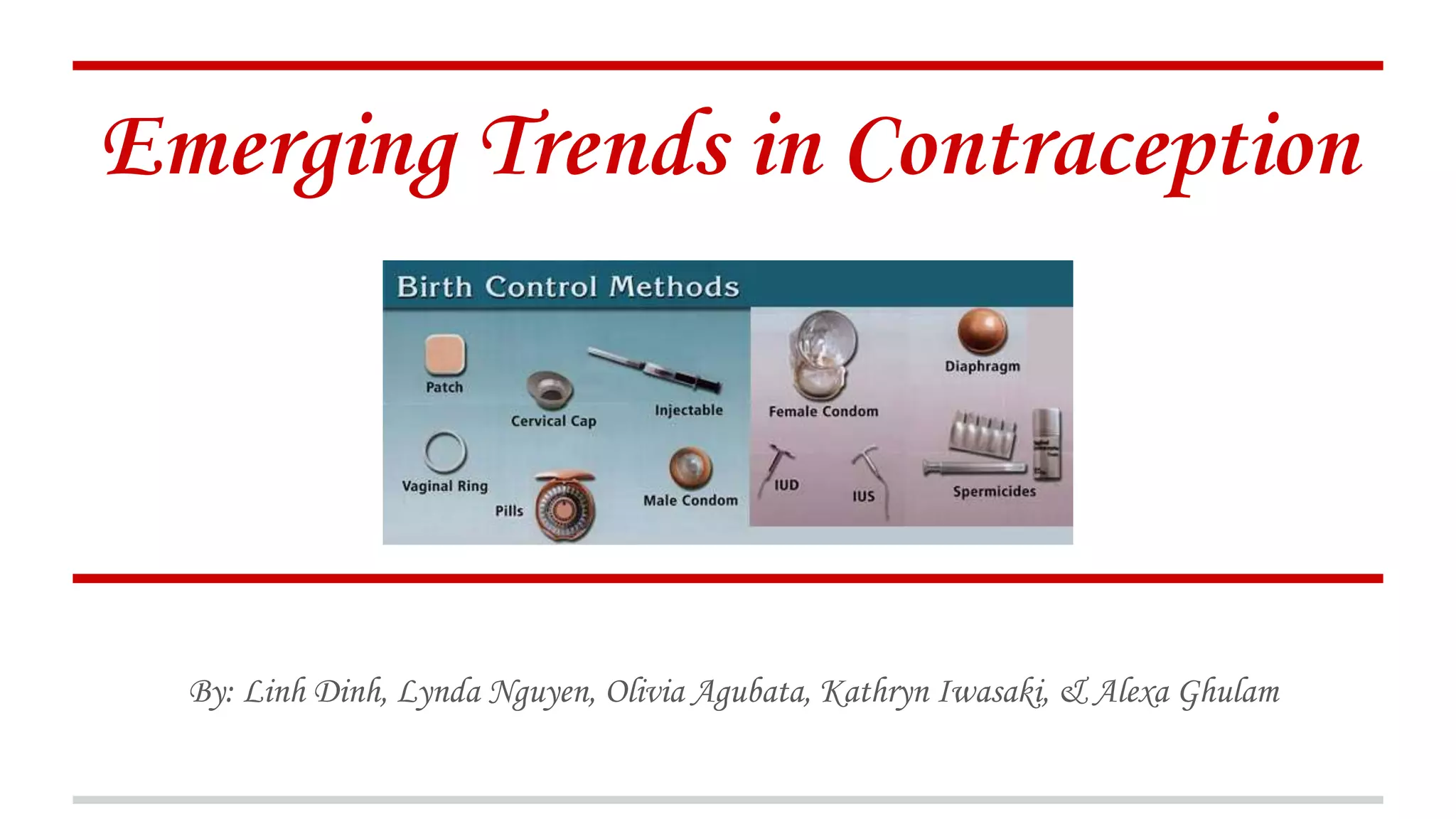
Emerging Trends in Contraception
By: Linh Dinh, Lynda Nguyen, Olivia Agubata, Kathryn Iwasaki, & Alexa Ghulam
What is it? Why use it?
Contraception is the use of various drugs, agents, sexual practices, or surgical
procedures to prevent conception or impregnation (pregnancy). The usage of
contraceptives help females plan if and when they want to have a baby.
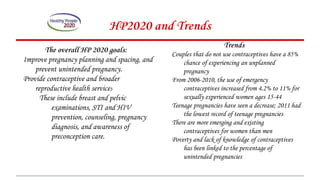
The overall HP 2020 goals:
Improve pregnancy planning and spacing, and
prevent unintended pregnancy.
Provide contraceptive and broader
reproductive health services
These include breast and pelvic
examinations, STI and HIV
prevention, counseling, pregnancy
diagnosis, and awareness of
preconception care.
HP2020 and Trends
Trends
Couples that do not use contraceptives have a 85%
chance of experiencing an unplanned
pregnancy
From 2006-2010, the use of emergency
contraceptives increased from 4.2% to 11% for
sexually experienced women ages 15-44
Teenage pregnancies have seen a decrease; 2011 had
the lowest record of teenage pregnancies
There are more emerging and existing
contraceptives for women than men
Poverty and lack of knowledge of contraceptives
has been linked to the percentage of
unintended pregnancies
Types of Contraceptives
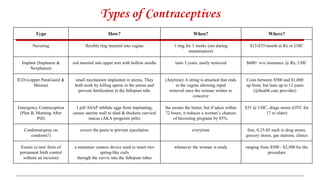
Type How? When? Where?
Nuvaring flexible ring inserted into vagina 1 ring for 3 weeks (not during
menstruation)
$15-$35/month at Rx or UHC
Implant (Implanon &
Nexplanon)
rod inserted into upper arm with hollow needle lasts 3 years, easily removed $600+ w/o insurance @ Rx, UHC
IUD (copper ParaGuard &
Mirena)
small mechanism implanted in uterus, They
both work by killing sperm in the uterus and
prevent fertilization in the fallopian tube
(Anytime) A string is attached that ends
in the vagina allowing rapid
removal once the woman wishes to
conceive
Costs between $500 and $1,000
up front, but lasts up to 12 years
(@health care provider)
Emergency Contraception
(Plan B, Morning After
Pill)
1 pill ASAP inhibits eggs from implanting,
causes uterine wall to shed & thickens cervical
mucus (AKA progestin pills)
the sooner the better, but if taken within
72 hours, it reduces a woman’s chances
of becoming pregnant by 85%.
$35 @ UHC, drugs stores (OTC for
17 or older)
Condoms(spray on
condoms?)
covers the penis to prevent ejaculation everytime free, 0.25-$5 each in drug stores,
grocery stores, gas stations, clinics
Essure (a new form of
permanent birth control
without an incision)
a miniature camera device used to insert two
spring-like coils
through the cervix into the fallopian tubes
whenever the woman is ready ranging from $500 - $2,500 for the
procedure
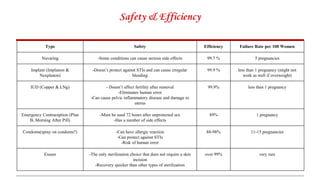
Safety & Efficiency
Type Safety Efficiency Failure Rate per 100 Women
Nuvaring -Some conditions can cause serious side effects 99.7 % 5 pregnancies
Implant (Implanon &
Nexplanon)
-Doesn’t protect against STIs and can cause irregular
bleeding
99.9 % less than 1 pregnancy (might not
work as well if overweight)
IUD (Copper & LNg) - Doesn’t affect fertility after removal
-Eliminates human error
-Can cause pelvic inflammatory disease and damage to
uterus
99.9% less than 1 pregnancy
Emergency Contraception (Plan
B, Morning After Pill)
-Must be used 72 hours after unprotected sex
-Has a number of side effects
89% 1 pregnancy
Condoms(spray on condoms?) -Can have allergic reaction
-Can protect against STIs
-Risk of human error
88-98% 11-15 pregnancies
Essure -The only sterilization choice that does not require a skin
incision
-Recovery quicker than other types of sterilization
over 99% very rare

Emerging Trends in Contraception

  • 1.
    Emerging Trends inContraception By: Linh Dinh, Lynda Nguyen, Olivia Agubata, Kathryn Iwasaki, & Alexa Ghulam
  • 2.
    What is it?Why use it? Contraception is the use of various drugs, agents, sexual practices, or surgical procedures to prevent conception or impregnation (pregnancy). The usage of contraceptives help females plan if and when they want to have a baby.
  • 3.
    The overall HP2020 goals: Improve pregnancy planning and spacing, and prevent unintended pregnancy. Provide contraceptive and broader reproductive health services These include breast and pelvic examinations, STI and HIV prevention, counseling, pregnancy diagnosis, and awareness of preconception care. HP2020 and Trends Trends Couples that do not use contraceptives have a 85% chance of experiencing an unplanned pregnancy From 2006-2010, the use of emergency contraceptives increased from 4.2% to 11% for sexually experienced women ages 15-44 Teenage pregnancies have seen a decrease; 2011 had the lowest record of teenage pregnancies There are more emerging and existing contraceptives for women than men Poverty and lack of knowledge of contraceptives has been linked to the percentage of unintended pregnancies
  • 4.
    Types of Contraceptives TypeHow? When? Where? Nuvaring flexible ring inserted into vagina 1 ring for 3 weeks (not during menstruation) $15-$35/month at Rx or UHC Implant (Implanon & Nexplanon) rod inserted into upper arm with hollow needle lasts 3 years, easily removed $600+ w/o insurance @ Rx, UHC IUD (copper ParaGuard & Mirena) small mechanism implanted in uterus, They both work by killing sperm in the uterus and prevent fertilization in the fallopian tube (Anytime) A string is attached that ends in the vagina allowing rapid removal once the woman wishes to conceive Costs between $500 and $1,000 up front, but lasts up to 12 years (@health care provider) Emergency Contraception (Plan B, Morning After Pill) 1 pill ASAP inhibits eggs from implanting, causes uterine wall to shed & thickens cervical mucus (AKA progestin pills) the sooner the better, but if taken within 72 hours, it reduces a woman’s chances of becoming pregnant by 85%. $35 @ UHC, drugs stores (OTC for 17 or older) Condoms(spray on condoms?) covers the penis to prevent ejaculation everytime free, 0.25-$5 each in drug stores, grocery stores, gas stations, clinics Essure (a new form of permanent birth control without an incision) a miniature camera device used to insert two spring-like coils through the cervix into the fallopian tubes whenever the woman is ready ranging from $500 - $2,500 for the procedure
  • 5.
    Safety & Efficiency TypeSafety Efficiency Failure Rate per 100 Women Nuvaring -Some conditions can cause serious side effects 99.7 % 5 pregnancies Implant (Implanon & Nexplanon) -Doesn’t protect against STIs and can cause irregular bleeding 99.9 % less than 1 pregnancy (might not work as well if overweight) IUD (Copper & LNg) - Doesn’t affect fertility after removal -Eliminates human error -Can cause pelvic inflammatory disease and damage to uterus 99.9% less than 1 pregnancy Emergency Contraception (Plan B, Morning After Pill) -Must be used 72 hours after unprotected sex -Has a number of side effects 89% 1 pregnancy Condoms(spray on condoms?) -Can have allergic reaction -Can protect against STIs -Risk of human error 88-98% 11-15 pregnancies Essure -The only sterilization choice that does not require a skin incision -Recovery quicker than other types of sterilization over 99% very rare

Editor's Notes

  • #3 - We chose this topic because as a group of females, we wanted to learn about different contraceptives and their effectiveness in preventing pregnancy/STIs. We also wanted to share our knowledge with other students. - There are 15 methods of contraception from which women can choose. Women typically choose a contraceptive that is best suited to their current health and circumstances. Although some contraceptive methods may be more effective than others, they are only effective if used correctly thus some contraceptives may be more prone to human error.