Dr. Priya Bagade
Issues
 Decision made by individual or by couple
 Many factors influence decision:
 Advantages & disadvantages of various methods
 Side effects & contraindications
 Effectivenes
 Expense
 Spiritual/cultural beliefs
 Practicality of method
Some facts
 Correct & consistent use of contraceptives results in lower risk of pregn
ancy
 Using more than one method together dramatically lowers risk of preg
nancy
 Emergency contraception offers last chance to prevent pregnancy after
unprotected intercourse or when extent of protection isn’t clear
 Most contraceptives pose little risk to most users’ health
 Half of all pregnancies are unintended (3.1 million/yr)
 More than 4/10 unintended pregnancies end in elective abortion
 Half of unintended pregnancies result from contraceptive failure
 1/3 of all births are unintended
Source: Contraceptive Technology (19th ed)
 Defination:
 CONTRACETION: All measures , temporary or permanent
, designed to prevent pregnancy due to coital act.
 IDEAL CONTRACEPTION: Fulfill following criteria
 Widely accetable
 Inexpensive
 Simple to use
 Safe
 Highly effective
 Require minimal motivation, maintainence, and supervision
 Benefits of fertility control:
 Improved quality of life
 Better health
 Less physical & emotional stress of life
 Better education, job & economic opportunities
 Fertility Control: Includes
Fertility Inhibition(Contraception)
 Fertility Stimulation.
Basic types of contraception
 Fertility awareness methods
 Barrier methods
 Situational methods
 Spermicides
 IUDs
 Hormonal contraception
 Operative sterilization
Fertility Awareness Methods
 Natural Family Planning methods
 Based on understanding ovulatory cycle
 Require periods of abstinence & careful recording of events throughout
cycle
 Cooperation very important
 Free, safe, and acceptable to all spiritual beliefs
 Require extensive initial counseling
 25% of women will experience unintended pregnancy in first year
 Some women combine barrier methods (use during fertile periods) an
d/or combine types of FAM
 More difficult when breastfeeding (masks some signs)
Fertility Awareness Methods
 Basal body temperature (BBT)
 Woman takes temp early morning
 Must be before any activity
 Uses BBT thermometer and same method
 Chart for 3-4 months to determine normal pattern
 Temp sometimes drops just before ovulation
 Almost always rises by 0.5 degrees & remains elevated fo
r several days after
 Abstain from intercourse several days before and 3 days
after anticipated ovulation
Fertility Awareness Methods
 Calendar method
 Also known as rhythm method
 Assumes ovulation takes place 14 days before start of me
nstrual period
 Sperm viable for 48-72 hours, ovum for 24 hours
 Record menstrual cycles for 6-8 months to determine sh
ortest & longest cycles
 Use record to identify fertile & infertile periods
 Least reliable of FAM
Fertility Awareness Methods
 Cervical mucus method
 Also known as Billings or ovulation method
 Involves careful assessment of cervical mucus changes throughout c
ycle
 Ovulation mucus clearer, more stretchable (spinnbarkeit), more per
meable to sperm
 Also ferns when dried on glass slide
 Luteal phase mucus thick, sticky, traps sperm (progesterone influen
ce)
 Woman abstains from intercourse for one cycle & assesses mucus st
atus
 Peak day of wetness & clear, stretchable mucus is assumed day of ov
ulation
 Can be used by women with irregular cycles
Fertility Awareness Methods
 Symptothermal method
 Multiple assessments made & recorded
 Cycle days, coitus, cervical mucus changes, BBT, & secon
dary changes (increased libido, bloating, mittelschmerz)
 Combined approach is more effective
Situational contraceptives
 Abstinence
 Coitus interruptus (withdrawal)
 Very unreliable
 Demands great self-control
 Pre-ejaculate may contain sperm, esp. after a recent ejaculation
 Douching after intercourse
 Not recommended; may facilitate conception
 Lactational amenorrhea method (LAM)
 Lactation depresses ovarian function
 Exclusive breastfeeding, from the breast (no pumping), in first s
ix months following birth without PP menses is 98% effective
 Even more effective if used with other method of contracep.
Barrier Methods
 Male condom
 Female condom
 Diaphragm
 Cervical cap
 Vaginal sponge
 Usually used with spermicides
 All vaginal barriers may cause increased risk of tox
ic shock syndrome if used longer than recommend
ed
Spermicides
 Available as creams, jellies, foams, film, suppositories
 May require up to 30 minutes to become effective
 Minimally effective if used alone
 May cause skin/mucus membrane irritation, allergic re
action
Barrier methods
 Male condom
 Must be used correctly to be effective
 No side effects
 Inexpensive and easily available
 Usually latex, but other types available for allergic
 Offers protection from pregnancy and STIs
 May also be used for STI protection in oral and anal inte
rcourse
Barrier Methods
 Female condoms
 Thin sheath with flexible ring at each end
 May be inserted up to 8 hrs before intercourse
 Internal ring functions like diaphragm to cover cervix
 External ring covers portion of perineum
 Cannot be used with male condom
 Slightly less reliable than other barrier methods
 More expensive than male condom
 Noisy and cumbersome
Barrier methods
 Diaphragm
 Must be used with spermicide
 Requires prescription and fitting by HCP
 Fits over cervix between pubic symphysis and posterior fornix
 Must be inserted before and remain in place at least six hours after i
ntercourse; additional spermicide must be inserted for additional ac
ts of coitus
 No hormones involved; may help protect cervix against HPV
 Requires comfort with insertion and checking placement
 Not recommended for those with hx of recurrent UTI
Barrier methods
 Cervical cap
 Fits over cervix by suction (smaller than diaphragm)
 Also used with spermicide
 May be left in place 24- 48 hrs
 May be more difficult to fit than diaphragm
 Requires more comfort with body to place correctly
Barrier methods
 Lea’s shield
 Similar to cervical cap, but with valve for passage of secr
etions & air
 One size fits all, but only available by rx in US
 Contraceptive sponge
 Available OTC, one size (expensive)
 Contains nonoxynol-9
 No additional spermicide needed for additional coitus w
ithin 24 hrs sponge may be in place
 Less effective in parous women
Intrauterine contraception
 Two forms available
 Paragard (copper T)
 Mirena (releases levonogestrel)
 Trigger spermicidal reaction in body, preventing fe
rtilization
 Provide long-term, highly effective contraception
 Risks include PID, perforation, dysmenorrhea, exp
ulsion
 Also may be used as emergency contraception (Par
agard only)
Intrauterine contraception
 Used in parous women in stable, long-term, monogamous re
lationships
 Inserted into uterus by practitioner.
 Nursing action: premedicate with ibuprofen to decrease cra
mping with procedure
 Usually inserted immidiately after menses or during first six
weeks postpartum (may be inserted any time as long as not p
regnant)
 String protrudes through cervix into vagina (path for ascendi
ng infection if exposed to STI)
 Women should check string after each menses
 Warning signs: late period, abnormal bleeding (may happen
with Mirena), abnormal discharge, s/sx of infection
Intrauterine contraception
Copper T
 Works by impairing fertilization
 May stay in place up to ten years
 May cause increased bleeding/cramping with periods
 No hormones
 Contraindicated in copper allergy
 Low daily cost
 High user compliance, continuation, & satisfaction
 May help prevent endometrial cancer
Intrauterine contraception
 Mirena
 Releases small amount of progesterone (10% of oral cont
raceptives)
 May remain in place for up to 5 yrs
 Decreased bleeding, cramping compared to copper T
 May be recommended to women with menorrhagia
 Some women stop ovulating while it’s in place
 May cease bleeding altogether
 May have irregular bleeding, esp. in first few months
Hormonal contraception
 Combined oral contraceptives
 Progesterone-only oral contraceptives
 Implanted contraceptives
 Injected contraceptives
 Other hormonal contraceptives
 Vaginal ring
 Contraceptive patch
Hormonal contraception
 Combined oral contraceptives (COCs)
 Birth control pills with both estrogen & progesterone
 Most taken daily for 21 days, with 7 days of placebo or no
pill (exceptions: Seasonale,Seasonique, Yaz)
 Many formulations--monophasic, multiphasic, different
strengths, different progesterones
 Side effects differ somewhat based on formulations
 Very effective if used correctly
 No protection against STI
Hormonal contraception
 COCs
 Action:
 Suppress ovulation through negative feedback to hypothalami
c-pituitary axis
 Thickening of cervical mucus to prevent sperm entry
 May also slow tubal motility, disrupt transport of ova, change f
unction of endometrial vessels, cause endometrial atrophy, an
d inhibit implantation (not proven)
Hormonal contraception
 COCs
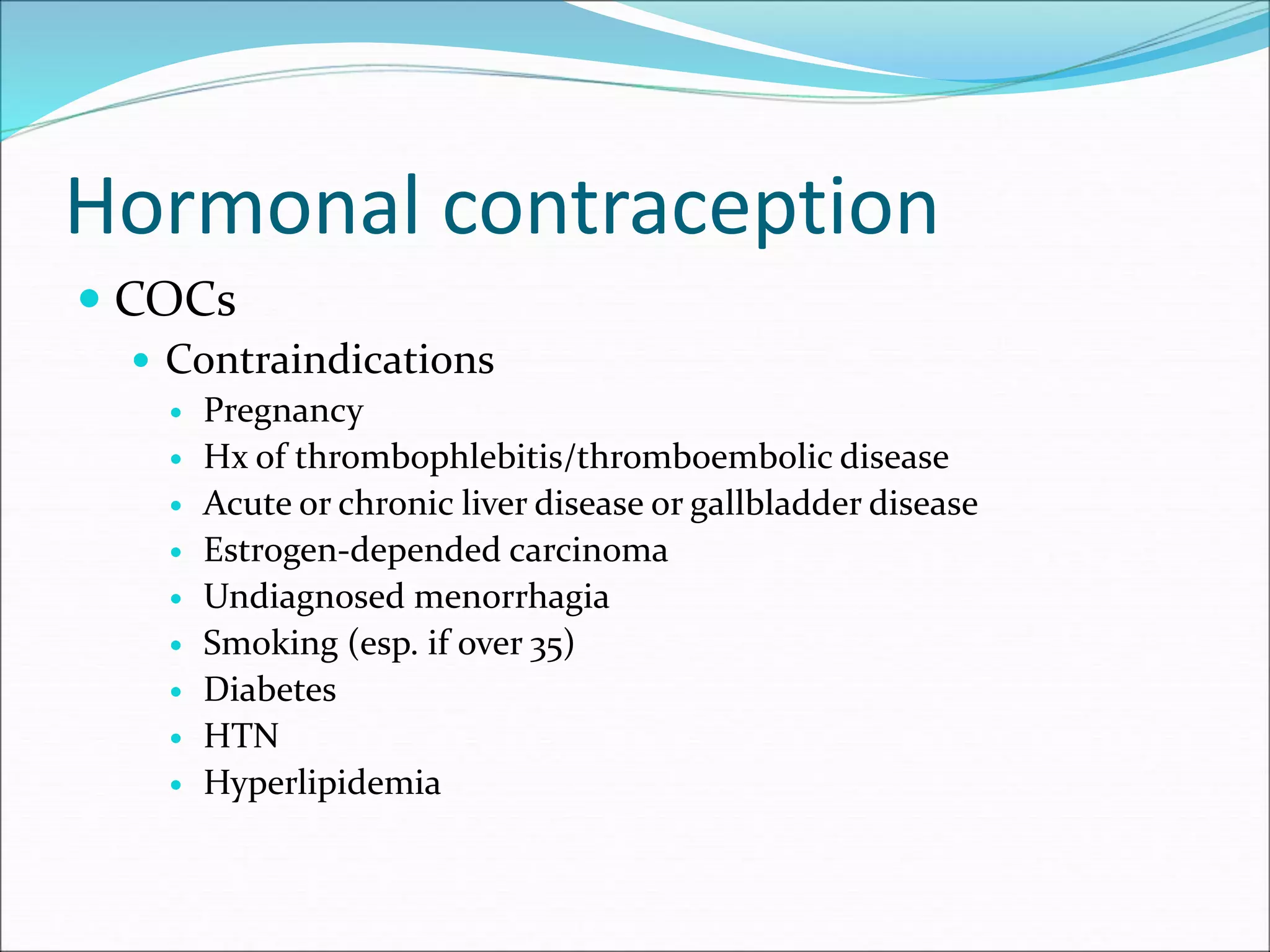
 Contraindications
 Pregnancy
 Hx of thrombophlebitis/thromboembolic disease
 Acute or chronic liver disease or gallbladder disease
 Estrogen-depended carcinoma
 Undiagnosed menorrhagia
 Smoking (esp. if over 35)
 Diabetes
 HTN
 Hyperlipidemia
Hormonal contraception
 COCs
 Caution/relative contraindications
 Hx of migraine headaches
 Seizure disorder
 Depression
 Oligomenorrhea
 Amenorrhea
 Often safer than pregnancy
Hormonal contraception
 COCs
 Noncontraceptive benefits:
 Decreased risk of ovarian and endometrial cancer
 Relief of menstrual symptoms (e.g. fewer/less painful cramps
, lighter flow)
 Regulation of irregular menses
 Reduced risk of ovarian cysts
 Improvement in menstrual migraines
 Decreased incidence of ectopic pregnancy
 Decreased incidence of benign breast disease & iron deficien
cy anemia
 Some pills decrease PMS symptoms (Yasmin & Yaz)
 Reduced symptoms of endometriosis, acne, hirsutism
Hormonal contraception
 Other combined methods
 NuvaRing vaginal ring (must be comfortable inserting)
 Ortho Evra contraceptive patch
 Similar effectiveness, non-contraceptive benefits, contraindications,
and side effects as COCs
 Patch dispenses higher dose of hormones than COCs, with possible
higher risk of venous thromboemobolic conditions
 Ring uses progesterone formulation that may increase risk of VTC a
s well
 Neither require daily use
 Patch replaced weekly for three weeks, then one week without
 Ring left in for three weeks, then one week without
Hormonal contraception
 Progesterone only pills (mini-pill)
 Do not suppress ovulation
 Do not affect breast milk supply (good for nursing mom
s)
 Must be taken at same time every day to be effective
 Often causes irregular bleeding
 Not as effective as combined methods
 No risk of venous thromboembolic events
Hormonal contraception
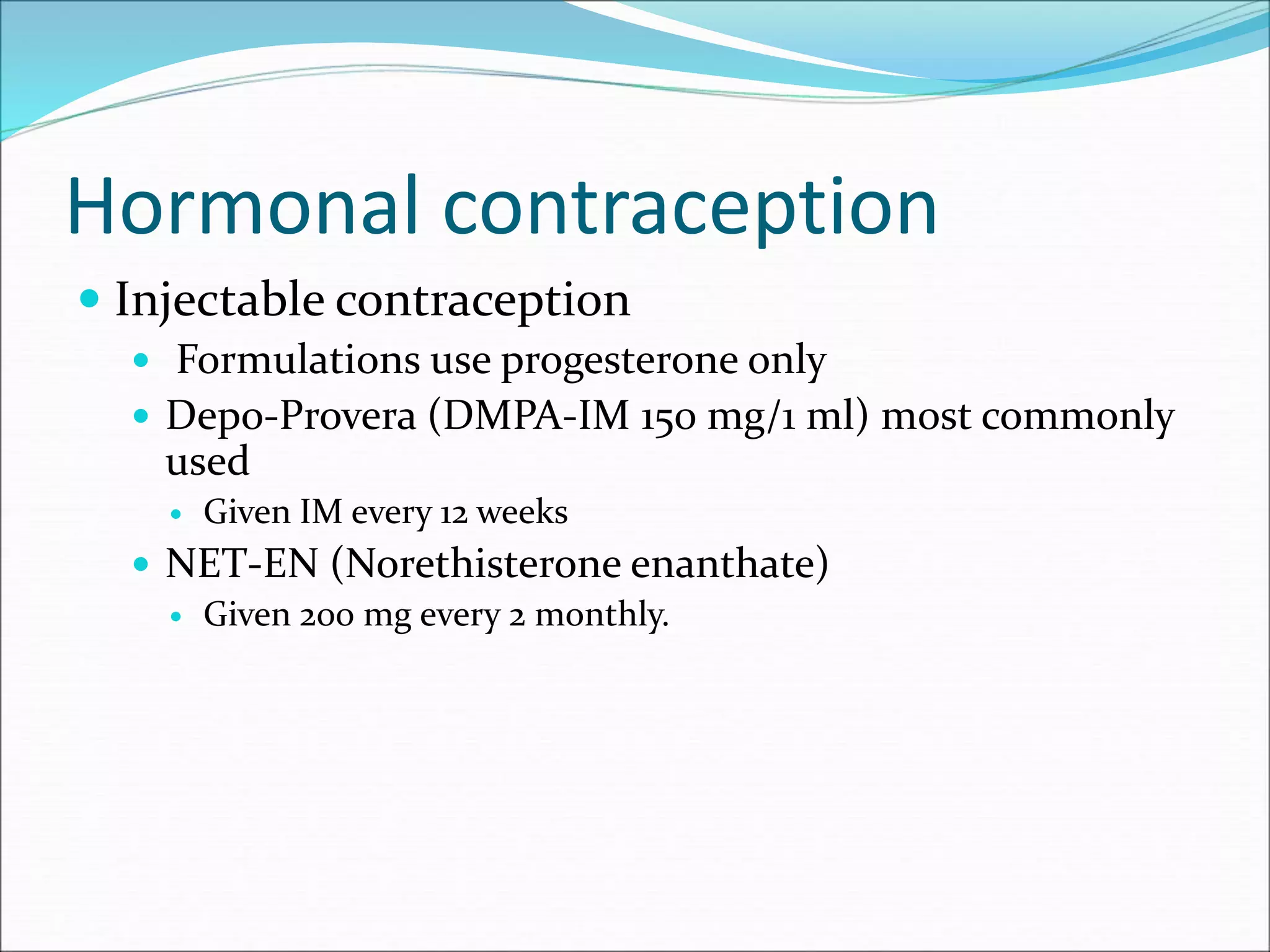
 Injectable contraception
 Formulations use progesterone only
 Depo-Provera (DMPA-IM 150 mg/1 ml) most commonly
used
 Given IM every 12 weeks
 NET-EN (Norethisterone enanthate)
 Given 200 mg every 2 monthly.
Hormonal contraception
 DMPA actions & advantages
 Works by inhibiting ovulation (suppresses FSH & LH), t
hickening cervical mucus
 Safe for those who can’t take estrogen (e.g. hx of DVT)
 Highly effective
 Very light to no menstrual periods (but can have irregul
ar bleeding)
 New SC formulation less painful, may be self-administer
ed
Hormonal contraception
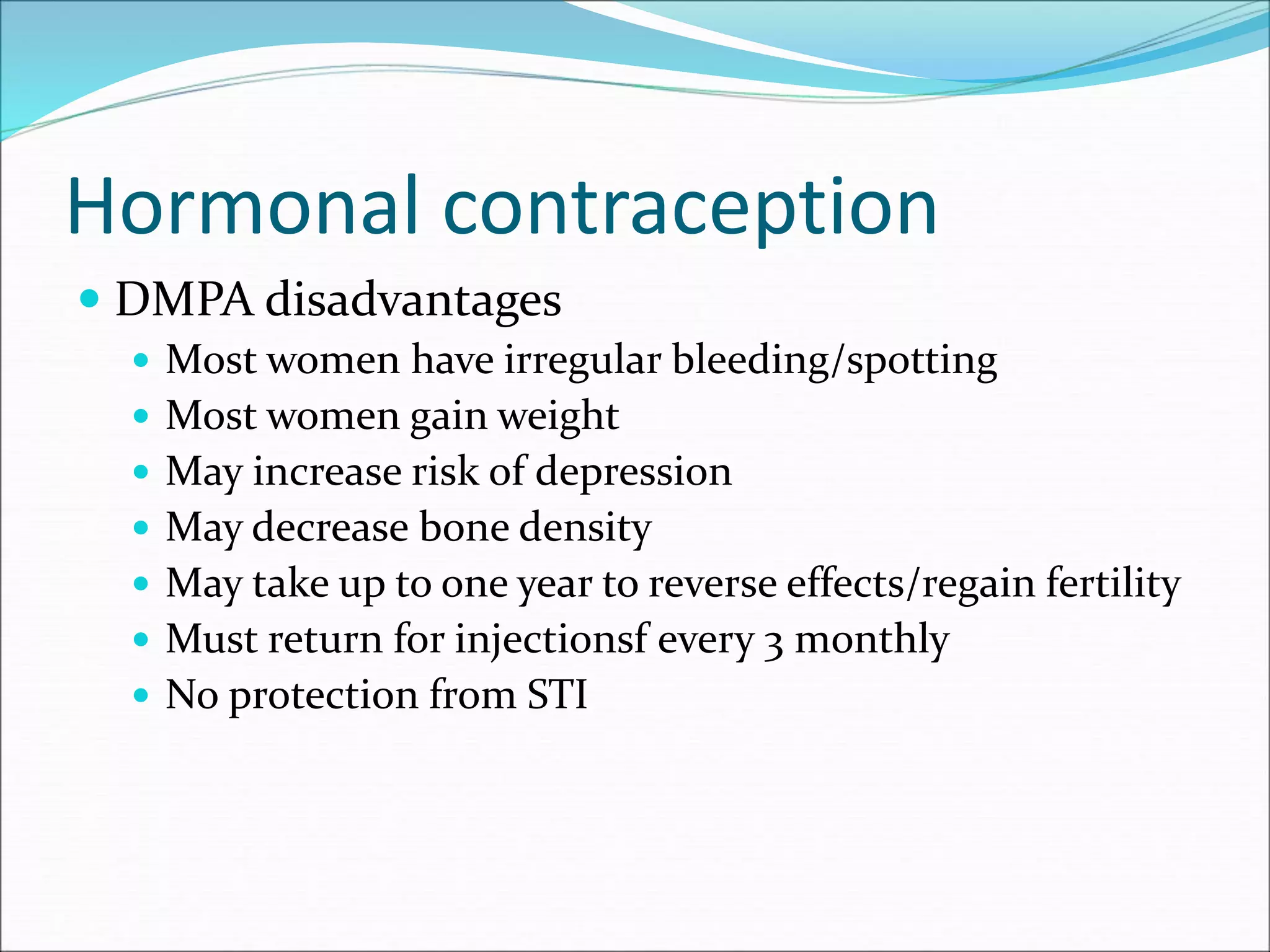
 DMPA disadvantages
 Most women have irregular bleeding/spotting
 Most women gain weight
 May increase risk of depression
 May decrease bone density
 May take up to one year to reverse effects/regain fertility
 Must return for injectionsf every 3 monthly
 No protection from STI
Hormonal contraception
 Implanted contraception
 Implanon
 Single rod implanted under skin of upper arm
 Provides contraception for 3 years
 Releases progestin continuously
 Extremely effective
 Like all progestin-only methods, causes irregular bleeding in ma
ny women
 Must be inserted by HCP & removed later
Emergency contraception
 Used after unprotected sex, contraceptive failure, or unsure
protection
 Should be taken as soon as possible after incident
 No medical contraindications except established pregnanc
y
 Most effective in first 72 hours, but still somewhat effective
up to 5 days after coitus
 Providing EC is the standard of care for women who requ
est it
Emergency contraception
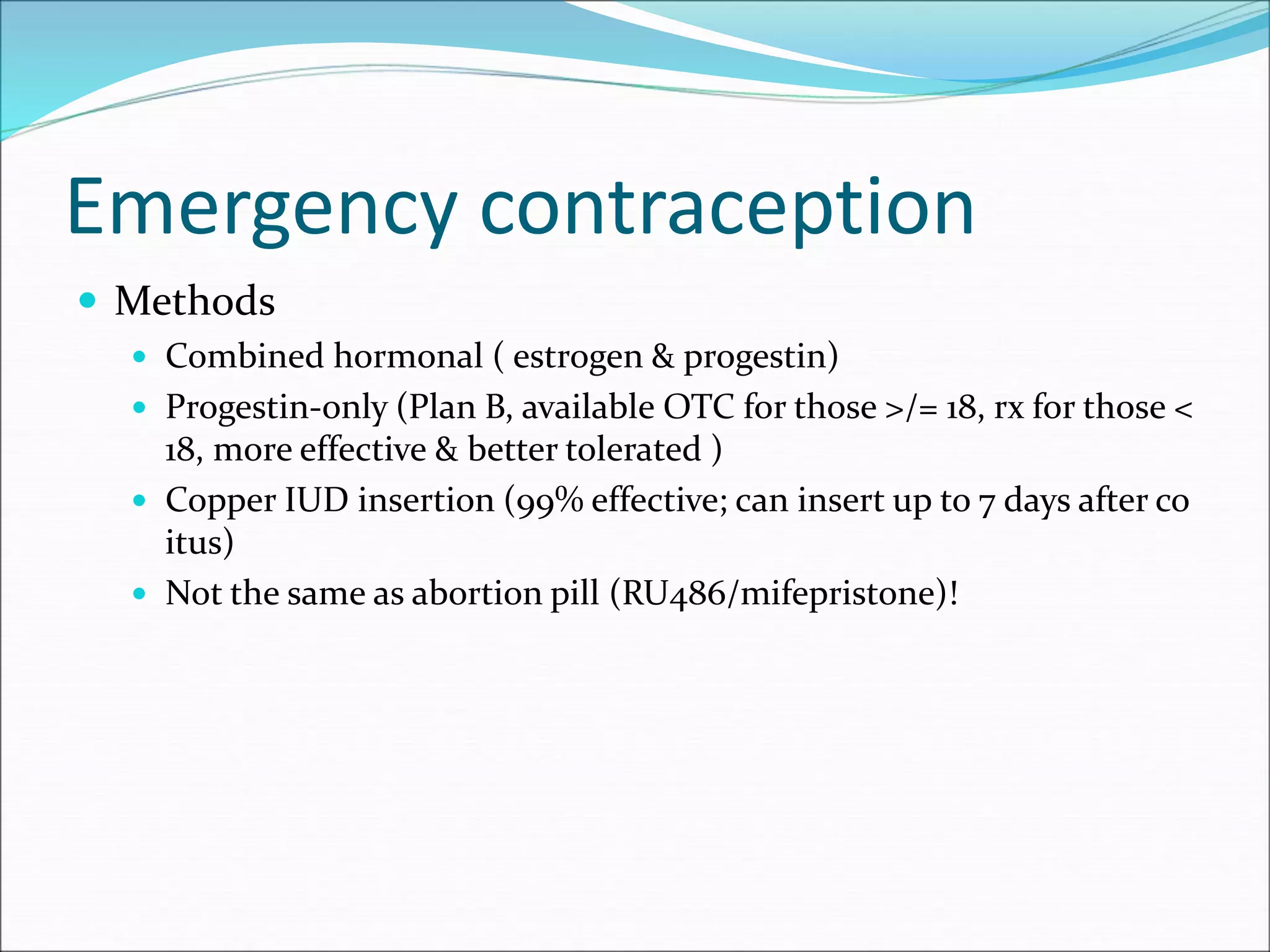
 Methods
 Combined hormonal ( estrogen & progestin)
 Progestin-only (Plan B, available OTC for those >/= 18, rx for those <
18, more effective & better tolerated )
 Copper IUD insertion (99% effective; can insert up to 7 days after co
itus)
 Not the same as abortion pill (RU486/mifepristone)!
Operative sterilization
 Surgical procedures that permanently prevent pregnan
cy
 Very difficult to reverse
 Vasectomy and tubal ligation
 Extremely effective and cost-effective
 Does not protect against STI
Operative sterilization
 Vasectomy
 Relatively minor procedure (safer and less expensive tha
n female sterilization)
 Surgical severing of vas deferens
 Takes 4-6 weeks/6-36 ejaculations to clear remaining act
ive sperm from vas
 Couple needs to use alternate method and bring in seme
n samples to verify (and recheck at 6-12 months)
 SE include pain, infection, hematoma, sperm granuloma
s, spontaneous reanastomosis
Operative sterilization
 Female sterilization
 May be done with repeat cesarean section or postpartum
from vaginal birth
 More serious surgery than vasectomy
 Complications include injury to bowel, bladder & adjace
nt structures, pain, infection, hemorrhage, adverse effec
ts of anesthesia
 New transcervical method (Essure) does not require ope
ning abdominal cavity, can be done under local anesthes
ia in physician’s office
Thank you

Contraception.pptx

  • 1.
  • 2.
    Issues  Decision madeby individual or by couple  Many factors influence decision:  Advantages & disadvantages of various methods  Side effects & contraindications  Effectivenes  Expense  Spiritual/cultural beliefs  Practicality of method
  • 3.
    Some facts  Correct& consistent use of contraceptives results in lower risk of pregn ancy  Using more than one method together dramatically lowers risk of preg nancy  Emergency contraception offers last chance to prevent pregnancy after unprotected intercourse or when extent of protection isn’t clear  Most contraceptives pose little risk to most users’ health  Half of all pregnancies are unintended (3.1 million/yr)  More than 4/10 unintended pregnancies end in elective abortion  Half of unintended pregnancies result from contraceptive failure  1/3 of all births are unintended Source: Contraceptive Technology (19th ed)
  • 4.
     Defination:  CONTRACETION:All measures , temporary or permanent , designed to prevent pregnancy due to coital act.  IDEAL CONTRACEPTION: Fulfill following criteria  Widely accetable  Inexpensive  Simple to use  Safe  Highly effective  Require minimal motivation, maintainence, and supervision
  • 5.
     Benefits offertility control:  Improved quality of life  Better health  Less physical & emotional stress of life  Better education, job & economic opportunities  Fertility Control: Includes Fertility Inhibition(Contraception)  Fertility Stimulation.
  • 6.
    Basic types ofcontraception  Fertility awareness methods  Barrier methods  Situational methods  Spermicides  IUDs  Hormonal contraception  Operative sterilization
  • 7.
    Fertility Awareness Methods Natural Family Planning methods  Based on understanding ovulatory cycle  Require periods of abstinence & careful recording of events throughout cycle  Cooperation very important  Free, safe, and acceptable to all spiritual beliefs  Require extensive initial counseling  25% of women will experience unintended pregnancy in first year  Some women combine barrier methods (use during fertile periods) an d/or combine types of FAM  More difficult when breastfeeding (masks some signs)
  • 8.
    Fertility Awareness Methods Basal body temperature (BBT)  Woman takes temp early morning  Must be before any activity  Uses BBT thermometer and same method  Chart for 3-4 months to determine normal pattern  Temp sometimes drops just before ovulation  Almost always rises by 0.5 degrees & remains elevated fo r several days after  Abstain from intercourse several days before and 3 days after anticipated ovulation
  • 9.
    Fertility Awareness Methods Calendar method  Also known as rhythm method  Assumes ovulation takes place 14 days before start of me nstrual period  Sperm viable for 48-72 hours, ovum for 24 hours  Record menstrual cycles for 6-8 months to determine sh ortest & longest cycles  Use record to identify fertile & infertile periods  Least reliable of FAM
  • 10.
    Fertility Awareness Methods Cervical mucus method  Also known as Billings or ovulation method  Involves careful assessment of cervical mucus changes throughout c ycle  Ovulation mucus clearer, more stretchable (spinnbarkeit), more per meable to sperm  Also ferns when dried on glass slide  Luteal phase mucus thick, sticky, traps sperm (progesterone influen ce)  Woman abstains from intercourse for one cycle & assesses mucus st atus  Peak day of wetness & clear, stretchable mucus is assumed day of ov ulation  Can be used by women with irregular cycles
  • 11.
    Fertility Awareness Methods Symptothermal method  Multiple assessments made & recorded  Cycle days, coitus, cervical mucus changes, BBT, & secon dary changes (increased libido, bloating, mittelschmerz)  Combined approach is more effective
  • 12.
    Situational contraceptives  Abstinence Coitus interruptus (withdrawal)  Very unreliable  Demands great self-control  Pre-ejaculate may contain sperm, esp. after a recent ejaculation  Douching after intercourse  Not recommended; may facilitate conception  Lactational amenorrhea method (LAM)  Lactation depresses ovarian function  Exclusive breastfeeding, from the breast (no pumping), in first s ix months following birth without PP menses is 98% effective  Even more effective if used with other method of contracep.
  • 13.
    Barrier Methods  Malecondom  Female condom  Diaphragm  Cervical cap  Vaginal sponge  Usually used with spermicides  All vaginal barriers may cause increased risk of tox ic shock syndrome if used longer than recommend ed
  • 14.
    Spermicides  Available ascreams, jellies, foams, film, suppositories  May require up to 30 minutes to become effective  Minimally effective if used alone  May cause skin/mucus membrane irritation, allergic re action
  • 15.
    Barrier methods  Malecondom  Must be used correctly to be effective  No side effects  Inexpensive and easily available  Usually latex, but other types available for allergic  Offers protection from pregnancy and STIs  May also be used for STI protection in oral and anal inte rcourse
  • 16.
    Barrier Methods  Femalecondoms  Thin sheath with flexible ring at each end  May be inserted up to 8 hrs before intercourse  Internal ring functions like diaphragm to cover cervix  External ring covers portion of perineum  Cannot be used with male condom  Slightly less reliable than other barrier methods  More expensive than male condom  Noisy and cumbersome
  • 17.
    Barrier methods  Diaphragm Must be used with spermicide  Requires prescription and fitting by HCP  Fits over cervix between pubic symphysis and posterior fornix  Must be inserted before and remain in place at least six hours after i ntercourse; additional spermicide must be inserted for additional ac ts of coitus  No hormones involved; may help protect cervix against HPV  Requires comfort with insertion and checking placement  Not recommended for those with hx of recurrent UTI
  • 18.
    Barrier methods  Cervicalcap  Fits over cervix by suction (smaller than diaphragm)  Also used with spermicide  May be left in place 24- 48 hrs  May be more difficult to fit than diaphragm  Requires more comfort with body to place correctly
  • 19.
    Barrier methods  Lea’sshield  Similar to cervical cap, but with valve for passage of secr etions & air  One size fits all, but only available by rx in US  Contraceptive sponge  Available OTC, one size (expensive)  Contains nonoxynol-9  No additional spermicide needed for additional coitus w ithin 24 hrs sponge may be in place  Less effective in parous women
  • 20.
    Intrauterine contraception  Twoforms available  Paragard (copper T)  Mirena (releases levonogestrel)  Trigger spermicidal reaction in body, preventing fe rtilization  Provide long-term, highly effective contraception  Risks include PID, perforation, dysmenorrhea, exp ulsion  Also may be used as emergency contraception (Par agard only)
  • 21.
    Intrauterine contraception  Usedin parous women in stable, long-term, monogamous re lationships  Inserted into uterus by practitioner.  Nursing action: premedicate with ibuprofen to decrease cra mping with procedure  Usually inserted immidiately after menses or during first six weeks postpartum (may be inserted any time as long as not p regnant)  String protrudes through cervix into vagina (path for ascendi ng infection if exposed to STI)  Women should check string after each menses  Warning signs: late period, abnormal bleeding (may happen with Mirena), abnormal discharge, s/sx of infection
  • 22.
    Intrauterine contraception Copper T Works by impairing fertilization  May stay in place up to ten years  May cause increased bleeding/cramping with periods  No hormones  Contraindicated in copper allergy  Low daily cost  High user compliance, continuation, & satisfaction  May help prevent endometrial cancer
  • 23.
    Intrauterine contraception  Mirena Releases small amount of progesterone (10% of oral cont raceptives)  May remain in place for up to 5 yrs  Decreased bleeding, cramping compared to copper T  May be recommended to women with menorrhagia  Some women stop ovulating while it’s in place  May cease bleeding altogether  May have irregular bleeding, esp. in first few months
  • 24.
    Hormonal contraception  Combinedoral contraceptives  Progesterone-only oral contraceptives  Implanted contraceptives  Injected contraceptives  Other hormonal contraceptives  Vaginal ring  Contraceptive patch
  • 25.
    Hormonal contraception  Combinedoral contraceptives (COCs)  Birth control pills with both estrogen & progesterone  Most taken daily for 21 days, with 7 days of placebo or no pill (exceptions: Seasonale,Seasonique, Yaz)  Many formulations--monophasic, multiphasic, different strengths, different progesterones  Side effects differ somewhat based on formulations  Very effective if used correctly  No protection against STI
  • 26.
    Hormonal contraception  COCs Action:  Suppress ovulation through negative feedback to hypothalami c-pituitary axis  Thickening of cervical mucus to prevent sperm entry  May also slow tubal motility, disrupt transport of ova, change f unction of endometrial vessels, cause endometrial atrophy, an d inhibit implantation (not proven)
  • 27.
    Hormonal contraception  COCs Contraindications  Pregnancy  Hx of thrombophlebitis/thromboembolic disease  Acute or chronic liver disease or gallbladder disease  Estrogen-depended carcinoma  Undiagnosed menorrhagia  Smoking (esp. if over 35)  Diabetes  HTN  Hyperlipidemia
  • 28.
    Hormonal contraception  COCs Caution/relative contraindications  Hx of migraine headaches  Seizure disorder  Depression  Oligomenorrhea  Amenorrhea  Often safer than pregnancy
  • 29.
    Hormonal contraception  COCs Noncontraceptive benefits:  Decreased risk of ovarian and endometrial cancer  Relief of menstrual symptoms (e.g. fewer/less painful cramps , lighter flow)  Regulation of irregular menses  Reduced risk of ovarian cysts  Improvement in menstrual migraines  Decreased incidence of ectopic pregnancy  Decreased incidence of benign breast disease & iron deficien cy anemia  Some pills decrease PMS symptoms (Yasmin & Yaz)  Reduced symptoms of endometriosis, acne, hirsutism
  • 30.
    Hormonal contraception  Othercombined methods  NuvaRing vaginal ring (must be comfortable inserting)  Ortho Evra contraceptive patch  Similar effectiveness, non-contraceptive benefits, contraindications, and side effects as COCs  Patch dispenses higher dose of hormones than COCs, with possible higher risk of venous thromboemobolic conditions  Ring uses progesterone formulation that may increase risk of VTC a s well  Neither require daily use  Patch replaced weekly for three weeks, then one week without  Ring left in for three weeks, then one week without
  • 31.
    Hormonal contraception  Progesteroneonly pills (mini-pill)  Do not suppress ovulation  Do not affect breast milk supply (good for nursing mom s)  Must be taken at same time every day to be effective  Often causes irregular bleeding  Not as effective as combined methods  No risk of venous thromboembolic events
  • 32.
    Hormonal contraception  Injectablecontraception  Formulations use progesterone only  Depo-Provera (DMPA-IM 150 mg/1 ml) most commonly used  Given IM every 12 weeks  NET-EN (Norethisterone enanthate)  Given 200 mg every 2 monthly.
  • 33.
    Hormonal contraception  DMPAactions & advantages  Works by inhibiting ovulation (suppresses FSH & LH), t hickening cervical mucus  Safe for those who can’t take estrogen (e.g. hx of DVT)  Highly effective  Very light to no menstrual periods (but can have irregul ar bleeding)  New SC formulation less painful, may be self-administer ed
  • 34.
    Hormonal contraception  DMPAdisadvantages  Most women have irregular bleeding/spotting  Most women gain weight  May increase risk of depression  May decrease bone density  May take up to one year to reverse effects/regain fertility  Must return for injectionsf every 3 monthly  No protection from STI
  • 35.
    Hormonal contraception  Implantedcontraception  Implanon  Single rod implanted under skin of upper arm  Provides contraception for 3 years  Releases progestin continuously  Extremely effective  Like all progestin-only methods, causes irregular bleeding in ma ny women  Must be inserted by HCP & removed later
  • 36.
    Emergency contraception  Usedafter unprotected sex, contraceptive failure, or unsure protection  Should be taken as soon as possible after incident  No medical contraindications except established pregnanc y  Most effective in first 72 hours, but still somewhat effective up to 5 days after coitus  Providing EC is the standard of care for women who requ est it
  • 37.
    Emergency contraception  Methods Combined hormonal ( estrogen & progestin)  Progestin-only (Plan B, available OTC for those >/= 18, rx for those < 18, more effective & better tolerated )  Copper IUD insertion (99% effective; can insert up to 7 days after co itus)  Not the same as abortion pill (RU486/mifepristone)!
  • 38.
    Operative sterilization  Surgicalprocedures that permanently prevent pregnan cy  Very difficult to reverse  Vasectomy and tubal ligation  Extremely effective and cost-effective  Does not protect against STI
  • 39.
    Operative sterilization  Vasectomy Relatively minor procedure (safer and less expensive tha n female sterilization)  Surgical severing of vas deferens  Takes 4-6 weeks/6-36 ejaculations to clear remaining act ive sperm from vas  Couple needs to use alternate method and bring in seme n samples to verify (and recheck at 6-12 months)  SE include pain, infection, hematoma, sperm granuloma s, spontaneous reanastomosis
  • 40.
    Operative sterilization  Femalesterilization  May be done with repeat cesarean section or postpartum from vaginal birth  More serious surgery than vasectomy  Complications include injury to bowel, bladder & adjace nt structures, pain, infection, hemorrhage, adverse effec ts of anesthesia  New transcervical method (Essure) does not require ope ning abdominal cavity, can be done under local anesthes ia in physician’s office
  • 41.