Emerging Nations
The Third World
Objectives


Identify locations in Africa.

Analyze definitions of third world.

  Categorize data to support these definitions.
Vocabulary
Sub-Saharan Africa - geographical term for the area of Africa
which is south of the Sahara Desert.

literacy: The ability to read and write; national measure of the
relative education level of the people

HIV/AIDS: Human Immunodeficiency Virus/Acquired Immune
Deficiency Syndrome; viral disease without cure that has
ravaged African nations over the past 40 years.

standard of living: measure of the quality of life for people in a
country; often influenced by that governments actions or
inactions.

apartheid: government policy of complete separation of races in
South Africa from 1948-1994.
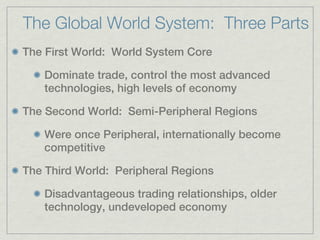
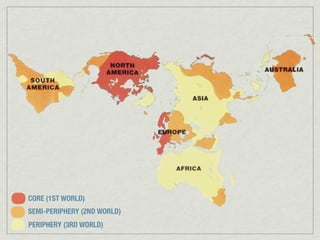
The Global World System: Three Parts
The First World: World System Core

    Dominate trade, control the most advanced
    technologies, high levels of economy

The Second World: Semi-Peripheral Regions

    Were once Peripheral, internationally become
    competitive

The Third World: Peripheral Regions

    Disadvantageous trading relationships, older
    technology, undeveloped economy
CORE (1ST WORLD)
SEMI-PERIPHERY (2ND WORLD)
PERIPHERY (3RD WORLD)
How Can You Tell?
We’ll be looking at 5 measures of countries to help
describe life in different countries

The vast majority of Africa contains those emerging
nations that exist in the Third World

  Most of the countries that fit the definitions of Third
  World countries in Africa lie in Sub-Saharan Africa

Let’s examine some examples of these different
measure and their impact
Education
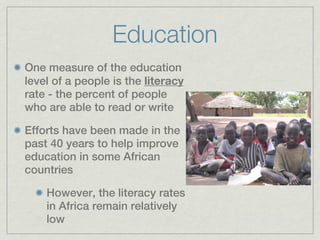
One measure of the education
level of a people is the literacy
rate - the percent of people
who are able to read or write

Efforts have been made in the
past 40 years to help improve
education in some African
countries

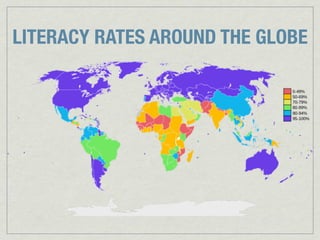
    However, the literacy rates
    in Africa remain relatively
    low
LITERACY RATES AROUND THE GLOBE
Health
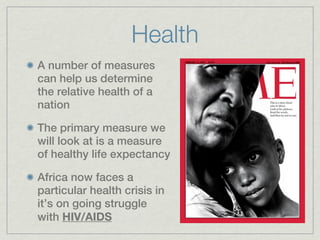
A number of measures
can help us determine
the relative health of a
nation

The primary measure we
will look at is a measure
of healthy life expectancy

Africa now faces a
particular health crisis in
it’s on going struggle
with HIV/AIDS
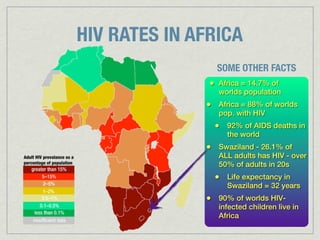
HIV RATES IN AFRICA
                 SOME OTHER FACTS
               • Africa = 14.7% of
                 worlds population
              • Africa = 88% of worlds
                 pop. with HIV
                • 92% of AIDS deaths in
                   the world
              • Swaziland - 26.1% of
                 ALL adults has HIV - over
                 50% of adults in 20s
                • Life expectancy in
                   Swaziland = 32 years
              • 90% of worlds HIV-
                 infected children live in
                 Africa
Quality of Life
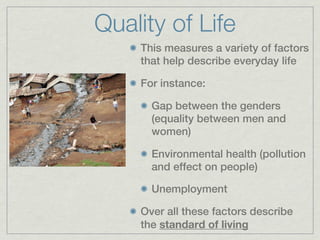
    This measures a variety of factors
    that help describe everyday life

    For instance:

      Gap between the genders
      (equality between men and
      women)

      Environmental health (pollution
      and effect on people)

      Unemployment

    Over all these factors describe
    the standard of living
Poverty

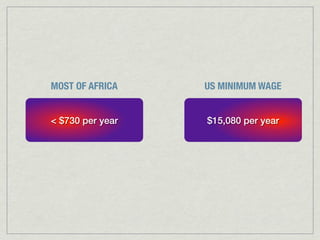
One of those standards is the number of people who
live on less than $2 a day.

  Do the math! $2 per day X 365 day = $________

  McDonald’s minimum wage = $7.25/hour

    $7.25 X 40 hours (week) - X 52 weeks = $_________
MOST OF AFRICA    US MINIMUM WAGE


< $730 per year   $15,080 per year
Economic & Political
            Factors
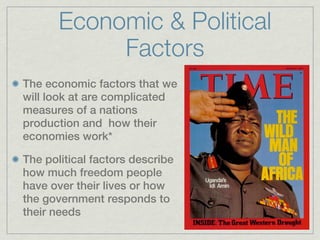
The economic factors that we
will look at are complicated
measures of a nations
production and how their
economies work*

The political factors describe
how much freedom people
have over their lives or how
the government responds to
their needs
South Africa: Apartheid
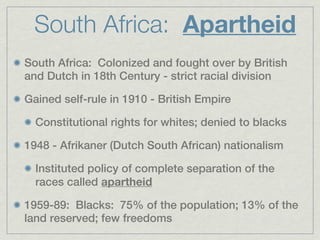
South Africa: Colonized and fought over by British
and Dutch in 18th Century - strict racial division

Gained self-rule in 1910 - British Empire

  Constitutional rights for whites; denied to blacks

1948 - Afrikaner (Dutch South African) nationalism

  Instituted policy of complete separation of the
  races called apartheid

1959-89: Blacks: 75% of the population; 13% of the
land reserved; few freedoms
Nelson Mandela
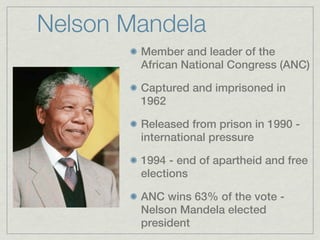
        Member and leader of the
        African National Congress (ANC)

        Captured and imprisoned in
        1962

        Released from prison in 1990 -
        international pressure

        1994 - end of apartheid and free
        elections

        ANC wins 63% of the vote -
        Nelson Mandela elected
        president
Define the Third World

For the rest of the period, you will be gathering
specific data to make your own definition of
what life is like in a third world.

Go to Mr. English’s website and click on “Third
World” to begin this assignment once you have
received your worksheet.

Emerging Nations - The Third World

  • 1.
  • 2.
    Objectives Identify locations inAfrica. Analyze definitions of third world. Categorize data to support these definitions.
  • 3.
    Vocabulary Sub-Saharan Africa -geographical term for the area of Africa which is south of the Sahara Desert. literacy: The ability to read and write; national measure of the relative education level of the people HIV/AIDS: Human Immunodeficiency Virus/Acquired Immune Deficiency Syndrome; viral disease without cure that has ravaged African nations over the past 40 years. standard of living: measure of the quality of life for people in a country; often influenced by that governments actions or inactions. apartheid: government policy of complete separation of races in South Africa from 1948-1994.
  • 4.
    The Global WorldSystem: Three Parts The First World: World System Core Dominate trade, control the most advanced technologies, high levels of economy The Second World: Semi-Peripheral Regions Were once Peripheral, internationally become competitive The Third World: Peripheral Regions Disadvantageous trading relationships, older technology, undeveloped economy
  • 5.
    CORE (1ST WORLD) SEMI-PERIPHERY(2ND WORLD) PERIPHERY (3RD WORLD)
  • 6.
    How Can YouTell? We’ll be looking at 5 measures of countries to help describe life in different countries The vast majority of Africa contains those emerging nations that exist in the Third World Most of the countries that fit the definitions of Third World countries in Africa lie in Sub-Saharan Africa Let’s examine some examples of these different measure and their impact
  • 7.
    Education One measure ofthe education level of a people is the literacy rate - the percent of people who are able to read or write Efforts have been made in the past 40 years to help improve education in some African countries However, the literacy rates in Africa remain relatively low
  • 8.
  • 9.
    Health A number ofmeasures can help us determine the relative health of a nation The primary measure we will look at is a measure of healthy life expectancy Africa now faces a particular health crisis in it’s on going struggle with HIV/AIDS
  • 10.
    HIV RATES INAFRICA SOME OTHER FACTS • Africa = 14.7% of worlds population • Africa = 88% of worlds pop. with HIV • 92% of AIDS deaths in the world • Swaziland - 26.1% of ALL adults has HIV - over 50% of adults in 20s • Life expectancy in Swaziland = 32 years • 90% of worlds HIV- infected children live in Africa
  • 11.
    Quality of Life This measures a variety of factors that help describe everyday life For instance: Gap between the genders (equality between men and women) Environmental health (pollution and effect on people) Unemployment Over all these factors describe the standard of living
  • 12.
    Poverty One of thosestandards is the number of people who live on less than $2 a day. Do the math! $2 per day X 365 day = $________ McDonald’s minimum wage = $7.25/hour $7.25 X 40 hours (week) - X 52 weeks = $_________
  • 13.
    MOST OF AFRICA US MINIMUM WAGE < $730 per year $15,080 per year
  • 14.
    Economic & Political Factors The economic factors that we will look at are complicated measures of a nations production and how their economies work* The political factors describe how much freedom people have over their lives or how the government responds to their needs
  • 15.
    South Africa: Apartheid SouthAfrica: Colonized and fought over by British and Dutch in 18th Century - strict racial division Gained self-rule in 1910 - British Empire Constitutional rights for whites; denied to blacks 1948 - Afrikaner (Dutch South African) nationalism Instituted policy of complete separation of the races called apartheid 1959-89: Blacks: 75% of the population; 13% of the land reserved; few freedoms
  • 16.
    Nelson Mandela Member and leader of the African National Congress (ANC) Captured and imprisoned in 1962 Released from prison in 1990 - international pressure 1994 - end of apartheid and free elections ANC wins 63% of the vote - Nelson Mandela elected president
  • 17.
    Define the ThirdWorld For the rest of the period, you will be gathering specific data to make your own definition of what life is like in a third world. Go to Mr. English’s website and click on “Third World” to begin this assignment once you have received your worksheet.

Editor's Notes

  • #2 \n
  • #3 \n
  • #4 \n
  • #5  1st World: Past: Greece, Rome, UK &amp;#x2799; Now: U.S., Canada, Japan, Western Europe &amp;#x2799; Capitalism\n 2nd World: Russia, China, Australia, Brazil &amp;#x2799; After WWII &amp;#x2799; Communism (USSR, China); Taiwan, South Korea\n 3rd World: Africa, Central Asia\n
  • #6 \n
  • #7 \n
  • #8 \n
  • #9 \n
  • #10 \n
  • #11 \n
  • #12 \n
  • #13 \n
  • #14 \n
  • #15 \n
  • #16 \n
  • #17 \n
  • #18 \n