



















EMC / JOUR 3000
INTRO TO MOTION
    PICTURES

      Edward Bowen

Lecture One - The Technical
     Dimension, Part 1
Technology of Motion Pictures
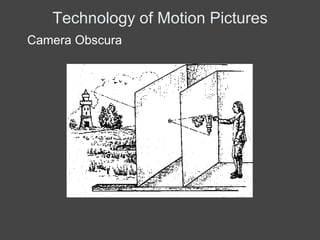
Camera Obscura
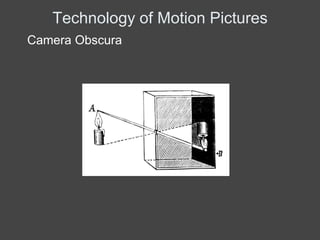
• Take a big box into the sunlight.
• Get inside.
• Cut a small hole in one side.
• Stand clear.
• On the side opposite the hole you will see an
  image (reversed and upside down) of what's
  outside.
• You are in a camera obscura.
• Put a piece of film where the image is and
  expose it.
• You are now in a camera.
Technology of Motion Pictures
Camera Obscura
Technology of Motion Pictures
Camera Obscura
Technology of Motion Pictures
   Camera Obscura


http://www.youtube.com/watch?v=RuJ_Jd6Qgyo
Technology of Motion Pictures
Persistence of Vision
The concept that the eye retains one image just
  long enough to blend it with a following
  image.
This permits a sequence of still pictures to
  appear as one continuous action.
Physiologists and neurologists have developed
  revised theories for how we perceive motion
  (Beta Movement, Phi Phenomenon).
The theory of “persistence of vision” still retains
  popular acceptance.
Technology of Motion Pictures
  Persistence of Vision


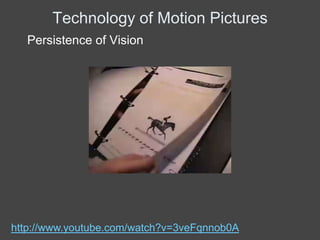
http://www.youtube.com/watch?v=3veFqnnob0A
Technology of Motion Pictures
   Apparent Motion


http://www.youtube.com/watch?v=_ulQ_vaBM0Q
Technology of Motion Pictures
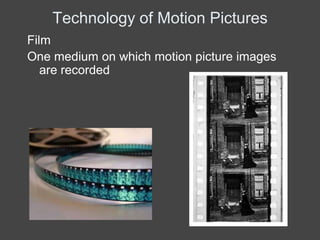
Film
One medium on which motion picture images
   are recorded
Technology of Motion Pictures
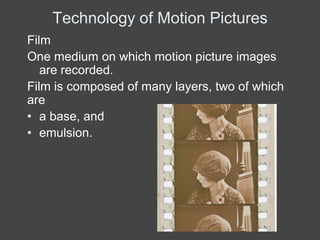
Film
One medium on which motion picture images
   are recorded.
Film is composed of many layers, two of which
are
• a base, and
• emulsion.
Technology of Motion Pictures
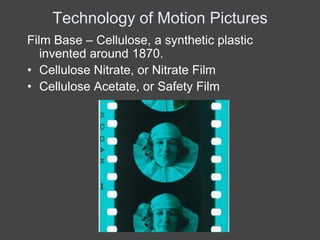
Film Base – Cellulose, a synthetic plastic
   invented around 1870.
• Cellulose Nitrate, or Nitrate Film
• Cellulose Acetate, or Safety Film
Technology of Motion Pictures
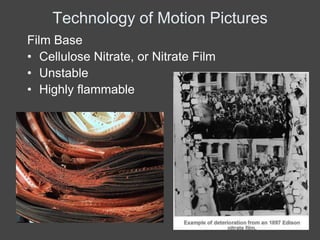
Film Base
• Cellulose Nitrate, or Nitrate Film
• Unstable
• Highly flammable
Technology of Motion Pictures
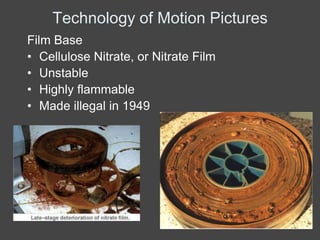
Film Base
• Cellulose Nitrate, or Nitrate Film
• Unstable
• Highly flammable
• Made illegal in 1949
Technology of Motion Pictures
Film is not a permanent medium.

About 80% of films made before 1920 no longer
  exist.

About 50% of films made before 1950 no longer
  exist.
Technology of Motion Pictures
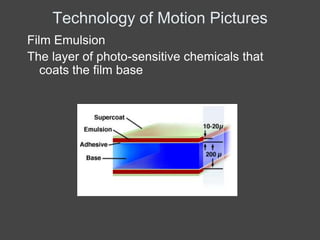
Film Emulsion
The layer of photo-sensitive chemicals that
   coats the film base
Technology of Motion Pictures
   Film Emulsion
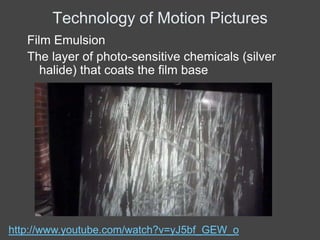
   The layer of photo-sensitive chemicals (silver
      halide) that coats the film base


http://www.youtube.com/watch?v=yJ5bf_GEW_o
Technology of Motion Pictures
Film Emulsion
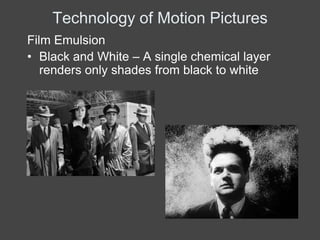
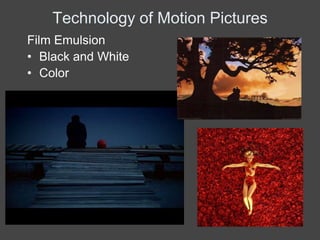
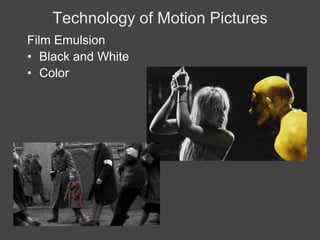
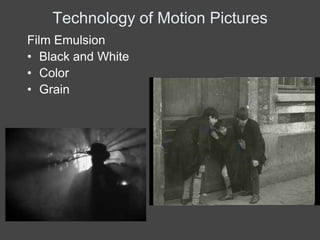
• Black and White – A single chemical layer
   renders only shades from black to white
Technology of Motion Pictures
Film Emulsion
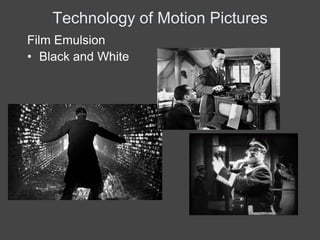
• Black and White
Technology of Motion Pictures
Film Emulsion
• Black and White
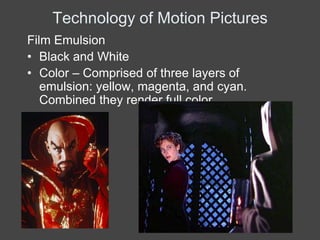
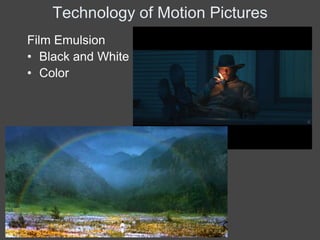
• Color – Comprised of three layers of
   emulsion: yellow, magenta, and cyan.
   Combined they render full color
Technology of Motion Pictures
Film Emulsion
• Black and White
• Color
Technology of Motion Pictures
Film Emulsion
• Black and White
• Color
Technology of Motion Pictures
Film Emulsion
• Black and White
• Color
Technology of Motion Pictures
Film Emulsion
• Black and White
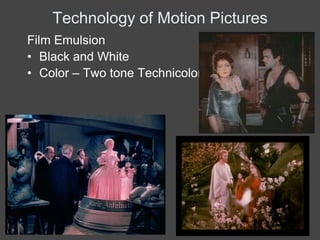
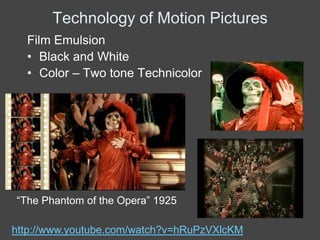
• Color – Two tone Technicolor
Technology of Motion Pictures
  Film Emulsion
  • Black and White
  • Color – Two tone Technicolor


“The Phantom of the Opera” 1925

http://www.youtube.com/watch?v=hRuPzVXlcKM
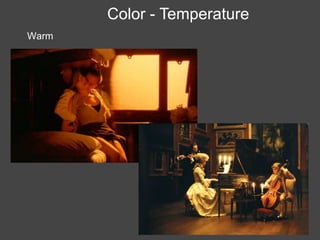
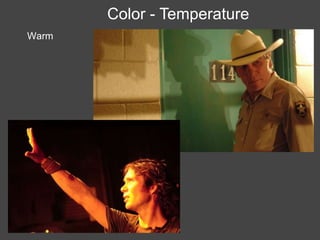
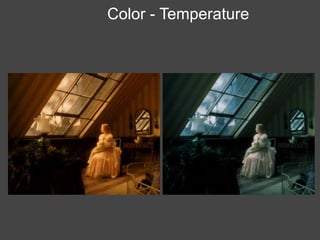
Color - Temperature
Warm
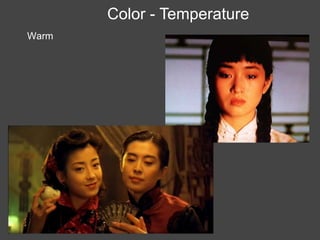
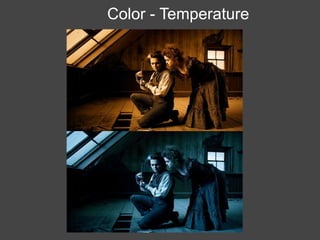
Color - Temperature
Warm
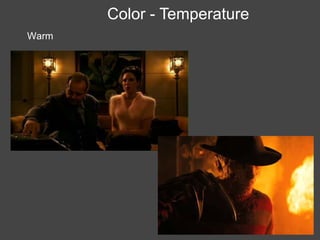
Color - Temperature
Warm
Color - Temperature
Warm
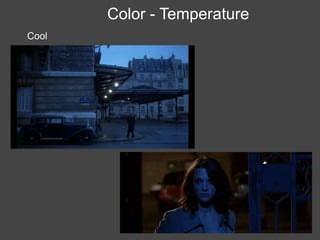
Color - Temperature
Cool
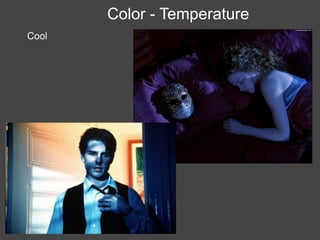
Color - Temperature
Cool
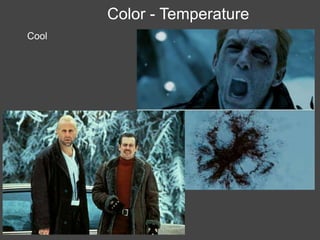
Color - Temperature
Cool
Color - Temperature
Color - Temperature
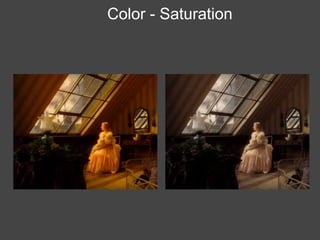
Color - Saturation
Technology of Motion Pictures
Film Emulsion
• Black and White
• Color
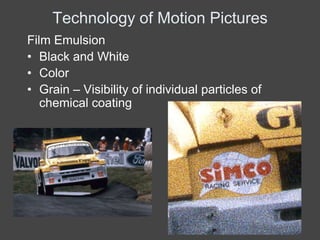
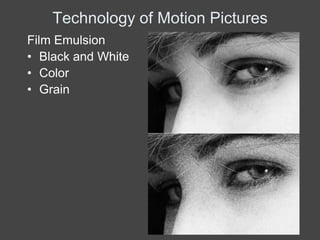
• Grain – Visibility of individual particles of
   chemical coating
Technology of Motion Pictures
Film Emulsion
• Black and White
• Color
• Grain
Technology of Motion Pictures
Film Emulsion
• Black and White
• Color
• Grain
Technology of Motion Pictures
Film Emulsion
• Black and White
• Color
• Grain
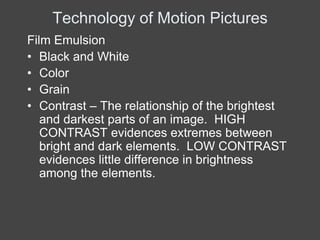
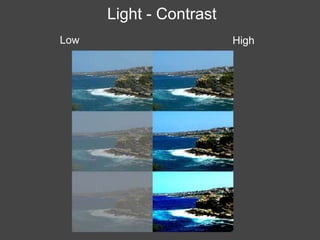
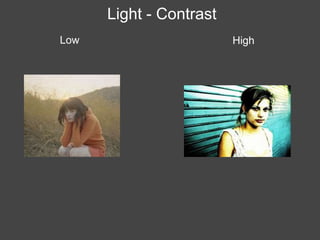
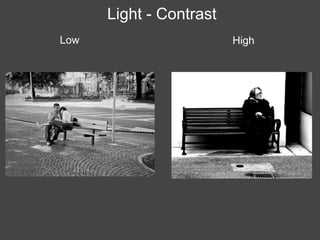
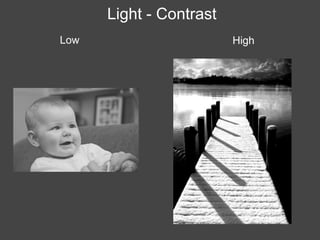
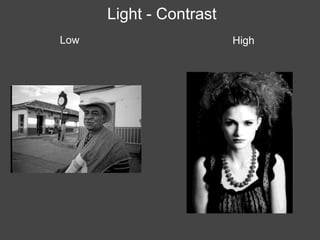
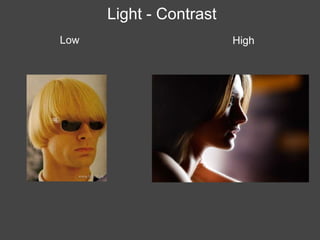
• Contrast – The relationship of the brightest
   and darkest parts of an image. HIGH
   CONTRAST evidences extremes between
   bright and dark elements. LOW CONTRAST
   evidences little difference in brightness
   among the elements.
Light - Contrast
Low                      High
Light - Contrast
Low                      High
Light - Contrast
Low                      High
Light - Contrast
Low                      High
Light - Contrast
Low                      High
Light - Contrast
Low                      High
Light - Contrast
Low                      High
Technology of Motion Pictures
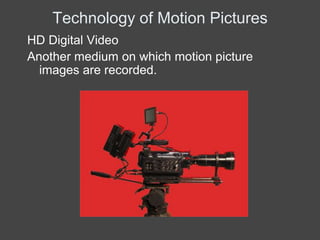
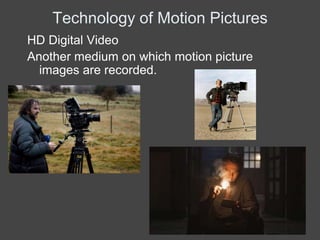
HD Digital Video
Another medium on which motion picture
  images are recorded.
Technology of Motion Pictures
HD Digital Video
Another medium on which motion picture
  images are recorded.
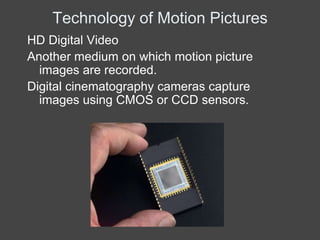
Digital cinematography cameras capture
  images using CMOS or CCD sensors.
Technology of Motion Pictures
HD Digital Video
Another medium on which motion picture
  images are recorded.
Digital cinematography cameras capture
  images using CMOS or CCD sensors.
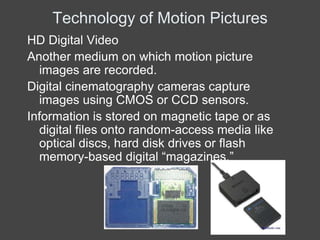
Information is stored on magnetic tape or as
  digital files onto random-access media like
  optical discs, hard disk drives or flash
  memory-based digital “magazines.”
Technology of Motion Pictures
HD Digital Video
Another medium on which motion picture
  images are recorded.
Technology of Motion Pictures
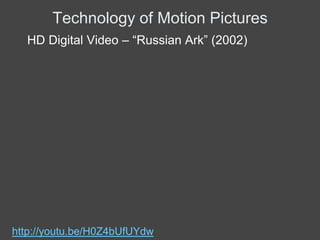
  HD Digital Video – “Russian Ark” (2002)


http://youtu.be/H0Z4bUfUYdw
Technology of Motion Pictures
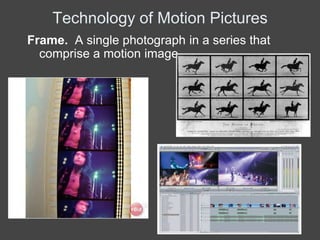
Frame. A single photograph in a series that
  comprise a motion image.
Technology of Motion Pictures
Aspect ratio: The relationship of the width of the image to
the height of the image.

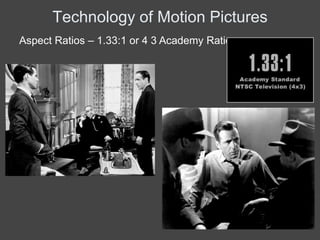
Standard or Academy ratio (4 X 3 or 1.33:1). In adopting
the 35 mm format early filmmakers established the
standard aspect ratio as a classical rectangle with a ratio
of four units of width to three units of height. Thus if the
projected image is twenty feet wide it will be fifteen feet
high.
Technology of Motion Pictures
Aspect ratio: The relationship of the width of the image
to the height of the image.
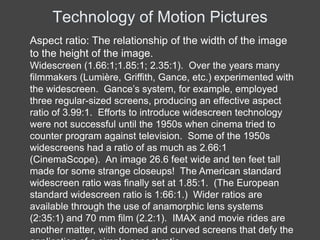
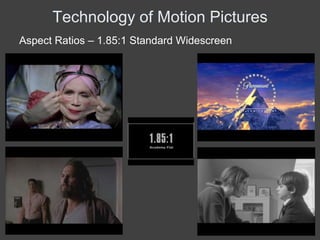
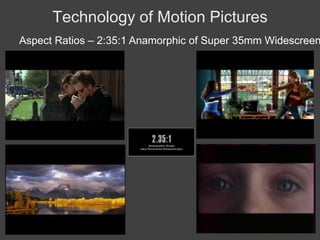
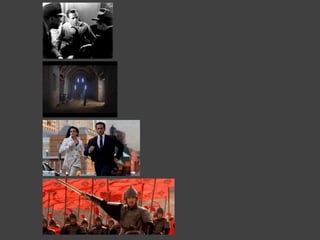
Widescreen (1.66:1;1.85:1; 2.35:1). Over the years many
filmmakers (Lumière, Griffith, Gance, etc.) experimented with
the widescreen. Gance’s system, for example, employed
three regular-sized screens, producing an effective aspect
ratio of 3.99:1. Efforts to introduce widescreen technology
were not successful until the 1950s when cinema tried to
counter program against television. Some of the 1950s
widescreens had a ratio of as much as 2.66:1
(CinemaScope). An image 26.6 feet wide and ten feet tall
made for some strange closeups! The American standard
widescreen ratio was finally set at 1.85:1. (The European
standard widescreen ratio is 1:66:1.) Wider ratios are
available through the use of anamorphic lens systems
(2:35:1) and 70 mm film (2.2:1). IMAX and movie rides are
another matter, with domed and curved screens that defy the
Technology of Motion Pictures
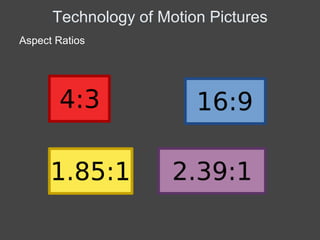
Aspect Ratios
Technology of Motion Pictures
Aspect Ratios – 1.33:1 or 4 3 Academy Ratio
Technology of Motion Pictures
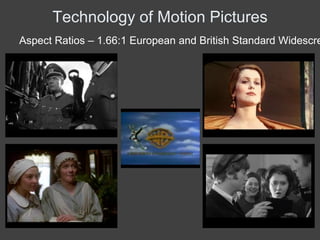
Aspect Ratios – 1.66:1 European and British Standard Widescre
Technology of Motion Pictures
Aspect Ratios – 1.85:1 Standard Widescreen
Technology of Motion Pictures
Aspect Ratios – 2:35:1 Anamorphic of Super 35mm Widescreen
Technology of Motion Pictures
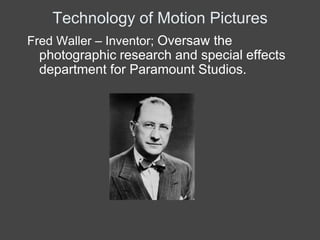
Fred Waller – Inventor; Oversaw the
  photographic research and special effects
  department for Paramount Studios.
Technology of Motion Pictures
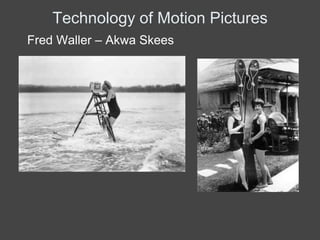
Fred Waller – Akwa Skees
Technology of Motion Pictures
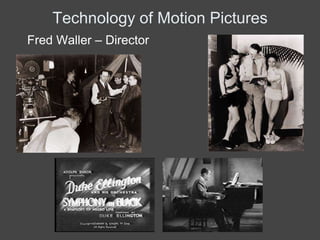
Fred Waller – Director
Technology of Motion Pictures
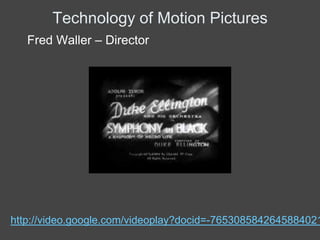
   Fred Waller – Director


http://video.google.com/videoplay?docid=-7653085842645884021
Technology of Motion Pictures
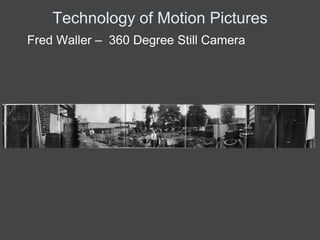
Fred Waller – 360 Degree Still Camera
Technology of Motion Pictures
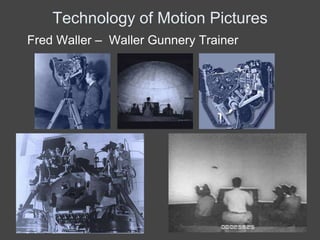
Fred Waller – Waller Gunnery Trainer
Technology of Motion Pictures
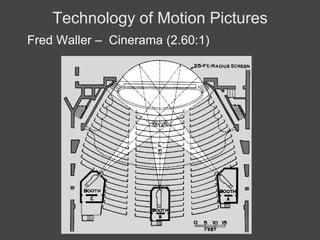
Fred Waller – Cinerama (2.60:1)
Technology of Motion Pictures
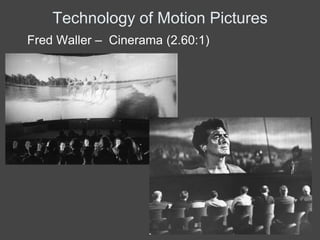
Fred Waller – Cinerama (2.60:1)
Technology of Motion Pictures
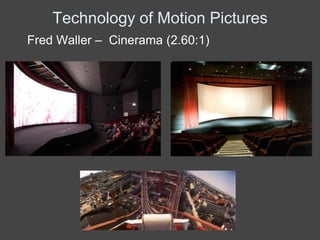
Fred Waller – Cinerama (2.60:1)
Technology of Motion Pictures
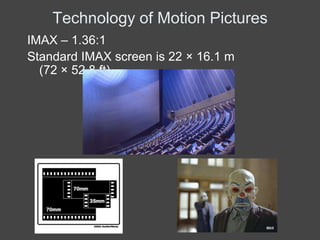
IMAX – 1.36:1
Standard IMAX screen is 22 × 16.1 m
  (72 × 52.8 ft)
Technology of Motion Pictures
3D - Creating the illusion of depth by
  photographing two images simultaneously,
  one for the viewer’s right eye and one for the
  left, then projecting or displaying them in such
  a fashion that each eye sees only one of the
  images. The brain then “thinks” it sees three
  dimensions.
Technology of Motion Pictures
   3D


http://youtu.be/DFJZ1HKybZA
http://www.hollywoodreporter.com/video/video-james-
cameron-martin-scorsese-hugos-3d-special-effects

EMC/JOUR 3000 Spring 2012 Lecture 1 Technical Dimension

  • 1.
    EMC / JOUR3000 INTRO TO MOTION PICTURES Edward Bowen Lecture One - The Technical Dimension, Part 1
  • 2.
    Technology of MotionPictures Camera Obscura • Take a big box into the sunlight. • Get inside. • Cut a small hole in one side. • Stand clear. • On the side opposite the hole you will see an image (reversed and upside down) of what's outside. • You are in a camera obscura. • Put a piece of film where the image is and expose it. • You are now in a camera.
  • 3.
    Technology of MotionPictures Camera Obscura
  • 4.
    Technology of MotionPictures Camera Obscura
  • 5.
    Technology of MotionPictures Camera Obscura http://www.youtube.com/watch?v=RuJ_Jd6Qgyo
  • 6.
    Technology of MotionPictures Persistence of Vision The concept that the eye retains one image just long enough to blend it with a following image. This permits a sequence of still pictures to appear as one continuous action. Physiologists and neurologists have developed revised theories for how we perceive motion (Beta Movement, Phi Phenomenon). The theory of “persistence of vision” still retains popular acceptance.
  • 7.
    Technology of MotionPictures Persistence of Vision http://www.youtube.com/watch?v=3veFqnnob0A
  • 8.
    Technology of MotionPictures Apparent Motion http://www.youtube.com/watch?v=_ulQ_vaBM0Q
  • 9.
    Technology of MotionPictures Film One medium on which motion picture images are recorded
  • 10.
    Technology of MotionPictures Film One medium on which motion picture images are recorded. Film is composed of many layers, two of which are • a base, and • emulsion.
  • 11.
    Technology of MotionPictures Film Base – Cellulose, a synthetic plastic invented around 1870. • Cellulose Nitrate, or Nitrate Film • Cellulose Acetate, or Safety Film
  • 12.
    Technology of MotionPictures Film Base • Cellulose Nitrate, or Nitrate Film • Unstable • Highly flammable
  • 13.
    Technology of MotionPictures Film Base • Cellulose Nitrate, or Nitrate Film • Unstable • Highly flammable • Made illegal in 1949
  • 16.
    Technology of MotionPictures Film is not a permanent medium. About 80% of films made before 1920 no longer exist. About 50% of films made before 1950 no longer exist.
  • 20.
    Technology of MotionPictures Film Emulsion The layer of photo-sensitive chemicals that coats the film base
  • 22.
    Technology of MotionPictures Film Emulsion The layer of photo-sensitive chemicals (silver halide) that coats the film base http://www.youtube.com/watch?v=yJ5bf_GEW_o
  • 24.
    Technology of MotionPictures Film Emulsion • Black and White – A single chemical layer renders only shades from black to white
  • 25.
    Technology of MotionPictures Film Emulsion • Black and White
  • 26.
    Technology of MotionPictures Film Emulsion • Black and White • Color – Comprised of three layers of emulsion: yellow, magenta, and cyan. Combined they render full color
  • 27.
    Technology of MotionPictures Film Emulsion • Black and White • Color
  • 28.
    Technology of MotionPictures Film Emulsion • Black and White • Color
  • 29.
    Technology of MotionPictures Film Emulsion • Black and White • Color
  • 32.
    Technology of MotionPictures Film Emulsion • Black and White • Color – Two tone Technicolor
  • 33.
    Technology of MotionPictures Film Emulsion • Black and White • Color – Two tone Technicolor “The Phantom of the Opera” 1925 http://www.youtube.com/watch?v=hRuPzVXlcKM
  • 34.
  • 35.
  • 36.
  • 37.
  • 38.
  • 39.
  • 40.
  • 41.
  • 42.
  • 43.
  • 44.
    Technology of MotionPictures Film Emulsion • Black and White • Color • Grain – Visibility of individual particles of chemical coating
  • 45.
    Technology of MotionPictures Film Emulsion • Black and White • Color • Grain
  • 46.
    Technology of MotionPictures Film Emulsion • Black and White • Color • Grain
  • 47.
    Technology of MotionPictures Film Emulsion • Black and White • Color • Grain • Contrast – The relationship of the brightest and darkest parts of an image. HIGH CONTRAST evidences extremes between bright and dark elements. LOW CONTRAST evidences little difference in brightness among the elements.
  • 48.
  • 49.
  • 50.
  • 51.
  • 52.
  • 53.
  • 54.
  • 57.
    Technology of MotionPictures HD Digital Video Another medium on which motion picture images are recorded.
  • 58.
    Technology of MotionPictures HD Digital Video Another medium on which motion picture images are recorded. Digital cinematography cameras capture images using CMOS or CCD sensors.
  • 59.
    Technology of MotionPictures HD Digital Video Another medium on which motion picture images are recorded. Digital cinematography cameras capture images using CMOS or CCD sensors. Information is stored on magnetic tape or as digital files onto random-access media like optical discs, hard disk drives or flash memory-based digital “magazines.”
  • 60.
    Technology of MotionPictures HD Digital Video Another medium on which motion picture images are recorded.
  • 63.
    Technology of MotionPictures HD Digital Video – “Russian Ark” (2002) http://youtu.be/H0Z4bUfUYdw
  • 65.
    Technology of MotionPictures Frame. A single photograph in a series that comprise a motion image.
  • 66.
    Technology of MotionPictures Aspect ratio: The relationship of the width of the image to the height of the image. Standard or Academy ratio (4 X 3 or 1.33:1). In adopting the 35 mm format early filmmakers established the standard aspect ratio as a classical rectangle with a ratio of four units of width to three units of height. Thus if the projected image is twenty feet wide it will be fifteen feet high.
  • 67.
    Technology of MotionPictures Aspect ratio: The relationship of the width of the image to the height of the image. Widescreen (1.66:1;1.85:1; 2.35:1). Over the years many filmmakers (Lumière, Griffith, Gance, etc.) experimented with the widescreen. Gance’s system, for example, employed three regular-sized screens, producing an effective aspect ratio of 3.99:1. Efforts to introduce widescreen technology were not successful until the 1950s when cinema tried to counter program against television. Some of the 1950s widescreens had a ratio of as much as 2.66:1 (CinemaScope). An image 26.6 feet wide and ten feet tall made for some strange closeups! The American standard widescreen ratio was finally set at 1.85:1. (The European standard widescreen ratio is 1:66:1.) Wider ratios are available through the use of anamorphic lens systems (2:35:1) and 70 mm film (2.2:1). IMAX and movie rides are another matter, with domed and curved screens that defy the
  • 68.
    Technology of MotionPictures Aspect Ratios
  • 69.
    Technology of MotionPictures Aspect Ratios – 1.33:1 or 4 3 Academy Ratio
  • 70.
    Technology of MotionPictures Aspect Ratios – 1.66:1 European and British Standard Widescre
  • 71.
    Technology of MotionPictures Aspect Ratios – 1.85:1 Standard Widescreen
  • 72.
    Technology of MotionPictures Aspect Ratios – 2:35:1 Anamorphic of Super 35mm Widescreen
  • 74.
    Technology of MotionPictures Fred Waller – Inventor; Oversaw the photographic research and special effects department for Paramount Studios.
  • 75.
    Technology of MotionPictures Fred Waller – Akwa Skees
  • 76.
    Technology of MotionPictures Fred Waller – Director
  • 77.
    Technology of MotionPictures Fred Waller – Director http://video.google.com/videoplay?docid=-7653085842645884021
  • 78.
    Technology of MotionPictures Fred Waller – 360 Degree Still Camera
  • 79.
    Technology of MotionPictures Fred Waller – Waller Gunnery Trainer
  • 80.
    Technology of MotionPictures Fred Waller – Cinerama (2.60:1)
  • 82.
    Technology of MotionPictures Fred Waller – Cinerama (2.60:1)
  • 83.
    Technology of MotionPictures Fred Waller – Cinerama (2.60:1)
  • 84.
    Technology of MotionPictures IMAX – 1.36:1 Standard IMAX screen is 22 × 16.1 m (72 × 52.8 ft)
  • 86.
    Technology of MotionPictures 3D - Creating the illusion of depth by photographing two images simultaneously, one for the viewer’s right eye and one for the left, then projecting or displaying them in such a fashion that each eye sees only one of the images. The brain then “thinks” it sees three dimensions.
  • 90.
    Technology of MotionPictures 3D http://youtu.be/DFJZ1HKybZA http://www.hollywoodreporter.com/video/video-james- cameron-martin-scorsese-hugos-3d-special-effects

Editor's Notes

  • #6 Camera-Obscura.movhttp://www.youtube.com/watch?v=RuJ_Jd6Qgyo
  • #8 Muybridge-horse-in-motion.movhttp://www.youtube.com/watch?v=3veFqnnob0A
  • #9 http://www.youtube.com/watch?v=_ulQ_vaBM0QApparent-Motion.mov
  • #15 Nitrate-burning.movhttp://www.youtube.com/watch?v=JhiwKnZlW1c
  • #16 Nitrate-burning.movhttp://www.youtube.com/watch?v=JhiwKnZlW1c
  • #18 Guardians-of-History--Pt-1http://www.youtube.com/watch?v=oift1b_CwX4
  • #19 MoMA-Film-Preservation-Center--Nitrate-Facilityhttp://www.youtube.com/watch?v=iN1_zEjOQ6o
  • #20 Frankenstein--1910---Full-Movie.movhttp://www.youtube.com/watch?v=TcLxsOJK9bs
  • #22 http://www.youtube.com/watch?v=9fvkbpaNA14David-Rimmer-teaches-April-Smith-of-AHA-MEDIA-to-scratch-emulsion-off-film-in-Vancouver-DTES.mov
  • #23 http://www.youtube.com/watch?v=yJ5bf_GEW_oApril-Smith-of-AHA-MEDIA--s--scratch-emulsion-film--played-on-a-Steenbeck-in-Vancouver-DTES-mp4.mov
  • #32 http://www.youtube.com/watch?v=qoe7noZkLlIThe-Great-White-Silence--1924---trailer.mov
  • #34 Phantom-of-the-Opera--Silent-Version.movhttp://www.youtube.com/watch?v=hRuPzVXlcKM
  • #56 http://www.youtube.com/watch?v=aulRoQTK5HYPi-Subway-Scene.mov
  • #57 http://www.youtube.com/watch?v=oQ1sZSCz47wPi-movie-trailer.mov
  • #62 Dark-Portals---Vidocq-HQ-Trailer-avi.movc http://www.youtube.com/watch?v=bkUvp9JFMS8
  • #63 http://www.youtube.com/watch?v=J--TDEHizVATrailer---Russian-Ark.mov
  • #65 http://www.youtube.com/watch?v=Byb2cHTMStgStar-Wars--Digital-Cam-Vs-Film-Cam-In-Attack-Of-The-Clones.mov
  • #78 http://video.google.com/videoplay?docid=-7653085842645884021#Duke-Ellington-and-his-Orchestra-Symphony-in-Black.mov
  • #80 Virtual Reality predecessor
  • #86 James-Cameron-on-Avatar-aspect-ratio--Hometheaterforum-com.movhttp://www.youtube.com/watch?v=OqwCQQ4qIXw
  • #89 THE-FILM-LAB---How-3D-Movies-Workhttp://www.youtube.com/watch?v=DmuuThydmZQ