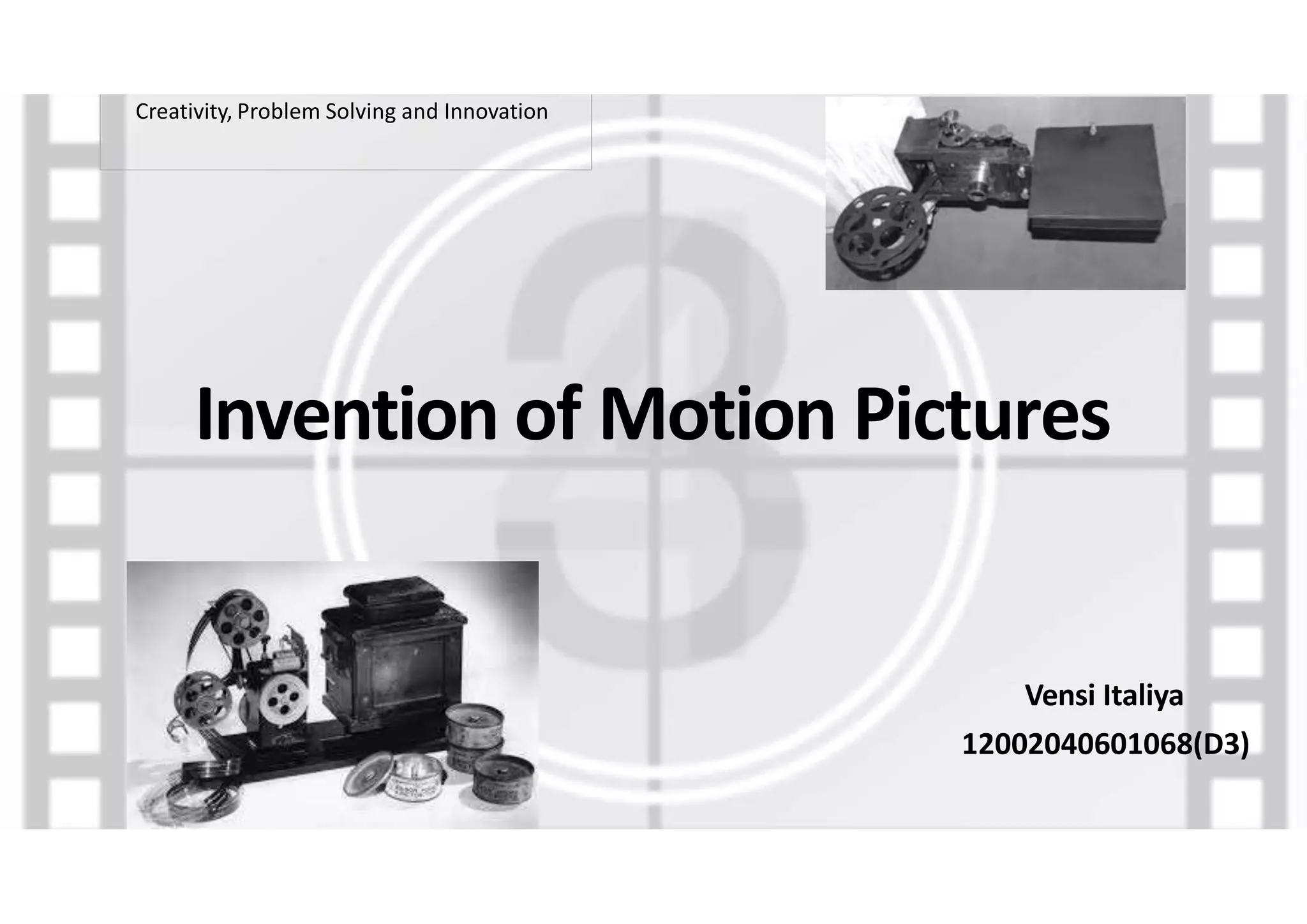
Invention of Motion Pictures
Vensi Italiya
12002040601068(D3)
Creativity, Problem Solving and Innovation
What is Motion Picture
•Motion Picture also known as film or movie, series of photographs
on film, projected in rapid succession
onto a screen by means of light.
• Because of the optical phenomena known
as persistence of vision, this gives the
illusion of actual, smooth and
continuous movement.
• Emerging at the end of the 19th century, this new art form became one of
the most popular and influential media of the 20th century and beyond.
The Beginning
• Charles Emile Reynaud invented the Praxinoscope.
Praxinoscope:
A device that has drum with hand-drawn pictures,
each one a little different then the last, and
many little mirrors at the center of the
drum that, when turned, look like
the pictures are moving.
History
• By 1852, photographs begin to replace hand-drawn pictures.
• Louis Jacques Mande Daguerre first invented the Daguerre process
which was the first way of producing permanent picture on a silver
coated copper plate.
• Later, Henry Fox of England invented the chemical process, called the
photogenic drawing, that produced negative images on paper. He
later invented calotype process which produced visible images
outside of a camera by bathing the negatives with a specific chemical
solution.
The first moving Pictures
•Coleman Sellers invented the Kinematoscope, which
made posed pictures seem to move when they were
placed on a turning paddlewheel.
•Later Thomas Edison and his assistant
invented Kinetoscope that ran
about 15m of film in an endless
loop that showed a moving picture.
(i.e. first real moving picture camera recorder)
First form of editing
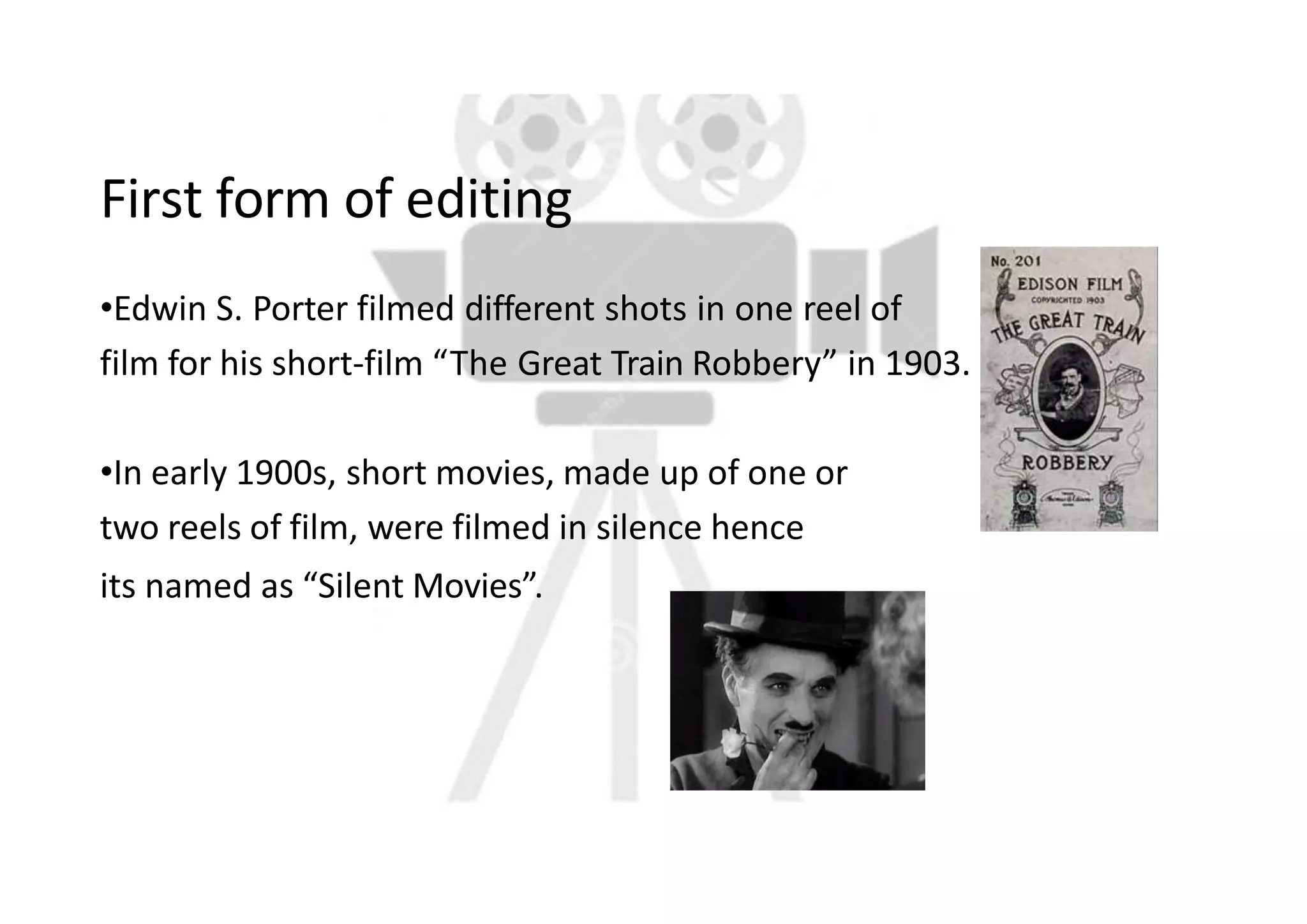
•Edwin S. Porter filmed different shots in one reel of
film for his short-film “The Great Train Robbery” in 1903.
•In early 1900s, short movies, made up of one or
two reels of film, were filmed in silence hence
its named as “Silent Movies”.
Sound films
•In 1926, Warner Brothers studio was the
first to introduce films with sound with
the process called Vitaphone.
•First Sound Film “The Jazz Singer” was
released in 1927.
• Microphones allowed for the dialogue in a movie to have more
emotion and to be less stiff.
Beauty of Color
•Color movies were first filmed in 1935, but
color really took off in the 1950s.
• Some film producers even hastily added
color to their films because of the high
demand even after they had started filming
in black and white.
•In 1953, 20th century fox studio made a film with wide-screen
revolution called Cinemascope.
Beginning of 3D Films
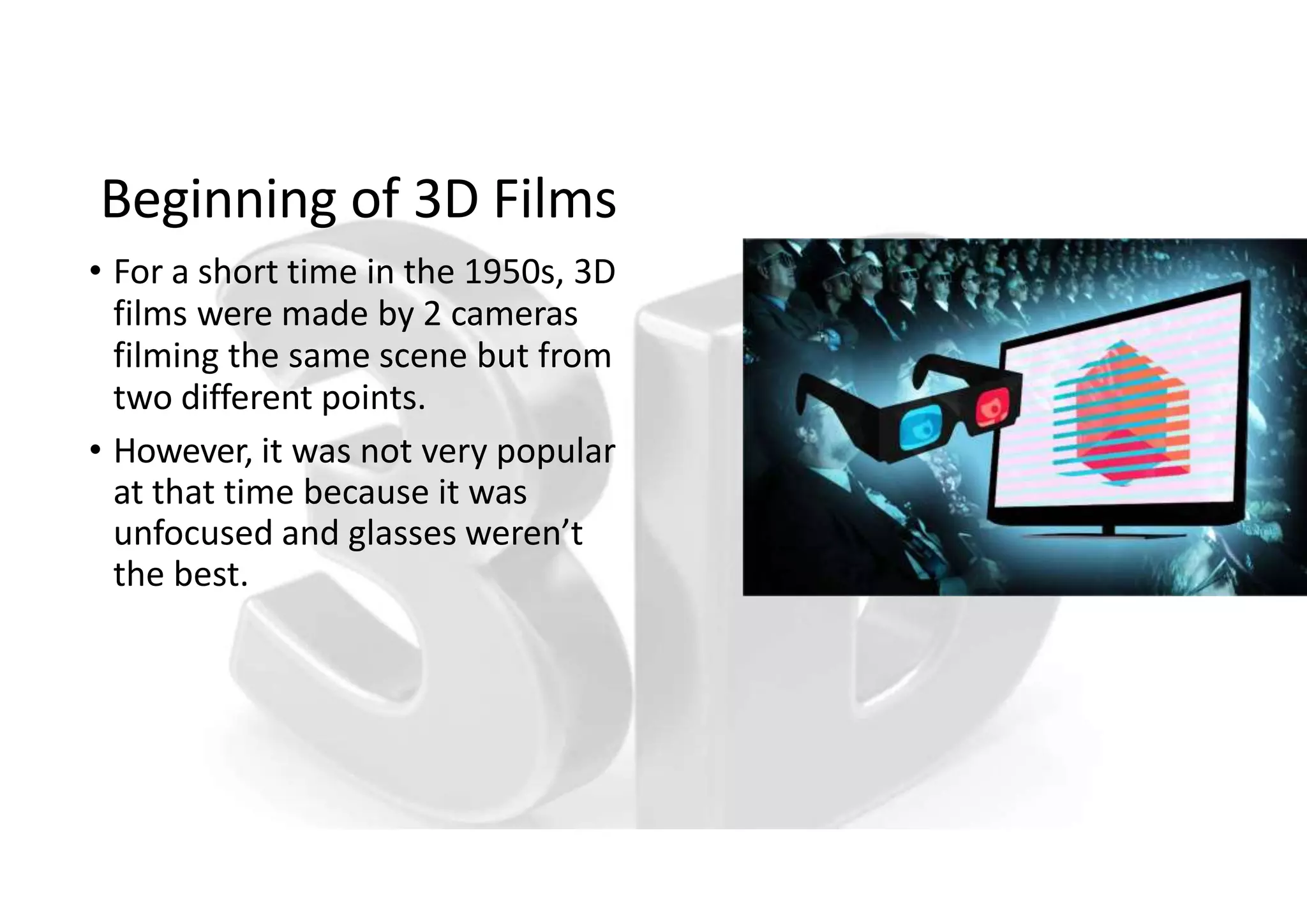
• For a short time in the 1950s, 3D
films were made by 2 cameras
filming the same scene but from
two different points.
• However, it was not very popular
at that time because it was
unfocused and glasses weren’t
the best.
THX Sounds System
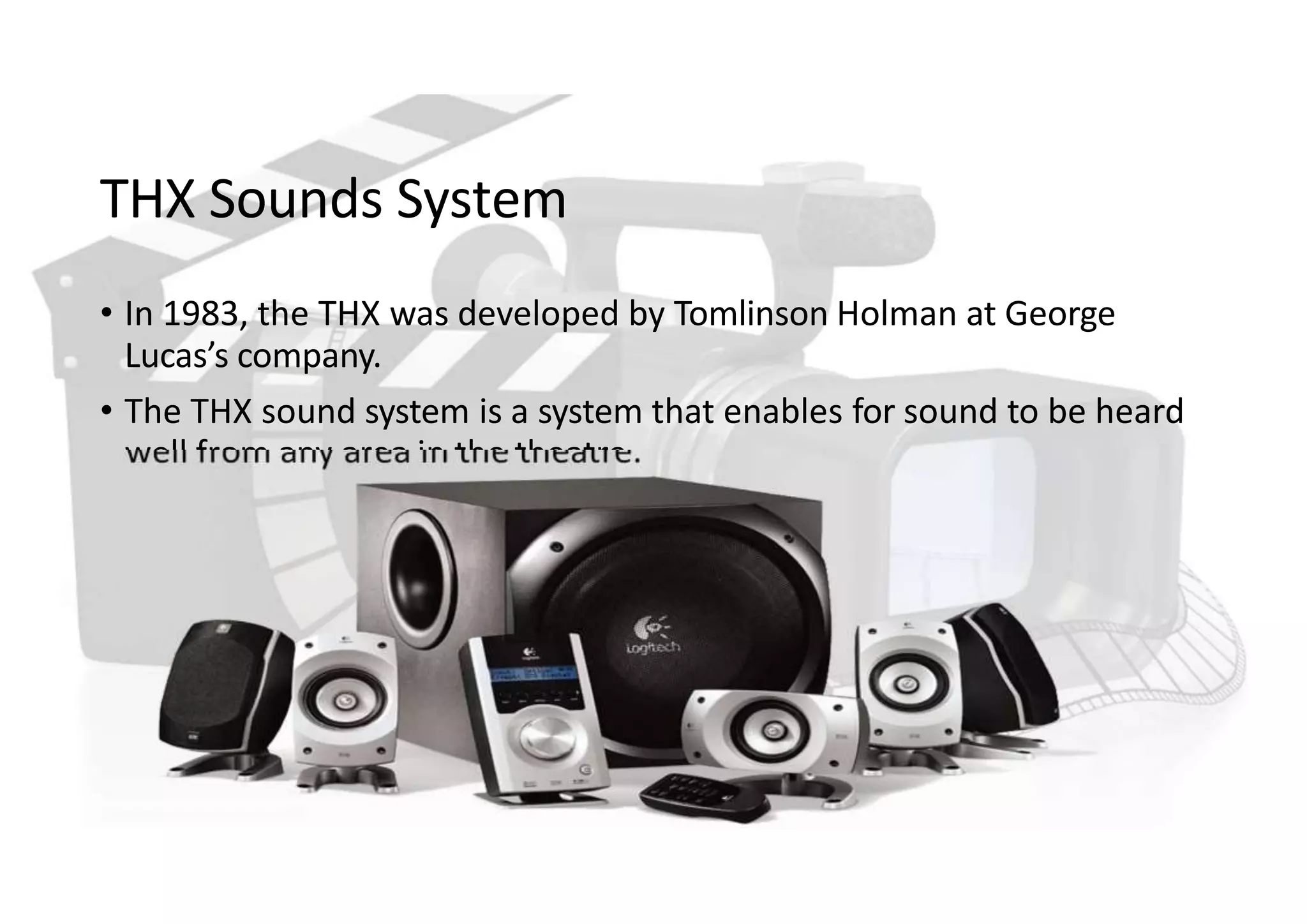
• In 1983, the THX was developed by Tomlinson Holman at George
Lucas’s company.
• The THX sound system is a system that enables for sound to be heard
well from any area in the theatre.
Present Day Films
• In the present, many movies have been filmed in a green screen and
have special effect or CGIs were added.
• More and more special effects are used in every film.
• Camera recorders are now digital and in high definition.
Hollywood Studio
• Studio system is a method of film production and distribution by a
small number of “major” studios in Hollywood.
• Hollywood is dominated by six movie studios, all engaged in bith
producing and distributing movies.
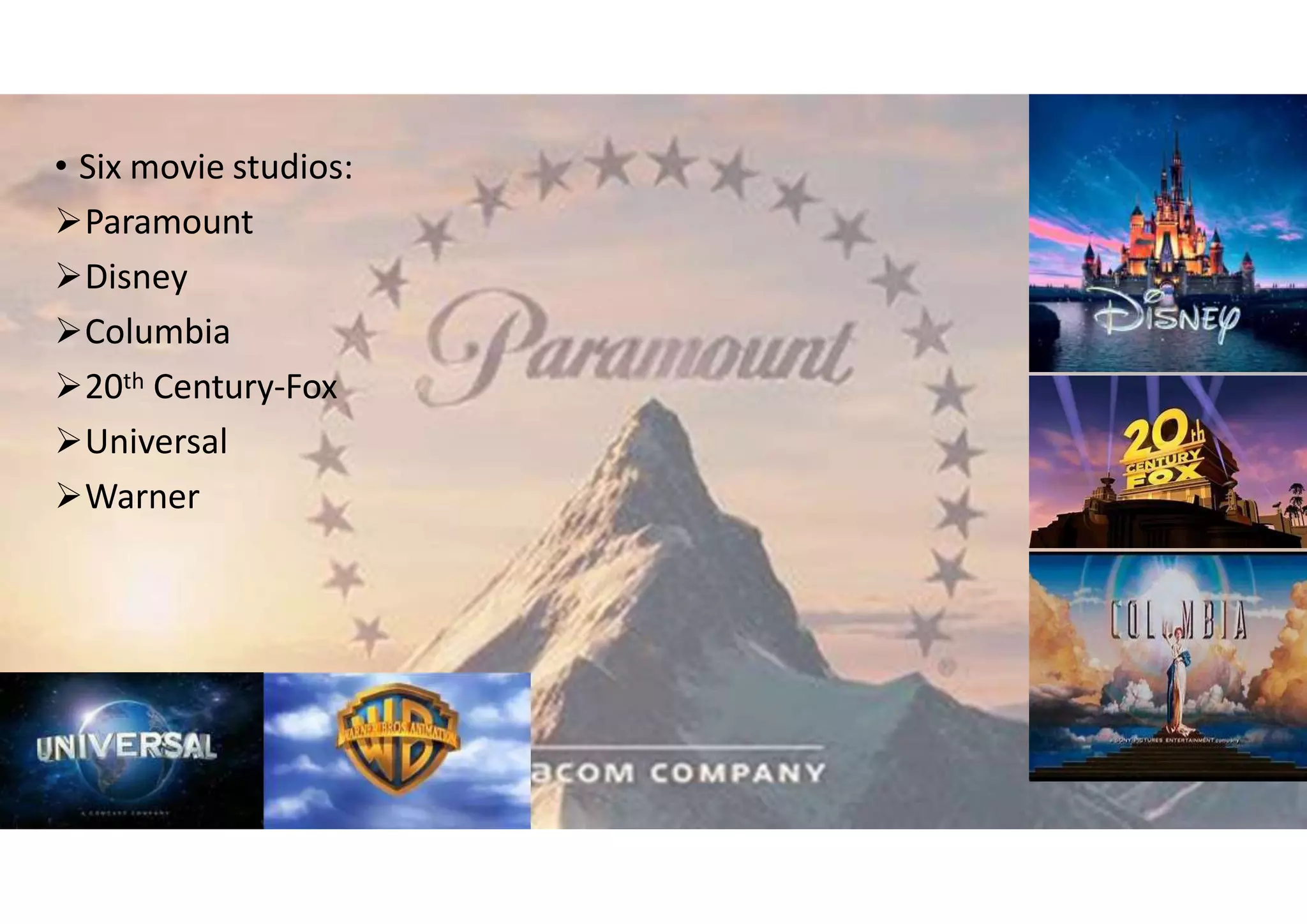
• Six movie studios:
Paramount
Disney
Columbia
20th Century-Fox
Universal
Warner
Thank You

motion picture.pptx

  • 1.
    Invention of MotionPictures Vensi Italiya 12002040601068(D3) Creativity, Problem Solving and Innovation
  • 2.
    What is MotionPicture •Motion Picture also known as film or movie, series of photographs on film, projected in rapid succession onto a screen by means of light. • Because of the optical phenomena known as persistence of vision, this gives the illusion of actual, smooth and continuous movement. • Emerging at the end of the 19th century, this new art form became one of the most popular and influential media of the 20th century and beyond.
  • 3.
    The Beginning • CharlesEmile Reynaud invented the Praxinoscope. Praxinoscope: A device that has drum with hand-drawn pictures, each one a little different then the last, and many little mirrors at the center of the drum that, when turned, look like the pictures are moving.
  • 4.
    History • By 1852,photographs begin to replace hand-drawn pictures. • Louis Jacques Mande Daguerre first invented the Daguerre process which was the first way of producing permanent picture on a silver coated copper plate. • Later, Henry Fox of England invented the chemical process, called the photogenic drawing, that produced negative images on paper. He later invented calotype process which produced visible images outside of a camera by bathing the negatives with a specific chemical solution.
  • 5.
    The first movingPictures •Coleman Sellers invented the Kinematoscope, which made posed pictures seem to move when they were placed on a turning paddlewheel. •Later Thomas Edison and his assistant invented Kinetoscope that ran about 15m of film in an endless loop that showed a moving picture. (i.e. first real moving picture camera recorder)
  • 6.
    First form ofediting •Edwin S. Porter filmed different shots in one reel of film for his short-film “The Great Train Robbery” in 1903. •In early 1900s, short movies, made up of one or two reels of film, were filmed in silence hence its named as “Silent Movies”.
  • 7.
    Sound films •In 1926,Warner Brothers studio was the first to introduce films with sound with the process called Vitaphone. •First Sound Film “The Jazz Singer” was released in 1927. • Microphones allowed for the dialogue in a movie to have more emotion and to be less stiff.
  • 8.
    Beauty of Color •Colormovies were first filmed in 1935, but color really took off in the 1950s. • Some film producers even hastily added color to their films because of the high demand even after they had started filming in black and white. •In 1953, 20th century fox studio made a film with wide-screen revolution called Cinemascope.
  • 9.
    Beginning of 3DFilms • For a short time in the 1950s, 3D films were made by 2 cameras filming the same scene but from two different points. • However, it was not very popular at that time because it was unfocused and glasses weren’t the best.
  • 10.
    THX Sounds System •In 1983, the THX was developed by Tomlinson Holman at George Lucas’s company. • The THX sound system is a system that enables for sound to be heard well from any area in the theatre.
  • 11.
  • 12.
    • In thepresent, many movies have been filmed in a green screen and have special effect or CGIs were added. • More and more special effects are used in every film. • Camera recorders are now digital and in high definition.
  • 13.
    Hollywood Studio • Studiosystem is a method of film production and distribution by a small number of “major” studios in Hollywood. • Hollywood is dominated by six movie studios, all engaged in bith producing and distributing movies.
  • 14.
    • Six moviestudios: Paramount Disney Columbia 20th Century-Fox Universal Warner
  • 15.