EMBRYOLOGY
A s e v i d e n c e o f e v o l u t i o n
WHAT IS
EMBRYOLOGY?
WHAT IS EMBRYOLOGY?
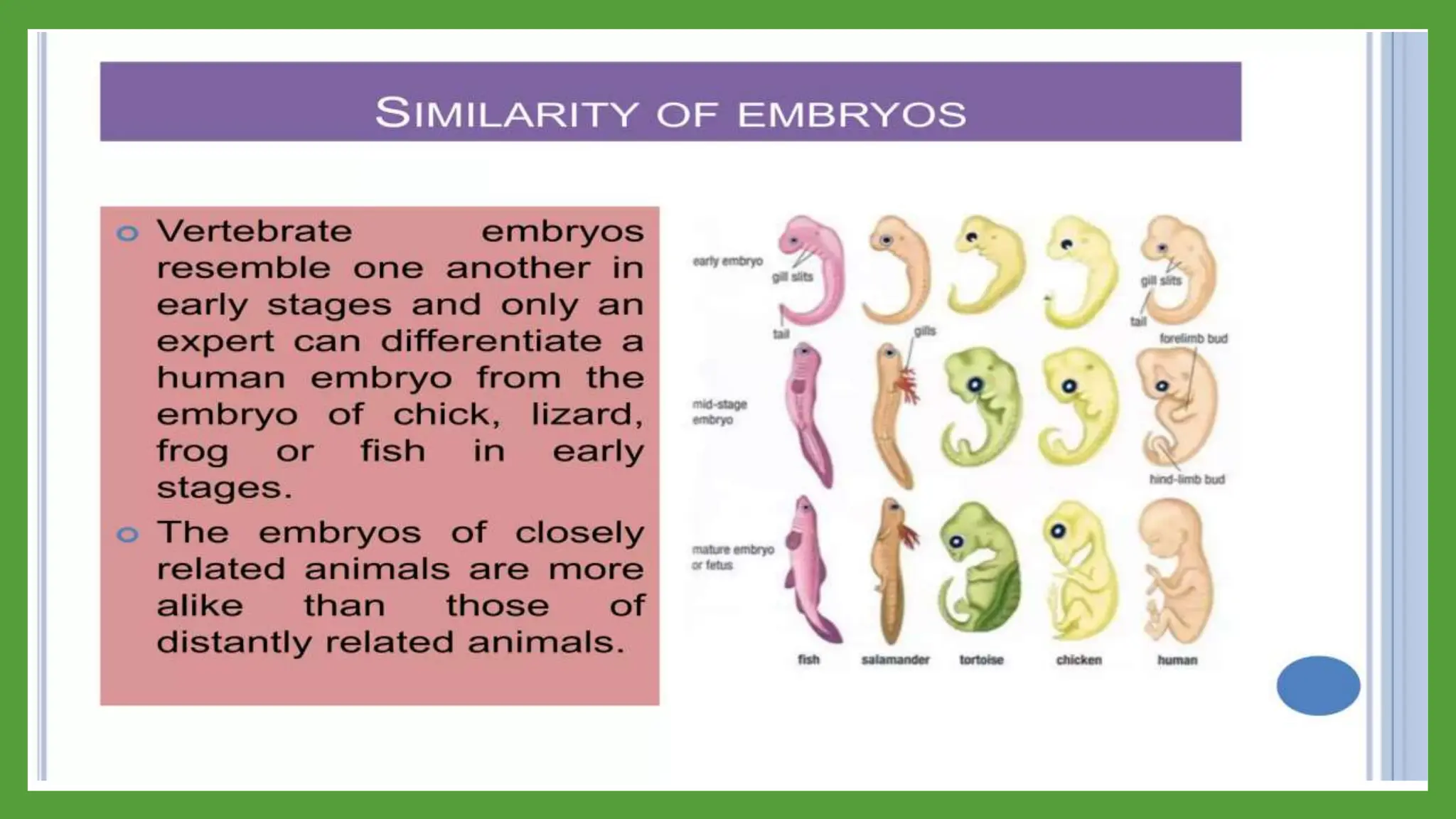
Embryology, the study of the development of the anatomy of an organism
to its adult form, provides evidence for evolution as embryo formation in
widely-divergent groups of organisms tends to be conserved. Structures that
are absent in the adults of some groups often appear in their embryonic
forms, disappearing by the time the adult or juvenile form is reached. For
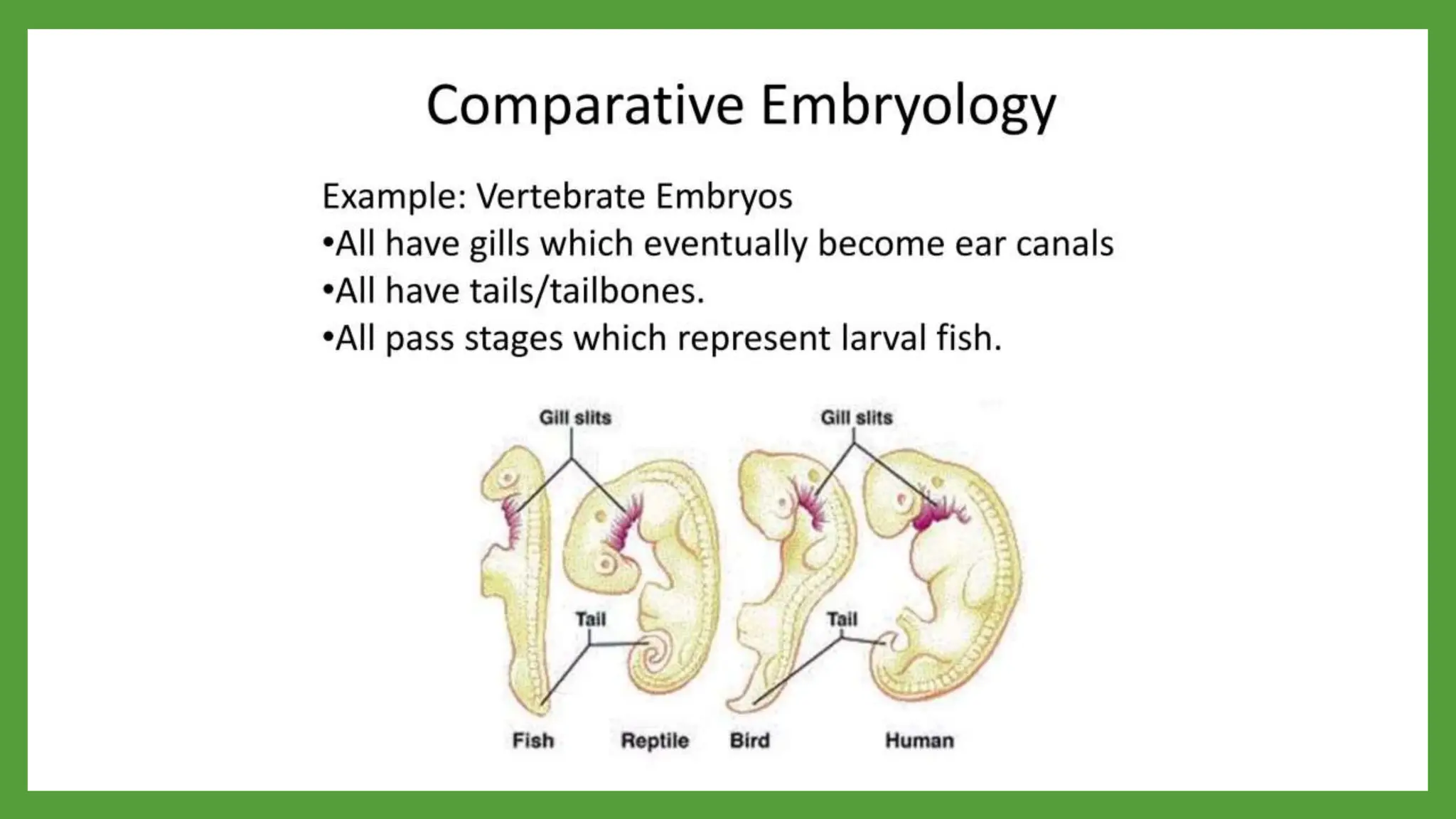
example, all vertebrate embryos, including humans, exhibit gill slits and tails
at some point in their early development.These disappear in the adults of
terrestrial groups, but are maintained in adults of aquatic groups, such as fish
and some amphibians. Great ape embryos, including humans, have a tail
structure during their development that is lost by birth.
DEVELOPMENT OF EMBRYO
•Similarities in Early Development
•Homologous Structures
•Vestigial Structures
•Embryonic Recapitulation
•Comparative Embryology
•Evolutionary Conservation
SIMILARITIES IN
EARLY
DEVELOPMENT
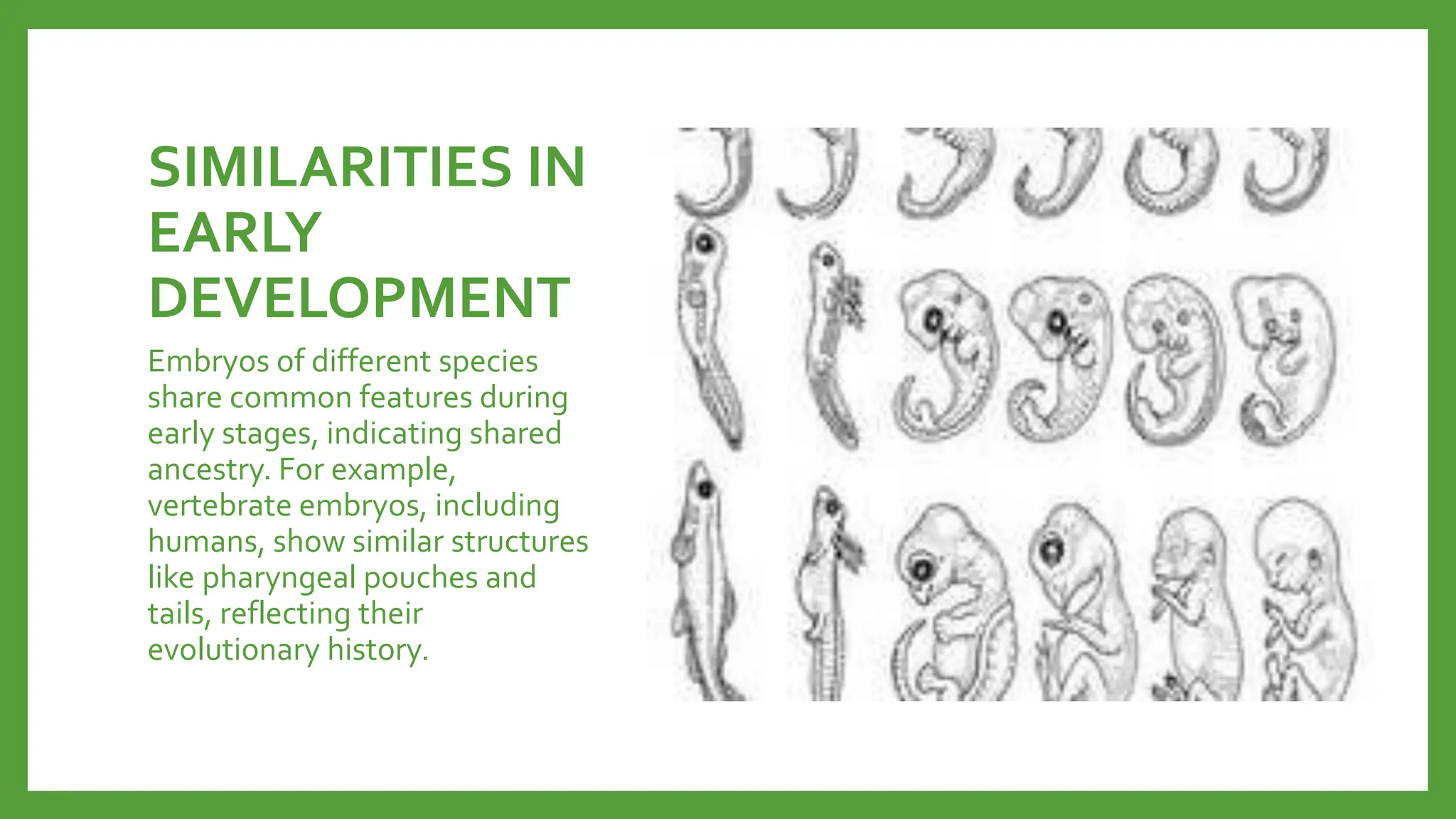
Embryos of different species
share common features during
early stages, indicating shared
ancestry. For example,
vertebrate embryos, including
humans, show similar structures
like pharyngeal pouches and
tails, reflecting their
evolutionary history.
HOMOLOGOUS
STRUCTURES
Structures in embryos that lead
to different adult forms in
various species can be
homologous, showing
evolutionary connections. For
instance, vertebrates like
humans, birds, and bats have
forelimbs with a common
developmental origin, despite
their different functions.
VESTIGITAL
STRUCTURES
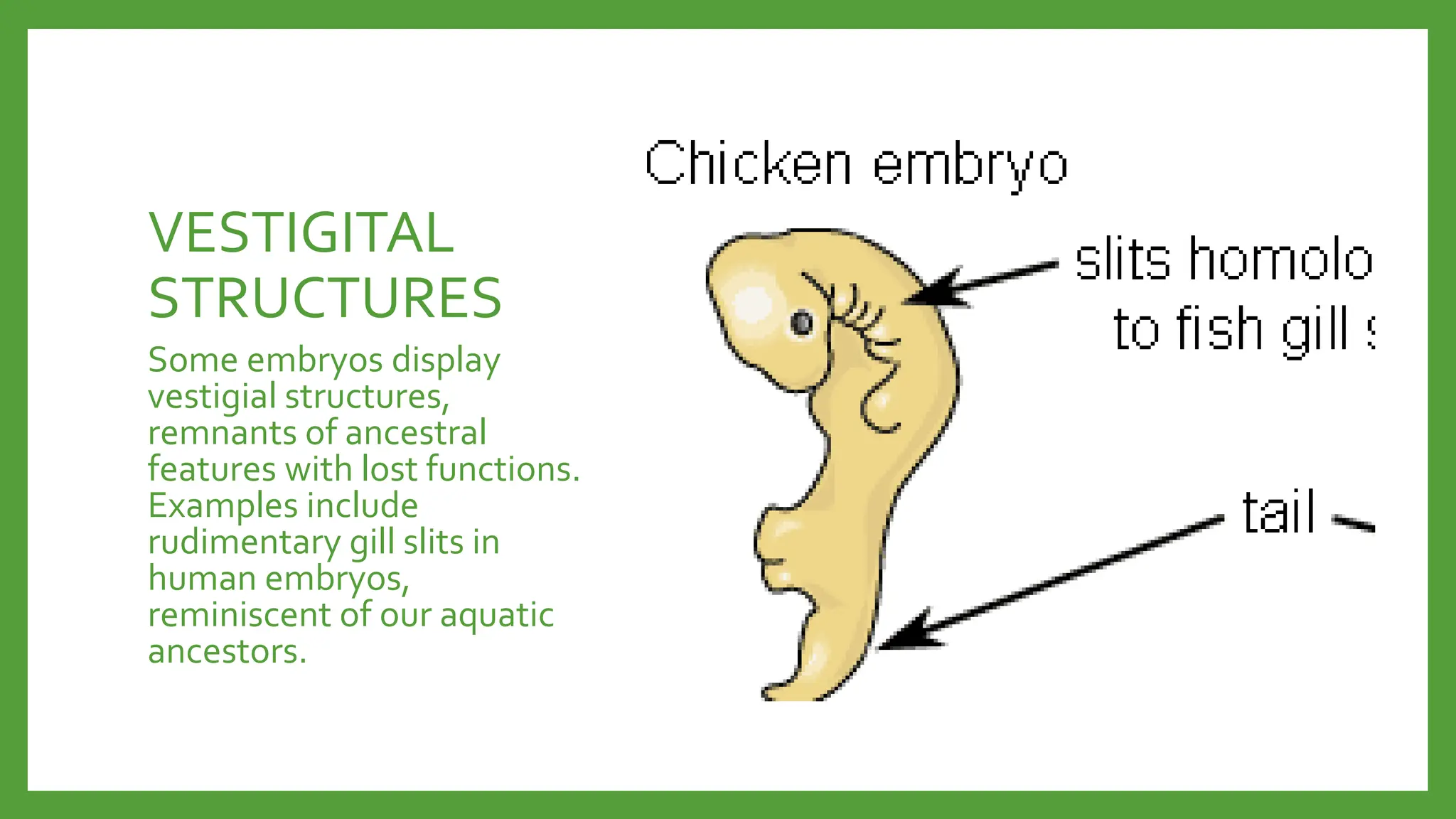
Some embryos display
vestigial structures,
remnants of ancestral
features with lost functions.
Examples include
rudimentary gill slits in
human embryos,
reminiscent of our aquatic
ancestors.
EMBRYONIC RECAPITULATION
Embryonic development retains ancestral
features that align with evolutionary
relationships.This concept, proposed by
Ernst Haeckel, suggests that the stages of
embryo development mirror the species'
evolutionary past.
COMPARATIVE
EMBRYOLOGY
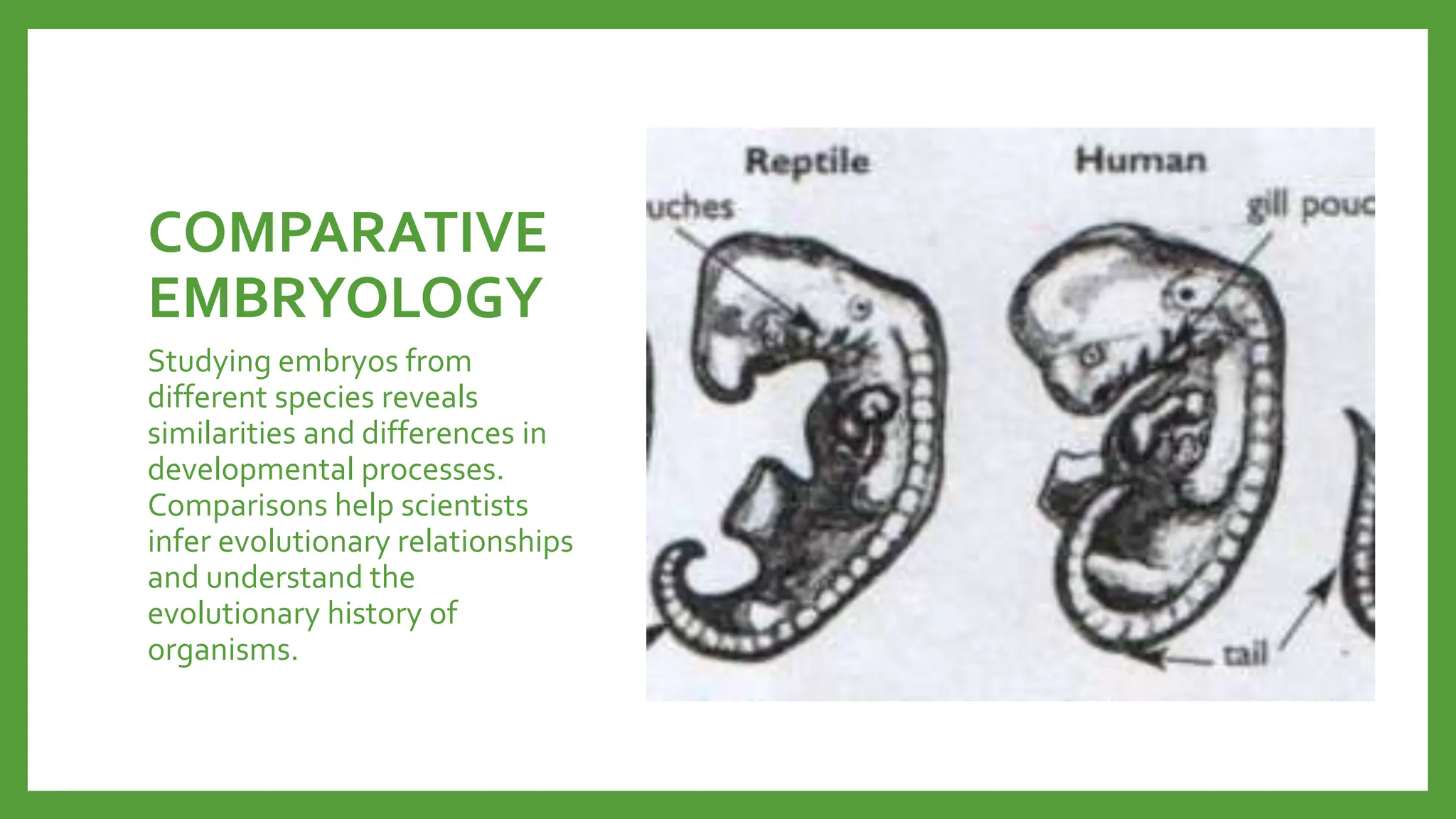
Studying embryos from
different species reveals
similarities and differences in
developmental processes.
Comparisons help scientists
infer evolutionary relationships
and understand the
evolutionary history of
organisms.
EVOLUTIONARY CONSERVATION
Evolutionarily conserved developmental genes
and pathways play crucial roles in embryonic
development across diverse organisms.The
presence of these shared genetic mechanisms
supports the idea of common ancestry and
evolutionary conservation of developmental
processes.
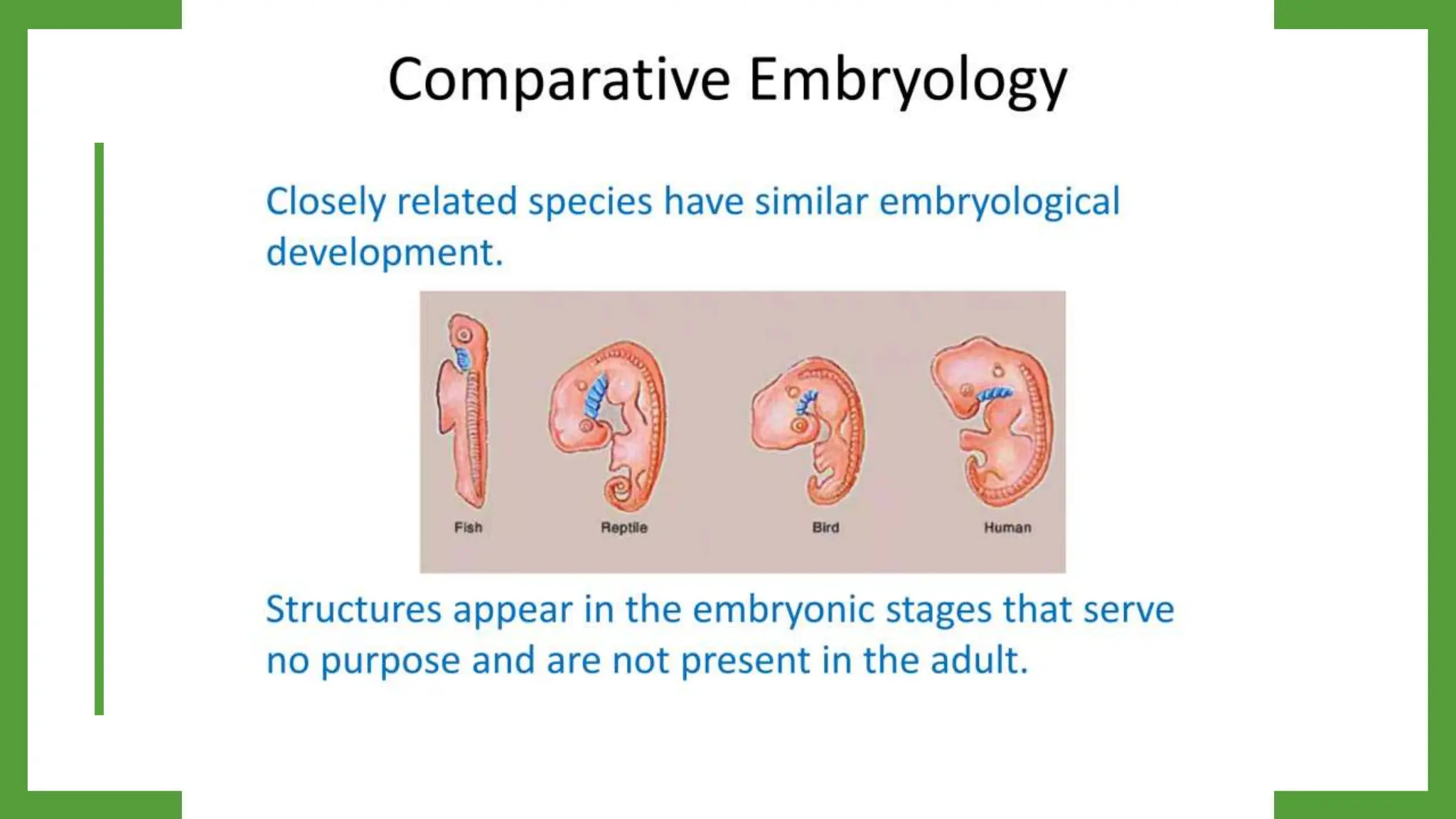
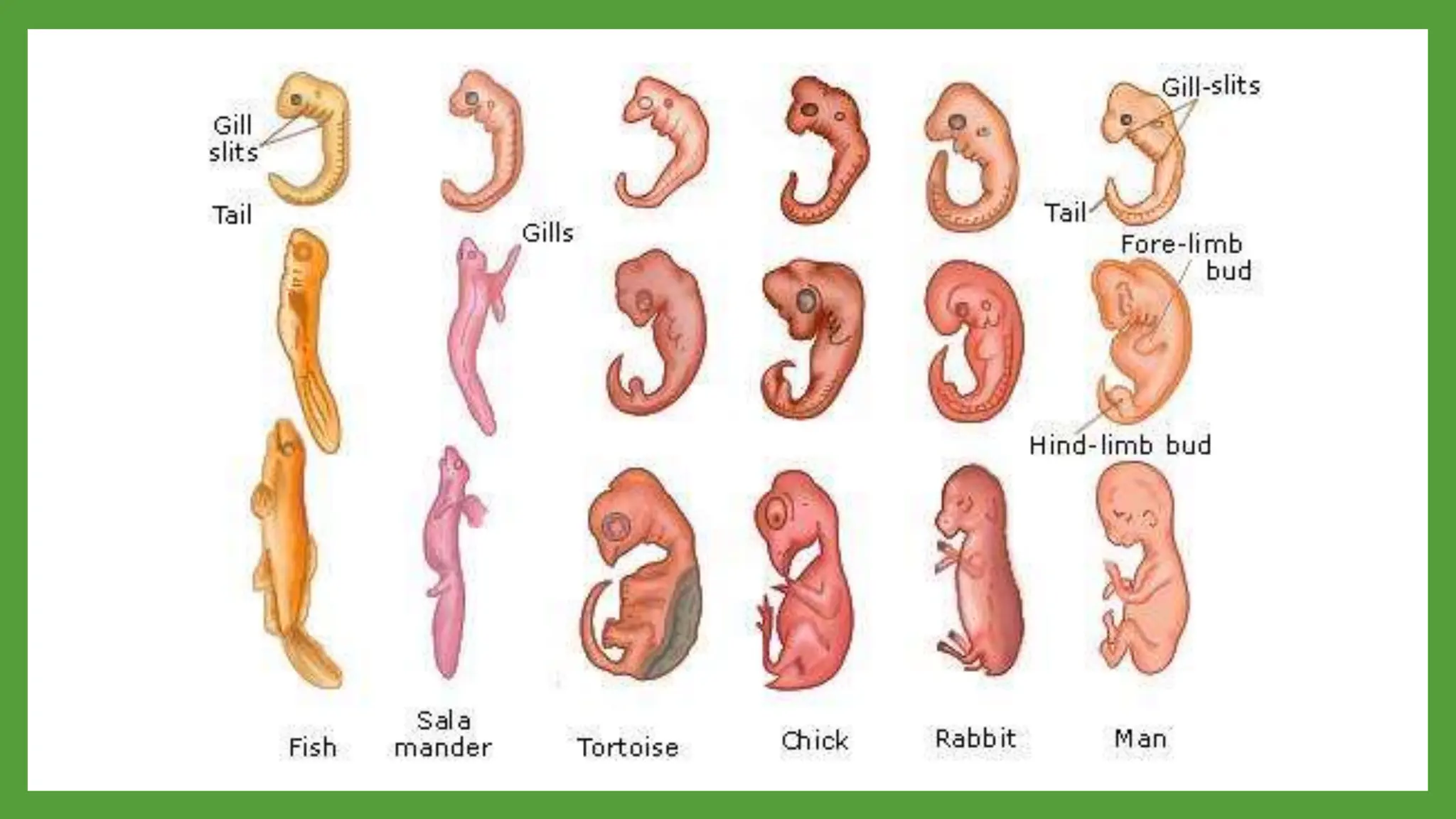
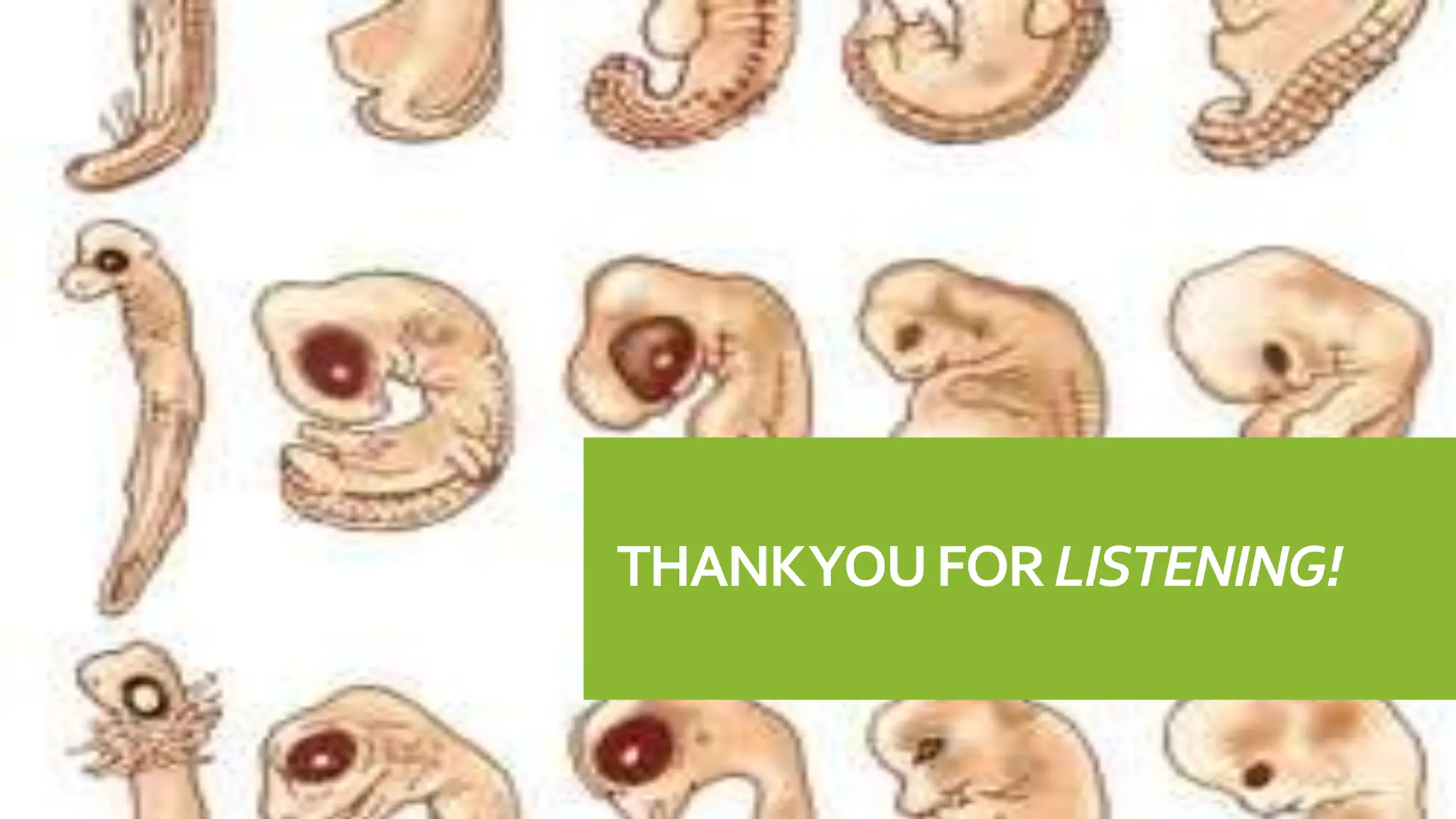
COMPARATIVE EMBRYOLOGY
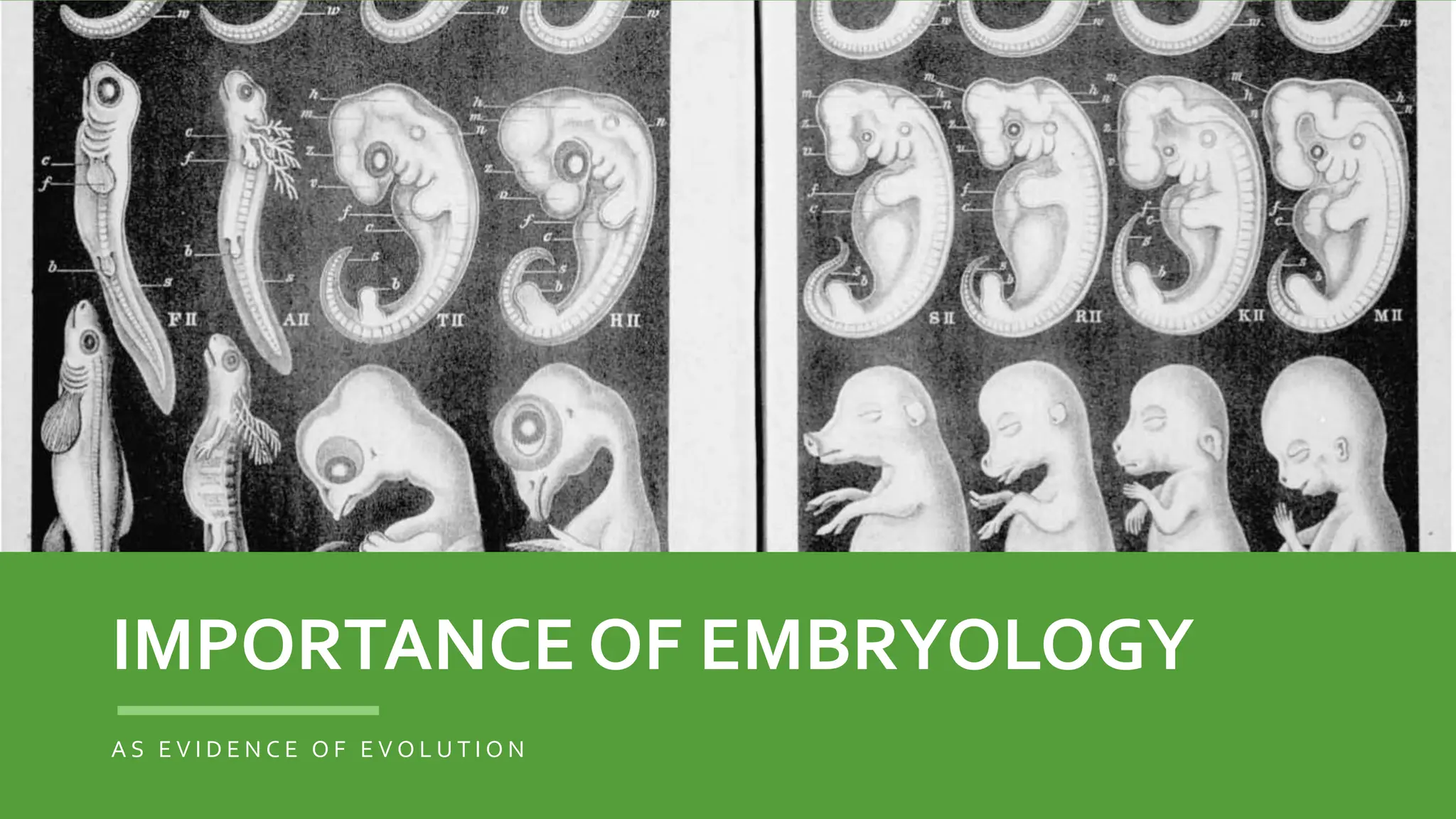
EARLY EMBRYOS OFVARIOUS
ORGANISMS DEMONSTRATE
EVOLUTIONARY RELATIONSHIPS
AS DEVELOPMENT PROCEEDS,THE
TRAITS OF EACH SPECIES BECOME
MORE EVIDENT.
IMPORTANCE OF EMBRYOLOGY
A S E V I D E N C E O F E V O L U T I O N
THE IMPORTANCE OF EMBRYOLOGY:
• Understanding development - Embryology helps us understand how
organisms grow and develop, from the simplest creatures to humans.
• Medical applications -This knowledge has numerous medical applications,
including assisted reproductive technologies, prenatal diagnosis of birth
defects, and regenerative medicine.
• Evolutionary insights - By studying the development of different species,
embryology can shed light on evolutionary relationships and the history of
life on Earth
THANKYOUFORLISTENING!

EMBRYOLOGY-bio-1.Evidence of evolution.pptx

  • 1.
    EMBRYOLOGY A s ev i d e n c e o f e v o l u t i o n
  • 2.
  • 3.
    WHAT IS EMBRYOLOGY? Embryology,the study of the development of the anatomy of an organism to its adult form, provides evidence for evolution as embryo formation in widely-divergent groups of organisms tends to be conserved. Structures that are absent in the adults of some groups often appear in their embryonic forms, disappearing by the time the adult or juvenile form is reached. For example, all vertebrate embryos, including humans, exhibit gill slits and tails at some point in their early development.These disappear in the adults of terrestrial groups, but are maintained in adults of aquatic groups, such as fish and some amphibians. Great ape embryos, including humans, have a tail structure during their development that is lost by birth.
  • 6.
    DEVELOPMENT OF EMBRYO •Similaritiesin Early Development •Homologous Structures •Vestigial Structures •Embryonic Recapitulation •Comparative Embryology •Evolutionary Conservation
  • 8.
    SIMILARITIES IN EARLY DEVELOPMENT Embryos ofdifferent species share common features during early stages, indicating shared ancestry. For example, vertebrate embryos, including humans, show similar structures like pharyngeal pouches and tails, reflecting their evolutionary history.
  • 10.
    HOMOLOGOUS STRUCTURES Structures in embryosthat lead to different adult forms in various species can be homologous, showing evolutionary connections. For instance, vertebrates like humans, birds, and bats have forelimbs with a common developmental origin, despite their different functions.
  • 12.
    VESTIGITAL STRUCTURES Some embryos display vestigialstructures, remnants of ancestral features with lost functions. Examples include rudimentary gill slits in human embryos, reminiscent of our aquatic ancestors.
  • 14.
    EMBRYONIC RECAPITULATION Embryonic developmentretains ancestral features that align with evolutionary relationships.This concept, proposed by Ernst Haeckel, suggests that the stages of embryo development mirror the species' evolutionary past.
  • 16.
    COMPARATIVE EMBRYOLOGY Studying embryos from differentspecies reveals similarities and differences in developmental processes. Comparisons help scientists infer evolutionary relationships and understand the evolutionary history of organisms.
  • 17.
    EVOLUTIONARY CONSERVATION Evolutionarily conserveddevelopmental genes and pathways play crucial roles in embryonic development across diverse organisms.The presence of these shared genetic mechanisms supports the idea of common ancestry and evolutionary conservation of developmental processes.
  • 18.
    COMPARATIVE EMBRYOLOGY EARLY EMBRYOSOFVARIOUS ORGANISMS DEMONSTRATE EVOLUTIONARY RELATIONSHIPS AS DEVELOPMENT PROCEEDS,THE TRAITS OF EACH SPECIES BECOME MORE EVIDENT.
  • 19.
    IMPORTANCE OF EMBRYOLOGY AS E V I D E N C E O F E V O L U T I O N
  • 20.
    THE IMPORTANCE OFEMBRYOLOGY: • Understanding development - Embryology helps us understand how organisms grow and develop, from the simplest creatures to humans. • Medical applications -This knowledge has numerous medical applications, including assisted reproductive technologies, prenatal diagnosis of birth defects, and regenerative medicine. • Evolutionary insights - By studying the development of different species, embryology can shed light on evolutionary relationships and the history of life on Earth
  • 22.