
EMBEDDED
WEB
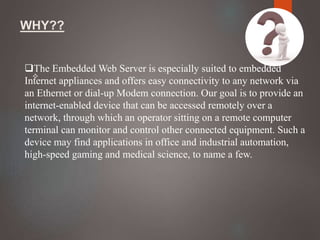
Embedded Web server
 An Embedded Web Server is a microprocessor- or microcontroller-
based embedded system that contains an Internet software suite as
well as application code for monitoring and controlling external
systems. Such a system can serve web pages over a TCP/IP
network, allowing any browser with access to the network the
ability to control and monitor devices connected to the Embedded
Web Server.
WHY??

The Embedded Web Server is especially suited to embedded
Internet appliances and offers easy connectivity to any network via
an Ethernet or dial-up Modem connection. Our goal is to provide an
internet-enabled device that can be accessed remotely over a
network, through which an operator sitting on a remote computer
terminal can monitor and control other connected equipment. Such a
device may find applications in office and industrial automation,
high-speed gaming and medical science, to name a few.
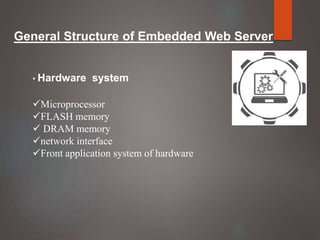
General Structure of Embedded Web Server
Microprocessor
FLASH memory
 DRAM memory
network interface
Front application system of hardware
• Hardware system
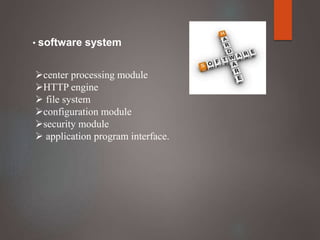
center processing module
HTTP engine
 file system
configuration module
security module
 application program interface.
• software system
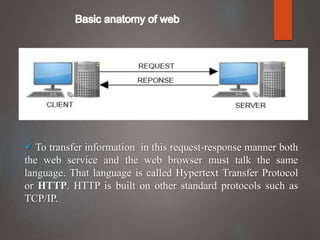
 To transfer information in this request-response manner both
the web service and the web browser must talk the same
language. That language is called Hypertext Transfer Protocol
or HTTP. HTTP is built on other standard protocols such as
TCP/IP.
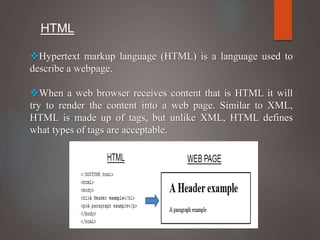
Hypertext markup language (HTML) is a language used to
describe a webpage.
When a web browser receives content that is HTML it will
try to render the content into a web page. Similar to XML,
HTML is made up of tags, but unlike XML, HTML defines
what types of tags are acceptable.
HTML
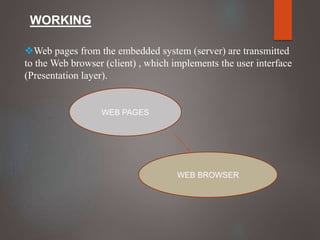
Web pages from the embedded system (server) are transmitted
to the Web browser (client) , which implements the user interface
(Presentation layer).
WEB PAGES
WEB BROWSER
WORKING
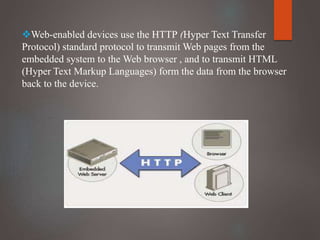
Web-enabled devices use the HTTP (Hyper Text Transfer
Protocol) standard protocol to transmit Web pages from the
embedded system to the Web browser , and to transmit HTML
(Hyper Text Markup Languages) form the data from the browser
back to the device.
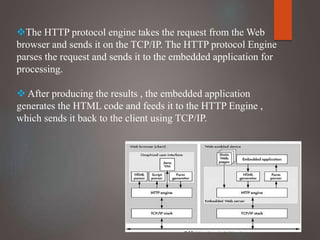
The HTTP protocol engine takes the request from the Web
browser and sends it on the TCP/IP. The HTTP protocol Engine
parses the request and sends it to the embedded application for
processing.
 After producing the results , the embedded application
generates the HTML code and feeds it to the HTTP Engine ,
which sends it back to the client using TCP/IP.
• Simplifies software and communications: The Embedded Web Server
contains dynamic web pages that allow the operator to control and
manipulate the embedded device over a TCP/IP-based network
•Offers increased functionality: Web-based GUIs offer a tremendous
advantage over traditional control and monitoring systems where the system’s
GUI software is running on the operator’s computer system itself. Unlike these
traditional systems which are OS-specific and need installation, a web-based
GUI is platform independent and needs no installation at the operator’s end
•Simplifies system management :Web pages can be used to monitor, control
and update the Embedded Web Server system. Any authorized user can access
the system through a browser on a client to conduct maintenance, change
system settings, and update system software
With Web access ability of the embedded devices will get
rapid development, the application in communication
equipment, information home appliances, instruments remote
management and other fields. Embedded Web server for
embedded devices provide network interface, to realize the
remote management and control, which is an important
technology of the network embedded equipment.
WHERE??
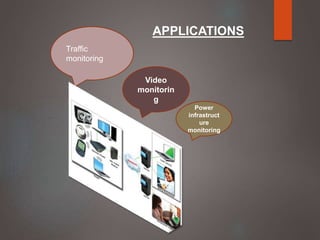
Traffic
monitoring
Video
monitorin
g
Power
infrastruct
ure
monitoring
APPLICATIONS
Web technology in embedded applications has distinct
advantages over legacy and custom communication
mechanisms due to the scalability and security. The amount
of knowledge and skills needed to create a web application
may be large. However embedded technology is vastly
becoming an important tool in our daily lives
CONCLUSION
THANK YOU!!!!
Presented By
C.Kavya Sree
13911A0416

EMBEDDED WEB SERVER

  • 1.
  • 3.
    Embedded Web server An Embedded Web Server is a microprocessor- or microcontroller- based embedded system that contains an Internet software suite as well as application code for monitoring and controlling external systems. Such a system can serve web pages over a TCP/IP network, allowing any browser with access to the network the ability to control and monitor devices connected to the Embedded Web Server.
  • 4.
    WHY??  The Embedded WebServer is especially suited to embedded Internet appliances and offers easy connectivity to any network via an Ethernet or dial-up Modem connection. Our goal is to provide an internet-enabled device that can be accessed remotely over a network, through which an operator sitting on a remote computer terminal can monitor and control other connected equipment. Such a device may find applications in office and industrial automation, high-speed gaming and medical science, to name a few.
  • 5.
    General Structure ofEmbedded Web Server Microprocessor FLASH memory  DRAM memory network interface Front application system of hardware • Hardware system
  • 6.
    center processing module HTTPengine  file system configuration module security module  application program interface. • software system
  • 8.
     To transferinformation in this request-response manner both the web service and the web browser must talk the same language. That language is called Hypertext Transfer Protocol or HTTP. HTTP is built on other standard protocols such as TCP/IP.
  • 9.
    Hypertext markup language(HTML) is a language used to describe a webpage. When a web browser receives content that is HTML it will try to render the content into a web page. Similar to XML, HTML is made up of tags, but unlike XML, HTML defines what types of tags are acceptable. HTML
  • 10.
    Web pages fromthe embedded system (server) are transmitted to the Web browser (client) , which implements the user interface (Presentation layer). WEB PAGES WEB BROWSER WORKING
  • 11.
    Web-enabled devices usethe HTTP (Hyper Text Transfer Protocol) standard protocol to transmit Web pages from the embedded system to the Web browser , and to transmit HTML (Hyper Text Markup Languages) form the data from the browser back to the device.
  • 12.
    The HTTP protocolengine takes the request from the Web browser and sends it on the TCP/IP. The HTTP protocol Engine parses the request and sends it to the embedded application for processing.  After producing the results , the embedded application generates the HTML code and feeds it to the HTTP Engine , which sends it back to the client using TCP/IP.
  • 13.
    • Simplifies softwareand communications: The Embedded Web Server contains dynamic web pages that allow the operator to control and manipulate the embedded device over a TCP/IP-based network •Offers increased functionality: Web-based GUIs offer a tremendous advantage over traditional control and monitoring systems where the system’s GUI software is running on the operator’s computer system itself. Unlike these traditional systems which are OS-specific and need installation, a web-based GUI is platform independent and needs no installation at the operator’s end •Simplifies system management :Web pages can be used to monitor, control and update the Embedded Web Server system. Any authorized user can access the system through a browser on a client to conduct maintenance, change system settings, and update system software
  • 14.
    With Web accessability of the embedded devices will get rapid development, the application in communication equipment, information home appliances, instruments remote management and other fields. Embedded Web server for embedded devices provide network interface, to realize the remote management and control, which is an important technology of the network embedded equipment. WHERE??
  • 15.
  • 16.
    Web technology inembedded applications has distinct advantages over legacy and custom communication mechanisms due to the scalability and security. The amount of knowledge and skills needed to create a web application may be large. However embedded technology is vastly becoming an important tool in our daily lives CONCLUSION
  • 17.

Editor's Notes

  • #4 Embedded systems are specialized computer systems designed and optimized to perform a particular task. Usually they are a part of a larger system or a machine In today's world, embedded systems are everywhere homes, offices, cars, factories, hospitals, plains and consumer electronics. They span all aspects of modern life and examples of their use are numerous. Modern embedded systems are able to connect to the internet and can be remotely maintained and diagnosed . M2M(Machine to machine) communication is growing with a considerable rate. The possibility to connect two or more embedded systems enables developers to build more powerful distributed systems such as networked embedded systems .Remote maintenance is performed by different communication protocols. The most common communication protocol is HTTP which enables remote system control and monitoring
  • #6 Microprocessor is responsible for all of the operation and management, FLASH, ROM memory used to store real-time operating system kernel system, TCP/IP protocol stack, all kinds of Web documents; DRAM memory for system is running use; The network interface implementation and Interne/Intranet connection; Front application system hardware finish of a traditional application function [2]
  • #7 The server is the core of the central processing module, it is the control and the scheduling, HTTP engine realize the HTTP protocol, the file system access to resources, configuration module and security module implements the server configuration and security mechanism, application server interface implementation and application interaction. Application program interface module common are CGI (common gateway interface), SSI (server side contains) and HCPA (HTML-to-C preprocessor facilities), element order, custom, API interface and other forms, there are no corresponding realize standards
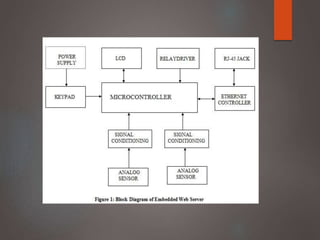
  • #8 This project implements an EMBEDDED WEBSERVER with networking capability using ARM microcontroller. Various Analog Sensors can be connected to the ARM Board. The project includes complete implementation of an HTTP Web Server in am ARM7 microcontroller. The websites are stored inside the program space of the ARM7 microcontroller and features a flexible pattern parsing algorithm. This supports using keywords to instruct the web server to include special data in the page delivered to the browser (i.e. current temperature as ASCII text).
  • #9 There are two primary actors when communicating over the web, the server and the client. For right now think of the server and the client as two desktop computers. The server computer waits for the client computer to initiate communication and then the client computer makes a request for information. If the server computer understands the request it replies with a response. If the server computer does not understand the request it replies back to the client computer with an error. This pattern is called the client-server.