Embedded Systems
Embedded Systems
i
AbouttheTutorial
We can broadly define an embedded system as a microcontroller-based, software-driven,
reliable, real-time control system, designed to perform a specific task. It can be thought of as a
computer hardware system having software embedded in it.
An embedded system can be either an independent system or a part of a large system. In this
tutorial, we will explain all the steps necessary to design an embedded system and use it.
Audience
This tutorial has been designed to help the students of electronics learn the basic-to-advanced
concepts of Embedded System and 8051 Microcontroller.
Prerequisites
Before proceeding with this tutorial, you should have a good understanding of the concepts of
basic electronics such as circuits, logic gates, etc.
Disclaimer&Copyright
© Copyright 2015 by Tutorials Point (I) Pvt. Ltd.
All the content and graphics published in this e-book are the property of Tutorials Point (I) Pvt.
Ltd. The user of this e-book is prohibited to reuse, retain, copy, distribute, or republish any
contents or a part of contents of this e-book in any manner without written consent of the
publisher.
We strive to update the contents of our website and tutorials as timely and as precisely as
possible, however, the contents may contain inaccuracies or errors. Tutorials Point (I) Pvt. Ltd.
provides no guarantee regarding the accuracy, timeliness, or completeness of our website or its
contents including this tutorial. If you discover any errors on our website or in this tutorial,
please notify us at contact@tutorialspoint.com
Embedded Systems
ii
TableofContents
About the Tutorial............................................................................................................................................... i
Audience............................................................................................................................................................. i
Prerequisites....................................................................................................................................................... i
Disclaimer & Copyright ....................................................................................................................................... i
Table of Contents............................................................................................................................................... ii
1. EMBEDDED SYSTEMS – OVERVIEW................................................................................................1
System ............................................................................................................................................................... 1
Embedded System ............................................................................................................................................. 1
Characteristics of an Embedded System............................................................................................................. 1
Basic Structure of an Embedded System ............................................................................................................ 3
2. EMBEDDED SYSTEMS – PROCESSORS ............................................................................................4
Processors in a System....................................................................................................................................... 4
Types of Processors............................................................................................................................................ 4
Microprocessor.................................................................................................................................................. 4
Microcontroller.................................................................................................................................................. 5
Microprocessor vs Microcontroller .................................................................................................................... 6
3. EMBEDDED SYSTEMS – ARCHITECTURE.........................................................................................7
Von Neumann Architecture ............................................................................................................................... 7
Harvard Architecture ......................................................................................................................................... 8
Von-Neumann Architecture vs Harvard Architecture ......................................................................................... 8
CISC and RISC ..................................................................................................................................................... 9
4. EMBEDDED SYSTEMS – TOOLS AND PERIPHERALS......................................................................10
Compilers and Assemblers ................................................................................................................................10
Debugging Tools in an Embedded System.........................................................................................................11
Embedded Systems
iii
Simulators.........................................................................................................................................................11
Microcontroller Starter Kit................................................................................................................................11
Emulators..........................................................................................................................................................12
Peripheral Devices in Embedded Systems .........................................................................................................12
Criteria for Choosing Microcontroller................................................................................................................12
5. EMBEDDED SYSTEMS – 8051 MICROCONTROLLER.....................................................................14
Brief History of 8051 .........................................................................................................................................14
8051 Flavors / Members ...................................................................................................................................14
Comparison between 8051 Family Members ....................................................................................................14
Features of 8051 Microcontroller......................................................................................................................15
Block Diagram of 8051 Microcontroller.............................................................................................................15
6. EMBEDDED SYSTEMS – I/O PROGRAMMING..............................................................................16
I/O Ports and their Functions............................................................................................................................16
Dual Role of Port 0 and Port 2...........................................................................................................................19
Hardware Connection of Pins............................................................................................................................19
I/O Ports and Bit Addressability........................................................................................................................21
Single-Bit Instructions .......................................................................................................................................22
7. EMBEDDED SYSTEMS – TERMS...................................................................................................23
Program Counter ..............................................................................................................................................23
Reset Vector .....................................................................................................................................................23
Stack Pointer.....................................................................................................................................................23
Infinite Loop......................................................................................................................................................23
Interrupts..........................................................................................................................................................24
Little Endian Vs Big Endian................................................................................................................................24
8. EMBEDDED SYSTEMS – ASSEMBLY LANGUAGE...........................................................................25
Structure of Assembly Language .......................................................................................................................25
Embedded Systems
iv
Assembling and Running an 8051 Program .......................................................................................................26
Data Type..........................................................................................................................................................27
Assembler Directives.........................................................................................................................................28
Labels in Assembly Language ............................................................................................................................28
9. EMBEDDED SYSTEMS – REGISTERS.............................................................................................29
Storage Registers in 8051..................................................................................................................................29
ROM Space in 8051 ...........................................................................................................................................31
10. EMBEDDED SYSTEMS – REGISTER BANK / STACK.........................................................................34
RAM Memory Space Allocation in 8051 ............................................................................................................34
Register Banks in 8051 ......................................................................................................................................34
Default Register Bank .......................................................................................................................................35
How to Switch Register Banks...........................................................................................................................35
Stack and its Operations ...................................................................................................................................35
11. EMBEDDED SYSTEMS – INSTRUCTIONS .......................................................................................37
Loop and Jump Instructions ..............................................................................................................................37
Other Conditional Jumps...................................................................................................................................38
Unconditional Jump Instructions.......................................................................................................................39
Calculating the Short Jump Address..................................................................................................................39
CALL Instructions...............................................................................................................................................40
12. EMBEDDED SYSTEMS – ADDRESSING MODES..............................................................................41
Immediate Addressing Mode............................................................................................................................41
Direct Addressing Mode....................................................................................................................................42
Register Direct Addressing Mode......................................................................................................................43
Register Indirect Addressing Mode ...................................................................................................................44
Indexed Addressing Mode ................................................................................................................................45
Embedded Systems
v
13. EMBEDDED SYSTEMS – SPECIAL FUNCTION REGISTERS...............................................................47
14. EMBEDDED SYSTEMS – TIMER / COUNTER..................................................................................49
Timers of 8051 and their Associated Registers ..................................................................................................49
Different Modes of Timers................................................................................................................................51
Initializing a Timer.............................................................................................................................................52
Reading a Timer ................................................................................................................................................52
Detecting Timer Overflow.................................................................................................................................52
15. EMBEDDED SYSTEMS – INTERRUPTS ...........................................................................................53
What is Polling? ................................................................................................................................................53
Interrupt Service Routine..................................................................................................................................54
Interrupt Vector Table ......................................................................................................................................54
Steps to Execute an Interrupt............................................................................................................................55
Edge Triggering vs. Level Triggering...................................................................................................................55
Enabling and Disabling an Interrupt..................................................................................................................56
Interrupt Priority in 8051 ..................................................................................................................................57
Interrupt inside Interrupt..................................................................................................................................57
Triggering an Interrupt by Software..................................................................................................................57
Embedded Systems
6
System
A system is an arrangement in which all its unit assemble work together according to a set of
rules. It can also be defined as a way of working, organizing or doing one or many tasks
according to a fixed plan. For example, a watch is a time displaying system. Its components
follow a set of rules to show time. If one of its parts fails, the watch will stop working. So we
can say, in a system, all its subcomponents depend on each other.
EmbeddedSystem
As its name suggests, Embedded means something that is attached to another thing. An
embedded system can be thought of as a computer hardware system having software
embedded in it. An embedded system can be an independent system or it can be a part of a
large system. An embedded system is a microcontroller or microprocessor based system
which is designed to perform a specific task. For example, a fire alarm is an embedded
system; it will sense only smoke.
An embedded system has three components:
 It has hardware.
 It has application software.
 It has Real Time Operating system (RTOS) that supervises the application software
and provide mechanism to let the processor run a process as per scheduling by
following a plan to control the latencies. RTOS defines the way the system works. It
sets the rules during the execution of application program. A small scale embedded
system may not have RTOS.
So we can define an embedded system as a Microcontroller based, software driven, reliable,
real-time control system.
CharacteristicsofanEmbeddedSystem
 Single-functioned – An embedded system usually performs a specialized operation
and does the same repeatedly. For example: A pager always functions as a pager.
 Tightly constrained – All computing systems have constraints on design metrics, but
those on an embedded system can be especially tight. Design metrics is a measure of
an implementation's features such as its cost, size, power, and performance. It must
1. Embedded Systems – Overview
Embedded Systems
7
be of a size to fit on a single chip, must perform fast enough to process data in real
time and consume minimum power to extend battery life.
 Reactive and Real time – Many embedded systems must continually react to
changes in the system's environment and must compute certain results in real time
without any delay. Consider an example of a car cruise controller; it continually
monitors and reacts to speed and brake sensors. It must compute acceleration or de-
accelerations repeatedly within a limited time; a delayed computation can result in
failure to control of the car.
 Microprocessors based – It must be microprocessor or microcontroller based.
 Memory – It must have a memory, as its software usually embeds in ROM. It does
not need any secondary memories in the computer.
 Connected – It must have connected peripherals to connect input and output devices.
 HW-SW systems – Software is used for more features and flexibility. Hardware is
used for performance and security.
Advantages
 Easily Customizable
 Low power consumption
 Low cost
 Enhanced performance
Embedded Systems
8
Disadvantages
 High development effort
 Larger time to market
BasicStructureofanEmbeddedSystem
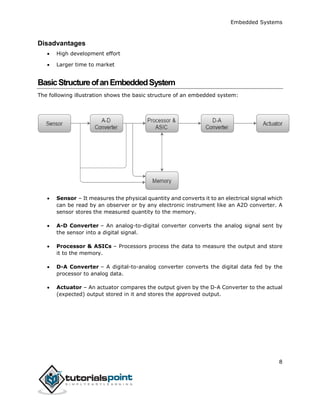
The following illustration shows the basic structure of an embedded system:
 Sensor – It measures the physical quantity and converts it to an electrical signal which
can be read by an observer or by any electronic instrument like an A2D converter. A
sensor stores the measured quantity to the memory.
 A-D Converter – An analog-to-digital converter converts the analog signal sent by
the sensor into a digital signal.
 Processor & ASICs – Processors process the data to measure the output and store
it to the memory.
 D-A Converter – A digital-to-analog converter converts the digital data fed by the
processor to analog data.
 Actuator – An actuator compares the output given by the D-A Converter to the actual
(expected) output stored in it and stores the approved output.
Embedded Systems
9
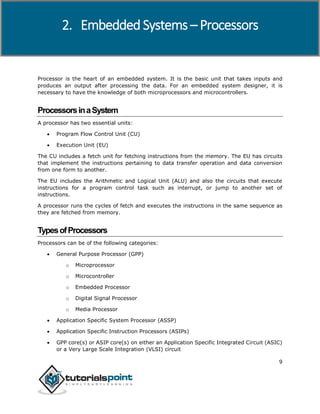
Processor is the heart of an embedded system. It is the basic unit that takes inputs and
produces an output after processing the data. For an embedded system designer, it is
necessary to have the knowledge of both microprocessors and microcontrollers.
ProcessorsinaSystem
A processor has two essential units:
 Program Flow Control Unit (CU)
 Execution Unit (EU)
The CU includes a fetch unit for fetching instructions from the memory. The EU has circuits
that implement the instructions pertaining to data transfer operation and data conversion
from one form to another.
The EU includes the Arithmetic and Logical Unit (ALU) and also the circuits that execute
instructions for a program control task such as interrupt, or jump to another set of
instructions.
A processor runs the cycles of fetch and executes the instructions in the same sequence as
they are fetched from memory.
TypesofProcessors
Processors can be of the following categories:
 General Purpose Processor (GPP)
o Microprocessor
o Microcontroller
o Embedded Processor
o Digital Signal Processor
o Media Processor
 Application Specific System Processor (ASSP)
 Application Specific Instruction Processors (ASIPs)
 GPP core(s) or ASIP core(s) on either an Application Specific Integrated Circuit (ASIC)
or a Very Large Scale Integration (VLSI) circuit
2. Embedded Systems – Processors
Embedded Systems
10
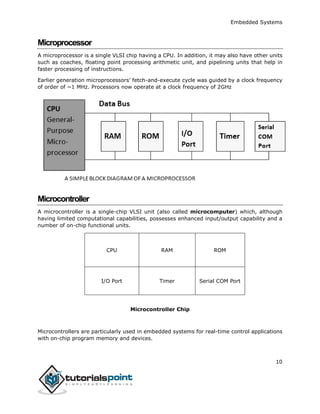
Microprocessor
A microprocessor is a single VLSI chip having a CPU. In addition, it may also have other units
such as coaches, floating point processing arithmetic unit, and pipelining units that help in
faster processing of instructions.
Earlier generation microprocessors’ fetch-and-execute cycle was guided by a clock frequency
of order of ~1 MHz. Processors now operate at a clock frequency of 2GHz
Microcontroller
A microcontroller is a single-chip VLSI unit (also called microcomputer) which, although
having limited computational capabilities, possesses enhanced input/output capability and a
number of on-chip functional units.
CPU RAM ROM
I/O Port Timer Serial COM Port
Microcontroller Chip
Microcontrollers are particularly used in embedded systems for real-time control applications
with on-chip program memory and devices.
Embedded Systems
11
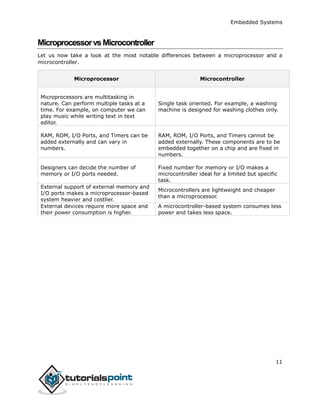
MicroprocessorvsMicrocontroller
Let us now take a look at the most notable differences between a microprocessor and a
microcontroller.
Microprocessor Microcontroller
Microprocessors are multitasking in
nature. Can perform multiple tasks at a
time. For example, on computer we can
play music while writing text in text
editor.
Single task oriented. For example, a washing
machine is designed for washing clothes only.
RAM, ROM, I/O Ports, and Timers can be
added externally and can vary in
numbers.
RAM, ROM, I/O Ports, and Timers cannot be
added externally. These components are to be
embedded together on a chip and are fixed in
numbers.
Designers can decide the number of
memory or I/O ports needed.
Fixed number for memory or I/O makes a
microcontroller ideal for a limited but specific
task.
External support of external memory and
I/O ports makes a microprocessor-based
system heavier and costlier.
Microcontrollers are lightweight and cheaper
than a microprocessor.
External devices require more space and
their power consumption is higher.
A microcontroller-based system consumes less
power and takes less space.
Embedded Systems
12
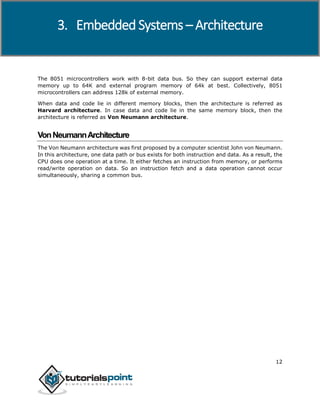
The 8051 microcontrollers work with 8-bit data bus. So they can support external data
memory up to 64K and external program memory of 64k at best. Collectively, 8051
microcontrollers can address 128k of external memory.
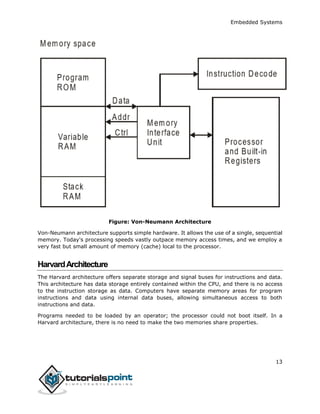
When data and code lie in different memory blocks, then the architecture is referred as
Harvard architecture. In case data and code lie in the same memory block, then the
architecture is referred as Von Neumann architecture.
VonNeumannArchitecture
The Von Neumann architecture was first proposed by a computer scientist John von Neumann.
In this architecture, one data path or bus exists for both instruction and data. As a result, the
CPU does one operation at a time. It either fetches an instruction from memory, or performs
read/write operation on data. So an instruction fetch and a data operation cannot occur
simultaneously, sharing a common bus.
3. Embedded Systems – Architecture
Embedded Systems
13
Figure: Von-Neumann Architecture
Von-Neumann architecture supports simple hardware. It allows the use of a single, sequential
memory. Today's processing speeds vastly outpace memory access times, and we employ a
very fast but small amount of memory (cache) local to the processor.
HarvardArchitecture
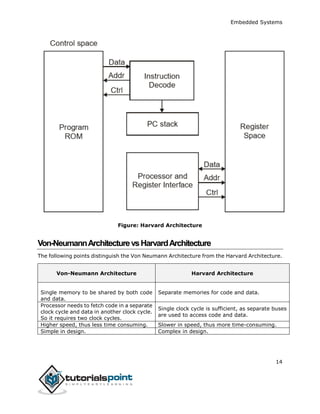
The Harvard architecture offers separate storage and signal buses for instructions and data.
This architecture has data storage entirely contained within the CPU, and there is no access
to the instruction storage as data. Computers have separate memory areas for program
instructions and data using internal data buses, allowing simultaneous access to both
instructions and data.
Programs needed to be loaded by an operator; the processor could not boot itself. In a
Harvard architecture, there is no need to make the two memories share properties.
Embedded Systems
14
Figure: Harvard Architecture
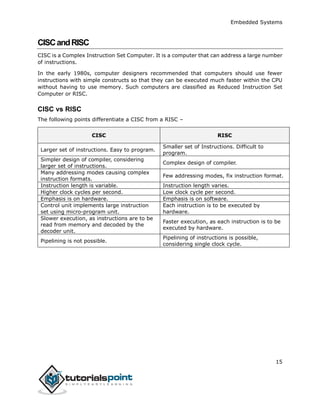
Von-NeumannArchitecturevsHarvardArchitecture
The following points distinguish the Von Neumann Architecture from the Harvard Architecture.
Von-Neumann Architecture Harvard Architecture
Single memory to be shared by both code
and data.
Separate memories for code and data.
Processor needs to fetch code in a separate
clock cycle and data in another clock cycle.
So it requires two clock cycles.
Single clock cycle is sufficient, as separate buses
are used to access code and data.
Higher speed, thus less time consuming. Slower in speed, thus more time-consuming.
Simple in design. Complex in design.
Embedded Systems
15
CISCandRISC
CISC is a Complex Instruction Set Computer. It is a computer that can address a large number
of instructions.
In the early 1980s, computer designers recommended that computers should use fewer
instructions with simple constructs so that they can be executed much faster within the CPU
without having to use memory. Such computers are classified as Reduced Instruction Set
Computer or RISC.
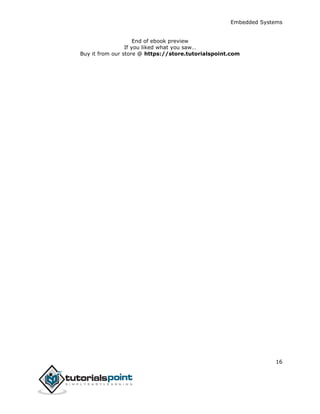
CISC vs RISC
The following points differentiate a CISC from a RISC –
CISC RISC
Larger set of instructions. Easy to program.
Smaller set of Instructions. Difficult to
program.
Simpler design of compiler, considering
larger set of instructions.
Complex design of compiler.
Many addressing modes causing complex
instruction formats.
Few addressing modes, fix instruction format.
Instruction length is variable. Instruction length varies.
Higher clock cycles per second. Low clock cycle per second.
Emphasis is on hardware. Emphasis is on software.
Control unit implements large instruction
set using micro-program unit.
Each instruction is to be executed by
hardware.
Slower execution, as instructions are to be
read from memory and decoded by the
decoder unit.
Faster execution, as each instruction is to be
executed by hardware.
Pipelining is not possible.
Pipelining of instructions is possible,
considering single clock cycle.
Embedded Systems
16
End of ebook preview
If you liked what you saw…
Buy it from our store @ https://store.tutorialspoint.com

Embedded systems tutorial

  • 1.
  • 2.
    Embedded Systems i AbouttheTutorial We canbroadly define an embedded system as a microcontroller-based, software-driven, reliable, real-time control system, designed to perform a specific task. It can be thought of as a computer hardware system having software embedded in it. An embedded system can be either an independent system or a part of a large system. In this tutorial, we will explain all the steps necessary to design an embedded system and use it. Audience This tutorial has been designed to help the students of electronics learn the basic-to-advanced concepts of Embedded System and 8051 Microcontroller. Prerequisites Before proceeding with this tutorial, you should have a good understanding of the concepts of basic electronics such as circuits, logic gates, etc. Disclaimer&Copyright © Copyright 2015 by Tutorials Point (I) Pvt. Ltd. All the content and graphics published in this e-book are the property of Tutorials Point (I) Pvt. Ltd. The user of this e-book is prohibited to reuse, retain, copy, distribute, or republish any contents or a part of contents of this e-book in any manner without written consent of the publisher. We strive to update the contents of our website and tutorials as timely and as precisely as possible, however, the contents may contain inaccuracies or errors. Tutorials Point (I) Pvt. Ltd. provides no guarantee regarding the accuracy, timeliness, or completeness of our website or its contents including this tutorial. If you discover any errors on our website or in this tutorial, please notify us at contact@tutorialspoint.com
  • 3.
    Embedded Systems ii TableofContents About theTutorial............................................................................................................................................... i Audience............................................................................................................................................................. i Prerequisites....................................................................................................................................................... i Disclaimer & Copyright ....................................................................................................................................... i Table of Contents............................................................................................................................................... ii 1. EMBEDDED SYSTEMS – OVERVIEW................................................................................................1 System ............................................................................................................................................................... 1 Embedded System ............................................................................................................................................. 1 Characteristics of an Embedded System............................................................................................................. 1 Basic Structure of an Embedded System ............................................................................................................ 3 2. EMBEDDED SYSTEMS – PROCESSORS ............................................................................................4 Processors in a System....................................................................................................................................... 4 Types of Processors............................................................................................................................................ 4 Microprocessor.................................................................................................................................................. 4 Microcontroller.................................................................................................................................................. 5 Microprocessor vs Microcontroller .................................................................................................................... 6 3. EMBEDDED SYSTEMS – ARCHITECTURE.........................................................................................7 Von Neumann Architecture ............................................................................................................................... 7 Harvard Architecture ......................................................................................................................................... 8 Von-Neumann Architecture vs Harvard Architecture ......................................................................................... 8 CISC and RISC ..................................................................................................................................................... 9 4. EMBEDDED SYSTEMS – TOOLS AND PERIPHERALS......................................................................10 Compilers and Assemblers ................................................................................................................................10 Debugging Tools in an Embedded System.........................................................................................................11
  • 4.
    Embedded Systems iii Simulators.........................................................................................................................................................11 Microcontroller StarterKit................................................................................................................................11 Emulators..........................................................................................................................................................12 Peripheral Devices in Embedded Systems .........................................................................................................12 Criteria for Choosing Microcontroller................................................................................................................12 5. EMBEDDED SYSTEMS – 8051 MICROCONTROLLER.....................................................................14 Brief History of 8051 .........................................................................................................................................14 8051 Flavors / Members ...................................................................................................................................14 Comparison between 8051 Family Members ....................................................................................................14 Features of 8051 Microcontroller......................................................................................................................15 Block Diagram of 8051 Microcontroller.............................................................................................................15 6. EMBEDDED SYSTEMS – I/O PROGRAMMING..............................................................................16 I/O Ports and their Functions............................................................................................................................16 Dual Role of Port 0 and Port 2...........................................................................................................................19 Hardware Connection of Pins............................................................................................................................19 I/O Ports and Bit Addressability........................................................................................................................21 Single-Bit Instructions .......................................................................................................................................22 7. EMBEDDED SYSTEMS – TERMS...................................................................................................23 Program Counter ..............................................................................................................................................23 Reset Vector .....................................................................................................................................................23 Stack Pointer.....................................................................................................................................................23 Infinite Loop......................................................................................................................................................23 Interrupts..........................................................................................................................................................24 Little Endian Vs Big Endian................................................................................................................................24 8. EMBEDDED SYSTEMS – ASSEMBLY LANGUAGE...........................................................................25 Structure of Assembly Language .......................................................................................................................25
  • 5.
    Embedded Systems iv Assembling andRunning an 8051 Program .......................................................................................................26 Data Type..........................................................................................................................................................27 Assembler Directives.........................................................................................................................................28 Labels in Assembly Language ............................................................................................................................28 9. EMBEDDED SYSTEMS – REGISTERS.............................................................................................29 Storage Registers in 8051..................................................................................................................................29 ROM Space in 8051 ...........................................................................................................................................31 10. EMBEDDED SYSTEMS – REGISTER BANK / STACK.........................................................................34 RAM Memory Space Allocation in 8051 ............................................................................................................34 Register Banks in 8051 ......................................................................................................................................34 Default Register Bank .......................................................................................................................................35 How to Switch Register Banks...........................................................................................................................35 Stack and its Operations ...................................................................................................................................35 11. EMBEDDED SYSTEMS – INSTRUCTIONS .......................................................................................37 Loop and Jump Instructions ..............................................................................................................................37 Other Conditional Jumps...................................................................................................................................38 Unconditional Jump Instructions.......................................................................................................................39 Calculating the Short Jump Address..................................................................................................................39 CALL Instructions...............................................................................................................................................40 12. EMBEDDED SYSTEMS – ADDRESSING MODES..............................................................................41 Immediate Addressing Mode............................................................................................................................41 Direct Addressing Mode....................................................................................................................................42 Register Direct Addressing Mode......................................................................................................................43 Register Indirect Addressing Mode ...................................................................................................................44 Indexed Addressing Mode ................................................................................................................................45
  • 6.
    Embedded Systems v 13. EMBEDDEDSYSTEMS – SPECIAL FUNCTION REGISTERS...............................................................47 14. EMBEDDED SYSTEMS – TIMER / COUNTER..................................................................................49 Timers of 8051 and their Associated Registers ..................................................................................................49 Different Modes of Timers................................................................................................................................51 Initializing a Timer.............................................................................................................................................52 Reading a Timer ................................................................................................................................................52 Detecting Timer Overflow.................................................................................................................................52 15. EMBEDDED SYSTEMS – INTERRUPTS ...........................................................................................53 What is Polling? ................................................................................................................................................53 Interrupt Service Routine..................................................................................................................................54 Interrupt Vector Table ......................................................................................................................................54 Steps to Execute an Interrupt............................................................................................................................55 Edge Triggering vs. Level Triggering...................................................................................................................55 Enabling and Disabling an Interrupt..................................................................................................................56 Interrupt Priority in 8051 ..................................................................................................................................57 Interrupt inside Interrupt..................................................................................................................................57 Triggering an Interrupt by Software..................................................................................................................57
  • 7.
    Embedded Systems 6 System A systemis an arrangement in which all its unit assemble work together according to a set of rules. It can also be defined as a way of working, organizing or doing one or many tasks according to a fixed plan. For example, a watch is a time displaying system. Its components follow a set of rules to show time. If one of its parts fails, the watch will stop working. So we can say, in a system, all its subcomponents depend on each other. EmbeddedSystem As its name suggests, Embedded means something that is attached to another thing. An embedded system can be thought of as a computer hardware system having software embedded in it. An embedded system can be an independent system or it can be a part of a large system. An embedded system is a microcontroller or microprocessor based system which is designed to perform a specific task. For example, a fire alarm is an embedded system; it will sense only smoke. An embedded system has three components:  It has hardware.  It has application software.  It has Real Time Operating system (RTOS) that supervises the application software and provide mechanism to let the processor run a process as per scheduling by following a plan to control the latencies. RTOS defines the way the system works. It sets the rules during the execution of application program. A small scale embedded system may not have RTOS. So we can define an embedded system as a Microcontroller based, software driven, reliable, real-time control system. CharacteristicsofanEmbeddedSystem  Single-functioned – An embedded system usually performs a specialized operation and does the same repeatedly. For example: A pager always functions as a pager.  Tightly constrained – All computing systems have constraints on design metrics, but those on an embedded system can be especially tight. Design metrics is a measure of an implementation's features such as its cost, size, power, and performance. It must 1. Embedded Systems – Overview
  • 8.
    Embedded Systems 7 be ofa size to fit on a single chip, must perform fast enough to process data in real time and consume minimum power to extend battery life.  Reactive and Real time – Many embedded systems must continually react to changes in the system's environment and must compute certain results in real time without any delay. Consider an example of a car cruise controller; it continually monitors and reacts to speed and brake sensors. It must compute acceleration or de- accelerations repeatedly within a limited time; a delayed computation can result in failure to control of the car.  Microprocessors based – It must be microprocessor or microcontroller based.  Memory – It must have a memory, as its software usually embeds in ROM. It does not need any secondary memories in the computer.  Connected – It must have connected peripherals to connect input and output devices.  HW-SW systems – Software is used for more features and flexibility. Hardware is used for performance and security. Advantages  Easily Customizable  Low power consumption  Low cost  Enhanced performance
  • 9.
    Embedded Systems 8 Disadvantages  Highdevelopment effort  Larger time to market BasicStructureofanEmbeddedSystem The following illustration shows the basic structure of an embedded system:  Sensor – It measures the physical quantity and converts it to an electrical signal which can be read by an observer or by any electronic instrument like an A2D converter. A sensor stores the measured quantity to the memory.  A-D Converter – An analog-to-digital converter converts the analog signal sent by the sensor into a digital signal.  Processor & ASICs – Processors process the data to measure the output and store it to the memory.  D-A Converter – A digital-to-analog converter converts the digital data fed by the processor to analog data.  Actuator – An actuator compares the output given by the D-A Converter to the actual (expected) output stored in it and stores the approved output.
  • 10.
    Embedded Systems 9 Processor isthe heart of an embedded system. It is the basic unit that takes inputs and produces an output after processing the data. For an embedded system designer, it is necessary to have the knowledge of both microprocessors and microcontrollers. ProcessorsinaSystem A processor has two essential units:  Program Flow Control Unit (CU)  Execution Unit (EU) The CU includes a fetch unit for fetching instructions from the memory. The EU has circuits that implement the instructions pertaining to data transfer operation and data conversion from one form to another. The EU includes the Arithmetic and Logical Unit (ALU) and also the circuits that execute instructions for a program control task such as interrupt, or jump to another set of instructions. A processor runs the cycles of fetch and executes the instructions in the same sequence as they are fetched from memory. TypesofProcessors Processors can be of the following categories:  General Purpose Processor (GPP) o Microprocessor o Microcontroller o Embedded Processor o Digital Signal Processor o Media Processor  Application Specific System Processor (ASSP)  Application Specific Instruction Processors (ASIPs)  GPP core(s) or ASIP core(s) on either an Application Specific Integrated Circuit (ASIC) or a Very Large Scale Integration (VLSI) circuit 2. Embedded Systems – Processors
  • 11.
    Embedded Systems 10 Microprocessor A microprocessoris a single VLSI chip having a CPU. In addition, it may also have other units such as coaches, floating point processing arithmetic unit, and pipelining units that help in faster processing of instructions. Earlier generation microprocessors’ fetch-and-execute cycle was guided by a clock frequency of order of ~1 MHz. Processors now operate at a clock frequency of 2GHz Microcontroller A microcontroller is a single-chip VLSI unit (also called microcomputer) which, although having limited computational capabilities, possesses enhanced input/output capability and a number of on-chip functional units. CPU RAM ROM I/O Port Timer Serial COM Port Microcontroller Chip Microcontrollers are particularly used in embedded systems for real-time control applications with on-chip program memory and devices.
  • 12.
    Embedded Systems 11 MicroprocessorvsMicrocontroller Let usnow take a look at the most notable differences between a microprocessor and a microcontroller. Microprocessor Microcontroller Microprocessors are multitasking in nature. Can perform multiple tasks at a time. For example, on computer we can play music while writing text in text editor. Single task oriented. For example, a washing machine is designed for washing clothes only. RAM, ROM, I/O Ports, and Timers can be added externally and can vary in numbers. RAM, ROM, I/O Ports, and Timers cannot be added externally. These components are to be embedded together on a chip and are fixed in numbers. Designers can decide the number of memory or I/O ports needed. Fixed number for memory or I/O makes a microcontroller ideal for a limited but specific task. External support of external memory and I/O ports makes a microprocessor-based system heavier and costlier. Microcontrollers are lightweight and cheaper than a microprocessor. External devices require more space and their power consumption is higher. A microcontroller-based system consumes less power and takes less space.
  • 13.
    Embedded Systems 12 The 8051microcontrollers work with 8-bit data bus. So they can support external data memory up to 64K and external program memory of 64k at best. Collectively, 8051 microcontrollers can address 128k of external memory. When data and code lie in different memory blocks, then the architecture is referred as Harvard architecture. In case data and code lie in the same memory block, then the architecture is referred as Von Neumann architecture. VonNeumannArchitecture The Von Neumann architecture was first proposed by a computer scientist John von Neumann. In this architecture, one data path or bus exists for both instruction and data. As a result, the CPU does one operation at a time. It either fetches an instruction from memory, or performs read/write operation on data. So an instruction fetch and a data operation cannot occur simultaneously, sharing a common bus. 3. Embedded Systems – Architecture
  • 14.
    Embedded Systems 13 Figure: Von-NeumannArchitecture Von-Neumann architecture supports simple hardware. It allows the use of a single, sequential memory. Today's processing speeds vastly outpace memory access times, and we employ a very fast but small amount of memory (cache) local to the processor. HarvardArchitecture The Harvard architecture offers separate storage and signal buses for instructions and data. This architecture has data storage entirely contained within the CPU, and there is no access to the instruction storage as data. Computers have separate memory areas for program instructions and data using internal data buses, allowing simultaneous access to both instructions and data. Programs needed to be loaded by an operator; the processor could not boot itself. In a Harvard architecture, there is no need to make the two memories share properties.
  • 15.
    Embedded Systems 14 Figure: HarvardArchitecture Von-NeumannArchitecturevsHarvardArchitecture The following points distinguish the Von Neumann Architecture from the Harvard Architecture. Von-Neumann Architecture Harvard Architecture Single memory to be shared by both code and data. Separate memories for code and data. Processor needs to fetch code in a separate clock cycle and data in another clock cycle. So it requires two clock cycles. Single clock cycle is sufficient, as separate buses are used to access code and data. Higher speed, thus less time consuming. Slower in speed, thus more time-consuming. Simple in design. Complex in design.
  • 16.
    Embedded Systems 15 CISCandRISC CISC isa Complex Instruction Set Computer. It is a computer that can address a large number of instructions. In the early 1980s, computer designers recommended that computers should use fewer instructions with simple constructs so that they can be executed much faster within the CPU without having to use memory. Such computers are classified as Reduced Instruction Set Computer or RISC. CISC vs RISC The following points differentiate a CISC from a RISC – CISC RISC Larger set of instructions. Easy to program. Smaller set of Instructions. Difficult to program. Simpler design of compiler, considering larger set of instructions. Complex design of compiler. Many addressing modes causing complex instruction formats. Few addressing modes, fix instruction format. Instruction length is variable. Instruction length varies. Higher clock cycles per second. Low clock cycle per second. Emphasis is on hardware. Emphasis is on software. Control unit implements large instruction set using micro-program unit. Each instruction is to be executed by hardware. Slower execution, as instructions are to be read from memory and decoded by the decoder unit. Faster execution, as each instruction is to be executed by hardware. Pipelining is not possible. Pipelining of instructions is possible, considering single clock cycle.
  • 17.
    Embedded Systems 16 End ofebook preview If you liked what you saw… Buy it from our store @ https://store.tutorialspoint.com