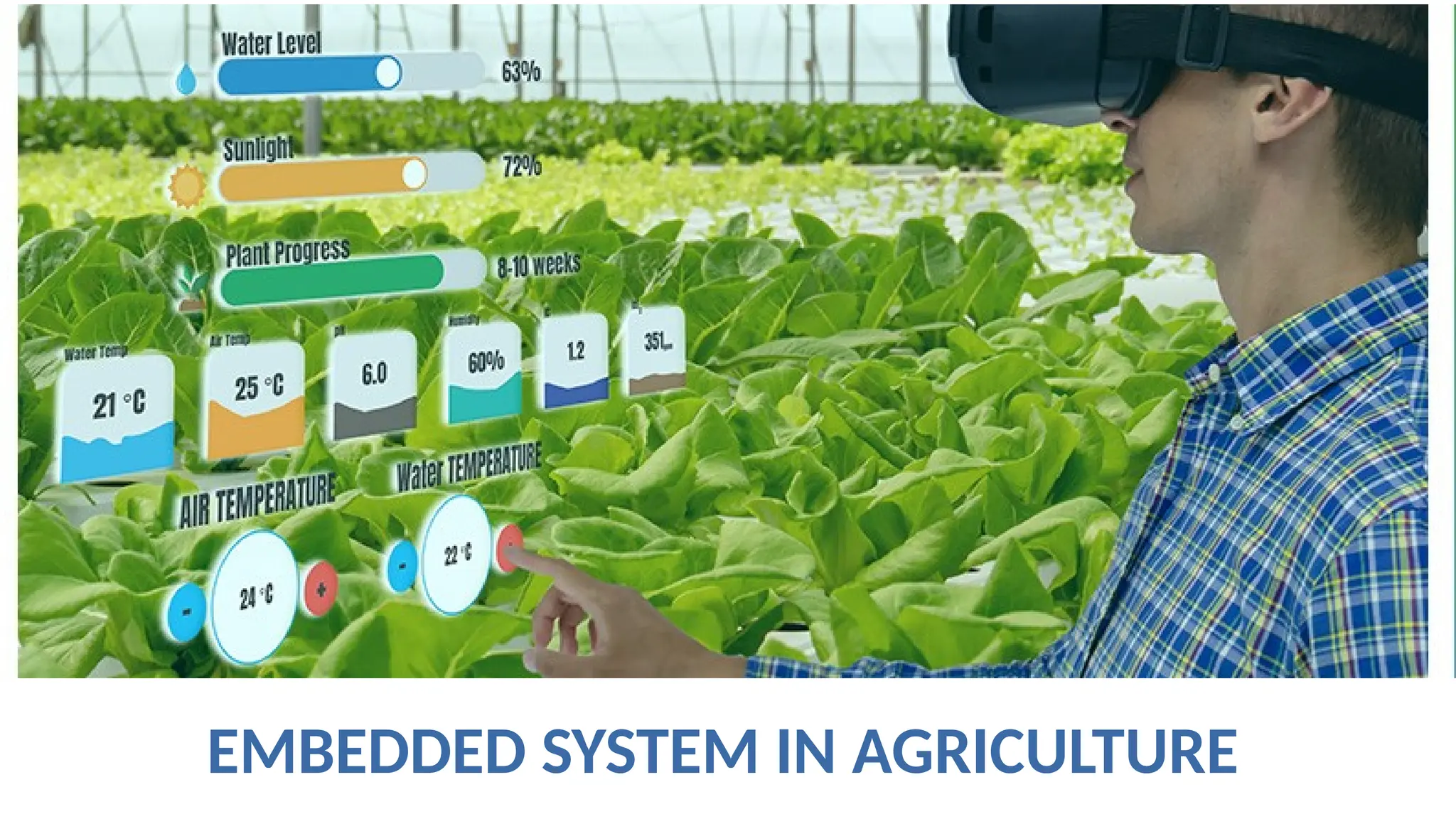
EMBEDDED SYSTEM IN AGRICULTURE
Table Of Content
1. Introduction.
2. Types of Embedded and Application of Embedded.
3. Role of Embedded systems in Agriculture .
4. Advantages of Embedded in agriculture.
5. Application of Embedded in agriculture.
6. current agricultural embedded system devices available in market.
7. Introduction about the project.
8. Objectives .
9. Block Diagram.
10. List Of Components used in project .
11. Development Board and explanation.
12. Sensors used and explanation HUMIDITY.
13. Sensors used and explanation TEMPERATURE.
14. Sensors used and explanation WATER PUMP.
15. Sensors used and explanation MOTURE SENSOR.
16. Language used in development of hardware.
17. Significance of the Project.
18. What are the Robotic Application in agriculture.
19. Feature Trends in Automation of Agriculture.
20. Advantages of Automation in Agriculture.
21. Video Resource Slide.
Introduction
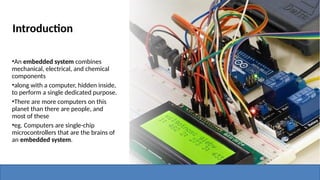
•An embedded system combines
mechanical, electrical, and chemical
components
•along with a computer, hidden inside,
to perform a single dedicated purpose.
•There are more computers on this
planet than there are people, and
most of these
•eg. Computers are single-chip
microcontrollers that are the brains of
an embedded system.
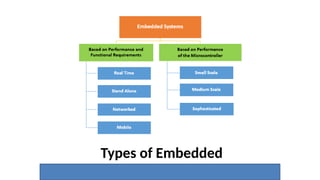
Types of Embedded
Types of Embedded
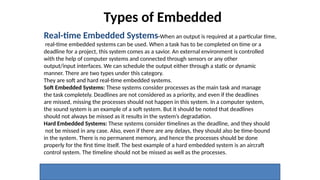
Real-time Embedded Systems-When an output is required at a particular time,
real-time embedded systems can be used. When a task has to be completed on time or a
deadline for a project, this system comes as a savior. An external environment is controlled
with the help of computer systems and connected through sensors or any other
output/input interfaces. We can schedule the output either through a static or dynamic
manner. There are two types under this category.
They are soft and hard real-time embedded systems.
Soft Embedded Systems: These systems consider processes as the main task and manage
the task completely. Deadlines are not considered as a priority, and even if the deadlines
are missed, missing the processes should not happen in this system. In a computer system,
the sound system is an example of a soft system. But it should be noted that deadlines
should not always be missed as it results in the system’s degradation.
Hard Embedded Systems: These systems consider timelines as the deadline, and they should
not be missed in any case. Also, even if there are any delays, they should also be time-bound
in the system. There is no permanent memory, and hence the processes should be done
properly for the first time itself. The best example of a hard embedded system is an aircraft
control system. The timeline should not be missed as well as the processes.
Types of
Embedded
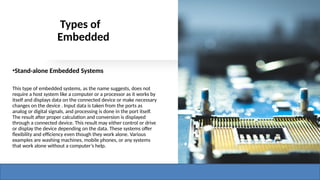
•Stand-alone Embedded Systems
This type of embedded systems, as the name suggests, does not
require a host system like a computer or a processor as it works by
itself and displays data on the connected device or make necessary
changes on the device . Input data is taken from the ports as
analog or digital signals, and processing is done in the port itself.
The result after proper calculation and conversion is displayed
through a connected device. This result may either control or drive
or display the device depending on the data. These systems offer
flexibility and efficiency even though they work alone. Various
examples are washing machines, mobile phones, or any systems
that work alone without a computer’s help.
Types of
Embedded
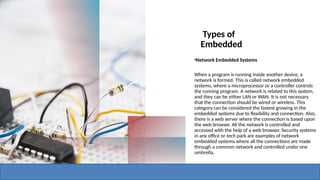
•Network Embedded Systems
When a program is running inside another device, a
network is formed. This is called network embedded
systems, where a microprocessor or a controller controls
the running program. A network is related to this system,
and they can be either LAN or WAN. It is not necessary
that the connection should be wired or wireless. This
category can be considered the fastest growing in the
embedded systems due to flexibility and connection. Also,
there is a web server where the connection is based upon
the web browser. All the network is controlled and
accessed with the help of a web browser. Security systems
in any office or tech park are examples of network
embedded systems where all the connections are made
through a common network and controlled under one
umbrella.
Types of Embedded
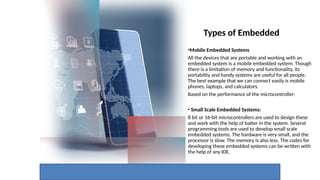
•Mobile Embedded Systems
All the devices that are portable and working with an
embedded system is a mobile embedded system. Though
there is a limitation of memory and functionality, its
portability and handy systems are useful for all people.
The best example that we can connect easily is mobile
phones, laptops, and calculators.
Based on the performance of the microcontroller:
• Small Scale Embedded Systems:
8 bit or 16-bit microcontrollers are used to design these
and work with the help of batter in the system. Several
programming tools are used to develop small scale
embedded systems. The hardware is very small, and the
processor is slow. The memory is also less. The codes for
developing these embedded systems can be written with
the help of any IDE.
•Medium Scale Embedded Systems: 16 bit or 32-bit
microcontrollers are used to develop medium systems. Also, these
can be developed with DSPs or RISCs. Hardware and software
functionalities are complex, and several coding languages can be
used as programming tools. As small-scale systems, an IDE is
required for medium scale systems also. We can use medium-
scale systems in high-end applications with large memory and
processing data.
•Sophisticated Embedded Systems: The most complex embedded
system with all the difficult complexities of hardware and software
that makes the system useful for all is called sophisticated
embedded systems. These systems require registers of huge
memory, scalable processors, and IPs to work well in any
environment. They are used in systems with graphical screens,
touchpads, and cutting-edge options where software and
hardware are equally needed for performance.
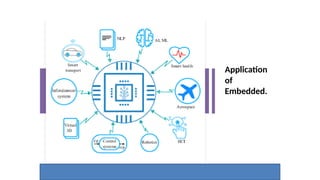
Application
of
Embedded.
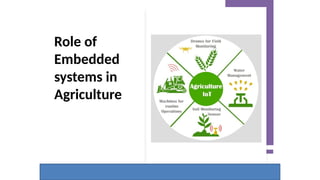
Role of
Embedded
systems in
Agriculture
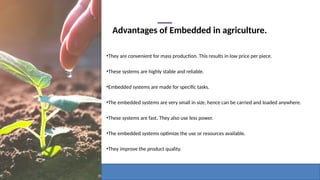
Advantages of Embedded in agriculture.
•They are convenient for mass production. This results in low price per piece.
•These systems are highly stable and reliable.
•Embedded systems are made for specific tasks.
•The embedded systems are very small in size, hence can be carried and loaded anywhere.
•These systems are fast. They also use less power.
•The embedded systems optimize the use or resources available.
•They improve the product quality.
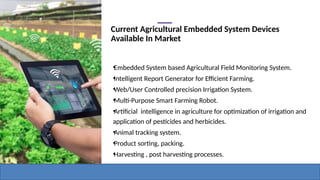
Current Agricultural Embedded System Devices
Available In Market
•Embedded System based Agricultural Field Monitoring System.
•Intelligent Report Generator for Efficient Farming.
•Web/User Controlled precision Irrigation System.
•Multi-Purpose Smart Farming Robot.
•Artificial intelligence in agriculture for optimization of irrigation and
application of pesticides and herbicides.
•Animal tracking system.
•Product sorting, packing.
•Harvesting , post harvesting processes.
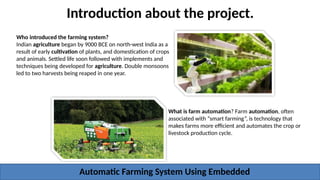
Introduction about the project.
What is farm automation? Farm automation, often
associated with “smart farming”, is technology that
makes farms more efficient and automates the crop or
livestock production cycle.
Who introduced the farming system?
Indian agriculture began by 9000 BCE on north-west India as a
result of early cultivation of plants, and domestication of crops
and animals. Settled life soon followed with implements and
techniques being developed for agriculture. Double monsoons
led to two harvests being reaped in one year.
Automatic Farming System Using Embedded
Objectives
Automatic Farming System Using Embedded
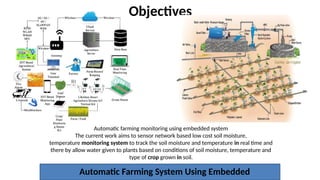
Automatic farming monitoring using embedded system
The current work aims to sensor network based low cost soil moisture,
temperature monitoring system to track the soil moisture and temperature in real time and
there by allow water given to plants based on conditions of soil moisture, temperature and
type of crop grown in soil.
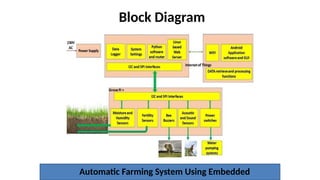
Block Diagram
Automatic Farming System Using Embedded
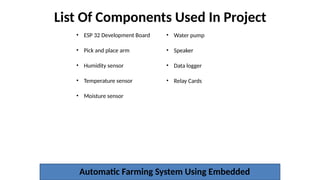
List Of Components Used In Project
Automatic Farming System Using Embedded
• ESP 32 Development Board
• Pick and place arm
• Humidity sensor
• Temperature sensor
• Moisture sensor
• Water pump
• Speaker
• Data logger
• Relay Cards
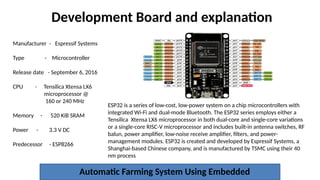
Development Board and explanation
Automatic Farming System Using Embedded
Manufacturer - Espressif Systems
Type - Microcontroller
Release date - September 6, 2016
CPU - Tensilica Xtensa LX6
microprocessor @
160 or 240 MHz
Memory - 520 KiB SRAM
Power - 3.3 V DC
Predecessor - ESP8266
ESP32 is a series of low-cost, low-power system on a chip microcontrollers with
integrated Wi-Fi and dual-mode Bluetooth. The ESP32 series employs either a
Tensilica Xtensa LX6 microprocessor in both dual-core and single-core variations
or a single-core RISC-V microprocessor and includes built-in antenna switches, RF
balun, power amplifier, low-noise receive amplifier, filters, and power-
management modules. ESP32 is created and developed by Espressif Systems, a
Shanghai-based Chinese company, and is manufactured by TSMC using their 40
nm process
Automatic Farming System Using Embedded
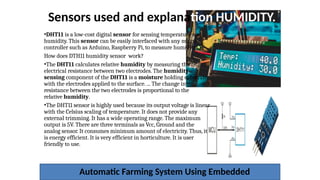
•DHT11 is a low-cost digital sensor for sensing temperature and
humidity. This sensor can be easily interfaced with any micro-
controller such as Arduino, Raspberry Pi, to measure humidity.
How does DTH11 humidity sensor work?
•The DHT11 calculates relative humidity by measuring the
electrical resistance between two electrodes. The humidity
sensing component of the DHT11 is a moisture holding substrate
with the electrodes applied to the surface. ... The change in
resistance between the two electrodes is proportional to the
relative humidity.
•The DHT11 sensor is highly used because its output voltage is linear
with the Celsius scaling of temperature. It does not provide any
external trimming. It has a wide operating range. The maximum
output is 5V. There are three terminals as Vcc, Ground and the
analog sensor. It consumes minimum amount of electricity. Thus, it
is energy efficient. It is very efficient in horticulture. It is user
friendly to use.
Sensors used and explanation HUMIDITY.
Sensors used and explanation TEMPERATURE.
Automatic Farming System Using Embedded
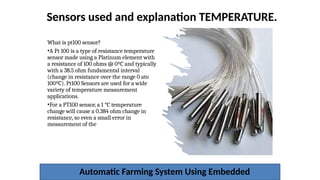
What is pt100 sensor?
•A Pt 100 is a type of resistance temperature
sensor made using a Platinum element with
a resistance of 100 ohms @ 0ºC and typically
with a 38.5 ohm fundamental interval
(change in resistance over the range 0 ato
100ºC). Pt100 Sensors are used for a wide
variety of temperature measurement
applications.
•For a PT100 sensor, a 1 °C temperature
change will cause a 0.384 ohm change in
resistance, so even a small error in
measurement of the
Sensors used and explanation WATER PUMP.
Automatic Farming System Using Embedded
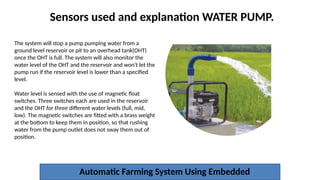
The system will stop a pump pumping water from a
ground level reservoir or pit to an overhead tank(OHT)
once the OHT is full. The system will also monitor the
water level of the OHT and the reservoir and won't let the
pump run if the reservoir level is lower than a specified
level.
Water level is sensed with the use of magnetic float
switches. Three switches each are used in the reservoir
and the OHT for three different water levels (full, mid,
low). The magnetic switches are fitted with a brass weight
at the bottom to keep them in position, so that rushing
water from the pump outlet does not sway them out of
position.
Sensors used and explanation MOISTURE SENSOR.
Automatic Farming System Using Embedded
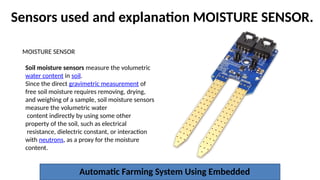
MOISTURE SENSOR
Soil moisture sensors measure the volumetric
water content in soil.
Since the direct gravimetric measurement of
free soil moisture requires removing, drying,
and weighing of a sample, soil moisture sensors
measure the volumetric water
content indirectly by using some other
property of the soil, such as electrical
resistance, dielectric constant, or interaction
with neutrons, as a proxy for the moisture
content.
Language used in development of hardware.
Automatic Farming System Using Embedded
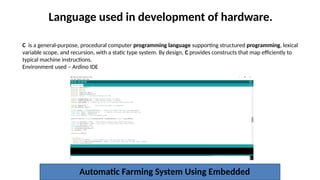
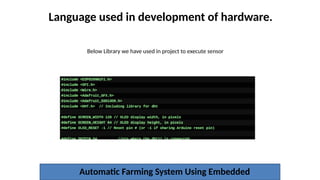
C is a general-purpose, procedural computer programming language supporting structured programming, lexical
variable scope, and recursion, with a static type system. By design, C provides constructs that map efficiently to
typical machine instructions.
Environment used – Ardino IDE
Language used in development of hardware.
Automatic Farming System Using Embedded
Below Library we have used in project to execute sensor
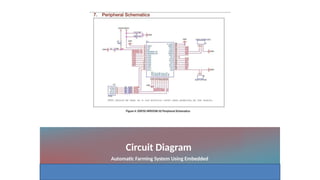
Circuit Diagram
Automatic Farming System Using Embedded
Significance of the Project.
Automatic Farming System Using Embedded
• The robots are not getting sick or tired, and the time off is not needed.
• With higher speeds and closer tolerances, they can operate with fewer errors.
• They make fewer errors and operate at higher velocities and higher quality.
• The robots can reduce the use of pesticides by up to 80% of the farm.
• In different fields, robots are more efficient and can work around trees, rocks, ponds,
and other obstacles easily.
• The robots can deliver products of high quality and lower the cost of production.
• Robots gantry can function as both fertilizer or liquid sprays and, most importantly, as
an automatic self-control system that meets weather conditions.
• They can be small in size, allowing to accumulate near-crop data and perform
mechanical weeding, mowing, spraying, and fertilizing.
• Robotic cameras and sensors are capable of detecting weeds, identifying pests,
parasites or diseases, and other stress. Usually, the sensors are selective and are only
used to spray on the affected area.
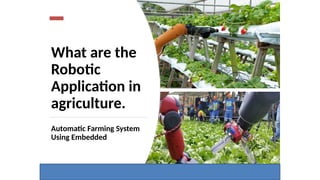
What are the Robotic Application in agriculture.
Automatic Farming System Using Embedded
Agricultural robots automate slow, repetitive and dull tasks for farmers, allowing them to focus more on improving overall production
yields. Some of the most common robots in agriculture are used for:​
Harvesting and picking​
Weed control​
Autonomous mowing, pruning, seeding, spraying and thinning​
Sorting and packing​
Utility platforms​
Harvesting and picking is one of the most popular robotic applications in agriculture due to the accuracy and speed that robots can
achieve to improve the size of yields and reduce waste from crops being left in the field.​
These applications can be difficult to automate, however. For example, a robotic system designed to pick sweet peppers encounters
many obstacles. Vision systems have to determine the location and ripeness of the pepper in harsh conditions, including the presence
of dust, varying light intensity, temperature swings and movement created by the wind.​
But it still takes more than advanced vision systems to pick a pepper. A robotic arm has to navigate environments with just as many
obstacles to delicately grasp and place a pepper. This process is very different from picking and placing a metal part on an assembly
line. The agricultural robotic arm must be flexible in a dynamic environment and accurate enough not to damage the peppers as
they’re being picked​
What are the
Robotic
Application in
agriculture.
Automatic Farming System
Using Embedded
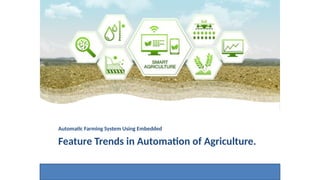
Feature Trends in Automation of Agriculture.
Automatic Farming System Using Embedded
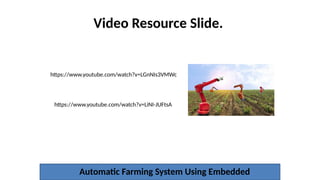
Video Resource Slide.
Automatic Farming System Using Embedded
https://www.youtube.com/watch?v=LGnNIs3VMWc
https://www.youtube.com/watch?v=LiNI-JUFtsA
Automatic Farming System Using
Embedded

EMBEDDED SYSTEM IN AGRICULTURE bscit students iot

  • 1.
    EMBEDDED SYSTEM INAGRICULTURE
  • 2.
    Table Of Content 1.Introduction. 2. Types of Embedded and Application of Embedded. 3. Role of Embedded systems in Agriculture . 4. Advantages of Embedded in agriculture. 5. Application of Embedded in agriculture. 6. current agricultural embedded system devices available in market. 7. Introduction about the project. 8. Objectives . 9. Block Diagram. 10. List Of Components used in project . 11. Development Board and explanation. 12. Sensors used and explanation HUMIDITY. 13. Sensors used and explanation TEMPERATURE. 14. Sensors used and explanation WATER PUMP. 15. Sensors used and explanation MOTURE SENSOR. 16. Language used in development of hardware. 17. Significance of the Project. 18. What are the Robotic Application in agriculture. 19. Feature Trends in Automation of Agriculture. 20. Advantages of Automation in Agriculture. 21. Video Resource Slide.
  • 3.
    Introduction •An embedded systemcombines mechanical, electrical, and chemical components •along with a computer, hidden inside, to perform a single dedicated purpose. •There are more computers on this planet than there are people, and most of these •eg. Computers are single-chip microcontrollers that are the brains of an embedded system.
  • 4.
  • 5.
    Types of Embedded Real-timeEmbedded Systems-When an output is required at a particular time, real-time embedded systems can be used. When a task has to be completed on time or a deadline for a project, this system comes as a savior. An external environment is controlled with the help of computer systems and connected through sensors or any other output/input interfaces. We can schedule the output either through a static or dynamic manner. There are two types under this category. They are soft and hard real-time embedded systems. Soft Embedded Systems: These systems consider processes as the main task and manage the task completely. Deadlines are not considered as a priority, and even if the deadlines are missed, missing the processes should not happen in this system. In a computer system, the sound system is an example of a soft system. But it should be noted that deadlines should not always be missed as it results in the system’s degradation. Hard Embedded Systems: These systems consider timelines as the deadline, and they should not be missed in any case. Also, even if there are any delays, they should also be time-bound in the system. There is no permanent memory, and hence the processes should be done properly for the first time itself. The best example of a hard embedded system is an aircraft control system. The timeline should not be missed as well as the processes.
  • 6.
    Types of Embedded •Stand-alone EmbeddedSystems This type of embedded systems, as the name suggests, does not require a host system like a computer or a processor as it works by itself and displays data on the connected device or make necessary changes on the device . Input data is taken from the ports as analog or digital signals, and processing is done in the port itself. The result after proper calculation and conversion is displayed through a connected device. This result may either control or drive or display the device depending on the data. These systems offer flexibility and efficiency even though they work alone. Various examples are washing machines, mobile phones, or any systems that work alone without a computer’s help.
  • 7.
    Types of Embedded •Network EmbeddedSystems When a program is running inside another device, a network is formed. This is called network embedded systems, where a microprocessor or a controller controls the running program. A network is related to this system, and they can be either LAN or WAN. It is not necessary that the connection should be wired or wireless. This category can be considered the fastest growing in the embedded systems due to flexibility and connection. Also, there is a web server where the connection is based upon the web browser. All the network is controlled and accessed with the help of a web browser. Security systems in any office or tech park are examples of network embedded systems where all the connections are made through a common network and controlled under one umbrella.
  • 8.
    Types of Embedded •MobileEmbedded Systems All the devices that are portable and working with an embedded system is a mobile embedded system. Though there is a limitation of memory and functionality, its portability and handy systems are useful for all people. The best example that we can connect easily is mobile phones, laptops, and calculators. Based on the performance of the microcontroller: • Small Scale Embedded Systems: 8 bit or 16-bit microcontrollers are used to design these and work with the help of batter in the system. Several programming tools are used to develop small scale embedded systems. The hardware is very small, and the processor is slow. The memory is also less. The codes for developing these embedded systems can be written with the help of any IDE.
  • 9.
    •Medium Scale EmbeddedSystems: 16 bit or 32-bit microcontrollers are used to develop medium systems. Also, these can be developed with DSPs or RISCs. Hardware and software functionalities are complex, and several coding languages can be used as programming tools. As small-scale systems, an IDE is required for medium scale systems also. We can use medium- scale systems in high-end applications with large memory and processing data. •Sophisticated Embedded Systems: The most complex embedded system with all the difficult complexities of hardware and software that makes the system useful for all is called sophisticated embedded systems. These systems require registers of huge memory, scalable processors, and IPs to work well in any environment. They are used in systems with graphical screens, touchpads, and cutting-edge options where software and hardware are equally needed for performance.
  • 10.
  • 11.
  • 12.
    Advantages of Embeddedin agriculture. •They are convenient for mass production. This results in low price per piece. •These systems are highly stable and reliable. •Embedded systems are made for specific tasks. •The embedded systems are very small in size, hence can be carried and loaded anywhere. •These systems are fast. They also use less power. •The embedded systems optimize the use or resources available. •They improve the product quality.
  • 13.
    Current Agricultural EmbeddedSystem Devices Available In Market •Embedded System based Agricultural Field Monitoring System. •Intelligent Report Generator for Efficient Farming. •Web/User Controlled precision Irrigation System. •Multi-Purpose Smart Farming Robot. •Artificial intelligence in agriculture for optimization of irrigation and application of pesticides and herbicides. •Animal tracking system. •Product sorting, packing. •Harvesting , post harvesting processes.
  • 14.
    Introduction about theproject. What is farm automation? Farm automation, often associated with “smart farming”, is technology that makes farms more efficient and automates the crop or livestock production cycle. Who introduced the farming system? Indian agriculture began by 9000 BCE on north-west India as a result of early cultivation of plants, and domestication of crops and animals. Settled life soon followed with implements and techniques being developed for agriculture. Double monsoons led to two harvests being reaped in one year. Automatic Farming System Using Embedded
  • 15.
    Objectives Automatic Farming SystemUsing Embedded Automatic farming monitoring using embedded system The current work aims to sensor network based low cost soil moisture, temperature monitoring system to track the soil moisture and temperature in real time and there by allow water given to plants based on conditions of soil moisture, temperature and type of crop grown in soil.
  • 16.
    Block Diagram Automatic FarmingSystem Using Embedded
  • 17.
    List Of ComponentsUsed In Project Automatic Farming System Using Embedded • ESP 32 Development Board • Pick and place arm • Humidity sensor • Temperature sensor • Moisture sensor • Water pump • Speaker • Data logger • Relay Cards
  • 18.
    Development Board andexplanation Automatic Farming System Using Embedded Manufacturer - Espressif Systems Type - Microcontroller Release date - September 6, 2016 CPU - Tensilica Xtensa LX6 microprocessor @ 160 or 240 MHz Memory - 520 KiB SRAM Power - 3.3 V DC Predecessor - ESP8266 ESP32 is a series of low-cost, low-power system on a chip microcontrollers with integrated Wi-Fi and dual-mode Bluetooth. The ESP32 series employs either a Tensilica Xtensa LX6 microprocessor in both dual-core and single-core variations or a single-core RISC-V microprocessor and includes built-in antenna switches, RF balun, power amplifier, low-noise receive amplifier, filters, and power- management modules. ESP32 is created and developed by Espressif Systems, a Shanghai-based Chinese company, and is manufactured by TSMC using their 40 nm process
  • 19.
    Automatic Farming SystemUsing Embedded •DHT11 is a low-cost digital sensor for sensing temperature and humidity. This sensor can be easily interfaced with any micro- controller such as Arduino, Raspberry Pi, to measure humidity. How does DTH11 humidity sensor work? •The DHT11 calculates relative humidity by measuring the electrical resistance between two electrodes. The humidity sensing component of the DHT11 is a moisture holding substrate with the electrodes applied to the surface. ... The change in resistance between the two electrodes is proportional to the relative humidity. •The DHT11 sensor is highly used because its output voltage is linear with the Celsius scaling of temperature. It does not provide any external trimming. It has a wide operating range. The maximum output is 5V. There are three terminals as Vcc, Ground and the analog sensor. It consumes minimum amount of electricity. Thus, it is energy efficient. It is very efficient in horticulture. It is user friendly to use. Sensors used and explanation HUMIDITY.
  • 20.
    Sensors used andexplanation TEMPERATURE. Automatic Farming System Using Embedded What is pt100 sensor? •A Pt 100 is a type of resistance temperature sensor made using a Platinum element with a resistance of 100 ohms @ 0ºC and typically with a 38.5 ohm fundamental interval (change in resistance over the range 0 ato 100ºC). Pt100 Sensors are used for a wide variety of temperature measurement applications. •For a PT100 sensor, a 1 °C temperature change will cause a 0.384 ohm change in resistance, so even a small error in measurement of the
  • 21.
    Sensors used andexplanation WATER PUMP. Automatic Farming System Using Embedded The system will stop a pump pumping water from a ground level reservoir or pit to an overhead tank(OHT) once the OHT is full. The system will also monitor the water level of the OHT and the reservoir and won't let the pump run if the reservoir level is lower than a specified level. Water level is sensed with the use of magnetic float switches. Three switches each are used in the reservoir and the OHT for three different water levels (full, mid, low). The magnetic switches are fitted with a brass weight at the bottom to keep them in position, so that rushing water from the pump outlet does not sway them out of position.
  • 22.
    Sensors used andexplanation MOISTURE SENSOR. Automatic Farming System Using Embedded MOISTURE SENSOR Soil moisture sensors measure the volumetric water content in soil. Since the direct gravimetric measurement of free soil moisture requires removing, drying, and weighing of a sample, soil moisture sensors measure the volumetric water content indirectly by using some other property of the soil, such as electrical resistance, dielectric constant, or interaction with neutrons, as a proxy for the moisture content.
  • 23.
    Language used indevelopment of hardware. Automatic Farming System Using Embedded C is a general-purpose, procedural computer programming language supporting structured programming, lexical variable scope, and recursion, with a static type system. By design, C provides constructs that map efficiently to typical machine instructions. Environment used – Ardino IDE
  • 24.
    Language used indevelopment of hardware. Automatic Farming System Using Embedded Below Library we have used in project to execute sensor
  • 25.
    Circuit Diagram Automatic FarmingSystem Using Embedded
  • 26.
    Significance of theProject. Automatic Farming System Using Embedded • The robots are not getting sick or tired, and the time off is not needed. • With higher speeds and closer tolerances, they can operate with fewer errors. • They make fewer errors and operate at higher velocities and higher quality. • The robots can reduce the use of pesticides by up to 80% of the farm. • In different fields, robots are more efficient and can work around trees, rocks, ponds, and other obstacles easily. • The robots can deliver products of high quality and lower the cost of production. • Robots gantry can function as both fertilizer or liquid sprays and, most importantly, as an automatic self-control system that meets weather conditions. • They can be small in size, allowing to accumulate near-crop data and perform mechanical weeding, mowing, spraying, and fertilizing. • Robotic cameras and sensors are capable of detecting weeds, identifying pests, parasites or diseases, and other stress. Usually, the sensors are selective and are only used to spray on the affected area.
  • 27.
    What are theRobotic Application in agriculture. Automatic Farming System Using Embedded Agricultural robots automate slow, repetitive and dull tasks for farmers, allowing them to focus more on improving overall production yields. Some of the most common robots in agriculture are used for:​ Harvesting and picking​ Weed control​ Autonomous mowing, pruning, seeding, spraying and thinning​ Sorting and packing​ Utility platforms​ Harvesting and picking is one of the most popular robotic applications in agriculture due to the accuracy and speed that robots can achieve to improve the size of yields and reduce waste from crops being left in the field.​ These applications can be difficult to automate, however. For example, a robotic system designed to pick sweet peppers encounters many obstacles. Vision systems have to determine the location and ripeness of the pepper in harsh conditions, including the presence of dust, varying light intensity, temperature swings and movement created by the wind.​ But it still takes more than advanced vision systems to pick a pepper. A robotic arm has to navigate environments with just as many obstacles to delicately grasp and place a pepper. This process is very different from picking and placing a metal part on an assembly line. The agricultural robotic arm must be flexible in a dynamic environment and accurate enough not to damage the peppers as they’re being picked​
  • 28.
    What are the Robotic Applicationin agriculture. Automatic Farming System Using Embedded
  • 29.
    Feature Trends inAutomation of Agriculture. Automatic Farming System Using Embedded
  • 30.
    Video Resource Slide. AutomaticFarming System Using Embedded https://www.youtube.com/watch?v=LGnNIs3VMWc https://www.youtube.com/watch?v=LiNI-JUFtsA
  • 31.