EMBEDDED SYSTEMS
Introduction
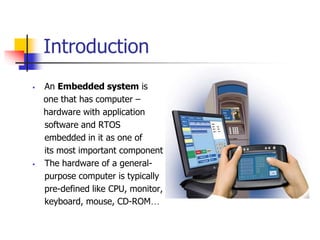
 An Embedded system is
one that has computer –
hardware with application
software and RTOS
embedded in it as one of
its most important component .
 The hardware of a general-
purpose computer is typically
pre-defined like CPU, monitor,
keyboard, mouse, CD-ROM…
Overview Of Embedded
Systems Architecture:
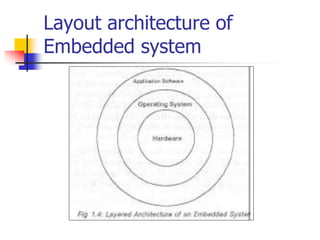
 Every Embedded system consists of:
 Custom built hardware around a central
processing unit (CPU).
 A software residing on the memory chip of
hardware and an Operating system.
 The operating system runs above the hardware
and the application software runs above the
hardware.
Layout architecture of
Embedded system
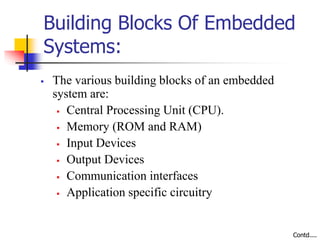
Building Blocks Of Embedded
Systems:
 The various building blocks of an embedded
system are:
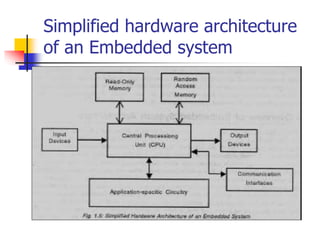
 Central Processing Unit (CPU).
 Memory (ROM and RAM)
 Input Devices
 Output Devices
 Communication interfaces
 Application specific circuitry
Contd....
Simplified hardware architecture
of an Embedded system
CPU
 CPU is usually made of:
 Microcontrollers: On chip only there will be
place for many components like memory, serial
communication interface etc.
(or)
 Microprocessors: They are most powerful but
need many external components.
(or)
 DSP (digital signal processing): It used in
applications where video and audio processing is
involved.
Memory, Input and Output
devices
 Memory: It is of 2 types-RAM and ROM.ROM is used
for storing contents as it wont get erased if power is off,
where as it gets erased in case of RAM
 Input devices: They wont have key board or mouse for
taking input but sensors and transducers are used as input.
 Output devices: They have a limited capacity. usually
LCD may be used to display some important parameter.
Communication Interfaces And
Application Specific Circuitry
 Communication Interfaces: One embedded
system communicates with another embedded
system to transfer data by communication interfaces
such as Universal Serial Bus (USB)
 Application specific circuitry:
 Sensors, transducers, special processing and
control circuitry are required for an embedded
system.
Special Features Of Embedded
Systems:
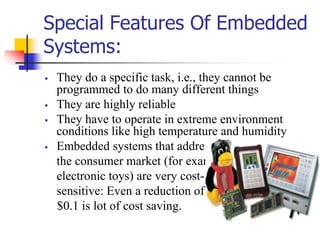
 They do a specific task, i.e., they cannot be
programmed to do many different things
 They are highly reliable
 They have to operate in extreme environment
conditions like high temperature and humidity
 Embedded systems that address
the consumer market (for example,
electronic toys) are very cost-
sensitive: Even a reduction of
$0.1 is lot of cost saving.
Categories Of Embedded
Systems
 Based on functionality and performance
requirements, embedded systems can be categorized
as:
 Stand-alone embedded systems
 Real-time systems
 Networked information appliances
 Mobile devices
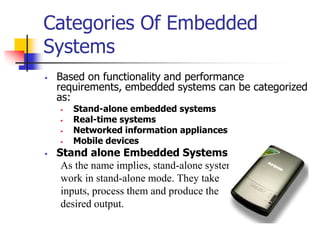
 Stand alone Embedded Systems
As the name implies, stand-alone systems
work in stand-alone mode. They take
inputs, process them and produce the
desired output.
Categories Of Embedded
Systems
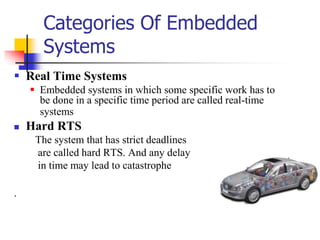
 Real Time Systems
 Embedded systems in which some specific work has to
be done in a specific time period are called real-time
systems
 Hard RTS
The system that has strict deadlines
are called hard RTS. And any delay
in time may lead to catastrophe
.
Soft RTS:
The systems that have strict deadlines, but not
adhering to them once in a while may not lead to
catastrophe.
Networked Information Appliances
Embedded systems that are provided with network
interfaces and accessed by networks such as Local
Area Network or the Internet are called networked
information appliances
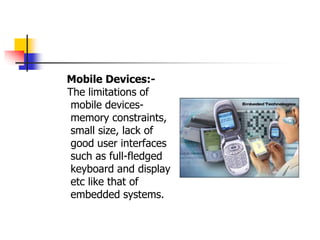
Mobile Devices:-
The limitations of
mobile devices-
memory constraints,
small size, lack of
good user interfaces
such as full-fledged
keyboard and display
etc like that of
embedded systems.
Applications
 Consumer appliances
 DVD player, electronic toys, microwave oven,
remote controls for TV and air-conditioner, V CD
player, video game consoles, video recorders etc.
 Office automation: The office automation products
using embedded systems are copying machine, fax
machine, key telephone, modem, printer, scanner etc.
 Industrial automation: Pharmaceutical, cement,
sugar, oil exploration, nuclear energy, electricity
generation and transmission. The embedded systems for
industrial use are designed to carry out specific tasks such
as monitoring the temperature, pressure, humidity,
voltage, current ,robotics and many more.
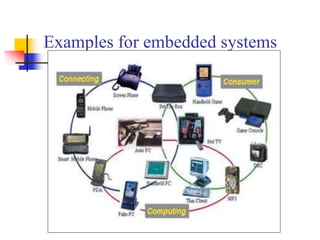
Examples for embedded systems
Applications
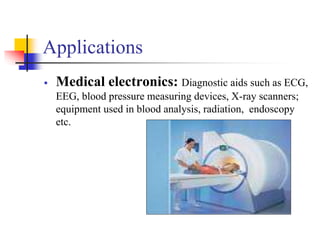
 Medical electronics: Diagnostic aids such as ECG,
EEG, blood pressure measuring devices, X-ray scanners;
equipment used in blood analysis, radiation, endoscopy
etc.
 Computer networking: Computer
networking products such as bridges, routers,
Integrated Services Digital Networks (ISDN) are
examples of embedded systems.
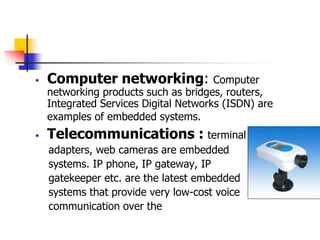
 Telecommunications : terminal
adapters, web cameras are embedded
systems. IP phone, IP gateway, IP
gatekeeper etc. are the latest embedded
systems that provide very low-cost voice
communication over the
Applications
Insemination: The measuring equipment we use in
laboratories to measure parameters such as weight,
temperature, pressure, humidity, voltage, current etc. are
all embedded systems. Testing and measurement are the
fundamental requirements in all scientific and engineering
activities.
Applications
 Security: Security of persons and information
has always been a major issue . Security devices
at homes, offices, airports etc. for authentication
and verification are embedded systems.
 Finance: Financial dealing through cash and
cheques are now slowly paving way for
transactions using smart cards and
ATM(Automatic Teller Machine, also expanded as
Any Time Money) machines.
Conclusion
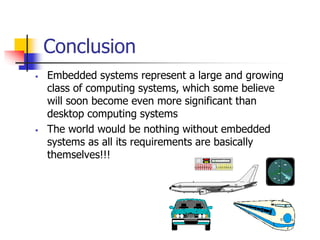
 Embedded systems represent a large and growing
class of computing systems, which some believe
will soon become even more significant than
desktop computing systems
 The world would be nothing without embedded
systems as all its requirements are basically
themselves!!!
THANK
YOU!

Embedded system and real time operating system

  • 1.
  • 2.
    Introduction  An Embeddedsystem is one that has computer – hardware with application software and RTOS embedded in it as one of its most important component .  The hardware of a general- purpose computer is typically pre-defined like CPU, monitor, keyboard, mouse, CD-ROM…
  • 3.
    Overview Of Embedded SystemsArchitecture:  Every Embedded system consists of:  Custom built hardware around a central processing unit (CPU).  A software residing on the memory chip of hardware and an Operating system.  The operating system runs above the hardware and the application software runs above the hardware.
  • 4.
  • 5.
    Building Blocks OfEmbedded Systems:  The various building blocks of an embedded system are:  Central Processing Unit (CPU).  Memory (ROM and RAM)  Input Devices  Output Devices  Communication interfaces  Application specific circuitry Contd....
  • 6.
  • 7.
    CPU  CPU isusually made of:  Microcontrollers: On chip only there will be place for many components like memory, serial communication interface etc. (or)  Microprocessors: They are most powerful but need many external components. (or)  DSP (digital signal processing): It used in applications where video and audio processing is involved.
  • 8.
    Memory, Input andOutput devices  Memory: It is of 2 types-RAM and ROM.ROM is used for storing contents as it wont get erased if power is off, where as it gets erased in case of RAM  Input devices: They wont have key board or mouse for taking input but sensors and transducers are used as input.  Output devices: They have a limited capacity. usually LCD may be used to display some important parameter.
  • 9.
    Communication Interfaces And ApplicationSpecific Circuitry  Communication Interfaces: One embedded system communicates with another embedded system to transfer data by communication interfaces such as Universal Serial Bus (USB)  Application specific circuitry:  Sensors, transducers, special processing and control circuitry are required for an embedded system.
  • 10.
    Special Features OfEmbedded Systems:  They do a specific task, i.e., they cannot be programmed to do many different things  They are highly reliable  They have to operate in extreme environment conditions like high temperature and humidity  Embedded systems that address the consumer market (for example, electronic toys) are very cost- sensitive: Even a reduction of $0.1 is lot of cost saving.
  • 11.
    Categories Of Embedded Systems Based on functionality and performance requirements, embedded systems can be categorized as:  Stand-alone embedded systems  Real-time systems  Networked information appliances  Mobile devices  Stand alone Embedded Systems As the name implies, stand-alone systems work in stand-alone mode. They take inputs, process them and produce the desired output.
  • 12.
    Categories Of Embedded Systems Real Time Systems  Embedded systems in which some specific work has to be done in a specific time period are called real-time systems  Hard RTS The system that has strict deadlines are called hard RTS. And any delay in time may lead to catastrophe .
  • 13.
    Soft RTS: The systemsthat have strict deadlines, but not adhering to them once in a while may not lead to catastrophe. Networked Information Appliances Embedded systems that are provided with network interfaces and accessed by networks such as Local Area Network or the Internet are called networked information appliances
  • 14.
    Mobile Devices:- The limitationsof mobile devices- memory constraints, small size, lack of good user interfaces such as full-fledged keyboard and display etc like that of embedded systems.
  • 15.
    Applications  Consumer appliances DVD player, electronic toys, microwave oven, remote controls for TV and air-conditioner, V CD player, video game consoles, video recorders etc.  Office automation: The office automation products using embedded systems are copying machine, fax machine, key telephone, modem, printer, scanner etc.  Industrial automation: Pharmaceutical, cement, sugar, oil exploration, nuclear energy, electricity generation and transmission. The embedded systems for industrial use are designed to carry out specific tasks such as monitoring the temperature, pressure, humidity, voltage, current ,robotics and many more.
  • 16.
  • 17.
    Applications  Medical electronics:Diagnostic aids such as ECG, EEG, blood pressure measuring devices, X-ray scanners; equipment used in blood analysis, radiation, endoscopy etc.
  • 18.
     Computer networking:Computer networking products such as bridges, routers, Integrated Services Digital Networks (ISDN) are examples of embedded systems.  Telecommunications : terminal adapters, web cameras are embedded systems. IP phone, IP gateway, IP gatekeeper etc. are the latest embedded systems that provide very low-cost voice communication over the
  • 19.
    Applications Insemination: The measuringequipment we use in laboratories to measure parameters such as weight, temperature, pressure, humidity, voltage, current etc. are all embedded systems. Testing and measurement are the fundamental requirements in all scientific and engineering activities.
  • 20.
    Applications  Security: Securityof persons and information has always been a major issue . Security devices at homes, offices, airports etc. for authentication and verification are embedded systems.  Finance: Financial dealing through cash and cheques are now slowly paving way for transactions using smart cards and ATM(Automatic Teller Machine, also expanded as Any Time Money) machines.
  • 21.
    Conclusion  Embedded systemsrepresent a large and growing class of computing systems, which some believe will soon become even more significant than desktop computing systems  The world would be nothing without embedded systems as all its requirements are basically themselves!!!
  • 22.